
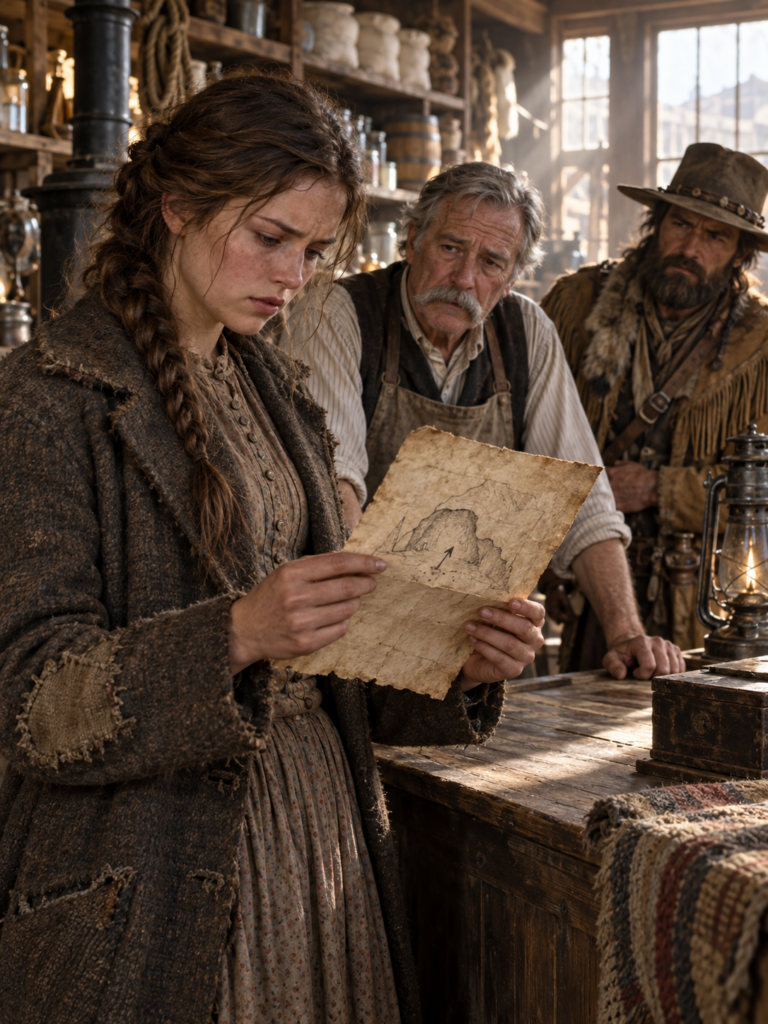
“Keep.”
That was the word my grandmother had written beneath the arrow.
I read it again.
Keep.
Not a name. Not a location. Not an explanation.
An instruction.
I turned the deed toward the fire, studying the lines around it.
The larger oval matched the cavern where I had been sleeping and storing my supplies. The narrower line seemed to follow a dark opening near its far wall.
I had noticed that opening during my first night.
I had not entered it.
At the time, finding shelter and water had been more important than exploring an unfamiliar passage alone.
Now I understood that Edith had deliberately marked somewhere beyond it.
I took a burning splinter from the hearth and carried the light into the cavern.
The sheep pens were not there yet. Neither were the chickens I hoped eventually to acquire.
There was only the bare chamber, the basin, and my growing collection of provisions.
I walked to the far wall.
The gap was narrower than I remembered.
Beyond it, the floor disappeared into darkness.
I held the flame forward.
A faint movement of air disturbed it.
There was a passage.
That much was certain.
But the little flame could not show me how far it extended, whether the floor was safe, or what waited beyond the first bend.
I returned to the cabin.
It was difficult to leave a question unanswered when I knew the answer might be only a few yards away.
But I had already learned that impatience could be expensive in the mountains.
A careless movement with an axe could destroy a hand. A badly fitted log could bring down a wall.
Entering a narrow passage without adequate light or preparation could be worse.
I set the deed beside my hearth and considered what Birdie had told me.
Edith had made her promise not to speak.
That meant at least one other person knew the land contained something worth protecting.
But it did not prove that the hidden chamber contained anything valuable.
Perhaps Edith had stored supplies there.
Perhaps she had kept records of her homestead.
Perhaps the drawing was simply a reminder to preserve the part of the cave that made her life possible.
I needed facts, not guesses.
Winter approached before I could investigate further.
There was food to obtain, firewood to stack, and a cabin to finish.
I traded rabbit and squirrel pelts in Drover’s Bend for four laying hens, a ewe, and a ram. Mr. Haskell was astonished to see me alive, much less capable of making a trade.
Cotter Bry was astonished too, though he disguised it with another prediction that the winter would finish me.
The animals made the return journey difficult, but eventually I got them inside the cave.
I had built pens from saplings and planted a few small beds of soil near the entrance.
The vegetables grew poorly at first. I found an old working mirror among the stones and angled it to reflect additional daylight toward the beds.
The improvement was modest, but visible.
The cave was becoming more than a shelter.
It was becoming a small, demanding system of life.
Then the first heavy snow arrived.
I closed the cabin door, banked the hearth, and listened to the wind striking the walls.
For the first time since leaving my father’s house, I possessed something I had built myself.
Yet every night, when the fire settled, I thought about that second chamber.
And about Birdie’s oath.
Six weeks into the deep winter, a rider arrived.
His name was Leland Stowe.
He owned thousands of acres to the south.
Unlike the people in town, he did not laugh at my cabin.
He examined it carefully.
Then he offered fifty dollars for the property.
I refused.
His expression changed only slightly.
“Your grandmother’s original claim may not be as secure as you believe,” he said. “My attorney has questions about its registration.”
I felt the deed inside my coat.
He explained that if the claim could be shown to be defective or abandoned, he intended to pursue the land himself.
“Why do you want it?” I asked.
He glanced toward the cave.
“The water, Miss Whitmore. That spring may be the most reliable source for miles.”
After he rode away, I stood beside the hearth.
A wealthy rancher knew about my spring.
An elderly neighbor knew about my grandmother’s secret.
And Edith had left an unexplained map leading deeper into the mountain.
I could no longer afford to treat those facts as separate matters.
I unfolded the deed, laid it beside my lantern, and began comparing the drawn passage with the cavern I knew.
If Stowe challenged my right to the land, I would need more than stubbornness to keep it.
I would need to learn what Edith had preserved—and whether she had left proof that the place was rightfully ours.
I traced the narrow passage on the deed with one finger, then looked toward the dark opening beyond the cave.
The map could tell me where to search.
It could not tell me what I would find.
I spent the next several days preparing to explore, but winter made every plan uncertain.
My food was rationed. My animals needed tending. The fire required constant attention, and every armload of wood represented time and strength that could not be spent elsewhere.
I kept telling myself there would be a better morning.
Then the blizzard arrived.
It began with a strange stillness outside the cabin. By evening, wind-driven snow had erased the trail, the ravine, and nearly every visible feature of the mountainside.
I brought in the remaining firewood, secured the animal pens, and braced the cabin door.
The cabin walls complained beneath the pressure of the wind.
But they held.
The chimney drew.
The fire burned.
And the cavern beyond my doorway remained sheltered from the storm.
I was mending my coat near midnight when someone began pounding on the door.
At first, I thought a loose branch was striking the wood.
Then I heard a voice.
I lifted the brace.
A man fell through the opening, trailing snow across the floor.
I dragged him inside, closed the door, and pulled the scarf away from his face.
Cotter Bry.
The trapper who had laughed when I purchased my supplies.
His skin was frighteningly cold. He struggled to speak.
“Wagon,” he managed. “Half a mile east.”
He swallowed, trying again.
“Haskell. His wife. They’re still out there.”
For a moment, I could only look at him.
Mr. Haskell had warned me against this land.
Cotter had predicted that I would die here.
And now those same people were depending on the shelter they had dismissed.
I could have argued with myself for an hour about whether I owed them anything.
But they did not have an hour.
I wrapped Cotter in a blanket, gave him a place beside the hearth, and gathered a lantern, rope, and a covered pot of warm stew.
Then I opened the door again.
Outside, the storm stole the breath from my lungs.
I kept the cliff to my left, using its shape to hold my direction as I fought through deep snow.
Several times I nearly lost my footing.
At last, my lantern revealed a dark shape ahead.
An overturned wagon.
Mr. Haskell was crouched beside his wife, trying to shield her from the wind with his own body.
I pressed the warm pot into her hands and helped them stand.
Returning to the cabin was even harder.
Mrs. Haskell stumbled repeatedly. Her husband could scarcely keep his balance.
But at last we reached the door.
I pushed them inside and shut out the storm.
For three days, the weather kept us there.
My visitors saw the cave, the spring, the animals, and the small struggling vegetable beds.
Mr. Haskell stood for a long time beside the water basin.
“I told you there was nothing here,” he said quietly.
“You had never been inside.”
He nodded.
“No. I hadn’t.”
There was no need to make him feel smaller.
The truth had already done that.
When the storm finally passed, all three returned to Drover’s Bend alive.
Before leaving, Haskell pressed a gold coin into my hand, insisting that it was payment for shelter and supplies rather than charity.
I accepted it.
It would buy provisions I badly needed.
More importantly, there were now three people who could testify that Split Rock Hollow was an occupied, working home.
I remembered Stowe’s suggestion that the property might be considered abandoned.
For the first time, I had witnesses to something beyond my own determination.
Three weeks later, another visitor appeared.
This one was smaller, coatless, and scarcely able to stand.
I recognized him before he reached the hearth.
“Thomas?”
My brother looked up at me with cracked lips and exhausted eyes.
Our father had sold the homestead.
Then he had disappeared after a prolonged drinking spell, leaving Thomas with nowhere secure to live.
My brother had walked through the February cold to find me.
I brought him inside and fed him before asking anything more.
When he was warm enough to speak, he stared around the cabin.
“You built all this?”
“Yes.”
“Alone?”
“Most of it.”
He looked toward the cave, where a hen was complaining loudly about being disturbed.
For the first time since arriving, he smiled.
Thomas remained.
Within days, I was teaching him to tend the hearth, collect eggs, carry water, and examine the condition of the cabin walls.
He learned quickly.
He also asked questions I had stopped noticing were questions.
Why did the cave remain so much steadier in temperature than the cabin?
Why was the spring still running while surface water froze?
Why did the plants respond when I adjusted the mirror?
I answered what I knew and admitted what I did not.
Having Thomas there changed the place.
Work was still hard, but it was shared.
The cabin no longer held only my footsteps and my voice.
It held my brother’s questions, his small successes, and the possibility of a life that extended beyond a single winter.
When the snow began to retreat, Birdie Tanfield returned.
She accepted a place by the hearth, warmed her hands, and told me why she had come.
Leland Stowe had filed a formal challenge against my claim.
He alleged that my grandmother’s original registration lacked the necessary witness signatures and that the land had been abandoned long enough to invalidate her rights.
A hearing was scheduled for April.
I took out the deed.
“This is all I have.”
Birdie glanced at it.
“Not necessarily.”
I waited.
She pointed toward the cave.
“Edith kept things carefully. Especially things other people might someday deny.”
I wanted her to tell me exactly what she knew.
Instead, she reminded me of the promise she had made thirty years earlier.
“I gave Edith my word,” she said. “The chamber is hers to show you, even now.”
After she left, Thomas noticed the way I kept looking toward the cave.
“Are you going in?”
“Yes.”
“When?”
“When the light is good and you can manage things here without me.”
He considered that.
“I can manage them now.”
He was almost right.
I chose a clear morning after the thaw had begun.
I checked the animals, showed Thomas where the provisions were, and made sure he understood not to follow me if I took longer than expected.
Then I took the lantern and the deed into the cave.
The passage began exactly where the drawing suggested.
For several yards, I could move while crouching.
Then it narrowed so sharply that I had to lie on my stomach and pull myself forward with my elbows.
The rock scraped my shoulders.
My lantern revealed only a little of the passage ahead.
At one point I stopped, frightened by how difficult it would be to turn around.
But I could feel moving air.
I kept going.
Then the rock walls opened.
I stood inside a smaller chamber, roughly circular, with a ceiling rising into shadow.
The walls were streaked with greenish and bluish mineral markings.
Someone had cleared the floor.
And against the far wall, on a natural stone shelf, sat a rusted tin box.
Three small rocks lay beside it.
Each contained reddish metal and green staining unlike the ordinary gray stone near the cave entrance.
I had heard miners in Drover’s Bend describe copper ore.
I had never expected to see it here.
I lifted one sample.
It was heavier than its size suggested.
Then I set it down and opened the tin box.
Inside was a journal wrapped in oilcloth.
Its pages were filled with careful observations, sketches, dates, and notes about the land.
Edith’s notes.
My grandmother had discovered the copper years after settling at Split Rock Hollow.
She had studied the vein and believed it extended deep into the mountain.
Her writing suggested it might be commercially valuable.
But the journal was not simply a record of mineral discoveries.
Page after page concerned the spring.
The route of the water through the rock.
The steadiness of the cave’s temperature.
The effects that excavation might have on the underground channels.
I read until my lantern began to burn low.
Then I reached an entry describing visits from representatives of a mining company.
They had offered Edith money.
When she refused, they had returned with stronger offers and pressure from a lawyer.
She had refused again.
Not because she failed to understand the value of the copper.
Because she understood another value.
She feared that mining the vein would damage the water channel, contaminate the spring, and destroy the natural shelter that had sustained her.
I lowered the journal.
For years, our family had treated Edith’s solitude as evidence that she had wasted her life.
But she had known precisely what she was protecting.
She had been offered wealth.
She had deliberately chosen not to take it.
I sat on the stone floor, listening to the faint sounds of the hidden chamber.
Then I remembered the word on the deed.
Keep.
It was not merely an instruction to keep the property.
It was an instruction to preserve what was inside it.
I carefully closed the journal and examined the remaining pages.
A folded document lay between two entries near the back.
I opened it enough to see an official land-office stamp and two witness signatures.
My breath caught.
The paper appeared to be an original registration record.
And if it was authentic, it might answer the very accusation Leland Stowe had made against my grandmother’s claim.
I carried the document toward the lantern and began reading the names.
The first witness name meant nothing to me.
The second stopped me completely.
Bernadette Tanfield.
Birdie.
I read the name twice, then looked at the date and the territorial office stamp.
The registration was dated 1859.
Both witness signatures were present.
Stowe’s attorney had argued that my grandmother’s claim lacked properly documented witnesses.
Yet here was a record that appeared to contradict him.
I held the sheet toward the lantern.
The ink had faded, but the signatures remained legible. The official stamp was still visible.
It was not enough simply to believe that the paper settled everything.
A document could be misunderstood. Records might differ. The land office would need to determine whether this registration was genuine and applicable to Edith’s property.
But for the first time, I possessed something more substantial than the worn deed my father had handed me.
I had evidence.
And Birdie might be able to explain it.
I returned the journal and three copper samples to the tin box, keeping the registration paper with me.
Then I crawled back through the narrow passage.
Thomas was waiting near the cabin fire.
When he saw my face, he stood.
“What did you find?”
“Something Grandmother wanted protected.”
“Is it good?”
I looked at the document in my hand.
“I think it may save our home.”
His expression changed.
He had only recently arrived, but he already understood what losing this place would mean.
There was no homestead waiting for him with our father.
No certain welcome elsewhere.
Split Rock Hollow had become his home as surely as it had become mine.
I told him I needed to visit Birdie.
The following morning, I carried the tin box down the three-mile trail to her cabin.
She opened the door and stepped aside.
I placed the journal and copper samples on her table first.
For a long moment, she said nothing.
Then she pulled out her chair and sat.
“So you found it.”
“Yes.”
Her eyes moved toward the mineral samples.
“Edith showed me those many years ago.”
“You knew about the copper?”
“I knew enough to understand why she was frightened of the mining men.”
I looked at her.
“She wasn’t frightened of them finding her, was she? She was frightened of what they would do to the mountain.”
Birdie nodded.
“Your grandmother could bear a difficult life. What she couldn’t bear was watching someone destroy a place that kept people alive, simply because there was money beneath it.”
I opened the journal to the entries about the mining company.
Birdie read a few lines, then rested her hands on the table.
“She could have left,” Birdie said. “People offered her enough money to live comfortably somewhere else. But she thought the water and shelter were worth more than anyone could pay.”
“Why didn’t she tell the family?”
Birdie hesitated.
“I cannot tell you every reason Edith kept her distance. She didn’t explain all her family troubles to me. But I do know she feared that word of the copper would bring the mining company back.”
That was an answer I could trust.
Not an invented explanation for every unhappy year, but something Birdie actually knew.
I unfolded the registration.
“Then tell me about this.”
Birdie leaned toward the paper.
Her fingers stopped above the second signature.
For the first time since meeting her, I saw her expression soften completely.
“I remember signing that.”
She told me how she had accompanied Edith to the territorial land office when the original claim was registered.
The journey had been long, and Edith had insisted upon completing the paperwork properly.
Birdie had witnessed the registration.
The office retained its copy, and Edith kept her document.
“Stowe’s attorney says the claim was never properly signed,” I told her.
“Then he hasn’t seen this.”
“He may say it isn’t genuine.”
“He can say what he likes. I was there.”
She described the trip in the plain, careful way she described everything.
I asked questions.
She answered what she could and admitted when details had faded.
The journey itself, however, was not something she had forgotten.
Neither was her signature.
I studied the paper again.
“Why would Stowe’s attorney miss it?”
Birdie explained that older territorial records were not necessarily found in the same indexes as later county paperwork.
It was possible that he had searched the wrong set of records.
It was also possible he had not searched carefully enough.
What mattered was that we could identify the document and ask the land office to examine the corresponding register.
Then I asked the question that had troubled me since discovering the chamber.
“Why did Edith hide the registration with the copper?”
Birdie looked toward the tin box.
“Because she knew someone might challenge her right to keep that mountain. She wanted the evidence safe.”
I thought about the path through the rock.
The narrow passage.
The dry chamber.
The journal protected in oilcloth.
Edith had placed her records where casual visitors would never stumble upon them.
The cave protected the papers, just as she had tried to protect the cave.
I looked again at the three copper samples.
“And the mining company?”
Birdie shook her head.
“I haven’t heard of anyone returning since those earlier visits. But interest in valuable ore doesn’t always disappear.”
I understood.
Leland Stowe had come seeking access to water.
He had offered fifty dollars because he considered the land useful to his cattle.
As far as I knew, he had no idea what the concealed chamber contained.
If he learned about the copper, he might see the land as even more valuable.
And other buyers could follow.
That knowledge left me facing two different problems.
I needed to prove that the property belonged to me.
But I also needed to decide how much of Edith’s hidden discovery I should expose in doing so.
I brought the registration home.
I left the tin box and the mineral samples secure, then returned them to the hidden chamber once I had finished examining the papers with Birdie.
Thomas listened while I explained the situation.
“Does this mean we get to stay?” he asked.
“It means we have evidence to bring to the hearing.”
“That’s not the same.”
“No.”
He was quiet for a while.
Then he picked up the small rabbit snare he had been learning to make and resumed his work.
I watched him.
At eighteen, I had been sent away because my father could no longer bear the cost of feeding me.
Now my brother was depending on the place I had built from the inheritance everyone else had mocked.
I was frightened of losing it.
But I was no longer helpless.
There was a difference.
The days before the hearing were filled with ordinary work.
I planted where the soil allowed. Thomas repaired sections of fencing and helped clear the remaining snow from the roof.
The hens continued laying.
The ewe grew heavier with her coming lamb.
And each morning the spring continued its steady flow into the basin.
That sound became reassuring in a way I could scarcely explain.
It reminded me that the land’s value did not begin or end with the opinion of an assessor.
Still, I knew I could not win a land dispute merely by explaining that a place mattered to me.
I needed proof.
When the April hearing approached, I dressed in my cleanest surviving dress, braided my hair, and tucked the registration paper carefully into my coat.
The original deed went with it.
The journal stayed in the hidden chamber.
So did the copper.
Thomas remained at the cabin to tend the animals and keep the fire.
As I prepared to leave, he came to the doorway.
“You’ll come back?”
I turned toward him.
“Yes.”
He watched me a moment longer.
“With the land?”
I could not promise what an official would decide.
So I told him the only thing I knew for certain.
“I will do everything I can.”
The road into Drover’s Bend was muddy with spring thaw.
Water ran through the ruts. The snow had retreated from the lower ground, and the air smelled of wet timber and returning grass.
It was difficult to believe that only months earlier I had walked the same road with seventeen dollars and no idea where I would sleep.
Now I was returning with evidence left by the woman whose judgment the town had dismissed.
Mr. Haskell offered me a cot in his storeroom that evening.
I thanked him.
He asked whether I had what I needed for the hearing.
“I believe I do.”
He nodded, though I could see the concern in his face.
Leland Stowe was a wealthy man.
He could afford legal representation and lengthy disputes.
I could scarcely afford the time away from my cabin.
The hearing convened the following morning in the back room of the territorial land office.
Commissioner Aldrich presided.
Stowe sat opposite me with his attorney.
He looked as composed as he had on the day he offered to buy the land.
His lawyer began by describing defects he believed existed in Edith’s original claim.
He questioned the documentation.
He raised the issue of continuous habitation.
He suggested that the property might have been left unused long enough to invalidate the claim.
I listened without interrupting.
Then Aldrich asked me about the property.
I explained that I had inherited the deed, taken possession, built a cabin, and lived there through the winter.
Stowe’s attorney seemed prepared for that answer.
He returned to the question of Edith’s original registration.
The record, he said, lacked proper witness documentation.
I reached into my coat.
“I have a document I’d like the commissioner to examine.”
I placed the original registration on the desk.
Aldrich adjusted his spectacles.
He studied the stamp.
Then the date.
Then the signatures.
His expression changed.
“Where did you obtain this?”
“It was preserved among my grandmother’s papers.”
I did not mention the mineral chamber.
The location where the record had been found was less important to the legal question than whether the document was authentic.
Aldrich examined it carefully.
The attorney leaned forward.
Stowe stopped smiling.
One of the witness signatures was identified as belonging to Bernadette Tanfield.
Birdie had come to testify about that very record.
When she stepped forward, the room became quiet.
She was an elderly woman who had lived far from town for decades.
But she knew exactly what she had signed.
She described accompanying Edith to the territorial office.
She identified her handwriting.
And she explained that the original registration had been completed there.
Aldrich asked questions about the date and circumstances.
Birdie answered.
He then examined the available territorial register.
The corresponding entry supported the document Edith had preserved.
The allegation that the claim had never been properly witnessed was no longer supported by the record.
That did not automatically settle the question of abandonment.
Stowe’s attorney turned to it next.
But he faced another difficulty.
Edith had occupied the place for decades, and I had built a home there after inheriting it.
The land was not simply an unclaimed stretch of rock.
Nor was its present use theoretical.
Mr. Haskell could describe the shelter I had constructed.
Cotter Bry could confirm that he had entered it during the blizzard.
Mrs. Haskell could explain that she had survived the storm inside it.
The witnesses did not prove every year of Edith’s residence.
But they helped establish the condition and use of the property during my own occupation.
The commissioner considered the testimony and the available records.
Finally, he rejected Stowe’s challenge.
My claim stood.
For a moment, the words barely registered.
I looked at the paper on the desk.
The worn deed.
The original registration.
The signatures of people who had stood beside Edith decades earlier.
She had anticipated that proof might matter someday.
And because she had preserved it, I would not have to surrender our home.
Stowe gathered his papers.
He was not pleased.
But he had no further argument that altered the commissioner’s ruling that day.
His attorney followed him out.
The room emptied slowly.
Mr. Haskell approached and offered his hand.
“I hope you’ll continue trading with my store,” he said.
“At fair rates?”
He smiled.
“At fair rates.”
I accepted.
For once, I could plan the next season without beginning from the assumption that everything might be taken from me.
The journey home took a full day.
By the time I reached Split Rock Hollow, the sun was dropping behind the ridge.
Smoke rose from the chimney.
Thomas appeared in the doorway.
He searched my face.
“Well?”
I stepped onto the stones of the foundation.
“We keep it.”
He stared at me.
“All of it?”
“All forty acres.”
He made a sound somewhere between a laugh and a gasp.
Then he threw his arms around me.
For a moment, I held him tightly and said nothing.
He had already lost one home.
Now he knew he would not lose this one because a wealthy neighbor wanted its water.
Inside, the fire was burning.
The animals were fed.
The water basin was full.
Thomas had kept everything in order.
I told him so.
His face brightened.
It was the look of a boy who had discovered he was needed and capable of being useful.
Later, when he fell asleep, I took the lantern into the cave.
I passed the spring.
I passed the vegetable beds.
Then I lowered myself into the narrow passage and crawled toward Edith’s hidden chamber.
The tin box remained on the stone shelf.
The copper samples lay beside it.
I opened the box, removed the journal, and found the last entry.
I had read much of it before.
But I had not understood its full meaning until now.
Edith wrote about the choice awaiting whoever inherited the land.
The copper could bring considerable money.
A mining company might pay enough to provide comfort far beyond anything the cave could offer.
But she believed removing the ore would cause irreversible damage to the underground water, the rock shelter, and the system of life she had built around them.
She had chosen not to sell.
Not because she had mistaken poverty for virtue.
Not because she hated other people.
Not because she was incapable of recognizing an opportunity.
She had understood the opportunity.
And rejected its cost.
I sat with the journal open across my knees.
My father had treated the deed as something almost worthless.
Mr. Haskell had regarded it as a burden.
Cotter Bry had thought it a sentence of death.
Even I had looked at the cave entrance that first evening and wondered whether I had made the worst decision of my short life.
Yet this place had sheltered me.
It had sheltered strangers caught in a blizzard.
It had welcomed Thomas when he had nowhere else to go.
It had offered food, water, and a way forward that depended on work rather than someone else’s permission.
All of those things could disappear if the mountain were torn apart.
Edith had never met me.
She could not have known what kind of woman I would become.
But she had left the facts where I could find them.
And, in the end, she had left the decision to me.
I looked at the copper samples.
They were small, rough pieces of rock.
Nothing about them resembled the wealth they might represent.
I could imagine selling the mineral rights.
I could imagine leaving the mountains, buying warm clothes, and living in a comfortable house where every meal did not require so much labor.
I could imagine Thomas growing up without the constant demands of our isolated homestead.
I did not dismiss those possibilities.
They were real advantages.
But so were the consequences Edith had described.
I thought about the water channel beneath my hand.
I thought about the cave ceiling and the sheltered chamber that had kept us alive when the storm buried the cabin windows.
I thought about the people who had survived because this place remained intact.
My grandmother had left me something valuable.
But she had also left me a responsibility.
I closed her journal.
Then I placed it back in the tin box, together with the original registration.
I arranged the three copper samples where they had been.
I had made my decision.
The copper would remain in the rock.
I would not sell the mineral rights.
And I would not announce the discovery to people who might see only a mine where I saw our home.
I secured the tin box and left the chamber.
The passage felt less frightening on the return journey.
Not because it had widened.
Not because the darkness had become less complete.
But because I finally understood why Edith had marked the route on her deed.
She had wanted her successor to find the truth.
Not merely to possess it.
To decide what to do with it.
When I emerged into the main cavern, I stopped beside the water basin.
A drop fell from the narrow fissure.
Then another.
The sound had greeted me on my first night.
It had continued through the winter.
And now, with the land secure, it seemed to belong to the future as much as to the past.
Spring brought more work.
The ewe delivered a lamb.
Thomas helped care for it, learning quickly that new life demanded as much attention as anything we built with our hands.
We expanded the vegetable beds where light permitted.
We repaired the cabin after the thaw and prepared additional ground for planting.
Haskell honored his offer of fair trade.
The provisions we obtained made our little settlement more secure, though never effortless.
Birdie visited when her strength and the weather allowed.
She inspected our repairs, corrected our mistakes, and occasionally sat beside the fire without speaking.
One afternoon, Thomas asked why she had helped our grandmother keep such a long secret.
Birdie looked toward the cave.
“Because your grandmother trusted me.”
“Even when everybody thought she was foolish?”
“Especially then.”
Thomas seemed to think about that.
I did too.
I no longer believed every silence concealed wrongdoing.
Sometimes people kept quiet because explaining would expose something they were trying to protect.
Sometimes they were mistaken.
Sometimes they were afraid.
And sometimes they understood a danger that other people had not yet considered.
Edith’s secrecy had not made her perfect.
Her decision had required sacrifice, and her isolation had meant that much of her life remained unknown to us.
I could not recover those missing years merely by reading her journal.
But I could understand the choice that had shaped them.
As summer approached, Split Rock Hollow began to look less like an outpost someone had occupied out of desperation.
The cabin stood firmly against the cliff.
The animal pens were maintained.
New growth appeared in the soil we had carried by hand.
And my younger brother no longer watched the road as though expecting another adult to send him away.
One evening, Thomas joined me outside.
The last sunlight rested on the upper granite face.
He studied the building, the narrow ravine, and the dark cave entrance.
“Do you think Father knew what was here?”
I considered the question.
“I don’t know.”
“Would he have given you the land if he had?”
“I don’t know that either.”
Thomas nodded.
For once, he did not press for an answer.
Not every uncertainty needed to be resolved before we could go forward.
He looked toward the cabin.
“I’m glad you came.”
“So am I.”
He went inside to tend the fire.
I remained outside for another minute, listening to the spring within the mountain.
I thought of the eighteen-year-old girl who had arrived carrying a sack of flour, a few tools, and an inheritance everyone had called useless.
She had believed that belonging somewhere depended on whether someone else would allow her to stay.
Edith had left her a different possibility.
A place she could build, protect, and share.
I took the old deed from my pocket one last time.
The pencil drawing was still visible on its reverse.
The arrow still pointed toward the hidden chamber.
And beneath it was the same small word that had stopped me in Haskell’s store.
Keep.
At first, I had believed it referred to an object concealed in the rock.
Then I thought it meant the land itself.
Now I understood it more fully.
Keep the water flowing.
Keep the shelter standing.
Keep the knowledge that made survival possible.
Keep faith with the people who depended on you.
I folded the deed and returned it to my pocket.
Then I walked into the cabin where Thomas was adding another log to the hearth.
He looked up.
“Everything all right?”
I closed the door against the evening air.
“Yes,” I said.
And this time, I knew why.


