
Part 1
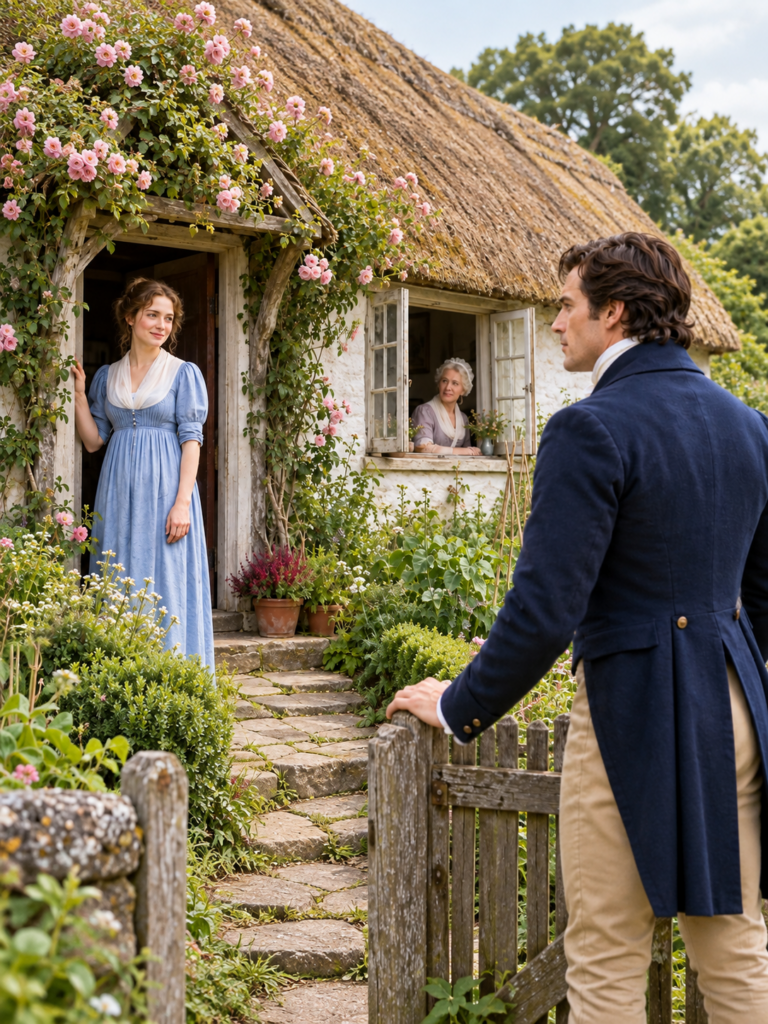
The first thing Edwin, Duke of Raxby, noticed was the little red flower on the cottage doorstep.
The second was his mother’s voice coming through the open window.
And the third was that the woman he had spent three years trying to forget was sitting beside her, holding her hand.
For a moment, the duke could not move.
His mother was supposed to be in Bath.
His former fiancée was supposed to be nothing more than a painful memory.
Yet here they were, together in a gardener’s cottage at the bottom of a quiet country lane, behaving as though the past had never happened.
Then he heard his mother say something that made his blood run cold.
“Tell me what the flower looks like, Selina. I cannot see it clearly anymore.”
Edwin stepped closer to the window.
“Red, Your Grace,” the younger woman answered gently. “A lovely deep red, like a winter apple. And the edges are white, almost like little drops of cream.”
His mother laughed softly.
“Then it is even prettier than I imagined.”
Edwin’s hand tightened around the wooden gate.
His mother could not see.
And somehow, the woman who had broken his heart knew about it before he did.
Three years earlier, Selina Penwood had lived in a beautiful country house called Holmcroft, on the edge of England’s New Forest.
Her family had owned the property for generations.
Her father, Arthur Penwood, had been a charming man who loved expensive horses, fine wine, and entertaining important visitors.
Unfortunately, he loved spending money far more than he loved earning it.
Selina had never cared much for society.
She preferred the gardens, the woods, and the small wildflowers growing among the roots of ancient oak trees.
At twenty-one, she was quiet, intelligent, and more comfortable with a sketchbook than a ballroom.
She had an unusual gift.
Where other people saw an ordinary patch of grass, Selina noticed delicate orchids, tiny insects, and beautiful patterns in the leaves.
She could spend hours painting a single flower.
Her mother had died when she was sixteen, leaving her with a father who loved her but understood very little about her.
Then Edwin came into her life.
He had recently inherited his father’s dukedom, along with a vast northern estate and responsibilities that seemed to weigh on him more heavily than the title itself.
He was handsome, serious, and painfully reserved.
At thirty-two, he had already learned that many people were interested in his fortune, while very few cared about the man who possessed it.
The first time Selina saw him, he was walking alone beside a quiet woodland pond.
She had been drawing a rare orchid.
Without thinking, she turned to a fresh page and began sketching the stranger.
He stood with his shoulders hunched, looking toward the water.
There was something terribly lonely about him.
When he finally noticed her, he approached with a faint frown.
“May I ask what you are drawing?”
Selina hesitated, then showed him the orchid.
He examined it carefully.
“Very fine work.”
“Thank you.”
Then, in a moment of dreadful honesty, she turned the page.
“And I drew you.”
Edwin stared at the sketch.
For a long time, he said nothing.
“Is that really what I look like?”
“From behind,” Selina answered. “I haven’t had the opportunity to study your face properly.”
To her surprise, he laughed.
It was a warm, unexpected sound.
And Selina decided that she wanted to hear it again.
Over the following weeks, he returned to the pond almost every afternoon.
She showed him the forest.
He listened when she explained why some seeds would not grow without smoke, why certain flowers bloomed only after heavy rain, and how the wild ponies knew where to find water during dry summers.
He never made her feel foolish for caring about such small things.
Instead, he began asking questions.
Soon he was walking her home, visiting her father’s house, and finding increasingly unconvincing reasons to remain at Holmcroft until evening.
One August afternoon, they stood together on the heathland while the setting sun turned the grass golden.
Edwin took her hand.
“Selina, I have spent most of my life looking at things without truly seeing them.”
She looked up at him.
“That sounds rather sad.”
“It was.”
He smiled.
“Until you.”
Then he said the words she would remember for the rest of her life.
“I would like to see what you see for the rest of my life. Will you let me?”
She answered yes before he had finished speaking.
They were engaged within the week.
For nine wonderful weeks, Selina believed her future had finally become certain.
She would marry the man she loved.
She would leave behind her father’s endless worries.
And perhaps, one day, they would raise children who would learn the names of every flower in the forest.
But eight days before the wedding, everything changed.
It began with a letter.
Her father had fallen asleep in his study, his head resting on the desk beside an empty wine bottle.
Selina had come downstairs for water.
She noticed a candle burning dangerously close to a pile of papers.
When she reached to move it, she saw Edwin’s name written across the top of an unfinished letter.
She had never read her father’s correspondence before.
But something made her stop.
The letter was addressed to Mr. Hayter, a wealthy moneylender in Southampton.
Her father begged for more time to repay his debts.
Then came the sentence that destroyed Selina’s happiness.
“Once my daughter marries the Duke of Raxby, his fortune will settle every obligation. The young man is hopelessly in love and will never refuse his wife’s father.”
Selina read the words once.
Then again.
Then a third time.
Her father’s debts were enormous.
He had gambled away investments, mortgaged the estate, and borrowed against nearly everything the family owned.
He had welcomed Edwin into their home not simply because he approved of the marriage.
He had welcomed him because Edwin was rich.
And Selina was the means by which he intended to reach that fortune.
The next morning, she confronted her father.
Arthur Penwood collapsed into his chair and began to cry.
“I never meant to hurt you, my darling.”
“How much do you owe?”
He could barely answer.
When he finally named the amount, Selina felt physically sick.
“Father, that is more than Holmcroft is worth.”
“I know.”
“And you expected Edwin to pay it?”
“He loves you. He would do anything for you.”
“That is precisely why you must not ask him.”
Her father took her hands.
“Selina, if he does not help us, we will lose everything.”
She withdrew her fingers.
“And if he does help you, what happens when you borrow again?”
Arthur looked away.
That silence told her everything.
Selina spent the afternoon wandering the heathland.
She imagined telling Edwin the truth.
He would listen.
He would hold her.
And without hesitation, he would pay the debts.
He would do it because he loved her.
Then, every Christmas, every family dinner, every visit from her father would carry the same invisible burden.
How long before Edwin began to wonder whether she had known?
How long before their marriage became another debt her father expected him to pay?
She was young, frightened, and desperate to protect both men.
So she made a decision that would haunt her for three years.
That evening, she wrote four lines.
I find that I cannot marry you. I am sorry. Please do not come to me. Please do not ask why.
She sealed the letter before she could lose her courage.
When Edwin arrived the following morning, she refused to see him.
He waited in the entrance hall for nearly an hour.
Her father told him she was unwell.
Edwin sent another message.
Then another.
At last, he left.
A month later, he sailed for the Cape of Good Hope.
Selina learned of his departure from a newspaper.
She sat alone in the garden where he had once kissed her and cried until there were no tears left.
Within a year, her father was dead.
Holmcroft had been seized by the moneylender.
The furniture was sold.
The paintings disappeared from the walls.
And Selina Penwood, once promised to a duke, found herself living in the old gardener’s cottage at the bottom of her own childhood lane.
She survived by painting botanical illustrations for a nursery merchant in Southampton.
He paid her a modest amount for every picture.
Then he published them under his own name.
She knew it was unfair.
But the rent was due every quarter, the roof leaked, and pride would not buy bread.
One June morning, a carriage bearing the Raxby family crest stopped outside her gate.
Selina came to the door expecting Edwin.
Instead, she found his mother.
Beatrix, the Dowager Duchess of Raxby, stood on the path in an elegant gray gown.
Her expression was grave.
“Miss Penwood,” she said, “I have come to ask why you broke my son’s heart.”
Selina invited her inside.
And, for the first time since that terrible night, she told someone the whole truth.
When she finished, the duchess sat silently for a very long time.
Finally, she reached across the table.
“My dear girl, you have made a dreadful mistake.”
Selina lowered her eyes.
“I know.”
“But you made it because you loved him.”
Beatrix took her hand.
“And I think I have made a dreadful mistake about you.”
Before leaving, the duchess promised never to reveal the secret without Selina’s permission.
The following summer, she returned.
Then she returned again.
Gradually, the two women became friends.
And when Beatrix’s eyesight began failing, Selina painted flowers in large, brilliant colors so the old lady could still enjoy the beauty she feared she was losing.
That was how Edwin found them three years after the broken engagement.
Standing together inside the little cottage.
Surrounded by painted flowers.
And keeping secrets from the one man whose life those secrets had changed.
Part 2
“Mother?”
Edwin’s voice broke the quiet of the cottage.
Beatrix turned toward the doorway.
“Edwin?”
For one extraordinary moment, she looked exactly as she had when he was a child and had unexpectedly come home from school.
Then she extended both hands.
“My boy.”
He crossed the room immediately.
She reached for his face, touching his cheeks, his hair, and the familiar line of his jaw.
“You’ve grown thinner.”
“Mother, what is happening?”
She smiled sadly.
“I suppose you have noticed my eyes.”
“Why did you not tell me?”
“Because you would have worried.”
“Of course I would have worried!”
His voice was sharper than he intended.
He stepped away and looked around the cottage.
The walls were covered with enormous paintings of roses, orchids, foxgloves, and woodland flowers.
Then he looked at Selina.
“You knew.”
She stood beside the table, holding a paintbrush.
“Yes.”
“For how long?”
“Nearly three years.”
He stared at her.
“Three years?”
Beatrix raised her hand.
“Edwin, I asked her not to tell you.”
“And she obeyed?”
“Yes.”
He laughed bitterly.
“How remarkable. She can obey you for three years, yet could not offer me five minutes of explanation before destroying our engagement.”
Selina went pale.
Beatrix straightened.
“That is enough.”
But Edwin had spent three years burying his pain beneath cold courtesy, and now it was rising faster than he could control.
He turned toward Selina.
“Tell me why.”
She looked down.
“Your Grace—”
“No. Not Your Grace. You once called me Edwin.”
Her hands tightened around the brush.
“Please.”
“You wrote four sentences and shut a door. I crossed half the world trying to forget you. And all the while, you were sitting here with my mother.”
He took a breath.
“Do you understand what that feels like?”
Selina’s eyes filled.
“Yes.”
“Then tell me why you did it.”
For a moment, she almost spoke.
Then she remembered her father’s letter.
She remembered the shame, the debts, and the terrible decision she had made.
“It is not a secret that belongs only to me.”
Edwin turned toward Beatrix.
“Mother?”
The dowager folded her hands.
“I gave my word.”
“You know?”
“Yes.”
“And you will not tell me?”
“No.”
The silence that followed was terrible.
Finally Edwin picked up his hat.
“I shall return tomorrow.”
Beatrix nodded.
“I would like that.”
He looked once more at Selina.
Her face was composed, but tears trembled on her eyelashes.
He left without another word.
Outside, he mounted his horse and rode up the lane so quickly that stones scattered beneath the animal’s hooves.
Selina remained standing in the doorway.
Only when the sound of the horse had disappeared did she allow herself to cry.
Beatrix listened quietly.
Then she said, “We have hurt him.”
“I know.”
“Perhaps more than we intended.”
Selina wiped her eyes.
“I thought he hated me.”
“My dear, hatred would have been easier for him.”
That night, Selina sat alone with her old sketchbook.
She opened it to the pages she had not looked at for years.
There was Edwin standing beside the pond.
Edwin beneath the oak trees.
Edwin laughing with his head thrown back.
Edwin sleeping in a patch of afternoon sunlight with his hat over his eyes.
She had drawn him so many times.
And she had never stopped loving him.
Upstairs, Beatrix moved restlessly in her narrow bed.
Her eyesight had grown steadily worse over the past three years.
At first, she had struggled to read small print.
Then letters became impossible.
Now faces disappeared unless she stood close enough to touch them.
Her physician had offered little hope.
She could distinguish light from shadow and sometimes recognize strong colors.
But the world she had known was slowly fading.
At Raxby Hall, everyone had treated her as a helpless invalid.
Servants rushed to move chairs.
Companions insisted on reading to her.
Visitors spoke too loudly, as though failing eyesight meant failing hearing.
Only Selina allowed her to remain herself.
When Beatrix wanted to walk in the garden, Selina offered an arm rather than an order.
When she wanted to help prepare supper, Selina placed vegetables beneath her hands.
When she wanted to know whether a flower had bloomed, Selina described it carefully, then let her touch the petals.
For three summers, the old duchess had found more independence in that tiny cottage than in all the grand rooms of her son’s estate.
And now Edwin had discovered her refuge.
The next morning, he returned.
This time he knocked.
Selina opened the door to find him standing with a basket.
“My mother likes cherries,” he said stiffly.
“Yes.”
“And the innkeeper’s wife insisted on sending a cold chicken.”
“That was kind of her.”
He glanced past Selina into the room.
“May I come in?”
She stepped aside.
For the next hour, the three of them attempted an ordinary morning.
Beatrix talked about the weather.
Edwin asked whether the cottage roof required repairs.
Selina painted a large pink rose beside the window.
No one mentioned the past.
But Edwin noticed everything.
He watched Selina place his mother’s teacup exactly where her hand expected to find it.
He watched her gently guide Beatrix around a chair without making her feel foolish.
He watched her take a freshly cut rose and place it in the old woman’s palm.
“Here,” Selina said. “Feel the petals. The outer ones are a little rough from yesterday’s rain.”
Beatrix raised the flower to her nose.
“Oh, that is lovely.”
Selina lifted the painting close to her face.
“And this is how it looks in the sunlight.”
Beatrix smiled.
“I can see the pink. Just a little.”
Edwin turned away.
He had not realized how much his mother had lost.
Nor had he realized how much Selina had quietly given her.
A few minutes later, he walked outside.
Selina found him standing beside the old stone well.
His hands rested on the rim.
“Edwin?”
He did not turn.
“I remember Christmas.”
She waited.
“She complained that the dining room was poorly lit. I ordered more candles.”
His voice trembled.
“More candles, Selina. As though that would help.”
She set down her water bucket.
“You couldn’t have known.”
“I should have.”
“She was determined you wouldn’t.”
He finally turned.
“Do you know what frightens me most?”
Selina shook her head.
“That she felt safer telling you.”
There was no anger in his face now.
Only grief.
“I have become so cold that my own mother would rather grow blind in a stranger’s cottage than ask her son for help.”
Selina stepped closer.
“You are not cold.”
He gave a bitter smile.
“Everyone says otherwise.”
“Everyone does not know you.”
“You do?”
She hesitated.
“Once, I did.”
He studied her.
“And what did you know?”
She looked toward the meadow.
“That you are kinder than you allow people to see.”
He said nothing.
Then she added softly, “And that your mother loves you more than anything in this world.”
Something in his expression changed.
He lowered his head.
For the first time since returning from Africa, Edwin allowed himself to cry.
Not loudly.
Not dramatically.
Just one exhausted man standing beside an old well, grieving the years he had lost.
Selina wanted desperately to hold him.
But she remained where she was.
She had no right to assume that he would welcome her comfort.
At last he straightened.
“Thank you for caring for her.”
“It has been my privilege.”
He shook his head.
“No. It has been work. Difficult work. And you’ve done it while struggling to keep this place.”
Selina looked away.
The roof had begun leaking again.
Her boots needed replacing.
And the nursery merchant had recently reduced the payment for her illustrations.
She had told none of this to Beatrix.
Nor would she tell Edwin.
“I manage,” she said.
He looked at her worn dress and paint-stained fingers.
For the first time, he began to understand that the woman who had rejected him had not escaped into an easier life.
She had suffered.
Quietly.
And alone.
That afternoon, a carriage rolled up the lane.
Its polished doors bore the crest of Isabella Hayter, the wealthy widow who now owned Holmcroft.
Isabella stepped down in a pale lilac gown, carrying a basket of strawberries.
She was beautiful, sophisticated, and accustomed to being admired.
She was also the woman who had invited Edwin to the forest.
When she entered the cottage and discovered the duke sitting beside his mother, her smile froze.
“Your Grace. What a delightful surprise.”
Edwin stood.
“Mrs. Hayter.”
“And the dowager duchess! I had no idea you were visiting.”
Beatrix smiled politely.
“I expect there are several things you do not know, my dear.”
Isabella laughed.
For ten minutes, she chatted pleasantly.
Then she asked Selina to accompany her to the gate.
Once they were alone, her expression changed.
“How fortunate,” Isabella murmured, “that you have such important visitors.”
Selina held the strawberry basket.
“They are my guests.”
“Of course.”
Isabella glanced toward the cottage.
“People will talk, you know. A duke visiting his former fiancée every day. Some might think you are attempting to win him back.”
Selina said nothing.
“And I would hate for your father’s unfortunate affairs to become public again.”
Selina felt a chill despite the warm afternoon.
“What do you mean?”
“My late husband kept excellent records. Letters. Agreements. Financial arrangements.”
Isabella smiled.
“I believe your father wrote to him frequently.”
Selina’s stomach tightened.
The letter.
Her father’s terrible letter.
It still existed.
And Isabella possessed it.
“Quarter day is approaching,” the widow continued. “I’ve been considering whether this cottage ought to remain standing. It rather spoils the view from my drive.”
Then she stepped into her carriage.
“Do think carefully about your future, Miss Penwood.”
The carriage departed in a cloud of dust.
Selina remained at the gate long after it had gone.
For three years, she had feared the truth becoming known.
Now someone had discovered a way to use that fear against her.
And this time, losing Edwin might not be enough.
She could lose her home as well.
Part 3
The hay harvest began beneath a sky so blue that the entire forest seemed brighter than usual.
Across the meadow, men swung long scythes through the grass.
Women followed with wooden rakes, gathering the cut hay into rows.
The air smelled of sunshine, clover, and freshly broken stems.
Selina had always loved this time of year.
Even after losing Holmcroft, she continued helping the neighboring families bring in the harvest.
The meadow did not belong to the grand houses.
Its haymaking rights had been shared among local families for generations.
Selina owned no livestock, but she worked alongside everyone else.
There was comfort in labor that mattered.
A full wagon meant fodder for winter.
Dry hay meant animals might survive the cold months.
And a careless afternoon could destroy weeks of work if rain arrived before the crop was stored.
That morning, Selina sat on a stile drawing a patch of wildflowers before the mowers reached them.
She was so absorbed that she did not hear footsteps.
“Will they all be cut?”
She looked up.
Edwin stood beside her.
He had removed his coat and loosened his cravat.
“Yes,” she said. “Before noon.”
“Then why draw them?”
“So someone remembers they were here.”
He looked at the sketchbook.
A tiny yellow flower occupied most of the page.
“You always did notice things other people walked past.”
Selina smiled faintly.
“You remembered.”
“I remember everything.”
The words hung between them.
Then Edwin nodded toward the cottage.
“My mother told me about the flower I sent from Africa.”
Selina’s fingers stilled.
“The Cape heather?”
“Yes.”
She looked toward the distant roof.
“It took two years to grow.”
He raised his eyebrows.
“Two years?”
“The seeds would not germinate. I tried different soils and temperatures. Nothing worked.”
“What changed?”
“A nursery gardener told me that certain mountain plants need smoke before their seeds will grow. So I burned dried heather beside the pots and let the smoke drift over them.”
“And it worked?”
“Three seedlings appeared. Two died in winter. One survived.”
Edwin looked toward the cottage.
“And now it has flowered.”
“Yes.”
He was silent for a moment.
Then he said, “I collected those seeds on a mountain outside Cape Town.”
Selina turned toward him.
“It was a dreadful day,” he continued. “I had been traveling alone for months. I was angry with the world and entirely tired of myself.”
He stared across the meadow.
“I climbed because I couldn’t bear to remain indoors.”
“What happened?”
“Nothing remarkable. I found a hillside covered in little red flowers.”
He smiled sadly.
“And I thought of you.”
Selina lowered her eyes.
“I thought you would know their names. I imagined you kneeling among them with your sketchbook.”
His voice softened.
“So I gathered some seeds and sent them to my mother. I couldn’t bear to send them to you.”
She swallowed.
“And she gave them to me.”
“Yes.”
They stood together in the warm morning.
Edwin picked up a blade of grass.
“All that distance, and they found their way here.”
Selina looked at him.
“Some things take longer to grow than we expect.”
Neither spoke for a while.
Then a farmer shouted for more hands.
Edwin glanced at the hayfield.
“Can you teach me?”
Selina blinked.
“To rake hay?”
“Yes.”
“Your Grace, I don’t think—”
“Edwin.”
She laughed despite herself.
“Very well, Edwin. But you will be dreadful at it.”
He removed his waistcoat and climbed over the stile.
For the next hour, the Duke of Raxby made a magnificent fool of himself.
He held the rake incorrectly.
He scattered hay that Selina had already gathered.
At one point, he nearly struck his own boot with the wooden handle.
The carter’s wife watched with open amusement.
“Your Grace, you’ll ruin the harvest before dinner!”
Edwin looked at his disastrous row.
“Then I shall have to work harder.”
And he did.
By afternoon, his hands were blistered.
His shoulders ached.
His shirt was damp with sweat.
But the rows of hay behind him had finally begun to look respectable.
Selina watched him accept a mug of cold tea from the carter’s wife.
He thanked her as graciously as he would have thanked a duchess.
The older woman blushed.
And when Edwin laughed at something one of the farmers said, Selina felt the sound pass through her like sunlight after rain.
It was the same laugh she remembered from the pond.
For a moment, she almost believed the missing years had been returned to them.
But when evening came, she found a letter waiting beneath her cottage door.
It was from Isabella Hayter.
The message was brief.
The cottage would be demolished at midsummer.
Selina had five days to leave.
Below the widow’s signature was a handwritten addition.
Of course, if His Grace’s visits cease immediately, I may reconsider.
Selina read the letter twice.
Then she folded it carefully and placed it inside her sketchbook.
She did not tell Beatrix.
She did not tell Edwin.
Instead, she began measuring her possessions in silence.
Two chairs.
A narrow bed.
Her mother’s old china.
Three cooking pots.
A shelf of books.
Dozens of botanical paintings.
And the little Cape heather on the doorstep.
She could probably sell most of the furniture.
Perhaps the churchwarden knew of an empty room in the village.
Perhaps the nursery merchant could advance her payment.
Perhaps she could find work painting labels or cleaning a respectable household.
That night, she took out her account book.
The figures were humiliatingly small.
After paying rent, buying food, and purchasing paper and pigments, she had barely enough to survive.
She could not afford to move.
Yet she had survived worse.
She had buried her father.
She had watched strangers carry the furniture from her childhood home.
She had accepted a smaller life and learned how to make it meaningful.
She would survive this too.
But Beatrix complicated everything.
The duchess could not remain in a cottage scheduled for demolition.
And Selina feared that telling Edwin would turn her desperate circumstances into a request for rescue.
That was the very thing she had sacrificed their engagement to avoid.
The following afternoon, Edwin found her in the garden.
She was repairing a broken trellis with string.
“That won’t hold through winter,” he said.
“It only needs to last through summer.”
He looked at her carefully.
“What’s wrong?”
“Nothing.”
“Selina.”
She concentrated on the knot.
“I am merely tired.”
He waited.
Then he gently took the string from her fingers.
“You used to tell me the truth.”
Her head came up.
“I have always tried to.”
“Except when you left me.”
The words wounded them both.
Edwin looked away.
“I’m sorry.”
Selina stepped back.
“You needn’t apologize for what is true.”
He shook his head.
“No. I do. Whatever happened, I cannot spend the rest of our acquaintance punishing you for it.”
She looked at him in surprise.
“Our acquaintance?”
A faint smile touched his lips.
“I don’t know what else to call it.”
For a moment, she wanted to tell him everything.
The letter.
The eviction.
The fear that had followed her for three years.
Instead, she said, “There is a reason I left you.”
He watched her.
“A real reason?”
“Yes.”
“One I might understand?”
She hesitated.
“I hope so.”
His expression softened.
“Then perhaps one day you’ll trust me enough to tell me.”
Before leaving, he touched her cheek.
It was only a moment.
But Selina stood beside the broken trellis long after he had gone, remembering the warmth of his fingers.
The next day, Edwin spent the afternoon reading aloud to his mother.
Beatrix sat with her eyes closed, listening to the familiar sound of his voice.
When Selina entered with fresh water, she stopped in the doorway.
It was a sight she had dreamed of and feared she would never see.
Mother and son together.
Not separated by distance or secrets.
Just sharing a quiet afternoon.
Later, while Selina carried paintings to the village carrier, Edwin sat beside Beatrix on the cottage step.
“Mother?”
“Yes, my boy?”
“Did she ever love me?”
Beatrix’s hands grew still.
Edwin stared toward the meadow.
“I don’t ask why she left. You’ve promised not to tell me.”
He took a breath.
“But I need to know whether any of it was real.”
Beatrix reached for his hand.
“Every day I have spent here, Selina has spoken of you with kindness.”
He said nothing.
“Even when she believed you hated her. Even when others repeated unkind rumors about you. She has defended you.”
“That doesn’t answer my question.”
His mother touched his face.
“No, Edwin. It does not.”
She paused.
“But you are a clever man. And you have eyes.”
Her voice became gentler.
“Use them.”
That evening, Edwin stood at Selina’s gate.
He looked troubled.
“May I ask you something?”
She nodded.
“When you wrote that letter, did you believe you were protecting someone?”
Selina’s breath caught.
“Yes.”
“Me?”
She looked toward the darkening forest.
“Among others.”
He waited.
But she could say no more.
At last he nodded.
“Then I shall try to understand what you cannot yet tell me.”
Selina closed her eyes.
She had spent three years believing he would never forgive her.
Now forgiveness stood in front of her, asking only for the truth.
And she was still afraid.
Part 4
The truth reached Edwin in the most unexpected way.
It came from the woman who intended to destroy Selina.
Isabella Hayter invited him to dinner at Holmcroft on a warm evening, three days before midsummer.
The invitation was written in her elegant hand.
Edwin almost refused.
But he knew Isabella had been watching his visits to the cottage with increasing displeasure.
He suspected she wanted something.
And he had learned long ago that people often revealed their intentions when they believed they were in control.
So he went.
Holmcroft looked worse than he remembered.
The roof above the west wing had collapsed in one corner.
The garden walls were buried beneath ivy.
Several windows remained shuttered.
Inside, candles burned in a drawing room that smelled faintly of damp plaster.
Isabella wore a blue silk gown and her finest pearls.
She greeted Edwin with practiced warmth.
They spoke about Bath, the weather, and mutual acquaintances.
But Edwin noticed the way her eyes repeatedly moved toward a locked writing desk beside the window.
After supper, she finally rose.
“Your Grace, there is something I believe you ought to see.”
She opened the desk.
From a drawer, she removed an old folded letter.
“My husband kept extensive records of his financial dealings.”
Edwin remained silent.
“Some of them concern the Penwood family.”
She placed the letter before him.
“I fear the truth may be painful.”
He unfolded it.
The handwriting was immediately familiar.
Arthur Penwood.
He recognized the exaggerated loops of the letters and the slightly crooked signature.
As Edwin read, his expression hardened.
The letter described the duke’s fortune as the solution to the Penwood family’s debts.
It referred to Edwin as a young man too blinded by affection to protect his own money.
It promised that everything would be settled after the wedding.
For one dreadful moment, Edwin felt the old humiliation return.
Had he been nothing more than a wealthy fool?
Had Selina known what her father intended?
Had every smile across the dinner table concealed a calculation?
Isabella watched him carefully.
“I am so sorry,” she murmured.
Edwin did not answer.
He reached the bottom of the page.
Then his eyes returned to the date.
Eight days before the wedding.
He froze.
He knew that date.
He had never forgotten it.
It was the very night before Selina’s terrible letter arrived.
His gaze moved through Arthur Penwood’s words again.
Suddenly, he noticed what was missing.
There was no evidence Selina had agreed to the scheme.
No indication she had even known about it.
Only her father’s confidence that Edwin would pay.
And the very next morning, Selina had broken their engagement.
Edwin leaned back slowly.
The pieces began fitting together.
Her father’s debts.
The abrupt refusal to marry.
Her insistence that the reason was not hers alone.
Her years of poverty.
Her refusal to defend herself.
And the fact that she had never asked him for a single shilling.
He looked at Isabella.
“You believe this proves Miss Penwood intended to deceive me?”
Isabella hesitated.
“Surely you can see—”
“I can see the date.”
He tapped the letter.
“Eight days before our wedding.”
“Yes.”
“And Miss Penwood ended our engagement immediately afterward.”
Isabella’s smile vanished.
Edwin folded the paper.
“She discovered what her father intended, didn’t she?”
The widow said nothing.
“She discovered it and refused to let him use our marriage to repay his debts.”
Isabella looked toward the window.
“Your Grace, I merely wished to protect you.”
“From what?”
“From being deceived.”
Edwin stood.
“Then you have done me a tremendous kindness.”
Her face went pale.
“May I keep the letter?”
She stared at him.
Then she nodded.
He placed it inside his coat.
“Good evening, Mrs. Hayter.”
He left before she could speak again.
The ride to the cottage seemed longer than any journey he had taken.
The forest lay dark beneath the summer stars.
A warm breeze moved through the trees.
He remembered Selina as she had been at twenty-one.
Her bright eyes.
Her paint-stained fingers.
The way she laughed when he misidentified flowers.
And then he remembered the last time he had seen her before the engagement ended.
She had been unusually quiet.
He had asked whether something troubled her.
She had kissed him and said, “Nothing that will matter tomorrow.”
He had believed her.
Now he understood that she had been saying goodbye.
When he reached the cottage, one candle burned in the window.
He knocked.
Selina opened the door wearing a plain gray gown.
The instant she saw his face, she knew something had changed.
“Edwin?”
He stepped inside.
“I’ve seen your father’s letter.”
Her face drained of color.
“Mrs. Hayter showed it to you?”
“Yes.”
Selina gripped the back of a chair.
“Then you know.”
“I know enough.”
He placed the letter on the table.
“She expected me to despise you.”
Selina stared at the paper.
“And do you?”
Edwin’s answer came immediately.
“No.”
Her eyes filled with tears.
“I thought you would.”
“I know.”
He stepped closer.
“Selina, I came here tonight because you have been carrying this alone for three years.”
She covered her mouth.
“And I would like to understand the part that still hurts.”
For a long time, she could not speak.
Then she opened her sketchbook.
Near the back was a drawing she had never shown anyone except Beatrix.
Her father asleep at his desk.
The empty wine bottle.
The candle.
And the unfinished letter beneath his hand.
“I drew this that night,” she whispered.
Edwin studied it.
The lines were rough, hurried, and full of anguish.
“I had just read the letter.”
She sat down slowly.
“I confronted Father the next morning. He admitted everything. The debt was greater than the value of the estate.”
Edwin pulled out a chair.
“Why didn’t you tell me?”
“Because I knew what you would do.”
“What?”
“You would pay.”
He said nothing.
“And he would borrow again. You would keep paying because you loved me. Eventually you would resent him, and perhaps you would resent me.”
She wiped her eyes.
“I thought I could prevent that by leaving.”
Edwin looked down at the drawing.
“You should have trusted me to choose.”
“I know.”
“You decided what my happiness required without asking me.”
“I know.”
He reached for her hand.
“I would have chosen you.”
The words broke something inside her.
She began crying.
Not the careful, quiet tears she allowed herself when no one was watching.
These were the tears of a woman who had spent three years pretending that heartbreak was simply another hardship to endure.
Edwin knelt beside her chair.
“I was so angry with you.”
“I’m sorry.”
“I thought you had never loved me.”
She shook her head fiercely.
“Never. Edwin, I never stopped loving you.”
He closed his eyes.
Then he drew her into his arms.
For a long time, they held each other beside the candlelit table.
Outside, the meadow lay silent beneath the stars.
Finally Selina pulled away.
“There’s something else.”
She took Isabella’s eviction notice from her pocket.
Edwin read it.
His expression grew dark.
“She threatened to demolish the cottage unless I stopped visiting?”
Selina nodded.
“And you were going to tell me when?”
“I wasn’t.”
He stared at her.
“Selina.”
She raised her chin.
“I know how that sounds.”
“Do you?”
“Yes. But this is my home. My struggle. And I cannot begin our lives again by making you responsible for saving me from every difficulty.”
He drew a long breath.
“You aren’t asking to be saved.”
“No.”
“What are you asking?”
“To be allowed to fight for myself.”
He studied her face.
Then he nodded.
“Very well.”
She blinked.
“Very well?”
“You shall handle Mrs. Hayter.”
A small smile appeared.
“Thank you.”
“But there is something I must do.”
“What?”
He glanced toward the painting of the Cape heather.
“May I borrow that?”
Selina followed his gaze.
“The flower?”
“The painting.”
“Why?”
“I have an idea. It may come to nothing.”
She hesitated, then removed the picture from the wall.
She rolled it carefully and tied it with green ribbon.
Edwin accepted it.
“I must go to London tomorrow.”
“London?”
“I shall return before midsummer.”
He kissed her forehead.
“Trust me this once.”
After he left, Selina sat beside the window.
For the first time in years, she had told Edwin the truth.
He had not rejected her.
He had not called her foolish or dishonest.
But the cottage was still threatened.
The future remained uncertain.
And Isabella Hayter still held power over the one place Selina could call home.
The following morning, Edwin left for London.
By evening, rumors had spread throughout the village.
The duke had gone to obtain a special marriage license.
He intended to marry Isabella Hayter.
The widow had already ordered new curtains for Holmcroft.
The gardener’s cottage would be demolished after midsummer.
When the carter’s wife brought the news, Selina thanked her and shut the door.
Then she sat at her painting table.
She tried to work.
But the brush trembled in her hand.
Had she misunderstood Edwin?
Was London merely an excuse to escape?
Had she opened her heart only to lose him again?
Beatrix listened quietly as Selina repeated the rumors.
Then the old duchess laughed.
“My dear girl, Edwin would sooner marry the carter’s horse.”
Selina gave a startled laugh.
“Your Grace!”
“I know my son.”
Beatrix extended her hand.
“And I know that whatever he is doing, he is not betraying you.”
Selina sat beside her.
“I want to believe that.”
“Then believe it.”
The old woman squeezed her fingers.
“But tomorrow, you must deal with Mrs. Hayter.”
Selina looked toward Holmcroft.
The house where she had been born stood dark above the lane.
Three years earlier, she had walked away from it in shame.
Tomorrow, she would return.
And this time, she would not surrender her future simply because someone threatened her with the past.
Part 5
Selina walked up the lane shortly after breakfast.
She wore her best dress, a faded blue gown she had carefully mended at the cuffs.
Her old sketchbook rested beneath her arm.
The meadow was almost bare now.
The last of the hay had been gathered into wagons.
A few farmers were repairing fences before the next rain.
They greeted her as she passed.
She answered each one.
But she did not stop.
At the top of the lane, Holmcroft stood behind its overgrown gardens.
The house seemed smaller than she remembered.
Its roof sagged.
Its windows were dark.
And the beautiful rose garden her mother had tended was almost completely swallowed by weeds.
Selina climbed the steps and rang the bell.
A servant showed her into the drawing room.
Isabella Hayter sat beside an unlit fireplace.
She wore a white morning gown and looked as though she had not slept.
“Miss Penwood.”
“Mrs. Hayter.”
“I assume you’ve come about the cottage.”
“Yes.”
Isabella smiled thinly.
“Then I regret that my decision is unchanged.”
Selina stood straight.
“I came to tell you two things.”
The widow raised an eyebrow.
“How very formal.”
“The first is that I will leave the cottage by midsummer if you insist.”
Isabella looked surprised.
Selina continued.
“I won’t purchase a roof by promising never to see Edwin again.”
The widow’s expression hardened.
“And the second?”
“You will no longer use my father to frighten me.”
Isabella stared.
“Excuse me?”
“Edwin has the letter. He knows everything. I have told him the truth.”
A long silence followed.
Then Isabella laughed.
It was a strange, unhappy sound.
“So you’ve won.”
Selina frowned.
“This isn’t a contest.”
“Isn’t it?”
Isabella rose abruptly.
“You have the duke. His mother adores you. The entire village thinks you a saint.”
“Mrs. Hayter—”
“And I have this house.”
She gestured toward the damp walls.
“This miserable, enormous house.”
Her voice broke.
“Do you know what people call me?”
Selina remained silent.
“The moneylender’s widow. That’s all I shall ever be.”
Isabella turned toward the window.
“My father was indebted to my husband too.”
Selina looked at her.
“He was sixty. I was eighteen.”
The widow’s hands began shaking.
“My father promised me to him in exchange for the cancellation of his debts.”
Selina felt a slow, terrible understanding.
“Isabella…”
“I was frightened. I didn’t want to marry him.”
Her voice grew thin.
“But my father told me the family would be ruined unless I agreed.”
She wiped her face angrily.
“So I married him.”
Neither woman spoke for a moment.
Then Isabella turned.
“And you had the chance to do exactly the same thing.”
Selina looked down.
“But you walked away.”
Isabella laughed through her tears.
“You refused the bargain. You lost your home. You became poor. And somehow, everyone loved you more.”
She sank into a chair.
“I did what I was told, and everyone despised me.”
Selina moved slowly toward her.
The widow looked smaller now.
Not the elegant, calculating woman who had threatened her.
Just a lonely young woman who had once been treated as payment for someone else’s debts.
“I found your father’s letter after my husband died,” Isabella whispered.
“I understood what you’d done.”
She stared at her hands.
“And I hated you for having the courage I didn’t.”
Selina sat beside her.
For a long time, neither spoke.
Then Selina opened her sketchbook.
She turned to a drawing made the previous Easter.
It showed a young woman sitting alone in church.
Her head was tilted toward a stained-glass window.
Sunlight touched her face.
The pew around her was empty.
Selina carefully removed the page.
“I drew this in church,” she said.
Isabella looked at it.
“Who is that?”
“You.”
The widow stared.
“I didn’t know anyone was watching.”
“You looked lonely.”
Isabella’s eyes filled.
Selina placed the drawing in her hands.
“I couldn’t bear to throw it away.”
For a moment, Isabella did not move.
Then she pressed the paper against her chest and began to cry.
No one had ever painted her before.
No one had looked at her without seeing the fortune, the title, or the dead husband who had purchased her marriage.
For the first time in years, someone had simply seen her.
At last Isabella rose.
She crossed to her writing desk and removed Selina’s eviction notice.
Then she tore it in half.
And again.
And again.
The pieces fell into the empty fireplace.
“Keep your cottage,” she whispered.
Selina stared.
“Are you certain?”
“Yes.”
Isabella wiped her cheeks.
“I never truly wanted to demolish it. I only wanted you to suffer.”
She looked ashamed.
“I am sorry.”
Selina stood.
“Thank you.”
The widow gave a weak smile.
“I think I shall sell Holmcroft.”
“Sell it?”
“Perhaps I’ll move to Bath. Somewhere no one knows my husband.”
She glanced at the drawing.
“Perhaps I might make a friend.”
Selina smiled gently.
“I hope you do.”
When she left Holmcroft, the morning seemed strangely bright.
Nothing about the house had changed.
The roof still leaked.
The garden was still overgrown.
But Selina felt as though a door that had been closed for three years had finally opened.
She walked down the lane slowly.
For the first time, she did not feel like a visitor passing her former home.
She felt like a woman returning to her own.
That evening, Edwin came back.
The last wagon of hay was passing the cottage when Selina saw him riding toward her.
His coat was dusty.
His horse was tired.
And beneath his arm he carried a rolled painting tied with green ribbon.
Selina was standing at the gate.
She made no attempt to pretend she had not been waiting.
Edwin dismounted.
For a moment, they simply looked at one another.
Then he smiled.
“You went to see her.”
“Yes.”
“And?”
“She tore up the notice.”
His face brightened.
“Selina!”
“I did it myself.”
He stepped toward her.
“I never doubted you would.”
She laughed.
“It was harder than I expected.”
“I imagine it was.”
“She cried.”
Edwin looked surprised.
“And I gave her a drawing.”
He smiled.
“Of course you did.”
Selina touched his sleeve.
“I think we may not be enemies anymore.”
“That would be a very good thing.”
She looked at the rolled paper beneath his arm.
“Now tell me about London.”
He carefully untied the green ribbon.
Then he opened the painting.
The Cape heather glowed beneath the evening light.
Its three red bells hung from a thin green stem.
Every tiny needle had been rendered with extraordinary precision.
Pinned to the corner was a letter.
It bore the address of a distinguished botanical publisher in London.
Selina frowned.
“What is this?”
Edwin placed the letter in her hands.
“I took your painting to Kew.”
She looked up sharply.
“The Royal Botanic Gardens?”
“Yes.”
“Edwin, why?”
“Because you told me no one in England had managed to flower that particular heather.”
She stared at him.
“So I wanted to show it to someone who would understand what you had accomplished.”
He smiled.
“The gentlemen at Kew were astonished.”
Selina looked back at the letter.
“They had never seen such a specimen flowering here. One of them took the painting directly to a botanical publisher.”
She began reading.
Her hands trembled.
Edwin watched quietly.
“They wish to engrave your illustration for their next volume.”
Selina looked up.
“What?”
“And they wish to publish it under your name.”
She stared at the paper.
For a long moment, she could not understand what she was seeing.
Then the words became clear.
Miss Selina Penwood.
Her name.
Written by a London publisher.
Attached to her own work.
“They want to publish my painting?”
“Yes.”
“With my name?”
“Yes.”
She read it again.
Then she pressed the letter to her chest.
For three years, she had painted flowers for a nursery merchant who claimed the work as his own.
She had accepted small payments and silence because she believed there was no other choice.
Now a respected publication wanted her work.
Not because she had once been engaged to a duke.
Not because Edwin had offered money.
But because she had grown a remarkable plant and painted it beautifully.
“Edwin,” she whispered, “I don’t know what to say.”
He took her hands.
“You don’t have to say anything.”
She shook her head.
“No. You must understand what this means.”
He waited.
“I thought the world had finished with me when I lost Holmcroft.”
Her voice shook.
“I thought I would spend the rest of my life painting pictures that belonged to other people.”
She looked at the letter.
“And now someone has written my name.”
Edwin smiled.
“Someone should have done it years ago.”
Tears slid down her cheeks.
“You opened that door for me.”
“I carried a painting.”
“You did more than that.”
He shook his head.
“You grew the flower, Selina. You cared for it through two winters. You learned what it needed when everyone else had given up.”
He brushed a tear from her cheek.
“And then you made something beautiful enough that strangers in London wanted the world to see it.”
She laughed through her tears.
“I am afraid I shall never stop thanking you.”
“Then I shall have to find a way to endure it.”
They stood together at the gate while the sunset turned the meadow gold.
After a moment, Selina grew quiet.
“Edwin?”
“Yes?”
“Would you ask me again?”
He frowned slightly.
“Ask you what?”
She smiled through her tears.
“The question you asked me on the heathland three years ago.”
His expression changed.
“Selina…”
“I gave you four terrible lines once.”
She took a breath.
“And you deserved a better answer.”
He stood very still.
“Are you certain?”
“More certain than I have ever been.”
Edwin took both her hands.
There was no grand speech.
No kneeling.
No audience of noble families.
Only the dusty country lane, the last wagon of hay, and a little cottage with roses growing over the doorway.
Then he spoke the same words he had spoken three summers earlier.
“I would like to see what you see for the rest of my life. Will you let me?”
Selina nodded.
“Yes.”
His breath caught.
“Yes?”
“Yes, Edwin.”
She laughed.
“And I love you. I have loved you every day, even when I thought you were lost to me forever.”
He drew her close and kissed her.
Behind them, the carter gave a cheerful whistle.
“About time, Your Grace!”
Edwin laughed.
Selina buried her face against his coat.
“Not next year,” she whispered.
“What?”
“Our wedding. Not next spring. Not after the harvest.”
He drew back.
“When, then?”
“As soon as it can be arranged.”
Edwin reached into his pocket.
“That may be sooner than you think.”
He produced a folded document.
Selina stared at it.
“A special marriage license?”
He grinned.
“The village was correct about one thing.”
She looked from the paper to his face.
“But everyone said it was for Isabella.”
“Then everyone was wrong.”
He opened the document.
“Your name, Selina. It was always your name.”
She began laughing again.
And then Beatrix called from the porch.
“Will someone please tell me what is happening?”
They turned.
The dowager stood beside her chair, one hand resting on the doorframe.
“I can hear laughter, and I believe there has been kissing!”
Edwin went to her and took her hand.
“Mother, Selina has agreed to marry me.”
For a moment, Beatrix said nothing.
Then she reached for Selina.
“My dear girl.”
Selina embraced her.
The old duchess held her tightly.
“I had almost given up hope.”
“So had I,” Selina whispered.
Beatrix smiled.
“Then perhaps it is fortunate that certain things take time to bloom.”
The wedding took place before the month ended.
It was a small ceremony in the village church at Lyndhurst.
Selina wore a simple ivory gown.
Her hair was pinned with tiny white flowers from the cottage garden.
Beatrix sat in the front pew, dressed in soft gray silk.
The carter’s wife cried throughout the service.
Several local farmers attended in their best coats.
When Edwin took Selina’s hand, he noticed that her fingers were trembling.
“Nervous?” he whispered.
“A little.”
“So am I.”
She smiled.
“Then we’ll manage together.”
And they did.
When the church doors opened, sunlight spilled across the aisle.
Beatrix lifted her face toward the brightness.
“I can see the colors,” she whispered.
Perhaps she could.
Perhaps she only remembered them.
But nobody questioned her.
Some moments deserved to be believed.
The following months brought changes to the forest.
Isabella sold Holmcroft to a quiet family from Winchester.
They repaired the roof, opened the boarded windows, and restored the gardens.
Before leaving, Isabella transferred the gardener’s cottage to Selina for a single shilling.
It was her final apology.
She moved to Bath and took rooms near the Crescent.
In autumn, Selina received a letter from her.
It was short and slightly awkward.
Isabella had joined a lending library.
She had made the acquaintance of two widows who enjoyed music.
And the drawing Selina had given her now hung above her writing table.
At the bottom, she had written one simple sentence.
I think I am learning how to be happy.
Selina read it twice.
Then she placed it carefully inside her sketchbook.
In October, the botanical publication arrived.
The first illustrated plate showed the Cape heather.
Its delicate red flowers stood against a pale background.
Below the illustration, in neat printed letters, was her name.
Selina Penwood, Duchess of Raxby.
She carried the book to Beatrix.
“Would you like me to describe it?”
The old woman smiled.
“Of course.”
Selina sat beside her and began explaining the illustration.
The fine green needles.
The dark red bells.
The white edges of the petals.
Beatrix listened.
Then she said, “I remember the first time you showed me that flower.”
“So do I.”
“You were frightened that Edwin would come.”
Selina smiled.
“Terrified.”
“And now?”
Selina looked through the window.
Edwin was outside attempting to repair a garden fence.
He had somehow managed to tangle a length of wire around his boot.
She laughed.
“Now I think he belongs here.”
Beatrix followed the sound of her laughter.
“So do I, my dear.”
The little cottage remained Selina’s favorite place.
She and Edwin had a grand home in the north, but every summer they returned to the forest.
Selina used the cottage as her painting studio.
Its windows were always open.
The walls remained covered with bright flowers.
And every June, Beatrix came to stay during the hay harvest.
Edwin continued helping the farmers.
He was still dreadful with a rake for the first hour.
And still reasonably good by afternoon.
Years passed.
Selina’s paintings appeared in more publications.
Younger artists came to study with her.
Women who had been told their work would never be taken seriously found encouragement beneath the cottage’s thatched roof.
And Beatrix, though her eyesight continued to fade, never lost her pleasure in the garden.
She learned to recognize plants by their scents.
She could tell roses from honeysuckle, lavender from thyme, and the little Cape heather from its delicate waxy bells.
One autumn evening, Selina noticed that the heather had produced seeds.
She gathered them carefully.
Then she opened her old sketchbook.
Inside the back cover was the original paper packet.
Its folds had grown soft.
The ink had faded.
But Edwin’s five words were still visible.
Plant them where you like.
Selina smiled.
She poured the new seeds into the packet.
Then, beneath Edwin’s old message, she wrote six words of her own.
Plant them where you are loved.
When Beatrix came into the room, Selina placed the packet in her hands.
“What is this?”
“Something for next spring.”
The old duchess felt the fragile paper.
“The heather?”
“Yes.”
“Where shall we plant them?”
Selina looked toward the garden.
Edwin stood beside the open gate, waiting for her.
Beyond him lay the meadow, the ancient trees, and the little lane that had once carried him away from her.
It was the same land.
The same cottage.
The same evening light.
But so much had changed.
She no longer saw the place where she had been abandoned by happiness.
She saw the place where she had learned to stand on her own, where forgiveness had taken root, and where love had found its way home.
She took Beatrix’s hand.
“Right here,” she answered.
“Where they belong.”
And when spring returned, the three of them planted the seeds together.


