
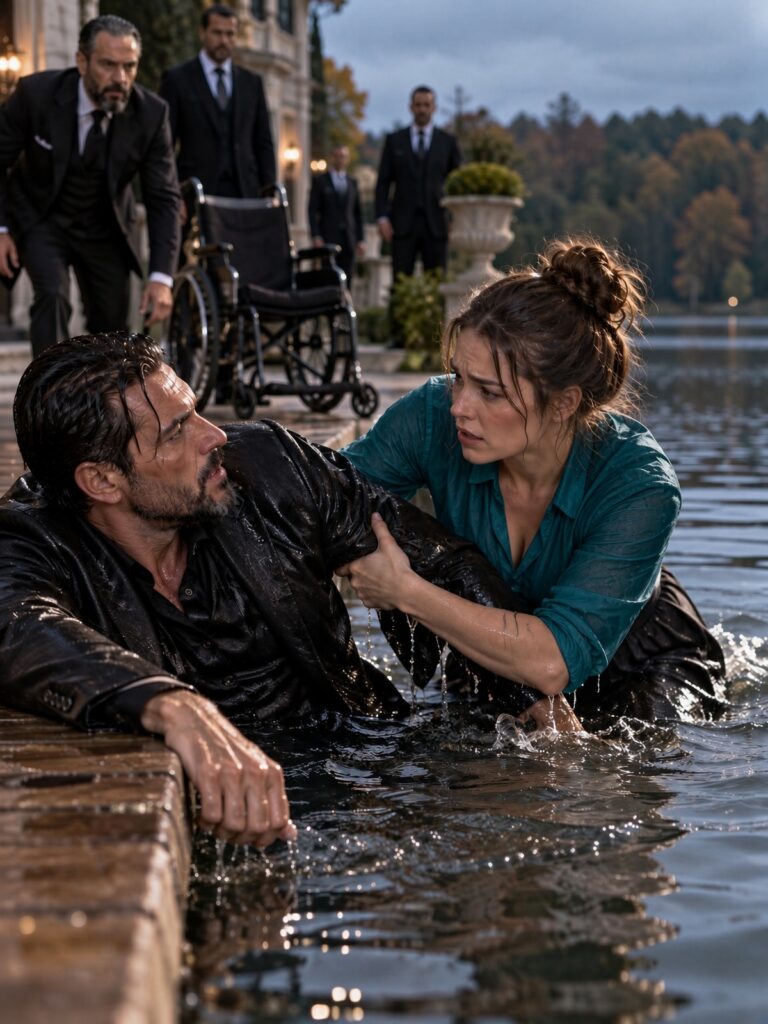
TWO HUNDRED GUESTS WATCHED THE MAFIA BOSS SINK BECAUSE THEY’D BEEN ORDERED NOT TO TOUCH HIS CHAIR—ONLY HIS NEW SECRETARY JUMPED IN
Two hundred people stood around Santino Ferrara’s pool and watched the most powerful man in Rhode Island sink ten feet underwater without lifting a hand to save him.
Emily Taylor had been his secretary for nine days—and she was the only person who broke the rule, dove in fully dressed, and dragged him back to the surface.
What Santino didn’t know was that Emily had spent nearly three years trying to get inside his family’s house…and the dead man whose name she carried in a hidden folder was the reason.

PART 1 — THE WOMAN WHO BROKE THE RULE EVERYONE ELSE OBEYED
Santino Ferrara went into the pool at 9:17 on a bright Newport morning.
One moment he was beside the flagstone edge in his wheelchair, listening to three men discuss shipping contracts.
The next, one front caster struck the lip of uneven stone.
The chair tipped.
Santino disappeared backward into ten feet of blue water.
Two hundred guests saw it.
Nobody moved.
Emily Taylor did.
She dropped the coffee tray and ran.
The water hit like ice.
Her dress shoes dragged immediately, but she kicked downward until she saw him at the bottom.
The wheelchair sat upright on the tile.
Santino was still strapped by circumstance rather than belt—his wet suit jacket had twisted through the rear axle and cinched tight.
Emily pulled.
Nothing.
His eyes remained open.
Calm.
Watching.
She had maybe thirty seconds of air.
She could surface.
Come back.
Too late.
Emily braced one palm against his chest and attacked the buttons of his jacket.
First.
Second.
Her fingers were already clumsy.
Third.
She shoved the wool from his shoulders.
The chair released him.
Santino rose suddenly.
Emily hooked her arm under his jaw the way a lifeguard instructor had taught her years before and kicked toward the shallow steps.
Only when she reached them did anyone help.
Hands appeared everywhere.
Men who had watched him sink were suddenly busy lifting him.
Emily ended up sitting on the flagstones, soaked and shaking.
No applause.
No shouting.
That disturbed her most.
The whole lawn seemed to be waiting.
Santino coughed twice.
Breathed.
Opened his eyes.
He ignored his sister.
Ignored Rafe Lombardi, his security chief.
Ignored the doctor.
He found Emily eight feet away.
Then asked:
“Who told you that you weren’t allowed?”
She stared.
He was not really asking her.
The lawn knew it.
Emily watched faces change.
Eyes lowered.
Forty minutes later she sat in the service kitchen wearing a towel around her shoulders.
Enzo Baron, the elderly man who managed the Ferrara household calendar and arrangements, entered carrying news.
“A transfer has been arranged.”
Emily looked up.
“Transfer?”
“Another household. Same salary. Better hours.”
Victoria Ferrara appeared behind him.
Santino’s older sister held a thick envelope.
“What you did was extraordinary,” she said warmly. “Please. The family remembers kindness.”
Emily looked at the envelope.
Money.
She kept both hands wrapped around her tea.
“No, thank you.”
Victoria’s smile remained.
She placed the envelope beside the sugar bowl.
Then wheels sounded in the corridor.
Santino entered in dry clothes.
Rafe walked behind him without touching the chair.
Santino noticed the envelope.
Then Enzo.
“There’s been a mistake.”
Enzo stiffened.
“Sir?”
“No transfer was approved.”
“Everything has already been arranged.”
Santino let him finish.
Then said:
“Undo it.”
His gaze moved toward Emily.
“She stays.”
Nobody spoke.
“Starting tomorrow, Miss Taylor works directly for me.”
Victoria’s face did not change.
Enzo’s did.
Santino turned the chair toward the hallway.
“My office. My calendar. My correspondence.”
Then, without looking back:
“Find her dry clothes.”
The wheels disappeared down the corridor.
Emily sat frozen beside the untouched envelope.
For nearly three years she had been trying to move closer to the Ferrara family.
By saving Santino’s life, she had just been placed closer than she had ever planned.
PART 2 — SHE CAME INTO HIS HOUSE LOOKING FOR A KILLER
Emily refused the Ferrara car that evening.
The driver stood at the gate holding open the rear door while she thanked him and walked toward the road wearing borrowed clothes and her ruined nineteen-dollar shoes.
Santino would later hear about that.
He would remember it.
At the time, Emily simply needed distance.
The first bus crossed the bridge toward Providence.
The second arrived twenty-three minutes late.
Emily spent the wait beneath a shelter with her arms folded against the cold.
Her shoes squished whenever she shifted her feet.
Replacement pair: probably twenty-five dollars.
She could make the old ones survive another month.
That was how Emily did money.
Not budgets.
Triage.
At eleven, she clocked into a laundromat off Atwells Avenue.
Marisol, the night manager, glanced at her wet hair.
“Bad day?”
“Long one.”
Marisol nodded.
Good enough.
Emily tied on an apron and spent five hours folding other people’s clothes beneath fluorescent lights.
By the end of every shift, industrial detergent lived in her skin.
She had stopped smelling it years ago.
At four fourteen she returned to her rooming house.
Four hours later she was awake again.
Tuesday.
Warwick.
Her mother.
Ruth Taylor sat in the sunroom of a memory-care residence holding a crossword puzzle she was not solving.
At fifty-eight, she had early-onset dementia.
The diagnosis had arrived three years earlier.
Emily still hated the phrase early onset.
As if disease had arrived ahead of schedule and should be congratulated for punctuality.
Ruth looked up.
Her face brightened.
“There’s my girl.”
Emily smiled.
“Hi, Mom.”
“How’s the new job?”
“Good.”
“Nice people?”
“Very.”
“Warm office?”
“Almost too warm.”
“Good. You always get cold.”
They worked on the crossword.
Eight minutes later Ruth asked:
“How’s the new job?”
Emily gave exactly the same answer.
Twenty minutes later:
“How’s the new job?”
Again.
Same wording.
Same smile.
Emily had learned that changing details confused her mother.
So she lied with precision.
She did not mention the pool.
The buses.
The laundromat.
The unpaid medical balance.
Or the fact that the memory-care residence sent statements every month that Emily paid late and in pieces.
That afternoon, back in Providence, Emily took two unopened bills from the mail.
Put them in a drawer.
Then knelt beside her mattress.
Beneath it waited an accordion folder.
Cheap cardboard.
Soft from years of handling.
Inside:
Photographs of an intersection in Cranston.
State police reconstruction report.
Insurance filing.
Phone records.
Vehicle registration.
Corporate ownership searches.
Three missing pages she had never located.
One photograph of her brother Daniel, twenty-two, sitting on a seawall holding coffee.
And one name circled so many times the paper had weakened beneath red ink:
FERRARA.
Daniel Taylor had died two years and five months earlier at Reservoir and Sackett.
Officially, he had been distracted by a phone call.
Lost control.
Collided with a black SUV.
Case closed in eleven days.
Emily had never believed it.
The SUV had been registered through a leasing company.
The leasing company connected to another company.
That company led eventually toward Ferrara interests.
Not proof.
A direction.
Emily had spent forty Saturdays in public-record offices.
Then applied for work.
Not once.
Four times.
Each job brought her geographically and socially closer.
Caterer.
Linen company.
Portsmouth household.
Then Ferrara residence.
She had accepted less money to get there.
And nine days after entering the house, she had saved the life of the man she had come to investigate.
Emily closed the folder.
She could not decide whether that was irony or catastrophe.
The next morning, Enzo Baron met her at the top of the Ferrara drive.
He had rules.
Many.
He recited them while walking.
East wing closed.
Garden phone for grounds crew only.
Do not answer the front door.
Unknown car enters drive—move away from windows.
Names never spoken on telephones.
Staff do not linger around family conversations.
Then Enzo stopped.
His voice changed.
“Nobody touches Mr. Ferrara’s wheelchair.”
Emily looked toward him.
“Ever?”
“Not the handles. Not the armrests. Not the footplate.”
“What if—”
“Unless he asks.”
Emily nodded.
“I understand.”
Eleven minutes later, she broke the rule.
Santino came from the study toward the terrace.
The carpet had folded slightly at the threshold.
A front caster caught.
The chair stopped hard.
Emily’s hand went automatically to the push handle.
Reflex.
Like the pool.
Her fingers closed around rubber.
The hallway changed.
Santino did not turn.
He placed one hand against the wheel rim.
Everything became still.
“Don’t push me until I ask.”
No anger.
That made the correction cut deeper.
Emily removed her hand.
“I’m sorry.”
Santino backed the chair four inches.
Cleared the rug himself.
Continued outside.
He never mentioned it again.
Emily stood there afterward staring at her own hand.
At the pool, everyone had watched him drown because someone had told them not to touch.
Inside the house, the rule remained.
Why?
At eleven she carried coffee to the morning room.
Victoria Ferrara sat reviewing vendor contracts with two businessmen.
Emily poured.
Victoria turned a page.
“Careful with the new girl.”
One man glanced up.
Victoria smiled.
“She’s ambitious.”
Polite laughter.
Then:
“I wouldn’t get attached. This house rarely remembers the name of whoever brings the coffee.”
No malice.
That made it worse.
Emily finished pouring without spilling.
Only outside did she realize she had stopped breathing.
In the kitchen, Rafe Lombardi stood eating a sandwich over the sink.
He watched her rinse cups.
Then said:
“You know what I keep thinking about?”
Emily waited.
“The pool.”
He set the sandwich down.
“Quarter to nine, I was on the terrace.”
“A call came.”
“Truck at the north gate. Wrong paperwork. Needed my signature personally.”
He rubbed his jaw.
“I walked out there.”
“No truck.”
Emily stopped washing.
“Did you call the supplier?”
“Monday.”
“They never sent anything.”
Rafe looked toward her.
“Twelve minutes.”
That was how long he had been away from Santino.
Rafe did not say someone had engineered the accident.
He did not need to.
That afternoon Santino summoned Emily.
Three months of correspondence was behind.
“Enzo handled it?”
“Yes.”
“Not anymore.”
He slid a key toward her.
“Archive room.”
Emily looked at it.
“You’re trusting me with files?”
“I’m trusting you to read.”
The answer unsettled her.
Four days later seven cars arrived.
Family meeting.
Emily was initially told to stay away.
Half an hour later Enzo appeared.
“Mr. Ferrara wants you taking minutes.”
She sat beside a window with a legal pad.
At the center of the room stood Carmine Sabatino, who had managed trucking yards for nineteen years.
Santino asked for the yard ledger.
Page forty.
Then forty-one.
Carmine read.
His face changed.
He closed the ledger himself.
Santino spoke only twice.
“The yards return to the family Monday.”
Then:
“You keep the Cranston house.”
Carmine nodded.
“Thank you.”
He left.
Emily could not stop thinking about the word.
Thank you.
Santino had not threatened him.
No shouting.
No violence.
Numbers.
Consequences.
A future erased with bookkeeping.
Business continued.
Men asked cautious questions about account signatures.
Nobody said Santino looked weak.
They tested him as if tapping ice.
Then Enzo read the asset schedule.
Trucking.
Marina lease.
Title company.
Funeral homes.
Commercial property.
Home-health agency.
Then:
“Meridian Care. Fourteen facilities.”
Santino lifted one hand.
“Again.”
Enzo froze.
“Meridian Care.”
“What is it?”
“Part of the Woonsocket home-health acquisition. Paper consolidation eighteen months ago.”
Too fast.
Emily heard it immediately.
So did Santino.
At the far end, Victoria said nothing.
That mattered because she had corrected two other items that morning.
Santino looked at Enzo.
“Continue.”
Later, after everyone left, Santino told Emily:
“In three years of correspondence, if you see Meridian Care, separate it.”
“Should I tell Mr. Baron?”
“No.”
She looked at him.
Santino met her eyes.
“No one.”
Near ten that night he asked Emily to sit in the study.
They remained eight feet apart.
He asked about Ruth.
Emily gave the first polite answer.
Then the truth.
Memory care.
Good days.
Bad days.
Tuesday had been good.
Santino did not offer sympathy.
Emily appreciated that.
Then he asked:
“Why did you jump?”
She knew exactly what he meant.
The true answer had two layers.
One:
She had been a lifeguard at nineteen.
When a person went under, she moved.
Two:
A dead Santino Ferrara could never answer her questions.
She gave him the first.
“Because nobody else was going to.”
“And?”
“Because I knew how.”
She paused.
“And because if I had stood there and watched you drown, I would have had to live afterward as somebody who did that.”
Santino studied her.
“Not the whole answer.”
“No.”
He surprised her by not asking.
Instead:
“Want to know where the wheelchair rule came from?”
“Yes.”
“It wasn’t mine.”
Twenty-six months earlier Santino had awakened at Rhode Island Hospital unable to move below the waist.
During eleven weeks in the hospital, a rule spread through the family.
Nobody touches the chair.
Santino came home and found it waiting.
“Why didn’t you change it?”
“Pride.”
His tone was flat.
“I preferred everyone thinking I made the rule to knowing somebody made it for me.”
Emily understood.
“A rule like that creates distance.”
“Eight feet.”
He nodded.
“Eight feet around me everywhere.”
Then his eyes darkened.
“And at the pool, somebody used it.”
The night before the party, someone had reminded everyone.
No touching.
Whatever happens.
Rule is the rule.
Santino had been thinking about it ever since.
Then he said something stranger.
“I know you’re carrying something.”
Emily’s stomach tightened.
“I don’t know what.”
He continued.
“I could search your room.”
“I could have Rafe investigate you.”
“But I haven’t.”
Why?
She did not ask.
Santino said:
“When this is over—six weeks at most—I’ll trade you.”
“For what?”
“Whatever name you’re carrying.”
Emily went still.
“I’ll put it back where it belongs.”
“Publicly.”
“In front of whoever needs to hear it.”
She could barely breathe.
He was offering exactly what she had entered the house to obtain.
Without knowing it.
Then he became businesslike.
“This house leaks information.”
“Enzo reports to someone.”
“Rafe has channels.”
“Victoria has several.”
“And me?”
“You’ve been here eleven days.”
“Nine when the pool happened.”
Something almost became a smile.
“Nine.”
He looked toward the study door.
“Nobody has built a channel to you yet.”
“So from now on, anything important comes to me in this room.”
“Not writing.”
“Not a car.”
“Not Mr. Baron.”
“You think he’s against you?”
“I don’t yet know that he isn’t.”
Emily waited four days before using the archive key.
The room smelled like old cardboard and dust.
Exactly like public-record offices.
She first searched for the crash.
Nothing.
Auto folder.
Gap.
One and a half inches wide.
A removed file had lived there for a long time.
Somebody had deliberately taken it.
Then she searched Meridian.
Two hours later she found it.
Woonsocket Home Health.
Administrative contract with Bayfield Administrative Group.
Bayfield owned by Onward Holdings.
Onward had acquired fourteen nursing and memory-care facilities.
Same signatures.
Same legal chain.
Emily opened the facility roster.
Fall River.
New Bedford.
Attleboro.
Woonsocket.
Pawtucket.
Warwick.
Her finger stopped.
Facility Nine.
She read the address.
Then opened the photograph of Ruth’s admission paperwork on her phone.
License number.
Same.
Emily sat down.
Her mother’s residence belonged indirectly to the Ferrara organization.
Not by coincidence.
She remembered the winter.
Nineteen calls.
Facilities refusing Medicaid admissions.
Capacity problems.
Waiting lists.
Then one miraculous callback.
A bed.
Immediate acceptance.
Emily had cried in the laundromat parking lot.
Someone had not been kind.
Someone had selected Ruth.
The next evening, Assistant United States Attorney Claire Devlin waited at Emily’s bus shelter.
Gray hair.
Raincoat.
Briefcase.
No drama.
“I’ve been building a racketeering case for three years.”
Emily said nothing.
“Labor.”
“Trucking yards.”
“Property closings.”
“Title company.”
“What I don’t have is somebody inside.”
Devlin explained that Emily’s false work history exposed her legally.
Small offenses.
But real.
Then:
“I am not threatening you.”
Emily almost laughed.
Devlin continued.
“I’m telling you what exists in the room.”
She also knew about Daniel.
“The accident file was closed badly.”
Emily’s grip tightened around the shelter pole.
“I can reopen it.”
“And my mother?”
“There are processes.”
Devlin’s voice softened.
“Placement protections.”
“I may be able to move her.”
Emily finally spoke.
“What do you want?”
“Ears.”
Then, eventually, more.
Emily whispered:
“Santino isn’t what you think.”
Devlin looked almost sad.
“In thirty-one years, nobody has ever told me the man was worse than I thought.”
She gave Emily one document.
State police log.
Same case number.
Two final reports.
Eight days apart.
“The one under your mattress is the second.”
Emily’s pulse jumped.
“What was in the first?”
“That’s what I want to know.”
A name appeared in both reports.
Warren Pike.
Accident reconstruction consultant.
Emily found him outside Tiverton.
Older man.
Low house.
Boat under tarp.
He refused to answer.
Emily left Daniel’s photograph against his storm door.
Her phone rang at 12:11 a.m.
Pike.
“I took money.”
Emily sat upright.
He had written the first report.
Then a man came to his office.
Eight days later he wrote another.
“How much?”
“Enough to pay for my wife’s medical care.”
He paused for breath.
“Not a defense.”
The first report said Santino’s SUV brake line had been deliberately compromised.
Cut from the inside face.
A location road debris could not reach.
Someone had been underneath the vehicle.
The final report changed one sentence.
Vehicle operator lost control.
That sentence buried everything.
“Do you still have the original evidence?”
“Yes.”
“Give it to me.”
“No.”
“Why?”
“Because there’s something else.”
“What?”
“You’re not ready.”
“I am.”
“No.”
His voice sharpened.
“I’ve listened to it too many times.”
Emily froze.
“Listened to what?”
“You’ll get it when I say.”
Before hanging up, Warren added:
“Don’t trust anyone in that house.”
“Not the sister.”
“Not Baron.”
“Not Lombardi.”
A pause.
“Especially not Santino.”
The power failed the following Tuesday.
A storm knocked out the peninsula.
The Ferrara generator restored only essential circuits.
Kitchen.
Gate.
Security.
One hallway.
Emily heard a hard wooden sound from Santino’s study.
Then nothing.
She entered carrying a candle.
He was on the floor.
Chair overturned several feet away.
Every instinct told her to rush forward.
She did not.
She set the candle down.
Sat against the desk six feet away.
Waited.
Santino breathed heavily.
Moved once.
Stopped.
Emily remained still.
Minutes passed.
Then:
“Miss Taylor.”
“Yes?”
“Bring the chair.”
She moved immediately.
Righted it.
Set brakes.
Positioned it exactly where he told her.
Then:
“I need your shoulder.”
Emily braced.
He used her only as much as necessary.
When he finally settled into the chair, sweat darkened his shirt.
“Two years.”
His voice was rough.
“Everybody either helps before I ask…”
He looked toward the door.
“…or pretends they didn’t hear.”
He looked at Emily.
“You sat down.”
“You told me not to touch the chair until you asked.”
“I could hear you not helping.”
Something changed in the room.
Then Santino said:
“The accident wasn’t an accident.”
Emily did not move.
“I knew on the third day.”
Someone close to him had arranged it.
Santino knew because one trusted man took four seconds too long answering a simple question about the wrecked vehicle.
He had no evidence.
So he pretended not to understand.
“You let them think the crash broke you.”
“I let them think it made me slow.”
Emily looked at the wheelchair.
The empty space around him.
The years of silence.
She understood.
Santino had not been passive.
He had been waiting.
Like a hunter inside a blind.
The next morning Victoria Ferrara drove Emily to Ruth’s residence.
Without warning, Victoria said:
“I know why you entered the house.”
Emily went cold.
“Your staffing history.”
“Daniel.”
“The record searches.”
Victoria had known since week two.
“Why didn’t you say anything?”
“I wanted to know what you were.”
Then Victoria offered something.
Every dollar Ruth owed.
Future bills too.
Paid anonymously.
“In exchange?”
“What Santino tells you.”
Emily stared.
“You want me spying on your brother.”
“I want to know what he knows.”
Victoria’s voice remained measured.
“In six weeks the succession council sits.”
Then she told Emily her story.
Seventeen years building the legitimate side.
Contracts.
Title company.
Marina lease.
Structures her father could not understand.
Then, eleven years earlier, her father placed the family ring on Santino’s hand.
Victoria stood eight feet away.
“He never looked at me.”
Emily understood that wound.
Too well.
That made Victoria more dangerous, not less.
“The Meridian file is yours,” Emily said.
Victoria looked at the road.
“The legal side is mine.”
Emily thought of Ruth.
Facility Nine.
Victoria placed a thin envelope on Emily’s lap.
Ruth’s account statement.
All arrears calculated.
“Think about what you’re turning down.”
Emily did not touch it.
She brought the conversation directly to Santino.
Or tried to.
Before she could, Rafe brought Santino a folder containing Emily’s false employment application and records searches.
Santino demanded independent confirmation.
Two unrelated sources.
When Rafe returned:
“It holds.”
Emily arrived at the house Friday evening.
Santino said thank you.
Nothing else.
Saturday morning her gate code turned red.
No explanation.
She stood outside for eleven minutes.
Then took the bus home.
At the laundromat, her hours were cut.
At the rooming house, rent terms changed.
At the residence, overdue calls intensified.
Victoria’s envelope remained unopened in Emily’s bag.
Monday, Emily called Claire Devlin.
Federal building.
Two hours forty minutes.
Forms.
Consent.
Monitoring device.
Devlin repeated:
“You can walk away.”
“My mother’s placement process continues either way?”
“Yes.”
Emily signed.
Then Devlin showed her Meridian.
Forty-one flagged deaths in eighteen months.
Lowest direct-care staffing hours among comparable Rhode Island operators.
Highest billing intensity.
Then one internal list.
Nineteen residents marked for conversion toward “comfort-focused care.”
Administrative list.
No physicians.
No clinical justification.
Emily scanned downward.
TAYLOR, RUTH — 58
Her vision narrowed.
“Nobody asked me.”
“You’re decision-maker of record.”
Devlin turned the page.
Signature line blank.
“They were preparing to do it anyway.”
Rafe called Wednesday morning.
“He wants you.”
Emily returned.
The gate light went green.
Santino waited in the study.
Empty desk.
No papers.
No ledger.
“I had you investigated.”
Emily said nothing.
“I won’t apologize for checking who enters my house.”
He paused.
“But I locked a gate on the woman who dragged me out of a pool without telling her why.”
His jaw tightened.
“My father used to do things like that.”
Santino disliked the resemblance.
Then:
“Your mother’s overdue balance is paid.”
Emily went cold.
“With my name.”
He continued.
“No shell foundation.”
“No condition.”
“Public if you want it public.”
She stared.
“You had no right.”
“I know.”
He had expected anger.
Then he opened a drawer.
Removed an old file.
Soft corners.
Broken rubber-band mark.
Pushed it toward her.
“Open it.”
Emily did.
State police reconstruction.
Forty-four pages.
The missing pages.
Photographs of Santino’s SUV.
Close image of the brake line.
White grease-pencil arrow.
Original date.
Eight days before Emily’s copy.
Santino said:
“I’ve had this twenty-six months.”
Emily’s hands trembled.
“How?”
“Anonymous envelope after I left the hospital.”
“Why give it to me?”
“There is another name inside.”
Page thirty-one.
Second vehicle.
Daniel Taylor.
Emily could not breathe.
Santino’s voice changed.
“I know what that page means.”
“Somebody who had nothing to do with us died.”
“I have known his name two years.”
Emily looked at him.
“Why now?”
“Because you sat on the floor.”
She frowned.
He continued.
“When I fell, anyone in this house would have lifted me.”
“Some would have been kind.”
“You waited for me to ask.”
Santino touched the file.
“To wait, you have to believe the man is still a man.”
He looked straight at Emily.
“I know you are hiding something.”
Her skin tightened around the recorder taped under her blouse.
Santino continued:
“I decided I don’t care.”
“I have four people around me I no longer trust.”
“I’m out of time.”
“So I’m choosing.”
Emily sat six feet away from him.
His deepest secret on her knees.
A federal recorder against her ribs.
And understood that the next thing she did would decide which one of them betrayed the other first.
PART 3 — HE PUT HER BROTHER’S NAME BACK WHERE IT BELONGED, EVEN THOUGH IT COST HIM EVERYTHING
Santino called the meeting himself.
Thursday.
Nine days before the succession council.
Eight senior men arrived at the Newport house.
Victoria sat at the far end of the long dining table with her folder.
Enzo Baron sat to Santino’s right.
Rafe stood near the sideboard.
Emily occupied the small secretary’s table beside the window.
The federal recorder pulled slightly against her ribs each time she inhaled.
She had not slept.
Santino did not waste time.
“Before the council sits, I’m putting several things on the table.”
The room quieted.
“Most should have been there two years ago.”
He opened the original accident file.
Photograph one.
Two.
Three.
Brake line.
White arrow.
“Twenty-first of April.”
“Route 110 downgrade above Reservoir.”
He pointed.
“Inside face of the driver-side brake line.”
“No road debris reaches that position.”
“A person has to be underneath the vehicle.”
Nobody spoke.
“The first engineer wrote sabotage.”
“Eight days later he wrote loss of control.”
“Warren Pike.”
“He’s alive.”
Emily’s pulse jumped.
Santino continued.
He did not stop at the crash.
He began opening the family.
Yards.
Title company.
Parking structure valuations.
Labor arrangements.
Appraisals.
Things Emily suspected.
Things Devlin knew pieces of.
Things even Victoria did not expect Santino to say aloud.
And each time Santino named himself.
“I approved it.”
“I knew.”
“That one was mine.”
Emily’s stomach turned.
The recorder captured everything.
Santino was building the federal case against himself.
Sentence by sentence.
Why?
Then he reached the vehicle repair.
“The SUV was serviced April nineteenth.”
“Not by our normal yard.”
“A shop in Johnston.”
“The payment authorization came through legal.”
Santino finally looked at Victoria.
“The vendor authorization signature matches Bayfield Administrative.”
Victoria placed her pen down.
Very carefully.
Santino’s voice stayed calm.
“I’ve had two years to be unfair to my sister.”
He looked at the men around the table.
“I decided not to.”
Victoria’s face remained still.
Santino continued.
“I don’t believe she meant for anyone to die.”
Rafe looked up.
Victoria did not.
“I believe she knew the council would sit within a month.”
“I believe she saw a disabled brother as an answer to a succession question that should have been answered differently eleven years earlier.”
Emily stopped writing.
Santino looked at Victoria.
“I believe you expected an accident.”
“A survivable one.”
“Frailty.”
“Proof I could no longer hold the chair.”
Victoria’s fingers curled slightly.
“But a cut brake line on a downgrade traveled farther than your arithmetic.”
Santino’s voice softened.
“And at Reservoir Avenue, it reached a twenty-two-year-old man who had never heard our names.”
Emily stood.
She did not decide.
Her body did.
The chair moved backward.
Eight men turned.
Emily put down her pen.
Reached beneath the edge of her blouse.
Grabbed the wire.
Tore the tape from her ribs.
Pain flashed.
Good.
She walked to Santino.
Placed the recorder beside Daniel’s photographs.
The room stopped breathing.
Enzo’s face went gray.
Rafe stepped away from the wall.
Victoria looked at the recorder.
Then Emily.
Santino did not touch it.
Four seconds.
Five.
Then he looked around the table.
“She’s mine.”
Emily’s chest tightened.
Santino clarified immediately.
“Her safety is mine.”
His voice hardened.
“Whatever you’re thinking, put it down.”
He looked at every man individually.
“If anything happens to Emily Taylor, it happens to me first.”
Nobody moved.
“Sit down, Miss Taylor.”
Emily returned to her chair.
Her legs barely worked.
Enzo Baron stood.
Slowly.
One hand on the table.
Before speaking, he closed the black household ledger.
Emily would remember that forever.
Like closing a book before confession.
“There’s something about the pool.”
Santino looked at him.
Enzo stared toward the window.
“The night before the party, someone told me there would be…an unpleasantness.”
Victoria remained motionless.
“I was not told what.”
Enzo’s mouth tightened.
“I did not ask.”
He inhaled.
“At seven that morning I spoke to staff.”
“Terrace.”
“Kitchen.”
“Security.”
“I told them if anything happened, nobody touched Mr. Ferrara.”
Emily heard her own heartbeat.
“The rule was the rule.”
Enzo looked at Santino.
“I created that rule when you were in the hospital.”
“You were furious when people pushed the chair without asking.”
“I thought distance would give you dignity.”
Santino said nothing.
Enzo continued.
“That morning I used a good reason for a bad thing.”
“How long?” Santino asked.
Enzo’s eyes closed briefly.
“Fifty-two seconds.”
Emily felt cold.
“I stood there and counted.”
“One.”
“Two.”
“All the way to fifty-two before she jumped.”
Santino’s hands remained flat on the table.
Enzo’s voice broke for the first time.
“I held you when you were three days old.”
“Your mother was nineteen and terrified.”
“I loved you before you knew my face.”
He removed the plain ring from his right hand.
Placed it on the table.
“But I convinced myself the family was bigger than you.”
A tear moved down his cheek.
“I thought a scene at the pool would make the council understand.”
“Frailty.”
“Transition.”
“I did not think you would drown.”
He swallowed.
“That is worth nothing.”
Then Enzo pushed in his chair.
Walked the length of the room.
Nobody stopped him.
The front door closed.
Santino did not call him back.
Emily looked toward Victoria.
Her eyes remained on her brother.
No confession.
No denial.
Only calculation collapsing into consequences.
The meeting ended after midnight.
Warren Pike died in his sleep that same night.
Seventy-one.
His heart.
Officially.
Rafe drove to Tiverton Saturday morning.
The back room had been searched.
Paper files gone.
Storm door open.
The boat remained under its tarp.
Someone had arrived before him.
The federal government moved Monday.
Claire Devlin possessed days of recordings.
And now Santino’s voice saying:
“I approved that.”
“That was mine.”
The indictment ran thirty-nine pages.
Santino Ferrara appeared in the first paragraph.
Not Victoria.
Victoria’s signatures lived on legal instruments.
Documents.
Corporate structures.
Not direct criminal instructions.
She had built walls between herself and everything.
The same skill that had made her indispensable now made her difficult to charge.
For a while.
Rafe was arrested over yard operations.
Released on bail.
Meridian Care went into receivership.
Emily thought that should have felt like victory.
Instead, Facility Nine closed.
The state had no choice.
Staffing failures.
Compliance problems.
Admissions frozen.
Residents transferred.
Ruth lost the sunroom.
Lost the familiar nurses.
Lost the window she recognized every Tuesday.
Her new facility was forty-one miles from Providence.
No direct bus.
Three hours each way.
The first visit, Ruth asked:
“Where’s my chair?”
Emily said:
“They moved it for cleaning.”
Ten minutes later:
“Where’s my chair?”
Same answer.
Then:
“Are we going home?”
Emily squeezed her mother’s hand.
“This is home for now.”
Ruth frowned.
“That doesn’t sound right.”
Emily nearly broke.
She had entered Ferrara House to find truth.
She had helped expose Meridian.
And truth had taken the only place where her mother had still felt safe.
The rooming house disappeared next.
Rent increase.
Four laundromat shifts could not cover it.
Emily packed everything into two bags.
The anonymous foundation envelope Victoria had offered remained unopened.
Emily mailed it back.
No note.
One evening she slept on Marisol’s couch.
The next in a cheap motel near Pawtucket.
She had exposed powerful people.
The moral victory did not pay rent.
Nobody tells stories that way.
Then a padded envelope arrived at the laundromat.
Ordinary stamps.
Tiverton return address.
Inside:
A note.
Thumb drive.
Manila folder.
Emily recognized Warren Pike’s careful handwriting on the label.
The note was from his wife.
I was married to Warren forty-one years.
He was frightened. That does not make what he did right, but I need someone to know the difference.
The note continued.
Warren had hidden the drive inside the bottom of his fishing tackle box.
Police had searched papers.
Not tackle.
Her name was taped across it.
Emily borrowed Marisol’s laptop.
Sat on an overturned crate behind the dryers.
Inserted the drive.
Two folders.
First:
Vehicle data.
Warren’s technical notes.
Second:
One audio file.
Eleven seconds.
Emily stared at it.
Clicked.
Road noise.
Daniel’s voice.
Her own voice through his truck speaker.
She remembered the call.
Their mother’s birthday.
Emily had asked about the cake.
Daniel laughed.
“I’m ten minutes out. Tell her I’m ten—”
Sound.
Then:
“Oh.”
Quiet.
File ended.
Emily covered her mouth.
For two years the official story said Daniel was distracted by his phone.
Driving while talking to his sister.
People at the funeral never accused her.
That was worse.
They had been gentle.
Kind.
As though she already knew.
Emily opened Warren’s data notes.
2.1 seconds before impact:
34 mph.
Throttle nineteen percent.
No braking.
1.4 seconds:
Throttle drops to zero.
Brake pedal fully applied.
Steering left.
Four degrees.
Eleven.
Nineteen.
Held.
Emily frowned.
The road geometry showed Daniel had open shoulder to his right.
A runaway SUV was descending toward a crosswalk outside a breakfast restaurant.
People waiting there.
Warren’s handwritten note:
Evasive action moves away from danger. Taylor steered toward it.
Then another sentence added later in different ink:
He didn’t swerve. He turned into it.
Emily read it once.
Twice.
A third time.
Then understood.
Daniel saw Santino’s SUV had no brakes.
Saw the pedestrians.
He could have escaped right.
Instead he turned left.
Into the oncoming vehicle.
Used his truck as a barrier.
He died stopping the SUV before it reached the crosswalk.
Emily placed her palm flat over Warren’s handwriting.
For two years, Daniel Taylor had been remembered as a distracted young driver who caused his own death while talking on the phone.
The truth was almost unbearably different.
He had seen people he did not know.
And chosen them.
Emily began crying without sound while dryers turned behind her.
She brought everything to Santino.
Not Newport.
The house was gone to federal seizure proceedings.
Santino lived temporarily in a three-room accessible apartment on Providence’s East Side.
Plain.
Ramp built quickly.
No guards at the door.
One attorney sat in the kitchen.
Emily placed the drive and printouts on the table.
Explained.
Santino read Warren’s last line four times.
His face did not move.
But his right hand closed around the page.
The attorney understood quickly.
“This changes our position.”
Emily looked at him.
“How?”
“Leverage.”
He looked toward Santino.
“There are two roads.”
Road one:
Give prosecutors Victoria.
Johnston repair authorization.
Brake sabotage.
Original reconstruction.
Protect much of the family.
Negotiate Santino’s exposure down.
The organization could survive.
Maybe Santino eventually returned home.
Road two:
Give Claire Devlin everything.
Vehicle evidence.
Ledger.
Title company.
Yards.
Parking structure.
Meridian.
Thursday recording.
Every crime Santino had already admitted.
The attorney spoke carefully.
“The second road destroys the organization.”
Santino looked toward Emily.
She said nothing.
He asked:
“Does it put Daniel’s name back publicly?”
The attorney hesitated.
“Yes.”
“Guaranteed?”
“We can make public disclosure part of cooperation.”
Santino nodded.
The lawyer leaned forward.
“You are choosing the worst available option for yourself.”
Santino looked down at Daniel’s data.
“I promised her.”
Emily’s throat tightened.
“You made that promise before you knew what it cost.”
“I didn’t price it when I made it.”
He looked at her.
“I’m not pricing it now.”
The attorney removed his glasses.
Santino continued:
“I spent twenty-six months protecting a table full of people because I told myself I needed certainty.”
He touched the page.
“A twenty-two-year-old delivery driver had less than two seconds.”
“He chose correctly.”
Santino looked toward the window.
“I can manage one decision.”
He chose the second road.
And it cost almost everything.
The Ferrara organization dissolved beneath indictments, asset forfeiture, plea agreements, audits, receiverships, and defections.
Properties sold.
Accounts frozen.
The Newport house disappeared from Santino’s life.
Men who had answered his calls stopped answering.
Enzo Baron never spoke to him again.
Rafe took his own plea.
Several legitimate businesses survived under court-approved separation.
Meridian did not remain with the family.
And Victoria?
For months, her legal structure protected her.
Until Warren Pike’s original reconstruction was paired with the Johnston shop authorization.
A payment chain.
A vendor Santino had never used before.
A signature.
Victoria’s.
On the courthouse steps, cameras packed behind barriers.
Emily nearly collided with Victoria at the bottom.
They stopped four feet apart.
Victoria looked thinner.
Still composed.
“You were right,” Emily said.
Victoria waited.
“This house didn’t remember the name of the person bringing coffee.”
Emily looked toward the courthouse.
“That’s why you lost.”
Victoria’s expression shifted.
“My father never remembered mine either.”
For one moment, Emily saw the daughter beneath everything else.
Then Victoria walked up the steps toward the grand-jury rooms.
Santino’s attorney guided his wheelchair toward the press microphones.
“You’re making no statement,” counsel said.
Santino looked up.
“I am.”
“As your attorney—”
“I heard you.”
He rolled forward.
For most of his adult life, Santino Ferrara had understood that names were power.
You did not say them carelessly.
You especially did not say the names of ordinary people connected to family business.
Now cameras waited.
He looked directly ahead.
“On April twenty-first, two years ago, at Reservoir and Sackett in Cranston, a young man named Daniel Taylor was driving a delivery truck.”
Emily stopped breathing.
“He was twenty-two.”
“A vehicle with failed brakes was coming down the grade toward a crosswalk outside a restaurant.”
Santino’s voice stayed level.
“The vehicle was mine.”
Camera shutters erupted.
“The event data from Mr. Taylor’s truck shows that he released his throttle, pressed his brake fully, and turned his steering wheel nineteen degrees toward the oncoming vehicle.”
Santino paused.
“He had open shoulder to his right.”
“He could have gone away from it.”
“He went toward it.”
Emily’s eyes blurred.
“He did not lose control.”
“He did not crash because he was distracted.”
“He saw a vehicle heading toward pedestrians and deliberately put his truck in front of it.”
Silence spread even among reporters.
“The phone call in the official record was with his sister.”
Santino looked toward Emily.
“He was telling her he would be ten minutes late to their mother’s birthday.”
Emily covered her mouth.
“For two years,” Santino continued, “I knew Daniel Taylor’s name.”
“I said it to no one.”
“That failure is mine.”
Then:
“He saved my life.”
“And probably the lives of people standing at that crosswalk.”
Santino leaned slightly toward the microphones.
“Daniel Taylor was not the cause of that crash.”
“He was the reason it stopped where it did.”
Forty-one miles north, Ruth Taylor watched from a common room television.
Emily sat beside her.
Ruth’s eyes wandered through much of the statement.
Then cleared suddenly near the end.
She looked at the screen.
Then at Emily.
“So people know now, honey?”
Emily took her mother’s hand.
“Yes, Mom.”
“They know.”
Ruth nodded.
Her mouth softened into a small smile.
“Well.”
She looked back toward Santino’s face on television.
“Good.”
Then, proudly:
“That’s my boy.”
Emily lowered her head onto her mother’s hand and finally cried the way she had not allowed herself to cry for two years.
The legal aftermath did not become a fairy tale.
Santino cooperated.
He pleaded to crimes that belonged to him.
Not Victoria’s.
Not Enzo’s.
His.
He lost the Ferrara organization.
Lost much of his wealth.
Lost the Newport estate.
His sentence accounted for cooperation, disability, and the breadth of evidence he provided, but consequences remained real.
He had spent years believing accountability was something he administered to other people.
Now he learned what it felt like from the other side of the ledger.
Emily never became a celebrated federal agent.
She did not want to.
Claire Devlin helped her through witness arrangements.
The state corrected Daniel’s crash record.
His employer held a small ceremony.
A plaque was installed at the restaurant near the intersection.
Not enormous.
Just:
DANIEL TAYLOR, 22
WHO TURNED TOWARD DANGER SO OTHERS COULD STEP AWAY
Emily read it alone the first time.
Then returned with Ruth on one of her clearer days.
Meridian’s collapse also changed her mother’s care eventually.
Receivership had been brutal.
Disruptive.
But a nonprofit operator later accepted the Woonsocket facility where Ruth had been transferred.
Staffing improved.
Not magically.
But enough.
Emily found work with a Providence legal-services nonprofit helping families navigate long-term-care records and billing disputes.
It paid less than the Ferraras.
More than the laundromat.
She kept two night shifts for six months anyway.
Fear of poverty does not disappear when a better job arrives.
It takes time to trust money too.
One year after the pool, Emily visited Santino at a rehabilitation center during the final stage of his federal cooperation arrangement.
He looked different without the house around him.
No Enzo.
No Victoria.
No line of cars.
Plain sweater.
Wheelchair with scratches on one rim.
“You look ordinary,” Emily said.
Santino raised an eyebrow.
“Cruel.”
“You survived.”
“Barely.”
They sat near a window.
Outside, physical therapists walked beside patients.
Santino asked:
“Your mother?”
“Stable.”
“Work?”
“Messy.”
“You like it?”
“Yes.”
He nodded.
That seemed enough.
Then:
“Why did you pull the recorder out?”
Emily looked toward him.
“At the meeting.”
“I’ve wondered.”
She thought for a while.
“Because you were confessing anyway.”
“That’s not an answer.”
“No.”
She looked down.
“I came into your house to expose someone.”
“At first I thought that someone was you.”
“Then I learned it wasn’t that simple.”
Santino smiled faintly.
“Nothing ever is.”
“I realized the recorder had stopped being evidence I was gathering.”
“It had become something I was hiding from somebody who had just handed me the truth.”
She met his eyes.
“I couldn’t let you finish without knowing.”
He absorbed that.
“Did you think they would kill you?”
“Yes.”
“Reasonable.”
“You threatened them.”
“I remember.”
“You said I was yours.”
Santino’s expression tightened.
“I regret the phrasing.”
Emily smiled.
“I know what you meant.”
“Do you?”
“Yes.”
She became serious.
“You meant responsibility.”
Santino nodded.
Then she added:
“But I wasn’t.”
He waited.
“I wasn’t yours.”
“No.”
That word no longer threatened him.
It relieved something.
“You were right.”
Months later, Santino was released into a heavily supervised life that looked nothing like the one he had ruled.
Small accessible home.
Legal employment through one of the surviving legitimate companies under outside management.
No family ring.
No private army.
No household where silence changed temperature when he entered.
He complained the first time Emily visited.
“The coffee is terrible.”
“You have a kitchen.”
“I know.”
“Make your own.”
“I preferred being feared.”
“You can be feared and use a coffee maker.”
He stared at her.
“You’ve become disrespectful.”
“I was always disrespectful.”
“You were quieter.”
“I needed the job.”
He laughed.
It came easier now.
The following spring they returned to Reservoir and Sackett.
The city had installed a pedestrian signal.
New painted crosswalk.
The breakfast restaurant remained.
The corner seemed impossibly ordinary for a place that had rearranged so many lives.
Santino sat at the curb.
Emily stood behind his chair.
Across the street, Daniel’s plaque caught sunlight.
The signal changed.
White walking figure.
Santino did not move.
Emily waited.
Cars stopped.
People crossed.
She did not touch the handles.
Thirty seconds passed.
Signal changed back.
Another cycle.
Santino still sat.
Emily did not ask whether he was afraid.
Did not say Let me.
Did not reach.
Finally he looked over one shoulder.
“Emily.”
“Yes?”
“I need you.”
Her hands settled on the grips.
“Ready?”
“Yes.”
She pushed.
They rolled into the crosswalk.
Halfway across, Santino looked toward the downhill road where his SUV had once come without brakes.
Emily looked toward the opposite shoulder Daniel could have chosen.
The space was still there.
Eleven feet.
Enough to escape.
Daniel had not taken it.
At the far curb, Santino said:
“I spent two years thinking the chair was what people saw.”
Emily stopped.
He continued.
“It took me longer to understand that before the chair, I did the same thing.”
“To who?”
“Everyone.”
His gaze moved toward the restaurant.
“The people carrying coffee.”
“Drivers.”
“Women filling out forms.”
“My sister.”
“Even Enzo.”
Emily said nothing.
“I knew their usefulness.”
He looked up at her.
“I did not always know their names.”
Emily smiled slightly.
“That sounds like something you should write down.”
“I don’t keep ledgers anymore.”
“Probably healthy.”
They continued toward the plaque.
Santino read Daniel’s name.
Then the dates.
Then the final line.
He stayed there for a long time.
Emily waited.
Eventually:
“Your brother saved me.”
“Yes.”
“I hated that sentence at first.”
“Why?”
“Because I didn’t deserve it.”
Emily looked toward the crosswalk.
“Maybe he wasn’t deciding whether you deserved it.”
Santino stared.
“He saw people.”
“That was enough.”
They stood in silence.
Then Emily said:
“That morning at the pool…”
“Yes?”
“Did you know nobody would jump?”
“No.”
His answer came immediately.
“I knew people were afraid to touch the chair.”
“I did not know fear had become stronger than instinct.”
Emily nodded.
Santino looked up.
“You?”
“What?”
“Did you know who I was when you jumped?”
“Yes.”
“Did that matter?”
She considered lying.
Didn’t.
“Yes.”
Santino waited.
“I knew if you died, I’d lose my chance to find out what happened to Daniel.”
He remained quiet.
Emily continued.
“And I knew I was a lifeguard once.”
“And I knew nobody else was moving.”
“And?”
She looked at him.
“And I still don’t know which reason got me into the water.”
Santino smiled.
“Good.”
“Good?”
“If you knew, you’d probably turn it into a story about yourself.”
Emily laughed.
“Maybe.”
The pedestrian signal changed again behind them.
A mother crossed holding a little boy’s hand.
Neither knew the names Emily and Santino had spent years learning.
They did not need to.
That was the point.
Daniel had not known theirs either.
He saw a crosswalk.
A runaway vehicle.
People.
And chose.
Emily moved behind Santino’s chair.
He did not tense.
She did not assume.
“Ready?”
He looked toward the street ahead.
“Yes.”
Only then did she put her hands on the grips.
And they went on.


