at 59, her husband and son threw her out with just $23—then she bought a roofless cottage for $1, and one year later they came begging at her gate
Part 1
The morning Margaret Whitmore lost her home, her husband laughed so loudly that three neighbors came to their windows.
“Twenty-three dollars,” Richard said, holding up the two crumpled bills and three singles she had left on the kitchen counter. “That’s what you’ve got after thirty-four years of marriage. Maybe you can afford a cardboard box.”
Margaret stood beside the refrigerator, holding a chipped blue coffee mug.
She was fifty-nine years old, a piano teacher at a small public music school in western Pennsylvania. Her hair had gone mostly silver around the temples. Her hands were narrow and slightly swollen at the knuckles, the hands of a woman who had spent four decades teaching children where to place their fingers on ivory keys.
Those hands were trembling now.
On the refrigerator hung a sheet of notebook paper Richard had divided into two columns.
HIS.
HERS.
Under his column were the house, the vehicles, the furniture, the lawn equipment, and nearly everything purchased during their marriage.
Under hers were books, clothes, a sewing machine, several flowerpots, and an upright piano her father had bought when she was ten.
Margaret looked at that list for a long time.
Then she reached for her mug.
“That belongs to the matching set,” Richard said without looking up from the cardboard box he was taping shut.
Margaret paused.
“The matching set?”
“Six mugs. You take one, the set’s ruined.”
She put the mug back.
There had been a time when Richard would have noticed the hurt in her face. Once, many years ago, he had waited outside her classroom holding a bouquet of grocery-store roses because she had passed her teaching examination.
That man had disappeared so slowly that Margaret hadn’t realized she was living with a stranger until the divorce papers arrived.
The house had belonged to Richard’s parents before the wedding. His lawyer had made that fact painfully clear. Margaret had spent her salary on groceries, medical bills, utilities, their son’s school expenses, and the thousand invisible purchases that kept a family running.
Richard had paid for the things that carried titles.
Now the things with titles were his.
At nine o’clock, their son Daniel arrived.
He was thirty-four, broad-shouldered, and dressed in the clean blue polo shirt he wore to the automobile dealership where he worked.
“Morning, Mom.”
His voice sounded polite, almost uncomfortable.
Margaret wanted him to ask whether she was all right.
Instead, he picked up a roll of packing tape.
“Dad said you need help moving the piano.”
Something inside her settled.
Not broke.
Settled, like dust falling after a door has slammed.
The piano was black, heavy, and worn along the lower edge where countless children had kicked their shoes against it during lessons.
Her father had purchased it secondhand with money saved from repairing farm equipment.
He had died when Margaret was twenty-three.
That piano was the last thing she owned that still felt connected to him.
When Richard and Daniel carried it through the doorway, one corner struck the frame.
A low, wounded note vibrated inside the instrument.
“Careful,” Margaret whispered.
Richard snorted.
“It’s not made of glass. Besides, maybe you’ll find somewhere to put it.”
Outside, an April wind blew across the cracked pavement.
A neighbor named Evelyn watched from a bench beneath a bare maple tree.
Richard noticed her watching.
“Margaret’s starting her new life,” he announced cheerfully. “With twenty-three bucks and a piano. She’s gonna need a miracle.”
Evelyn did not smile.
Neither did the other neighbors.
Daniel stared at the pavement, holding Margaret’s potted red geranium.
He said nothing.
And that silence hurt more than Richard’s laughter.
Margaret climbed into a waiting taxi with a wicker basket on her lap. Inside were a dented kettle, a folded hand towel, several packets of flower seeds, and a photograph of her parents.
The driver, an older man wearing a baseball cap, glanced at her through the mirror.
“Where to, ma’am?”
Margaret looked back at the house where she had raised her son, cooked thirty-four Christmas dinners, and spent countless nights tending a sick husband or frightened child.
She had no answer.
Then she remembered Helen.
Helen Pierce had taught music beside her for seventeen years. She was widowed, lived alone in a small house outside town, and had an empty garage.
“Maple Ridge Road,” Margaret said.
The driver nodded.
As they pulled away, Richard was still standing beside the piano, laughing at something he had said.
Daniel was carrying the geranium toward the moving truck.
Margaret turned her face toward the window before either man could see her cry.
But the tears never came.
Not that morning.
Not during the drive.
Not when Helen opened her front door and quietly wrapped both arms around her.
For three nights, Margaret slept on a folding bed in Helen’s sewing room.
Helen paid to have the piano and boxes stored in her garage. Margaret promised to reimburse her, though she had no idea when that would be possible.
At night, she listened to the old furnace clicking beneath the floor and calculated her future.
Her teaching salary barely covered rent in town.
Retirement was approaching.
She had no savings that Richard hadn’t already controlled.
At fifty-nine, she was discovering that a woman could work every day of her adult life and still have nowhere to sleep.
On the fourth afternoon, Helen entered the kitchen carrying her tablet.
“I found something ridiculous,” she said.
Margaret was sitting at the table, studying rental advertisements.
“I’m not in the mood for ridiculous.”
“Neither was I. Until I saw this.”
Helen placed the tablet in front of her.
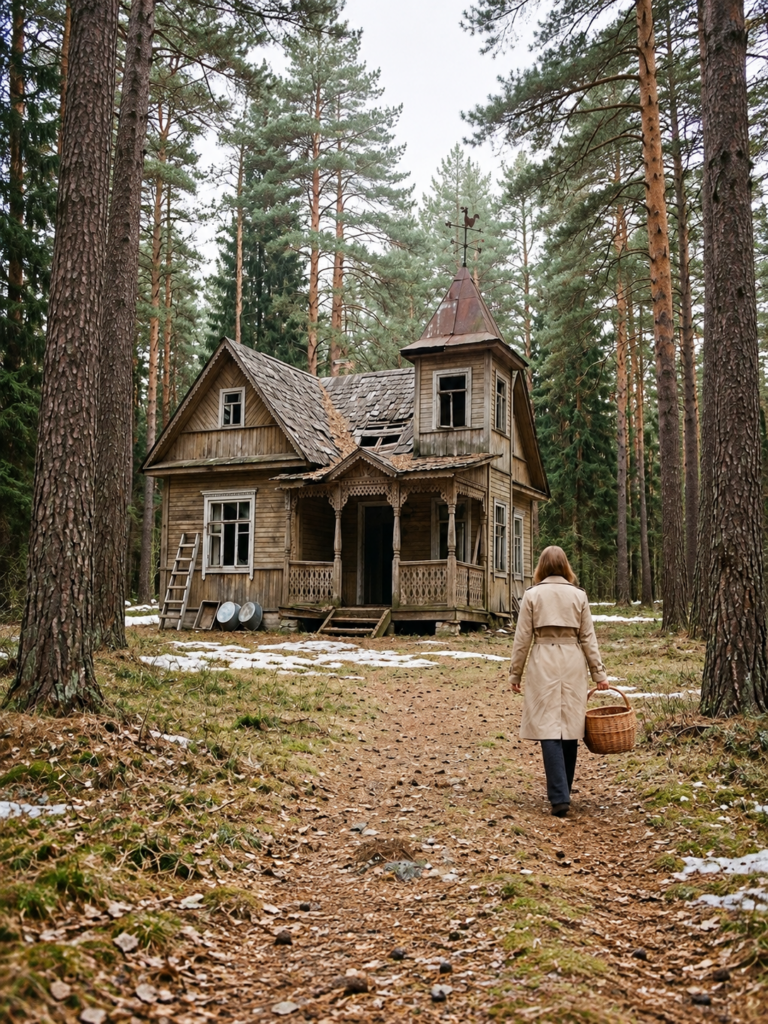
The photograph showed an abandoned wooden cottage almost hidden among enormous pine trees.
Half the roof had collapsed.
A crooked little tower leaned over the front porch.
The windows were dark, the white wooden trim almost invisible beneath weeds and climbing vines.
Under the photograph, the listing read:
Old cottage on two wooded acres. Severe storm damage. Structurally unsafe. Buyer responsible for repairs and cleanup. Transfer subject to legal closing. Asking price: $1.
Margaret read it twice.
“That’s a demolition project,” Helen said. “The owner just wants someone to take responsibility for it.”
Margaret enlarged the photograph.
Something about the porch held her attention.
Its decorative posts were intricately carved, even though most had disappeared behind weeds.
As a little girl, Margaret had spent summers at her grandmother’s country home. There had been a porch like that, where neighbors came after supper with homemade pies and children fell asleep beneath the sound of crickets.
Margaret touched the screen.
“Where is it?”
“Pine Hollow. About twenty-five miles west of here.”
“Is there a bus?”
Helen stared at her.
“Margaret.”
“Is there?”
“Yes, but—”
“I’d like to see it.”
Helen leaned back.
“That house doesn’t have a roof.”
Margaret looked toward the window.
Beyond the glass, Helen’s backyard was full of daffodils opening in the weak spring sunshine.
For the first time since the divorce, Margaret felt something other than humiliation.
“I don’t have one either,” she said quietly.
Three days later, she stepped off a county bus carrying her wicker basket and twenty-three dollars.
The road to the cottage was narrow, bordered by pine trees and old stone fences.
A young man named Kyle Bennett waited beside a crooked wooden gate.
He was the grandson of the deceased owner and had inherited the property six years earlier.
“I want to be clear,” Kyle said as he unlocked the gate. “The roof’s gone. There’s water damage. The township’s been after me about the tower. I had contractors quote demolition, and the cost was more than I can afford.”
Margaret stepped through the gate.
The cottage stood at the far end of the property, surrounded by towering pines.
Up close, it looked terrible.
The left side of the roof had collapsed into the largest room. Two windows had no glass. The porch steps were buried in nettles and fallen branches.
The eight-sided tower leaned forward at an alarming angle.
“Please don’t walk into the main room,” Kyle warned. “The ceiling could come down.”
Margaret carefully entered the small kitchen.
Its floor was dusty but dry.
A cast-iron woodstove stood in one corner.
Above it, several faded blue ceramic tiles were still set into the wall.
Margaret touched one tile.
Someone had once chosen that shade of blue because they wanted this room to be beautiful.
She walked back outside.
Kyle was watching her, plainly expecting another refusal.
“I’ll take it,” she said.
His eyebrows rose.
“Ma’am, you understand how much work this place needs?”
“Yes.”
“It could cost tens of thousands.”
“I don’t have tens of thousands.”
He gave an awkward laugh.
“Then why would you want it?”
Margaret looked up at the towering pines.
“Because nobody can tell me to leave a place that’s mine.”
Kyle stopped smiling.
Before any sale could be completed, the property records had to be checked and the dangerous structure disclosed. Kyle arranged the necessary paperwork through a local title office, using funds he had reserved to dispose of the property.
When the closing was finished, Margaret handed him a single dollar.
He looked at the coin in his palm.
“My grandmother loved this house,” he said softly. “She used to have people over every Sunday. I was little, but I remember everybody sitting on that porch.”
“What was her name?”
“Sarah Bennett.”
Margaret looked toward the cottage.
“Then perhaps Sarah wouldn’t mind someone living here again.”
Kyle handed her the keys.
Three old keys hung from a rusted metal ring.
“One’s for the front door, one’s for the shed. I don’t know what the smallest one opens.”
He hesitated.
“Good luck, Mrs. Whitmore.”
Then he drove away.
Margaret stood alone beneath the pines.
The wind moved through the branches overhead.
Somewhere in the woods, a woodpecker hammered against a tree.
She had purchased a ruined cottage for one dollar.
And she still had no idea how she was going to survive the first night.
Part 2
By sunset, Margaret understood why nobody wanted the cottage.
The main living room smelled of rotting leaves and soaked timber.
Rainwater stood in shallow pools between fallen rafters. Broken shingles, insulation, and old boards covered the floor.
One corner of the porch appeared ready to collapse.
Behind the house, the ground sloped toward a narrow creek that had overflowed repeatedly during the previous spring.
Margaret had planned to return to Helen’s house that evening.
But the last county bus had already departed.
Her phone battery was nearly dead.
She had no car, no electricity, and no working lights.
The nearest occupied house was across the road, almost hidden behind spruce trees.
She considered knocking.
Then she looked at the small kitchen.
Its ceiling was intact. The floorboards seemed firm. There was an old wooden bench against one wall.
Margaret set down her basket.
“All right,” she said aloud. “One thing at a time.”
She found a cracked broom in the shed and spent two hours removing broken glass, mouse nests, rotted boards, and old newspapers.
She worked with the kitchen door open, using the remaining daylight.
Her back began aching before the first pile was finished.
By the time she cleared a place to sleep, darkness had filled the pine woods.
She did not dare light the woodstove without having its chimney inspected.
Instead, she wrapped herself in her coat, folded a towel beneath her head, and lay on the wooden bench.
Cold air slipped through the broken window.
An animal scratched somewhere beneath the floor.
Outside, the wind caused loose metal on the tower to creak like an old gate.
Margaret pulled her knees toward her chest.
She thought of Richard sitting in his warm living room.
She pictured Daniel eating dinner in his bright apartment.
For years she had worried whether her son had enough food, whether he remembered his winter coat, whether the tires on his car needed replacing.
Now she wondered whether either of them had noticed that she was sleeping in an abandoned house.
The realization was almost unbearable.
She turned her face into her sleeve.
“Dad,” she whispered into the darkness, “I wish you were here.”
Her father had always smelled of engine oil and pine shavings.
When something broke, he didn’t complain first.
He examined it.
He tested it.
Then he decided whether it was worth saving.
Margaret remembered standing beside him in his workshop while he tapped the wooden body of her piano.
“Listen,” he had told her. “Good wood tells you something if you know how to hear it.”
She held that memory close until sleep finally came.
At dawn, birds woke her.
Sunlight entered the kitchen through a gap in the boards covering the broken window.
Margaret sat up slowly.
Her neck hurt.
Her hands were stiff.
But she was alive.
She stepped outside and walked around the house.
The morning air was sharp, and frost glittered on the grass.
She examined the lower walls, which were built of enormous old pine logs resting on a foundation of fieldstone.
Most of the wood looked gray and weathered.
Yet when she pressed her fingers against it, the surface was surprisingly firm.
She took a fallen stick and tapped one of the logs.
A clear, hard sound answered.
She tapped another.
Then another.
Along the rear wall, nearly every log responded with the same solid knock.
Only beneath the collapsed section of the roof did the wood sound dull.
Margaret walked around the building again.
And slowly, she understood.
The cottage was not entirely rotten.
Most of the structure had survived.
Water entering through the broken roof had destroyed the exposed section, but the remaining walls and foundation were remarkably strong.
She stood in the weeds, suddenly breathing faster.
Her father would have known what that meant.
The building might be salvageable.
It would still require a professional assessment, skilled repairs, and money she did not have.
But it wasn’t necessarily a lost cause.
Margaret placed her palm against the wall.
“You’re not finished yet,” she whispered.
A voice spoke behind her.
“Talking to the house, are you?”
Margaret turned.
An elderly man stood near the gate holding a metal bucket.
He wore faded overalls, rubber boots, and a brown jacket with a missing button.
His hair was white beneath a worn cap.
“Sorry,” Margaret said. “I didn’t hear you.”
“Most folks don’t. Name’s Samuel Porter. Live across the road.”
He looked at the cottage.
“Didn’t figure anyone would ever take this place.”
“I bought it.”
“For how much?”
“One dollar.”
Samuel stared at her.
Then he laughed once, quietly.
“Well. That’s about what it looks worth.”
Margaret managed a small smile.
“I think it may be worth more.”
Samuel set down his bucket.
“How do you figure?”
She explained what she had found in the logs.
Samuel listened carefully.
Then he walked over and tapped the wall with his knuckles.
His expression changed.
He tested another section.
Then another.
“Would you look at that.”
“You hear it?”
“I surely do.”
Samuel stepped back and studied the tower.
“I worked on that tower in 1987. Sarah hired me when a storm took off the shingles. Used to be a carpenter before my knees gave out.”
“You built the tower?”
“No, ma’am. That was Sarah’s father. Built this house in the early fifties. I only repaired it.”
He pointed toward the porch.
“See that post? The corner beneath the tower’s rotted. That’s why she’s leaning. Rest of the framework might still be sound.”
Margaret looked up.
“Could it be fixed?”
“Maybe. But not by guessing. We’d need to brace it, inspect the connections, and get somebody qualified to make sure it won’t come down on us.”
She nodded.
Samuel looked at her hands.
“You planning to stay here?”
“I don’t have anywhere else.”
His expression softened almost imperceptibly.
He glanced at the wicker basket on the windowsill.
“You got food?”
“A little.”
“Heat?”
“Not until someone checks the stove.”
Samuel nodded approvingly.
“Smart woman.”
He picked up his bucket.
“Come across the road. My woodstove works, and I’ve got enough bacon and eggs for two.”
Margaret hesitated.
“I don’t want to impose.”
“Then don’t. Come eat breakfast.”
Inside Samuel’s house, she sat at a kitchen table covered with a faded oilcloth while he fried eggs in a cast-iron pan.
There were photographs on the wall.
A younger Samuel stood beside a woman with dark hair and a laughing face.
“That your wife?” Margaret asked.
“Rose. Lost her seven years ago.”
“I’m sorry.”
He nodded.
“House gets quiet.”
They ate without much conversation.
Margaret noticed how carefully he set a second plate on the table, as if some part of him still expected Rose to appear.
After breakfast, Samuel gave her a pair of work gloves and an old measuring tape.
“I’ll call a building inspector I know,” he said. “And I’ve got a chimney sweep’s number. We’ll find out what we’re dealing with before anybody starts swinging hammers.”
Margaret’s throat tightened.
“I can’t afford to hire you.”
“Didn’t say I was for hire.”
“I still want to pay you.”
Samuel looked out the window toward the ruined cottage.
“Sarah used to bring Rose peach preserves every summer. When Rose got sick, Sarah came over every morning for three months.”
He pushed the gloves across the table.
“Some debts don’t get paid with money.”
Over the next two weeks, Margaret discovered just how expensive survival could become.
The title fees, taxes, food, transportation, inspections, and basic safety materials consumed nearly everything she earned.
She continued teaching in town, riding the bus each morning and returning in the evening.
At school, she wore the same three outfits in rotation.
Sometimes she ate crackers for lunch so she could buy a box of nails or another roll of heavy plastic sheeting.
Her students noticed the scratches on her wrists.
“Miss Whitmore, what happened?” one little boy asked.
“I’m fixing an old house.”
“By yourself?”
“Not entirely.”
He considered that.
“My grandpa says old houses are money pits.”
Margaret smiled.
“Your grandpa might be right.”
At the cottage, Samuel helped her arrange a proper structural inspection.
The inspector identified dangerous sections that had to remain off-limits until repaired. An electrician disconnected unsafe wiring. A chimney specialist cleaned and repaired the stove flue before Margaret used it.
The assessments were not cheap.
But the news was better than she had feared.
The stone foundation was stable.
Most of the exterior logs were sound.
The tower could be stabilized with engineered temporary bracing and replacement of the damaged support.
The worst damage was concentrated beneath the collapsed roof.
Margaret made a list on the back of an old bus ticket.
Roof.
Tower.
Windows.
Floor.
Stove.
Porch.
She underlined roof three times.
One evening, Samuel arrived carrying a bundle of reclaimed lumber.
“Had these stacked in my barn,” he explained. “Was saving them for a project I never got around to.”
They spent the weekend clearing debris from the safe portion of the cottage and preparing materials for the contractor Samuel had recommended.
Margaret carried boards, sorted usable hardware, pulled weeds, and swept.
By Sunday afternoon, her shoulders burned.
She sat on the porch steps, too exhausted to stand.
Samuel lowered himself beside her.
“You all right?”
“I used to think working all day meant teaching six children who didn’t practice their scales.”
He chuckled.
“Now?”
“Now I think it means carrying the same pile of boards from one place to another until you forget why you started.”
Samuel laughed.
For the first time in months, Margaret laughed too.
It startled her.
She had almost forgotten the sound.
That evening, after Samuel went home, she walked through the tiny kitchen.
The blue tiles above the stove were clean.
The floor was swept.
A small table stood beside the window.
Her kettle sat on the stove.
It was not much.
But everything in that room was there because she had chosen it.
She sat at the table and wrote in a notebook:
April 28. The house is still standing. So am I.
Part 3
Spring moved slowly through Pine Hollow.
The snow disappeared from the shaded ditches.
Wild violets opened along the creek.
The air filled with the smell of wet earth and warming pine needles.
And Margaret worked.
Every morning she rose before six, carried water from Samuel’s outdoor tap until the property’s water system was inspected, prepared a small breakfast, and walked to the bus stop.
Every evening she returned to another list of chores.
The house did not become beautiful overnight.
For weeks, the improvements were almost invisible.
A repaired window.
A dry floor.
A safe section of wall.
A stack of debris removed.
Margaret learned that restoration was not one dramatic act of courage.
It was hundreds of ordinary decisions made when a person was cold, tired, and short of money.
In May, Helen visited.
She parked her old sedan beside the gate and climbed out carrying a casserole.
One look at the crooked tower made her stop.
“Margaret Whitmore, have you completely lost your mind?”
Margaret came out of the kitchen, wiping her hands on a towel.
“Probably. Come inside.”
Helen followed her through the doorway.
The kitchen smelled of fresh coffee.
Sunlight shone through the repaired window.
The blue tiles sparkled above the stove, and a clean braided rug covered the floor.
Helen looked around.
Then she sat heavily on the bench.
“Well,” she admitted, “maybe not completely.”
Margaret laughed.
They ate the casserole together, and Helen told her that the piano was still safe in the garage.
“I’ve kept it covered,” she said. “Opened the lid twice, just to make sure nothing’s growing in there.”
Margaret looked down at her plate.
“Thank you.”
“When are you bringing it here?”
“When the big room has a roof.”
Helen glanced toward the boarded doorway.
“And when will that be?”
Margaret had no answer.
She was hoping to save enough from her summer teaching income to buy more roofing materials.
The roof was the greatest expense.
Even with Samuel’s connections, lumber, flashing, underlayment, fasteners, and professional labor cost far more than she had.
But summer brought unexpected opportunities.
Margaret began with the porch.
Under the dead vines and stinging nettles she discovered five wide wooden steps, carved railings, and decorative trim shaped like little bells and suns.
Some pieces were rotten.
Most had survived.
Samuel took two broken sections to his workshop.
A week later, he returned with replacements.
Margaret held one up beside the original.
The carving matched perfectly.
“How did you do that?”
Samuel shrugged.
“Same way I did it forty years ago.”
“Your hands must hurt.”
“They do.”
“Then why?”
He looked embarrassed.
“Rose always liked that porch.”
Margaret said nothing.
She understood.
Some things were worth saving because someone who was gone had loved them.
She spent the next week washing the trim and carefully painting it white.
While she worked, she hummed.
She had hummed during housework all her life. Richard used to complain that he couldn’t hear the television.
Here, no one complained.
One morning, a small voice came from the gate.
“Lady, what song is that?”
Margaret turned.
A girl of about nine stood outside holding a dented metal watering can.
She had brown braids and freckles across her nose.
“It’s Tchaikovsky,” Margaret said.
“Is he on the radio?”
“Not this morning.”
The girl tilted her head.
“It sounds sad.”
“It’s called ‘The Sick Doll.’”
“Oh.”
Margaret smiled.
“There’s another piece called ‘The New Doll.’ That’s happier.”
The girl considered this seriously.
“Can you sing that one?”
Margaret did.
The little girl stayed until she finished painting the railing.
Her name was Lily Carter, and she was spending the summer with her grandmother, Dorothy, two properties down.
The next morning, Lily returned.
Then the next.
On the fourth day, she noticed Margaret’s hands moving through the air as she hummed.
“What are you doing?”
“Practicing the fingering.”
“For what?”
“Piano.”
Lily looked into the cottage.
“Where’s your piano?”
“At a friend’s house.”
“Why?”
Margaret glanced toward the unfinished roof.
“Because my piano deserves a dry room.”
Lily nodded as though this made perfect sense.
Then she said, “I always wanted to learn.”
Margaret looked at the little girl.
And an idea came to her.
She found a clean piece of cardboard and drew two octaves of piano keys across it.
She placed it on the porch table.
“Sit down.”
Lily stared at the drawing.
“But it doesn’t make noise.”
“That’s why you’re going to need your imagination.”
Margaret showed her how to curve her fingers and move through a simple scale.
When Lily pressed a drawn key, Margaret sang the note.
At first the girl giggled so hard she could barely keep her hands straight.
But she returned every afternoon.
A week later, Lily could play the entire scale on cardboard while Margaret sang beside her.
One evening, Dorothy came to the gate.
“I hear you’ve been giving my granddaughter lessons.”
Margaret smiled.
“She’s a good student.”
“How much do I owe you?”
“Nothing.”
Dorothy shook her head.
“That won’t do.”
The following morning, she returned carrying a bag of potatoes, two jars of homemade pickles, and a tray of tomato seedlings.
“Payment,” she announced.
Margaret tried to protest.
Dorothy waved her away.
“Lady, you’re not the only stubborn woman in this county.”
Soon two other children began visiting.
Then a mother from the next road asked if Margaret could teach her seven-year-old son.
“I can pay twenty dollars a lesson,” she offered.
Margaret almost refused.
For years, she had associated accepting help with failure.
But she looked up at the unfinished roof.
Then she said yes.
By July, she had five summer students.
She taught music in the morning and worked on the house in the afternoon.
She also began selling vegetable seedlings near the gate.
A hand-painted sign read:
tomato plants — $2
marigolds — $1
all proceeds help save the cottage
Some neighbors bought plants they didn’t need.
Others brought spare tools or bags of potting soil.
A retired electrician helped arrange safe power to the kitchen.
A local carpenter offered discounted window frames.
And every Sunday afternoon, more people stopped by.
The first gathering happened by accident.
Dorothy arrived to collect Lily.
Helen appeared with a peach pie.
Samuel came across the road carrying a bucket of raspberries.
Margaret put her kettle on the stove and brought the old kitchen table onto the porch.
They sat on the newly painted steps, drinking tea from mismatched mugs.
Dorothy looked along the white railings.
“You know, Sarah Bennett used to have Sunday tea right here.”
Samuel nodded.
“Every week in the summer.”
“Everybody came,” Dorothy continued. “Farmers, schoolteachers, kids, even the preacher when he had time.”
Margaret glanced around the porch.
The tower still wore temporary protection.
Part of the roof remained covered with reinforced tarpaulin.
Yet the old house felt warmer than it ever had.
“Maybe we ought to bring that back,” Helen said.
Margaret looked surprised.
“Bring what back?”
“Sunday tea.”
Samuel grunted approvingly.
“Five o’clock. Gives folks time after church and supper.”
And so they did.
The following Sunday, twelve people came.
The next Sunday, eighteen.
Some brought cake.
Others brought sandwiches, preserves, flowers, or chairs.
Margaret learned their names, their children’s names, and the stories they carried.
A widower named Frank came because he couldn’t bear eating alone.
A retired nurse named June brought lemon bars and stayed to help wash dishes.
Two young mothers came with children who needed somewhere to play that didn’t involve a television screen.
Margaret began setting out her largest kettle every Sunday.
She listened more than she spoke.
For the first time since her marriage ended, she felt useful in a way that wasn’t measured by how much money she contributed or how many chores she completed.
One July evening, Samuel arrived with an old photograph.
“This was taken on the porch in 1961,” he said.
The black-and-white picture showed Sarah as a young woman standing beside her father. Behind them were the very same carved railings.
Margaret studied the photograph.
“It’s the same porch.”
“Sure is.”
“Look at all those people.”
Samuel smiled faintly.
“Sarah could make a stranger feel like family before they’d finished their first cup.”
Margaret placed the photograph carefully on the kitchen shelf.
Later that night, she sat alone beneath the pines.
She thought of Daniel.
He had not called in six weeks.
She had sent him one message telling him she was safe.
He had replied with three words.
Glad you’re okay.
She had read them more times than she wanted to admit.
Sometimes she wondered whether his silence meant he was ashamed.
Other times she feared it meant he simply didn’t care.
Her phone lay beside her on the porch step.
She reached for it.
Then she stopped.
For thirty-four years, she had been the person who made the first call, remembered the birthdays, arranged the visits, forgave the hurtful words, and repaired the silence.
This time, she put the phone down.
If Daniel wanted to know his mother, he would have to make the effort.
The wind stirred the leaves.
From across the road came the faint sound of Samuel closing his workshop.
Margaret looked at the cottage, its freshly painted railings pale against the dark trees.
She was building something here.
Not just a house.
A life.
And for the first time, she was beginning to believe she had a right to keep it.
Part 4
By late August, Margaret had spent nearly every spare dollar on the cottage.
Ten new rafters stretched across the damaged portion of the roof.
The wall repairs had passed inspection.
The kitchen was safe and dry.
But most of the roof still needed permanent metal covering, and the little tower remained unfinished.
Samuel had arranged for discounted lumber from a sawmill outside town.
Unfortunately, the owner went away for two weeks just as Margaret needed more boards.
Impatient and anxious about the approaching autumn, she purchased a load from an unfamiliar supplier.
The price was almost forty percent lower.
She thought she had been clever.
Samuel knew something was wrong as soon as the boards arrived.
He lifted one, examined its end grain, and frowned.
“Green lumber.”
Margaret looked puzzled.
“It’s pine.”
“Fresh-cut pine. Too wet for this job.”
“The man said it was ready.”
Samuel shook his head.
“He shouldn’t have.”
They stored the material under cover, but some had already been installed before the moisture problem became clear.
After repeated stretches of rain and hot sunshine, the boards began twisting as they dried.
Fasteners loosened.
Several lengths warped badly enough to make the planned roofing installation impossible.
The contractor came, examined the work, and gave Margaret the news.
The defective sections would have to be removed and replaced.
Margaret stood motionless.
“How much?”
He told her.
It was nearly everything she had saved for the metal roofing.
She sat down on the porch.
For a long time, nobody spoke.
Samuel lowered himself beside her.
“You couldn’t have known everything.”
“I should’ve listened.”
“Maybe.”
She stared at her blistered hands.
“I thought I was saving money.”
“Most expensive mistakes start that way.”
Margaret gave a weary, humorless laugh.
Then she looked up.
“What can we salvage?”
Samuel smiled.
“Now that’s the right question.”
They recovered what usable material they could.
The rest became kindling or was discarded.
By September, the roof framing was properly prepared.
But Margaret could afford only part of the metal covering.
She bought what she could and had the contractor install it over the most vulnerable section.
The remainder stayed beneath temporary weather protection.
Then the school year began.
Margaret returned to her long bus rides and teaching schedule.
Her summer students went home.
Seedling sales ended.
Money grew painfully scarce.
One Wednesday evening, while Margaret was grading music theory exercises beside the stove, her phone rang.
The screen showed an unfamiliar number.
She answered.
“Hello?”
“Margaret.”
She recognized Richard’s voice immediately.
Her fingers tightened around the phone.
“Hello, Richard.”
“Daniel tells me you’ve bought some old dump out in Pine Hollow.”
Margaret said nothing.
“For a dollar, apparently. That true?”
“Yes.”
Richard gave a short laugh.
“Unbelievable.”
Margaret looked at the photograph of Sarah on the kitchen shelf.
“Did you call for something?”
“Actually, I may have some good news for you.”
His tone became businesslike.
“A friend of mine’s buying properties out there. Says the land alone could be worth something to a developer.”
Margaret waited.
“He’d tear down that wreck and pay you cash. Maybe enough for a little apartment. Wouldn’t that make more sense than freezing to death in the woods?”
“The house isn’t a wreck anymore.”
“Margaret, don’t be ridiculous.”
“Richard, the roof is being repaired. The walls are sound.”
“Sure they are.”
He paused.
“You’ve always been stubborn.”
She remembered how often he had used that word when she disagreed with him.
“I’m not selling,” she said.
“Then you’re making a mistake.”
“Maybe.”
He sighed dramatically.
“I’m trying to help.”
Margaret looked around her little kitchen.
The repaired window.
The kettle.
The clean blue tiles.
The photograph on the shelf.
Then she spoke very quietly.
“You told me twenty-three dollars would buy me a cardboard box.”
Richard snorted.
“Well, looks like you found one.”
“No,” she replied. “I found a home.”
He hung up.
Margaret sat motionless for several minutes.
Her hands were shaking.
Then she stood, put another log into the stove, and went outside.
The wind was cold.
Above her, the unfinished tower stood dark against the evening sky.
She looked toward the road where Samuel’s porch light glowed among the trees.
And for one terrible moment, she wondered whether Richard was right.
She was fifty-nine years old.
Her savings were gone.
Winter was coming.
A severe weather forecast warned of early snow before the end of October.
What if the roof wasn’t finished?
What if she had spent everything on a dream she couldn’t complete?
She remembered her father’s workshop and the thousands of broken things he had repaired.
But she also remembered something else he used to say.
“There’s courage in knowing when to ask for help, Maggie.”
Margaret closed her eyes.
She had accepted donated lumber and discounted work.
She had allowed neighbors to help with repairs.
Yet she still felt ashamed of needing them.
Perhaps Richard had taught her that shame.
Perhaps she’d carried it much longer than their marriage.
At the next Sunday gathering, Margaret made a small announcement.
“I may have to close the porch once the weather turns,” she said.
The conversation quieted.
Dorothy frowned.
“Why?”
“Because if the remaining roof isn’t finished, the place won’t be safe.”
Samuel studied her.
“How short are you?”
Margaret shook her head.
“Please. You’ve all done too much already.”
“How short?” he repeated.
She told him.
Nobody spoke for several seconds.
Then Dorothy nodded slowly.
“We’ll figure something out.”
Margaret immediately protested.
“No. You can’t keep paying for my house.”
Dorothy leaned forward.
“Is this still just your house, Margaret?”
Margaret looked confused.
“Of course it is.”
“Then why do thirty people come here every Sunday?”
Helen reached for Margaret’s hand.
“You’ve given this town something we didn’t know we’d lost.”
Margaret struggled to answer.
She didn’t want generosity to become an obligation.
She didn’t want people to feel responsible for her mistakes.
That evening, she wrote each neighbor a thank-you note.
She planned to hand them out the following Sunday.
But the following week brought frost.
Then heavy rain.
Then a windstorm that tore loose part of the temporary covering.
Margaret spent the night listening to the tarpaulin slapping against the frame.
At dawn, she found water on the floor of the unfinished room.
She carried buckets, moved supplies, and did what she could to protect the dry walls without entering the unsafe area.
By lunchtime, she was exhausted.
Samuel came over to inspect the damage from outside.
He moved slowly.
His face was pale.
“Are you all right?” Margaret asked.
“Just tired.”
But halfway across the yard, he stumbled.
Margaret caught his arm.
“Samuel!”
He gripped the fence, breathing heavily.
She called an ambulance.
At the hospital, doctors treated him for a dangerously elevated blood pressure reading and insisted that he rest.
Margaret visited every evening she could manage.
Samuel looked furious at being confined to a hospital bed.
“Roof’s not gonna fix itself,” he muttered.
“Neither are you,” Margaret replied.
He scowled.
She pulled a chair closer.
“You’ve done enough.”
He looked at her for a long moment.
“Don’t give up on that place.”
Margaret swallowed.
“I won’t.”
But on the first Saturday in October, standing alone in her frozen yard, she was no longer sure.
Only a portion of the roof had permanent covering.
The tower’s metal cap was still missing.
Snow was forecast within two weeks.
She had just enough money for food, bus fare, and medication until payday.
The cottage stood before her, wounded but stubborn.
Margaret rested her hand against the wall.
“I tried,” she whispered.
The words frightened her.
They sounded too much like goodbye.
That night, she sat by the stove with her notebook open.
On the first page was the list she had written in April.
Roof.
Tower.
Windows.
Floor.
Stove.
Porch.
She ran her finger down the words.
So much had been completed.
So much remained.
She remembered her old home and the way Richard had laughed.
She remembered Daniel refusing to look at her.
She remembered the first freezing night on the wooden bench.
And she thought about the people who now gathered on the porch.
Lily with her cardboard piano.
Dorothy with her pickles.
Helen with her pies.
Samuel with his battered tools.
Margaret shut the notebook.
Whatever happened, she decided, she would not abandon the cottage before winter without exhausting every safe option.
She would ask the township about temporary housing assistance if necessary.
She would protect the building as best she could.
She would continue teaching.
And she would refuse to let Richard’s voice become the one she heard in her own head.
Before going to bed, she wrote one final line beneath the list.
Still standing.
Part 5
The pounding began at seven forty-five on Saturday morning.
Margaret woke with a start.
For a moment, she thought the wind had torn away another sheet of metal.
She pulled on her coat and boots and hurried to the kitchen door.
Then she stopped.
There were people in her yard.
At first, she counted nine.
Then she saw more coming through the gate.
Two men were pushing a utility cart stacked with dark green metal roofing panels.
A pickup truck waited by the road.
Another vehicle carried ladders, tools, and safety equipment.
At the front of the group stood Dorothy Carter, holding a clipboard.
“Morning, Margaret,” she called.
Margaret stared.
“What on earth—”
“Don’t stand there freezing. Come down and see.”
Margaret stepped onto the porch.
Helen stood beside Dorothy carrying a thermos.
Lily was wrapped in a red scarf.
Several neighbors were unloading equipment.
And near the gate, sitting in a folding chair with a thick blanket around his shoulders, was Samuel Porter.
Margaret hurried toward him.
“You’re supposed to be resting!”
“I am resting,” he said. “See the chair?”
She looked from him to the roofing materials.
“What’s happening?”
Dorothy handed her the clipboard.
At the top was written:
PINE HOLLOW COMMUNITY IMPROVEMENT COMMITTEE — EMERGENCY REPAIR CONTRIBUTION.
The township had approved a safety plan for the remaining work.
A local roofing contractor named David Miller had agreed to donate part of his labor and discount the rest.
Several residents had contributed money.
Others had donated equipment or materials.
And the local community association had voted to transfer unused roofing panels from a completed maintenance project, subject to the required approvals.
Every part of the work would be performed by qualified tradespeople.
Dorothy looked directly at Margaret.
“You gave this town back its Sundays,” she said. “We’re not letting you lose the roof.”
Margaret’s mouth opened.
Nothing came out.
Helen squeezed her shoulder.
“We’re not here because you’re helpless.”
David approached, carrying a rolled set of repair drawings.
“We’ve inspected everything. We’ve got the materials and a good crew. If you’re comfortable accepting the help, we’d like to get started.”
Margaret looked at the men waiting beside the truck.
She looked at Dorothy.
At Helen.
At Samuel.
Then she covered her face with both hands.
Her shoulders shook.
Helen put an arm around her.
For nearly a year, Margaret had refused to cry.
Not when Richard ridiculed her.
Not when Daniel turned away.
Not when she slept in the cold.
Not when the roof leaked.
But now the tears came so suddenly that she couldn’t stop them.
“I don’t know how to repay you,” she whispered.
Dorothy answered gently.
“You already have.”
The repairs took two full days.
David’s crew worked methodically, securing underlayment, installing flashing, fastening overlapping metal panels, and checking every vulnerable connection.
The darker green of the new roof shone beneath the autumn sun.
Margaret spent the weekend helping prepare food, organizing supplies, and keeping the children away from the work area.
Samuel sat in his chair with a blanket around his legs, offering occasional advice.
When Lily brought him a cup of tea, he raised it toward the roofers.
“To the finest roof in Pine Hollow.”
By Sunday evening, the main roof was complete.
Margaret stood in the yard looking up.
For the first time since April, no blue tarpaulin covered the cottage.
No broken rafters projected into the sky.
The roof was whole.
David came down from the ladder.
“Well?” he asked.
Margaret wiped her eyes.
“It looks like a home.”
He smiled.
“That’s what we were aiming for.”
The tower required another week.
Its eight-sided roof could not be covered properly with ordinary rectangular sheets.
David fabricated tapered metal sections and fitted them together over the restored framing.
On the final afternoon, he attached an old rooster-shaped weather vane Margaret had found beneath weeds near the shed.
It was rusty and missing part of its tail.
Samuel recognized it immediately.
“Sarah’s father made that,” he said. “Haven’t seen it in thirty years.”
The little rooster turned in the wind.
Margaret watched it with her hands folded against her chest.
On October twenty-third, the first snow fell.
She woke to a strange silence.
No flapping tarpaulin.
No dripping water.
No rattling boards.
She stepped outside.
The yard was white.
Snow rested on the porch railings, the stone fence, and the enormous pine branches.
The cottage’s green roof was covered in a clean blanket of snow.
And the tower stood straight above the porch.
Margaret went back inside, lit the woodstove, and placed her kettle on top.
While the water heated, she sat at the kitchen table.
Then she cried again.
Not from fear.
From relief.
Winter was not easy.
Margaret occupied the finished kitchen and a small adjoining room, keeping the larger space closed off until further work was completed.
She learned how much firewood a cold Pennsylvania winter could consume.
She kept extra blankets by the bench and checked the weather every morning before walking to the bus.
Samuel helped stack wood beneath the shed roof after his doctor cleared him for light activity.
Sometimes he came over in the evening with a checkerboard.
They played beside the stove, drinking tea while wind brushed snow against the windows.
One night, Margaret asked him why he had never moved closer to his daughter in Ohio.
Samuel looked at the checkerboard.
“Rose is buried here,” he said.
Margaret nodded.
After a while, he added, “Besides, somebody’s got to keep an eye on that crooked tower.”
Margaret smiled.
“It’s not crooked anymore.”
“Then I suppose I’m out of a job.”
“You could keep coming for tea.”
Samuel looked at her.
“I believe I could manage that.”
By February, Margaret had saved enough to begin finishing the main room.
A local contractor repaired the remaining interior damage.
She cleaned the original wooden floorboards, preserving those that could be saved.
Behind an old tapestry, she discovered pencil writing on the logs.
June 1952. Lower course: larch. Upper walls: pine.
Beneath it, written in a child’s uneven hand:
Sarah, age 8.
Margaret left the inscription exposed.
She framed it with a simple piece of trim.
In March, Helen arrived with news.
“I think it’s time.”
Margaret looked up from the kitchen table.
“For what?”
“Your piano.”
Margaret stood so quickly that her chair scraped the floor.
The piano arrived on a clear Saturday.
Professional movers carried it through the newly repaired doorway and positioned it against the interior wall.
Margaret watched every movement.
After they left, she walked around it slowly.
She touched the worn wooden case.
Then she sat on the bench.
For a long time, her hands rested in her lap.
Helen waited in the doorway.
Margaret finally lifted the lid.
She placed her fingers on the keys and played the opening notes of a piece her father had loved.
The instrument needed tuning.
Several notes were slightly sharp.
But the sound filled the room.
Margaret closed her eyes.
Her father had been gone thirty-six years.
Yet somehow, in that little cottage among the pines, she felt closer to him than she had in the expensive house she had shared with Richard.
When the final note faded, Helen was crying.
“So am I getting a concert?” she asked.
Margaret smiled through her own tears.
“Every Sunday.”
By April, the cottage looked entirely different.
The porch was bright white.
Flowerpots lined its railings.
The green roof stood out against the pine trees.
The tower was straight, its little weather vane turning above the pointed cap.
Margaret planted nasturtiums and sweet peas near the steps.
She bought an old brass samovar at a flea market, had it safely restored, and placed it on a table near the porch entrance.
Then she hung a wooden sign beside the gate.
SUNDAY TEA — 5 P.M.
EVERYONE WELCOME.
On the anniversary of the day she had left her marriage, nearly forty people gathered at the cottage.
Children played beneath the pines.
Dorothy brought strawberry jam.
Helen arrived with two peach pies.
Samuel sat at the porch table holding a blue ceramic mug.
Lily, now ten, played a simple piece on the piano in the main room.
The notes were hesitant, imperfect, and wonderfully real.
When she finished, the guests applauded.
Margaret was pouring tea when a silver SUV pulled up outside the gate.
She recognized it immediately.
There was a dent above the rear wheel that Richard had never bothered to repair.
The driver’s door opened.
Richard stepped out.
Daniel followed him.
For several seconds, both men stood motionless beside the gate.
Richard looked at the cottage.
Then at the repaired tower.
Then at the porch crowded with people.
He turned toward an older woman walking up the road carrying a pie.
“Excuse me,” he said. “I’m looking for an old house with a broken tower. Supposed to be somewhere on this road.”
The woman pointed.
“That’s the one.”
Richard stared.
“That can’t be right.”
“Sure is. Margaret Whitmore’s place.”
Daniel looked up at the house again.
Then he saw his mother standing on the porch.
She wore a pale blue dress beneath a cream-colored cardigan. Her silver hair was pinned neatly at the back of her head.
There was flour on one sleeve.
She held a kettle in one hand.
She was smiling at something a little girl had said.
Daniel had not seen that smile in years.
“Mom?” he called.
Margaret turned.
The smile faded, but she did not look frightened.
She set down the kettle and walked slowly toward the gate.
“Hello, Richard.”
Then she looked at her son.
“Hello, Daniel.”
Richard cleared his throat.
“Well,” he said. “Would you look at this.”
He examined the house again.
“Your place looks pretty good.”
“Thank you.”
“Had no idea you were doing all this.”
Margaret said nothing.
Richard shifted his weight.
“Actually, a friend of mine drove through last week. Said somebody had turned that old wreck into a beautiful cottage. I didn’t believe him.”
He looked toward the porch.
“You do all this yourself?”
“No.”
Margaret gestured toward the gathering.
“Those people helped me.”
Richard glanced at the guests.
Several were watching quietly.
He smiled awkwardly.
“Well, family should help family too.”
Margaret felt an old tightening in her chest.
Richard stepped closer.
“Listen, Maggie. We were married thirty-four years. That’s a long time.”
“Yes,” she said.
“And Daniel could use a place to get away in the summer. You have all this land. Maybe he could stay in the tower room once it’s finished.”
Daniel turned sharply.
“Dad—”
Richard ignored him.
“Actually, we ought to think about the paperwork. Put the property in Daniel’s name eventually. Save trouble with inheritance. You know how these things go.”
The porch became very quiet.
Margaret stared at him.
For a moment, she saw the man who had laughed beside the moving truck.
The man who had mocked her last twenty-three dollars.
The man who had called her cottage a cardboard box.
She also saw something else.
He had not asked if she was happy.
He had not asked how she survived the winter.
He had not asked who had helped her.
He saw a beautiful house and immediately began thinking about what he might take from it.
Margaret stood a little straighter.
“Richard,” she said calmly, “this house is mine.”
He gave a nervous laugh.
“Well, obviously—”
“I bought it for one dollar. I repaired it with my own work, my savings, and the kindness of people who asked for nothing in return.”
Richard’s face began turning red.
“Margaret, don’t make a scene.”
“You’re the one who came here discussing my property.”
Several guests lowered their eyes.
Samuel placed his mug on the table.
Margaret continued.
“This house is not for sale. I’m not transferring it to anyone. And I am not going to spend the rest of my life proving that I deserve a home.”
Richard opened his mouth.
She raised one hand.
“You’re welcome to have tea. Anyone is. But that’s all I’m offering.”
Richard looked around at the silent porch.
His jaw tightened.
“So that’s how it is.”
“Yes.”
“After thirty-four years?”
Margaret met his eyes.
“After thirty-four years.”
Richard turned toward the SUV.
“Come on, Daniel.”
But Daniel didn’t move.
He was staring at a red geranium blooming beside the porch steps.
It had grown thick and healthy, covered in bright flowers.
The same plant he had carried out of his mother’s house the day she left.
Margaret followed his gaze.
Daniel swallowed.
“I remember that.”
“So do I,” she said.
Richard opened his car door.
“Daniel!”
Daniel barely seemed to hear him.
He looked at Margaret.
“Mom?”
“Yes?”
“Could I have some tea?”
For a moment, Margaret could not speak.
Then she opened the gate.
“Of course.”
Richard waited another few seconds, furious.
Then he climbed into the SUV and drove away, scattering dust across the road.
Nobody followed him.
Margaret led Daniel onto the porch.
Samuel moved his chair to make room.
Dorothy brought another cup.
Margaret poured tea and set a piece of homemade gingerbread beside her son.
Daniel held the cup without drinking.
From inside the house came the uneven notes of Lily practicing her scales.
Daniel looked toward the doorway.
“Who’s playing?”
“One of my students.”
He smiled faintly.
“I remember you teaching me scales on a piece of cardboard when I was little.”
Margaret looked at him.
“Yes.”
“You drew the black keys with a marker.”
“I did.”
He was silent for a long time.
Then he whispered, “I’m sorry, Mom.”
Margaret waited.
Daniel stared into his tea.
“Dad told me you had somewhere else to live. He said you’d taken money and made arrangements. I knew you were upset, but I didn’t know you had almost nothing.”
Margaret spoke quietly.
“You could have asked.”
Daniel nodded.
“I know.”
“You saw me sitting in that taxi.”
His eyes filled.
“I know.”
She looked at the grown man before her and remembered the little boy who had once cried because he thought he’d disappointed her by breaking a neighbor’s window.
“I don’t need you to choose sides,” she said. “But I do need you to see me as a person, Daniel. Not just someone who’s always going to be there whenever you want something.”
He nodded again.
“I want to do better.”
Margaret looked toward the cottage.
The sunlight was turning golden.
Lily’s music floated through the open window.
“Well,” she said, “that takes time.”
Daniel gave a small, sad smile.
“I’ve got time.”
“Then start by staying for tea.”
He did.
He stayed until sunset, helping carry chairs, wash dishes, and put away tables.
He spoke little, but he listened.
Before leaving, he stopped beside the gate.
“Would it be all right if I came next Sunday?”
Margaret looked at him.
“Tea’s at five.”
He nodded.
Then she added, “Bring your own cup.”
Daniel smiled for the first time that day.
“I will.”
After everyone left, Margaret washed the last dishes and placed them in the cupboard.
The old wicker basket still sat on the kitchen windowsill.
Inside were flower seeds for the coming summer, a few handwritten recipes she had discovered among Sarah’s belongings, and the small photograph of Margaret’s parents.
Beside it stood her dented kettle.
Almost everything she had brought with her on that first terrible night was still there.
But the house around those objects had changed.
So had she.
A week later, a letter arrived from Kyle Bennett.
Inside was a faded black-and-white photograph of the cottage in 1952.
The porch was crowded with neighbors.
A samovar stood on the table.
And sitting proudly at the center was a little girl with braids.
Sarah.
Kyle had written beneath the photograph:
I thought my grandmother’s house was beyond saving. Thank you for proving me wrong. She would have loved what you’ve done.
Margaret framed the photograph and hung it beside the old pencil inscription.
As summer returned, Sunday tea became a permanent tradition.
Margaret continued teaching.
Lily eventually learned to play the cheerful companion piece to the sad little melody that had first brought her to the gate.
Samuel still came across the road, although he complained that everybody made too much fuss over his health.
And Daniel began visiting regularly.
He repaired the sagging gate.
He painted the shed.
Sometimes he simply sat with his mother and listened while she played.
They did not pretend the past had never happened.
Trust returned slowly.
Some wounds needed more than an apology.
But Margaret allowed herself to believe that a relationship could grow again without requiring her to surrender her dignity.
One Sunday evening, after the last guest departed, Margaret handed Dorothy a spare key.
Dorothy looked surprised.
“What’s this for?”
“In case I’m away visiting Helen. Or sick. Or just too tired to make the tea.”
Dorothy turned the key in her palm.
Margaret smiled.
“I don’t want this place to become quiet again.”
Dorothy closed her fingers around the key.
“It won’t.”
That night, Margaret sat on the porch as the sun slipped behind the pines.
From the living room came Lily’s piano practice.
The melody stopped, began again, and finally continued past the difficult passage.
Margaret smiled.
Overhead, the little metal rooster turned gently in the breeze.
A year earlier, she had arrived with twenty-three dollars, a wicker basket, and a house that nobody wanted.
Now she still lived carefully, counted her money, and worked hard for everything she had.
She had not become rich.
She had become something far more important.
She had become free.
And as the piano music traveled through the open windows and into the evening woods, Margaret looked at the cottage her family had once mocked and whispered the words she wished she’d known how to say that terrible April morning.
“I was always worth more than what you left me with.”