
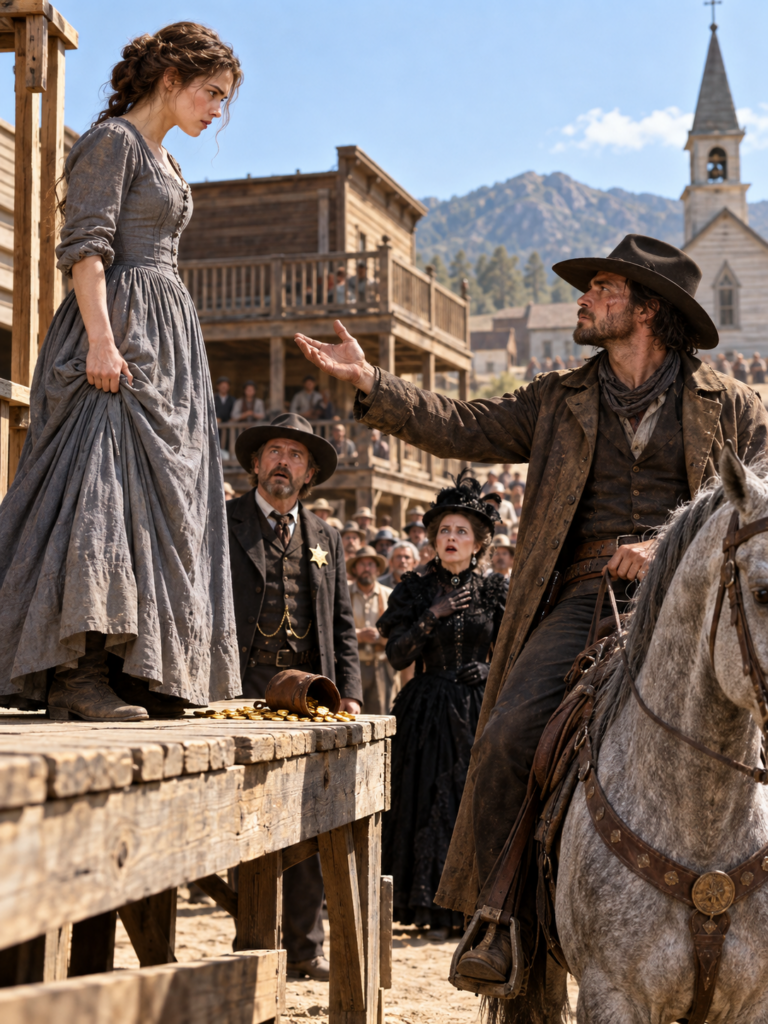
Luke’s fingers closed around the leather packet just as a shout rose behind them.
“Mercer! Stop!”
Marshal Briggs was hurrying down the street, two armed men following.
Luke pushed the packet back beneath the saddle flap.
“Hold steady,” he told Clara.
She tightened her knees against the horse.
“You were going to show me something.”
“I was. But I’d rather not show it to Briggs.”
The marshal stopped several yards away.
“You can’t carry her off without the necessary papers.”
Clara leaned around Luke’s shoulder.
“I am twenty-four years old, Marshal. I am leaving because I choose to.”
“Miss Whitfield, you don’t understand your position.”
“I understand it better than you do.”
Briggs glanced at Luke.
“You’ve purchased an indenture.”
“Then consider it discharged,” Luke answered. “She’s free to ride where she pleases.”
“That isn’t how these proceedings work.”
“Then bring the matter before a court that isn’t taking orders from Granger.”
Several spectators had followed them to the street.
A murmur moved through the group.
Briggs hesitated.
Luke waited until Clara had a firm seat, then turned the horse north.
They did not gallop.
There was no need to exhaust the animal simply to satisfy a marshal’s pride.
Only after the last building disappeared behind a bend did Clara speak.
“Did my father know they meant to put me on that platform?”
Luke’s shoulders stiffened.
“He feared Granger would try something of the kind.”
“And you knew?”
“I knew there was danger. I didn’t know whether the scheme would reach an auction.”
She looked back toward Asheford.
“Evelyn knew everything.”
“Perhaps more than either of us.”
“What does that mean?”
Luke considered his answer.
“It means your father trusted me with certain facts. The others are his daughter’s to discover.”
Clara felt her anger return.
“Do not speak to me as though I were a child.”
“I wasn’t trying to.”
“Then tell me what you know.”
They rode in silence until they reached a fork beneath a stand of pines.
Luke stopped the horse.
“The week before he died, Henry came to Blackpine Ridge. Alone.”
“My father hated climbing.”
“He wasn’t pleased with the trail.”
Despite herself, Clara almost smiled.
“He told me he’d found evidence of Granger taking land through false loans. He believed several men had died after challenging those transactions.”
Clara stared at the back of Luke’s head.
Her father’s death had been described as an accident.
A broken neck after being thrown from a horse.
She had believed it until Evelyn arranged the auction with such unnatural speed.
“Did my father think someone intended to kill him?”
Luke turned slightly.
“He thought he was in danger.”
“Then why didn’t he tell me?”
“He said you kept the ranch books. Said you’d notice what others missed. He wanted you kept clear of the danger until the evidence could be used.”
Clara looked at her hands.
“He didn’t keep me clear of anything.”
“No,” Luke admitted. “He couldn’t.”
The honesty hurt worse than reassurance would have.
After a moment, she asked, “What evidence?”
“A ledger.”
“My father’s account book?”
“Yes.”
She remembered the worn leather volume on his desk.
The book she had seen a hundred times.
“He gave it to you?”
“For safekeeping. Said if anything happened, it was to go to you.”
“Then it belongs to me.”
“It does.”
“And you’ll give it to me?”
“Yes.”
“Today?”
Luke hesitated.
Clara saw it.
“Mr. Mercer, I just walked away from people who claimed the right to decide my future. I’m not riding up another mountain to be told when I may see my own father’s property.”
He met her eyes.
“You’re right.”
The admission surprised them both.
“The book is at my cabin,” he continued. “It’s yours when we arrive. I’ll explain whatever I can, but you decide what to do with it.”
She studied him.
“What if I decide to leave?”
“I’ll show you the safest route I know. I won’t force you to stay.”
“Even if I take the ledger?”
“Especially then. Henry entrusted it to you, not me.”
Something eased in Clara’s chest.
But only a little.
The ride ahead was difficult, and the gray horse required rest before the steepest part of the ascent.
At a small stream, Luke dismounted and let the animal drink.
Clara stepped down without his help.
She washed the dust from her hands and looked back toward the valley.
The ranch lay somewhere beyond the distant hills.
Her father was buried there.
Every acre had a memory attached to it.
She had sworn beside his grave that she would not surrender it.
Now she had no home, no money of her own within reach, and one possible means of proving the truth.
Luke came to stand a respectful distance away.
“You needn’t trust me all at once,” he said.
“I don’t.”
“Fair enough.”
Clara looked at the narrow trail disappearing into the timber.
“Then take me to that book.”
Luke gathered the reins and led the gray horse toward the climbing path.
Clara followed, choosing with every step to continue.
Clara followed Luke into the shadows of Blackpine Ridge, her boots slipping occasionally on loose stones.
The mountain trail climbed in long, uneven bends.
Below them, Asheford disappeared behind the trees.
With every mile, the noise of the auction seemed farther away.
But the humiliation remained.
The faces of people who had watched her standing on that platform.
The rough edge of the plank beneath her shoes.
And Evelyn’s soft voice telling her that her father’s shame would be settled by seven years of her labor.
By late afternoon, they reached a shelf of cleared land.
A small cabin stood near a barn and corral.
Everything was plain, carefully maintained, and built to endure.
Luke dismounted and checked the yard before loosening the saddle.
Clara watched the practiced way he examined the doors, the ground near the barn, and the water trough.
“Do you always look at everything that carefully?”
“When I’ve been away.”
“Expecting trouble?”
“I prefer noticing it before it notices me.”
He helped her down after asking whether she wanted a hand.
Then he pointed toward the cabin.
“There’s food inside. The door isn’t locked.”
“And the ledger?”
“After I see to the horse, I’ll bring it out.”
She folded her arms.
“You said it was mine when we arrived.”
Luke looked at her for a moment.
Then he nodded.
“That’s what I said.”
He led her into the cabin.
A small fire burned beneath the cooking pot.
Bread and cold meat stood beneath a clean cloth.
Clara stared at the table.
“You prepared for me.”
“I hoped I’d be bringing you back.”
“You were sure I’d come?”
“No.”
He looked almost uncomfortable.
“I thought you deserved a meal if you did.”
He crossed to the hearth, knelt, and worked loose a stone near the base.
From the hollow behind it, he withdrew an oilskin bundle.
He placed it on the table.
Then he stepped away.
Clara slowly untied the cord.
The leather ledger inside was familiar enough to make her throat ache.
Her father’s book.
She opened it.
Henry Whitfield’s precise handwriting covered page after page.
Names.
Dates.
Loan amounts.
Property descriptions.
And notes concerning transfers of land she remembered hearing discussed in town.
Beside several entries, her father had written observations about signatures that did not match older documents.
Other pages identified payments made to men employed by Silas Granger.
Three entries carried a darker accusation.
Deaths recorded as accidents.
Clara turned another page.
“Amos Reed.”
Luke took off his hat.
“You knew him?”
“He came to the ranch when I was a child. He always brought peppermints.”
She read the entry.
Amos Reed had supposedly fallen into his own well.
The town said he had been drunk.
His wife had insisted otherwise.
Clara remembered her father’s fury over the way the widow had been treated.
“Henry believed Granger arranged it,” Luke said.
Clara looked up sharply.
“And you?”
“I believe your father had reason to suspect him. The book may help prove what happened, but accusations and proof aren’t always the same.”
She nodded reluctantly.
She understood records.
A ledger entry could point toward the truth.
It could not, by itself, compel a dishonest court to acknowledge it.
“Why didn’t you take this to the authorities?”
“Because Granger’s men already had the marshal and at least one local judge in their pockets. And because your father asked that you receive it.”
Clara looked down at the pages.
“He knew my handwriting.”
“He spoke of it.”
“He taught me his accounts when I was twenty.”
Luke sat opposite her.
“He said you could find an error in a column before he could finish pouring coffee.”
A painful smile crossed her face.
“That sounds like Papa.”
“He was proud of you.”
The words caught her unprepared.
She bent over the book until she could breathe again.
By lamplight, Clara began sorting the entries.
She separated transactions she could verify from accusations requiring independent witnesses.
Luke watched her work.
At last he asked, “What are you looking for?”
“The pattern.”
“What pattern?”
“Every false loan has a date. Every transfer has another. If the same witnesses appear again and again, someone can trace who prepared the papers.”
She ran one finger down a column.
“And my father noticed it.”
For the first time that day, Clara felt more than grief and anger.
She felt capable.
The book was not merely something to protect.
It was something she knew how to use.
Over supper, Luke explained that the territorial court was several days away.
They would need to travel through difficult country.
Granger’s men controlled the ordinary roads.
Clara listened.
Then she said, “We’ll use the high trails.”
“They’re dangerous.”
“You know them.”
“I do.”
“And I’m no stranger to a horse.”
He studied her.
“No. I don’t suppose you are.”
They agreed to leave at first light.
Clara would carry the ledger herself.
Luke would guide them.
Neither pretended the journey was safe.
That night, Luke gave Clara the cabin bed and slept in the barn.
She had offered to take a turn outside, but he explained that his stock needed tending and he was accustomed to the shelter.
The following morning, she found him speaking softly to his gray horse while checking the saddle.
His hands were patient.
His movements carried none of the violence that had made his name feared.
When he noticed her watching, he straightened.
“Ready?”
She raised the oilskin packet.
“Ready.”
They rode north along the higher trails.
Before midday, Luke heard horses moving below their position.
He stopped and motioned toward a sheltered hollow.
Clara guided her horse off the exposed trail.
Two men passed beneath them, discussing the money Silas Granger had offered for news of Mercer and the Whitfield girl.
They mentioned Cole Deckard.
Luke’s face tightened.
Clara waited until the riders disappeared.
“Who is Deckard?”
“A man Henry named in the ledger.”
“One of the deaths?”
“Yes.”
She looked toward the trail.
“Then Granger knows what we’re carrying.”
“He suspects it.”
“Does that change our plan?”
“It changes our route.”
They climbed toward the higher ground.
For two days, Clara learned how Luke read the mountain.
He studied clouds moving along the ridges.
He checked where loose rock lay beneath patches of dirt.
He watched the horses for fatigue and chose stopping places with water and shelter.
But he also learned from her.
She could calculate how much feed they had left without unpacking every sack.
She knew how to balance their supplies so neither horse bore an unnecessary burden.
When an old strap began to split, she repaired it with the same patient stitches she had used on harnesses at home.
“You’ve done that before,” Luke observed.
“More times than I care to count.”
He handed her the repaired strap.
“Henry taught you?”
“Some of it. The rest I learned because something broke when nobody else had time to fix it.”
Luke smiled faintly.
“That sounds familiar.”
At their second evening camp, he spoke more openly.
He told her of growing up in Texas and working cattle trails as a boy.
He admitted some of the stories about men dying in fights with him were true.
He did not describe those deaths proudly.
They were memories he carried because he could not undo them.
“I never went looking to kill a man,” he said. “But I won’t pretend I’ve never done it.”
Clara watched the small fire.
“Is that why you live alone?”
“Partly.”
“What else?”
He was silent.
Then he said, “A woman once loved me. She grew tired of being frightened by what people said about me.”
“Did you give her a reason?”
“I gave her plenty to worry over. She wanted an ordinary life. I couldn’t offer one then.”
“And now?”
Luke looked across the flames.
“I don’t rightly know.”
Clara pulled her blanket closer.
“People have spent the past week telling me what sort of woman I am. A daughter who ought to obey. A debtor who ought to submit. An inconvenience to be disposed of.”
Luke listened.
“I don’t intend to let them decide who I become.”
For a long while, neither spoke.
Then Luke said, “I hope you don’t.”
On the third day, they descended from the exposed heights toward a narrow river crossing.
The attack came without warning.
A rifle cracked from the trees.
Luke’s gray horse stumbled and fell.
Clara was thrown clear onto the rocky slope.
Luke went down beneath the animal.
Before she could reach him, three armed men emerged from the timber.
The leader wore a scar across one cheek.
“Morning, Mercer.”
Luke struggled beneath the fallen horse.
“Deckard.”
The man’s smile widened.
“Granger wants his book.”
Clara stood.
Dust clung to her skirt.
Her palms stung where she had struck the rocks.
Deckard pointed his rifle toward Luke.
“Hand it over, Miss Whitfield, and perhaps your friend gets to live.”
Luke looked at her.
“Don’t.”
Deckard took a step closer.
Clara understood the truth immediately.
They wanted the ledger intact.
It held information they could not afford to have examined.
That gave her one advantage.
She moved toward the edge of the slope.
Below lay a steep drop toward the river.
She withdrew the oilskin packet from her bag.
Deckard stopped.
“Careful.”
Clara held it out over the drop.
“Come closer and it goes into the water.”
Deckard’s expression changed.
“You wouldn’t destroy your father’s work.”
“I would rather lose the book than hand it to the men responsible for his death.”
He stared at her.
She raised the packet higher.
“You came to recover it. How do you intend to explain losing it because you frightened the woman carrying it?”
One of Deckard’s companions glanced nervously toward the river.
Clara kept her eyes on the leader.
“Put down the rifle.”
Deckard hesitated.
It was all the time Luke needed.
From beneath the horse, he managed to bring his rifle clear.
He fired.
One attacker fell back, wounded in the shoulder.
Luke brought the barrel toward Deckard.
“Enough.”
The remaining men froze.
Luke’s voice was strained, but steady.
“Take your wounded man and leave.”
Deckard considered the rifle.
Then the book.
Then the steep slope behind Clara.
At last, he signaled his men to withdraw.
They disappeared into the timber.
Clara waited until she could no longer hear them.
Only then did her raised arm begin trembling.
She hurried toward Luke.
His leg was trapped beneath the weight of the fallen horse.
“Can you move?”
“Not without help.”
She found a sturdy fallen branch and worked it beneath the animal’s weight.
The effort was exhausting.
Twice she had to reposition the branch.
Luke guided her through the work, never pretending she could simply lift what was beyond her strength.
At last, the pressure eased enough for him to pull his injured leg free.
He lay still for several moments.
Then he tried to stand.
Pain tightened his face.
Clara supported him as he gained his feet.
The horse was badly wounded.
Luke examined the animal and went silent.
He had raised the gray from a colt.
For eleven years, it had carried him through country few other men dared cross.
Now there was no way to save it.
Luke asked Clara to turn away.
She heard him speak softly to the horse.
Then one final shot.
When she looked back, he stood with his hat in his hands.
The grief in his face was worse than anything she had seen at the auction.
Clara approached slowly.
“I know you loved him.”
Luke nodded.
His voice came roughly.
“He was the one creature that never cared what people called me.”
She touched his arm.
“He trusted you because you gave him reason to.”
Luke looked at her.
For an instant, the distance he kept between himself and the world seemed painfully small.
Then he looked toward the trail.
“We still have a long way to go.”
“And you’re hurt.”
“I can walk.”
“Not quickly.”
He did not argue.
They divided the surviving supplies into what they could carry.
Clara kept the ledger beneath her coat.
Luke carried what remained of their provisions.
Together, they made their way down the slope toward the nearest homestead.
By late afternoon, they reached Josiah Boon’s cabin.
The old rancher opened his door holding a rifle.
Then he recognized Luke.
“Mercer? On foot?”
“Granger’s men shot my horse.”
Josiah looked past him at Clara.
“Henry Whitfield’s daughter?”
“Yes,” she answered.
The old man’s expression changed.
“Your father helped my family through a terrible winter. Come inside.”
Clara brought out the ledger.
She showed Josiah the entry concerning Amos Reed.
He read it.
His weathered face turned gray.
“I knew Amos forty years,” he said. “That man didn’t drink. Never believed the story about his death.”
Clara sat across from him.
“Then will you help us get this before a court?”
Josiah looked at Luke.
Then back at the book.
“Yes.”
He had once served as a deputy before Granger’s influence corrupted the local law.
There were still honest officers he knew.
Men who had withdrawn rather than serve a crooked power.
He would call on them.
He also knew an old cattle route through a gorge known as Widow’s Cut.
Dangerous country.
But a possible way around the watched roads.
Luke warned that men had died moving cattle through it.
Josiah nodded.
“Then you’ll have to take it carefully.”
They agreed on a plan.
Josiah would gather trustworthy former deputies and seek lawful support.
Luke and Clara would continue toward the territorial seat using the less-traveled route.
At dawn, Josiah furnished them with horses.
Before Clara mounted, the old man placed a hand over hers.
“Your father was a good man.”
Her throat tightened.
“I know.”
“He’d be proud you’ve carried this so far.”
She looked toward Luke.
“Then I intend to carry it the rest of the way.”
They rode into Widow’s Cut beneath a pale morning sky.
By afternoon, the rock walls rose on either side of the narrow passage.
While the horses rested on a sheltered ledge, Clara opened the ledger to check the pages.
Near the back, she found a folded sheet she had not noticed before.
Her name was written across it.
In her father’s hand.
She carefully opened the letter.
Then she began to read.
Clara unfolded the page with both hands.
Luke watched her face change.
The letter was written shortly before Henry Whitfield’s death.
It began with an apology.
Her father explained that he had spent too much of his life shielding her from the ugliness of the valley.
Now he was leaving her the burden of understanding it.
He told her she possessed both the ability to read the evidence and the courage to act on it.
Then came the confession.
Thirty years earlier, Henry Whitfield and Silas Granger had been business partners.
They had entered the valley with little money and ambitious plans.
Together, they had begun developing a ranching operation.
But Henry eventually discovered that Granger was willing to ruin other families to expand his holdings.
Henry broke their partnership.
He built the Whitfield Ranch separately.
And for years he tried to put the past behind him.
Clara stopped reading.
“My father worked with Granger?”
Luke remained silent.
“He never told me.”
She looked back at the paper.
Henry admitted that he had overlooked warning signs during their early partnership.
Later, even after separating from Granger, he had been reluctant to expose wrongdoing he could not yet prove.
He had feared the scandal would destroy families and livelihoods, including his own.
Then Amos Reed died.
Henry began asking questions.
The more he investigated, the more evidence he found of false debts, stolen ranches, and suspicious deaths.
The ledger was both an account of Granger’s crimes and an acknowledgment of Henry’s own years of silence.
Clara’s tears fell onto her dress.
At the end of the letter, her father wrote of one more matter.
Evelyn Harper.
His wife was not everything Clara believed.
If the worst happened, Henry wanted his daughter to ask Evelyn about her sister.
He admitted their marriage had not begun in love.
There were reasons Clara did not yet know.
Clara lowered the paper.
“Evelyn has a sister?”
Luke shook his head.
“Henry never told me that part.”
“Then she knew something.”
“Possibly.”
Clara looked toward the narrow trail ahead.
All her life, she had believed the Whitfield Ranch stood apart from Silas Granger.
Now she knew her father had once helped build the very enterprise that threatened them.
And Evelyn, the woman who had arranged her public humiliation, might have been connected to the investigation from the beginning.
She folded the letter.
“I’ll ask her when we reach the court.”
Luke studied the trail.
“First we have to reach it.”
He had barely finished speaking when the sound of horses reached them from behind.
Two riders.
Moving carefully through the gorge.
Luke recognized one voice before the men came into sight.
Cole Deckard.
He looked at Clara.
“We can’t outrun them along this ledge.”
“What do we do?”
He explained the narrow bend ahead and how the rock walls limited visibility.
Deckard expected them to flee together.
If Clara rode a short distance ahead, keeping the packet out of sight beneath her coat, Luke might be able to stop the pursuers before they reached her.
Clara listened.
Then she shook her head.
“I won’t leave you standing here to be killed.”
“I’m not asking you to abandon me.”
“You’re asking me to draw them after me.”
“Yes.”
Luke did not pretend otherwise.
“It’s dangerous. And you have every right to refuse.”
She considered the route.
Then she asked where he would stand, what signal she should expect, and how far ahead she would need to go.
Only after he answered did she agree.
“I’ll do it. But we get through this together.”
Luke nodded.
“That is the plan.”
Clara mounted.
She rode toward the bend, keeping her pace steady enough to invite pursuit without exhausting the horse.
Behind her, Deckard called out.
“Miss Whitfield! You can’t run forever!”
She kept moving.
Then the first shot echoed through the gorge.
Clara bent low against the horse’s neck.
Another shot followed.
A horse screamed.
For several terrible seconds, she heard shouting and the scrape of boots against stone.
Then silence.
“Clara!”
Luke’s voice.
She turned.
He stood near the trail, one hand pressed against his side.
Cole Deckard lay motionless.
The second pursuer had vanished from the passage.
Clara dismounted and hurried to Luke.
Blood darkened his shirt.
“You’ve been shot.”
“Through the side. I can still stand.”
“Standing isn’t the same as being well.”
She helped him into a sheltered place beside the rock wall.
The wound was serious enough to require proper attention, though he remained conscious and able to move.
She used clean cloth from their supplies to apply pressure and make a temporary dressing.
Luke watched her work.
“You’ve done this before?”
“Not with a bullet.”
“Then you’re doing better than I would.”
She looked up.
“Don’t flatter me to keep me calm.”
“Wouldn’t dream of it.”
Despite the fear twisting inside her, she almost smiled.
They could not remain where Deckard’s body lay.
Nor could they travel rapidly with Luke bleeding and weakening.
Clara insisted on taking the lead with the horses whenever the ground permitted.
She made him rest when his breathing became too labored.
She measured their water carefully.
And she refused to let him disguise the seriousness of the wound behind stubborn jokes.
Their progress was slow.
But they kept moving.
By the time the land opened beyond the gorge, Luke was pale with exhaustion.
Clara knew they would need help before they could go much farther.
Near the approach to the territorial seat, they met riders coming toward them.
Josiah Boon.
With five former deputies and men carrying lawful authority to assist.
The old rancher dismounted as soon as he saw Luke’s condition.
“Lord above, Mercer.”
“Been better.”
Josiah looked at Clara.
“Still have the book?”
She lifted the oilskin packet.
“Every page.”
He smiled grimly.
“Then we’ve got work to do.”
The men helped Luke onto a horse and escorted them into town.
At the courthouse, Clara requested an immediate hearing before Judge Alderman.
The judge examined Henry Whitfield’s ledger.
He questioned Clara about the handwriting, the accounts, and the circumstances surrounding the supposed loan against her father’s ranch.
She answered each question carefully.
She explained the false signature.
The unusual position of the crossbar on the H.
The pattern of identical witnesses on unrelated loan documents.
The names and dates that appeared in the ledger beside suspicious property transfers.
Then she produced Henry’s letter.
The judge read it in silence.
At last, he looked up.
“This material requires a thorough inquiry.”
Clara held herself straight.
“Will there be one?”
“Yes.”
For a moment, she could not speak.
After the auction, she had begun to believe that no man holding public authority would ever listen to her again.
Now the same evidence her father had died protecting lay on the judge’s desk.
A physician was called to attend Luke.
While Clara waited outside the examination room, the courthouse doors opened.
A woman in black entered.
Evelyn Harper.
Her clothes were coated in road dust.
Her face looked drawn and exhausted.
Clara stood.
For a moment, neither spoke.
Then Clara held up her father’s letter.
“I know there was more to your marriage than you told me.”
Evelyn closed her eyes.
“I thought you would find that.”
“My father said to ask about your sister.”
The composure drained from Evelyn’s face.
“Her name was Ruth.”
Clara waited.
Evelyn explained that Ruth had married a rancher named Tom Ellery in Cold Water Valley.
Eight years earlier, Granger had brought a false debt against their property.
Tom fought the claim.
Soon afterward, he was found dead at the bottom of a ravine.
His death was called an accident.
Ruth lost the ranch.
She never accepted the official explanation.
But no one with power would believe her.
Her grief and the injustices she endured eventually broke her health.
She died three years before Clara’s ordeal.
Evelyn had come to Asheford determined to expose Granger.
She learned that Henry Whitfield had once been his partner.
She knew he had reason to hate the banker and the means to investigate him.
Their marriage began as an arrangement between two people pursuing the same enemy.
For months, Evelyn supplied Henry with information gathered from Ruth’s experience and from other families.
Those details helped fill the ledger.
Clara stared at her.
“You were helping Papa?”
“Yes.”
“Then why did you put me on that platform?”
Evelyn’s face crumpled.
“Because Granger wanted you silenced. The bank’s men were watching every road. The auction was meant to put you in his agent’s hands under a document they could use to control you.”
“And you helped arrange it.”
“I did.”
Evelyn did not deny the cruelty.
She explained that she had feared an outright refusal would cause Granger to have Clara killed before anyone could intervene.
She had hoped the auction might create an opportunity for someone outside Granger’s arrangement to act.
But she had no guarantee.
No right to assume Clara would be saved.
And no excuse for treating her as a pawn.
Clara’s voice trembled.
“You could have told me.”
“I was afraid you’d reveal what you knew before we had proof.”
“You could have trusted me.”
Evelyn bowed her head.
“Yes.”
Clara looked at the woman who had helped her father investigate Granger, then helped Granger’s men place his daughter on an auction block.
Both truths existed.
One did not erase the other.
“You put me in terrible danger,” Clara said.
“I know.”
“And you let me believe my father was ashamed of me.”
Evelyn covered her face.
“I know that too.”
Clara drew a slow breath.
“Then tell the judge everything.”
Evelyn lowered her hands.
“I came here to do exactly that.”
“You understand you’ll have to answer for your own part?”
“Yes.”
Clara held her gaze.
“Then we can stand for the truth together. But forgiveness won’t be purchased by a confession.”
Evelyn nodded through tears.
“I wouldn’t ask it to be.”
That afternoon, Evelyn gave her testimony.
She described the false loan arrangements, her work with Henry, her knowledge of Granger’s associates, and her own participation in the fraudulent proceedings against Clara.
Clara testified to the ledger.
Other witnesses were summoned.
Josiah Boon and the former deputies helped locate men willing to testify about seized ranches, corrupt officers, and suspicious deaths.
Henry Whitfield’s records gave investigators a starting point.
For the first time, Granger’s influence was being challenged in a court beyond his immediate control.
The inquiry led to warrants and further examination of the bank’s records.
When word arrived that Silas Granger had fled toward the border, Luke struggled out of his sickbed.
Clara found him reaching for his coat.
“Where are you going?”
“After Granger.”
“No.”
He looked at her.
“Clara—”
“You’ve lost your horse. You’ve been shot. You can scarcely walk across the room without pain.”
“He’ll escape.”
“Josiah has men who can ride.”
Luke’s jaw tightened.
“I don’t like leaving a thing unfinished.”
She stepped closer.
“Then help me finish it by remaining alive long enough to testify.”
He stared at her.
She softened her voice.
“You have spent years believing everything rests on your shoulders. It doesn’t anymore.”
His expression changed.
“I’m not accustomed to that.”
“Then perhaps it’s time.”
Luke looked toward the window where Josiah’s men were preparing to ride.
Slowly, he took off his coat.
And sat.
Four days later, Granger was captured near the border.
He had been attempting to purchase assistance from men who no longer believed his money guaranteed protection.
The deputies brought him back to the territorial seat.
Clara stood on the courthouse steps when they arrived.
Luke, still recovering, stood beside her.
Granger looked older than she remembered.
Smaller.
His hands were bound.
Yet the cold arrogance remained in his eyes.
“You believe this changes anything?” he demanded.
Clara descended one step.
“It changes what happens to you.”
“There’ll always be another man who knows how to take what he wants.”
“Perhaps.”
He gave a bitter smile.
“And there’ll always be frightened people who let him.”
Clara looked toward the crowd.
Farmers.
Widows.
Former deputies.
People who had spent years believing they were alone.
“Then they must remember this,” she said. “He can only keep taking while everyone is too frightened to speak together.”
Granger had no answer.
The court proceedings continued.
Evidence from the ledger was compared with bank records, testimony from injured families, and statements from men who had once served Granger.
Marshal Briggs confessed to carrying out the eviction and other wrongful orders.
The judge who had supported Granger’s arrangements faced charges.
Further testimony connected Granger’s organization to fraudulent seizures and violent acts committed to protect them.
The trial lasted three weeks.
Silas Granger was convicted.
Evelyn Harper was also held responsible for her part in the fraudulent auction and related wrongdoing.
Her testimony and the circumstances involving Ruth were considered at sentencing.
She received two years’ imprisonment.
Clara attended.
She did not celebrate the sentence.
Nor did she ask that Evelyn be excused from it.
When she later visited her stepmother, Evelyn looked through the bars and spoke quietly.
“I thought revenge would ease what happened to Ruth.”
“Did it?”
“No.”
Clara waited.
“Seeing those families get their homes back has done more for her memory than all the anger I carried.”
Clara considered that.
“Papa wanted the truth known. Not just Granger punished.”
“I know that now.”
They clasped hands briefly.
It was not the easy affection of mother and daughter.
It was the beginning of an understanding neither had believed possible.
Over the following year, the courts worked through the fraudulent claims identified during the investigation.
Thirty affected families became part of the proceedings.
Ranch titles wrongfully taken were restored as the evidence allowed.
The Baileys returned to their land.
The Coopers recovered their holding.
Amos Reed’s widow stood outside the courthouse with proof that her husband’s ranch had been stolen.
For her, the vindication of his name mattered as much as the property.
“They said Amos was drunk,” she told Clara. “I knew he wasn’t.”
Clara held the older woman’s hands.
“Now they know too.”
The Whitfield Ranch was restored to Clara.
She returned home and walked through the rooms her father had built.
His desk stood where he had left it.
The ledgers she had maintained remained on the shelves.
Outside, the northern pasture stretched toward the creek.
She could have stayed.
It was her land.
Her inheritance.
The life she had fought to reclaim.
But the struggle had changed what she wanted from the years ahead.
She had seen how easily families could be ruined when no one was willing to examine a false document or challenge an influential man.
She knew she could help.
And she knew she did not want to do it alone.
When Luke had recovered enough to travel, she rode with him to Blackpine Ridge.
His cabin stood silent among the trees.
The corral seemed painfully empty without the gray horse.
Luke looked at it for a long time.
Then he opened the cabin door.
They spent the afternoon sorting the tools and supplies he had accumulated through years of living alone.
Clara found the stone beside the hearth where he had hidden her father’s ledger.
For a moment, she rested her hand against it.
“Everything began here,” she said.
Luke glanced toward her.
“Your father coming to my door?”
“And you keeping his book when it would have been easier to send him away.”
Luke leaned against the table.
“He was a stubborn man.”
“Yes.”
“His daughter takes after him.”
Clara smiled.
“I hope so.”
As the afternoon light faded, Luke went out onto the porch.
Clara joined him.
Below them, the valley lay in soft blue shadows.
Luke looked toward the distant ranch country.
“I’ve been thinking about what comes next,” he said.
“So have I.”
“For eleven years, this place has been enough.”
“And now?”
He removed his hat.
“Now it feels empty when you’re not here.”
Clara felt her heartbeat quicken.
Luke turned toward her.
“I’ve spent most of my life keeping people at a distance because it was easier than explaining myself.”
She waited.
“You came into my cabin and demanded the truth. Then you carried that book through country that frightened seasoned drovers.”
“Not without your help.”
“No. But you made your own choices. And you kept making them when every choice grew harder.”
He drew a breath.
“I love you, Clara.”
The words were plain.
There was no demand in them.
No assumption that his rescue had earned him anything.
“I’d like to marry you,” he continued. “If that’s a future you want.”
Clara took his hand.
“I love you too.”
Luke’s expression softened.
“But I won’t live hidden on this mountain.”
He looked at her carefully.
She continued.
“There are families in the valley who still need help. There will be others who find themselves facing men like Granger. I want to use what Papa taught me to keep them from standing alone.”
Luke listened.
“I want a home where we can do that work. Where people can bring their records, ask for help, and be heard.”
She glanced toward the empty corral.
“And I want you beside me. Not because you’re feared. Because I know the man who stands behind that reputation.”
Luke looked down at their joined hands.
“I haven’t lived among people in a long while.”
“Then we’ll learn together.”
“Some days I may make a poor job of it.”
“So may I.”
He gave a quiet laugh.
Clara stepped closer.
“Marry me, Luke. Come down into the valley and help me build something worth staying for.”
He looked into her eyes.
“Yes.”
She smiled.
And when he kissed her, it was with the careful tenderness of a man who had spent years believing no one would welcome him home.
They married that winter in the little church Henry Whitfield had helped build.
The people of the valley filled the pews.
Families who had recovered their land came to witness the ceremony.
Josiah Boon attended wearing his old deputy’s star, carefully polished.
Evelyn was permitted to attend under guard.
She stood quietly as Clara made her vows.
And when the ceremony ended, tears ran down her face.
Clara embraced her briefly.
The hurt between them had not vanished.
But they had chosen a way forward that did not require pretending the hurt had never existed.
Luke and Clara established their shared ranching home near the valley they had fought to free.
Clara kept her family’s ranch interests secure and managed accounts with the same sharp attention she had shown her father.
Luke brought his knowledge of cattle, horses, and the land.
Together, they made room for people who needed practical help.
A widow uncertain about a bank note.
A rancher whose signature appeared on a document he had never seen.
A family threatened by men who hoped fear would keep them quiet.
Clara examined the papers.
Luke helped with travel, livestock, and the practical dangers of difficult country.
When legal matters required an attorney or a court, they helped families reach someone trustworthy rather than promising to settle every dispute themselves.
Their home became a place where questions could be asked without shame.
Sometimes the work was exhausting.
Sometimes there was little money to be made from it.
And sometimes Clara wondered whether they had taken on too much.
On those evenings, Luke would sit beside her at the table.
He would help sort the records.
Or quietly prepare supper.
Or tell her, when she had done all she could for the day, that the remaining work would still be there in the morning.
She offered him the same consideration.
When memories of the cattle trails troubled him, she did not demand that he speak before he was ready.
When the loss of his gray horse returned sharply, she listened.
And when someone repeated an old story about Luke Mercer’s dangerous past, Clara did not pretend he had never fought or killed.
She simply insisted that a man be judged by the truth of what he had done, not by rumor alone.
The years brought work, disagreements, laughter, and the ordinary responsibilities of a shared life.
The ranch did not run itself.
Its fences needed repairs.
Its horses needed care.
Its accounts needed balancing.
Luke and Clara learned that marriage was not a promise to agree on everything.
It was the choice to return to the same table after a difficult day and keep building together.
Clara never forgot the auction block.
She remembered the rough boards beneath her feet and the terrible silence of the crowd.
But with time, the memory changed.
She no longer thought of herself as the girl who had been sold.
She thought of herself as the woman who had stood before the men who tried to take away her freedom, carried her father’s evidence through the mountains, and demanded that the truth be heard.
Luke remembered that day differently.
He remembered riding into Asheford convinced that Henry Whitfield’s daughter needed rescue.
He had not understood then how much she would change his own life.
How she would persuade him to leave the isolation he had mistaken for peace.
How she would teach him that courage could mean putting down a rifle, accepting help, or speaking honestly when silence was easier.
One evening, years after the trial, they sat together on their porch.
The sun was falling beyond the valley.
A horse stood quietly near the corral.
Inside, Clara’s account books rested neatly on a shelf.
Beside them lay Henry Whitfield’s old ledger, preserved not as a weapon but as a reminder of what silence had cost.
Luke reached for Clara’s hand.
“Ever think about that day in Asheford?”
“Sometimes.”
“You were mighty angry with me.”
“I had good reason.”
“You did.”
She smiled.
“You expected me to climb onto your horse without asking questions.”
“I hadn’t thought through how that would sound.”
“No,” she said. “You hadn’t.”
He chuckled.
Then his face grew thoughtful.
“I thought I was riding into town to save Henry’s girl.”
Clara looked at him.
“And?”
Luke squeezed her hand.
“Turns out she had quite a bit of saving left to do herself.”
Clara rested her head against his shoulder.
Below them, the valley settled into evening.
The land her father had fought to protect was in the hands of families who could work it without fearing Silas Granger.
The man once feared throughout the territory had found a home where he was known and loved.
And the woman once displayed on an auction platform had built a life in which no one could purchase her choices.
Luke looked toward the last light along the ridge.
“Do you ever wish I’d stayed up on Blackpine?”
Clara answered without hesitation.
“No.”
“Not even on the days when the whole valley comes asking for help?”
She laughed.
“Especially not then.”
He turned toward her.
“Why?”
“Because when Papa went looking for a man who couldn’t be bought, he found you.”
Luke was silent.
“And when I needed someone to stand beside me, you came.”
She held his hand more tightly.
“But the best thing you ever did wasn’t spending two thousand dollars.”
“What was?”
“You listened when I said I wanted a different life.”
For a long moment, Luke looked at the woman beside him.
Then he kissed her forehead.
A lantern burned in the window behind them.
The evening air carried the scent of grass and warm earth.
And somewhere beyond the distant hills, the old trail climbed toward the cabin on Blackpine Ridge.
It was no longer the place where Luke Mercer hid from the world.
It was where two people had first begun to understand that freedom meant more than escaping those who threatened them.
It meant having the right to choose where to go.
Whom to trust.
What to build.
And whom to love.
When darkness finally settled over the valley, Clara rose and held out her hand.
Luke took it.
Together, they went inside the home they had chosen.

