
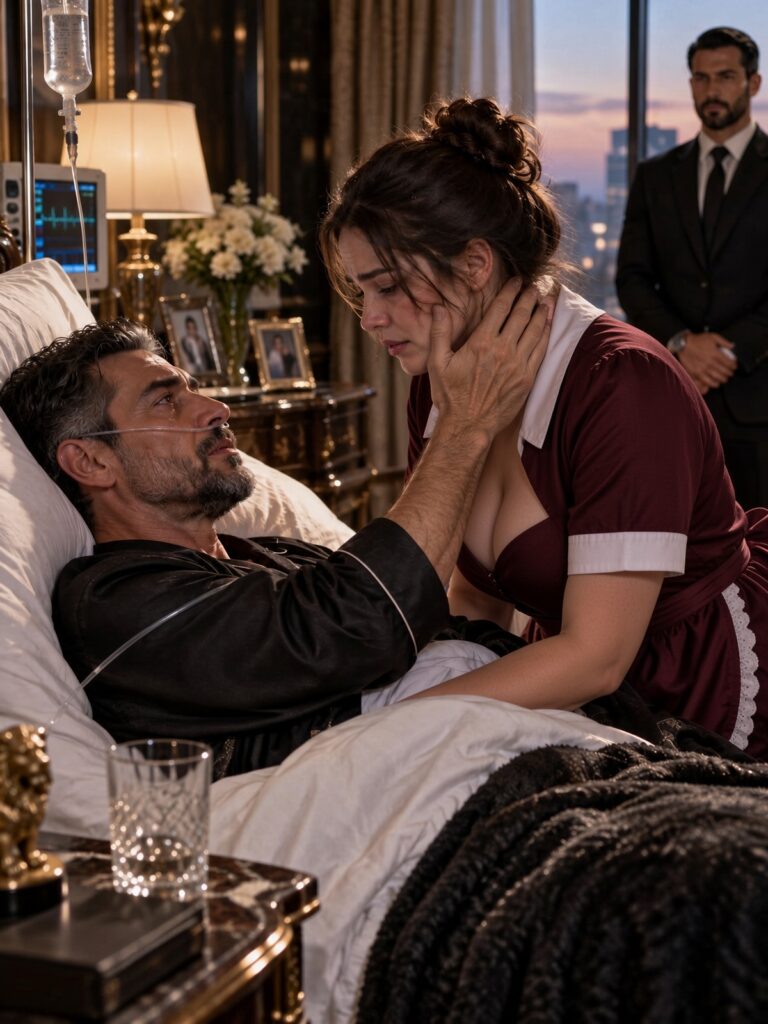
THE MAFIA BOSS PAID $4,000 TO TEST THE MAID’S SCENT—THEN SHE TOLD HIM TO OPEN THE WINDOW
Emilio Corsaro secretly spent $4,000 testing the little cloth sachet his maid carried because every night she entered his room, the dying man somehow slept until morning.
When he finally asked her to stay beside him—to let him hold her just once—Etta Malloy refused and told him he had mistaken desperation for permission.
Then she pressed one finger against the swollen paint around his sealed bedroom window and said, “Sir, I don’t think the problem is inside you.”

PART 1 — THE ONLY WOMAN IN THE HOUSE WHO TOLD HIM NO
“Will you stay?”
The rag slipped from Etta Malloy’s hand.
It hit the floor softly.
Emilio Corsaro sat on the edge of his bed, one hand gripping the carved walnut cane beside him.
At thirty-four, he looked like a man twice his age.
His expensive three-piece suits hung loose now. His cheeks had sharpened. Every sentence cost him breath.
Half of New Orleans feared Emilio Corsaro.
Etta had spent nineteen months cleaning his house.
Nobody in its nineteen rooms had ever asked her last name.
“Sir?”
“Stay here tonight.”
He swallowed.
Then, with visible effort:
“Let me hold you once.”
Etta’s hands disappeared instinctively into her uniform sleeves, hiding the cracks bleach had left across her knuckles.
“No, sir.”
Emilio blinked.
Men did not say no to him.
Women rarely did either.
“I’ll pay you.”
“That makes it worse.”
His expression tightened.
“Why?”
“Because tomorrow morning I still have to work here.”
She picked up the rag.
“Mrs. Tunney will know by breakfast. The kitchen will know by noon. Your brother will know before supper.”
“Nobody would dare—”
“They don’t have to say it in front of you.”
That stopped him.
Etta looked at him directly.
“You checked my assignment sheets.”
“Yes.”
“You sent something from my pocket to a laboratory.”
“Yes.”
“You decided money could solve whatever happened next.”
His hand tightened around the cane.
“I was trying to understand.”
“No.”
Her voice stayed quiet.
“You were informing me.”
Silence.
On the mantel, a white ceramic diffuser pushed sandalwood perfume into the sealed room.
Emilio looked toward the bedside drawer.
He opened it.
Inside lay a small hand-sewn cloth sachet.
Orange peel.
Lavender.
Cedar.
Etta’s.
“You dropped this in the east hallway.”
“I know.”
“I paid a laboratory in Baton Rouge four thousand dollars to test it.”
She stared.
“They found nothing.”
“Because it’s dried orange peel.”
“Forty-three blood draws.”
His voice roughened.
“Three machines. Specialists from Houston. A physician I pay three hundred thousand dollars a year.”
He looked at her.
“In six weeks, I slept eleven full nights.”
Etta said nothing.
“You were assigned to this wing every one of them.”
“Three evenings a week.”
“Eleven out of eleven.”
Outside, rain moved away across the river.
Inside, only the air-conditioning remained.
Emilio asked:
“Why?”
Etta’s gaze moved toward the tall window behind the bed.
Paint had swollen along one corner of the frame.
She had noticed it months ago.
Mentioned it once.
Nothing happened.
“Tell me what to do,” Emilio said.
That was different.
She crossed the room.
Pressed one finger against the swollen paint.
The surface gave slightly beneath her touch.
“Open the window.”
“It was sealed last spring.”
“I know.”
“Security.”
“I know.”
“Four buildings have direct sightlines into this room.”
“I know.”
“Dr. Prentiss says outside air could—”
“Then I can’t help you.”
Etta picked up her bucket.
On the way toward the door, she stopped beside the mantel.
Reached over.
Turned off the ceramic diffuser.
The sweet smoke vanished.
Emilio watched.
“You always do that.”
“Yes.”
“Why?”
Etta looked back.
“Anything that has to smell that loud is covering something.”
She left.
The door clicked shut.
Emilio lay back.
For the first time in fourteen months, he listened to his bedroom rather than his own breathing.
Air conditioner.
Distant traffic.
Rainwater somewhere in the gutters.
Then—
Drip.
A single drop of water fell inside the wall directly behind his head.
PART 2 — THE HOUSE WASN’T KILLING HIM BY ACCIDENT
The conservatory became Emilio’s morning room because it was the only place in Corsaro House where the air seemed to come from somewhere real.
Glass walls ran along three sides.
Iron ribs curved overhead.
Ferns crowded clay pots beside citrus trees and orchids.
Sunlight touched Emilio’s face differently there.
Less like a patient.
More like a living man.
Etta noticed that on the third morning after refusing him.
She also noticed that he had stopped asking her to stay.
That mattered.
The next person who entered did not notice Emilio’s color.
His younger brother Rafe came carrying temporary authorization papers and two attorneys.
At twenty-six, Rafe Corsaro was handsome in the polished, restless way of men who had spent their whole lives close enough to power to assume it would eventually become theirs.
“Medical conservatorship,” he said, placing a folder on the wicker table.
Emilio’s expression did not move.
Rafe continued.
“You’re deteriorating. There are decisions being delayed. Contracts. Port issues. The board needs continuity.”
Etta stood near the far windows watering ferns.
She watched Rafe’s right hand.
Phone in his jacket.
Screen up.
Camera facing outward.
Recording.
Etta set down the watering can.
Then crossed to the glass walls.
One blind.
Then another.
She pulled them down.
Green shadow filled the room.
Rafe turned.
“What are you doing?”
“You’re recording.”
His face changed.
“What?”
“Phone in your pocket. Screen facing out.”
She pulled the third blind.
“If you’re going to record your sick brother, you’re not doing it with sunlight behind you.”
One attorney looked at the other.
Rafe’s jaw tightened.
“You wash floors.”
“Yes.”
“Stay out of family business.”
“I am.”
Etta met his eyes.
“You’ve been here four minutes.”
Silence.
“You’ve asked about the company three times.”
Emilio looked toward her.
Etta finished:
“You haven’t asked once how your brother breathed last night.”
The room became still.
Rafe looked toward Emilio.
Too late.
Emilio had already seen it.
He did not argue.
He simply looked at the two attorneys.
“You are both present in my home.”
That was all.
The first attorney closed his case.
The second picked up the conservatorship folder.
Neither man wanted to be “noted” by Emilio Corsaro.
They left.
Rafe remained.
“You’re letting a maid influence decisions now?”
Emilio looked at the blind Etta had lowered.
“No.”
Then at his brother.
“I’m noticing who asked whether I was alive.”
Rafe left without another word.
In the service kitchen, Bess Tunney stirred gumbo in a copper pot.
She had cooked for the Corsaro family for thirty-two years.
Etta put the watering can in the sink.
Bess never turned around.
“You pulled the blinds on Rafe.”
“Yes.”
“In front of attorneys.”
“Yes.”
Bess tapped her spoon twice against the pot.
Then said:
“I am going to give you the only useful advice anybody ever gave me about surviving this house.”
Etta waited.
“In Corsaro House, if you want to last, don’t see anything.”
Etta did not answer.
She went upstairs instead.
Constance Whitaker managed the domestic staff from a narrow linen office lined with ledgers.
Etta stood in the doorway.
“When I sign my assignment sheet at the start of a shift, I want you to countersign it.”
Connie’s pen stopped.
“Why?”
“Because I’d like you to.”
“You’re preparing for something.”
“Will you sign?”
Connie studied her.
Then:
“Yes.”
For the next several weeks, every east-wing assignment bore two names.
Etta Malloy.
Constance Whitaker.
Nobody else understood why.
Emilio began speaking to Etta during Dr. Hollis Prentiss’s ten-minute service window.
The rule was posted outside his room:
DOMESTIC STAFF MAY NOT REMAIN IN PATIENT’S ROOM LONGER THAN TEN MINUTES.
Prentiss had written it himself.
Etta followed it exactly.
Tray down.
Tea poured.
Bathroom door propped open.
Diffuser off.
Window sill wiped.
Glasses collected.
Leave.
On the fourth evening, Emilio said:
“Who’s home tonight?”
Etta turned.
“My brother.”
“How old?”
“Nine.”
He waited.
No follow-up demand.
No interrogation.
Just space.
Etta found herself filling it.
“Otis has asthma.”
Emilio looked toward her.
“Bad?”
“Some seasons.”
She wrung out the cloth.
“He thinks I don’t know when he’s struggling.”
“How?”
“He says ‘I’m fine’ in three breaths instead of one.”
A tiny smile touched Emilio’s mouth.
“You hear that?”
“I hear everything about him.”
“And your parents?”
“My mother died eight years ago.”
He waited again.
He did not ask how.
Something about that restraint stayed with her.
Every wealthy employer Etta had ever worked for believed grief was a door they had purchased the right to open.
Emilio let it stay shut.
On the seventh evening, Etta’s cloth passed over the window casing.
The paint moved.
Not flaked.
Moved.
A soft blister beneath white enamel.
She pressed.
The surface flexed.
Her eyes shifted toward the wall behind Emilio’s headboard.
Olive-green silk wallpaper had started bulging along one seam.
She touched it.
Wet beneath.
“Mrs. Malloy.”
Etta turned.
Dr. Prentiss stood in the doorway.
“Your ten minutes.”
She stepped away.
“Yes, doctor.”
Downstairs, she showed Bess a small piece of wallpaper she had peeled from the swollen seam.
The front was olive green.
The back was dark.
Damp.
Bess took one look.
Her face changed.
Then she pushed Etta’s hand away.
“Put it back.”
“What is it?”
“I said put it back.”
“Bess—”
“In this house, you do not carry things down my stairs.”
Fear lived in the older woman’s voice.
Not loyalty.
Fear.
Etta did not throw it away.
She carried the piece to the third-floor linen room.
Slipped it between two folded bath towels.
Third shelf from the bottom.
Then forgot it.
Or tried to.
A week later she found an old cardboard box of assignment sheets behind winter blankets.
Three women had worked the east wing before her in fourteen months.
One left without explanation.
One for “personal reasons.”
The third:
Delphine Boudreau — Health.
In the margin, written in pencil:
Reported it. Nothing done.
Etta sat on the step stool holding the sheet.
The room smelled of cedar.
Below, a clock struck eleven.
Something inside her stopped treating the east wing as a mystery.
It became evidence.
That night, she did not return to her room above the garage.
She waited until the mansion settled.
Then crossed the second-floor gallery in stocking feet.
Shoes in one hand.
The unused study beside Emilio’s bedroom still contained old Corsaro property files.
Etta entered without turning on the light.
She knew which floorboards complained.
Which latch caught.
Which security camera left a six-second blind spot when rotating.
People paid enormous money to make domestic workers invisible.
Eventually, invisibility teaches you the entire map.
Etta opened the second drawer of the second cabinet.
Her phone light hidden against her palm.
Property management.
Holdings.
Subsidiaries.
Shell corporations.
One tab stopped her.
Then another.
She took one photograph.
Only one.
Closed the drawer.
Left.
The following morning, Mrs. Whitaker met Etta beside the laundry table.
A male staff supervisor stood behind her.
“Turn out your apron.”
Etta did.
A diamond tie clip fell onto the white folding table.
Silence.
Etta stared.
It belonged to Emilio’s father.
Everyone knew it.
Connie looked sick.
A security report accompanied it.
East-wing camera failure.
Forty minutes.
Exactly when Etta had entered the study.
Dr. Prentiss submitted a note.
Patient displaying inappropriate emotional dependency upon domestic employee. Separation clinically advisable.
Then came the final blow.
Rafe filed a complaint with the agency employing Etta.
And someone reopened the guardianship review involving her nine-year-old brother.
Etta learned that part on the service telephone.
She wrote the case number on the inside of her wrist because she had no paper.
When she replaced the receiver, her hand remained against the wall.
For the first time since entering Corsaro House, she was truly afraid.
Losing work was ordinary.
Threatening Otis was not.
They brought the evidence upstairs on a tray.
That detail stayed with Etta.
A silver tray.
Tie clip.
Security report.
Doctor’s note.
Presented as neatly as breakfast.
She stood at the foot of Emilio’s bed.
Connie by the door.
The diffuser running again.
Sandalwood filling the room.
Emilio read everything.
Once.
Then twice.
He did not look at Etta.
“Let her go.”
Three words.
Connie closed her eyes.
Etta waited.
For a question.
None came.
No:
Is this yours?
No:
Were you in the study?
No:
Why?
Nothing.
The man who had counted eleven nights of sleep and cross-referenced her work schedule believed three sheets of paper before he believed the woman standing four feet away.
Etta untied her apron.
Folded it carefully.
Laid it over a chair.
Then said:
“You trust paper more than people.”
Emilio finally looked at her.
“For six weeks you kept a book.”
His expression changed.
“You wrote down every night you slept.”
She continued.
“You had my assignment sheets pulled.”
“Etta—”
“No.”
The word surprised him.
“You tested something from my pocket without asking.”
Her voice stayed calm.
“And when I told you no, I thought maybe you had finally heard me.”
Emilio looked toward the tray.
She followed his eyes.
“Then this morning someone puts jewelry beside a report with times printed down the edge.”
Her throat tightened.
“And that was enough.”
“I have responsibilities.”
“So do I.”
She showed him the pencil number on her wrist.
“My brother.”
Emilio’s face hardened.
“What about him?”
“You don’t know.”
That was the point.
“You didn’t ask.”
She picked up her canvas bag.
“People like me die of paperwork, Mr. Corsaro.”
The sentence struck strangely.
“You erase us cleanly.”
She looked at him one last time.
“No raised voice.”
“No blood.”
“Just documents.”
Then she walked out.
Rain fell over New Orleans.
Etta did not retrieve an umbrella.
She crossed the courtyard.
Entered her small room over the garage.
Her shoes waited beside the door exactly as they had for nineteen months.
Laces crossed.
Loops loose.
Ready to put on while standing.
A habit learned from too many temporary rooms.
Within thirty seconds, Etta had them on.
Bag over shoulder.
Gate behind her.
Corsaro House remained lit in the rain.
Nineteen rooms.
Not one person came after her.
Emilio responded the only way he knew.
He made calls.
The domestic staffing agency that had placed Etta lost contracts.
Then bonding.
Then license renewal.
Within ten days, its office closed.
Cleanly.
Legally.
Emilio expected satisfaction.
None came.
When Connie told him the agency was finished, he only asked:
“How many people worked there?”
She did not know.
Etta did.
Forty.
She returned to Corsaro House wearing her own clothes.
Not through the servants’ entrance.
The front door.
Connie admitted her.
Etta entered Emilio’s bedroom and placed a printed list on his blanket.
“Forty names.”
He stared.
“Thirty-one women.”
She pointed.
“Odetta Frank. Sixty-six. Eleven months from pension vesting.”
Emilio’s face changed.
“I did it because they framed you.”
“Did you?”
He looked at her.
“Or because someone touched something you had decided was yours?”
He opened his mouth.
Stopped.
Etta waited.
Emilio Corsaro was many things.
A liar to himself was not usually one.
“I don’t know.”
Etta nodded.
“That’s the first answer I believe.”
She placed her hand on the list.
“My mother died because of a company with no face.”
Emilio went still.
“No man came upstairs and threatened her.”
“No one broke anything.”
“No one shouted.”
“Letters arrived.”
“Calls weren’t returned.”
“Management companies changed.”
“Registered agents disappeared.”
She tapped the paper.
“Clean hands.”
“That is what killed her.”
Etta turned.
At the door she stopped.
“You just erased forty people the same way.”
Then left.
Emilio did not send anyone after her.
Dr. Prentiss sealed the damaged window casing the following evening.
He increased two medications.
And wrote another instruction beneath the ten-minute service rule:
AROMATIC DIFFUSER TO REMAIN OPERATING CONTINUOUSLY.
Without Etta, no one shut it off.
Emilio’s condition deteriorated quickly.
Night one:
Three hours sleep.
Night three:
One hour.
Night six:
He could no longer cross the room without stopping for breath.
Night eight:
He remained in bed.
Night nine:
He woke after midnight with his heart racing and his vision collapsing at the edges.
He forced himself upright.
Put his feet on the floor.
Reached for the cane.
Missed.
He stood without it.
One step.
Two.
Then his legs failed.
Emilio struck the wall behind the headboard.
His hand tore through olive-green silk wallpaper.
A strip peeled from ceiling to floor.
He fell onto his side.
And found himself staring into the opened wall cavity.
Black.
Wet.
Thick.
Fourteen months living behind silk and plaster.
For the first time in his life, Emilio Corsaro had no name for what he was looking at.
Then the room disappeared.
Constance Whitaker found him.
Dr. Prentiss arrived two minutes later.
“He cannot be moved.”
Connie looked at the black wall.
Then at Emilio.
Prentiss blocked the door.
“His blood pressure will not tolerate transfer.”
“He needs a hospital.”
“He has a hospital here.”
“He needs out of this room.”
“If you move him and he dies, that is on you.”
Connie went downstairs.
Called a public ambulance.
The ambulance reached the iron gates.
They did not open.
Four Corsaro men stood inside the drive.
Rain ran from their jackets.
They had been told the boss did not leave.
Connie walked down the center of the drive wearing her dressing gown beneath a raincoat.
Keys in one hand.
One guard shifted to stop her.
Then recognized the woman who had handed him his Friday wages for seventeen years.
He stepped aside.
Connie unlocked the gates herself.
The ambulance entered.
Then she called Etta.
Etta arrived on foot.
No umbrella.
The stretcher came across wet gravel.
Emilio lay beneath a blanket, oxygen mask over his face.
Etta walked beside him.
For nineteen months, they had never touched.
Now she reached beneath the blanket.
Took his hand.
No one asked.
Emilio’s eyes opened.
Found her.
His lips moved.
Two words:
“The window.”
At Charity Hospital, nobody cared who Emilio Corsaro was.
His wristband had his name.
That was all.
Dr. Ruth Vance came on shift at six.
Pulmonary and critical care.
Gray entering the front of her dark hair.
Pen cap chewed flat.
She read fourteen months of private medical records for nearly an hour.
Then entered Emilio’s bay.
Connie sat beside the bed.
Etta stood near the foot rail in her wet coat.
Ruth said:
“Mr. Corsaro, I want you awake.”
He opened his eyes.
“Forty-three blood draws.”
She placed his file on the table.
“Imaging.”
“Neurologic studies.”
“Two complete cardiac workups.”
“Specialists.”
“Home equipment better than some hospitals.”
“And four thousand dollars spent analyzing dried orange peel.”
Etta looked down.
Ruth continued.
“Not one air sample.”
Emilio stared.
“What?”
“Everyone examined you.”
She leaned closer.
“Nobody examined your room.”
Silence.
“When did you begin sleeping in the east bedroom?”
“Fourteen months.”
“When was the last time the window opened?”
Emilio’s eyes slowly found Etta.
He remembered.
Her finger against swollen paint.
Open your window.
He closed his eyes.
Ruth watched.
“That answer matters.”
“The spring before last.”
“Why sealed?”
“Security.”
“Who approved it?”
“I did.”
“There.”
Ruth sat back.
“That’s how this happens.”
Emilio frowned.
“How what happens?”
“You inspect threats.”
“Not the thing you built yourself.”
The next afternoon, Ruth Vance entered Corsaro House off duty.
With her came Marva Doss, a city housing inspector acting privately until formal authorization could be obtained.
And Aussie Pike, the estate groundskeeper, carrying a pry bar wrapped in cloth.
Etta came too.
Connie let them into the east wing.
The diffuser was still running.
Etta switched it off.
Immediately.
They waited.
Air-conditioning.
Distant traffic.
Nothing.
Then slowly—
the smell appeared.
Sweet.
Wet.
Rotten beneath perfume.
Everyone stepped backward almost simultaneously.
Ruth covered her nose.
Marva stared at the torn wallpaper.
“Open the baseboard.”
Aussie worked carefully.
The board came free.
Behind it:
Blackened cavity.
Wet insulation.
Dark growth climbing upward through plaster.
Water damage reaching toward the ceiling.
Aussie sat back.
His face had gone gray.
“I reported the roof drain.”
“When?”
“Three times.”
He looked at Emilio’s absent bed.
“Spring.”
“Summer.”
“Thanksgiving.”
Marva asked:
“What happened to the work orders?”
“Canceled.”
“By whom?”
Aussie looked toward the doorway.
Then said a name.
“Gus Renner.”
The thick-necked man with the folded handkerchief.
The man who managed half of Emilio’s operations.
The man who had watched Etta come down the stairs the first night Emilio asked her to stay.
The investigation widened.
Etta found Delphine Boudreau through domestic workers.
Not databases.
Women.
One cleaner knew another who knew a cousin who remembered Delphine’s name.
They found her selling ferry tickets at Algiers Point.
Fifty-one years old.
Breathing carefully between sentences.
When Etta said Corsaro, Delphine’s hands flattened on the counter.
That evening she sat in Etta’s apartment with Ruth, Marva, Connie, and Bess.
“I worked that room four hours at a time.”
Delphine spoke without drama.
“Sometimes six.”
“Deep clean.”
“Doors shut because he couldn’t tolerate hallway noise.”
She paused for breath.
“I shampooed the carpet.”
“Cleaned drapes.”
“Removed vent covers.”
Her fingers tightened.
“I breathed whatever was in there.”
Ruth asked:
“When did symptoms begin?”
“Winter.”
“Did you report the smell?”
“Twice.”
“To whom?”
“Dr. Prentiss.”
Etta searched old assignment sheets while Delphine spoke.
Found the date of her second complaint.
Then opened the old care-protocol amendments.
The ten-minute rule had been added nine days later.
Marva said what everyone else was thinking.
“That rule wasn’t written to protect Emilio.”
Silence.
“It was written so domestic staff would never stay in that room long enough to notice.”
The room felt colder.
Etta looked at Delphine.
And understood something awful.
The same rule designed to silence Delphine may have saved Etta’s lungs.
Dr. Prentiss did not deny it when confronted.
They met in the conservatory.
Emilio was still hospitalized.
Ruth attended.
Prentiss sat among the ferns.
“You told me too.”
He looked at Etta.
“November.”
“You said the paint around the window was lifting.”
Etta’s jaw tightened.
“You wrote that down?”
“Yes.”
“What did you write?”
He looked ashamed.
“Domestic staff displaying anxiety and overinvolvement.”
Connie closed her eyes.
Prentiss said:
“I’m not asking Emilio to forgive me.”
Then to Etta:
“I’m asking you.”
She stared.
“No.”
He looked stunned.
“Not yet.”
That was all.
Then evidence began disappearing.
A wall sample Ruth had sealed was opened inside the clinic refrigerator.
Chain-of-custody form vanished.
Marva’s unofficial photographs showed staining but could be challenged.
A restoration contractor obtained permits to strip the bedroom to the studs.
Three days.
After that, the wall would be demolition debris.
There was only one untouched sample remaining.
Dry.
Dated by circumstance.
Hidden months earlier.
Between two towels in the third-floor linen room.
Etta knew exactly where it was.
She returned to Corsaro House after midnight.
Without permission.
Side laundry door.
Loose strike plate.
Shoes off.
Fourth stair tread avoided along the outer edge.
Second-floor photocell skirted close to the wall.
Third-floor corridor dark after eleven.
Nineteen months of invisibility became a map.
She reached the linen room.
Lifted the settled door before pushing.
No sound.
Third shelf.
Bath towels.
Wallpaper.
Still there.
Etta slid it inside her coat.
Then a floodlight came on outside.
Cars entered the drive.
One.
Two.
Doors slammed.
Men’s voices filled the first floor.
Etta froze.
Someone was searching the house.
Properly.
Room by room.
Footsteps reached the third floor.
Lights came on.
Etta backed between two linen racks.
Shoes in one hand.
Wallpaper pressed beneath the other.
The steps moved along the corridor.
Door.
Door.
Door.
Stopped outside the linen room.
Etta stopped breathing.
The knob turned.
Caught against the frame.
The stranger tried again.
He did not know to lift the door half an inch.
After a moment, the knob released.
Footsteps moved on.
Etta stood motionless until every light went dark.
At dawn, she left Corsaro House with the sample against her heart.
Nobody saw her.
Three weeks later, everyone who mattered was summoned to the library.
Connie sent the message.
Nobody ignored Connie.
The lamps were all lit.
Rafe.
Dr. Prentiss.
Bess.
Ruth Vance.
Marva Doss.
Aussie Pike.
Delphine.
Etta.
And halfway down the table—
Gus Renner.
Folded handkerchief in his breast pocket.
Perfectly calm.
The double doors opened.
Emilio entered walking.
No wheelchair.
Walnut cane in his hand, but the tip never touched the floor.
Forty feet separated him from the head of the table.
He crossed all forty.
Every step cost him.
Nobody looked at his legs.
That not-looking became a form of respect.
He reached his chair.
Waited until his breathing settled.
Then said:
“For fourteen months, meetings happened in this house without me.”
He looked at every face.
“Tonight, I listen.”
Etta laid out nineteen months of assignment sheets.
Each signed by her.
Each countersigned by Connie.
Ruth opened Emilio’s sleep notebook.
Called eleven dates.
Etta matched every one.
Eleven nights.
Eleven nights she had worked the east wing.
The first hard evidence connecting his improvement to something outside his body.
Bess stood next.
Placed her kitchen ledger on the table.
Meal deliveries.
Deep-clean shifts.
Hours.
Names.
Thirty-two years of domestic memory nobody had ever considered evidence.
“I told Etta not to see anything.”
Bess looked toward her.
“I was wrong.”
Then the hallway lights went out.
Eight long-time Corsaro employees entered.
Garage men.
Groundskeepers.
Drivers.
Night staff.
They formed two silent lines.
Gus Renner took his hands off the table.
Connie spoke.
“Mr. Renner.”
“The car is waiting.”
Gus smiled faintly.
“So that’s what this is.”
He stood.
Buttoned his coat.
Then stopped at the doors.
“You all think I put the rot in that wall.”
Nobody answered.
Gus looked toward Emilio.
“The night at the container yard was me.”
Silence.
Fourteen months of suspicion crystallized in eight words.
“You survived.”
Gus’s voice stayed conversational.
“That was my mistake.”
Rafe went pale.
Gus continued.
“You sealed your windows because you were frightened.”
“I didn’t tell you to.”
“Didn’t need to.”
He looked toward the room.
“Aussie reported the roof drain.”
“I killed the first work order because we were in a war and I didn’t want contractors on the roof.”
He shrugged.
“Then summer came.”
“Then winter.”
“At some point I understood the room was hurting you.”
Ruth said:
“And you let it continue.”
“Yes.”
Gus looked at Prentiss.
“I didn’t tell him what rule to write either.”
“I only made clear that his position depended on me.”
Prentiss looked down.
Gus smiled without humor.
“People are useful when you convince them the choice was theirs.”
Emilio had not moved.
“You spent seven years waiting to kill me.”
Gus tilted his head.
“And in the end, I didn’t have to.”
He reached into his coat.
Eight men shifted.
But Gus removed only paper.
He placed it on the table.
“One more thing.”
His gaze moved to Etta.
“Her employment file.”
Etta went still.
“I approved it personally.”
Silence.
“I knew who her mother was.”
Etta’s fingers tightened.
“I knew the building.”
“The lawsuit.”
“The loss.”
Gus’s eyes settled on her.
“You don’t hire a woman like Etta Malloy because she is careful.”
He smiled.
“You hire her because if one day you need someone blamed for theft, you already have a woman under your roof with revenge written into her file.”
Etta could no longer hear the clock.
“The tie clip,” Gus said, “took eleven seconds.”
And suddenly Etta understood.
She had not merely walked into Corsaro House.
She had walked into a trap prepared before her first shift.
PART 3 — THE MAID CAME FOR REVENGE. SHE LEFT WITH SOMETHING HARDER: THE TRUTH
No one followed Gus immediately.
That was what Etta remembered later.
Nobody shouted.
Nobody overturned a chair.
Nobody reached for a weapon.
The room simply absorbed what he had said.
Nineteen months.
Etta had believed herself invisible.
Gus had seen her before she ever arrived.
Seen her mother’s name.
Her lawsuit.
Her need for work.
Her anger.
He had hired her because one day she might become convenient.
A scapegoat selected in advance.
The eight Corsaro men walked Gus toward the side door.
He turned once.
Looked at Emilio.
“You still think this is about me.”
Emilio’s face remained colorless.
“What is it about?”
“The house you inherited.”
Gus smiled.
“I only learned how to use it.”
The door closed.
Car tires moved along the drive.
Then silence.
Marva Doss opened her bag.
“I have something else.”
She unfolded a property portfolio.
“Two hundred fourteen residential addresses controlled through Corsaro Coastal Holdings.”
Emilio looked toward her.
Marva placed another folder beside it.
“One address matters tonight.”
Etta’s stomach tightened before Marva spoke.
“A three-story frame building in Central City.”
No one moved.
“Seven complaints in fourteen months.”
“Water through interior walls.”
“All closed with the same statement.”
She read:
“Inspected. No violation found.”
Etta’s hand found the edge of the table.
“The complaining tenant was Nadine Malloy.”
Her mother’s name entered Corsaro House for the first time.
Emilio looked at Etta.
She did not look back.
Marva continued.
“Eight years ago, the tenant’s daughter filed civil action.”
“Defendant was a limited-liability company registered through a post-office box.”
“The ownership chain rises through four subsidiaries.”
She placed her finger on the final page.
“To Corsaro Coastal Holdings.”
Emilio did not touch the paper.
Etta finally spoke.
“She wrote for fourteen months.”
Her voice did not shake.
“Management stopped answering.”
“She wrote the post-office box.”
“When those letters came back, she went to Poydras Street herself.”
“She sat in a plastic chair for four hours.”
“A receptionist finally took the envelope.”
Etta looked at Emilio.
“My mother kept copies of everything.”
She reached into her handbag.
Removed a worn envelope.
Inside:
One rent receipt.
Folded into sixteen squares.
She opened it slowly.
Smoothed it against the rosewood table.
“Nadine Malloy.”
Her handwriting across the bottom.
“She always wrote the month out fully.”
Etta smiled faintly.
“She said abbreviations looked careless.”
Ruth Vance spoke softly.
“Otis?”
Etta’s face changed.
“He was a baby.”
Ruth nodded.
“His lungs developed in that apartment.”
Nothing else needed saying.
Etta looked at Emilio.
“You wanted to know why I smell like orange peel.”
He went still.
“You paid four thousand dollars.”
“Laboratory.”
“Analysis.”
“Three ordinary ingredients.”
Her hand rested beside the receipt.
“I was nineteen when my mother died.”
“I couldn’t afford perfume.”
“I couldn’t get the smell of that apartment out of my clothes.”
“Wet plaster.”
“Bleach.”
“Rot.”
Her throat tightened.
“So I cut up orange peels.”
“Dried lavender.”
“Cedar from an old wardrobe.”
“Sewed them inside little cloth bags made from one of my mother’s sheets.”
She breathed carefully.
“I have carried them ever since.”
Emilio’s hand tightened around his cane.
“That is what helped me sleep.”
“Yes.”
Etta’s eyes stayed on him.
“That smell comes from the room where my mother died.”
No one looked away.
“And you rested on it.”
Emilio closed his eyes.
For six weeks he had treated Etta’s scent as mystery.
Medicine.
Comfort.
Something perhaps magical.
It was grief.
Another person’s grief.
Something poverty had taught her to carry quietly.
Etta reached into her bag again.
Spiral notebook.
Placed beside the rent receipt.
“There’s another thing.”
Rafe looked toward her.
Emilio did not move.
Etta opened the notebook.
“This is not a diary.”
Pages of corporate searches.
Property records.
Names.
Addresses.
Registered agents.
Photographed ledgers.
Date after date.
“This is a case file.”
Emilio stared.
“I built it against you.”
Silence.
Rafe whispered:
“What?”
Etta continued.
“I didn’t accidentally end up in this house.”
“I applied.”
“On purpose.”
Connie looked at her.
“You requested the east wing.”
“Yes.”
“You said your knees handled that staircase better.”
“I lied.”
Connie almost smiled despite everything.
Etta looked toward Emilio.
“I traced the company that owned my mother’s apartment.”
“One subsidiary.”
“Then another.”
“Then another.”
“Six years.”
“Clerk offices.”
Copies.”
“Fees I couldn’t afford.”
“Registered agents in three states.”
“Every road ended here.”
She tapped the notebook.
“Corsaro Coastal Holdings.”
Emilio’s voice came quietly.
“So you came to steal documents.”
“Yes.”
“To destroy me?”
“I wanted a name in a chair.”
He frowned.
Etta’s eyes hardened.
“When my mother sued, there was no person.”
“There was a corporation.”
“Then a subsidiary.”
“Then an agent.”
“Then a lawyer.”
“Nobody looked at her.”
“Nobody could be made to answer.”
She looked around the table.
“I came because I wanted one human being whose face I could put at the top of the page.”
Emilio absorbed that.
“The night you entered my father’s study…”
“Yes.”
“You were photographing property records.”
“Yes.”
“The tie clip—”
“Wasn’t mine.”
“I know now.”
Etta closed the notebook.
“The sleeping.”
“The sachet.”
“Opening your window.”
“The diffuser.”
“None of that was part of the plan.”
She looked almost angry about it.
“I didn’t expect to like anyone here.”
Connie’s eyes lowered.
Bess stared at her ledger.
Etta continued.
“I especially didn’t expect to care whether you lived.”
Emilio’s mouth tightened.
“Yet you did.”
“Yes.”
“Why?”
Etta looked toward the windows.
“Because sick is sick.”
The simplicity of it broke something in the room.
Emilio removed the cane from beside his chair.
Placed it flat on the table.
“In the spring…”
His voice slowed.
“I asked you to stay in my room.”
Etta said nothing.
“I asked you to let me hold you.”
His eyes held hers.
“I told myself I was begging.”
He looked toward his notebook.
“I was not.”
No one moved.
“I had your schedule pulled without your knowledge.”
“I had property belonging to you analyzed.”
“I offered money.”
“And I asked something intimate in a house where everyone has been trained to understand that refusing me has consequences.”
He breathed.
Slow.
Deliberate.
“I withdraw the request.”
Etta’s throat tightened.
“All of it.”
His voice remained calm.
“I had no right to ask it the way I did.”
The apology was not romantic.
That made it matter.
Emilio looked at the notebook in front of her.
“You came here intending to take something from me.”
“Yes.”
“You spent nineteen months building a case.”
“Yes.”
“And tonight you could have kept silent.”
Etta waited.
“You could have let Gus’s confession become the whole story.”
“Yes.”
“You did not.”
“No.”
Emilio nodded.
“Whatever you were when you entered my gate…”
He looked at Nadine’s rent receipt.
“…you are not that now.”
Etta pushed her notebook across the table.
It traveled past the receipt.
The property list.
His sleep record.
Stopped in front of him.
Eight years of work.
“Take it.”
Emilio did not touch it.
“Why?”
“Because you need it more than I do.”
“Why would you trust me?”
“I don’t.”
That answer almost made Rafe laugh.
Etta continued:
“I’m giving you the chance to become someone worth trusting.”
Tuesday morning, Emilio Corsaro signed a consent agreement authorizing full municipal inspection of all 214 residential properties under Corsaro Coastal Holdings.
Three attorneys told him not to.
A fourth used the phrase catastrophic civil exposure.
Emilio listened.
Then uncapped his pen.
“For most of my adult life,” he said, “I have erased people with paper.”
The attorney beside him shifted.
“I think paper deserves one turn at me.”
He signed.
The consequences were expensive.
Not symbolic.
Buildings failed inspections.
Roofs required replacement.
Plumbing.
Electrical systems.
Ventilation.
Water intrusion.
Several tenants had documented complaints ignored through property managers who had never met Emilio.
Some records had been suppressed by Gus.
Others had simply vanished into bureaucracy because nobody powerful cared enough to notice.
Emilio refused to hide behind the distinction.
“My name collected the rent.”
That became his answer.
“My name pays.”
Rafe received control of the residential division.
Not as a gift.
As responsibility.
Emilio placed two conditions in writing.
Rafe would complete formal property-management training at Tulane.
And every quarter would undergo independent audit by an outside firm Rafe could neither choose nor fire.
Rafe read the conditions twice.
“You don’t trust me.”
Emilio answered:
“I am trying to stop treating trust as an alternative to systems.”
Rafe signed.
That evening, in his apartment on Camp Street, Rafe opened a case he had not touched in eight years.
Took out his trumpet.
Played badly for twenty minutes.
Then better.
Dr. Hollis Prentiss lost his position.
His medical decisions went before licensing review.
Emilio did not destroy him privately.
He could have.
That would have been easy.
Etta insisted on documentation.
“Do it where somebody has to sign their name.”
So they did.
Delphine Boudreau received medical support.
Not charity hidden inside an envelope.
A formal settlement with counsel of her choice.
Other domestic workers who had suffered respiratory symptoms were contacted.
Records preserved.
Compensation structured.
Bess Tunney watched all of it.
One morning she found Etta in the kitchen.
“You were right.”
Etta looked up.
“About what?”
“Seeing.”
Bess stirred her pot.
“I spent thirty-two years thinking not seeing kept me safe.”
She tapped the spoon against the rim.
“Turns out it only kept everybody else comfortable.”
Etta smiled.
“That’s usually how it works.”
The eastern bedroom was stripped completely.
Not repaired.
Opened.
Every wall.
Every joist.
Every duct.
The mold remediation required weeks.
Roof drainage rebuilt.
Windows replaced with secure units capable of opening.
Emilio insisted.
Ruth Vance reviewed the plans herself.
When contractors asked whether he wanted the room restored exactly as before, Emilio said no.
“Nothing exactly as before.”
He never slept there again.
Not because he feared the room.
Because he had learned that a man could build his own prison and call it safety until somebody with a rag told him to open a window.
Etta did not return to domestic service.
Not immediately.
She moved Otis into a second-floor apartment on Barrow Street.
Four windows.
That was why she chose it.
On the first afternoon, Otis opened every one.
Street noise entered.
Car horn.
Bicycle bell.
A woman calling to someone from downstairs.
Birdsong.
Otis sat on the front sill with his bird chart.
“Wren.”
Etta unpacked dishes.
“Sure?”
“Sparrow.”
He listened again.
“No. Wren.”
“How can you tell?”
“Too loud.”
He grinned.
“A wren has a bigger sound than a bird that size has any business having.”
Etta laughed.
No sandalwood diffuser.
No sealed glass.
Just air.
Across the street, a black car sat at the curb.
Emilio sat inside.
Window lowered.
He did not get out.
That was the kindest thing he had done for her.
Not arriving with flowers.
Not bringing money.
Not assuming the door would open because he had come.
He waited.
After ten minutes, Etta noticed him.
She stood behind the curtain.
Watched.
Emilio remained in the car.
Hands visible.
No driver at the door.
No guard.
No message sent upstairs.
He would leave.
Etta realized that.
He would actually leave if she did not invite him.
Something in her softened.
She went downstairs.
Crossed the street.
Stopped beside the open car window.
Emilio looked up.
“You’re walking better.”
“A little.”
“You’re still watching my building.”
“I was looking at the windows.”
“They’re nice.”
“Yes.”
Silence.
He did not ask to come in.
Etta almost smiled.
“Get up.”
His eyebrow moved.
“Excuse me?”
“You came all this way.”
He looked toward her building.
“Am I invited?”
“Yes.”
Only then did he open the door.
Months later, the Central City building where Nadine Malloy had lived reopened after complete rehabilitation.
New roof.
New drains.
Walls stripped and rebuilt.
Mechanical ventilation.
Independent inspection.
Tenant complaint system answered by actual people with names.
On the brick beside the entrance hung a small bronze plaque.
NADINE MALLOY
Nothing else.
No Corsaro name.
No foundation logo.
No redemption campaign.
Etta insisted.
“My mother does not become your advertisement.”
Emilio agreed.
By then, Etta had begun night courses in housing inspection.
Marva helped her apply.
Ruth wrote a recommendation.
Connie wrote another.
Emilio offered to pay tuition.
Etta said no.
He expected that.
Then she added:
“You can fund the city scholarship that already exists.”
He did.
Anonymously.
Mostly.
Rafe figured it out.
Said nothing.
Two years later, Etta Malloy carried a city badge.
Field housing officer.
She knelt beside a baseboard inside a rented apartment on a hot Louisiana afternoon.
A young trainee stood behind her holding a clipboard.
The tenant’s daughter laughed from another room.
The trainee asked:
“Should I ask whether they smell mold?”
Etta shook her head.
“No.”
“Why?”
“People stop smelling their own homes.”
She pressed two fingers against a blister in the paint.
“That is how noses work.”
“What should I ask?”
Etta stood.
“Ask which nights their children sleep through.”
The trainee wrote it down.
“Anything else?”
“Ask how often they use inhalers.”
“Whether windows open.”
“Whether anybody complained before.”
“And?”
Etta looked around the room.
“Always inspect the thing everyone else says is normal.”
That evening, she came home.
Otis was doing homework at the kitchen table.
Older now.
Breathing better.
Not cured.
Life rarely offered miracles.
But better.
Etta removed her shoes.
For most of her life, she had kept the laces crossed and loose.
Ready to slip on while standing.
Ready to leave quickly.
She looked down.
Then pulled the laces free.
Set the shoes on the rack.
Side by side.
Ordinary.
The phone rang.
Emilio.
She answered.
“What?”
“I said hello.”
“No, you said my name.”
“That usually means hello.”
“Not from you.”
He sighed.
“I have a question.”
“Ask.”
A pause.
“Dinner tomorrow?”
Etta smiled.
“Is that an order?”
“No.”
“Are you sure?”
“Yes.”
“Will you erase forty companies if I decline?”
“I deserved that.”
“You did.”
Another pause.
“Dinner?”
Etta looked at Otis.
He mouthed:
GO.
She narrowed her eyes.
“Seven.”
Emilio exhaled.
“Seven.”
“And Emilio?”
“Yes?”
“Open windows.”
A pause.
Then something warm in his voice.
“Always.”
Years earlier, Emilio Corsaro had believed Etta Malloy carried a secret medicine in a crooked cloth sachet.
He paid laboratories.
Tracked dates.
Studied patterns.
He thought the mystery lived in lavender and cedar.
It never did.
The thing that helped him breathe had been simpler.
Every evening Etta entered his room, she turned off the scent designed to hide decay.
She opened interior doors.
She stood near the swollen window.
She disturbed the sealed little world everyone else had been paid to preserve.
Etta never cured Emilio.
She interrupted the lie around him long enough for his body to notice the difference.
And Emilio never rescued Etta.
Money could not do that.
Power could not.
He learned that the day she put forty unemployed names on his bed and asked whether his vengeance had been for her or for himself.
What they gave one another was less romantic than rescue.
And harder.
A question.
Then enough silence to hear the answer.
Years later, Emilio still kept the thin leather sleep notebook.
Not locked away.
On a shelf beside the medical records.
Inside were eleven dates.
Eleven nights.
Eleven small marks written by a frightened man who believed he was documenting the presence of a woman.
He understood now that he had actually been documenting the absence of poison.
On the final page, beneath the last recorded night, Emilio eventually added one sentence.
Not about Etta.
Not about love.
Not about gratitude.
It read:
Before deciding what is wrong with a person, inspect the room you have asked them to survive in.
He never underlined it.
There was no need.
And in Etta’s apartment across town, four windows remained open whenever weather allowed.
Orange peel dried on a tray beside the sink.
Lavender hung upside down near the pantry.
Cedar shavings waited in a glass jar.
She still sewed the sachets sometimes.
Not because she needed to hide the smell of her past.
Because now the scent belonged to her.
One spring evening, Emilio found one sitting on the table beside his dinner plate.
He picked it up.
Looked at Etta.
“This is for me?”
“Yes.”
He turned the small cloth bag over.
The seam was crooked.
Exactly like the first.
“What does it mean?”
Etta sat opposite him.
“Nothing.”
He smiled.
“Good.”
Outside, a wren began shouting from the fire escape with more sound than a bird that size had any business making.
Otis called from the next room:
“Told you!”
Etta laughed.
The windows were open.
And nobody in that apartment was planning to run.


