
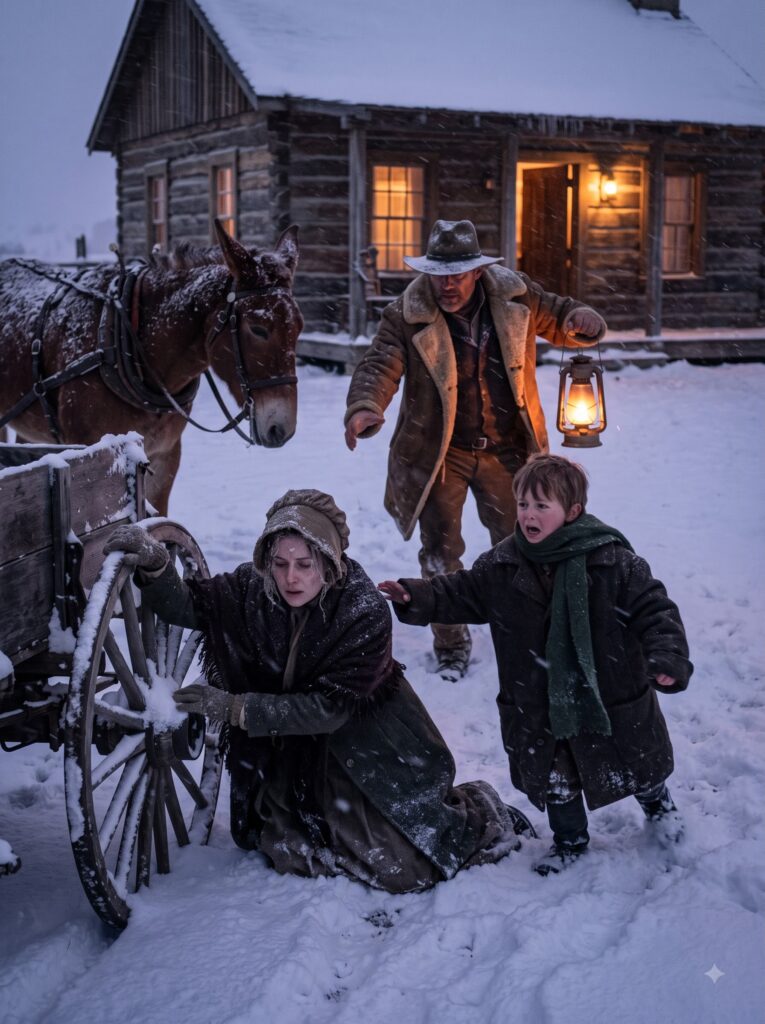
Nathan’s boot sank almost to his knee.
He dragged himself free and followed the smaller tracks, calling Eli’s name against the wind.
Past the gate, the footprints grew uneven. The boy had been stumbling. One mark showed where he had fallen and struggled upright again.
Nathan quickened his pace.
Then he saw a small dark shape beyond the abandoned wagon.
Eli was fighting through a drift nearly as high as his waist. His father’s green scarf covered his mouth, and both hands clutched something beneath his coat.
“Eli!”
The boy turned.
His foot slipped.
Nathan caught him before he disappeared into the deeper snow.
“I have to get there!” Eli cried. “Mama needs that job!”
Nathan lifted him clear.
“You’re coming home.”
“But it’s only four miles!”
“Four miles is too far in this weather.”
Eli struggled once, then sagged against Nathan’s shoulder.
“I thought I could walk where the wagon couldn’t.”
Nathan felt how cold the child’s clothing had become.
“You were trying to help your mother. I know. But she needs you safe more than she needs that letter delivered.”
Eli reached inside his coat.
The letter was still there, damp around the edges.
“Mrs. Avery said noon.”
Nathan looked toward the invisible road.
He had been watching the clock himself.
And there was nothing he could do about it.
Clara was waiting at the farmhouse door with a quilt.
She took one look at her son’s snow-packed boots and pressed a hand over her mouth.
Nathan carried Eli inside, removed his wet outer clothing, and helped him into dry socks.
Clara knelt beside the chair.
“Why didn’t you tell me you were going?”
Eli lowered his eyes.
“Because you’d say no.”
“Yes,” she whispered. “I would.”
“I heard you counting money before we left. And you said that lady would pay you every week.”
Clara’s expression changed.
Eli’s voice broke.
“I thought if I got there, you wouldn’t have to worry anymore.”
She drew him close.
“Oh, sweetheart. You aren’t supposed to carry my worries.”
“But Papa used to find a way.”
Clara closed her eyes.
“Your papa knew when a road was too dangerous, too.”
Nathan turned toward the stove, giving them a moment.
The clock showed only minutes until noon.
Clara noticed him looking.
“Could you take the letter?” she asked.
Nathan hesitated.
He wanted to say yes.
He wanted to put on his coat, harness his horse, and return with a promise that everything would be all right.
But Mrs. Avery’s offer required Clara herself to report for work.
And the road had already defeated his horse.
“I’m sorry,” he said. “Even if I could get through, the letter alone wouldn’t meet her condition.”
Clara nodded.
She looked at the paper lying in Eli’s lap.
Then the clock struck twelve.
No one spoke.
Somewhere in Bell Creek, Mrs. Avery was free to give the position to another seamstress.
Clara had traveled so far for that opportunity.
Now she could only wonder whether it was gone.
Nathan put another log into the stove.
“You and Eli can remain until the road clears.”
Clara shook her head slowly.
“I appreciate that. But Bell Creek is where the work is. And the school. I can’t build a living four miles away from both.”
Nathan accepted her answer.
“Then we’ll get you there when it’s safe.”
“Even if I’m too late?”
“Even then.”
That afternoon, while Eli rested beneath the quilt, Clara took up Nathan’s coat and began repairing the frayed cuff.
Nathan offered to leave it until she felt stronger.
“My hands are steady now,” she replied.
She tightened the final stitch and tested the seam.
“Whatever Mrs. Avery says, I can still sew.”
Nathan looked at the neat work.
“That much is plain.”
Outside, snow continued to cover the lane.
Clara returned the coat, then unfolded Mrs. Avery’s damp letter.
She pressed it flat beneath her sewing case and looked Nathan in the eye.
“Tomorrow, if the road opens, I’m going to that shop. I need to hear her answer for myself.”
Nathan reached for his barn lantern.
“Then at first light, I’ll see whether we can repair that wheel.”
As he lifted the lantern, Clara caught his sleeve.
“And Mr. Ward—if the answer is no, please don’t tell Eli everything will be all right unless we know how.”
Nathan stopped.
Then he set the lantern down and answered her without looking away.
“I won’t.”
Clara released Nathan’s sleeve.
For a moment, neither moved.
Then he picked up the lantern and went to check the mule, leaving Clara with the one thing she had asked him to give her.
An honest answer.
By evening, the wind had weakened. Snow still lay thick around the fences, but the terrible force that had driven it across the ranch seemed to be passing.
Eli slept near the stove with his green scarf drying over the back of a chair.
Clara sat opposite Nathan, holding his repaired coat.
“I haven’t thanked you properly for going after him.”
“You don’t have to.”
“I know.” Her gaze settled on the scarf. “That’s why I wanted to.”
Nathan examined the stitches along his cuff.
His father had taught him how to work a wagon wheel, sharpen a blade, and nurse a tired animal. The old man had died the previous year after months of illness, leaving Nathan accustomed to a house that had become painfully quiet.
There had been times during his father’s sickness when Nathan would have given anything for someone to tell him what the next day would bring.
He had never found anybody who could.
So he would not make Clara promises that might fail her.
“My father used to say a man ought to know the difference between helping and making himself important,” Nathan said.
Clara smiled faintly.
“He sounds sensible.”
“He could be. Especially when I wasn’t.”
The next morning brought a pale, weak sunshine.
Nathan stepped outside before breakfast and saw wagon tracks on the open stretch beyond his gate.
The wind had scoured some of the road clear. Other portions remained deeply rutted, but the route was no longer buried beyond recognition.
He walked the worst part before returning.
“We may get through today.”
Clara stood immediately.
“What about the wheel?”
“I can make it serviceable. It’ll take some work.”
“Then I’ll see to the mule and our things.”
Nathan started to object when he noticed how carefully she rose.
Clara caught his hesitation.
“I know my own strength, Mr. Ward. I’ll stop if I need to.”
He nodded.
“Fair enough.”
In the shed, Nathan selected two lengths of dry ash and worked them into replacement spokes.
Eli watched from the doorway while Clara fed and watered the mule.
The boy asked why Nathan was testing the wood so closely.
“A spoke can look sound and still have a weakness running through it,” Nathan explained. “You have to follow the grain.”
“Did your papa teach you?”
“He did.”
Eli fingered the green scarf at his throat.
“Mine taught me knots.”
Nathan looked up.
“Useful thing to know.”
There was no pity in his voice.
Eli stayed to watch.
By late morning, the new spokes were fitted. Nathan inspected the wheel, then had the mule pull the empty wagon a short distance before allowing Clara to load her bundles.
They departed carefully.
Four miles had never seemed such a distance.
The mule needed time through the remaining drifts, and Nathan stopped twice to examine the repaired wheel.
When the first buildings of Bell Creek finally appeared, the afternoon was already advancing.
Clara sat straighter.
Nathan drew the wagon beside a modest dressmaking shop.
“Would you like me to come in?”
She looked at the neatly dressed window, the rolls of fabric beyond it, and the sewing case resting in her lap.
“No, thank you. I should speak for myself.”
Nathan climbed down to wait with Eli.
Inside, Mrs. Avery stood behind a counter surrounded by unfinished garments.
Clara introduced herself and handed over the letter.
The shopkeeper recognized her name.
For one hopeful instant, Clara believed the position might still be open.
Then Mrs. Avery’s expression softened.
“I’m sorry, Mrs. Bennett.”
Clara felt her stomach tighten.
“I waited until noon yesterday, as I wrote. Another seamstress came after that. She was available to start immediately.”
Clara gripped her sewing case.
“Could you use two women for a little while? Even for fewer hours?”
Mrs. Avery shook her head.
“I wish I had enough orders to pay you both. But I don’t.”
There was no insult in her answer.
No accusation that Clara had failed to try hard enough.
Only a small business with more work than its regular staff could manage, but not enough to hire two additional seamstresses.
“I understand,” Clara said.
She folded the letter carefully.
Outside, Eli ran to meet her.
“Mama? Did she say yes?”
Clara crouched until their faces were level.
“She gave the work to another woman.”
Eli looked stricken.
“Because I didn’t get there?”
“No.” Clara held his shoulders. “Because the road was closed, and we arrived after she needed someone. You mustn’t put that on yourself.”
“What will we do?”
She glanced toward the street.
“We’ll find other sewing.”
Nathan stood near the wagon, listening but offering no false solution.
Finally, Clara rose.
“Mr. Ward, could you tell me where Mrs. Pike keeps her boarding house?”
A short walk from the school, Mrs. Pike showed them a clean upstairs room with one bed, a narrow cot, and enough space for Clara’s sewing case.
Meals were included in the weekly price.
Clara asked about the school, the mule, and the cost of another week.
Then she counted the coins she had protected throughout the journey.
She could pay for the first week.
Very little would remain.
“I’ll take it,” she said.
Mrs. Pike wrote out a receipt.
As Clara put it into her sewing case, the landlady noticed the neatly folded thread and needles.
“You’re a seamstress?”
“Yes, ma’am.”
Mrs. Pike tugged at the shoulder of her winter coat.
“Then perhaps you could tell me whether this lining is worth repairing.”
Clara examined it.
The cloth was sound except where the seam had separated.
She named a modest but fair price.
Mrs. Pike considered it.
“When can you finish?”
“Tomorrow morning.”
“Then you have your first customer.”
Clara looked down at the coat.
It wasn’t six weeks of guaranteed wages.
It was one repair.
Yet for the first time since the clock had struck noon at Nathan’s ranch, she knew what she would do next.
Nathan carried their bundles upstairs.
Before leaving, he told Clara that his ranch clothes needed mending and that he would bring them when he next came for supplies.
“Charge what you’d charge anybody.”
“I will.”
Eli followed him to the wagon.
“Mr. Ward?”
Nathan turned.
“Thank you for finding me.”
Nathan rested a hand briefly on the wagon rail.
“Next time you want to help your mother, ask her what needs doing.”
Eli nodded seriously.
“I will.”
Then Nathan drove away.
Clara watched until the wagon disappeared beyond the bend.
That evening, Eli sat on his cot while she spread Mrs. Pike’s coat across the little table.
“Will Mr. Ward be lonely again?”
Clara threaded her needle.
“He’s used to living on his ranch.”
“That wasn’t what I asked.”
She paused.
“No,” she admitted softly. “It wasn’t.”
She thought of Nathan eating alone beside his stove.
Then she returned to the seam.
There was work to finish.
By Saturday morning, Mrs. Pike’s coat was repaired. The landlady tested the shoulder, paid Clara the agreed price, and introduced her to a neighbor with three damaged work coats.
Two needed their pockets reinforced.
The third required a visible patch at the collar, where the wool had worn too thin to hold an ordinary seam.
Clara examined every garment before quoting her fee.
“I can make that collar strong,” she told the woman. “But I can’t make the repair invisible.”
“My youngest has no other coat fit for traveling,” the woman replied. “Make it last.”
Clara worked through Saturday and much of Sunday.
Eli sorted buttons and read his schoolbook beside her.
When a patch threatened to pucker, Clara removed it and began again rather than accept work she knew would fail.
On Monday, the customer inspected all three coats and paid in full.
That morning, Eli entered the Bell Creek school.
He stopped just inside the doorway, holding his book so tightly that his knuckles whitened.
Clara remained until the teacher found him a place.
When she returned to Mrs. Pike’s, two women were waiting with sewing.
The neighbor had shown them her son’s patched coat.
By the end of the day, Clara had written down their names, their orders, the promised dates, and the prices she expected to receive.
She was no longer waiting for a dress shop to decide whether she was worth employing.
She was beginning to discover what her own hands could earn.
The first weeks were difficult.
Some nights her fingers ached.
Some customers wanted repairs faster than good stitching allowed.
She learned to explain her prices plainly and refused to promise work she could not finish.
But when rent came due, she had enough to pay Mrs. Pike from her earnings.
She purchased fresh thread and kept a small amount aside.
Nathan appeared on his next supply trip carrying two worn wool shirts and a damaged canvas apron.
Clara examined them in the boarding-house parlor.
She quoted her usual price.
He paid it when the repairs were finished.
Afterward, he asked about Eli’s schoolwork.
Clara told him the boy had struggled with arithmetic but was determined to improve.
Nathan smiled.
“I was never much good at sums either.”
“You managed a ranch.”
“Animals don’t always ask questions with numbers in them.”
She laughed.
It surprised them both.
By February, his visits had become something Clara quietly anticipated.
Sometimes he brought clothes to mend.
Other times he stopped because he had business in town and wanted to know whether she and Eli were well.
He never mentioned the night he had carried her through the snow as though it gave him a particular claim upon their lives.
He listened when she spoke of sewing.
She listened when he described the ranch and the tools his father had left him.
Eli especially enjoyed Nathan’s explanations of wagon wheels and wood grain.
But one afternoon, a schoolboy saw them together and asked whether Nathan was Eli’s father.
“No,” Eli answered sharply.
That evening, Clara found him sitting beside a drawing.
It showed herself, Eli, their mule, and the wagon.
A fourth figure had been rubbed almost out of the paper.
“Would you like to tell me about it?” she asked.
Eli’s eyes filled.
“I like Mr. Ward. But I already had a papa.”
Clara sat beside him.
“Yes, you did.”
“Would Papa be upset if I drew Mr. Ward with us?”
“I don’t believe remembering someone new makes us forget somebody we’ve loved.”
Eli folded the drawing without answering.
Clara didn’t press him.
She knew he needed time.
And she was beginning to understand that she did too.
By early March, her customers were returning regularly.
She could pay for board, sewing supplies, and the mule’s feed, with a little left to save.
Then Mr. Doran, a traveling shopkeeper from Grayford, noticed Mrs. Pike’s repaired coat.
After examining several examples of Clara’s work, he returned with a written offer.
His dry-goods business needed someone to fit and mend clothing.
He would pay steady weekly wages for six months.
A small room above the shop would be provided for Clara and Eli.
There was a school nearby.
The position was an excellent opportunity.
But Grayford lay a day’s journey west.
Accepting meant leaving Bell Creek, Eli’s teacher, the customers Clara had won—and Nathan.
Mr. Doran needed an answer by Monday morning.
When Nathan visited on Friday, Clara showed him the letter.
He read it carefully and handed it back.
“That’s a sound offer.”
“Yes.”
“Have you worked out what you’d be leaving behind?”
“Most of it.”
Nathan waited.
Finally, Clara asked the question she had been afraid to say aloud.
“Would you want us to go?”
Nathan’s expression grew still.
“I’d miss you both.”
Her heart lifted.
Then he continued.
“But I won’t ask you to turn down honest wages because you think I’m lonely.”
He paid for the mending he had collected.
And when he drove away, Clara stood with Mr. Doran’s letter in her hand, realizing that the man who had saved her from the snow might be willing to let her disappear from his life rather than ask her to sacrifice her future for him.
Clara tightened her fingers around Mr. Doran’s letter as Nathan’s wagon rolled out of sight.
She wanted to call after him.
She wanted to ask whether he understood what his answer had done to her.
But what could she fairly accuse him of?
He had told her he would miss her.
He had refused to ask her to surrender an opportunity that might give Eli a more secure life.
Those were honorable things.
Still, the quiet ache in her chest followed her all the way upstairs.
Mrs. Pike was preparing supper when Clara returned to her room. Eli sat beside the window with a schoolbook open across his knees.
“Did Mr. Ward come?”
“He did.”
“Was he pleased about my arithmetic?”
“Very.”
Eli smiled, then noticed the paper in her hand.
“Is that from Grayford?”
Clara nodded.
“Mr. Doran wants us to move there.”
Eli’s smile vanished.
“Do we have to?”
“No, sweetheart. Not unless I decide it’s right for us.”
“But he said you’d get paid every week.”
“He did.”
“Then why wouldn’t we go?”
Clara looked around the narrow room.
The table held three coats waiting to be repaired. Beside them sat her order book, several carefully wrapped bundles of thread, and a little tin containing the money she had saved.
Three months earlier, she had possessed almost nothing except those needles and her determination to keep her son fed.
Now customers trusted her.
Her work had become something she could build upon.
“Because there are different ways to make a living,” she answered. “And different things to consider when choosing a home.”
Eli closed his schoolbook.
“Would Mr. Ward still come see us in Grayford?”
“That would be a long journey.”
The boy looked down.
Clara noticed the green scarf looped around his wrist.
He had begun wearing it less often as the days grew warmer, but he rarely allowed it far from him.
“Mama?”
“Yes?”
“If I want to stay where Mr. Ward lives, does that mean I’m forgetting Papa?”
Clara drew her chair closer.
“No.”
“But sometimes I wish Mr. Ward could come to school when the other fathers visit.”
His voice dropped.
“And then I feel bad.”
Clara reached for his hand.
Her husband had been gone two years, yet there were mornings when she still expected to hear his footsteps.
She remembered how carefully he had wrapped Eli’s scarf around his small neck.
She remembered his patient hands, his laughter, and the way he always tried to make their little home feel safe even when money was scarce.
Nothing about those memories had become less precious.
And still, her heart had begun to make room for Nathan.
Perhaps that was why she could answer her son with certainty.
“Your father loved you, Eli. That doesn’t disappear because another person becomes important to you.”
Eli rubbed the scarf between his fingers.
“Could I tell Mr. Ward about Papa?”
“I think he would listen.”
“What if he doesn’t want to?”
“Then he ought to tell you himself. But I’ve never seen him turn away from something important to you.”
Eli was quiet.
Then he reached into his schoolbook and brought out the folded drawing.
The fourth figure remained little more than a gray smudge.
“I wanted him in the picture,” he confessed.
Clara felt her throat tighten.
“Then maybe you should show it to him.”
That night, after Eli fell asleep, Clara opened her account book.
She counted only money already earned or paid, not the value of work that might never arrive.
She subtracted Mrs. Pike’s weekly charge, mule feed, replacement thread, and the cost of cloth she used in repairs.
Then she counted the small reserve she had managed to put aside.
It wasn’t wealth.
But it was enough to carry them through a slow week.
Her notebook also held the names of people who trusted her work.
There was Mrs. Pike, who recommended her to nearly everyone entering the boarding house.
There was the schoolteacher, who had returned twice with dresses to alter.
There were farmers’ wives, laborers, and neighbors whose winter clothing she had repaired.
And more work was promised.
Grayford offered wages she could depend upon for six months.
Bell Creek offered customers she had earned for herself.
Neither future required Nathan to support her.
That knowledge mattered more than Clara had expected.
She placed the two offers of a future side by side: Mr. Doran’s letter and her own small notebook.
For the first time since her husband’s death, she could choose without asking whether someone would rescue her if things went wrong.
She had already learned how to stand.
Now she had to decide where she wanted to stand.
***
On Sunday morning, Clara hitched the mule to the repaired wagon.
The road to Nathan’s ranch was clear.
Eli climbed beside her with his drawing tucked inside his schoolbook and his father’s scarf loosely tied around his neck.
When Nathan heard the wagon approaching, he came out of the barn.
At the sight of them, he stopped.
Clara saw the question in his face.
“We haven’t decided about Grayford,” she said before he could ask.
Nathan nodded.
“Would you like to come in?”
“Eli wanted to speak with you.”
Nathan looked toward the boy.
“Then I’m glad you came.”
He helped unhitch the mule and invited Eli to carry a small bucket while they filled the water trough.
Clara remained near the barn doorway.
She could have followed them, but something told her that her son needed to speak without her answering for him.
Eli talked first about school.
He described a difficult arithmetic problem and how his teacher had helped him understand it.
Nathan listened as seriously as if the matter concerned a year’s cattle accounts.
Then the boy grew quiet.
He pulled the folded drawing from his book.
“A boy at school thought you were my papa.”
Nathan set down the water bucket.
“I see.”
“I told him you weren’t.”
“That was the truth.”
Eli held out the paper.
“I drew us. Mama, me, our mule…”
Nathan studied the nearly erased shape beside the wagon.
“And someone else?”
Eli nodded.
“I tried to draw you. But then I thought Papa might be unhappy.”
Nathan did not answer immediately.
He turned an overturned crate upright and sat so Eli could look directly into his face.
“Your father must have been a good man.”
“He was.”
“Your mama has told me he worked hard for you both.”
Eli touched the green scarf.
“He used to tie this twice so the wind couldn’t take it.”
Nathan regarded the knot.
“Would you show me?”
The boy blinked.
“You want to learn?”
“I do.”
Eli untied the scarf and demonstrated the two loops.
Nathan attempted the knot.
He made the second turn incorrectly.
Eli shook his head.
“No, this part goes underneath.”
Nathan tried again.
“Like that?”
“Almost.”
The third attempt held.
Eli smiled.
Nathan handed the scarf back.
“Now I’ll remember how your father tied it.”
The boy stared at him.
“You’re not upset?”
“About what?”
“About me talking about Papa.”
Nathan’s expression softened.
“Eli, I never knew your father. I can’t pretend to take his place or speak for him.”
He looked at the drawing.
“But I like being your friend. And I don’t see why you should have to rub anybody out of a picture.”
Eli swallowed.
“Even if I draw you beside us?”
“Put me wherever you like.”
From the doorway, Clara pressed her fingertips against the weathered barn frame.
She had feared that loving again might somehow diminish what she and Eli had already lost.
Nathan had answered that fear without making a speech about it.
He had simply given a little boy permission to remember.
Eli carefully refolded the drawing.
“Mr. Ward?”
“Yes?”
“Could we look at the old wagon wheel again?”
Nathan rose.
“Certainly. You can help me see which spoke failed first.”
The two disappeared into the shed, leaving Clara standing in the pale sunshine.
A moment later, Nathan returned to ask whether she wanted to sit on the porch while Eli examined the wheel.
They crossed the yard together.
The snow that had once buried the lane was gone, leaving damp earth and the first signs of spring near the fence.
Clara rested a hand on the porch railing.
Nathan stood beside her.
“I thought you were coming to say goodbye,” he admitted.
“I nearly didn’t come at all.”
He looked toward the barn.
“I’m glad you did.”
Clara gathered her courage.
“When I asked you whether you wanted us to go, you said you would miss us.”
“Yes.”
“Was that all you wanted to say?”
Nathan lowered his eyes.
“No.”
For a moment, Clara heard only the faint noises of Eli moving about the shed.
Then Nathan spoke.
“When my father died, I thought I understood what my life would be. The ranch needed work, and I knew how to do it. There didn’t seem much reason to think beyond the next day’s chores.”
Clara listened.
“Then Eli came to my door.”
Nathan smiled faintly.
“I remember thinking I’d never seen a boy so determined to be brave while asking for a piece of bread.”
Clara’s own smile trembled.
“And after you went to town,” he continued, “I kept finding myself looking toward the road on days I had no reason to expect anybody.”
He looked at her.
“I wanted to know whether Eli was enjoying school. I wanted to hear about the sewing you were doing. I found myself saving little things to tell you when I came into Bell Creek.”
Clara felt the weight of those ordinary confessions.
There were no extravagant promises.
Only proof that their lives had quietly begun to matter to each other.
“I should have told you more plainly,” Nathan said. “I hope you stay. Both of you.”
“Why didn’t you?”
“Because you’ve worked too hard to have choices. I was afraid you’d think you owed me something.”
Clara shook her head.
“I haven’t felt that way for months.”
“I know that now.”
She moved closer.
“What would you want if we stayed?”
Nathan took a breath.
“I’d like to call on you properly. Spend time together because we want to. Not because you need a roof, or I need somebody to fill my house.”
Clara looked at his hands resting on the railing.
The same hands had carried her through the snow, repaired her wagon, and taught Eli how to recognize damaged wood.
But those things alone were not why she had come to care for him.
It was the way he had stood back while she spoke to Mrs. Avery.
The way he had paid her sewing prices without argument.
The way he remembered Eli’s lessons.
And the way he had allowed her to make decisions he might not like.
“I would like that,” she said.
Nathan turned toward her.
“Would you?”
“Very much.”
Their hands met on the railing.
For a little while, neither moved.
Then Clara said, “I still owe Mr. Doran an answer tomorrow.”
Nathan nodded.
“Of course.”
“And the answer has to be mine.”
“I wouldn’t have it otherwise.”
Clara smiled.
“Then we’d better get Eli home before supper. I have some figures to check.”
Nathan laughed softly.
“All right.”
He walked with her to the wagon.
When Eli emerged from the shed, he was carrying his drawing with a little less care, as if the paper were no longer something dangerous.
He said goodbye to Nathan and climbed beside his mother.
Nathan watched them leave.
This time, Clara did not mistake his willingness to let her go for an absence of feeling.
***
That evening, Clara sat at the little table in Mrs. Pike’s boarding house.
She checked her accounts one final time.
Then she asked Eli a question.
“What do you like about Bell Creek besides Mr. Ward?”
Eli thought hard.
“My teacher. And Thomas, who sits beside me. And Mrs. Pike’s biscuits.”
Clara laughed.
“Anything else?”
“The shed where our mule sleeps.”
“That’s a fair number of things.”
Eli looked at her.
“What do you like?”
Clara glanced at her sewing case.
“The people who trust me to do good work. Having orders I can plan for. Knowing what I earn is ours.”
“And Mr. Ward?”
She smiled.
“Yes. Mr. Ward too.”
Eli watched her carefully.
“Are we staying?”
Clara closed the notebook.
“Yes.”
He looked relieved, but she continued before he could misunderstand.
“We’re staying because we’ve made a life here, Eli. A life I believe we can keep building. And I’m glad Nathan is part of it.”
Eli leaned against her.
“Me too.”
On Monday morning, Clara visited Mr. Doran before his deadline.
She thanked him for his generous offer and told him she had decided to remain in Bell Creek.
He accepted the answer courteously.
“If you ever change your mind, I can’t promise the same position will be open,” he said. “But you’ve good hands for the work.”
“Thank you. I appreciate your confidence.”
Then Clara returned to Mrs. Pike’s and finished the coat promised to a customer that afternoon.
The customer paid.
Clara entered the sum in her notebook.
Her future had not become certain.
No frontier livelihood could promise that.
But it was hers to work for.
When Nathan next arrived in town, he found her sewing beside the window.
She put down her needle.
“Mr. Doran has his answer.”
Nathan stood still.
“We’re staying in Bell Creek.”
A smile spread slowly across his face.
Clara had imagined that smile more than once.
But she wanted him to understand something before he reached for her.
“My customers are here. Eli’s settled at school. I’ve earned enough to keep us, and I want to see what I can make of the work.”
Nathan nodded.
“Good reasons.”
“And,” Clara said, looking directly at him, “I would very much like you to keep coming to see us.”
His smile widened.
“I was hoping you’d say that.”
She extended her hand across the table.
Nathan took it.
It was not a promise that every difficulty was over.
It was the beginning of something neither of them needed to hurry.
***
Spring changed the country gradually.
The wet roads dried.
Grass returned along the fences.
The mule no longer had to be coaxed through frozen ruts, and Eli began coming home from school with stories about lessons, games, and a boy named Thomas who liked to draw horses.
Nathan visited whenever ranch work and trips for supplies allowed.
Some evenings, he stayed for supper at Mrs. Pike’s.
On Sundays, Clara and Eli sometimes drove out to the ranch.
Clara saw more of Nathan’s life than she had during the storm.
He worked long hours.
He worried about fences, feed, and the condition of his livestock.
He sometimes grew too absorbed in a repair to remember he had promised himself a proper meal.
Clara discovered that he could be stubborn about matters involving his tools.
Nathan discovered that Clara had strong opinions about more than sewing.
Once, they disagreed about where a small patch of beans might grow best near the ranch fence.
Nathan preferred a spot with easier access to water.
Clara believed the light would be better farther along the fence.
Eli proposed a third location.
They examined all three before agreeing to try the boy’s choice.
When the first shoots appeared, Eli considered it a victory for sound judgment.
Clara and Nathan let him enjoy it.
On another visit, Clara showed Nathan how she measured a shirt sleeve so the repaired garment would fit correctly.
He watched her mark the cloth.
“I always thought you could tell by looking.”
“That’s how sleeves end up uneven.”
“I suppose you’ll be measuring both of mine now.”
“If you want them to match.”
He looked down at his shirt.
“They’ve managed this long.”
Clara laughed.
And Nathan found that hearing her laughter in his kitchen made him want to hear it there again.
Still, neither forgot the lives they had established outside those visits.
Clara rented a small workroom near Eli’s school, where she could meet customers without filling Mrs. Pike’s parlor with garments.
She paid the rent from her own sewing.
Nathan never expected her to put aside an order merely because he had come to town.
When he arrived early, he sometimes sat quietly while she finished a seam.
Sometimes he helped Eli with a lesson.
Sometimes he made tea.
Their affection grew in the spaces between necessary things.
One evening, Eli asked whether Nathan had ever wanted children of his own.
Nathan considered the question.
“I hadn’t made much of a plan for it.”
“Because you were busy with the ranch?”
“Partly.”
Eli nodded.
“Would you want somebody living there besides you?”
Nathan looked toward Clara.
“I believe I would.”
The boy seemed satisfied.
Clara lowered her sewing, her heart beating a little faster.
But Nathan did not use the moment to force a promise.
He simply returned to helping Eli with his sums.
By late May, Clara understood that the deepest change in her life was not that a kind rancher had fallen in love with her.
It was that she no longer had to choose between being loved and remaining herself.
Nathan cared about the woman who worked until a seam was right.
The mother who refused to let her son carry her fears.
The widow who still spoke of her husband with tenderness.
The seamstress who could support her household.
He had never asked her to set those pieces aside.
And she loved him for that.
***
On a warm Sunday afternoon near the end of May, Clara stood outside Nathan’s barn, watching Eli finish feeding the mule.
Nathan came to stand beside her.
“I’ve been thinking,” he said.
Clara smiled.
“You often do that before making yourself nervous.”
He gave her a rueful look.
“I suppose I do.”
They walked toward the house.
Nathan spoke first about ordinary things.
The four miles into Bell Creek.
Eli’s school.
Clara’s workroom.
The wagon, which had traveled the road safely many times since he repaired the spokes.
“If you ever wanted to make your home here,” he said, “we could arrange the days so your work wouldn’t suffer.”
Clara listened carefully.
“You mean I would still sew in town?”
“Of course. It’s your living. I wouldn’t ask you to give it up.”
“And Eli would stay at his school?”
“Yes. We could share the driving, and Mrs. Pike has said you could board there when bad weather made the road unsafe.”
Clara stopped near the porch steps.
“Nathan, what are you asking me?”
He looked at her.
For once, the man who could judge a broken wheel at a glance seemed uncertain how to begin.
“I’ve been trying to tell you how our days might work,” he admitted, “because I’m afraid I’ll make a poor job of saying what I really mean.”
Clara reached for his hand.
“Then say it plainly.”
Nathan took her other hand.
“Clara, I love you.”
She felt tears gather.
“I love the life you and Eli have made in Bell Creek. I love how you work, how you speak your mind, and how you never let a hard day have the final word.”
He swallowed.
“I would like to share my home and my life with you. Not because you need a place to stay. Because I want you beside me, and I hope you want the same.”
His hands tightened gently around hers.
“Will you marry me?”
Clara looked toward the barn.
She could hear Eli talking to the mule.
Beyond the fence lay the road to Bell Creek, the same road that had once seemed to carry all her hopes toward a single dressmaking job.
Nathan did not rush her answer.
He would have waited as long as she needed.
But Clara had already spent months discovering what her heart wanted.
She knew that she could support herself.
She knew that Eli would have a school and a home whether or not she married again.
She knew Nathan respected those things.
And she knew she wanted to wake beside him through ordinary mornings as well as difficult nights.
“Yes,” she whispered.
Nathan stared at her.
“Yes?”
She laughed through her tears.
“Yes, Nathan. I’ll marry you.”
He drew her close only when she stepped into his arms.
For a long moment, they stood together while a soft breeze moved across the yard.
Then Clara leaned back.
“We’ll need to tell Eli.”
Nathan nodded.
“Together.”
They found the boy near the mule’s stall.
Clara crouched beside him.
“Nathan has asked me to marry him.”
Eli looked from one face to the other.
“And you said yes?”
“I did.”
He considered this solemnly.
“Would I have to change my name?”
“No,” Clara said. “You can keep your father’s name.”
“And my scarf?”
Nathan knelt beside them.
“That scarf is yours. Nobody will ask you to give it up.”
Eli looked relieved.
Then another question came.
“Could I still talk about Papa?”
“As often as you wish,” Clara answered.
Nathan nodded.
“Always.”
Eli thought about that.
Finally, he asked, “Where would I stand at the wedding?”
Nathan smiled.
“Where would you like to stand?”
“Beside Mama.”
“Then that’s where you’ll be.”
The boy looked at Clara.
“Can Mr. Ward stand there too?”
She laughed and pulled him into her arms.
“I think we can find room for all three of us.”
***
The wedding took place at the ranch before May was over.
It was a modest gathering.
Mrs. Pike came from town, along with Eli’s schoolteacher and several neighbors who knew Nathan and had come to know Clara through her sewing.
There were no grand decorations or costly arrangements.
The house had been cleaned and prepared, the table set for a shared meal, and extra chairs brought in for the visitors.
Clara wore a dress she had carefully fitted herself.
Nathan wore his best coat.
The cuff she had repaired during the snowstorm remained as neat and strong as the day she finished it.
Eli stood beside Clara, holding his father’s green scarf folded in both hands.
He had insisted on bringing it.
Nobody questioned him.
When the vows were spoken, Nathan looked at Clara as though he were still astonished that she had chosen to share her life with his.
And Clara thought of the first night she had met him.
The snow.
The empty purse.
The letter that represented her last hope of finding steady work.
She remembered how frightened she had been of accepting kindness because she feared it might become another debt she could never repay.
Nathan had never treated it as one.
He had given her warmth when she needed warmth.
A ride when she needed a ride.
Distance when she needed independence.
And love only when she was free to return it.
Now, standing beside him, she promised a life built through the choices they would continue to make together.
Eli watched every moment.
When the vows were finished, he slipped his hand into Nathan’s.
Nathan held it.
Then he reached for Clara’s hand as well.
Afterward, the guests shared supper at the same wooden table where the three of them had eaten beans on that first winter night.
Mrs. Pike remarked that she had never seen a seamstress work harder than Clara.
Clara replied that she hoped Mrs. Pike would continue sending customers her way.
“I certainly shall,” the boarding-house keeper said. “Marriage won’t mend anybody’s coat for them.”
Nathan raised his cup.
“And I can testify that she does excellent work.”
Clara smiled at him.
“At my usual prices.”
Everyone laughed.
Eli ate two generous helpings and informed his teacher that he intended to keep improving his arithmetic because his mother now had a workroom and many accounts to manage.
His teacher promised that she would hold him to it.
When the guests departed, the house grew quiet.
But it was no longer the silence Nathan remembered after his father’s death.
There were coats to hang up, dishes to wash, and a schoolbook Eli had left on the table.
Clara carried her sewing case into the room, along with the notebook that held her customers’ names and orders.
Her workroom in Bell Creek would open the following morning.
She and Eli would continue their regular journeys into town, and Nathan would tend the ranch, helping with the travel whenever his own work permitted.
They had agreed on those arrangements long before the ceremony.
The house was theirs to make together, but Clara’s business remained hers to manage.
Nathan’s ranch still needed the skills and labor his father had taught him.
And Eli’s schooling was no less important than either livelihood.
Their marriage had not made those responsibilities disappear.
It had given them someone with whom to share them.
That evening, as Nathan finished putting away the last chairs, he noticed Eli standing near the wall beside the door.
The boy held his green scarf.
“Could I hang it here?”
Nathan examined the empty peg Eli had chosen.
It was low enough for the child to reach without help.
“That looks like a good place.”
Eli hung the scarf beside Nathan’s coat.
Then he went to the table and unfolded his old drawing.
Clara came to stand behind him.
The paper was worn along the creases.
There was the wagon.
There was the mule.
There was Clara.
And there was Eli.
Beside them, the fourth figure remained a faint smudge.
The boy selected a pencil.
He carefully drew Nathan again, standing near the wagon.
This time, he left the figure untouched.
He also added a small green scarf around his own neck.
Clara rested a hand on his shoulder.
“That’s a fine picture.”
Eli studied it.
“Papa isn’t in it.”
Clara leaned closer.
“No. But you remember him.”
Eli nodded.
“And his scarf is there.”
“It certainly is.”
Nathan joined them at the table.
Eli showed him the drawing.
“You’re beside us now.”
Nathan took in the four figures, the wagon, and the scarf.
“I see that.”
“Is it all right?”
Nathan looked at the boy.
“It’s more than all right.”
Eli smiled and set the picture carefully beside his schoolbook.
Outside, the last light of the May evening fell across the ranch.
The wagon stood near the barn, its repaired wheel still sound.
The mule was fed.
Tomorrow would bring work, school, chores, and the small difficulties that came with living.
Clara knew there would still be tiring days.
There would be repairs that took longer than expected, ranch work that delayed supper, and winter roads that sometimes kept them in Bell Creek overnight.
There might even be weeks when sewing orders grew scarce.
But those things no longer frightened her as they once had.
She had learned to earn her living through her own skill.
Nathan had learned that opening his life to others did not mean surrendering the quiet responsibilities he valued.
And Eli had learned that love did not require him to forget the father who had tied his scarf twice against the cold.
Before bedtime, Clara stood beside Nathan at the doorway.
For a moment, she looked out toward the gate.
“Do you ever think about that night?” she asked.
Nathan followed her gaze.
“Often.”
“Eli only wanted bread.”
Nathan smiled.
“And you were determined not to trouble a stranger.”
“I was afraid of needing too much.”
He turned toward her.
“You never asked too much.”
Clara looked back into the house.
At Eli putting away his drawing.
At the sewing case on the table.
At the two coats and a little green scarf hanging beside the door.
“No,” she said softly. “I don’t believe I did.”
Nathan took her hand.
The house had once seemed large enough for only one lonely man and the memories of his father.
Now it held three lives, each carrying a past that deserved its place.
Clara had not been saved from poverty by becoming a rancher’s wife.
She had found work, built a livelihood, and chosen a home where her independence was welcome.
Nathan had not earned a family merely by opening his door during a snowstorm.
He had earned their trust through the months that followed, by keeping his word, honoring their choices, and making room for the people they had loved before him.
And Eli had not lost one father by growing to love another man.
He had simply found another kind person willing to stand beside him.
That night, when Clara closed the front door, she remembered how it had stood open during the storm, letting cold air pour into the room while Nathan followed her son’s footprints into the snow.
Back then, she had believed one missed appointment might destroy the future she was trying to build.
It had not.
The dressmaking position was lost.
The road had been closed.
The little boy had nearly exhausted himself trying to save his mother from disappointment.
Yet the life they eventually found had grown from something more lasting than a single opportunity.
It had grown from honest work, patient affection, and the freedom to choose.
Before blowing out the lamp, Eli checked the green scarf on its peg.
He straightened it carefully, just as his father had taught him.
Then he went to bed.
Clara took Nathan’s hand once more.
And in the house where a hungry boy had once begged a stranger for bread, there was warmth enough, work enough, and love enough for all three.


