
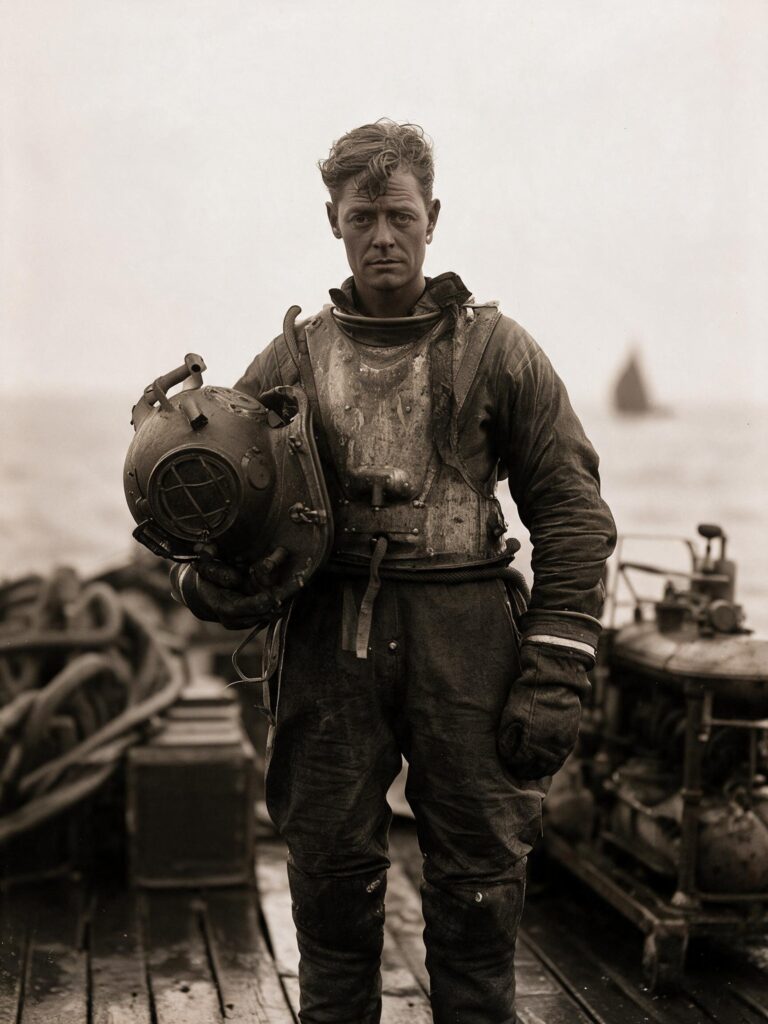
Part 1
For the remaining 37 years of his life, Absalom Vardsted refused to enter water deeper than his ankles.
He would not swim in a lake, cross a river in a boat, or step into the shallow end of a public swimming pool. He avoided docks and harbors. He would not board a ferry, even when doing so meant saving hours of travel. In the privacy of his own home, he washed standing at a sink, using a basin and a cloth, as though he belonged to an earlier century when immersion in water was considered a dangerous indulgence.
His wife, Astrid, never persuaded him to explain this aversion completely. She knew its beginning, and she knew that it had nothing to do with an ordinary fear of drowning.
Years after his death, when she was finally willing to discuss the summer of 1931, she described the change in her husband with a simplicity that made further explanation seem unnecessary.
“He came home wrong that August,” she said. “And whatever came home with him, it never quite left.”
Before that summer, Absalom had spent most of his adult life beneath the surface of the sea.
He was 37 years old in August 1931, a tall, spare Norwegian whose body had been shaped by heavy labor and years of exposure to cold. He was not thin in the unhealthy sense. Rather, he seemed to have been worn down to those parts of a man that were essential for survival. His shoulders were broad, his waist narrow, and his arms carried the dense, economical strength of someone accustomed to working against great resistance.
His hair was the dull color of wet rope. A small piece of his left ear was missing, taken by a swinging hook aboard a fishing vessel near Stavanger when he was 20. His hands were unusually distinctive. The knuckles were enlarged, the skin permanently roughened, and the nails split along their edges. After years of handling iron cables, bronze fittings, and submerged machinery, his fingers had acquired a slight inward curve. Even at rest, his hands appeared ready to close around an object.
He had been born near Bergen, Norway, and had crossed the Atlantic at 19. His early years in America were spent aboard herring boats working out of Gloucester. Later, he apprenticed himself to Angus Muir, a Scottish diver who specialized in salvaging coal barges and damaged vessels in Portland Harbor.
Muir taught him the use of standard diving dress: the heavy canvas suit, the copper helmet, the breastplate, and the lead-weighted boots that allowed a man to stand and work on the floor of a harbor or along the submerged side of a ship.
By 1931, Absalom had worked in that equipment for more than 10 years.
He had helped dismantle a torpedoed collier in 50 feet of dirty Atlantic water. He had walked the muddy bottom of the Kennebec River in almost complete darkness, following the hull of a sunken barge by touch. Near Nantucket, he had recovered a strongbox from a wreck, only to discover that it contained nothing more valuable than water-damaged accounting ledgers.
In 1927, he had spent 11 hours working on the submerged propeller of a tug stranded on a shoal, cutting away a cable in visibility so poor that his lamp illuminated scarcely more than his own hands.
He was familiar with the sensations that frightened inexperienced divers: the weight of black water overhead, the isolation, the narrowing of the visible world, and the knowledge that survival depended upon men working at the surface whom he could neither see nor reach.
He understood the sounds a ship made underwater. He knew the difference between a current moving through a companionway and the vibration of a loose plate against a hull. He knew that darkness could distort distances, and that a tired man might mistake drifting sediment for movement.
Above all, he had learned not to surrender himself to panic.
Once, when asked whether he feared dying beneath the sea, Absalom had answered with a remark his friends repeated for years.
“Death and I shook hands in a boat off Oscoy when I was 11. He’s a courteous fellow. He’ll wait.”
The remark was characteristic of him. He had no taste for boasting, and he rarely raised his voice. In dangerous circumstances, he became quieter rather than louder.
That temperament had made him valuable to salvage captains, particularly those who accepted work that better-funded companies considered too hazardous.
In late July 1931, one such captain approached him with a contract.
His name was Renard Cornish.
Cornish owned the Petronel Wrecking and Marine Recovery Company, a small salvage concern operating out of Rockland, Maine. He had once commanded merchant vessels and had accumulated enough money to establish a respectable business. The stock market collapse of 1929 had taken most of his savings, however, and the economic depression that followed had steadily reduced the amount of legitimate recovery work available along the coast.
By the summer of 1931, Cornish was in his 60s, lean and deeply sunburned, with a habitual squint that gave his face an expression of suspicion even when he was amused.
He had begun accepting contracts that other salvage operators declined.
The wreck of the SS Amberley was among them.
The Amberley was a coastal freighter, approximately 280 feet long, built in Sunderland, England, in 1906. She had entered American service in 1911 and spent the following years carrying general cargo between ports along the North Atlantic seaboard.
Her holds had carried paper-mill machinery, canned provisions, textiles, hardware, and industrial supplies. She was neither remarkable nor especially profitable, but she had been considered dependable.
In the final week of November 1929, she encountered a severe squall off the Maine coast near a formation known as Petronel Ledges.
The precise sequence of her sinking remained uncertain.
According to the surviving crew, the ship had been running toward shelter when a heavy swell struck her broadside. Something below decks, possibly unsecured cargo, shifted with sufficient force to damage the hull. A plate opened below the waterline, and water entered faster than the pumps could remove it.
The Amberley settled by the stern.
Of the 19 men aboard, 12 escaped in the lifeboats.
The remaining 7 went down with the ship.
Their employer survived the loss only briefly. The shipping company, already weakened by the financial collapse, ceased operations the following year. Its final cargo remained in the Amberley’s holds, approximately 190 feet below the surface.
For nearly 20 months, the wreck lay undisturbed.
Then an insurance concern in Hartford offered payment for the recovery of a strongbox believed to have been stored in the purser’s office.
The box reportedly contained approximately $60,000 in bearer bonds.
In the summer of 1931, the possibility of recovering that amount was sufficient to attract men who might otherwise have refused a dive approaching 32 fathoms.
Cornish accepted the contract.
He hired Absalom as his principal diver, Bertram Kohlstedt as tender, and Emmerick Palgrave to operate the air compressor.
Kohlstedt was a former Swedish naval man in his 50s. He had worked with Absalom on 2 earlier salvage operations and possessed a quality that was essential in a tender: the ability to remain attentive for hours without appearing to do anything at all.
He could sit beside a hose and lifeline throughout a long dive, watching the angle of the line, the movement of the water, and the condition of the machinery without allowing his concentration to wander.
Palgrave was younger, approximately 25, and less experienced. He was related to Cornish by marriage and had obtained his position largely through that connection.
Absalom did not know him.
This troubled the diver more than he admitted. In standard diving dress, the man operating the compressor controlled the supply of air on which the diver’s life depended. An error in judgment, an interruption, or even a moment of carelessness could leave a man helpless beneath hundreds of feet of water.
Absalom examined the machinery himself before agreeing to the work.
On August 7, 1931, the salvage tug Petronel departed Rockland beneath a low ceiling of cloud.
The vessel was aging and slow, with a worn deck, a cramped cabin, and an engine whose steady vibration traveled through the soles of a man’s boots. Cornish had rented her for the expedition because she was large enough to carry the compressor and lifting equipment, but inexpensive enough to leave some profit if the recovery succeeded.
The departure was uneventful.
The harbor disappeared astern. The coastline gradually flattened into a dark strip beneath the cloud cover, and the tug worked southward toward the marker left by a survey vessel above the wreck.
Absalom spent much of the passage inspecting his equipment.
He checked the helmet fittings, the telephone connection, the hose couplings, and the leather straps securing his weights. He spoke briefly with Kohlstedt about the depth, the expected current, and the position of the wreck. Nothing about the morning suggested that the work would prove different from other difficult recoveries.
Yet Absalom later remembered something peculiar about the air.
It carried a metallic odor.
Not the ordinary smell of marine machinery, fuel, or saltwater, but something dry and sharp beneath those familiar scents.
He told Father Cyprian Halverson many years afterward that the sea smelled of iron that morning.
He had never noticed such a smell before.
By the time the Petronel reached the survey buoy, it was nearly noon.
The buoy was a small orange shape rising and falling on the gray surface. Beneath it, a line disappeared into green water.
Cornish slowed the tug and brought her alongside the marker. The men prepared the equipment while the engine settled to an idle.
Absalom stood at the rail for several minutes, looking down.
There was no sign of the Amberley. The water revealed nothing of the iron hull lying far beneath it. A small swell passed under the tug, causing the buoy to rise, then sink into the trough beyond.
For a moment, Absalom experienced an impression that he could not explain.
It was not quite apprehension.
He had known apprehension before difficult dives, and this was different. It resembled the sensation of approaching a closed room and knowing, without seeing or hearing anything, that someone was already inside.
He considered the feeling, found no practical reason for it, and returned to his equipment.
At 1:12 that afternoon, he went over the side.
The standard diving dress enclosed a man almost completely. Its thick canvas suit restricted movement. The lead-soled boots, weighing approximately 18 pounds each, kept the diver upright against the buoyancy of the water. A metal breastplate supported the heavy copper helmet, which locked into place around the neck.
Air entered through a hose connected to the surface compressor. A separate line allowed the diver to communicate with the tender.
Once the helmet had been secured, the diver inhabited a sealed and artificial environment.
He could not wipe moisture from his forehead. He could not scratch an itch or clear his eyes with his fingers. Every breath arrived through machinery somewhere above him, and every movement had to be calculated against the resistance of the water and the weight of his clothing.
Absalom descended along a weighted shot line.
The green water near the surface gradually became darker. At 40 feet, the daylight had weakened considerably. Lower still, suspended sediment turned the water a muddy yellow-brown. Beneath that layer, the world assumed the deep color of slate.
The beam of his lamp failed to penetrate far ahead.
At 190 feet, darkness occupied nearly everything.
His boots touched the Amberley’s boat deck.
He had descended near the center of the ship, approximately where the survey drawings placed the officers’ accommodation.
For a moment, he stood still, adjusting his balance and listening to the quiet mechanical breathing inside his helmet.
Then he switched on his lamp.
The deck emerged in fragments.
A ventilator cowl stood beside the funnel, still turned toward a wind that had ceased to exist for the ship almost 2 years earlier. Lifeboat davits projected upward from their mountings. The funnel retained patches of paint. The seams between the deck planks were surprisingly tight.
What struck Absalom was not the presence of these objects but their condition.
He had worked on vessels submerged for shorter periods that were covered with marine growth, their exposed wood softened and their iron fittings heavily corroded.
The Amberley appeared strangely preserved.
There was growth on some surfaces, but far less than he expected. The exposed structures seemed unusually orderly. Even the silt had accumulated in a peculiar fashion.
Instead of lying in irregular deposits, it formed smooth, shallow lines where the bulkheads met the deck.
The effect was faintly domestic.
Absalom thought of dust that had been carefully swept into corners and left there.
He remained on the deck, turning his lamp slowly.
The current touched his air hose and drew it gently toward the stern.
Through the telephone connection, Kohlstedt’s voice sounded thin and distant.
“Absalom. Report.”
“On the boat deck. Amberley confirmed.”
“Everything sound?”
“Sound enough. Going below.”
He made his way toward the port companionway.
According to the ship’s plans, a passage beneath the boat deck provided access to the purser’s office. The office contained a small safe, and that safe was the likely location of the strongbox.
Absalom found the companionway entrance without difficulty.
Its door stood open.
There was nothing unusual about that. Wrecked vessels often contained doors forced loose by currents or left unsecured during abandonment. The Amberley had foundered quickly, and in the confusion of her last minutes a door might easily have been left standing wide.
But this door had not merely drifted open.
Something held it in place.
Absalom directed his lamp toward the lower edge.
An object had been positioned against the door, preventing it from closing.
He leaned forward.
It was a man’s black leather shoe.
The shoe appeared expensive, the sort an officer might have worn ashore or while dining aboard a passenger vessel. Its surface showed little sign of deterioration, and it had been placed upright against the doorframe, with the toe pointing into the passage.
A short distance away, against the interior bulkhead, stood the matching shoe.
It, too, was upright.
Its toe pointed inward.
Both shoes were free of the fine silt that covered the surrounding deck.
Absalom studied them.
He could imagine circumstances under which a man might have abandoned his footwear during a sinking. He could imagine currents carrying loose objects along a passage or trapping them against a door. Years spent on salvage work had taught him that water could arrange wreckage in ways that looked deliberate.
But the shoes appeared to have been set there.
Their alignment was too orderly.
For reasons he could not have explained, they reminded him of footwear left outside a bedroom door in a respectable household.
He straightened and activated the telephone.
“Bertram.”
“Go ahead.”
“There’s evidence someone has entered the wreck.”
A pause followed.
“What kind of evidence?”
“Some personal effects. Arranged inside the companionway. Doesn’t look accidental.”
Kohlstedt said nothing immediately.
Absalom could hear faint noise from the Petronel’s deck, followed by a muffled exchange.
“Captain says no other outfit has worked this wreck,” Kohlstedt replied. “He says come up.”
Absalom looked into the passage.
His lamp illuminated a narrow section of cream-painted wall, now dulled by a greenish film. Beyond it, the darkness continued beyond the reach of the beam.
“Give me 10 minutes,” he said. “I’ll make a look.”
Another pause.
“Captain says 5.”
“Then 5.”
He stepped over the shoes.
Inside, the passage was narrow and almost undisturbed.
A thin layer of silt covered the deck. It showed no obvious tracks or marks of recent movement. The walls retained their wooden paneling, and the doors of the cabins stood closed on either side.
Absalom advanced carefully, drawing the heavy hose behind him.
His own movement produced an unfamiliar intimacy of sound. The boots scraped against the deck. The canvas suit shifted at his shoulders. Air entered the helmet in measured pulses.
Beyond those noises, the vessel remained silent.
He passed a closed door on the left, then another on the right.
The 3rd door on his left belonged to the purser’s office.
It stood fully open.
Absalom entered.
His light passed across an upright chair, a narrow desk, and an oil lamp with a corroded brass base. The lamp’s glass chimney remained intact.
A ledger lay open on the desk.
Its pages had not entirely disintegrated, though the writing was no longer readable. The chair stood neatly tucked beneath the desk, and nothing appeared to have shifted violently during the sinking.
Against the far bulkhead stood a small safe.
Its door was open.
Absalom approached it and examined the interior.
There was no strongbox.
He searched beneath the desk, behind the chair, and along the edges of the office.
Nothing.
The safe had been emptied, although no survey or insurance record had mentioned that possibility.
He turned to leave.
And saw the strongbox standing in the passageway.
It sat approximately 8 feet beyond the purser’s door, in the direction from which he had come.
Absalom stopped.
He had passed that section of the passage moments earlier. His lamp had traveled over the floor. The object was large enough that he could not reasonably have overlooked it.
Yet there it stood.
The box was made of wood reinforced with iron bands, approximately 18 inches long and 12 inches wide. Its lid was closed, and its fittings appeared intact.
Resting on the lid was a small parcel.
Someone had folded a square of yellowish oilcloth around an object and secured it with a narrow black ribbon.
Absalom remained in the office doorway.
The parcel did not belong to the inventory he had studied. It had no apparent connection to the bonds.
Like the shoes, it appeared carefully placed.
After a moment, he called the surface.
“Bertram.”
“Go ahead.”
“I have the box.”
There was an audible release of breath at the other end of the line.
“Good. Attach the lifting line and come up.”
“Understood.”
He moved toward the strongbox.
With the effort required by the suit, he bent far enough to examine the parcel.
The ribbon had been tied in a simple knot.
He could have left it alone. His contract required him to recover the strongbox, not investigate its contents or anything resting upon it.
He knew that.
He also recognized that the object had probably been left there deliberately.
Slowly, he worked the knot loose.
The ribbon drifted away from the oilcloth.
Inside lay a photograph.
It was an old studio portrait mounted on stiff card, the kind commonly produced during the final years of the 19th century. The image was sepia-toned, with faint discoloration around its edges.
Despite nearly 20 months of submersion, the picture appeared remarkably well preserved.
Absalom lifted it into the lamplight.
The photograph showed a diver standing on the deck of a small salvage vessel.
Behind him stood a wooden compressor. Harbor structures were visible in the distance, indistinct and pale.
The diver wore standard dress, with the copper helmet removed and carried beneath an arm.
His face was clearly visible.
He was tall and spare, with narrow features and hair that had begun to gray. Deep lines marked the corners of his mouth and eyes. His expression suggested weariness rather than age alone.
A small section of his left ear was missing.
Absalom stared at the photograph.
The man was himself.
Not as he appeared in 1931.
The face in the picture belonged to an older Absalom Vardsted, perhaps 47, with silver beginning to spread through his hair and a tiredness in his expression that had not yet appeared in the man standing inside the wreck.
There was no reasonable possibility of mistaking the resemblance.
The ear made that certain.
In the lower corner of the photograph, someone had written a date in pencil.
August 7, 1941.
Exactly 10 years in the future.
The diver held the photograph motionless in his gloved hand.
Years later, in the account he gave Father Halverson, Absalom described the moment without offering an explanation.
He said that he understood the picture had been left for him.
More troubling still was the certainty that whoever had left it knew precisely what he looked like.
He placed the photograph back on the strongbox.
The oilcloth loosened in the water, and the black ribbon floated beside it.
Absalom straightened.
He turned slowly toward the passage.
At the far end, beyond the office and past the last visible doorway, his lamp began to lose its strength.
Something appeared to stand in that darkness.
He could not be certain of what he saw.
It might have been a trick of the light, a shadow thrown by a doorframe, or a shape his mind assembled from partial impressions.
Nevertheless, he believed for a moment that a man stood at the end of the passage.
A man wearing a diving suit.
The figure appeared to face him.
It did not advance.
Absalom did not point the lamp directly at it.
Instead, he returned his attention to the strongbox.
He secured the lifting line around its iron banding and gave the prescribed signal.
The line tightened.
The box rose from the deck and moved toward the companionway.
As it lifted, the oilcloth parcel slid from its lid.
The photograph drifted out of sight, settling toward the silt-covered boards.
Absalom watched it fall.
He did not retrieve it.
He followed the suspended box along the passage, stepped past the polished shoes, and climbed back onto the boat deck.
From there he made his way to the shot line.
The return to the surface was slow and controlled.
He paused at the required depths, allowing the pressure to diminish around him. The water gradually lightened from black to dark green, then to the pale, clouded color of the upper layers.
At approximately 4:00 that afternoon, his copper helmet broke the surface beside the Petronel.
Kohlstedt and Palgrave helped him aboard.
Cornish stood nearby, looking down at the recovered strongbox with an expression of unmistakable satisfaction.
The box had been opened.
Inside lay a sealed leather pouch containing the bearer bonds.
They were dry.
Cornish had recovered the money for which he had been hired, and by every practical measure the expedition had succeeded.
He congratulated Absalom.
The diver gave little response.
Once the helmet was removed, he sat on a bench near the compressor and watched the dark water beyond the rail.
His breathing remained steady.
His hands did not shake.
But when Cornish suggested that they might leave for Rockland in the morning, Absalom did not answer.
That evening the Petronel remained anchored above the Amberley.
The weather was calm, and a faint swell moved beneath the tug.
In the cabin, Cornish opened a bottle of rye whiskey and placed the recovered strongbox on the table.
Kohlstedt and Palgrave had gone to attend to the equipment.
Absalom sat opposite the captain.
For some time, Cornish spoke about the recovery fee and the arrangements for delivering the bonds. Then he poured another drink and rested his hand on the strongbox.
“There’s more in that ship than a purser’s box,” he said.
Absalom looked up.
Cornish explained that the Hartford insurance concern was not the only party interested in the Amberley.
A family living in Boston had contacted him privately.
They were Portuguese immigrants, and the family’s patriarch had served as the Amberley’s 2nd officer.
He was among the 7 men who had died when she sank.
According to his relatives, the officer had carried a small metal case in his cabin. The case was about the size of a cigar box and contained 3 objects: a silver crucifix that had belonged to his mother, a leather-bound prayer book, and a lock of hair wrapped in waxed paper.
The family wanted the case recovered.
They had offered Cornish $250.
Absalom listened without interruption.
The amount was not insignificant in the middle of the Depression, but it was hardly enough to justify sending a man down to 190 feet for belongings of no apparent commercial value.
Cornish understood the objection.
He had raised it himself when the family’s representative visited his office.
The man was a shipping clerk, elderly, nervous, and visibly exhausted. Throughout their conversation, his hands had trembled.
Cornish had asked why the family was prepared to pay so much for objects that could have little value to anyone else.
The clerk had answered that his father had been responsible for keeping the peace.
Cornish paused when he repeated the phrase.
“That’s exactly what he called it,” he said. “Keeping the peace.”
Before the Amberley sank, the officer had apparently performed some duty within the family that the others did not fully understand.
Since his death, the clerk said, strange things had occurred in the house.
His wife refused to sleep in the upstairs bedroom. Their dog had begun growling at the door of a room the dead officer used whenever he visited.
The clerk’s mother, a woman of 68 who had always been considered sensible and practical, claimed to hear her dead husband speaking to her.
The voice came from beneath the parlor floor.
It called her by name.
Sometimes it continued for hours.
The clerk believed the disturbance was connected to the objects carried aboard the Amberley.
If the silver crucifix could be returned to his mother, the prayer book placed in a church, and the lock of hair buried in the family plot, he was convinced the trouble would end.
Cornish drank from his glass.
“He says the peace hasn’t been kept since the ship went down.”
Absalom looked at the captain, then at the strongbox.
He had intended to tell Cornish about the polished shoes, the open safe, and the photograph. Throughout the evening, he had been arranging those observations into an account that could be understood without sounding irrational.
Now he was no longer certain how to begin.
Cornish continued.
“There was something else.”
The clerk had told him that shortly before the Amberley sank, his father experienced an unusual dream.
It occurred approximately 3 nights before the disaster.
The officer had awakened disturbed enough to mention it to a shipmate at breakfast.
In the dream, a diver was walking along the Amberley’s deck.
The diver approached the officer’s cabin and knocked on the door.
When the officer opened it, the stranger stood outside wearing a heavy canvas suit, with a copper helmet tucked beneath his arm.
The diver spoke only a few words.
“I’m coming for the case.”
Cornish finished the account and waited.
The cabin was very quiet.
A lantern hanging above the table shifted slightly with the motion of the tug. Outside, water touched the hull in slow, hollow sounds.
Absalom looked toward the dark window.
He thought of the photograph lying in the passageway, of the man who bore his face, and of the date written in pencil.
He thought of the shoes standing neatly at the companionway entrance.
And he thought of the figure he believed he had seen waiting in the darkness beyond the purser’s office.
At last he turned back to Cornish.
“I’ll go down tomorrow,” he said.
The captain appeared relieved.
Absalom offered no further explanation.
He did not mention the photograph.
He did not mention the shoes.
He did not describe the shape at the far end of the passage.
Later, he lay awake in his narrow bunk while the Petronel rose and fell gently above the wreck.
The woodwork creaked. Machinery cooled somewhere beyond the cabin wall. Occasionally, the anchor chain tightened with a muted metallic sound.
He could not sleep.
Somewhere near 4:00 in the morning, he became aware of a sensation that he would remember for the rest of his life.
It seemed to him that something connected him to the wreck.
Not merely the memory of what he had seen, nor his obligation to return for the officer’s case.
The connection felt almost physical.
He imagined a thin, cold thread extending from somewhere inside his body, passing through the bunk, through the tug’s hull, and down into the black water.
It followed the line to the Amberley, descended through the companionway, and continued along the passage toward the closed doors.
Beyond those doors, it disappeared into darkness.
And from that darkness, at irregular intervals, Absalom felt what seemed to be a faint, deliberate pull.
Not a violent movement.
Only a quiet tug, as though something far below wished to know whether he was still there.
Part 2
The morning of August 8, 1931, arrived without sunrise.
The eastern horizon gradually became visible beneath a uniform sheet of pale cloud. The sea, restless the previous afternoon, had settled into an unusual calm. There was almost no wind. The Petronel lay over the marker buoy with scarcely enough movement to make her rigging sound.
Absalom emerged from the cabin shortly before 6:00.
He had not slept.
His face was drawn, and a faint stiffness had settled around his eyes, but he showed no outward hesitation as he prepared the equipment.
Kohlstedt was already on deck.
The Swedish tender had spent much of the night checking the fittings and examining the air hose for signs of wear. He spoke little as he helped Absalom into the rubberized undergarments and heavy canvas suit.
Palgrave arrived at the compressor with a cigarette between his lips.
He seemed tired and irritable. His movements lacked the alertness Absalom preferred in a man responsible for his air supply.
Cornish had previously warned Palgrave against smoking near the machinery. That morning, he watched the young man for several seconds and said nothing.
Absalom noticed the omission.
He also noticed that the captain’s eyes were red and that Kohlstedt seemed unusually withdrawn.
The 3 men had slept poorly.
Whether the cause was the narrow bunks, the uncomfortable motion of the tug, or something else, Absalom could not tell. On a salvage vessel, exhaustion was common enough to require no special explanation.
Yet he remembered their condition afterward.
Each man appeared distracted in a different way.
Cornish moved impatiently between the cabin and the rail, checking his watch and looking toward the buoy. Palgrave busied himself with the compressor and avoided conversation. Kohlstedt inspected connections he had already examined, running his fingers along the same lengths of hose as though reassured by the repetition.
Absalom said nothing about his sleepless night.
He did not speak of the thread or the sensation of being drawn toward the wreck.
He occupied himself with familiar procedures.
The helmet was brought forward. The breastplate was secured. Kohlstedt checked the telephone and tested the air pressure. Absalom flexed his fingers inside the heavy gloves and shifted his weight from boot to boot.
Beyond the rail, the water looked motionless.
There was a faint metallic scent in the morning air.
He recognized it immediately.
Iron.
At 7:09, Absalom went over the side for the 2nd time.
The water closed above his helmet.
He grasped the shot line and began his descent.
At first, everything seemed ordinary. The air entered steadily. The telephone wire remained clear. The line was firm beneath his hands, and his weight carried him downward at the expected pace.
Then, at approximately 40 feet, the sensation of entering a room returned.
It was stronger than the previous day.
Absalom felt as though the surrounding water had ceased to be open sea and had become an enclosed space of extraordinary dimensions.
He could see no boundaries.
Nevertheless, there was an impression of walls beyond the range of his lamp and a vast ceiling somewhere above.
He imagined something waiting within that space, aware of him but making no effort to approach.
The thought irritated him.
He was a working diver, not a child frightened by darkness.
He tightened his grip on the line and continued downward.
At 190 feet, his boots touched the Amberley’s deck.
He reported his position to Kohlstedt and began walking toward the port companionway.
The wreck appeared unchanged.
The ventilator remained upright beside the funnel. The davits projected into the black water. The thin deposits of silt still lay in smooth lines against the deck structures.
Absalom moved directly to the entrance.
The 2 shoes were there.
Both stood exactly where he had found them.
Neither appeared to have shifted during the night.
Their polished leather surfaces showed no new sediment, though Absalom could see fine particles moving through the water beyond the threshold.
He stepped past them.
The narrow passage was silent.
The silt lay undisturbed across its floor. The cabin doors remained closed. The purser’s office stood open, just as he had left it.
He passed the office without entering.
The strongbox was gone.
The place where it had stood showed no clear indentation in the silt, and Absalom could find no sign of the oilcloth or the photograph.
He had watched the parcel fall to the deck during the recovery, yet now there was nothing where he expected to find it.
He did not stop to search.
The passage extended ahead of him toward the last cabin on the port side.
On the previous afternoon, he had believed that a figure stood in that direction, just beyond the reach of his lamp.
Now, as he approached, the darkness resolved into a closed door.
There was no visible figure.
The door was narrow, with a metal handle and a small identification plate clouded by corrosion.
According to the plans, it opened into the cabin belonging to the Amberley’s 2nd officer.
Absalom stopped several feet away.
He studied the frame.
The door fitted closely. There was no visible damage around the hinges, no sign that it had been forced open by the sinking, and no sediment disturbed around its base.
It looked like the door of a cabin in a ship still carrying its crew.
He called Kohlstedt.
“Bertram.”
“Go ahead.”
“I’m at the officer’s cabin.”
A brief crackle passed along the wire.
“You have the location?”
“Confirmed.”
“How does it look?”
“Door’s closed. No apparent damage.”
Kohlstedt told him to proceed cautiously.
Absalom placed his gloved right hand on the handle.
For a moment, he remained motionless.
He could hear his breathing inside the helmet.
The air entered through the hose with a steady mechanical hiss, then left through the exhaust valve in short, muted bursts.
The sound had accompanied him on hundreds of dives. Usually, after a few minutes underwater, he ceased to notice it.
Now each breath seemed unusually loud.
He turned the handle.
The door opened easily.
There was no resistance from warped wood or rusted fittings. It swung inward as though someone had recently attended to its hinges.
Absalom directed his lamp into the cabin.
The room was small, approximately 8 feet long and 6 feet wide.
A single bunk occupied the port wall. A desk stood forward, with a chair positioned beneath it. Against the starboard bulkhead rested a small trunk. A round porthole admitted no visible light.
Its glass was cracked, though the metal frame remained intact.
The cabin contained little sediment.
There were no obvious signs of the violent flooding that must have accompanied the Amberley’s sinking.
Absalom moved his lamp from the desk to the trunk.
Then the beam reached the bunk.
Someone was lying on it.
For several seconds, Absalom could make no sense of what he saw.
The figure wore a complete diving suit.
The canvas was heavy and dark, the boots weighted with lead, and the copper helmet firmly secured to the breastplate.
The figure lay flat on its back, with its arms resting beside the body and its feet extending toward the end of the bunk.
A hose emerged from the back of the helmet.
It followed the curve of the bulkhead and disappeared through a crack beside the porthole.
Where it went beyond the ship, Absalom could not determine.
The diver’s breastplate moved.
It rose slightly.
Then it fell.
A few moments later, it rose again.
The person on the bunk appeared to be breathing.
Absalom stood in the doorway.
His first thought was that another salvage outfit had reached the wreck.
Perhaps a diver had become trapped. Perhaps the man’s air was still being supplied from some vessel at the surface, outside the range of the Petronel’s observations.
The explanation was improbable, but it was the only explanation his experience offered.
It did not survive what happened next.
The figure turned its head.
The copper helmet rotated slowly across the pillow until its thick glass faceplate pointed directly toward the doorway.
Absalom could see no face behind the glass.
It was dark.
The helmet remained directed at him.
He did not step forward.
Neither did he retreat.
He stood with his lamp fixed on the figure and waited for some movement that would establish whether the occupant of the bunk was alive, injured, or dead.
The figure moved again.
Its arms shifted at its sides.
Then it sat upright.
Absalom knew the weight and limitations of the diving equipment better than he knew almost anything else.
A man wearing standard dress could not rise easily from a narrow bunk. At the surface, the suit was cumbersome. Underwater, buoyancy relieved some of its weight, but its stiffness still restricted the body.
The figure on the bunk sat up without apparent effort.
Its movements were smooth and carefully controlled.
The diver swung its legs over the side of the mattress.
The lead boots came to rest on the deck.
Then it stood.
It was taller than Absalom.
The shoulders filled much of the narrow cabin, and the copper helmet nearly reached the overhead beams.
For several seconds, the 2 divers faced each other in silence.
Absalom’s lamp illuminated the breastplate, the canvas folds, and the glass of the helmet.
He could still see nothing within the faceplate.
He thought he should speak.
He could ask the figure’s name. He could use his telephone to report another diver inside the wreck. He could retreat into the passage and wait for instructions.
Instead, he remained motionless.
What he felt was not ordinary fear.
He had experienced fear in open water, in damaged hulls, and beneath ice. Fear usually concerned the immediate possibility of injury or death. It sharpened his thinking and directed his attention toward escape.
This feeling was different.
It was closer to recognition.
He had entered the cabin expecting to find a lost officer’s possessions, and instead he had found someone who seemed to have been waiting for him.
The diver raised its right hand.
The gauntleted fingers extended past Absalom’s shoulder, pointing into the passageway behind him.
The gesture was deliberate.
Absalom turned his head.
There was nothing behind him.
The passage stood empty. The purser’s door remained open farther along the wall. No movement disturbed the silt.
He turned back toward the cabin.
The other diver had moved closer.
Absalom had not heard its boots.
He had not seen it take a step.
But the distance between them had diminished.
The copper helmet faced him from only a few feet away.
Absalom reached for his telephone control.
His hand found the mechanism.
He tried to speak.
No sound emerged.
His throat seemed to close around the words. He could hear his own breathing, louder and more rapid now, but he could not make himself call the surface.
The figure raised its right hand again.
This time the palm turned upward.
The gesture was unmistakable.
It was an invitation.
Absalom was being asked to enter the cabin.
The other diver stood aside just enough to leave a space beyond the threshold.
Nothing in its posture suggested an intention to attack.
It did not seize his arm or try to drag him forward. It simply waited, one hand extended, in the manner of someone offering passage through a doorway.
And in that moment, Absalom thought he understood the photograph.
He remembered the image of himself standing on the deck of a salvage vessel, wearing the same equipment, with deeper lines around his eyes and gray spreading through his hair.
He remembered the date.
August 7, 1941.
The realization did not arrive as a reasoned conclusion.
It came with the force of something already known.
He believed that the diver standing before him was himself.
Not the man he had been at 37, but the man he might become at 47.
Somehow, impossibly, a version of Absalom Vardsted from 10 years in the future had entered the Amberley’s cabin and was waiting for him there.
The idea was beyond anything he had encountered.
Yet the longer he looked at the figure, the less he doubted the connection.
The empty faceplate, the familiar shape of the suit, the posture of the waiting man, and the photograph lying somewhere in the wreck all seemed parts of an arrangement whose purpose he had only begun to recognize.
If he stepped through the doorway, he believed, he would remain in the cabin.
He would take the place of the diver waiting there.
And the figure would leave.
It would pass him in the doorway, move along the passage, climb the shot line, and rise to the Petronel.
The men on deck would remove its copper helmet.
They would see Absalom Vardsted.
They would recognize the face, the damaged ear, and the hands they knew.
The figure would take his place in the world above.
It would live the intervening years as him, wearing his appearance, speaking with his voice, and inhabiting the life that should have belonged to him.
Then, on August 7, 1941, the exchange might begin again.
He could not explain why he believed this.
No voice had told him.
The figure had communicated nothing beyond the silent invitation.
Nevertheless, the entire sequence presented itself to him with a terrible coherence.
The diver took another step.
Absalom’s hand tightened around the telephone control.
At last he found his voice.
“Bertram,” he said.
The word sounded unfamiliar inside his own helmet.
He swallowed and forced himself to speak again.
“Bertram. Pull me up now.”
Kohlstedt answered immediately.
“Absalom?”
“Pull me up. Now.”
The tender did not ask what had happened.
Later, he would say that Absalom’s voice had been unlike anything he had heard from him before. There was no panic in it, no shouting, and no obvious confusion.
It sounded like a man delivering a final instruction.
Kohlstedt gave the emergency signal.
Above the wreck, Cornish and Palgrave moved to assist him.
The lifeline tightened against Absalom’s harness.
Inside the cabin, the waiting diver remained still.
Absalom stepped backward into the passage.
The figure did not follow.
He took another step.
The outstretched hand remained raised.
Then, very slowly, the copper helmet tilted to 1 side.
The motion was slight.
It resembled the movement of a person considering an answer, or asking whether a decision had been made carefully.
There was no anger in it.
No threat.
Only the quiet suggestion that Absalom might wish to reconsider.
He stared at the dark faceplate.
“I’m certain,” he said.
His voice sounded hollow within the helmet.
The figure did not move.
Absalom turned away.
He began walking as quickly as the weighted boots and narrow passage allowed.
He passed the purser’s office and reached the companionway. The polished shoes stood beside the doorway, undisturbed.
He stepped over them without looking down.
On the boat deck, he followed the taut line toward the place where he had descended.
He could feel the pull from above.
He signaled that he was ready.
The ascent began almost immediately.
It was too fast.
Kohlstedt had recognized the urgency in Absalom’s voice, but the men above had not fully understood the consequences of hauling a diver from such depth without proper decompression.
Cornish joined the operation, and Palgrave abandoned his usual position long enough to assist.
The line moved upward.
Absalom rose from the Amberley’s deck.
The wreck disappeared below his boots.
He passed through the black water, then the dark green layers above it.
The pressure changed around him.
Ordinarily, an ascent from such depth required careful pauses. A diver had to allow dissolved gases to leave the tissues gradually, avoiding the dangerous effects of a sudden reduction in pressure.
But the men at the surface were frightened.
They hauled him upward in approximately 9 minutes.
By the time he reached the upper water, Absalom knew something was wrong.
Pain had begun to develop deep within his joints.
His legs felt stiff and unfamiliar.
The sensation spread toward his shoulders and arms. His hands, already enclosed in thick gloves, seemed to lose their ordinary strength.
He tried to signal for a slower ascent.
The line continued pulling.
When his helmet finally broke the surface, the Petronel’s crew dragged him aboard.
Kohlstedt removed the helmet.
Absalom attempted to stand.
His legs failed beneath him.
He collapsed against the deck, unable to support his own weight.
A faint stream of blood appeared at his nose. There was blood at his ear as well.
His joints began to lock, and pain moved through his body in heavy, tightening waves.
Cornish recognized the symptoms of decompression sickness almost immediately.
The men laid Absalom on the deck while the captain ordered the equipment secured and prepared to return to shore.
They were no longer concerned with the officer’s metal case.
Whatever remained in the Amberley would remain there.
The Petronel turned toward Rockland.
Absalom remembered little of the journey.
At times he was conscious of the sky above him, a pale expanse crossed by slow clouds. He remembered the vibration of the tug and the pressure of a folded blanket beneath his head.
He remembered hearing someone say that the bends could kill him.
He could not recall who spoke.
During the journey, a sentence repeated itself in his mind.
He had stepped back.
Whatever had been offered to him in the cabin, he had refused.
He had stepped back.
He held to that knowledge while the pain spread through his body.
It was the only part of the experience that remained clear.
At Rockland, Cornish arranged transport to a naval facility in Portland where a recompression chamber was available.
He drove Absalom through the night in a borrowed truck.
The diver lay nearly motionless, his body stiff with pain. At intervals, he drifted into confused sleep, then awakened to the sound of the engine and the uneven movement of the road.
At approximately 3:30 on the morning of August 9, he was placed in the chamber.
The treatment continued over the following days.
Pressure was restored and carefully reduced in an effort to relieve the effects of his rapid ascent.
Absalom survived.
By August 11, he had emerged from treatment alive, though weakened and visibly changed.
He was still 37 years old.
But the men who had known him before the dive noticed something altered in his appearance.
His hair had begun to gray at the temples.
Deep lines had formed around his mouth. His movements were cautious and sometimes unsteady. A slight tremor appeared in his hands, most visible when he tried to perform delicate tasks.
The tremor would remain with him for the rest of his life.
Cornish visited him before he left Portland.
The captain attempted to discuss the failed recovery of the officer’s case, but Absalom showed no interest in the subject.
When Cornish asked what had happened inside the wreck, the diver answered only that there had been someone in the cabin.
Cornish waited for more.
Absalom said nothing.
The captain suggested that low visibility, exhaustion, and pressure might have affected his judgment.
Absalom did not argue.
There was nothing he could have said that would make Cornish understand.
He no longer cared whether the captain believed him.
The following day, he prepared to return home.
He did not ask about the Petronel, the recovered bonds, or whether another expedition would attempt the officer’s cabin.
As far as he was concerned, the work was finished.
On August 14, Astrid Vardsted met her husband at the Rockland railway station.
She had expected a man recovering from a serious diving accident.
Instead, she saw someone who seemed to have aged 15 years in the space of a week.
His shoulders were still broad, and his posture remained upright, but his face had lost much of its former vitality. Gray marked his temples. His expression was guarded and remote.
When she took his hand, she felt the faint tremor in his fingers.
She asked whether he was in pain.
He told her he was tired.
During the journey home, he kept his hat pulled low over his face.
The road passed places from which the harbor and the open water could be seen. Ordinarily, Absalom would have watched the vessels working offshore, identifying their types and studying the weather beyond the breakwater.
Now he looked down at his knees.
When Astrid asked whether something was wrong with his eyes, he said there was nothing wrong with them.
He simply did not wish to look at the water.
Their rented house stood on a hill above the town.
From an upstairs window, a person could see portions of the coast through the trees.
Absalom never again stood at that window for the purpose of watching the sea.
He recovered enough strength to walk, work, and manage the ordinary demands of life, but the accident left lasting physical effects.
The tremor in his hands persisted.
On cold mornings, his joints stiffened. At times, pain settled into his legs for hours.
He rarely complained.
The more remarkable change was not physical.
He refused to enter the sea again.
At first, Astrid assumed his reluctance was temporary.
He had nearly died from decompression sickness. It seemed reasonable that he would avoid deep diving, perhaps permanently. No sensible person could have blamed him for abandoning such dangerous work.
But his refusal soon extended beyond diving.
He would not board a boat.
He would not travel by ferry.
He would not walk onto a pier, even on a clear day when the harbor was calm.
When a journey required crossing a river, he insisted upon using a bridge.
If no bridge was available, he changed the route.
He stopped fishing.
He discarded his fishing tackle and avoided the shore.
He no longer kept a bathing suit or any of the small equipment once associated with his life on the water.
At home, he began washing at a sink.
He would fill a basin, wet a cloth, and clean himself while standing.
Astrid tried to persuade him that a bath was different from a dive.
He agreed with her.
Then he continued washing at the sink.
She eventually ceased arguing.
His habits became part of their household, peculiar but firmly established.
Absalom took employment in a hardware store in Ashcombe, a small inland town in central Maine.
The move placed him far from the coastal work that had once sustained him.
He sold nails, stove parts, hinges, rope, tools, and the ordinary supplies required by farmers, carpenters, and householders.
He proved a dependable employee.
His experience with metalwork, rigging, and machinery made him useful to customers, and he possessed the patient manner of a man who had learned to solve problems without wasting motion.
He rarely discussed his former occupation.
People sometimes noticed the roughened hands, the damaged ear, and the faded marks where diving equipment had once pressed against his skin.
If asked, he acknowledged that he had worked as a salvage diver.
He did not elaborate.
There was a particular kind of customer he disliked serving.
Whenever someone entered the store seeking a cleat, a bilge pump, marine varnish, or another item intended for use aboard a boat, Absalom became strangely reserved.
He would often say that the store did not stock such equipment.
Sometimes the requested article was on a shelf within sight of both men.
Other employees learned to intervene when necessary.
They considered his behavior an eccentricity left by the accident.
Absalom offered no correction.
He performed his work, returned home at the end of each day, and lived quietly with Astrid.
There were evenings when she found him sitting without a book or newspaper, his hands resting on the arms of his chair.
He did not appear asleep.
Sometimes his gaze was fixed on a dark corner of the room.
When she spoke, he answered promptly enough.
But there were moments when she had the impression that he had been listening to something beyond her hearing.
He never again used the easy remark about death being a courteous fellow.
And he did not speak of the Amberley.
For nearly 2 years, Astrid accepted his silence.
Then, in 1933, an incident occurred that changed her understanding of what had happened.
She was rearranging books on a shelf when a small photograph slipped from between the pages of a Bible.
It fell faceup onto the floor.
At first, she assumed it was an old portrait Absalom had forgotten.
She bent to retrieve it.
The picture showed a man standing on the deck of a salvage vessel.
He wore the heavy clothing of a professional diver and held a copper helmet beneath his arm.
Astrid recognized her husband’s face immediately.
Yet the resemblance disturbed her.
The man in the photograph was older than Absalom had been when the picture could reasonably have been taken. His hair was grayer, and his expression carried a weariness she recognized from the months following the accident.
There was also something strangely formal about the pose, as though the photograph had been made to record a particular moment rather than to commemorate an ordinary working day.
She examined it more closely.
The familiar injury to his left ear was visible.
In the lower corner, there was a faint penciled date.
August 7, 1941.
Astrid stood holding the photograph.
The year was still 8 years away.
When Absalom entered the room, she turned toward him.
“Absalom, when was this taken?”
He looked at the photograph.
The change in his expression was immediate.
For a moment, he appeared unable to move.
Then he approached her and held out his hand.
“It hasn’t been,” he said.
Astrid looked down at the picture again.
“What do you mean?”
He did not answer.
He took the photograph gently from her fingers and walked to the stove.
She followed him.
Without another word, he opened the stove door and placed the photograph inside.
The paper curled in the heat.
The edges darkened, then caught fire.
Absalom watched until the image disappeared.
Only when the last recognizable fragment had become ash did he close the stove.
Astrid remained beside him.
She had never seen her husband destroy a photograph before.
She wanted to ask where he had obtained it, why it had been hidden in the Bible, and what he meant when he said that the picture had not yet been taken.
But his face had become so closed and exhausted that she could not bring herself to question him further.
He returned the Bible to the shelf.
Neither of them mentioned the photograph again.
Yet Astrid remembered its date.
And as the years passed, she began to notice that her husband remembered it too.
Part 3
By the summer of 1941, Absalom Vardsted had spent nearly 10 years living beyond sight of the sea.
The change in his circumstances had gradually become permanent.
He was known in Ashcombe as a courteous, reserved man who worked steadily and caused no trouble. Customers brought him broken hinges, damaged tools, and questions about machinery. He answered carefully, sometimes sketching a simple repair on a scrap of paper or demonstrating how a fitting should be assembled.
He remained exceptionally knowledgeable about ropes, cables, and metalwork.
When he encountered a difficult mechanical problem, some of his old habits returned. He would lean forward, narrow his eyes, and turn the damaged object slowly in his hands, studying it with the same concentration he had once brought to machinery submerged in black water.
He rarely wasted a movement.
But when the work was finished, his hands sometimes trembled as he put the tools away.
The tremor had become more pronounced with age. He learned to manage it through patience rather than force.
Astrid watched these small accommodations accumulate.
There were mornings when he took longer than usual to fasten his collar. Sometimes he held a cup in both hands. On damp days, his joints troubled him enough that he avoided unnecessary walking.
None of these limitations seemed to anger him.
What disturbed Astrid was the manner in which he occasionally stopped listening to the conversation around him.
He might be sitting beside the stove, reading, when his attention suddenly shifted.
His eyes would rise from the page.
He would remain perfectly still, his head inclined slightly, as though trying to distinguish a faint sound somewhere beyond the room.
The expression would pass after several seconds.
If she asked what he had heard, he would say nothing.
At times, he seemed puzzled by the question.
She wondered whether the diving accident had left some injury that the doctors had failed to recognize.
Absalom had no interest in returning for further examinations.
He said he was well enough.
He worked, ate, slept, and fulfilled his responsibilities. That, in his view, was sufficient.
The years had softened some of Astrid’s concern, but they had not erased her memory of the photograph.
She had never forgotten the date written in its corner.
August 7, 1941.
As that summer approached, she noticed changes in her husband’s behavior.
At first, they were so slight that she could not be certain they meant anything.
He became less talkative in the evenings. He spent more time sitting alone. Occasionally, he looked toward the calendar hanging in the kitchen, then turned away without comment.
In late July, he began waking unusually early.
Astrid would find him sitting at the kitchen table before sunrise, fully dressed, with a cup of coffee that had gone cold.
When she asked whether he was sleeping poorly, he told her that he had never required much sleep.
That was not true.
Before 1931, he had slept heavily and peacefully, as men accustomed to physical labor often do.
She chose not to contradict him.
By August 3, Absalom had almost stopped eating.
He accepted small portions of bread and drank water, but showed little interest in the meals Astrid prepared.
His face grew pale.
He continued going to the hardware store, though his employer remarked that he seemed distracted.
On August 6, he returned home earlier than usual.
He sat beside the parlor stove for most of the evening.
There was no fire inside it. The weather was warm, and the stove had not been needed for weeks.
Nevertheless, he remained in his chair, staring at the dark iron door.
Astrid sat nearby with her sewing.
They spoke very little.
Shortly before bed, she asked whether he wanted her to call a doctor.
“No,” he said. “There’s nothing a doctor can do.”
She looked at him.
“Absalom, what is happening?”
He did not answer immediately.
His eyes moved toward the mirror above the mantel.
For several seconds, he studied the darkened room reflected in its glass.
Then he stood.
“Nothing yet,” he said.
He went upstairs without explaining what he meant.
The following morning was August 7, 1941.
Exactly 10 years had passed since the day he first entered the Amberley.
Astrid found him already seated at the kitchen table.
He had shaved and dressed carefully. His collar was straight, and his shoes were polished.
He looked as though he intended to attend an important meeting.
But he had prepared no breakfast.
A glass of water stood untouched beside his hand.
When she entered, he raised his eyes to her.
“Astrid,” he said, “I’d like to ask you something.”
His voice was steady.
She sat opposite him.
“Of course.”
“For today, would you keep me away from mirrors?”
She waited.
He seemed embarrassed by the request, though he made no attempt to explain it.
“Just for today,” he added.
Astrid remembered the photograph.
She remembered the older face, the copper helmet, and the penciled date.
She did not ask why.
Instead, she went through the house with a bundle of bedsheets.
She covered the mirror over the parlor mantel, the mirror in their bedroom, and the small glass above the washstand.
She checked the other rooms.
Wherever Absalom might see his reflection, she covered the surface.
He watched her carry the sheets upstairs.
When she returned, he was still at the kitchen table.
“Thank you,” he said.
He did not go to work that day.
They remained together in the house.
The morning passed quietly.
Absalom sat in the parlor while Astrid occupied a chair nearby. She read for a time, then put the book aside. Later, she prepared tea and brought it to him.
He drank a little.
He would not eat.
Outside, the weather was ordinary for August in central Maine. Sunlight moved across the garden. A breeze stirred the leaves near the porch. Somewhere along the road, a farmer drove past with a wagon, and the wheels made their familiar noise over the uneven ground.
Nothing happened that could be described as unusual.
Yet Astrid remembered the day more clearly than many of the important events of their marriage.
The house seemed to have become a place in which something was expected.
Absalom rarely moved from his chair.
At intervals, he closed his eyes.
Sometimes his hands tightened on the armrests.
Once, in the middle of the afternoon, he raised his head sharply and looked toward the covered mirror above the mantel.
Astrid followed his gaze.
The bedsheet hung motionless.
After several seconds, he lowered his eyes again.
She did not ask what he had seen.
As evening approached, his attention became more concentrated.
He watched the slow movement of light across the floorboards.
At sunset, he asked Astrid to close the curtains.
She did so.
They lit a lamp.
The room became a small circle of amber light surrounded by shadow.
Absalom sat upright.
He seemed to be listening.
At times, Astrid thought his breathing had become unusually measured, as though he were counting each breath.
She remembered the years when he had worked beneath the sea and wondered whether he was unconsciously returning to the rhythm of the diving helmet.
He had never told her how the air sounded inside that helmet.
He had never described what it was like to depend upon a hose descending from a vessel far above.
Nevertheless, she found herself watching his chest rise and fall.
The hours passed.
They did not speak.
When midnight came, Absalom remained in his chair.
Astrid stayed beside him.
Sometime afterward, he appeared to relax.
His shoulders lowered. His hands loosened.
He did not smile.
He simply looked toward the covered mirror and then at the lamp on the table.
The room was unchanged.
Before dawn, he finally slept.
Astrid did not move him.
She brought a blanket and placed it over his knees, then sat nearby until the light outside the curtains began to brighten.
On August 8, he awakened shortly after sunrise.
For several minutes, he seemed uncertain where he was.
Then he looked at Astrid.
“You can uncover the mirrors,” he said.
She searched his face for some indication of what had passed.
He appeared exhausted, but the fixed attention that had troubled her the previous evening was gone.
She removed the sheets.
The house gradually returned to its ordinary appearance.
When she uncovered the mirror above the mantel, Absalom rose from his chair.
He crossed the room and stood before it.
Astrid watched from the doorway.
Her husband studied his reflection for a long time.
He looked at his gray hair, the lines around his eyes, and the face that had changed so greatly since the summer of 1931.
He examined himself with a concentration that made Astrid think of a man trying to identify someone he had not seen for years.
At last he stepped back.
“It wasn’t me then,” he said quietly.
He paused.
“Good.”
That was all.
He never explained the words.
The following week, he returned to the hardware store.
His appetite recovered. He resumed his ordinary schedule, and the household settled back into its familiar routine.
But Astrid understood that the day had mattered to him.
Whatever he had expected on August 7 had either failed to occur or had occurred in some manner that left him alive and apparently unchanged.
She could not determine which possibility was more disturbing.
The date passed into memory.
Yet the years that followed did not entirely free Absalom from whatever had begun in the Amberley.
At intervals separated by 7 years, Astrid noticed a return of his peculiar watchfulness.
He would grow quiet for several days, avoid reflective surfaces, and spend long evenings sitting where he could observe the entrances to a room.
She gradually learned to cover the mirrors without asking.
There was no explanation she could offer to another person that would not make the custom sound absurd.
She did not tell their neighbors.
The arrangement belonged to the private history of their marriage.
Absalom remained considerate toward her throughout these periods. He thanked her for ordinary things and never spoke harshly.
He simply appeared to be waiting for a disturbance to pass.
There were moments when Astrid suspected that he was measuring time according to some calendar different from the one used by everyone else.
His life had become divided into years that others could see and intervals that seemed to matter only to him.
He never returned to the coast to investigate the wreck.
Nor did he attempt to contact Cornish or the men who had served aboard the Petronel.
Whatever questions remained unanswered after the 2nd dive, he left them unanswered.
The small metal case belonging to the Amberley’s 2nd officer had not been recovered.
The silver crucifix, prayer book, and lock of hair remained somewhere within the vessel, assuming they had survived the sinking.
Whether the Portuguese family in Boston continued to experience the disturbances described by the shipping clerk was never established in Absalom’s account.
He spoke of the family only when asked about the reasons for his return to the wreck.
He had no satisfactory explanation for their story.
Sometimes Astrid wondered whether the officer’s dream had been connected to her husband’s experience in a way neither of them understood.
The officer had dreamed of a diver coming for the case.
Absalom had entered the cabin and found another diver waiting.
Both accounts contained a doorway.
Both concerned an encounter that appeared to have been anticipated before it occurred.
Yet the relationship between them remained obscure.
The missing case might have been the reason Absalom returned, or it might have been no more than a means of bringing him back to the cabin.
He never said which he believed.
As he grew older, he withdrew even further from conversations about the sea.
Occasionally, a customer at the hardware store would mention a wreck found off the coast or a vessel lost in a storm.
Absalom would listen politely.
If someone asked about his own diving experience, he answered in practical terms.
He could describe how a helmet was secured, how a line was managed, or how a diver worked in poor visibility.
He never described the Amberley.
He did not use the word haunted.
He did not speak of ghosts.
He did not claim to have discovered anything about death or time.
The few people who knew of his accident regarded his fear of water as a lasting consequence of decompression sickness.
Absalom allowed them to believe it.
He lived with Astrid in Ashcombe for the remainder of his working years.
Their life was modest.
The house was kept in good order. He repaired what needed repairing and tended to his responsibilities as his health permitted.
When he could no longer work comfortably, he spent more time at home.
His hands continued to tremble.
He grew thin.
The damaged left ear remained an unmistakable feature of his face, though the rest of his appearance changed so much that the young salvage diver of 1931 became increasingly difficult to imagine.
In the final years of his life, he developed cancer.
The illness progressed slowly at first, then more rapidly.
By 1968, he was confined to bed for much of the day.
Pain and exhaustion had reduced his strength, but his mind remained clear.
It was during these last months that he became willing to speak about the Amberley.
The person who listened was Father Cyprian Halverson, a priest serving the parish in Ashcombe.
Halverson had known Absalom as a quiet, dependable member of the community. He was familiar with the old diver’s unusual habits, though not with their origin.
As the illness advanced, the priest began visiting the house regularly.
At first, their conversations concerned ordinary matters.
Absalom spoke about his childhood near Bergen, his arrival in America, and the years he had spent working in harbors along the northeastern coast.
He remembered Angus Muir, the Scottish diver who had taught him his trade.
He described the weight of the copper helmet and the peculiar loneliness of walking across the floor of a harbor with only a few feet of visibility.
Halverson found these recollections fascinating.
He asked questions.
Absalom answered carefully.
Eventually, the conversation reached the summer of 1931.
The old man became quiet.
For some time, he looked toward the window.
Then he began describing the Amberley.
He spoke of the 1st descent, the preserved deck, and the shoes at the companionway.
He described the open safe, the strongbox that appeared in the passage, and the photograph dated 10 years in the future.
He told Halverson about the figure at the end of the passage and Cornish’s account of the officer’s dream.
Then he described the 2nd dive.
The priest listened without interrupting.
Absalom’s manner was calm.
He did not embellish the details or attempt to make them more frightening. He spoke as though recounting a difficult recovery operation whose facts had become permanently fixed in his memory.
When he reached the cabin, his pace slowed.
He described the diver lying on the bunk.
He remembered the hose passing through the cracked porthole, the slow movement of the breastplate, and the dark glass of the helmet.
He described how the figure stood and extended its hand.
Then he explained what he had believed would happen if he entered.
Halverson asked whether he thought the figure had truly been himself.
Absalom considered the question.
“I don’t know what it was, Father.”
The priest waited.
“I know what I understood when I saw it.”
He closed his eyes for a moment.
“It wanted me to take its place.”
Halverson asked how he could be certain of that.
“I wasn’t certain of anything else.”
The old man opened his eyes.
“But I was certain of that.”
The priest did not try to persuade him otherwise.
He made notes after their conversations, preserving the sequence of events as accurately as he could.
There were details he found difficult to reconcile.
The photograph was among them.
According to Absalom, he had watched the parcel slip from the strongbox and fall to the passageway floor during the 1st dive.
Yet Astrid had found that same photograph inside a Bible in 1933.
Absalom offered no explanation for how it had come into his possession.
He remembered leaving it.
He also remembered the day Astrid found it.
Both memories remained clear to him.
Halverson asked whether he might have retrieved the photograph without remembering.
Absalom shook his head.
“I watched it fall.”
The priest suggested that memories formed under extreme stress could be unreliable.
Absalom accepted the possibility without argument.
But he did not alter his account.
The same was true of the diver in the cabin.
He acknowledged that the water had been dark and his body under enormous pressure.
He understood that exhaustion and fear could affect perception.
Nevertheless, he maintained that someone had stood before him, wearing a copper helmet, and had silently invited him through the doorway.
For most of the 37 years since the incident, he had avoided speaking of that encounter because he knew how it would sound.
He had no wish to convince the world.
Now, approaching death, he seemed interested only in describing what he remembered.
On 1 of Halverson’s final visits, Absalom returned to the subject without being prompted.
The room was quiet.
Astrid had gone downstairs, leaving the priest beside the bed.
Outside, autumn light fell across the window.
Absalom lay with his hands resting on the blanket.
His voice had become weak, but the words were clear.
“Father, there’s a man in a copper helmet standing in a cabin in the black at the bottom of the North Atlantic, off the coast of Maine.”
Halverson said nothing.
“He has been standing there for 37 years.”
Absalom looked toward the ceiling.
“He is still standing there.”
The priest asked how he could know.
The old diver turned his head.
“Every 7 years, I feel him tilt his head.”
The statement seemed to exhaust him.
He rested for several moments.
Then he spoke again.
“I stepped back, Father.”
His fingers tightened faintly against the blanket.
“But I don’t know if I stepped back far enough.”
Halverson wrote those words down.
He understood that the dying man was not asking him to solve the mystery.
He was describing a burden that had accompanied him through almost every remaining year of his life.
Whether the burden came from something that had happened beneath the sea or from the mind’s response to an experience too terrible to understand, the priest could not determine.
He did not tell Absalom that the figure was imaginary.
He did not tell him it was real.
He listened.
Absalom Vardsted died on November 12, 1968.
He had not entered water above his ankles since the summer of 1931.
His funeral was held in Ashcombe.
The autumn had been unusually dry, and the fields surrounding the town were brown beneath a pale sky.
On the morning of the burial, however, a strange mist began moving over the countryside.
It came from the south, from the direction of the coast, approximately 70 miles away.
The mist was thin at first.
By the time the mourners assembled outside the church, it had thickened enough to soften the outlines of the surrounding buildings and trees.
Several people noticed an unexpected smell in the air.
Salt.
The odor was faint but distinctive.
In a town so far inland, it was unusual enough to attract comment.
Older residents called it sea fog.
They had known rare occasions when moisture from the coast appeared to travel unusually far into the interior, though few remembered an instance quite like that morning.
The mist remained throughout the service.
It hung between the gravestones and gathered along the low places in the churchyard.
The mourners stood quietly while Father Halverson conducted the burial.
Astrid remained beside the grave until the service was finished.
Then, instead of accepting a ride home, she told the others that she wanted to walk.
The distance to the house was approximately 2 miles.
It was a journey she had made many times.
The road crossed farmland, passed a stand of trees, and continued along the edge of several small fields before reaching the houses nearer town.
She set out alone.
The mist had thickened.
Beyond the nearest fences, the countryside appeared colorless and indistinct.
The air was cool.
Her footsteps sounded unusually clear on the road, and the dampness settled on her coat.
She walked slowly, thinking of Absalom.
She remembered him as he had been before the accident: tall, strong, with hair the color of wet rope and hands capable of working for hours in bitter water.
She remembered meeting him at the station in August 1931 and realizing that the man approaching her was profoundly changed.
She thought of his refusal to enter the sea, of the years in Ashcombe, and of the mirrors she had covered because he asked her to.
She remembered the photograph burning in the stove.
More than anything, she remembered the extraordinary discipline with which he had lived.
Whatever had frightened him, he had endured it without allowing his fear to become cruelty or bitterness.
He had built a life around an absence.
He had remained inland.
He had kept away from water.
He had waited through the years that troubled him.
And now, at last, he was dead.
The road passed a shallow pond at the edge of a farmer’s field.
It was an ordinary piece of water, scarcely more than 4 feet deep at its deepest point, bordered by reeds and a narrow strip of muddy ground.
Astrid knew it well.
She had walked past it in every season.
In summer, insects moved over its surface. In winter, it froze beneath the snow. During dry spells, its edges receded and exposed patches of mud.
That November afternoon, mist lay thickly over the pond.
The far bank was barely visible.
Astrid was passing the field when she heard a sound.
She stopped.
At first, she thought it came from machinery somewhere beyond the trees.
It was low and rhythmic.
A long, hollow intake.
A pause.
Then a slow release.
She listened.
The sound came again.
It seemed to rise from the water.
There was no splash, no visible disturbance, and no movement among the reeds.
Only the measured, mechanical breathing.
Astrid had never worn a diving helmet.
She had never stood beside Absalom while he worked beneath the sea.
But she had heard the descriptions he gave Father Halverson in the final months of his illness.
She knew how he described the sound of air traveling through a hose into a copper helmet.
The noise from the pond reminded her of those words.
A compressor.
A slow breath drawn through metal.
She turned toward the water.
The mist was thick enough to conceal almost everything beyond the near shore.
She could see no person.
No machinery.
Nothing that might account for the sound.
It continued for several seconds.
Then it stopped.
Astrid remained where she was.
She felt no desire to move closer.
Whatever explanation might exist, she understood that approaching the pond would not help her.
The water lay still beneath the mist.
At last, she turned away.
“He kept his side,” she said aloud.
Her voice sounded small in the damp air.
“Now you keep yours.”
She resumed walking.
She did not look back.
The sound did not follow her along the road.
She reached the house before dark.
When Father Halverson visited her afterward, she described the incident without embellishment.
She told him where she had stopped, what she believed she had heard, and what she had said before continuing home.
The priest included her account among his notes.
Astrid never spoke publicly of the pond again.
She lived until 1981.
In 1973, she gave the written account of her husband’s experience to a historian at the University of Maine.
Father Halverson’s notes, including his correspondence with a folklorist after Absalom’s death, preserved much of what the diver had been willing to disclose.
The surviving account did not answer the questions it raised.
It offered no explanation for the condition of the Amberley, the polished shoes, or the photograph that appeared to show a future version of the man who found it.
It did not explain why the purser’s strongbox had been removed from the safe and left in the passageway, or why the officer’s cabin contained a diver whose air hose disappeared through a cracked porthole.
Nor did it establish what became of the objects the Portuguese family had asked Cornish to recover.
The silver crucifix, the prayer book, and the lock of hair remained unaccounted for.
The family’s belief that those objects had somehow maintained peace within their household was never confirmed or disproved by Absalom’s testimony.
There were also questions about the man in the diving suit.
Absalom had believed that the figure was a version of himself from August 7, 1941.
He had believed that entering the cabin would allow the other diver to escape into his life.
Yet on the morning after that date, 10 years later, he had looked into a mirror and said that the figure had not been him.
The statement suggested that he had feared a future exchange, perhaps even feared discovering that the man who had returned from the wreck in 1931 was not the man who had descended.
But what he meant by those words was never made clear.
His refusal to enter water afterward might be understood as the response of a survivor who had nearly died from decompression sickness.
His aversion to mirrors might have arisen from the photograph and the terror of seeing an unfamiliar age upon his own face.
The sensation of a presence following him through the years might have been a persistent memory of extreme isolation and physical trauma.
None of these possibilities fully accounted for his story.
But neither did his story provide a way to distinguish between memory, dream, coincidence, and something beyond ordinary understanding.
The photograph had been destroyed.
The witnesses to the original recovery were no longer available to answer every question.
The wreck remained far below the surface.
And the only man who claimed to have seen what waited inside the officer’s cabin had spent the remaining 37 years of his life doing everything he could to avoid returning.
Among those who later encountered the account, the strangest detail was often considered to be the invitation.
The figure in the cabin had not attacked Absalom.
It had not pursued him into the passage.
It had made no attempt to cut his air hose, seize his lifeline, or prevent his escape.
Even when he retreated, it had simply stood in the doorway with its hand extended.
Then it had tilted its helmet.
The movement seemed almost courteous.
It was the gesture of someone asking a question and prepared to wait for an answer.
There was no assurance that Absalom had correctly understood what was being offered.
Perhaps the figure had not meant to exchange places with him.
Perhaps the photograph had been intended as a warning rather than an invitation.
Perhaps he had witnessed some arrangement of time and identity that could not be understood from the perspective of a man whose life moved steadily from year to year.
He had interpreted the scene according to what he felt in that moment.
Then he had stepped backward.
And the figure had let him go.
The Amberley remained submerged off the Maine coast, in approximately 32 fathoms of North Atlantic water.
No later salvage expedition was known to have repeated Absalom’s journey into the officer’s cabin.
The passageways, if they remained intact, would have continued to fill with silt. The wooden fittings would have weakened, the iron corroded, and the sea slowly taken possession of the structures that had once supported the lives of 19 men.
The currents around Petronel Ledges were not gentle.
Over enough years, they could bury a wreck almost completely or leave sections unexpectedly exposed.
The Amberley might have collapsed into the seabed.
Her passageways might have become inaccessible.
The purser’s office, with its upright chair and open ledger, might have disappeared beneath sediment.
The shoes at the companionway could have been carried away long ago.
There was no surviving observation to establish their fate.
Yet in the final weeks of his life, Absalom spoke as though none of these changes mattered.
He did not say that the figure had remained in the cabin because the wreck was still intact.
He said only that the figure was still there.
He spoke of its presence with the certainty of a man describing something that existed outside the ordinary effects of time.
Every 7 years, he said, he felt the helmet tilt.
The date written on the photograph had passed.
The man who appeared in that photograph had grown older, lived another 27 years, and died far inland.
Whatever possibility had once been represented by August 7, 1941, it had not unfolded in any way Astrid could recognize.
But Absalom never claimed that the danger had ended.
He had stepped back.
He had survived.
He had spent the remainder of his life keeping his distance from the sea.
And even at the end, he did not know whether that distance was sufficient.
Nearly a century after the Amberley sank, her exact interior condition remains a matter of uncertainty within the story preserved by Father Halverson.
Far above the wreck, the North Atlantic continues its ordinary movement.
Fishing boats cross the waters near the ledges. Weather systems pass over the coast. The surface changes from green to gray beneath the shifting sky.
Below, the light diminishes with depth.
At 190 feet, little of the world above remains visible.
There is only the pressure, the cold, the suspended sediment, and whatever has endured within the iron hull.
If the officer’s cabin still exists, the narrow doorway may remain somewhere behind a passage filled with silt.
The bunk may have collapsed.
The desk may have fallen.
The cracked porthole may have disappeared beneath corrosion and marine growth.
Or perhaps the room remains much as Absalom described it, strangely preserved in the darkness.
There is no reliable way to know.
The last man who entered that cabin left without recovering the case he had been sent to find.
He came back injured and spent the rest of his life refusing to approach deep water.
His widow heard something breathing beneath a shallow pond on the day he was buried.
And the priest who listened to his final confession wrote down a sentence that neither man could explain.
I stepped back, but I don’t know if I stepped back far enough.
Somewhere in the account, beneath the changing details of dates, vessels, and recollections, that uncertainty remains.
Absalom Vardsted believed that a man in a copper helmet had been waiting for him at the bottom of the sea.
He believed the figure had offered him a choice.
And when he refused, it had neither protested nor pursued him.
It had merely inclined its head, as though the answer had been heard and accepted.
Whether anything still waits inside the Amberley is unknown.
But there is a final image that survives the passage of the years: a narrow cabin in cold black water, a diver standing beside an empty bunk, and a dark faceplate turned toward an open door.
The figure makes no sound beyond the slow passage of air.
Its hand remains extended.
The helmet is tilted very slightly to 1 side.
And beyond the doorway, the passage stretches away into darkness.
There is no movement.
No urgency.
Only the quiet patience of something that has learned to wait.


