
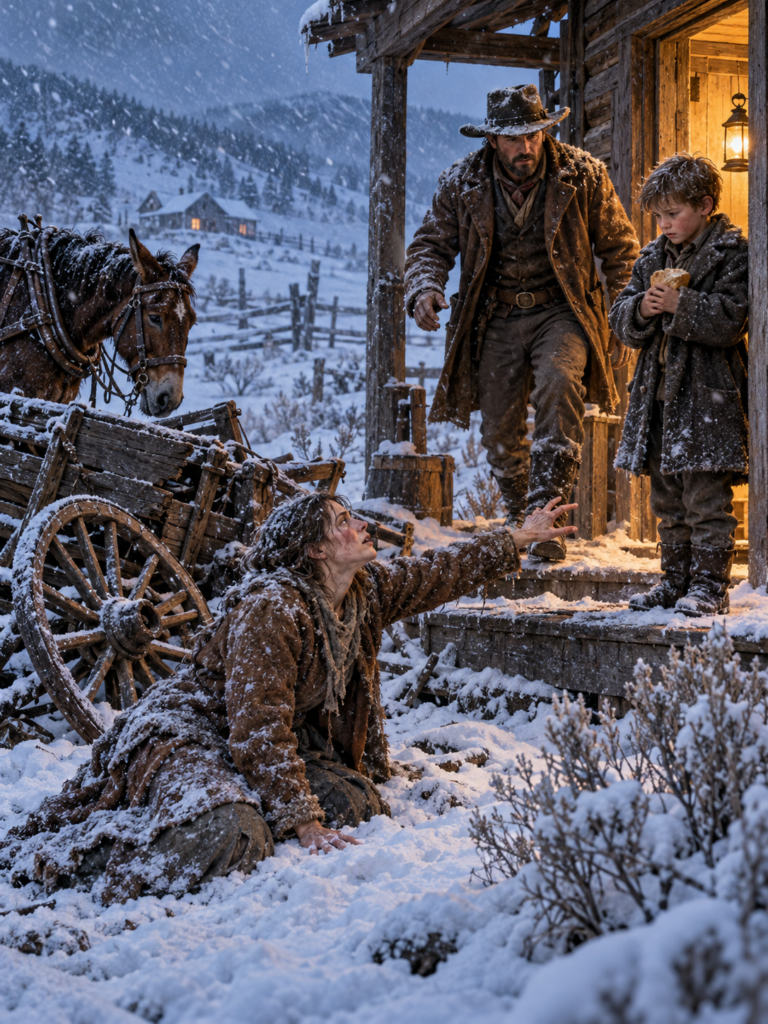
Nathan caught Eli just before the drift swallowed his shoulders.
The boy’s boots were trapped, and his mittened hands clutched a folded letter beneath his coat.
“Don’t make me go back!” Eli cried. “I can get there!”
Nathan planted his feet firmly.
“You’re going home with me.”
“But it’s only four miles!”
“Four miles is too far in this snow.”
Eli struggled once more.
Then Nathan saw tears gathering along the boy’s lashes.
“If I get Mama’s letter there before twelve, she can still have the job.”
Nathan’s grip softened.
“Son, the lady needs to meet your mother. Sending the letter won’t be enough.”
Eli stared at him.
The fight went out of his small body.
“But Mama said we needed that work.”
“I know.”
“She was hungry yesterday. She told me she wasn’t.”
Nathan couldn’t find an easy answer.
He lifted the boy free and carried him back toward the house.
By the porch, Clara was waiting with a quilt.
She had opened the door despite the cold and stood gripping its frame.
“Eli!”
Nathan carried him inside.
His mother knelt beside the stove as soon as Nathan set him down.
She removed his wet mittens while Nathan worked his boots loose.
Snow had packed around the tops.
Clara touched his feet through his stockings.
“Can you feel my hands?”
Eli nodded miserably.
Nathan brought dry socks and another blanket.
As the child warmed, he slowly opened his coat.
The letter lay against his chest.
Its edges were damp.
“I tried, Mama.”
Clara took it but did not unfold it.
“Look at me.”
Eli raised his eyes.
“You must never go out alone like that again.”
“I thought I could help.”
“You do help me. Every day. But keeping you safe matters more than any job.”
“Even the Bell Creek one?”
“Even that one.”
His lower lip trembled.
“I wanted you to stop worrying.”
Clara pulled him against her.
Nathan moved away to give them a moment.
At the mantel, the clock approached noon.
He knew they couldn’t reach town now, even if the wind stopped.
There would be no miraculous ride through the drifts.
No stranger arriving to carry the letter.
No way to turn the clock backward.
Clara knew it too.
She lifted her face toward the ticking mantel.
Eleven minutes remained.
Nathan said, “Your wagon wheel can be repaired once I can work outdoors. The road may clear tomorrow.”
“The deadline won’t.”
“No.”
She looked at him.
“Thank you for saying it plainly.”
Eli curled beneath the quilt, the green scarf resting in his lap.
Clara carried the letter to the table and laid it beside her sewing case.
Then she reached for Nathan’s frayed winter coat, which she had noticed the night before.
“May I mend this?”
“You don’t owe me mending.”
“I know. I’m asking because I’d like something useful to do.”
He placed the coat before her.
“Then I’d be obliged.”
She examined the cuff, found sound cloth beneath the worn edge, and threaded a needle.
Her hands were steady now.
Nathan watched her fold the fabric so the repair would strengthen the part that took the hardest wear.
“You’ve done that often,” he said.
“For people who paid me.”
He gave a quiet nod.
“Then tell me your price.”
Clara almost smiled.
“After you’ve brought my boy home through that snow?”
“Your work’s worth paying for, whether you needed help today or not.”
Her needle paused.
Something passed between them that neither was ready to name.
Respect, perhaps.
Or recognition.
The clock struck twelve.
Clara lowered her head for one brief moment.
The appointment was gone.
The future she had planned was no longer certain.
When the final stroke faded, she drew the thread through Nathan’s coat.
“I still need to see Mrs. Avery,” she said.
“I’ll take you when the road opens.”
“And if she’s given the place away?”
“Then you’ll hear that from her.”
Clara tied off the stitch.
“I’ll use what money I have to find a room. Eli needs to be near the school. I need to be where customers can find me.”
Nathan felt an unexpected heaviness at the thought of them leaving.
But he answered, “That makes sense.”
Outside, the wind struck the door again.
Clara lifted the repaired coat toward him.
“If the road opens tomorrow,” she said, “promise me one thing.”
“What is it?”
“Don’t ask Mrs. Avery to hire me out of pity. Whatever she says, let me answer for myself.”
Nathan took the coat.
“You have my word.”
Then Clara picked up her sewing case, turned toward the small bedroom, and began gathering their belongings for the journey that might end with no wages and nowhere affordable to go.
Clara placed Eli’s folded clothes beside the sewing case and reached for the few coins hidden beneath the lining of her traveling bag.
She counted them twice.
Nathan stood in the bedroom doorway without crossing the threshold.
“You don’t have to pack tonight.”
“I know.”
“The weather may hold us here another day.”
“Then I’ll unpack what we need. But I won’t let the storm decide everything for us.”
He admired that answer more than he could explain.
Clara tucked the coins away.
“If Mrs. Avery can’t take me, I shall ask whether she knows anyone who needs sewing. Bell Creek is still where we meant to begin.”
Nathan nodded.
“I’ll see to the wagon as soon as the snow eases.”
She gave him a tired smile.
“Then we’d best hope for a little sunshine.”
That evening the wind weakened.
Eli slept beside the stove for a while, wrapped in a quilt with his father’s scarf drying on a chair.
When he woke, he apologized again.
Clara drew him close.
“Your father always said there was a way through a difficult day,” Eli murmured.
“He did.”
“I thought I ought to find it.”
Clara rested her cheek against his hair.
“Your father also knew when a road wasn’t safe. Remember how he turned us back from the creek crossing that spring?”
Eli nodded.
“He said a man doesn’t prove himself by drowning his horse.”
Nathan, stirring beans at the stove, hid a small smile.
“Sounds like sensible advice.”
Eli looked at him.
“Did your papa teach you things like that?”
“He taught me most of what I know about this ranch.”
“Where is he?”
Nathan set down the spoon.
“He died last year.”
Eli’s expression changed.
“Oh.”
For a moment the boy studied the green scarf.
Then he said, “I miss mine.”
Nathan looked directly at him.
“I miss mine too.”
Nothing more was needed.
By Friday morning, pale sunlight fell across the kitchen floor.
Nathan went out before breakfast.
The drifts remained deep in sheltered places, but the wind had scoured much of the open road.
Tracks from an early wagon showed where travelers had already passed toward Bell Creek.
He returned and found Clara feeding Jasper while Eli watched from the barn doorway.
“The road’s open enough if we take our time,” Nathan said.
Clara straightened.
“And the wheel?”
“I’ll make it sound.”
He carried dry ash from his shed and set to work replacing the cracked spokes.
His father’s tools lay where they always had.
A wooden mallet, a saw, and the implements needed to shape and fit the replacements.
Eli watched eagerly.
Clara checked the harness and brushed snow from Jasper’s back.
By midmorning, Nathan had repaired the wheel and tested the empty wagon over a short stretch of firm ground.
Only when he was satisfied did they load the bundles.
Clara placed the sewing case beside her seat.
Nathan noticed that she held it as carefully as another person might hold a box of jewelry.
“All your tools in there?”
“Everything I need to begin again.”
The journey took longer than it would have in fair weather.
Nathan walked the horse through difficult stretches and drove cautiously where frozen ruts remained.
Eli sat bundled between his mother and the sideboard.
His green scarf was tied twice.
When Bell Creek finally appeared beyond the open fields, Clara clasped her hands to stop their trembling.
Nathan brought the wagon to a halt outside Mrs. Avery’s dress shop.
“Would you like me to come in?”
Clara looked through the window at the bolts of fabric.
“No. Thank you. I need to do this myself.”
She stepped down with her letter and sewing case.
Nathan stayed beside Eli.
Through the glass, he watched Clara approach a woman standing behind the counter.
Mrs. Avery appeared to listen patiently.
She examined the letter.
Then she shook her head.
Clara said something else.
The woman shook her head again, this time with visible regret.
Nathan’s stomach sank.
Several minutes later, Clara came outside.
Eli ran to her.
“Did she give you the job?”
Clara knelt to meet his eyes.
“No, sweetheart. She had to hire someone else yesterday.”
The boy looked toward the shop.
“But we were coming.”
“I know.”
“Could she give you another job?”
“I asked. She doesn’t have enough work for two.”
Eli’s face crumpled.
Clara took his hands.
“Listen to me. We haven’t lost the ability to work. We’ve lost one offer. Those aren’t the same thing.”
Nathan looked away.
He wanted to tell them that everything would be fine.
But he had already learned that Clara valued an honest answer more than easy comfort.
So he waited.
When she stood, she said, “There’s a boarding house near the school, isn’t there?”
“Mrs. Pike keeps one.”
“Will you show me?”
“Of course.”
They found it on a quieter street a short walk from the schoolhouse.
Mrs. Pike was a sturdy woman who listened without interruption while Clara asked about rooms.
She had one upstairs with a narrow bed, a small cot, and enough room for a sewing table.
The weekly charge included simple meals.
Clara asked to see it.
She examined the window, the door latch, and the light falling across a small table.
Then she counted out the money for one week.
Nathan understood what that payment meant.
She was spending nearly everything she had reserved for shelter.
She would have seven days to find work sufficient to pay for the next seven.
Mrs. Pike handed her a receipt.
“School begins again Monday. Your boy can go down the street with the others.”
Eli brightened.
Then Mrs. Pike noticed the sewing case.
“You mend clothes?”
“Yes, ma’am. I also fit dresses, replace linings, and make alterations.”
Mrs. Pike lifted an arm.
“The lining in this coat’s been coming loose for a month. What would you charge to put it right?”
Clara examined the shoulder carefully.
She named a price.
Mrs. Pike considered it.
“Can you have it ready by morning?”
“Yes.”
“Then you have your first customer.”
Nathan saw Clara’s face change.
Not into happiness exactly.
Into concentration.
The uncertainty remained, but now she had work she could measure.
When he carried their belongings upstairs, Clara thanked him.
“You’ve done a great deal for us.”
“You’ve got a room, a job to finish, and a boy with a school waiting for him.”
He smiled faintly.
“Seems to me you’re already doing most of the work yourself.”
Before Nathan left, Eli caught his sleeve.
“Mr. Ward?”
“Yes?”
“Thank you for finding me.”
Nathan crouched.
“Next time there’s trouble, come tell an adult before you try fixing it alone.”
Eli nodded solemnly.
“I will.”
Nathan tipped his hat to Clara and drove back toward the ranch.
That evening, his house was quiet again.
He hung his repaired coat on its peg.
For a long time he stood looking at the neat stitches around the cuff.
He had worn that coat through years of ranch work.
The repair was modest.
But someone had taken care to make it last.
Meanwhile, Clara worked by lamplight in her rented room.
Eli slept on the cot, his scarf tucked beside him.
By Saturday morning, Mrs. Pike’s lining was sound.
The boarding housekeeper examined it, raised her arm, and paid the agreed fee.
Before dinner, she returned with a neighbor.
The woman had three work coats belonging to her sons.
Two needed their pockets repaired.
The third had worn thin around the collar.
“My boys leave Monday,” the woman said. “Can you make them fit for work?”
Clara turned each coat inside out.
The pockets were straightforward.
The collar would require a visible patch.
“I can make it strong,” she said. “But I won’t promise it will look new.”
The woman touched the worn fabric.
“Strong is what we need.”
Clara quoted the full price.
The woman agreed.
For the next two days, Clara worked steadily.
Eli sorted buttons and carried finished garments upstairs.
Mrs. Pike allowed Clara to use a downstairs table where the light was better.
Clara reinforced the pockets, cut a careful patch from her wool scraps, and strengthened the collar through sound fabric.
When the customer arrived Monday morning, she inspected every repair before paying.
By afternoon, two more women had brought clothing.
One needed a dress taken in.
The other had a child’s coat with a torn seam.
Clara wrote down their names, prices, and promised collection days.
She no longer had to imagine whether someone might pay for her work.
People were paying.
On Monday, Eli also began school.
Clara walked him to the door.
He hesitated on the step, gripping a book against his chest.
“Will you be here when school finishes?”
“I will.”
He looked up at her.
“Even if you’re busy sewing?”
“Especially then. I can put down a needle.”
He smiled and went inside.
That night he returned with a page of sums and so many stories that Clara hardly finished her supper.
On Friday, she paid another week’s board from money she had earned herself.
She bought thread and set aside a little toward Jasper’s feed.
In a notebook, she recorded every expense.
There wasn’t much left.
But it was hers to account for.
The following Thursday, Nathan came into town for feed and flour.
He stopped at Mrs. Pike’s with two shirts whose elbows had worn thin and a canvas apron split along the side.
Clara examined them.
“This is honest work, Mr. Ward. I’ll charge you what I’d charge anyone.”
“I’d be disappointed if you didn’t.”
She named her price.
He accepted it without bargaining.
Then he asked about Eli.
Clara found herself talking longer than necessary.
About the boy’s sums.
About his new teacher.
About a stubborn customer who wanted an old coat to look unworn without paying for new cloth.
Nathan laughed.
It was the first time Clara had heard him laugh openly.
The sound stayed with her after he left.
Throughout February, the work continued.
A farmer brought trousers.
The teacher needed a dress altered.
Several families entrusted Clara with their winter clothes.
Word traveled because her repairs held and her promises were kept.
Nathan visited on his supply trips.
Sometimes he brought mending.
Sometimes he didn’t.
He always asked about Eli.
Once he met the boy outside the feed store and showed him how to recognize a cracked spoke by following the grain of the wood.
Eli listened with extraordinary seriousness.
Clara watched them from a few steps away.
For a moment she felt a warmth she had not expected to feel again.
Then fear followed it.
Not fear of Nathan.
Fear of wanting something she had no right to promise herself.
One afternoon, a schoolmate saw Eli standing beside Nathan and asked whether the rancher was his father.
Eli answered quickly.
“No.”
That evening Clara found a drawing on the boy’s cot.
It showed herself, Eli, Jasper, and their wagon.
Beside the wagon was a fourth person, rubbed almost completely away.
Eli folded the paper when he saw her.
“I like Mr. Ward,” he said.
“I know.”
“But I already had Papa.”
Clara sat beside him.
“Yes, you did.”
“Is it wrong to like another man so much?”
She took his hand.
“No. There isn’t a small amount of love that gets used up. Remembering your father doesn’t keep you from caring about people who are kind to us.”
Eli looked at the folded page.
He did not open it.
Clara didn’t ask him to.
By early March, she had regular customers and a little money saved.
Then Mr. Doran came to Mrs. Pike’s boarding house.
He owned a dry goods shop in Grayford, a day’s travel west.
After seeing Clara’s repairs, he returned the following morning with a written offer.
Six months of steady wages.
A small room above the shop for Clara and Eli.
A school within walking distance.
He needed an answer by Monday.
Clara read the letter twice.
It was a good offer.
Perhaps the safest one she had received since her husband died.
When Nathan came into town Friday, she showed it to him.
He studied the terms.
“Regular wages,” he said.
“And a room. I wouldn’t have to worry every week whether enough customers came.”
“That’s worth considering.”
She waited.
He handed the paper back.
“Would you want us to go?” she asked.
Nathan looked at her for a long moment.
“I’d miss you both.”
Her heart lifted.
Then he added, “But I won’t ask you to turn down sound work because you think I want company.”
Clara nodded.
It was the honorable answer.
Yet as he drove away, she discovered how much she had hoped to hear something more.
Saturday evening, she placed Mr. Doran’s letter beside her notebook.
She counted her earnings, confirmed orders, expenses, and savings.
Bell Creek offered work she had built herself.
Grayford offered guaranteed wages.
Neither choice required Nathan to support her.
That should have made the decision simple.
It did not.
Eli came to the table with his father’s green scarf wrapped around one hand.
“Are we leaving?”
“I haven’t decided.”
He stared at the offer.
Then he asked the question that broke her heart.
“Mama, if I want to stay near Mr. Ward, does that mean I’m leaving Papa behind?”
Clara drew Eli onto the chair beside her.
His father’s green scarf lay between them, its faded wool twisted around his fingers.
“No, sweetheart,” she answered.
“But sometimes I think about Mr. Ward when I’m at school.”
“That isn’t wrong.”
“Sometimes I wish he’d come when the other fathers visit.”
Clara felt the sharp tenderness of her son’s confession.
She remembered her husband standing in their doorway two winters earlier, tying that very scarf around Eli’s neck.
He had been a hardworking, affectionate man who could make their son laugh even when money was scarce.
Illness had taken him.
Nothing could undo the years they had shared.
Nothing could make Eli stop needing people in the years ahead.
“Your papa loved you,” she said. “That hasn’t changed.”
Eli looked at the scarf.
“And Mr. Ward?”
“He cares about you too.”
“Would Papa be angry?”
Clara shook her head.
“I don’t believe love is something your father would have wanted you to be afraid of.”
Eli considered this.
Then he reached for the school drawing hidden beneath his book.
The fourth figure was still a smudge.
“I wanted to put Mr. Ward beside us.”
“You may.”
“But I rubbed him out.”
Clara put an arm around her son.
“You don’t have to decide who belongs in a picture tonight.”
“Can I ask Mr. Ward something?”
“Of course.”
“Will you take me to his ranch?”
Clara glanced toward Mr. Doran’s letter.
She needed to give an answer Monday.
Sunday remained.
“Yes,” she said. “We can go tomorrow.”
The next morning brought a clear sky.
The road that had nearly taken their lives in January lay open beneath early spring sunlight.
Clara harnessed Jasper herself.
Eli climbed into the wagon with his book, drawing, and scarf.
As they traveled, Clara noticed places she remembered from the storm.
The bend where Jasper had stumbled.
The low fence nearly hidden by snow.
The gate where Nathan had found them.
Everything looked smaller now.
The danger had passed, but she had not forgotten it.
Nathan came from the barn when he heard the wagon.
For a moment his face showed unmistakable surprise.
Then his eyes moved to the folded paper Clara carried.
He seemed to brace himself.
“We haven’t decided about Grayford,” she said before he could ask.
He nodded.
“Eli wanted to see you.”
“Then I’m glad you’ve come.”
Nathan helped unhitch Jasper and led him toward the barn.
Eli followed with a water bucket.
Clara remained near the open doorway.
She watched Nathan show the boy how much water the mule needed after the journey.
They discussed school.
Eli proudly explained a sum he had solved without help.
Nathan listened as though nothing at the ranch could be more important.
Then Eli grew quiet.
His fingers twisted the scarf’s fringe.
“Mr. Ward?”
“Yes, Eli?”
The boy pulled out his drawing.
Nathan saw Clara, Eli, Jasper, and the wagon.
He also saw the rubbed place beside them.
“A boy at school thought you were my papa.”
Nathan lowered the bucket.
“I see.”
“I told him you weren’t.”
“That’s right.”
Eli swallowed.
“But I wanted to draw you with us.”
Nathan waited.
“Would that mean I didn’t love my papa anymore?”
Nathan drew a crate near the barn wall and sat down so they could speak face-to-face.
“Your father was your father, Eli. Nobody gets to take that away from you.”
Eli’s eyes filled.
“But I like you.”
“I’m glad you do. I like you too.”
“Even if I talk about Papa?”
“Especially if you want to tell me about him.”
Eli touched his scarf.
“He always tied this twice.”
“Will you show me?”
The boy loosened the faded wool.
He wrapped it around his neck and made the familiar double knot.
Nathan tried to copy him.
His first attempt came loose.
Eli laughed.
“No. You have to bring this end underneath.”
Nathan obediently tried again.
“Like that?”
“Yes!”
Nathan handed the scarf back.
“That’s something your father taught you. I’m glad you can teach it to me.”
Eli looked down at his drawing.
“Could I put you back?”
“You can put me wherever you want. You needn’t rub anybody else away.”
Clara stood very still.
She had loved her husband.
She had grieved him through long evenings when Eli was asleep and the lamp burned beside her sewing.
She had feared that beginning again might somehow dishonor what had come before.
But Nathan had just shown her a different possibility.
A future need not erase the past.
It could make room for the people who remained.
Eli folded his drawing, smiling now.
“Can we see the old wagon wheel?”
Nathan rose.
“I’ve still got it in the shed.”
As the two went to look, Clara walked toward the porch.
Nathan joined her a few minutes later.
For a while they watched Eli examine the old wheel through the shed doorway.
Then Nathan rested one hand on the porch railing.
“When you asked whether I wanted you to go to Grayford, I didn’t give you the whole answer.”
Clara turned.
“You told me you would miss us.”
“I would.”
He looked toward the fields.
“I’ve missed you both since the day I brought you into town. Not because the house needs tending. Not because Eli reminds me of anything I lost.”
He paused.
“I miss hearing what you’re making of your days. I miss his questions. I find myself saving things to tell you when I come to town.”
Clara’s heartbeat quickened.
Nathan looked at her again.
“After my father died, I thought I’d gotten used to being alone. I had the ranch to work, and that seemed enough.”
“Was it?”
“For a while, I told myself so.”
He smiled ruefully.
“I’ve always known how to keep the animals fed and the fences standing. I didn’t know how to tell a woman I hoped she would stay nearby without making it sound like I needed her to arrange her life around mine.”
Clara stepped closer.
“You could simply have told me.”
“I should have.”
His honesty softened something she had held tightly for two years.
“I won’t choose Bell Creek only because you want us near,” she said. “Eli needs his school. I need customers who trust my work. I need to know I can provide for us.”
“I wouldn’t want you to surrender any of that.”
“And if we stay?”
Nathan met her eyes.
“I’d like permission to call on you properly.”
Clara felt a shy smile rise.
“I’d like that.”
Neither reached for a grander promise.
There was still a decision to make.
When Eli returned, Clara told him it was time to go home.
Nathan helped harness Jasper.
At the gate, he stood with one hand resting against the wagon’s sideboard.
“Whatever you decide tomorrow,” he said, “you’ll have a friend here.”
“I know.”
This time, when Clara said it, she understood how much those words meant.
That evening she opened her notebook for the last time before the deadline.
She listed the work promised for the coming weeks.
Two dresses.
A farmer’s trousers.
A coat requiring a new lining.
Additional repairs Mrs. Pike had already arranged.
She counted the money she had saved and allowed for slower weeks, feed, board, thread, and the room she hoped eventually to rent for her sewing.
It would not be an easy life.
But it could be a life of her own making.
Then she considered Grayford.
Mr. Doran had offered a respectable place and regular wages.
She could take Eli west and begin again with an income she could count on.
There was no shame in choosing that security.
Clara asked Eli what he valued about Bell Creek besides Nathan.
The boy thought seriously.
“My teacher. And Thomas, who sits beside me. And Mrs. Pike lets me help with the mule.”
Clara smiled.
“Anything else?”
“I know the way home from school now.”
Such a small answer.
Such a considerable thing for a child who had spent much of his recent life moving from one uncertain place to another.
Clara looked at the notebook.
She had customers who returned because they trusted her.
She had enough saved to manage a slow week.
She had a son who belonged somewhere.
And she had a man who cared enough to let her leave.
She closed the notebook.
“We’re staying in Bell Creek,” she said.
Eli stared.
“Truly?”
“Truly.”
“Because of Mr. Ward?”
“Partly because we care about him. But mostly because this is where we’re building our lives.”
Eli threw his arms around her.
She held him tightly.
For the first time in many months, she was not simply escaping uncertainty.
She was choosing where she wanted to stand.
Monday morning, Clara visited Mr. Doran and thanked him for his offer.
She explained that she had decided to continue her own sewing business in Bell Creek.
He accepted her answer graciously.
Then she returned to Mrs. Pike’s, finished the coat promised for that afternoon, and collected her payment.
The work did not stop because she had made a personal decision.
In fact, it continued to grow.
When Nathan came into town later that week, Clara was sewing beside the boarding house window.
He waited until she finished a seam.
“Have you decided?”
“We’re staying.”
His relief was so plain that Clara laughed softly.
“You’re allowed to look pleased.”
“I am pleased.”
She set down her needle.
“But I want you to understand why.”
She told him about her customers.
About Eli’s school.
About the accounts she had balanced and the money she had saved.
Nathan listened carefully.
When she finished, he said, “Then it sounds like you’ve made a sound choice.”
“And I would like you to call on us.”
“Then I will.”
He kept that promise.
Through March and April, their lives began weaving together without either one abandoning the work that mattered.
Nathan continued tending his ranch.
Clara continued sewing.
Eli learned his lessons and came home eager to report everything he had discovered.
Some Sundays, Nathan invited them to supper.
Clara would bring work only when she chose, and Nathan never expected her to spend her visiting hours mending his clothes.
Sometimes they prepared the meal together.
Other times Nathan did the cooking while Clara sat on the porch, listening to Eli explain a school lesson.
Once, she found Nathan examining the torn seam in his own work shirt.
“Let me see that,” she said.
“I was hoping to learn how to mend it myself.”
She handed him a needle.
“Then sit down.”
He made three crooked stitches before she took pity on him.
“You’re pulling too hard.”
“That’s what my father used to tell me when I worked wood before I understood the grain.”
“Cloth isn’t much different. You have to know what it will bear.”
He looked up at her.
“Seems there’s a good deal you might teach me.”
“There is.”
His smile deepened.
“And perhaps a little I can teach you.”
The following week, he showed her how to judge whether the wagon’s wooden fittings were sound.
She listened, asked questions, and tried the task herself.
Their affection grew through such ordinary moments.
A shared supper.
A repaired gate.
A walk past Eli’s school.
The quiet pleasure of having someone remember the small difficulties of your day.
Clara noticed that Nathan no longer spoke of the ranch as though it were a duty he carried alone.
He talked about improvements he hoped to make.
Where he might plant more beans.
Which part of the barn needed attention before another winter.
She began speaking of a sewing room large enough for fitting dresses, with shelves for supplies and good daylight.
They listened to each other’s plans.
And gradually those plans made space for one another.
Eli, meanwhile, became less cautious around Nathan.
One afternoon he brought his school drawing to the ranch.
The rubbed figure had been redrawn.
Nathan stood beside the wagon, wearing his work coat.
Eli had also drawn the green scarf around his own neck.
Nathan examined it seriously.
“You’ve made my hat a good deal finer than the one I own.”
Eli grinned.
“I know.”
“Think I should buy one to match?”
“No. I like your old one.”
Nathan laughed.
Clara watched from the doorway, filled with a happiness that no longer felt like a betrayal of her husband’s memory.
By May, she had rented a small workroom near the school.
The extra expense made her cautious, but her customers had grown numerous enough to justify it.
She arranged her tools beside the window.
Mrs. Pike continued taking messages when Clara was away.
Nathan helped move a heavy table into place, then stepped aside while Clara decided where it belonged.
“This is your room,” he told her.
She looked around at the shelves, the fabric, the order book, and the sunlight.
“Yes,” she said.
It was.
Late one Sunday in May, Nathan and Clara walked back from the barn while Eli finished feeding Jasper.
The afternoon was warm.
The same lane that had been buried beneath snow now lay dry beneath their feet.
Nathan stopped near the porch.
“I’ve been thinking about the distance between here and Eli’s school.”
Clara turned.
“Four miles.”
“Four miles,” he agreed. “A journey worth considering every day, especially when winter returns.”
She waited.
“If you ever wanted to live here, we’d have to plan it properly. Eli would still need his school. You would still need your workroom. We could share the wagon chores.”
“And when the weather made travel difficult?”
“Mrs. Pike has said she would welcome you at the usual rate when you needed a room in town.”
Clara studied him.
“You’ve given this some thought.”
“A great deal.”
He took off his hat.
“I’ve been trying to speak about ordinary arrangements because I’m afraid of saying the important part badly.”
Clara reached for his hand.
“Then say it as it comes.”
Nathan looked directly at her.
“I love you, Clara.”
The words were quiet.
He did not dress them in promises he couldn’t keep.
“I love how you speak to Eli. I love that you say what you think, even when it’s difficult to hear. I love the way you’ve built a living with those hands.”
She felt tears gathering.
Nathan continued.
“I would like to marry you, if that’s a future you want. Not because I took you in that night. Not because you owe this house anything. Because I want to share my life with you, and I want you to have your own life within it.”
Clara held his hand more tightly.
“What about my work?”
“I’ve been telling you. We make room for it.”
“And Eli?”
“He keeps his school. And his father remains his father.”
Her tears fell then.
For so long, she had believed that survival required giving up pieces of herself.
First comfort.
Then certainty.
Then the hope of loving someone again.
Nathan was offering something different.
Not rescue.
Partnership.
She looked toward the barn where Eli’s voice could be heard talking to Jasper.
Then back toward Nathan.
“I love you too.”
He scarcely seemed to breathe.
“Clara—”
“Yes,” she said.
He stared at her.
“Yes?”
“Yes, Nathan. I’ll marry you.”
He smiled with an astonishment that made her laugh through her tears.
Then he asked, softly, “May I kiss you?”
She answered by stepping closer.
Their first kiss was gentle.
There was no storm around them.
No urgent danger.
No desperate bargain.
Only two adults choosing one another in the warm light of an ordinary afternoon.
They told Eli before making any arrangements.
The boy listened solemnly.
“Would we live here?”
“Yes,” Clara said. “But you’ll still go to school in Bell Creek.”
“And Mama will still sew?”
“Of course,” Nathan answered.
Eli looked at the green scarf in his lap.
“Can I keep Papa’s name?”
Clara knelt beside him.
“Always.”
Nathan crouched too.
“And anything else of his you want to keep.”
Eli looked from one face to the other.
“Can I stand by Mama at the wedding?”
Nathan smiled.
“We’d be glad if you would.”
The ceremony was held at the ranch before the end of May.
Mrs. Pike came from town, along with Eli’s teacher and a few neighbors.
Clara wore a simple dress she had fitted herself.
Nathan wore his good coat.
The cuff she had repaired during the storm remained neat and strong.
Eli stood beside Clara, holding his father’s green scarf carefully folded in his hands.
Nobody asked him to put it away.
When Clara promised to share her life with Nathan, she knew what she was choosing.
She would keep her work.
Eli would keep his school.
The ranch would be their home, but it would not become the boundary of her world.
Nathan made his promises with the same steadiness he had shown on the night he opened his door.
And this time, Clara could answer without fear of needing his protection simply to survive.
Afterward, their guests shared a meal around the table where three frightened strangers had once waited for a storm to pass.
Mrs. Pike admired Clara’s dress.
Eli’s teacher spoke proudly of his progress.
Nathan listened while Eli explained to a neighbor exactly how the broken wagon wheel had been repaired.
When the guests finally left, the house grew quiet.
But it was not the quiet Nathan remembered.
Clara carried her sewing case inside.
She placed it near the table, beside the account book she would use the following morning in town.
Nathan hung his coat on its familiar peg.
Eli stood nearby holding the green scarf.
For a moment he studied the wall.
Then he pointed to a lower peg.
“Could this one be mine?”
Nathan knelt and checked that the boy could reach it.
“If that’s where you’d like it.”
Eli hung the scarf beside Nathan’s coat.
Two pieces of wool.
Two different histories.
Neither replacing the other.
Then he opened his school drawing on the table.
He took out his pencil and finished the fourth figure, darkening Nathan’s coat and giving him his familiar old hat.
Beside the wagon, he drew the green scarf as carefully as he could.
Clara watched her son work.
She remembered his small fist knocking on the door in the snow.
Remembered the unbearable shame of having no supper to give him.
Remembered the letter, the deadline, and the empty feeling when the clock struck noon.
At the time, she had believed everything depended on reaching one dress shop before a certain hour.
Losing that position had felt like losing their future.
But the future had not been waiting inside Mrs. Avery’s shop.
Clara had built it with a needle, a ledger, long working days, and the courage to begin again after disappointment.
Nathan had helped them survive the storm.
Then he had done something just as important.
He had allowed her to make her own way.
And she had returned to him because she wanted to.
Not because she had nowhere else to go.
As evening settled over the ranch, Nathan came to stand beside her.
“Are you tired?” he asked.
“A little.”
“Happy?”
She glanced toward Eli, who was still drawing.
“Very.”
Nathan touched her hand.
Outside, the same gate stood where the broken wagon had once stopped.
The same road led four miles into Bell Creek.
Winter would return.
There would be difficult mornings, damaged fences, slow weeks for sewing, and journeys best postponed until the weather cleared.
Their life would not be free from trouble.
But they would meet it together, each bringing something the other could trust.
Eli finished his picture and held it up.
There were four figures now.
A mother.
A boy.
A mule.
And a rancher standing beside them.
No one had been rubbed away.
Nathan looked at the drawing, then at Clara.
“I think we ought to find a place for that.”
Clara smiled.
“Somewhere we can all see it.”
Eli chose the wall beside the door.
And there, in the house where he had once begged for bread, he hung the picture of the home they had freely chosen to build.


