
Slade’s fingers stopped just above the water.
He crouched, studied the clear surface, then dipped two fingers into the basin.
He rubbed them together.
For several seconds, he said nothing.
The tracker who had followed him through the fissure stood near the entrance, examining the stone floor.
A third man, Durkin, removed his hat and stared at the water.
“Well,” Durkin murmured. “Would you look at that.”
Slade rose slowly.
His expression wasn’t one of relief.
It was calculation.
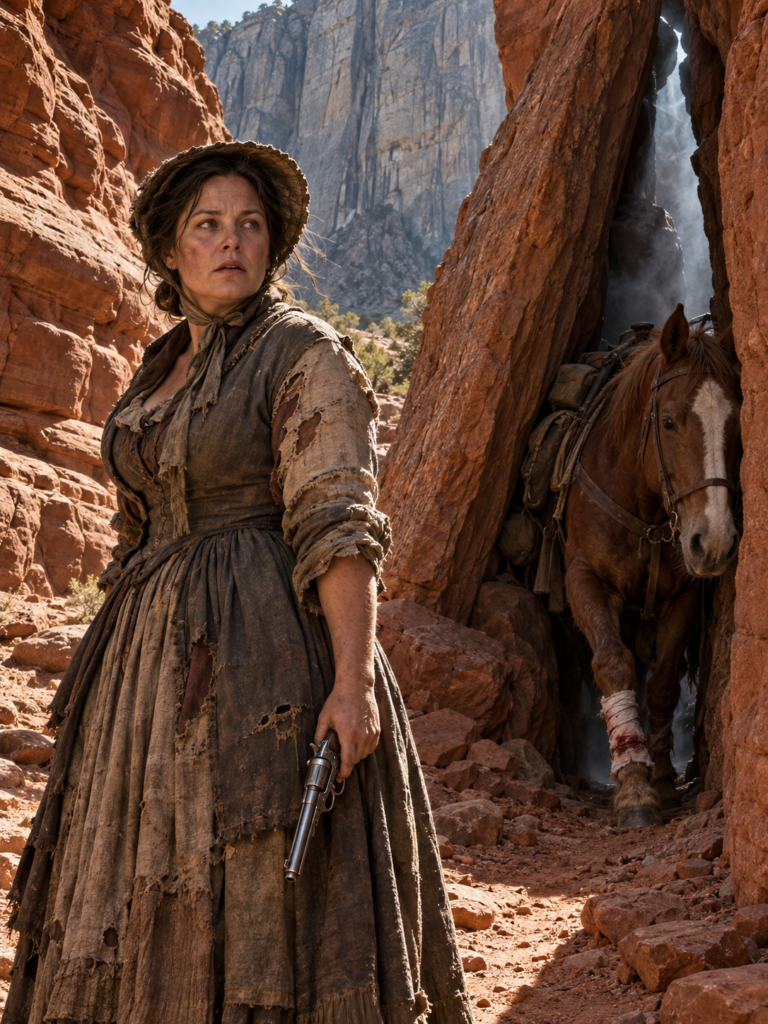
Hetty remained hidden behind the moss-covered wall, her revolver resting against her knee.
Copper stood beside her.
She pressed one hand against his muzzle, hoping he would remain quiet.
Slade walked around the pool, examining the narrow streams running down the rock.
“Steady supply,” he observed.
The tracker nodded.
“Looks that way.”
“And the ground?”
“Good soil where the moisture collects.”
Slade knelt beside the dark earth and pressed his fingers into it.
Hetty watched his face.
She knew that look.
She had seen it when he visited her homestead after Rosco died.
He hadn’t asked whether she had enough food.
He’d asked whether she intended to sell.
“How long do you suppose this has been here?” Durkin asked.
“Longer than Ashfall,” Slade replied.
Durkin looked pleased.
“Then we’ve found ourselves another source of drinking water.”
Slade turned toward him.
“No. We’ve found something far more valuable.”
Hetty felt her stomach tighten.
Slade began speaking about the families in Ashfall.
Forty households.
Dry farms.
Dying livestock.
Debts that increased every week.
He reminded Durkin that he controlled the town’s only productive well and charged two dollars for every gallon people needed.
Then he described what would happen if the drought continued.
Families would abandon their homesteads.
Those who remained would sell their land cheaply rather than lose everything.
By the following spring, Slade intended to own much of the valley.
Durkin glanced at the pool.
“But if they find this spring, they won’t need our water.”
“Exactly.”
Slade’s voice was almost pleasant.
“Which means I need to control this spring before anyone else learns about it.”
Hetty gripped the revolver harder.
The truth was worse than ordinary greed.
Slade hadn’t caused the drought.
But he intended to turn the suffering it created into an opportunity to acquire the land.
The hidden spring threatened that plan.
Now Hetty understood why he had brought armed men into the mountains.
He wanted to secure access, establish his claim, and prevent the town from using the water freely.
The tracker moved toward the old fire ring.
“Someone’s been here,” he said.
Slade turned.
The man pointed at disturbed ash, damp soil, and a small strip of bloodstained cloth near the entrance.
A fragment from Copper’s damaged bandage.
Hetty’s pulse quickened.
“Recently,” the tracker added.
Slade studied the fragment.
“Then someone knows.”
He withdrew a knife and walked to the granite beside the passage.
With deliberate movements, he began scratching a symbol into the rock.
A letter inside a circle.
His mark.
It wasn’t an official document or proof of ownership.
But Hetty recognized the intention.
He had been inside the chamber only minutes, and already he was treating the spring as property he could claim.
She eased farther into the shadow.
Copper shifted his weight.
His injured leg trembled.
The tracker looked toward them.
For one terrible moment, Hetty thought he had seen the horse’s copper-colored tail beyond the curve of stone.
His hand moved toward his holster.
She raised her revolver.
Then a rifle shot cracked outside the canyon.
The sound ricocheted through the chamber.
A second shot followed.
Someone shouted Slade’s name from beyond the fissure.
Slade turned sharply.
“What now?”
The tracker hurried toward the passage.
Durkin followed.
Within moments, all three were squeezing back through the rock.
Hetty waited, scarcely breathing.
She heard boots scraping stone, then distant hoofbeats.
When the canyon finally fell silent, she counted slowly to one hundred before lowering her weapon.
Copper moved out of the recess and returned to the pool.
Hetty went to the wall where Slade had left his mark.
She drew Rosco’s hunting knife and began cutting across it.
One stroke.
Then another.
By the time she finished, the neat symbol was a rough collection of scratches.
She knew that removing it couldn’t prevent Slade from claiming the land.
But she would not leave his mark untouched.
Her eyes moved toward the carved hand and seven seeds above the ancient fire ring.
Someone had used this chamber long before Slade arrived.
Someone had understood what water meant in a dry country.
Now Slade intended to make the spring another instrument of debt.
Hetty touched the seed pouch beneath her dress.
She could remain here.
She might grow enough food to survive.
The narrow entrance could be defended.
But Ashfall would continue dying beyond the mountains.
And Slade would return with more men.
Hetty filled her canteen, then the old coffee tin.
She knelt beside Copper, pressed her forehead against his neck, and made the hardest decision since burying Rosco.
She would leave the spring and carry its secret back to town.
But first, she would need to find a safe place for her injured horse.
Copper leaned against Hetty’s shoulder as she helped him turn toward the narrow passage.
The bandage around his front ankle was stiff and dirty.
He had found water when both of them were close to collapse.
Now she had to ask him for one more difficult journey.
She guided him through the fissure, taking her time where the granite narrowed.
Outside, the canyon was empty.
Slade’s men had disappeared.
Hetty followed the rocky draw until she reached a sheltered hollow higher on the ridge.
A few juniper bushes grew between the stones.
She tied Copper in their shade and offered him water from the coffee tin.
He drank eagerly.
“I’ll come back,” she whispered.
She pressed her cheek against his warm neck.
Then she looked toward Ashfall.
Six miles of open desert separated her from the town.
Her knees already hurt.
Her lower back ached.
The afternoon heat made the distant ground shimmer.
She knew she couldn’t cross those miles quickly.
So she waited until sunset, rested beside Copper, and began walking when the first stars appeared.
Throughout the night, Hetty followed the hard desert floor south.
She walked steadily rather than fast.
Twice she stopped to rest.
She drank sparingly from her canteen and kept the seed pouch close against her ribs.
When the sky finally began turning blue, the buildings of Ashfall appeared ahead.
The town looked exhausted.
Empty water troughs stood beside the road.
The general store’s shutters were faded.
Only a few chimneys showed smoke.
Hetty went directly to the blacksmith’s forge.
Gideon Pratt opened the door carrying a tin cup.
He was an older man with broad shoulders, weathered hands, and a wooden lower leg.
He looked at Hetty’s torn dress and scratched arms.
“Good Lord, woman. Where have you been?”
“In the mountains.”
“You look like you walked through them.”
“I nearly did.”
Gideon stepped aside.
She sat down and told him about the hidden passage, the spring, the dark soil, and Slade’s arrival.
She described his statements about buying the valley’s land once families could no longer afford water.
Gideon listened without interruption.
When she finished, he placed his cup on the table.
“How much water?”
“More than I could carry. It feeds a pool continuously.”
“And the soil?”
“Rich enough that something is already growing.”
Gideon went to the window.
Forty families lived in Ashfall and the surrounding homesteads.
Most depended on Slade’s well.
Some owed him money already.
Others would soon.
“If he gets control of that spring,” Gideon said, “we’ll be buying from him until there’s nothing left to sell.”
Hetty nodded.
“But he hasn’t secured it yet.”
A knock interrupted them.
Martha Foss arrived with her fourteen-year-old nephew, Emmett.
The boy had seen Hetty entering town and wanted to know what had happened.
She repeated the account.
Martha grew pale when Hetty described Slade’s plan.
“He offered me forty dollars for our property,” she said quietly. “Jerome spent fifteen years saving to buy it.”
Gideon looked at Hetty.
“We need witnesses. People willing to stand together.”
“We need to know what he’s doing at the spring first,” she replied.
She explained that the entrance was narrow and easily guarded.
Riding directly into the canyon with several armed townspeople could provoke a fight they might lose.
She needed to return, find Copper, and see what Slade had done.
Emmett volunteered his horse, Belle, to help scout the route.
Martha objected immediately.
But the boy insisted he could ride ahead, remain out of rifle range, and report what he saw.
Eventually she agreed, extracting promises that he would not confront Slade’s men.
Hetty slept a few hours, ate cornbread, washed her face, and changed into spare clothing Martha provided.
By afternoon, she and Emmett had reached the Sawbacks.
The boy waited near the juniper hollow.
His expression told Hetty something was wrong before she reached him.
Copper was gone.
The rope she’d used to tie him remained attached to the bush.
Its loose end had been cut cleanly.
Several sets of shod hoofprints marked the ground.
“Someone took him,” Emmett said.
Hetty knelt beside the severed rope.
For sixteen years, Copper had been part of her life.
Rosco had bought him as a young horse.
He had carried timber for their barn, helped work their land, and stood near Rosco’s bedside during the final days of his illness.
Copper was the last living companion who had known their life before the fever and drought.
Hetty held the cut rope for a long time.
Then she stood.
“Show me where you heard the hammering.”
Emmett led her to a ridge overlooking the canyon.
Below them, armed guards watched the entrance.
Metallic strikes echoed faintly from within the mountain.
Slade was already working.
Hetty studied the terrain.
The hidden chamber had a natural opening through its ceiling.
If she could reach the ridge above it, she might see inside.
The climb was punishing.
Loose shale shifted under her boots.
Twice she nearly fell.
At one steep rock face, her strength failed before she could pull herself over the ledge.
Emmett found a secure root above the obstacle, anchored a rope, and helped her climb.
Together they reached the top of the mountain.
Hetty lay flat and approached the opening above the chamber.
Looking down, she saw what Slade had done.
Iron stakes now surrounded the pool.
Rope barriers divided the floor.
The old fire ring had been dismantled.
Dark garden soil was scattered across the stone.
Men were measuring the chamber and filling barrels.
Slade stood beside the water, examining papers.
Then Hetty saw Copper.
He was tied against the far wall.
His injured leg hung stiffly beneath him.
The rope was too short for him to reach the pool.
Water lay only a few steps away.
But the horse that had discovered it could not drink.
Hetty felt anger rise through her exhaustion.
She pulled away from the opening.
“We can’t face those men alone,” she told Emmett.
The boy nodded.
“Then what do we do?”
“Go back to Gideon. Tell him what you’ve seen. Bring people who understand what Slade intends.”
“And you?”
“I’ll find another way down.”
Emmett hesitated, knowing she could not easily reverse the climb.
But Hetty insisted.
She needed to remain near the mountain and watch.
The boy left.
Hetty searched the northern slope until she found an ancient water-cut channel descending through the granite.
It was steep and narrow.
She used the rope Emmett had left to control the upper part of her descent.
Beyond the rope’s reach, she braced her shoulders and hips against the channel walls and lowered herself a few inches at a time.
The rock scraped her skin.
Her hands bled.
But her broad frame gave her enough contact with the sides to slow her movement.
By darkness, she reached the bottom.
She circled the mountains through a low saddle and began the return to Ashfall.
When she entered Gideon’s forge the following morning, several people were waiting.
Martha.
Gideon.
Margaret Eids.
Doc Sutterly.
The Hulcom brothers.
Emmett had returned safely.
Hetty told them that Copper had been taken and the spring was being enclosed.
Gideon began counting the people willing to help.
It wasn’t enough to overwhelm Slade’s men in a gunfight.
Hetty didn’t want one.
“We don’t have to shoot him,” she said. “We have to make sure he can’t frighten everyone into leaving.”
They began forming a plan.
Emmett would carry a letter and community objection toward the territorial authorities in Santa Fe.
The others would return to the mountains together.
They would try to reach the chamber without alerting the guards.
And if Slade claimed that the spring was his private property, they would demand that he explain his actions before the people who depended on its water.
Before leaving, Doc Sutterly examined Hetty’s injured hands.
As he wrapped the cuts, he mentioned Rosco.
“I was there when he died,” the doctor said.
Hetty looked up.
“He asked me to tell you something. I never did.”
She waited.
“He said the ground remembers what you plant.”
The words silenced her.
She touched the seed pouch.
Rosco had said similar things during their years together.
He believed that work mattered even when harvests failed, that one season did not decide the worth of the soil.
Now the little pouch felt heavier than before.
That evening, the group approached the Sawbacks under cover of darkness.
They followed a shallow wash past Slade’s guards, avoiding the light of their campfire.
One by one, they squeezed through the hidden fissure.
Hetty entered last.
The familiar cool air touched her face.
The sound of running water echoed through the passage.
But before she could reach the pool, she heard a new sound from the darkness.
A strained, familiar breath.
Copper.
She moved toward the alcove, feeling for the rope tied to his halter.
Her hand closed around it.
Then another sound came from the far side of the chamber.
A man’s boots striking stone.
Someone was approaching.
Hetty slipped Rosco’s revolver from its holster and turned toward the sound.
The footsteps stopped.
Hetty stood beside Copper, one hand gripping the horse’s halter and the other holding Rosco’s revolver low against her skirt.
Gideon moved silently to her side.
For a moment, the chamber remained dark except for the faint circle of starlight descending through the opening overhead.
Then a lantern appeared in the passage.
One of Slade’s hired men stepped into the chamber.
He stopped when he saw the figures gathered near the pool.
His hand moved toward his gun.
“Don’t,” Gideon said.
The man looked from the blacksmith to Hetty, then toward the narrow entrance behind him.
He was alone.
But more men could arrive at any moment.
“We’re not here to hurt you,” Hetty said.
“You’re trespassing.”
“On whose land?”
The man hesitated.
“Mr. Slade’s.”
Gideon raised his lantern.
“Show us his claim.”
The man had nothing to show.
He backed toward the passage, then disappeared through it.
Hetty knew he was going to warn Slade.
There was no point pretending otherwise.
The group moved quickly.
They removed the ropes stretched between the iron stakes and cleared space around the pool.
Doc Sutterly examined Copper’s injured leg.
The old bandage was badly soiled, and the swelling remained severe.
He worked carefully, cleaning what he could and applying a fresh dressing.
Hetty knelt beside the horse.
“I’m here, old man.”
Copper lowered his head against her shoulder.
She held him there for a long moment.
Then she guided him toward the pool.
He took several hesitant steps.
His swollen leg barely supported him.
But he reached the water.
Hetty watched him drink.
She remembered standing in the desert with the revolver raised.
She had believed she was about to lose him.
Now the horse was alive because she hadn’t pulled the trigger.
And the water he had found might save more lives than she could count.
Behind her, Gideon began examining the papers Slade had left near his measuring equipment.
Among them was a contract bearing Slade’s signature.
The document concerned water deliveries to several ranches at an increased price.
It did not automatically prove any violation of territorial law.
But it supported what Hetty had overheard about Slade’s plans to expand his control over the area’s water supply.
Gideon folded the paper.
“This may help explain what he’s been doing.”
Hetty nodded.
“Keep it safe.”
They had scarcely finished clearing the pool when voices came from the passage.
Slade had returned.
He entered with several armed men.
The lantern in his hand threw moving shadows across the stone.
His eyes went first to the pool.
Then to the broken rope barriers.
Then to Hetty.
“Mrs. Brazwell.”
He spoke her name with controlled displeasure.
“I should have known.”
Hetty stood beside Copper.
“You should have given my horse water.”
Slade glanced at the chestnut.
“Your animal was secured.”
“He was tied where he couldn’t reach the spring.”
“He was alive.”
“Barely.”
Slade dismissed the exchange with a small movement of his hand.
“What are these people doing here?”
Gideon stepped forward.
“We’ve come to see the water Mrs. Brazwell found.”
“You’ve entered a claim I’m preparing to register.”
“Preparing isn’t the same as owning,” Gideon replied.
Slade’s expression hardened.
“I have the resources to develop this spring. You people don’t.”
Margaret moved beside Hetty.
“We have people who know how to dig channels and carry water.”
“And who pays for that work?” Slade asked.
“We will decide that together.”
He laughed without amusement.
“You’re going to divide a mountain spring between forty starving households? You can’t even keep your existing wells running.”
The words struck close to the truth.
Ashfall was desperately poor.
Many of its residents had little food and almost no money.
They were not equipped to build a grand irrigation system.
But Hetty had seen how the water collected.
The supply might be modest compared with a river, yet it ran continuously.
They could carry it in containers.
They could establish simple collection points.
They could begin with the things they knew how to build.
Gideon held up the contract.
“We’ve also seen your agreements to sell water to ranches that can barely afford it.”
Slade stared at the paper.
“Where did you get that?”
“Among your surveying materials.”
“You had no right to take it.”
“Then we’ll let the proper authorities decide what it means.”
Slade’s eyes narrowed.
“You think one contract changes anything?”
“No,” Gideon replied. “But people hearing what you’ve planned might.”
Slade glanced toward the hired men.
Two stood near the passage.
Another held his rifle across his chest.
Durkin, the man Hetty remembered from Slade’s first visit, watched from beside the chamber wall.
His expression was unusually tense.
Slade took a step forward.
“I own a lawful well. I sell water to people willing to buy it. Every parcel I’ve purchased was sold voluntarily.”
Hetty didn’t deny those facts.
She had no evidence that Slade had forged deeds or physically forced anyone to sell.
But she had heard his intentions.
She knew that he intended to profit from the desperation of people who had no other water source.
And she knew that finding this spring had threatened his plan.
“You came here because you were afraid people would have another choice,” she said.
Slade looked at her.
“Choices cost money.”
“Not every choice belongs to the richest man.”
“Careful, Mrs. Brazwell.”
Hetty glanced at the armed men.
She knew how fragile the situation had become.
A frightened guard could fire.
A single shot could turn the narrow chamber into a trap.
She lowered her revolver and stepped beside the water.
“I didn’t come here to kill anyone,” she said.
“Then leave.”
“No.”
The word echoed softly.
Slade stared at her.
“You are a widow with a dead ranch and a lame horse. Do you seriously think you can stand against me?”
Hetty felt the insult.
Her homestead was nearly ruined.
Rosco was buried beneath a dead cottonwood.
Copper could barely walk.
But Slade had mistaken loss for weakness.
She turned toward the others.
Gideon stood on his wooden leg, holding the contract.
Margaret carried a shotgun that had belonged to her husband.
The Hulcom brothers looked exhausted but steady.
Doc Sutterly stood beside Copper with his medical bag still open.
Each of them had lost something to the drought.
Each had come anyway.
“I’m not standing here alone,” Hetty said.
Durkin shifted against the wall.
Slade turned on him.
“Keep your men ready.”
Durkin didn’t move.
“Mr. Slade,” he said, “you owe me three months’ wages.”
The chamber fell quiet.
Slade’s jaw tightened.
“This is not the time.”
“You told me the land purchases would cover what you owed.”
“They will.”
Durkin glanced toward the pool.
“Not if these people have water.”
Slade said nothing.
Durkin lowered his hand from his holster.
“I wasn’t paid to shoot thirsty families.”
One of the younger guards stepped away from the passage.
Another lowered his rifle.
Slade looked at them with open disbelief.
“You work for me.”
Durkin shook his head.
“You hired us. That isn’t the same thing as owning us.”
No one spoke for several seconds.
Then Copper moved.
His hooves clicked across the stone.
He walked between the two groups, limping heavily, and lowered his muzzle into the pool again.
The soft sound of drinking filled the silence.
Slade watched him.
The horse hadn’t waited for permission.
He had followed the smell of water, found the hidden opening, and led Hetty into a place none of them knew existed.
And now the animal was drinking from the same spring Slade intended to claim.
Hetty put one hand against Copper’s neck.
“This spring saved his life,” she said.
She looked around the chamber.
“Mine too.”
Her gaze returned to Slade.
“And it can save Ashfall.”
Slade drew a slow breath.
Then his manner changed.
“Five hundred dollars.”
Hetty blinked.
“What?”
“I’ll pay you five hundred dollars for your cooperation. I’ll reduce my water charges. Everyone gets a lower price. You walk away from this place.”
Five hundred dollars.
It was enough to make repairs to Hetty’s homestead.
Enough for supplies, seed, and another chance at a harvest.
For one brief moment, she pictured Rosco’s cabin restored.
A working roof.
A full pantry.
Copper grazing near the fence.
Then she remembered Martha’s expression when she spoke about the forty-dollar offer for her property.
She remembered the empty troughs.
The children in Ashfall carrying cups of water they were forbidden to finish.
She remembered Rosco’s seeds.
“No,” Hetty said.
Slade’s expression turned cold.
“You’d rather remain poor?”
“I’d rather not become rich by selling everyone else’s chance to live.”
Slade looked toward Gideon.
“This woman doesn’t understand business.”
“She understands exactly what you’ve offered,” Gideon replied.
“And she’s refused.”
Slade tried another argument.
Without professional surveying, he said, the spring could not be properly developed.
Without legal documents, the town had no guarantee that someone else wouldn’t claim it.
Without money, the families would struggle to maintain access.
Some of those concerns were legitimate.
Hetty knew they couldn’t solve everything merely by driving Slade away.
The spring’s precise legal status remained uncertain.
The water needed to be measured, the route made safe, and the town’s access protected.
But none of that required accepting Slade’s private monopoly as the only possible solution.
Gideon explained that Emmett had already ridden toward Santa Fe carrying a letter requesting official review of any claim to the Sawback spring.
They would also submit a community petition.
Slade looked startled.
“A boy?”
“A fast one,” Margaret answered.
Slade’s gaze moved around the chamber.
He could still threaten them.
He could attempt to force them out.
But several of his hired men were no longer willing to stand with him.
The townspeople outnumbered those who appeared prepared to fight.
And any shooting would attract attention to a dispute over water in which his own conduct could be examined.
Slade slowly removed his hat.
For the first time, he looked tired.
“This isn’t finished.”
“No,” Hetty agreed. “It isn’t.”
But he understood that forcing the people out that night would not end their claim.
Eventually, he turned toward the fissure.
His men followed.
Durkin remained long enough to look at the spring once more.
Then he, too, walked toward the passage.
The chamber grew quiet.
Hetty listened until the last footstep disappeared beyond the granite.
She didn’t celebrate.
Not yet.
They still needed to get water to Ashfall.
And a legal dispute might be coming.
Gideon approached her.
“What now?”
Hetty looked toward the dark soil.
“Now we make this place useful.”
Over the following days, the townspeople began working at the spring.
They cleared loose stone from the floor, repaired the damaged garden bed, and established safer collection points around the basin.
Gideon helped organize the work.
Margaret brought supplies.
Doc Sutterly continued tending Copper’s leg.
Others carried stones, filled water containers, and made the repeated journey between the mountain and Ashfall.
Hetty directed the masonry work.
Her father had taught her how to fit stone without wasting mortar, how to recognize sound rock, and how to build walls that could stand through changing seasons.
For the first time since Rosco died, those skills felt connected to a future she could imagine.
She worked until her arms ached.
Then she rested.
Then she worked again.
One afternoon, she stood beside the old fire ring and examined the carved hand above it.
Five fingers.
Seven seed-shaped marks.
She couldn’t know who had made them or exactly what they meant.
Perhaps someone had once grown food there.
Perhaps the markings served a purpose she would never understand.
But the arrangement of stones, the dark soil, and the old ash demonstrated that the chamber had been used before.
Whoever had passed through the hidden fissure had left evidence of human presence without leaving a name.
Hetty felt no need to give those unknown people a story she couldn’t prove.
She simply chose to preserve their carving.
Then she opened her leather pouch.
She poured some seeds into her palm.
Beans.
Corn.
Squash.
The last of the stock she had carried from Rosco’s homestead.
She pressed them into the damp earth.
Gideon watched from beside the pool.
“You think they’ll grow?”
Hetty covered the last seed.
“There’s water. There’s soil. There’s light.”
She straightened.
“We’ll find out.”
Four days after the confrontation, Emmett returned from Santa Fe.
Belle was exhausted.
The boy’s face was sunburned.
But he carried an official notice bearing the territorial land office’s seal.
He had delivered the community’s objection.
The notice stated that competing claims involving the identified Sawback area would be held for review.
It wasn’t a final judgment establishing the spring’s ownership.
But it meant Slade could not simply rely on an uncontested filing.
Emmett also reported that the man supposedly traveling to file Slade’s claim had not arrived.
No one knew why.
The town had gained time to put its case forward.
Gideon organized a petition supporting shared public access to the spring.
Residents signed it.
Doc Sutterly witnessed it.
Hetty did not seek private title to the water for herself.
She wanted the people of Ashfall to have a secure and lasting way to use it.
Weeks passed.
The drought continued.
The hills remained brown.
But the town began changing.
Children carried fuller cups.
Families no longer depended entirely on Slade’s well.
Livestock drank from troughs replenished with water brought from the mountains.
The spring wasn’t an endless miracle capable of making an entire desert fertile overnight.
The route was difficult, and transporting water required labor.
But it provided something Ashfall had lacked.
An alternative.
Slade lowered his water prices.
Then lowered them again.
With fewer families forced to purchase from him, his influence weakened.
The financial pressure he’d used to acquire distressed property no longer worked as he intended.
Inside the mountain, green shoots began appearing.
Bean vines climbed lines stretched between the old iron stakes.
Squash leaves opened across the soil.
Young corn reached toward the shaft of sunlight.
Margaret brought additional seeds she’d kept in a tin.
The garden grew slowly.
Not everything survived.
But enough did.
Copper improved too.
With clean dressings, rest, and access to water, the swelling in his leg gradually receded.
His wound closed.
One afternoon, he walked across the stone chamber without dragging his hoof.
Hetty watched him take those steps and felt tears gather unexpectedly in her eyes.
She thought of the desert.
The revolver.
The moment she had believed mercy required ending his suffering.
She had nearly lost the only living companion who still connected her to Rosco.
Instead, Copper had led her to something that gave many families a reason to remain.
One evening, Hetty climbed the slope above the hidden fissure.
The setting sun painted the Sawbacks copper and red.
Below her, a line of townspeople made their way toward Ashfall carrying filled containers.
Their figures grew smaller against the open desert.
Copper grazed near the entrance.
His ears turned toward her when she approached.
Hetty reached into her pouch.
Two seeds remained.
She had saved them for somewhere outside the mountain.
She knelt near the fissure and pushed the first into a small patch of soil.
Then the second.
The ground was poor.
The rainfall uncertain.
There was no promise that either would survive.
She covered them carefully and poured a little water from her canteen over the spot.
For a moment, she remembered kneeling beside Rosco’s grave.
The dry earth.
The seeds she had planted without expecting them to grow.
The loneliness of leaving their homestead behind.
Now she looked at her scarred hands.
The fingers were thick and strong.
The palms bore marks from ropes, stone, and work.
She spread them against the evening light.
Inside the mountain, an unknown person had carved an open hand above seven small seed shapes.
Hetty couldn’t say what that ancient mark had meant to its maker.
But she knew what planting meant to her.
It meant believing there could be another season.
Copper stepped beside her and lowered his warm muzzle against her shoulder.
She rested one hand on his neck.
Ashfall remained a hard place to live.
Rosco was still gone.
The drought had not ended.
But the people now had water they could reach together, and the spring’s future would be argued for openly rather than surrendered to one man’s demands.
Hetty stood slowly.
Then she and Copper turned toward the mountain entrance.
Behind them lay two newly planted seeds.
Ahead lay the sound of running water.
And for the first time since Rosco’s death, Hetty Brazwell was no longer walking away from a home she had lost.
She was helping build one that others could share.


