
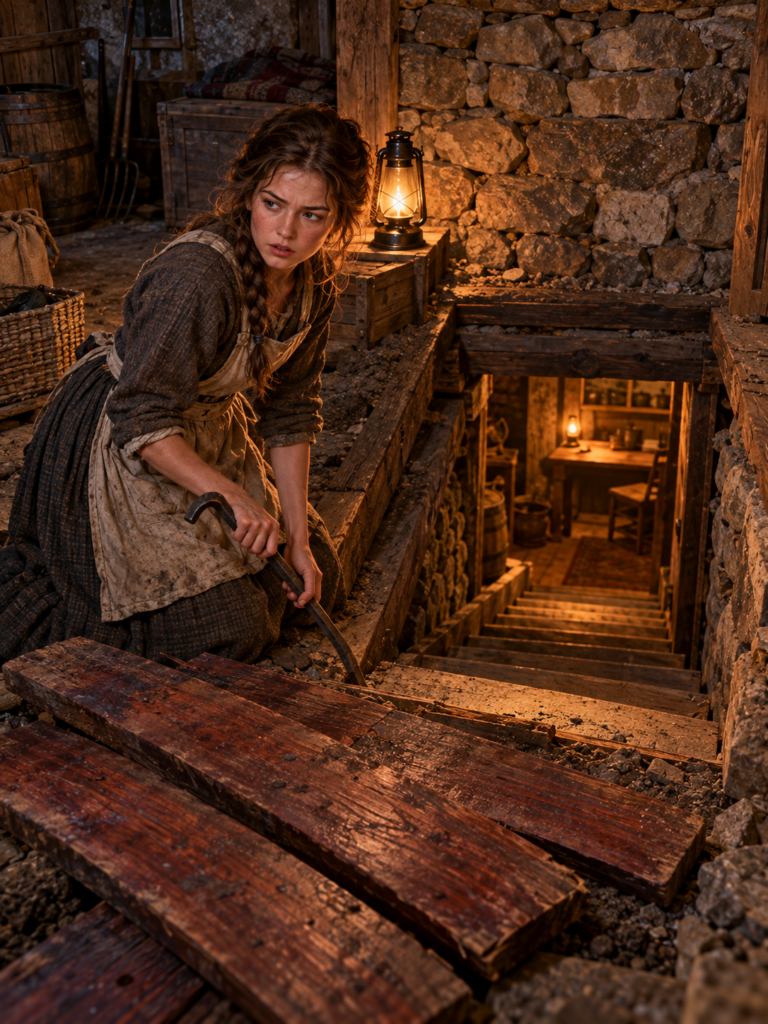
Elsie unfolded the envelope and found three separate objects inside.
A four-page letter.
A small leather pouch tied with rawhide.
And a document wrapped in oilcloth.
She examined the letter first, but the fading ink and tightly crowded lines required careful reading.
She set it aside and untied the pouch.
Gold coins slid into her palm.
For several seconds, she simply stared.
Then she counted them.
Two hundred fourteen gold pieces, followed by thirty silver dollars.
The money was astonishing.
Her father’s $420 debt, which had threatened to take everything she owned, could be paid with only part of it.
But the coins raised a troubling question.
Who would hide so much money beneath a ranch house and leave it untouched for decades?
Elsie turned to the oilcloth.
Inside was an old deed.
She brought the lantern closer.
The document described 160 acres along the north bank of Elhorn Bend Creek, including the improvements on the ground.
The name attached to it was unfamiliar.
Rachel Ashcraft.
The date was March 1852.
Elsie stopped reading.
Her grandfather had supposedly begun building the ranch house that summer.
Yet here was a deed dated months earlier, indicating that another woman had already held a recorded claim to the property.
Elsie checked the date again.
Then the seal.
Then the property description.
It appeared to concern the very ground above her head.
That didn’t, by itself, prove what had happened.
An old deed could have been superseded.
A claim could have been transferred.
But it directly challenged the family story that nobody had owned the ground before Owen Halverson.
And Corbin had mentioned old documents.
Elsie lifted the four-page letter again.
The writer identified herself as Rachel Ashcraft, a widow who had traveled west after losing her husband on the emigrant trail.
Rachel described building the underground dwelling years before the Halverson ranch house existed.
She had lived here.
Worked here.
And taught children from the surrounding valley.
The room with its books, table, and little stove had not been built to conceal anything frightening.
It had once been an ordinary home.
Then Elsie reached the portion describing Owen Halverson.
Rachel wrote that Owen had approached her in 1852 seeking permission to build on the rise above her dwelling.
She had agreed, but under conditions.
The land would remain Rachel’s.
The Halverson family could occupy and use it according to their arrangement.
They could not simply treat the underlying title as their own property to dispose of.
Elsie read those passages several times.
The family story was not entirely false.
Her grandfather really had built the house.
But he had not been the first person to make a home on that ground.
Nor, according to Rachel’s account, had he originally owned it.
Elsie sat in the old chair.
The implications settled slowly.
Her father might have spent his whole life believing the land was his.
He had borrowed money against the ranch.
He had left it to Elsie expecting her to inherit the property.
And now Vera Milward was claiming an older right through the Halverson family.
But if Rachel’s deed remained valid, Vera’s argument might rest on the same false assumption Elsie had inherited.
There was something else.
Rachel’s letter described leaving Oregon to care for a seriously ill sister in Ohio.
Before departing, she had asked Owen to close the entrance to the underground dwelling.
The concealed room had been intentional.
Rachel wanted her papers and possessions preserved for someone who might someday discover them.
The letter had later been delivered through a trusted acquaintance.
That explained why the entrance was hidden.
It did not explain how Vera learned enough to challenge the old title.
Or whether Rachel’s apparent deed would stand against whatever Vera intended to produce.
Elsie examined the old paper again.
She could not settle those questions alone.
But she had one important advantage.
Ambrose Whitaker kept the county’s land records.
If Rachel’s deed had been properly recorded, there might be an entry older than any claim Vera possessed.
Elsie carefully rewrapped the document.
She returned the letter to its envelope.
The gold went back into its pouch.
Then she rose from the chair, gathered the papers against her chest, and climbed the twelve stairs toward daylight.
Elsie emerged into the root cellar carrying the oilcloth-wrapped deed, the letter, and the pouch of coins.
For the first time since receiving Vera Milward’s notice, she possessed something more useful than an argument.
She had evidence.
But she needed to know how much of it could be trusted.
She placed the six removed boards against the cellar wall, leaving the passage accessible, and carried the discoveries into the kitchen.
The letter troubled her most.
Rachel Ashcraft had written about land, houses, and people whose lives had ended before Elsie was born.
Some details matched the family’s history.
Owen Halverson had built the ranch house in 1852.
Its original timberwork remained part of the structure.
But Rachel’s account gave the story a beginning no one had mentioned.
A widow had settled there first.
Her small underground house had existed before the Halverson family arrived.
And Owen had apparently understood that the land beneath his new home belonged to her.
Why had he allowed his children to believe otherwise?
Elsie couldn’t answer that from the deed alone.
The letter offered an explanation for the concealed room, though not for every silence that followed.
Rachel had asked Owen to close the passage.
She wanted the room left undisturbed.
The agreement was to remain known to him, while the objects and documents waited beneath the ranch.
If Owen kept that promise, his descendants might have inherited an inaccurate family story without ever knowing it.
Elsie thought about her father.
Isaiah had taught her how to mend fences, care for livestock, and identify weak timber.
He had pointed out the cellar’s dangerous joists.
He had even warned her about the wall that needed repair.
Yet he had never spoken about an underground dwelling.
It was possible he genuinely knew nothing.
That possibility saddened her more than the thought of deliberate deception.
She had spent years learning from a man who might himself have been living inside a story someone else had chosen for him.
The following morning, Elsie saddled Bess and rode the seven miles to Rowan Falls.
Her first stop was Ambrose Whitaker’s records office.
Ambrose greeted her from behind a desk crowded with ledgers.
Elsie placed the old deed before him.
He examined it slowly.
He inspected the seal, the signatures, and the description of the parcel.
Then he reached for an older record book.
The volume was heavy, its pages discolored at the edges.
He turned to the entries from the spring of 1852.
His finger stopped.
Rachel Ashcraft’s deed was recorded there.
It had been entered decades before.
Ambrose compared the ledger with the document Elsie had brought.
The descriptions corresponded.
He found no later recorded deed establishing the Halverson family’s independent ownership of that parcel.
Elsie remained standing while he examined the pages.
“So Rachel owned the ground?”
“The record supports her claim,” Ambrose said. “What happened afterward requires the other papers to be considered.”
She appreciated the distinction.
The deed was important.
But ownership and inheritance could involve more than finding one document in an old room.
Ambrose made a certified copy and returned the original.
Elsie asked him to preserve the record of what they had examined.
Then she went to the bank.
Silas Krebs looked surprised when she arrived.
She set the leather pouch on his desk.
“I want to satisfy the note.”
He opened the pouch and examined the coins.
“Your aunt has given you thirty days.”
“I know.”
“You have time remaining.”
“I don’t want the note hanging over this house another day.”
Silas counted the required amount.
Gold and silver passed across the desk.
He entered the payment in his ledger, marked the note satisfied, and returned the canceled document to Elsie.
The $420 debt was no longer outstanding.
That removed one immediate threat.
But it did not settle Vera’s older ownership claim.
Elsie understood that.
She left Rowan Falls knowing she had secured breathing room, not necessarily victory.
On the ride home, she tried to imagine how Vera would respond after learning the bank note had been paid.
At the bend below the ranch, she found out.
A covered coach stood in her yard.
Thaddeus Corbin sat beside the driver.
On the porch stood an older woman wearing a dark traveling cloak.
Her hair was gray.
Her face carried enough resemblance to Isaiah that Elsie recognized the family connection before the stranger spoke.
“I am Vera Milward.”
Elsie dismounted.
“You should have waited away from the house.”
Vera glanced toward the front door.
“I came to discuss what belongs to the family.”
“Then you’ve come to the wrong conclusion already.”
Corbin climbed down.
Vera opened a leather portfolio.
She removed a document bearing an impressive seal.
According to Vera, it was a federal land patent granted in 1846 to Owen Halverson.
She claimed it established the Halverson family’s original title and gave her an inheritance right superior to Elsie’s.
The second paper, she explained, challenged Rachel Ashcraft’s 1852 deed as fraudulent.
Elsie felt the cold move through her coat.
Vera already knew about Rachel.
And she was prepared to attack the woman’s very existence.
“There are people who say no such woman owned this ground,” Vera told her.
Elsie remembered the underground table.
The books.
The iron stove.
The carefully fitted stonework.
The letter left beneath the riverstone.
Someone had lived there.
Someone had built it.
And her name appeared in a recorded deed.
Vera offered Elsie one final opportunity to leave quietly.
If she resisted, Vera warned, she could face the complaint in court.
Elsie examined the date Vera had just mentioned.
1846.
She remembered something from her schooling.
Oregon Territory had not formally been established until 1848.
How could Vera possess a patent allegedly issued by an Oregon territorial authority two years earlier?
The contradiction did not establish who made the document or why.
But it was significant.
Elsie did not explain what she had noticed.
Instead, she told Vera that any challenge would have to be resolved through proper proceedings.
She demanded that the visitors leave.
Vera eventually returned to the coach.
Before departing, she warned Elsie that a hearing would follow.
Elsie watched the carriage disappear.
Then she went inside and placed the canceled bank note beside Rachel’s deed.
One claim against the property was finished.
The other had become more serious.
Over the next few days, damaging stories circulated around Rowan Falls.
Rachel Ashcraft was described as an unreliable woman who had disappeared under questionable circumstances.
The validity of her deed was openly questioned.
Elsie decided she needed independent confirmation.
She rode north to visit Barnaby Otley, an elderly stoneworker who lived near Otter Run.
Rachel’s letter had mentioned the assistance of a mason when the underground dwelling was built.
Barnaby had worked in that trade since his youth.
Elsie asked whether he remembered Rachel Ashcraft.
Barnaby stopped working.
“I remember her.”
He explained that he had helped his master lay stonework for Rachel’s dugout in 1846.
He remembered the small stove and the western wall.
He remembered Rachel paying them partly with a book of Latin poetry.
And he remembered that she taught children in the valley.
His account matched physical details Elsie had seen in the hidden room.
Barnaby hadn’t learned those details from the current dispute.
He had been there.
“Would you tell that to the authorities?” Elsie asked.
“I would.”
His recollection provided something the letter and deed could not.
A living witness.
After returning home, Elsie remembered the three notebooks Wilder Renshaw had left her.
Wilder had been the widow of a mason.
Elsie had preserved the notebooks but rarely opened them.
She found the first in a cedar chest.
On an early page was an old receipt concerning a sharpening stone purchased in 1854.
The buyer’s name was Rachel Ashcraft.
Elsie placed the receipt beside the deed.
The handwriting appeared remarkably similar.
The same sloping letter forms.
The same distinctive loops.
It wasn’t absolute proof of authorship.
But it was independent corroboration.
The notebook had belonged to Wilder’s household long before Vera challenged the ranch.
Elsie now possessed a recorded deed, a matching historical receipt, a letter, a physical dwelling, and the recollection of a man who had helped build it.
Then she went to see Josephine Vance, the schoolteacher.
Josephine read Rachel’s letter carefully.
She recognized the educational background reflected in the writing.
The phrasing and references were consistent with a woman accustomed to teaching children.
Again, that was supporting evidence rather than certainty.
But it strengthened the overall account.
Elsie also learned that one of Corbin’s supposed supporters, Letty Groves, had accepted money to repeat harmful claims about Rachel.
Elsie visited her.
Letty admitted she had been one of Rachel’s pupils.
She acknowledged that her previous accusations were untrue.
Desperate for money, she had accepted payment from Corbin.
When Elsie asked whether she would correct those statements publicly, Letty agreed.
The pieces of evidence were beginning to fit.
But the greatest discovery still waited beneath the ranch.
Before the hearing, Elsie returned to the underground dwelling and reread Rachel’s letter.
A passage about two additional purchases caught her attention.
Rachel had not confined her efforts to the ranch-house ground.
She had acquired land near the schoolhouse.
And another parcel involving the north pasture.
Elsie looked toward the shelf of books.
She remembered examining the room itself before opening the papers.
But she hadn’t searched every shelf.
She removed the books one by one.
Behind the final volume on the upper shelf lay another oilcloth packet.
Inside were two additional deeds.
Both concerned land acquired by Rachel in 1850.
One identified the schoolhouse parcel.
The other described the north pasture used by Emory Whitlock.
Elsie laid the three deeds across the table.
The discovery had become larger than the mortgage or the house.
Rachel had deliberately acquired important pieces of the valley.
And she had left behind the documents that could protect them.
Elsie looked at the narrow stairs.
She had entered this room trying to save her father’s home.
Now she understood that the forgotten woman who once lived here had been protecting much more than one building.
Elsie carefully wrapped the two newly discovered deeds and placed them with the first.
Three separate parcels.
Three documents bearing Rachel Ashcraft’s name.
And a history that had nearly disappeared beneath six painted boards.
She studied the additional passages in Rachel’s letter.
Rachel had encountered men representing outside financial interests who wanted to acquire useful land around Elhorn Bend.
Their offers were not always made in ways that protected the settlers already living there.
Rachel had recognized the importance of the creek, the schoolhouse ground, and the north pasture.
Over time, she acquired those properties herself.
Her purpose, according to the letter, was to keep them from being absorbed into distant speculative holdings.
She wanted the people who depended on the valley to retain a place within it.
The three deeds were therefore connected.
They were not an accidental collection of old papers.
They represented a deliberate decision.
Rachel had understood that ownership could shape what happened to an entire community.
Elsie thought of Vera Milward’s insistence that the Halverson family had been the rightful owners from the beginning.
Vera’s claim was troubling enough when applied to the ranch.
But Rachel’s additional deeds showed why the conflict mattered beyond one household.
The old schoolhouse stood on land recorded in Rachel’s name.
Emory’s grazing ground did too.
If Vera succeeded in establishing a competing superior claim based on the Halverson family, the consequences might extend into arrangements other people had trusted for years.
Elsie could no longer treat the disagreement as a private quarrel between relatives.
She returned the books to their places.
Then she extinguished the lantern on the table and climbed the twelve stairs.
In the kitchen, she arranged the documents in order.
Rachel’s first deed from 1852.
The two earlier deeds from 1850.
The four-page letter.
Wilder’s notebook with the 1854 receipt.
And the canceled bank note.
Each object answered a different question.
The paid note proved that the immediate debt had been satisfied.
The recorded deed supported Rachel’s ownership of the ranch parcel.
The other deeds identified additional land.
The old receipt corroborated the handwriting.
Barnaby’s account confirmed the underground dwelling’s existence decades earlier.
And Rachel’s letter explained how the Halverson house came to stand above her own.
No single piece established everything.
Together, they formed a history that could be tested.
That distinction helped Elsie remain calm when the formal notice arrived.
Ambrose Whitaker had arranged a public verification of the competing documents.
Judge Howerin would attend from Baker City.
Vera Milward and Elsie Halverson were both named.
The hearing was set for four days later.
Elsie read the notice at the kitchen table.
She had spent much of the previous week frightened of what might happen.
Now she had work to organize.
The next morning, she prepared copies of the relevant passages and carefully compared the handwriting on Rachel’s deed with the old receipt.
She did not attempt to improve the evidence.
She wanted the original documents examined.
She also visited Josephine Vance.
Josephine agreed to attend with Rachel’s letter, which Elsie entrusted to her for safekeeping before the hearing.
Barnaby Otley remained willing to testify.
Letty Groves, who had admitted accepting money from Corbin, agreed to tell the truth about Rachel’s character and presence in the valley.
Elsie knew witnesses could remember events imperfectly.
The decades between Rachel’s departure and the hearing were substantial.
But the witnesses’ accounts could be weighed alongside the contemporary documents.
That was far better than depending on rumor.
On the third day, Elsie stayed home.
She checked the ranch chores.
Fed the remaining cattle.
Made sure the firewood was stacked.
Then she returned to the hidden room.
She sat at Rachel’s table, with Wilder’s folding rule beside her.
For much of her childhood, the only story Elsie had known was the Halverson story.
Her grandfather had built the house.
Her father had inherited it.
She would inherit it from him.
That version contained real facts.
But it left Rachel completely out.
Elsie could see why her father might never have questioned what he had been told.
Isaiah had been a practical man.
He dealt with the things directly in front of him.
Livestock needed tending.
Fences needed repair.
Debts needed paying.
If Owen had never revealed the agreement with Rachel, Isaiah would have had little reason to suspect that his family’s house stood above an older dwelling.
The painted boards had become an ordinary feature of the cellar.
The explanation had passed from father to child.
Nobody had looked behind them.
Elsie ran her finger over the table’s worn surface.
Rachel had built a life here before the ranch existed.
She had taught children.
She had acquired land.
She had chosen to leave documents for someone who might come after her.
And for decades, nearly everything about her had been forgotten.
Elsie placed the riverstone back where she had found it.
She would return after the hearing.
Whatever the decision, the room deserved to remain known.
The following morning, she dressed carefully.
She wore her mother’s blue wool dress beneath her coat.
She braided her hair.
She placed Wilder’s folding rule in her pocket.
And she packed the documents into the leather satchel her father had left behind.
At eight o’clock, Emory Whitlock arrived with his wagon.
Delphine Kaiser sat beside him, carrying food for the journey.
Barnaby Otley followed on his mule.
Letty Groves came wearing a shawl against the cold.
Josephine Vance joined them near the ford.
Elsie had not ordered anyone to accompany her.
These were neighbors who had decided the truth about the valley mattered.
They traveled together to Rowan Falls.
By the time they reached Ambrose Whitaker’s office, a crowd had gathered.
The usual office furniture had been rearranged.
A central table held the competing documents.
Judge Howerin sat behind it.
Vera Milward occupied a chair on one side.
Thaddeus Corbin stood behind her.
Elsie took the opposite seat.
She placed her satchel on the table.
The judge explained that the proceeding concerned verification of the instruments presented.
More serious allegations, if necessary, would require appropriate later proceedings.
Then he asked Vera to submit her claimed patent.
She handed it across.
Judge Howerin read the document.
He studied its seal.
Checked the date.
Then examined it again.
The room grew quiet.
The patent purported to have been issued in 1846 by an Oregon territorial authority.
But Oregon Territory had not been established until August 1848.
The office named on the instrument had not existed in the form claimed at the date stated.
That was not a minor discrepancy.
It was a fundamental historical contradiction.
A document could not genuinely have been issued in 1846 by an institution that did not yet exist.
The judge laid the patent down.
He explained the problem plainly.
Vera’s face remained controlled.
Corbin looked toward the table.
Neither could supply an explanation that reconciled the impossible date with the official seal.
Elsie remembered standing on her porch and hearing Vera announce the patent with complete confidence.
She had noticed the contradiction then.
But noticing a flaw and establishing it before an authority were different things.
Now the flaw was part of the record.
The judge turned to the deed Elsie had brought.
Ambrose Whitaker confirmed that the original record appeared in the county books dating to the spring of 1852.
The document was not a recent creation introduced after the dispute began.
Its record had existed for decades.
Barnaby Otley was asked about Rachel Ashcraft.
He told the room that he had helped build part of her underground dwelling.
He described the stonework, the stove, and Rachel’s role as a teacher.
His recollection supported the existence of a woman Vera’s representatives had attempted to dismiss as unreliable or possibly imaginary.
Then Letty Groves spoke.
Her testimony was uncomfortable.
She admitted taking money from Corbin to repeat false accusations about Rachel.
She explained that she had known Rachel as a teacher and had no basis for the damaging stories she had repeated.
There was movement among the people listening.
The judge brought the room back to order.
Elsie watched Vera.
The older woman’s carefully maintained confidence had begun to fade.
The dispute was no longer a matter of one isolated nineteenth-century document against another.
Evidence from several independent sources now supported Rachel’s history.
Josephine Vance produced the four-page letter.
She explained its contents and identified features consistent with the writing of an educated schoolteacher.
That observation alone couldn’t authenticate it.
But it helped establish coherence between the writer’s stated life and the other evidence.
Finally, Elsie opened Wilder Renshaw’s notebook.
She showed the old receipt for the sharpening stone.
It bore Rachel’s signature.
The notebook’s history was known.
Wilder had preserved it from her household.
Elsie had received it after Wilder’s death, well before Vera’s challenge.
The judge compared the receipt with the signature on the deed.
The resemblance was strong.
More importantly, the notebook provided a separate connection between Rachel and the valley after the recorded deed had been made.
The pieces supported one another.
An old deed.
A contemporary transaction.
Physical evidence of the dwelling.
A letter explaining the arrangement.
And people who remembered Rachel personally.
The judge reviewed the papers again.
When he delivered his decision, he rejected Vera’s claimed patent as invalid on its face.
He accepted Rachel’s recorded deed as the governing instrument for the ranch parcel.
Under the inheritance interpretation adopted in the proceeding, the letter and the deed’s language supported Elsie’s claim.
Vera’s complaint was dismissed.
The costs were assigned to Vera.
And the judge warned that any renewed accusation involving false documents would have to be examined with the seriousness it deserved.
Vera stood slowly.
She gathered her papers.
Closed the portfolio.
Tied its ribbon.
Then walked from the office without acknowledging Elsie.
Corbin followed.
By afternoon, both were aboard the coach leaving Rowan Falls.
Neither returned to Elhorn Bend.
Elsie remained at the records office.
She had two additional deeds to address.
Ambrose examined the documents concerning the schoolhouse and north pasture.
He entered the appropriate records, with Elsie signing the necessary entries.
When the work was finished, she stood looking at the pages.
She had entered the office weeks earlier as a young woman facing the loss of her home.
She was leaving with the immediate debt satisfied and the property dispute resolved in her favor.
But the discovery had also given her responsibility for ground other people depended upon.
She rode home with her neighbors.
No one made speeches along the wagon track.
The late light fell across the creek.
Bess walked steadily beneath her.
At home, Elsie put the documents safely away.
Then she sat down with clean paper and began writing.
The first agreement concerned the schoolhouse.
Rachel had once taught children in the valley.
Elsie wanted that educational purpose protected.
She prepared a lease granting the Elhorn Bend School District use of the schoolhouse parcel for 999 years at a yearly rent of one dollar, conditioned on its continued use for teaching the valley’s children.
She carried the document to Josephine Vance.
Josephine read it without speaking.
Then she sat beside her stove.
Her hands rested on the paper.
“This is what you want?”
“Yes.”
“The rent is one dollar?”
“Each January.”
Josephine studied the agreement again.
Elsie had received something because another woman had thought about the future.
Now she was doing the same.
The second agreement concerned Emory Whitlock.
He had been using the north pasture for years.
Elsie offered a ten-year lease at forty dollars a year, with an option to renew for another decade.
Emory read the terms.
He observed that the rent was below what the land could command.
Elsie understood.
She wanted him to continue caring for the pasture under an arrangement both of them could trust.
She had learned what uncertainty about land could do to a household.
She did not want to pass that uncertainty to her neighbors.
The third parcel she kept.
It included the ranch house, the root cellar, and Rachel’s older dwelling beneath it.
Elsie recorded the description in the family Bible, following the entry concerning her father’s death.
She did not erase what had been written before.
The Halverson family history remained part of the house.
But it was no longer the entire history.
Her grandfather had built the upper house.
Rachel had built the lower one.
And Elsie had been fortunate enough to discover how the two came to stand together.
In the days that followed, the valley responded in ordinary ways.
Emory brought cordwood.
Delphine Kaiser arrived with a laying hen and a rooster.
Barnaby Otley brought a small piece of carved granite.
He had made it to honor Rachel Ashcraft and identify her as the woman who built the hidden room.
Elsie held the stone in her hands.
For years, Rachel’s name had existed only in forgotten records and fading memories.
Now it would be visible above the doorway.
Barnaby knew a mason who could set it securely.
Elsie agreed.
Two Saturdays later, the marker was installed above the entrance to the twelve stairs.
The six boards that had concealed the opening were no longer needed there.
The passage was no longer something Elsie had to discover by accident.
It was part of her home.
At the end of November, she returned to Rachel’s underground room.
The floor had been swept.
The little stove was functioning again after its flue had been cleared.
She placed two lit lanterns on the table.
Their combined light reached the stone walls and the old bedstead.
The books remained on the shelf.
The riverstone lay where Rachel had used it to hold down her envelope.
Elsie sat for a while.
She thought of her mother, who had died before Elsie was old enough to understand how much her presence meant.
She thought of Isaiah, who had taught her practical skills and left her a house burdened by debt.
She thought of Wilder Renshaw, who had taught her to measure carefully and distrust appearances that contradicted sound workmanship.
And she thought of Rachel.
Rachel had never known Elsie’s name.
She couldn’t have known that a nineteen-year-old woman would descend the stairs decades later carrying a lantern and a heart full of uncertainty.
But Rachel had left something worth finding.
Not merely money.
Not merely deeds.
She had left a record of choices.
She had protected land because she understood how easily people with greater resources could take it from those with less.
She had welcomed another family onto her ground.
And she had trusted that someone, someday, might find her documents and understand their significance.
Elsie took Wilder’s folding rule from her pocket.
She opened it on the table.
The brass joints still moved cleanly.
She remembered the older woman’s lessons.
A person repairing a house needed to understand what supported it.
And what threatened it.
For years, Elsie had believed the answer was simple.
Her family supported the house.
The bank threatened it.
Now she knew there had been another foundation all along.
One made of a woman’s labor, a recorded promise, and a determination not to surrender land to those who valued it only as property to be acquired.
Elsie closed the rule.
Then she lifted Rachel’s riverstone.
She carried it upstairs and placed it on the pantry windowsill.
There it would be touched, dusted, and noticed.
Not buried.
Not forgotten.
A small reminder that an ordinary object could carry a history larger than anyone suspected.
She closed the pantry door and went to the barn.
The three remaining Shorthorns were waiting to be milked.
She hung the lantern, set down her pail, and sat beside the first cow.
The familiar work brought her back to the present.
The cold evening settled over the valley.
Inside the house, the fire burned.
Below the pantry, the older room remained open.
The mortgage had been paid.
The disputed claims had been resolved in Elsie’s favor.
The schoolhouse and north pasture now had written arrangements intended to protect the people who used them.
And the ranch remained her home.
Elsie had begun the autumn believing that saving her inheritance meant defending the story her family had told.
Instead, she had saved it by discovering where that story was incomplete.
Her father had given her the skills to maintain a house.
Wilder had taught her how to examine one.
And Rachel had left behind the evidence that allowed her to understand the ground beneath it.
Twelve stairs separated the two homes.
But both now belonged to a single history.
The next morning, Elsie would rise, feed the cattle, tend the stove, and continue repairing what winter threatened.
There would still be work.
There would always be work.
But she would no longer look at the north corner of the cellar and see a wall holding back the earth.
She would see a doorway.
And beyond it, the life of a woman whose name would no longer be forgotten.


