
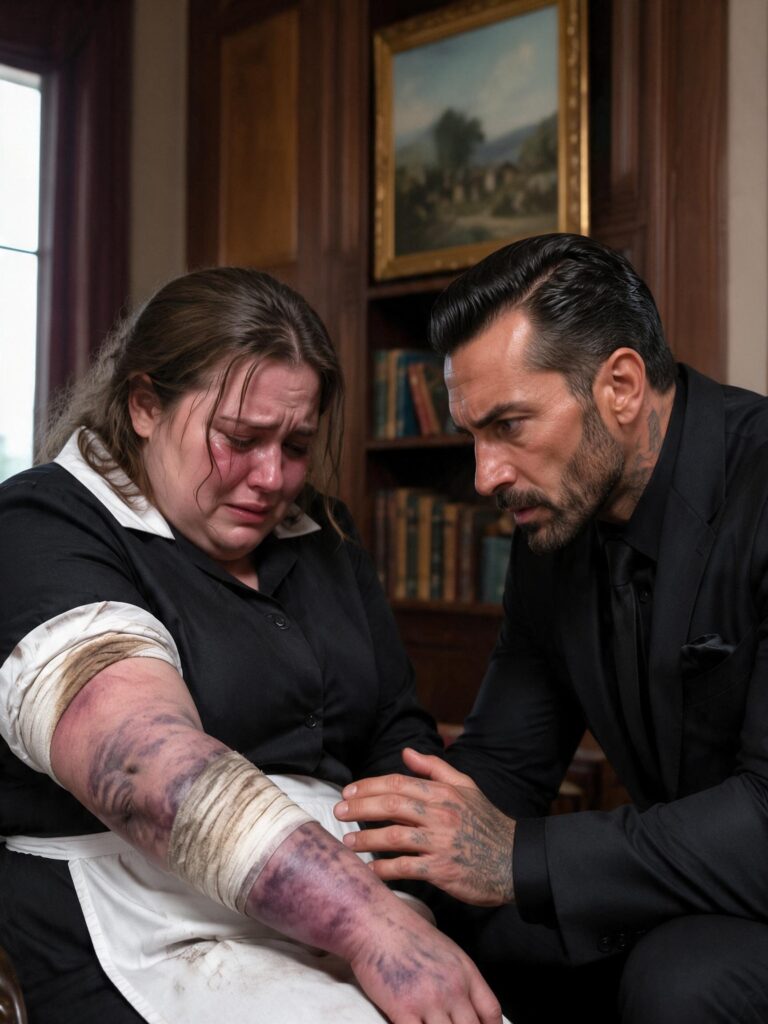
The Mafia Boss Saw His Overweight Maid Hide a Shattered Arm at His Table — By Dawn He Had Erased the Ten Men Who Broke It
Part 1
Blood always left a stain. Secrets bled differently.
Charlotte Higgins learned that in a wet alley behind her Queens walk-up, three hours before she was expected to pour wine for the most dangerous man on the East Coast.
The rain had not yet started. The brick walls held the heat of a late September day, and the dumpster beside the service door smelled of spoiled citrus and old grease. She had her canvas grocery bag clutched against her ribs and her keys between her fingers the way the women on her block had taught her, as if a key could stop a man who had already decided she was a debt and not a person.
Ten of them stepped out of the dark.
Mickey Sullivan’s collection crew. Low men with high opinions of themselves. Frankie Cole was the largest, a slab of a man with a metal bat resting on his shoulder as if he had been born holding it.
“Your old man owed forty grand,” Frankie said. “Dead men don’t pay. Daughters do.”
“I need a week,” Charlotte said. Her voice came out smaller than she wanted. She hated that. She was thirty-one years old, broad through the shoulders and the hips, strong enough to haul roasting pans and strip guest rooms until her back sang, and still her voice went thin when fear got into it. “I get paid Friday. I can give you two hundred. I can—”
“We’re not a bank.”
The bat moved. She threw her left arm up because her face was behind it, because some animal part of her still believed a bone could bargain. The crack echoed off the brick like a gunshot. White fire tore from wrist to elbow. She went down into the garbage, the grocery bag splitting, oranges rolling into the gutter. Someone laughed. Someone told her next time it would be her skull. Boots retreated. A car door slammed. The alley went quiet except for the sound of her own breathing, high and ruined.
She did not go to a hospital. Hospitals asked questions. Questions found Mickey. She bound the arm in a torn sheet and an old ace bandage, swallowed four ibuprofen she could not afford to waste, and took the late bus upstate because missing a shift at the De Agostino estate was a faster way to lose the roof over her head than a broken bone.
By the time she stood outside the dining room in her black uniform, sweat had soaked the collar and the left sleeve hid a forearm swollen to twice its size. The fabric bit. Her fingers had begun to tingle. Every step across the imported marble sent a shock up the bone that made her vision spark at the edges.
Usually her size made her invisible. The dangerous men who walked these halls looked through her the way they looked through furniture. Tonight the weight felt like an anchor. Her thighs brushed. Her orthopedic shoes squeaked. Rosa, the head housekeeper, shoved her between the shoulder blades.
“Stop dawdling. Take the Barolo to Mr. De Agostino. Spill it and I will have your hide.”
The decanter was crystal, heavy, meant for two hands. Charlotte gripped the neck with her right and forced the left to rise. The moment the base settled against the broken forearm, nausea rolled through her so hard the room went black for half a second.
A sound escaped her. Not a word. A mouse-small whimper.
Conversation at the long mahogany table died.
Vincent De Agostino did not look at the wine. He looked at her face.
He sat at the head of the table in a charcoal suit, dark hair silvering at the temples, eyes the color of wet slate. Underbosses flanked him. Shipping routes and union payoffs hung unfinished in the air. He was a man who ruled by noticing what other men missed, and what he noticed now was a housemaid the color of ash, a bead of blood on her bitten lip, and a left arm held at an angle no sprain produced.
“I apologize, sir,” Charlotte whispered, and poured with her right hand only, tucking the left against the soft width of her waist as if she could hide a crime inside her own body.
He did not touch the glass.
“Are you unwell, Charlotte?”
The room went still. Every underboss turned. She felt their attention like heat. The fat maid. The trembling one. The punchline who had finally done something worth looking at.
“No, Mr. De Agostino. I lost my footing.”
His gaze dropped to the sleeve stretched tight over a bulge that had not been there yesterday, to the way she leaned right to spare the left side of her body. He did not suffer liars. Even brave ones.
“Leave the decanter. Go to my study and wait.”
Her heart stopped. The study was where people were questioned. Fired. Handed to the basement crew when a mistake could not be mopped up.
“Yes, sir.”
She set the crystal down and retreated. Behind her, too low for anyone but the man at his right to hear, Vincent said, “Find out who worked the front gates. Someone let her walk in here trying to hide an injury. Call Dr. Aris. Portable X-ray. Study.”
The study smelled of cigar smoke and old bourbon. Leather books lined the walls. Charlotte stood near the desk because sitting felt like a liberty she had not been given. Her fingers were going blue. The door clicked. Vincent locked it behind him and did not go to the desk. He came straight at her, tall enough to cast her in his shadow.
“Sit.”
She sank into the leather sofa. The cushions took her weight without complaint. He did not.
“Roll up your sleeve.”
“Please. It’s a sprain. I can work.”
“Do not lie to me in my own house.”
Her right hand shook too badly to manage the buttons. He knelt on the rug. The sight of him there, the head of the De Agostino syndicate on one knee in front of a housemaid, stole what little air she had left. His hands were scarred and careful. He undid the cuff, rolled the fabric past the elbow, and went still at the bandage stained with sweat and the ugly bloom underneath.
A switchblade appeared. She flinched hard into the sofa.
“I am not going to hurt you.”
The blade slid under the cloth and parted it. What remained made even Vincent De Agostino stop breathing.
The forearm bowed at an angle bone was never meant to hold. Swollen, tight, mottled black and purple and a sick yellow at the edges. The skin shone as if it might split.
“Who did this?”
The room seemed to drop ten degrees.
“I fell. The stairs at my building.”
“A fall does not snap a radius in a transverse fracture.” His eyes came up to hers, and the observant calm in them had burned down to something colder. “That is a defensive wound. You raised your arm to block a blunt strike. You are under my roof. You are my staff. That means you are under my protection. I will ask once more. Who broke your arm?”
The dam went. She told him about her father’s cards, the forty thousand, the transfer of a dead man’s debt onto a living daughter. She named Mickey Sullivan. She named the alley. She named Frankie Cole and the bat and the promise about her skull. Her shoulders shook. She hated the sound of herself, pathetic and small in a room built for men who did not beg.
Vincent did not interrupt. A muscle ticked in his jaw.
Dr. Aris knocked and entered with his bags. Vincent stood, brushing his knees.
“Set the bone. Cast it. Whatever she needs for the pain.” He looked down at her, unreadable. “You will sleep in the east-wing guest suite. You are not going back to Queens.”
“My job—”
“Your job is to heal.”
He walked out. In the long hall, marble under his shoes and the estate dark beyond the windows, he dialed a single number.
“Richard. Pull the boys. We have a pest problem in Queens.”
“Who’s the target?”
“Mickey Sullivan’s collection crew. All ten who worked that alley. A heavy hitter named Frankie Cole.”
“Brought in for a talk?”
Vincent stopped at the grand window. Moonlight lay over the lawns like spilled silver.
“No. I don’t want them talking. I don’t want them found by sunrise. I want it to be as if they never existed.”
“Consider it done.”
Charlotte slept under silk and morphine in a bed wide enough to hold her without apology. Somewhere past the Henry Hudson, black SUVs rolled without headlights. Doors came off hinges. Men who had laughed in an alley learned what it was to be dragged from their own beds. By the time the sun cleared the tree line, the local news had a banner and no bodies.
Mass disappearance. NYPD baffled. Ten known affiliates. Empty apartments. A chilling silence on the streets of Astoria.
Vincent stood in the doorway of the guest suite with a tray of tea and toast, charcoal suit immaculate, a faint dangerous curve at his mouth as he watched the screen and then her.
“Drink your tea, Charlotte. The streets are safer today.”
She set the cup down before she dropped it. The duvet hid her waist and the heavy line of her thighs, and still she felt how much space she took in a room like this. A multi-millionaire with the power to erase men did not do it for the girl who scrubbed baseboards.
“If the police trace this to you—”
“The 114th is not going to trace a thing to me.” He sat on the edge of the mattress. The bed dipped. “They were extortionists. The city is relieved. And Mickey Sullivan no longer holds your paper.”
A knock cut the quiet. Richard stood in the hall, face cut from granite.
“Boss. We have a situation. City. Now.”
The warmth left Vincent’s face as if a door had shut.
“Stay in this room. Dr. Aris at noon. Rosa will bring lunch. Do not lift a finger.”
In the Escalade, Richard swiped a tablet and kept his voice professional. Cleanup was flawless. Vehicles crushed in Newark. Cargo resting in deep water off Montauk. Frankie Cole and nine associates, ghosted.
“Then what is the problem?”
“Mickey Sullivan. He didn’t go to the police. He went to his backers. He hasn’t been independent. He’s been kicking up to the O’Connor syndicate in Hell’s Kitchen. Tommy O’Connor thinks we just made a territorial strike.”
Vincent poured bourbon and watched the skyline. A decade of truce. Real estate. Casinos. Shipping. A rabid dog on the other end of a phone.
“Double the estate detail. No one through those gates without my clearance.”
He did not say the rest. He did not have to. The woman in the east wing had walked into his house with a shattered arm and a lie, and by trying to protect her he had set a match to a peace that had kept the East Coast from burning.
Back in the suite, Charlotte stared at roasted chicken she could not eat and at her own reflection in a floor-to-ceiling mirror: wide waist, heavy hips, a silk nightgown clinging to every curve she had spent her life trying to apologize for. A tear cut her cheek.
Men like Vincent De Agostino did not start wars for girls like her.
By afternoon the perimeter had filled with armed men, and somewhere in Hell’s Kitchen a man who had never met her was already deciding she was the excuse he had been waiting for.
Part 2
Two days of rain and rifles.
Charlotte went half mad in the guest suite. The cast ached in a deep bone-hum the pills only blurred. She missed the mindless mercy of work, the way a floor could be dirty and then clean and ask nothing about her father’s cards. Idleness left her alone with the knowledge that men with guns now walked the tree line because she had failed to keep her mouth shut and her arm hidden.
On the third morning the door opened and Vincent came in looking wrecked. Tie loose. Top button undone. Fatigue carved into the lines of his face. The harshness fractured when he saw her, softening into something she did not have a name for and did not trust.
Behind him walked a sharp-featured woman with three garment bags and two bodyguards hauling a rack.
Charlotte yanked the duvet to her chin. “Mr. De Agostino—”
“Vincent,” he said. “This is Madame Genevieve. She is going to measure you.”
“I don’t need silk. My uniform is fine. Designers don’t make clothes for women my size. I’ll stretch the fabric and look ridiculous.”
The words fell out before she could catch them, old humiliations from department-store mirrors and strangers who thought volume was a public service. Vincent went still. The fury that crossed his face was not aimed at her. He sent Genevieve and the guards into the hall and shut the door.
He crossed to the bed and pried her fingers off the duvet, drawing it down until she sat exposed in plain cotton, cast and all.
“Listen carefully,” he said, voice lower, stripped of the dining-room polish. “I have spent my life around hollow people. Thin, starving women in expensive clothes covering empty rooms. You have more warmth in your little finger than any of them. You think your weight is a flaw. I see a woman who carried the world and did not put it down. You are done hiding in polyester. You will wear fabric that respects you. Do you understand?”
No man had ever looked at the substantial fact of her and called it anything but a joke. Tears spilled. She nodded, small and jerky. His thumb caught one tear, and then the professional mask returned as if it had never slipped.
“Genevieve.”
For two hours Charlotte stood and turned and tried not to weep while a woman who dressed Manhattan royalty pinned emerald silk and cashmere to a body Charlotte had been taught to shrink. Empire waists. Tailored slacks. Nothing apologetic. Genevieve, under the weight of Vincent’s glare from the adjoining sitting room, was nothing but precise and kind.
The call came while a swath of green silk was still in Charlotte’s good hand.
She heard the chair crash. She put her head through the doorway. “Everything all right?”
Vincent’s face did not move. “Everything is perfectly fine, cara.”
The endearment slipped out in Italian and hung between them. He had already hung up. On the other end of that call, Richard had reported a federal warrant walked into the Midtown lobby by Detective James Miller of the 114th, pushed by a judge in Tommy O’Connor’s pocket. The warrant asked for shipping manifests. The detective had also asked the receptionist whether the company employed a woman matching Charlotte’s exact description.
They had found her.
Vincent stood at the bay window and watched a black unmarked sedan idle at the end of the drive. A tinted window came down an inch. A red laser dot kissed the stone pillar of the gatehouse and danced away.
“Get down!”
He lunged. The tackle took her off her feet as suppressed fire chewed the reinforced glass into a shrieking rain of shards and shredded silk. His weight covered her, careful even then of the cast, his mouth at her ear.
“Stay still.”
Return fire thundered from the grounds. Tires screamed. Metal hit metal as an armored SUV rammed the sedan into an oak. Then shouting. Then silence.
He rose on his forearms and checked her shoulders, her waist, the thick line of her thighs, hands fast and impersonal and shaking anyway.
“Are you hit?”
“No. They came because of me.”
“They came because Tommy O’Connor is a dying animal who thinks he can intimidate a predator.” He pulled her up. Despite everything she believed about her own weight, the lift was effortless. “You are not a burden. You are the line I have been waiting to draw.”
Richard filled the doorway, rifle slung, jacket gone. Two shooters dead. O’Connor ink on their necks. A message, not a breach.
“Take her to the bunker. Titanium doors. Four men on the hatch. No one in or out without my voice on the closed circuit.”
Charlotte’s stomach turned. “Don’t leave me in the dark. I can’t—”
She hated the need in it. A maid clinging to a billionaire. Vincent stepped into her space anyway, ignoring Richard, and took her face in both scarred hands.
“I will not leave you in the dark, my sweet girl. But I cannot fight if I am afraid a stray round will find you. You are my greatest weakness now. I need you safe so I can be ruthless.”
He kissed her forehead. Possessive. Lingering. Heat went through her like a struck match. Then he was gone down the hall, already dialing, already done with defense.
The bunker was concrete, cots, rations, a clock that blinked too slowly. Charlotte sat with her knees drawn up and her good arm around her shins and tried to remember she was a woman who baked pies and polished silver, not a reason for men to bleed. Hours dragged. The realization arrived without permission and hit harder than the bat: she cared whether Vincent De Agostino came back. He had seen past her size and her station and treated her with a reverence she had not been offered in thirty-one years.
Above ground, the dining room became a war room. Maps. Surveillance. Cigars. Vincent at the head of the same table where she had nearly dropped the Barolo, sleeves rolled, forearms corded with old ink.
“Tommy pulled his muscle into the club on Tenth Avenue,” Richard said. “Fortress. Forty guns. A frontal assault bleeds us. A siege brings the feds.”
“Then we draw him out.”
The oak doors opened. Six men reached for holsters and stopped when Vincent lifted a hand.
Charlotte stood in the threshold in the black dress Genevieve had finished that afternoon, fabric draped over her curves without apology, cast clutched to her ribs, chin up because she was tired of the dark and tired of being the helpless weight men died for.
“This is not a place for you,” Vincent said.
“I know.” Her voice shook. She stepped in anyway. “But I overheard the guards. You’re trying to get Tommy out of that club.”
Richard scoffed. “With respect, this is family business.”
“Quiet.” Vincent’s eyes stayed on her. “Speak.”
She smoothed the dress over her hip and told them what her father had taught her on jobs she was never paid for. Before the cards ate him, he had been a plumber. She had carried his tools through Hell’s Kitchen as a teenager. The building on Tenth Avenue had been a meatpacking house. Under the dance floor sat an antiquated ammonia system tied into the old steam tunnels. A death trap, he used to say. Crack the main pressure valve from the adjacent grate and the ventilation could not save the room.
Silence. Salvatore whistled. Richard’s skepticism died into something like respect.
Vincent crossed to her. He did not smile.
“You understand what you are handing me. A blueprint to slaughter forty men.”
“They broke my arm,” she said, and heard the cold in her own voice with surprise. “And they tried to kill you. I am done being a victim.”
The smile came then, slow and dangerous. His hand cupped the back of her neck.
“You are magnificent.”
He turned to his men. “Load the trucks. Breathing gear for the tunnel team. We hit at three. By sunrise the O’Connor syndicate is a memory.”
Midnight rain lashed Tenth Avenue. Vincent waited in the black of an abandoned storefront with Richard and Salvatore and a dozen rifles. Beneath the street, three men in respirators followed the map Charlotte had sketched on a napkin. At 3:04 the radio clicked twice.
The groan came up through the sidewalk. Then the hiss. Inside the fortress, archaic pipes ruptured and the club filled with what the lungs could not survive. Doors burst. Men poured into the rain blind and choking, weapons dropped, hands at their throats. Vincent’s hand fell. The crossfire was not a battle. It was an ending. He did not fire. He watched for the head of the snake, then took Richard down the rear alley because rats did not use the front door.
Tommy O’Connor stumbled out with a gold revolver and a handkerchief over his mouth. In the getaway car sat Judge Harrison Caldwell, the man who had signed the warrant. Richard froze the judge in place. Vincent walked into the rain.
“Caldwell is taking a permanent vacation,” he said. “You are not going anywhere.”
Tommy raised the revolver. Vincent was faster. One shot. The Irish boss folded into the pallets and did not rise. Vincent adjusted his cuffs as if the alley were a boardroom.
“Make sure His Honor catches his flight. I am going home.”
The Escalade rolled through the iron gates as the horizon bruised purple. The war was over. The East Coast had a new undisputed power. Vincent shrugged off a ruined jacket in the foyer and thought only of the woman upstairs.
He found her by the boarded bay windows, still in the black dress, lamp-light on her shoulders and the generous line of her hips. She turned, scanning him for wounds.
“You’re covered in blood.”
“It belongs to other men.”
He stopped inches from her. The adrenaline had burned out and left a hollow only she seemed able to fill. His hands settled on the wide flare of her waist, reverent, anchoring, asking her not to shrink.
“It’s over. Mickey. Tommy. No one raises a hand to you again while I have breath.”
Tears cut her lashes. Her good hand found his jaw.
“You burned half the city for a maid.”
“I burned half the city for my queen.” His fingers pressed into the soft yield of her hips and drew her flush against him. “There is no maid in this room. There is the woman whose mind saved my life, and the woman who owns every beat of my heart.”
She looked at him and let the old burden drop. Fat. Scarred. Casted. Standing in the arms of the most dangerous man in New York, she was, finally, terrifyingly herself.
He kissed her. Rain. Gunpowder. Devotion.
The sun cleared the skyline over a city that had been rearranged and did not know a quiet, overlooked woman with a broken arm had rewritten the rules by refusing to stay hidden.
She chose him in that kiss, freely, not as payment for a debt erased. He chose her not for the truce she had ended or the empire she had helped him take, but because when the guns stopped the only room he wanted was the one that held her.


