
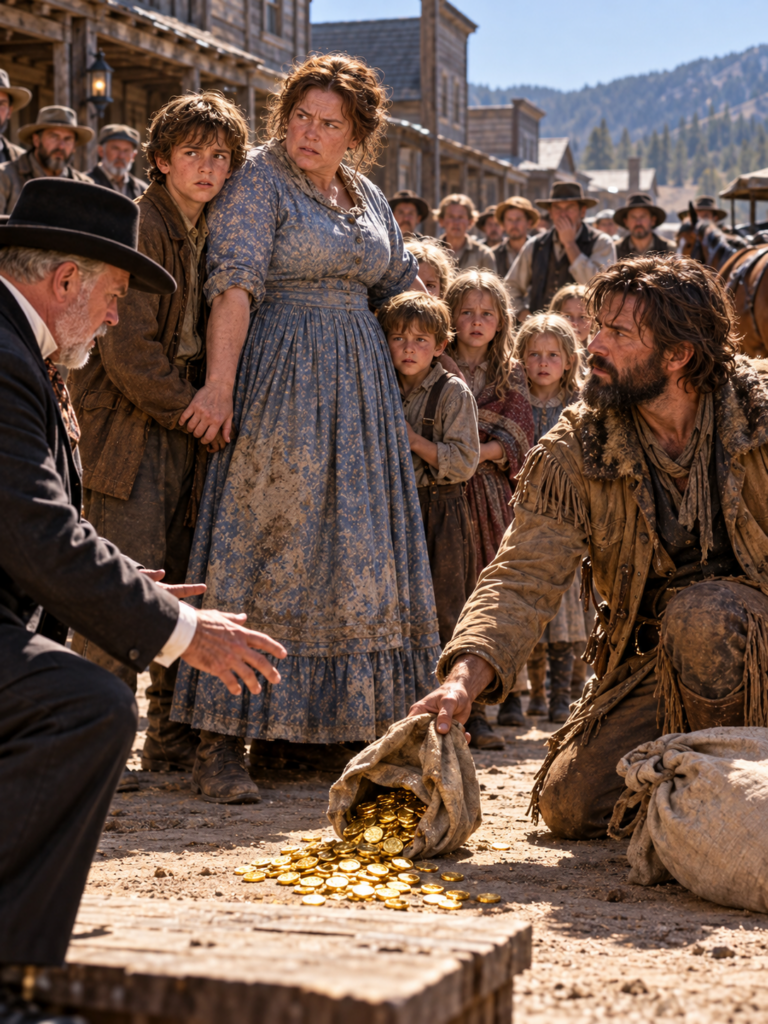
Clementine tightened her grip on Bessie’s hand as they approached the wagon.
The little girl stumbled over a rut, and Clementine caught her before she fell.
Behind them, laughter rose from the crowd.
“That mountain man’s bought himself a mighty expensive burden,” someone muttered.
Clementine kept walking.
She had heard worse.
Amos’s wagon stood beside the mercantile, its two draft horses waiting beneath the afternoon sun. Flour, salt, folded canvas, and supplies were secured behind the driver’s bench.
Jeb returned carrying their bundles.
“Everything we own,” he said bitterly.
Clementine saw the little parcel that contained Arthur’s old coat.
Her throat tightened.
“Put it somewhere dry.”
Amos moved a flour sack aside to make room.
Jeb watched him closely.
“Where are you taking us?”
“To my cabin. Up beyond the timber ridge.”
“How far?”
“Several hours by wagon. Longer coming back on foot.”
“Suppose we want to leave?”
Amos looked at Clementine before answering.
“Then your mother and I will discuss getting you back to a settlement.”
Jeb’s expression remained guarded.
“That doesn’t sound like a promise.”
“Fair enough. I’ll make it one.”
Clementine studied the man.
He seemed entirely serious.
When they reached the wagon, she stopped.
The driver’s bench was high, and the narrow step looked difficult to manage with her aching knees.
Heat rushed into her face.
She knew the children were watching.
So were several townspeople.
Amos came alongside her.
“Would a hand help?”
Clementine stared at the step.
“Yes,” she admitted.
He braced himself beside the wheel and offered his forearm. She gripped the rail, found the step, and climbed with his support.
The wagon shifted under her weight.
She waited for a remark.
Amos merely checked that she was seated comfortably.
Then he climbed aboard.
“Everyone settled?”
Sarah nodded from the back, Samuel resting against her.
Jeb sat among the bundles, keeping the younger children close.
Amos took up the reins.
The horses leaned into their collars.
And Oakhaven began slipping away.
For the first mile, nobody spoke.
Clementine stared at the road, hardly believing that all seven children were still with her.
Arthur was gone.
The farm was gone.
The life she had known was gone.
Yet the small voices behind her were still together.
She closed her eyes briefly.
Then Amos said, “The mountain road gets rough from here.”
Clementine opened them.
“How rough?”
“Enough that you’ll want to hold the bench.”
The wagon jolted as its front wheels entered the first rocky incline.
Behind them, Thomas gave a startled cry.
Amos slowed the team.
“Best take it steady.”
Clementine looked at him.
“You know children?”
“Not much.”
“That makes two of us concerning mountain men.”
He glanced at her.
For the briefest moment, she thought she saw a smile.
The road climbed into pine forest, where the air grew cooler and the late afternoon light filtered through the branches.
Clementine’s breathing became easier, though her knees still throbbed.
The twins began whispering.
Bessie fell asleep against Sarah.
But Jeb continued watching every turn.
When Amos stopped to rest and water the horses, Clementine climbed down with his offered assistance.
She gathered the children beside the wagon.
“Listen carefully,” she told them. “We’re going to a place we haven’t seen, with a man we don’t know. We will be grateful for kindness, but we will not forget to think for ourselves.”
Jeb nodded.
Amos, checking a harness strap nearby, appeared to hear every word.
He did not object.
By late afternoon, the trees opened onto a broad clearing.
A substantial log cabin stood beside a barn and smokehouse.
The roof was sound. Wood lay neatly stacked beneath an overhang. A narrow path led toward a water pump.
Clementine stared.
It was more than she had expected.
But the wilderness surrounding it seemed endless.
Amos halted the horses.
“Here we are.”
The children gathered at the edge of the wagon.
Clementine looked at the cabin, then at the man who had brought them there.
“Before we go inside,” she said, “I need to know where my children will sleep.”
Amos glanced toward the doorway.
“There’s room to arrange bedding. You and the young ones can have the sleeping end. I’ll use the hearth.”
“And food?”
“Enough for now. We’ll need to work together before winter.”
“And if we disagree?”
Amos looked directly at her.
“Then we’ll have to talk it through.”
Clementine remained still.
For years, she had lived with decisions made by other people.
Her husband had been a decent man, but the farm had been his livelihood, his plans, his world.
Then death had made those decisions for her.
Then Cobb had attempted to decide the fate of her children.
She would not exchange one authority for another.
“One more thing,” she said.
Amos waited.
“I won’t have anyone threatening my children with the road when they make a mistake.”
The mountain man’s expression grew serious.
He glanced toward Jeb, who stood watching from the wagon.
“That’s fair.”
Clementine stepped toward the cabin.
“Then open the door, Mr. Callahan.”
Amos reached past her and lifted the heavy latch.
She entered first.
The room was cool and dim, furnished with a sturdy table, a broad hearth, a stove, shelves, and a large bed.
There was space.
But not yet a place for seven children.
Clementine surveyed the room carefully.
Then she pointed toward the broad, sheltered end of the cabin.
“We’ll need bedding there.”
Amos nodded.
“And a place for washing.”
“Pump’s behind the house.”
“And I’ll need to see the provisions before deciding what to cook.”
He stepped aside.
“Come and look.”
Clementine walked toward the shelves, followed by Sarah and Jeb.
She had no certainty about the future.
Only seven children, a mountain cabin, and an unfamiliar man whose intentions she could not yet prove.
She reached for the first storage sack, loosened its cord, and began counting what they had to survive the coming winter.
Clementine opened the sack and drew a handful of flour between her fingers.
It was clean and dry.
Behind it, she found salt, dried beans, and cornmeal. Along the wall stood covered barrels. Amos showed her the smoked venison stored in the separate outbuilding and the wood he had stacked for the coming cold.
She counted carefully.
“Eight additional mouths,” she said.
“Seven growing ones,” Amos corrected. “Don’t forget yourself.”
Clementine glanced at him.
“I’m unlikely to forget myself.”
“Wasn’t suggesting you would.”
She almost smiled.
Almost.
Then she called Sarah over to help arrange their belongings while Jeb and Amos unloaded the wagon.
That first evening, Clementine prepared a stew with smoked venison, dried vegetables, and flour thickened into broth.
The younger children crowded around the table.
Samuel fussed until Sarah settled him.
Jeb kept looking toward the door.
Amos occupied the far end of the bench, seemingly uncertain how to sit among so many people.
When the food was ready, Clementine served the children before herself.
She was halfway through setting down her bowl when Amos noticed.
“There’s enough for you.”
“I know.”
“Then eat.”
Clementine stiffened at the command.
Amos saw it.
He set down his spoon.
“Didn’t mean to order you.”
Her eyes rose.
He nodded toward the pot.
“I only meant nobody needs to go hungry at this table.”
Clementine sat.
She ate a full supper for the first time in weeks.
And afterward, she cried quietly while washing the bowls.
She made certain the children did not see.
But Amos did.
He said nothing.
Instead, he brought fresh water and left her to finish.
In the days that followed, the cabin acquired a rhythm unlike any Amos had known.
Clementine rose early, though her knees often ached badly in the cold mornings.
She organized the kitchen, sorted provisions, repaired torn clothing, and kept careful track of what they consumed.
Sarah helped with Samuel.
Thomas and the twins carried small pieces of kindling, gathered dropped scraps of wood, and learned to keep boots and wet clothing away from the hearth.
Bessie sat beside Clementine, practicing letters from an old primer.
Jeb was another matter.
At fourteen, he considered himself responsible for protecting the family.
He distrusted Amos’s generosity.
He resented needing shelter.
Most of all, he hated that another man occupied the place his father had once held.
One morning, Amos returned from hunting and asked Jeb to fetch a rope from the barn.
The boy folded his arms.
“I’m not your hired man.”
Clementine heard the words from inside the cabin.
She came to the doorway.
Amos stood beside the deer he had brought home.
“No,” he said. “You’re not.”
Jeb’s jaw tightened.
“Then quit telling me what to do.”
Amos considered him.
“This meat needs tending before it spoils. I need help. If you’re willing, fetch the rope. If you aren’t, say so and I’ll find another way.”
Jeb looked surprised.
He had expected punishment.
Instead, the mountain man had given him a choice.
After a long pause, the boy went toward the barn.
Clementine approached Amos.
“He’s angry.”
“I noticed.”
“He misses his father.”
Amos lowered his eyes.
“Reckon he does.”
“Arthur taught him to mend fences and handle a plow. He thought the farm would be his someday.”
Amos glanced toward the barn.
“Then he’s lost more than a roof.”
Clementine nodded.
For the first time, she heard understanding in the mountain man’s voice.
Jeb returned with the rope.
Amos showed him how to secure the deer for dressing, explaining each step instead of treating the boy like an inexperienced fool.
Clementine helped prepare the meat for storage.
She knew more about handling food than Amos had expected.
He knew more about preserving it in mountain weather than she did.
They worked together until the light began to fade.
At the end, she leaned against the porch railing, exhausted.
Her arms trembled.
Her knees felt swollen.
She looked down at her flour-stained, blood-marked dress with a familiar rush of shame.
Amos brought her a towel.
“You’ve done enough for today.”
“There’s still work.”
“There’ll be work tomorrow.”
She wiped her face.
“I’m not afraid of labor.”
“Never thought you were.”
He leaned beside her, leaving a respectful distance.
Then, after a moment, he said, “I had a wife once.”
Clementine’s hand stopped.
Amos looked toward the mountains.
“She died during a hard winter. Years ago.”
“I’m sorry.”
He nodded.
“We were isolated when I injured my leg. She struggled with the cold and the loneliness. By the time I understood how badly she was failing, I couldn’t make things right.”
Clementine listened.
“I stayed here afterward,” he continued. “Didn’t want to return to a town. Didn’t want anyone depending on me.”
“Yet you brought eight people home.”
A faint, unhappy smile touched his mouth.
“Seems I made a different choice.”
Clementine studied him.
“Arthur died working timber. One broken chain, and everything we built started falling apart.”
Amos turned.
She continued softly.
“I don’t need another husband to replace him.”
“I wouldn’t ask you to.”
“But I need my children to have a life.”
“That I can help with.”
Clementine looked at his hands.
Weathered, scarred, capable.
The hands of a man accustomed to working alone.
For the first time, she wondered what it would mean if they learned to work alongside hers.
Autumn shortened.
The nights turned bitter.
Amos prepared the horses and repaired the barn.
Clementine checked their stores, mended winter garments, and insisted that the children continue reading each morning.
Jeb began helping Amos willingly.
Not because he had forgotten Arthur.
Because there was something satisfying about learning a task and doing it well.
The twins learned to stack kindling.
Thomas took pride in keeping the drinking-water buckets filled from the pump when conditions allowed.
Sarah became more confident managing the little ones, though Clementine made sure the girl had time for lessons and rest.
And little Bessie followed Amos around the cabin whenever her mother permitted it.
At first, the mountain man appeared bewildered by her questions.
“Why does snow stay on the northern slope?”
“Less sun.”
“Why do deer have long legs?”
“Helps them travel.”
“Why’s your beard so big?”
Amos stopped sharpening a tool.
Clementine nearly dropped her sewing.
Finally he answered, “Been too busy to argue with it.”
Bessie laughed.
So did Clementine.
Amos looked toward her.
It was the first time he had heard her laugh without trying to hide it.
After that, he began finding reasons to make her do it again.
Winter settled over the ridge.
The roof collected snow.
The horses needed extra feed.
Firewood disappeared faster than it had when Amos lived alone.
There were crowded evenings, damp boots, restless children, and days when everyone grew short-tempered.
But Clementine had made a schedule.
Lessons in the morning.
Useful work after dinner.
Mending and reading by the fire.
Even Amos began listening while Sarah read aloud.
He pretended not to.
Nobody believed him.
The week before Christmas, a heavy storm rolled across the mountains.
During the night, Goliath, the larger draft horse, forced open a weakened stall door.
By morning he was missing.
Amos discovered the tracks leading toward the creek.
“The ice won’t hold him near the stones,” he said.
Jeb reached for his coat.
“I’ll help.”
Clementine looked through the window.
Snow obscured the barn.
“Be careful.”
Amos met her eyes.
“We’ll follow the trail and turn back if we can’t see enough to move safely.”
Then he and Jeb left.
Clementine waited.
She kept the younger children near the stove, making certain they remained occupied.
But her eyes returned again and again to the window.
The minutes lengthened.
Finally, a figure appeared through the blowing snow.
Jeb.
He was running.
Clementine opened the door.
“Ma! The horse went through the ice!”
Her stomach tightened.
“Where’s Amos?”
“At the creek. He’s holding the rope, but Goliath can’t get up the bank!”
Clementine pulled on her coat.
She turned to Sarah.
“Stay inside with the little ones. Keep the stove going. Don’t open the door unless we’re back.”
Sarah nodded, frightened but steady.
Clementine followed Jeb into the storm.
Every step through the deepening snow was difficult.
Her knees burned.
The wind stole her breath.
But she kept moving.
At the creek, she found Amos braced against a pine tree, holding a line attached to Goliath’s halter.
The horse had broken through near the bank.
His head and shoulders remained above the black water, but his forelegs could not gain purchase on the icy edge.
Amos had secured the rope around the tree to keep the animal from slipping farther into the channel.
“He’s exhausted!” Amos shouted.
Clementine studied the bank.
There was a lower stretch of ground several yards downstream, where the water was shallower and the edge less steep.
“Bring him toward that opening!”
Amos followed her gaze.
He understood immediately.
They adjusted the line around the tree.
Jeb moved to the safer bank to encourage the horse toward the opening.
Clementine took hold of the rope behind Amos.
“Ready?”
“Ready.”
Together, they drew the line taut.
Goliath struggled.
His front hooves scraped against the bank.
For a moment, the horse slipped backward.
Clementine braced herself in the packed snow and held the rope steady while Amos shifted its angle.
“Now!” he called.
Goliath lunged.
His forelegs found a foothold in the muddy shallows.
He scrambled forward, finally pulling his hindquarters from the freezing water.
The horse stood shaking, drenched and frightened.
They could not afford to stop.
Amos and Jeb led him carefully back toward the barn while Clementine followed, keeping the others in sight.
By the time they reached shelter, all four were exhausted.
Amos rubbed down the horse and arranged dry bedding.
Jeb fetched blankets.
Clementine hurried inside to prepare warm drinks.
When Amos finally joined her, he paused beside the stove.
“You found the way out.”
“We all did.”
He smiled.
“Good thinking, Clementine.”
It was such a simple compliment.
Yet it warmed her more deeply than the fire.
The storm passed.
Christmas came quietly, marked by a special supper and the children sharing what small gifts they had managed to make.
But January brought another danger.
One night, Bessie woke coughing.
It was not an ordinary cough.
Her breathing was rapid and difficult, her face flushed with fever.
Clementine lifted the child into her arms.
“Bessie, sweetheart, look at Mama.”
The girl opened her eyes weakly.
Amos knelt beside them.
He listened to her breathing.
His expression grew grave.
“She’s very sick.”
Clementine knew it too.
Arthur’s sister had once lost a child to a fever that settled in the chest.
She remembered the fear in that household.
Remembered the helplessness.
They kept Bessie comfortably warm, offered small drinks, and watched her closely.
But her breathing worsened.
Amos considered the medicine supplies.
They had little left that might ease her symptoms, and no physician anywhere nearby.
He knew a place along the southern ridge where he had gathered useful roots before.
Clementine looked toward the dark window.
“You’re not going three miles in this cold.”
“I might find something to ease her. And I know the route.”
“You might not come back.”
Amos looked toward Bessie.
“I can’t promise it’ll help. But I can’t bear doing nothing.”
Clementine held his gaze.
Then she said, “If you go, you take the marked trail and turn back if the weather worsens. I will not lose you as well.”
He nodded.
She helped him prepare his coat and snowshoes.
Jeb stood near the door.
“Can I go?”
“No,” Amos said gently. “Stay here with your mother. She needs you.”
Then the mountain man stepped into the night.
Clementine closed the door.
Behind her, Bessie coughed again.
She returned to the child’s bedside, laid a cool damp cloth against her forehead, and began the longest vigil of her life.
Hours later, with the fire burning low and dawn still hidden beyond the mountains, the cabin latch began to rattle.
Clementine rose.
The door swung inward.
And Amos fell across the threshold, his clothing stiff with ice, a small pouch clenched in his frozen hand.
Clementine caught the edge of Amos’s coat as he fell and shouted for Jeb.
“Help me get him away from the doorway!”
The boy hurried forward.
Together they pulled Amos inside, shut out the bitter wind, and moved him onto blankets near the hearth.
His beard was crusted with ice.
His hands were stiff and pale.
He shook so hard he could scarcely speak.
Clementine felt terror rise in her throat.
She had already buried one husband.
She could not bear the thought of watching another man die beneath her roof.
Not this man.
Not Amos.
“The pouch,” he whispered.
She took it from his fingers.
Inside were the roots he had gone to find.
“Got them,” she said.
His eyes struggled to remain open.
“For Bessie.”
“We’ll see to her. Right now we need to warm you.”
Jeb brought dry blankets while Clementine helped Amos out of his frozen outer clothing.
They replaced wet garments with dry layers and sheltered him from further cold.
She kept him close to the warmth of the room, watching his breathing and calling to him whenever his eyes drifted shut.
“Amos. Stay with us.”
He made a faint sound.
“Trying.”
“Well, try harder.”
Even now, with fear tightening her chest, she could not help speaking to him in the blunt voice he had come to know.
Jeb knelt beside them.
“Ma, he’s going to be all right, isn’t he?”
Clementine looked at her son.
She wanted to promise.
But she had learned what empty promises could cost.
“I don’t know, sweetheart. Bring more dry blankets.”
Jeb obeyed.
Nearby, Bessie slept fitfully, her breathing still troubled.
Clementine felt torn between the child who needed her and the man who had risked his life trying to help.
Then Sarah came to her side.
“I’ll watch Bessie, Mama.”
Clementine looked at her daughter.
The girl was frightened, but her voice was steady.
“Call me if her breathing changes.”
Sarah nodded.
Clementine returned to Amos.
She sat beside him, keeping him covered and checking his face for signs that he was becoming more alert.
He was shivering less violently now.
But that alone did not reassure her.
“Can you hear me?”
His eyes opened slightly.
“Yes.”
“Good. I want you to keep answering when I speak.”
He gave the smallest nod.
For the next several hours, the household revolved around two desperate concerns.
Bessie’s illness.
And Amos’s dangerous exposure to the cold.
The roots he had gathered were prepared cautiously as a familiar frontier remedy, but Clementine knew no plant could promise a cure.
She concentrated on keeping her daughter comfortable and supplied with fluids when she could swallow.
Jeb tended the stove.
Sarah watched Samuel and helped with the younger children.
Even Thomas and the twins understood that this was not a morning for arguing or playing loudly.
Near sunrise, Amos began speaking more clearly.
He asked first about Bessie.
“Still fighting,” Clementine answered.
He closed his eyes.
“Good girl.”
Then he looked at Clementine.
“Did I frighten you?”
She stared at him.
“You came through that door looking half dead.”
“Reckon I did.”
“You foolish man.”
His mouth moved faintly.
“You’ve called me worse.”
“Not yet I haven’t.”
But her voice broke.
Amos saw the tears gathering in her eyes.
He reached for her hand.
She took it.
For a long while, neither spoke.
At last Clementine whispered, “Don’t ever make me stand here wondering whether you’ll come home again without at least giving me a chance to argue with you properly.”
Amos’s fingers tightened gently.
“Fair request.”
“You’ve got people who care whether you live.”
His gray eyes searched her face.
“Do I?”
The question was so quiet that it hurt.
Clementine leaned closer.
“Yes, Amos. You do.”
He looked at her hand surrounding his.
Then he said, “That’s something I haven’t had in a long time.”
She wanted to ask him what he meant.
Wanted to tell him how much he had come to mean to her.
But Bessie began coughing in the corner.
Clementine released his hand and went immediately to her daughter.
There would be time for the rest if they survived the night.
And for the first time, Clementine allowed herself to hope that they would.
The days that followed were difficult.
Amos remained weak and needed time to recover from his exposure.
Bessie’s illness did not disappear overnight.
Her cough lingered, and at times her fever frightened Clementine so badly she could scarcely keep her own hands steady.
But gradually the little girl’s breathing eased.
She began asking for water without being coaxed.
Then for broth.
One morning, she complained that Thomas had taken the warmest place near the stove.
Clementine nearly wept with relief.
Amos heard the argument from his chair.
He looked across the room at the little girl.
“Sounds like somebody’s feeling stronger.”
Bessie smiled weakly.
“You promised to show me the fox tracks.”
“When you’re well enough.”
“And not before,” Clementine added.
Bessie sighed dramatically.
Amos nodded solemnly.
“Your mother’s the authority on that.”
Clementine looked at him.
Their eyes met.
Something warm passed between them.
Not a grand declaration.
Something quieter.
The knowledge that the people gathered in that cabin had almost lost one another.
And that every one of them mattered.
By the time Amos could move about normally again, Jeb had taken over several of the chores that the mountain man usually performed.
He carried wood.
Checked the horses.
Repaired a loose section of the barn door.
One afternoon, Amos found him working on a damaged harness.
“Need a hand?”
Jeb shook his head.
“I’ve nearly got it.”
Amos examined the repair.
“That’s sound work.”
The boy tried to hide his pleasure.
“Pa showed me how.”
Amos nodded.
“Then your father taught you well.”
Jeb looked up.
For months, he had feared that accepting kindness from Amos meant betraying Arthur.
But Amos had never asked him to forget his father.
Never tried to take his place.
Never demanded that the children call him anything other than Amos.
And in that moment, Jeb understood something important.
A person could remember one man with love and still trust another.
“Amos?”
“Yes?”
“I’m glad you came to the square that day.”
The mountain man looked at him.
Then he rested a hand briefly on the boy’s shoulder.
“So am I, Jeb.”
It was enough.
Spring finally began loosening winter’s grip on the mountains.
Snow retreated from the southern slopes.
The creek grew louder.
The horses stood in the sun, shedding their thick winter coats.
And the cabin that had sheltered one solitary trapper now contained the sounds of eight people who had become accustomed to sharing their lives with him.
Clementine stood in the doorway one morning, watching Amos and Jeb repair a length of fencing.
Sarah was hanging washed clothing on a line.
Thomas helped the twins gather fallen branches.
Bessie sat wrapped in a blanket on the porch, still regaining her strength, while Samuel played beside her under Clementine’s watchful eye.
Her heart filled with a feeling she had not experienced since before Arthur died.
Security.
Not the false promise that nothing bad would ever happen.
But the knowledge that she no longer carried every burden alone.
Amos looked up from the fence.
He waved.
Clementine raised her hand in answer.
Then she returned to the kitchen.
There was bread to make.
But this time, the work did not feel like a test she had to pass to deserve her place.
She had helped build the household.
It belonged to all of them in the ways that mattered most.
That evening, after the children had settled, Amos sat across from her at the table.
He seemed unusually thoughtful.
Clementine poured coffee.
“Something troubling you?”
He looked at the cup.
“Been thinking about the day we left Oakhaven.”
She sat down.
“What about it?”
“The way I spoke.”
Clementine frowned.
“You offered us shelter.”
“I did. But I made it sound as though I was deciding what should happen to you.”
She remembered the town square.
The gold.
The crowd.
The words that had frightened her nearly as much as Cobb’s threats.
“I’ll take her. And all seven.”
Amos lowered his eyes.
“I should’ve said I wanted to help you stay together. Not that I was taking anybody.”
Clementine studied him.
Few men she had known were willing to admit a mistake without being forced.
“You did tell me the choice was mine,” she said.
“Later.”
“And you’ve honored it.”
“I mean to keep honoring it.”
She smiled faintly.
“Then I’ll accept your apology.”
Amos nodded.
But he did not seem finished.
“Clementine, there’s something else.”
Her heart began beating faster.
He looked toward the sleeping end of the cabin, where the children rested.
“When I first brought you here, I thought I was offering a roof until you could find your footing.”
“And now?”
“Now I can’t imagine this place without you.”
She lowered her eyes.
Amos continued.
“I know what it is to lose somebody. I know a man can’t make promises against sickness, weather, or death.”
His voice roughened.
“But I can promise to work beside you. To tell you the truth. To treat those children fairly. And to listen when you say I’m wrong.”
Clementine looked up.
His gray eyes held hers.
“I don’t want you staying because you need my cabin,” he said. “I want you staying because you want a life with me.”
Her eyes filled.
For years, she had believed no man would ever choose her without some calculation behind it.
She had been considered too large.
Too demanding.
Too difficult to provide for.
After Arthur’s death, the townspeople had treated her body as proof that she was incapable of raising her family.
Yet this man had watched her endure a winter, work through exhaustion, protect her children, and fight for their survival.
He had seen her at her weakest.
He had seen her angry.
He had seen her afraid.
And he was asking whether she would choose him.
Not because she owed him.
Because he wanted her.
“Amos,” she whispered, “I have seven children.”
“I’ve counted them.”
She laughed through her tears.
“I’m not a young girl.”
“Neither am I.”
“I’m large. My knees hurt. Sometimes I’m stubborn.”
“I’ve noticed.”
She gave him an indignant look.
He smiled.
Then his expression softened.
“Clementine, I haven’t spent this winter imagining a different woman sitting at this table.”
Her breath caught.
“I’ve been grateful for the one who’s here.”
For a long while, she could not answer.
Then she reached across the table.
Amos took her hand.
“I want to stay,” she said.
His eyes shone.
“And I want you to stay.”
She swallowed.
“But we have to speak with the children. And I want whatever future we choose to be something we both understand.”
“Of course.”
“And my children will always be my responsibility.”
“They’ll always be yours to love. I’ll do my part, if you’ll let me.”
Clementine smiled.
“Then I think we’ve got something worth building.”
Amos lifted her hand and kissed her knuckles.
It was the first time he had done anything so openly tender.
And Clementine, who had endured a lifetime of people making her feel ashamed of her body, discovered that she did not want to hide her hand.
She wanted him to hold it.
The next morning, they spoke with the children.
Jeb listened with grave seriousness.
Sarah smiled before either adult finished explaining.
Thomas wanted to know whether they would stay in the mountains.
The twins wanted to know whether there would still be chores.
Bessie climbed carefully onto the bench beside Amos.
“Are you going away?”
He looked at Clementine.
Then at the little girl.
“Not if your mother and I can help it.”
Bessie considered this.
“Good. You still owe me those fox tracks.”
Amos laughed.
“Then I reckon I’d better stay.”
The months that followed brought more work.
The ground had to be cleared.
Seed needed planting.
Goliath returned to pulling the plow, though Amos kept him carefully rested after the winter accident.
Clementine worked beside the others, sorting stones from the field and helping plan the garden.
Her knees still ached.
Some days she needed to sit while Jeb and Amos completed the heavier tasks.
But she no longer measured her worth by how much pain she could endure without complaint.
She had learned that directing work, teaching children, preserving food, and keeping accounts were necessary contributions.
Amos had learned that too.
When she said the household needed more flour before the next trading journey, he listened.
When he said the barn required repairs before another winter, she reviewed what they could afford.
Their disagreements did not disappear.
They simply became questions to solve together.
During a spring trip to Oakhaven, Clementine and Amos arranged a quiet marriage after speaking openly about what it would mean for their shared future.
There was no lavish ceremony.
No crowd waiting to laugh.
The children stood with them.
Jeb carried Arthur’s old pocketknife in his coat, a remembrance of the father he had loved.
Sarah held Samuel.
Bessie wore a ribbon Clementine had carefully saved.
And when Amos took Clementine’s hand, he did not speak as though he had purchased her with gold.
He asked whether she freely wished to marry him.
She answered yes.
Then she asked whether he would honor the woman she already was, the mother of seven, the capable widow who had endured hardship and refused to surrender her family.
“I will,” he said.
They returned to the mountains as husband and wife.
But marriage did not erase Arthur from the children’s memories.
Clementine kept his old coat carefully folded.
When Jeb spoke of his father, Amos listened.
When Bessie asked why she had two men to remember, Clementine explained that love did not have to disappear for another love to begin.
And Amos never asked the children to pretend otherwise.
By late spring, the Callahan cabin had become a place of ordinary, hard-won happiness.
The roof held firm.
The barn was repaired.
The garden showed its first green shoots.
And the porch, once occupied by a single rough bench, began to change.
One afternoon, Amos spent several hours working with oak boards behind the barn.
Clementine heard the sound of sawing and hammering.
When she asked what he was making, he merely said, “Something we need.”
She raised an eyebrow.
“We need another table?”
“No.”
“Another shelf?”
“No.”
“Then I suppose I’ll find out when you’re finished.”
He smiled into his beard.
“Reckon so.”
Several days later, a supply wagon arrived from the valley.
Hiram Cobb, the alderman’s brother, was driving.
Clementine recognized him immediately.
He had been among the men standing near the square when the council tried to separate her children.
Hiram climbed down and looked around the clearing.
His eyes lingered on the garden, the repaired barn, and the orderly stack of firewood.
Then he spotted Clementine standing beside the chopping block.
“Well, now,” he said. “Widow O’Rourke.”
Clementine rested her hand against the handle of the axe she had been using.
“Mrs. Callahan,” she corrected.
Hiram blinked.
“Married, are you?”
“I am.”
He looked toward the cabin.
“To that trapper?”
“To Amos.”
A faint sneer touched his face.
“Never thought you’d last a winter up here.”
Clementine looked at him calmly.
“We had a difficult winter.”
“Suppose you’re wanting passage back to town?”
She shook her head.
“No.”
Hiram glanced at the fields.
“Hard living for a woman with seven young ones.”
“It can be.”
“You’re certain you don’t want a place closer to civilization?”
Clementine thought of the square.
The children crying.
Cobb counting the debt as though he were calculating the value of livestock.
The laughter that had followed her for years.
Then she looked toward her home.
Through the open door came the sound of Sarah reading to the younger children.
Jeb was working near the barn.
And Amos stood on the porch, watching the exchange without interrupting.
Clementine straightened.
“My family’s home is here.”
Hiram looked from her to Amos.
Whatever response he had prepared seemed to fail him.
He muttered something about the supplies he carried.
Clementine purchased what the household needed.
She checked the prices and counted the money herself.
Then Hiram returned to his wagon and drove away.
She watched him disappear down the trail.
For the first time, his departure brought no shame.
Only relief that his opinion no longer determined anything about her future.
Amos came down from the porch.
“Everything settled?”
“Everything.”
He smiled.
“Good.”
Then he took her hand.
“Come see what I’ve finished.”
He led her around the side of the cabin.
There, beneath the porch roof, stood a new oak chair.
It was broad and sturdy, with carefully fitted joints, a deep seat, and armrests shaped for comfort.
Clementine stopped.
“What is this?”
“Your chair.”
She stared.
“Mine?”
“Made it wide enough that you won’t have to squeeze yourself into it. Used heavier timber where it mattered.”
Clementine stepped closer.
She ran her hand along the smooth wood.
All her life, chairs had been too narrow.
Benches too crowded.
People too ready to sigh when she needed more room.
She had learned to perch uncomfortably, apologize, or stand.
And here was a man who had spent days building something that fitted her without asking her to change.
She looked at Amos.
“Why would you go to all this trouble?”
He seemed puzzled by the question.
“Because I wanted you to sit comfortably on your own porch.”
Her eyes filled.
Amos reached into his coat pocket.
“There’s something else.”
He opened his hand.
A small wooden bear rested in his palm.
Its body was broad and solid, its legs planted firmly beneath it.
He had carved it during the evenings when winter kept them close to the fire.
Clementine lifted it carefully.
“It’s beautiful.”
“Thought it suited you.”
She looked up.
“Because it’s large?”
“Because it’s strong. Because it protects its young. Because it belongs in the mountains.”
She could not speak.
Amos brushed a tear from her cheek.
“You were never a burden, Clementine.”
She closed her fingers around the carving.
“Some days I still feel like one.”
“Then on those days, I’ll remind you.”
She gave a small, trembling laugh.
“And when you’re being stubborn?”
“You can remind me.”
He offered his hand.
“Try the chair.”
Clementine lowered herself carefully into it.
The seat held comfortably.
Her hips fitted without pressing against the arms.
Her feet rested securely on the porch boards.
For a long moment, she sat absolutely still.
Then she looked at the view.
The green clearing.
The barn.
The garden.
The mountains rising beyond the trees.
And the sound of her children calling to one another in the afternoon sunshine.
Amos leaned against the porch railing beside her.
“Will it do?”
Clementine swallowed.
“It’s perfect.”
He smiled.
She reached for his hand.
“Come sit beside me.”
“Only made one chair.”
“Then you’ve got more work to do.”
Amos laughed.
“I suppose I have.”
She pulled him close enough to kiss his cheek.
He turned toward her, and their second kiss was slow and familiar, without the frightened uncertainty of the first.
They were no longer strangers making an arrangement beneath the eyes of a cruel town.
They were husband and wife.
Partners in a demanding life.
Two people who had chosen one another after seeing the cost of survival.
That evening, the family gathered around the table for supper.
Jeb talked about a fence he had repaired.
Sarah read a passage from her primer.
Thomas argued cheerfully with the twins.
Bessie showed Amos a small drawing of a fox.
Samuel reached toward Clementine’s wooden bear, which she had placed carefully on a nearby shelf.
The room was noisy.
Crowded.
Warm.
Amos looked around it.
Ten years earlier, he had believed silence was the only thing he wanted from the mountains.
Now seven children’s voices filled the cabin, and the woman sitting beside him kept reminding everyone to finish their vegetables.
He had never expected to love such a life.
Yet he could not imagine returning to the old one.
Clementine caught him watching her.
“What?”
“Nothing.”
She raised an eyebrow.
“Amos Callahan, I know that look.”
He leaned closer.
“Just thinking I’m a fortunate man.”
Her cheeks warmed.
“You’re also a man with supper getting cold.”
He picked up his spoon.
“Yes, ma’am.”
Later, after the children had gone to sleep, Clementine stepped outside.
The mountain air was cool.
She sat in her new chair and looked toward the valley below.
Amos came out carrying a blanket.
He draped it across her knees and settled onto the porch bench beside her.
For a while, they listened to the wind moving through the pines.
Then Clementine said, “Do you remember the day you found us?”
Amos nodded.
“I do.”
“I thought they were going to take my children.”
His expression grew serious.
“I know.”
“I was standing there wondering how I could keep hold of all seven. I didn’t have the money. I didn’t have the farm. I couldn’t make Cobb listen.”
She looked down at her hands.
“Then you stepped out of that crowd.”
Amos studied the moonlit clearing.
“Wasn’t much of a choice to make.”
“It was to me.”
She turned toward him.
“You gave us shelter. But you also gave me time to remember I still had a say in my own life.”
He took her hand.
“You always had that right.”
“People don’t always act like it.”
“No,” Amos admitted. “They don’t.”
Clementine rested her head against his shoulder.
“I spent so long believing that being large meant I had to make myself smaller in every other way.”
Amos kissed her hair.
“You never needed to.”
She smiled.
The wooden bear rested inside on the shelf.
Her children slept beneath a safe roof.
The chair beneath her had been made for the woman she was, not for some smaller woman the world wished she would become.
And beside her sat a man who had never asked her to apologize for taking up space in his life.
She remembered the town square.
Three hundred dollars.
Seven frightened children.
A stranger with a pouch of gold.
People had thought he was purchasing a widow and her family.
They had never understood what happened that day.
Amos had not bought Clementine.
He had broken the hold of a debt, offered them shelter, and left a mother free to decide what came next.
She had decided to take her children into the mountains.
Later, when she had a real choice, she had decided to stay.
Not because she had nowhere else to go.
But because she had found someone willing to build a future alongside her.
Clementine squeezed Amos’s hand.
“There’s something I ought to tell you.”
“What’s that?”
“The day you came into the square, I thought you were the strangest man I’d ever seen.”
He chuckled.
“And now?”
She looked toward the warm light shining through the cabin window.
“Now I think you might be the best.”
Amos turned his head.
Their eyes met.
He leaned toward her, and she met him halfway.
Behind them, the cabin stood solid against the mountain wind.
For years, Clementine had believed happiness was something that could be taken from her without warning.
Now she knew no life was free from loss or hardship.
But she also knew that love could be chosen without surrendering dignity.
That strength could look like a mother standing before seven children.
Like a boy learning to trust again.
Like a mountain man admitting he wanted a family.
And like a broad wooden chair built carefully enough to tell a woman that she belonged exactly as she was.
Amos rose and offered his hand.
“Come inside, Clementine. Getting cold.”
She accepted it and stood.
Then she looked once more toward the mountains.
The wind was rising.
Another winter would come.
There would be work, storms, worries, and long nights.
But there would also be laughter.
Warm meals.
Children growing stronger.
Two chairs on the porch, once Amos finished the second.
And a family that had chosen to remain together.
Clementine turned toward the open door.
This time, no one was leading her into an unknown life.
She was walking into the one she had helped create.
Amos followed beside her.
And together, they went home.


