
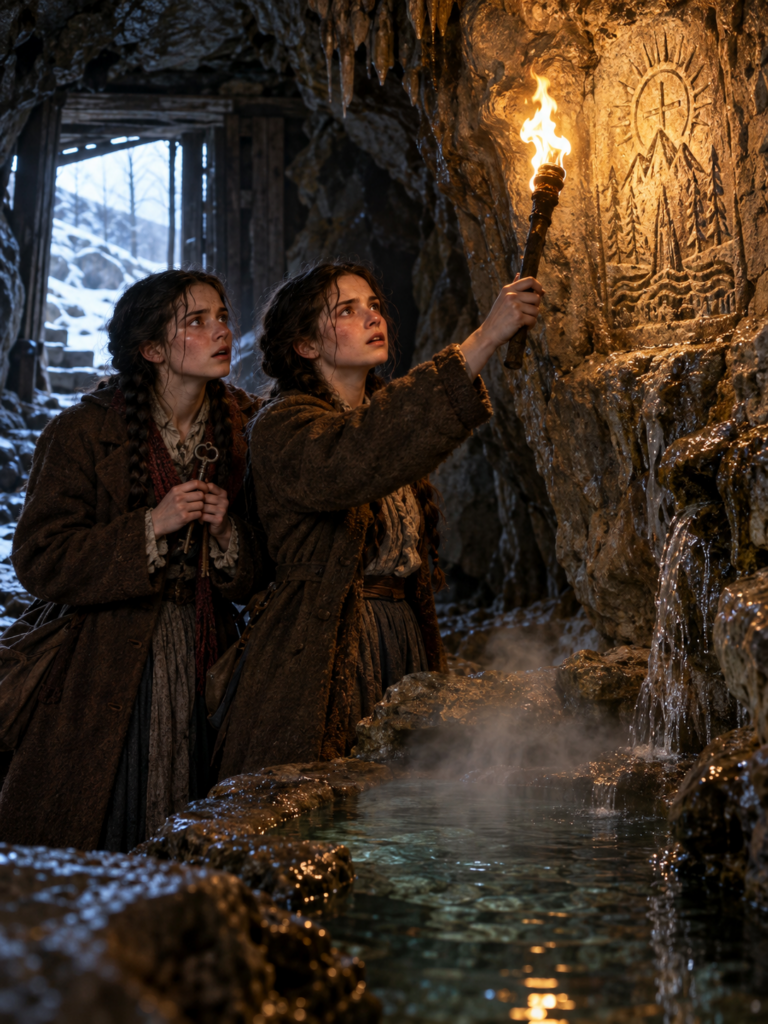
The stone shifted backward.
Ren caught its edge before it slipped farther and carefully pulled it aside.
Behind it was a narrow hollow deliberately cut into the limestone.
Inside lay a small bundle wrapped in oilcloth.
She stared at it.
The wrapping was old, discolored, and stiff at the folds, but it had protected something from the moisture of the cave.
Agnes knelt beside her.
“Was that here when Father came?”
“We’ll know more when we open it.”
Ren lifted the bundle onto the flat stone beside the opening.
She unfolded the oilcloth carefully.
Inside was a small book.
Its binding was firm, its cover plain, and its pages far better preserved than either sister expected.
On the front was their father’s handwriting.
Below his name was a description of Hawk Ridge and a range of years.
1871 to 1877.
Ren looked at Agnes.
“He came here for six years.”
Their father had never described these visits in any detail.
He had taught them to study weather, water, animal movements, and seasonal changes.
But he had not told them that a place high in the mountains contained years of his own observations.
Ren opened the book.
The earliest entries concerned the spring, the cave’s stable temperature, and the surrounding forest.
Later pages contained measurements, sketches, and notes about surviving difficult weather.
This was not a hidden fortune.
It was something more recognizable.
Their father’s work.
Agnes picked up their other family journal and compared the handwriting.
The shapes of the letters matched the pages Elias had written during his final years.
That did not explain every entry, but it strengthened what the cover already suggested.
The book had belonged to him.
Ren turned another page.
“Why would he leave it here?”
Agnes looked toward the spring.
“Maybe he thought we would need it.”
Ren considered that.
Their father had been ill when he gave them the key. He could not have known the exact circumstances that would bring them here.
But perhaps he had wanted them to possess a place and knowledge that would remain useful even if their lives changed.
The cave offered protection from the wind.
The spring supplied water.
And the book contained years of observations about how that shelter behaved through changing seasons.
Ren had spent five years trying to interpret weather through her own journal.
Her father had left another source of information in the one place he had urged them to find.
She began reading the first entry aloud.
Two words into the sentence, she stopped.
A sound came from the entrance passage.
The scrape of a boot against stone.
Agnes turned sharply.
The sisters had been certain they were alone.
Ren set the book down and reached for the hatchet.
Another footstep followed.
Then an elderly man appeared at the entrance of the chamber.
He had a white beard, a heavy weathered coat, and an old rifle carried loosely across one arm.
A gray-muzzled shepherd dog stood beside him.
The man did not raise the rifle.
He removed his hat.
His eyes moved from the girls to the carved name above the spring.
Then to the iron key in Agnes’s hand.
For several seconds, nobody spoke.
Ren tightened her grip on the hatchet.
“Who are you?”
The man remained near the entrance.
“Silas Ward.”
Neither sister recognized the name.
He glanced toward the small book.
“I knew your father.”
Ren waited.
Silas explained that Elias had found him wounded on Hawk Ridge in 1861.
Elias had carried him to shelter and remained with him during his recovery.
Years later, Elias had asked Silas to watch over the cave.
He had warned that two girls might arrive someday.
“I didn’t know when,” Silas said. “Only that I should be here if you came.”
Agnes looked at the old man.
“You’ve been waiting all this time?”
Silas nodded.
Ren glanced toward her father’s book.
One major question had been answered.
The cave was not merely a forgotten place Elias had once visited.
Someone had been entrusted to watch it.
Someone who had known about the book.
But another question remained.
What had her father intended Silas to do when the daughters finally arrived?
Ren lowered the hatchet slightly.
Then Agnes opened the journal to the later entries, searching for the name Silas Ward.
Her finger stopped halfway down a page.
“Ren,” she whispered.
Ren moved beside her.
Their father had written about Silas.
And what he wrote suggested the man standing before them had not always believed women were capable of understanding the mountain.
Agnes looked up at him.
“If Father wanted you to help us,” she asked, “why did he write that you wouldn’t listen to a woman?”
Silas’s gaze dropped toward the journal.
Ren waited, the hatchet still in her hand, while the old man considered whether he was prepared to answer.
Silas Ward looked at the open page without attempting to contradict it.
For a long moment, the only sounds were the movement of water in the basin and the faint rustle of his dog’s breathing.
Then he spoke.
“Your father wrote what he believed to be true about me.”
Agnes did not close the journal.
“Was it?”
“Yes.”
Ren loosened her grip on the hatchet but kept it at her side.
Silas looked from one sister to the other.
“I spent much of my life believing that knowing these mountains belonged to men who’d hunted and worked them. Your father argued otherwise. He thought a person who could observe carefully and learn from mistakes had earned the right to be heard.”
“Did you believe him?” Ren asked.
“Not enough.”
The admission was plain.
Agnes studied his face.
“Then why did he trust you to help us?”
Silas glanced toward the carved name above the spring.
“Because he trusted me to honor a promise, even when I hadn’t learned everything he wanted me to learn.”
Ren thought about that.
An imperfect man could still keep his word.
A man could also change, though she would not assume Silas had changed merely because he claimed to have done so.
She placed the hatchet on the stone beside her.
“We reached this cave by following Father’s directions,” she said. “We need to survive the winter. If you can help us, we’ll listen. But you’ll have to listen to us as well.”
Silas looked toward the open door and the snow gathering beyond it.
“Then we’d better begin with the cold.”
He led them toward the entrance, where the wind occasionally swept down the passage.
The cave’s inner chamber was sheltered, but the open doorway allowed gusts to reach the narrow tunnel.
Silas showed them how stones could be arranged to redirect the incoming air rather than allow it to blow straight through.
Ren helped him move the heavier pieces.
Agnes examined the alignment and suggested which stones would remain stable without blocking access.
By evening, they had begun improving the entrance.
Their work continued over the following days.
Silas showed them where he and Elias had once placed a fire so its smoke could escape through a natural draft near the upper wall.
He explained the importance of checking the draft rather than assuming a hole in the ceiling would provide sufficient ventilation.
The sisters gathered suitable fuel, arranged a protected hearth, and tested the smoke’s movement before committing to a larger fire.
They learned where supplies could be kept away from the dampest sections of the cave.
They learned which parts of the floor stayed dry.
And they learned how the limestone and underground water helped moderate the chamber’s temperature.
When Ren finally measured the spring, she recorded approximately fifty-two degrees Fahrenheit.
The water itself was not hot.
But against freezing conditions outside, its temperature made an enormous difference.
Silas taught them how to use the shelter.
Their father’s journal explained why many of its features mattered.
The sisters compared both sources instead of accepting either without question.
That habit surprised Silas.
When Ren asked him why he had placed certain stones near the fire, he first answered that they had always been arranged that way.
Ren did not accept that as sufficient.
She asked what would happen if they were moved.
Silas considered her question, then explained the relationship between the hearth, airflow, and the wall of rock behind it.
Later, while examining their father’s entries, Agnes found notes showing that Elias had changed the arrangement more than once.
He had tested different positions until he understood which kept smoke away from the occupied chamber.
The old man listened while she read.
“Your father did that with everything,” he said. “He never trusted a result simply because he liked it.”
Ren looked at him.
“Neither do we.”
Silas gave a small nod.
It was not an apology.
But it was evidence that he had begun listening.
Meanwhile, Cold Fork was discovering the limits of its preparations.
The snow did not disappear after October’s first storms.
It accumulated.
By early November, deep drifts obstructed the roads.
Families who had trusted the almanac’s promise of a mild beginning to winter watched their firewood diminish far sooner than expected.
Flour became harder to obtain.
Walter Boon’s store raised prices as supplies tightened.
People remembered the Marsh sisters’ warnings, though many remained reluctant to admit that two teenage girls might have noticed something important.
Dorothia Finch could not afford that reluctance much longer.
Her son Thomas had been coughing since October.
As the winter worsened, the boy grew weaker.
Dorothia had a limited supply of wood and little money for additional provisions.
She had understood more of Ren’s journal than she had admitted.
Yet in the store, under Walter Boon’s watchful eyes, she had remained silent.
She depended on his credit.
Had he withdrawn it, she might have been unable to buy flour for herself and her son.
The decision had frightened her at the time.
By late November, it frightened her for a different reason.
Thomas developed a persistent fever.
His breathing became increasingly labored.
Dorothia used what she had learned about nursing him, but her home was cold, her supplies were dwindling, and the boy was not improving.
She heard that the Marsh sisters had found a sheltered cave on Hawk Ridge.
She heard there was a fire, water, and a man familiar with the mountain.
And she knew that remaining where she was might cost Thomas his life.
On November 28, she wrapped her son in layers of clothing and secured him against her back with a blanket.
Then she started up the mountain.
The journey was nine miles.
In summer, it would have been difficult for a woman carrying an eight-year-old child.
In snow deep enough to slow every step, it was nearly beyond her strength.
Dorothia followed the rising trail, pausing whenever she needed to check Thomas’s breathing.
The boy moved little.
The air darkened as afternoon passed.
At one point, Dorothia feared she had lost the route entirely.
Then she saw smoke above the trees.
A thin gray line rising near the cliff.
She struggled up the final slope.
Ren opened the door.
For a moment, the two women looked at each other.
Ren remembered Dorothia holding her journal in Boon’s store.
She remembered the widow’s hesitation.
She remembered how Dorothia had stepped away when she might have spoken.
But she saw the child first.
“Bring him inside.”
Dorothia staggered into the chamber.
Agnes was already preparing warm cloths.
Silas helped them settle Thomas near the fire, where they could warm him gradually, offer small amounts of water when he could swallow, and watch his breathing.
His fever remained dangerous.
The sisters knew some traditional remedies from Margaret’s notebook, but neither pretended the cave’s warmth was a cure for every illness.
They could provide shelter, fluids, nursing, and rest.
Beyond that, they could only watch carefully.
Dorothia stayed beside Thomas through the evening.
She had imagined that arriving would be the end of the ordeal.
Instead, she spent hours fearing that she had come too late.
Agnes changed the cloths and checked the boy.
Silas maintained the fire.
Ren brought water and helped Dorothia reposition him whenever his breathing became uncomfortable.
Near midnight, Thomas began breathing more easily.
The change was gradual.
At first, Dorothia hardly trusted it.
Then he settled into a quieter sleep.
She remained awake, listening.
The following morning, he opened his eyes and asked for water.
Dorothia covered her face and wept.
The boy was not fully recovered.
But he had survived the night.
Later, while Thomas slept, Dorothia sat beside Ren at the spring.
“I need to tell you something.”
Ren looked up.
“About the store?”
Dorothia nodded.
“When your journal fell, I read the figures. I understood what they suggested.”
“Then why didn’t you say so?”
Dorothia lowered her eyes.
“Because Walter decided whether I could buy on credit. I had no money to survive a quarrel with him.”
Ren listened.
“I told myself I was protecting Thomas,” Dorothia continued. “But staying quiet didn’t protect him from the winter.”
Ren looked toward the place where the boy was sleeping.
Her own anger had not entirely disappeared.
She had been publicly humiliated.
She and Agnes had lost their place in the community.
And a woman who knew the warning deserved consideration had allowed the humiliation to happen.
But Dorothia’s fear had been real too.
Her circumstances had made speaking costly.
Both truths could exist together.
Ren did not pretend that one erased the other.
“What matters now,” she said, “is what you’ll do when someone else needs help.”
Dorothia followed her gaze toward the entrance.
“You think more people are coming?”
“Yes.”
“Then show me what needs doing.”
That afternoon, Dorothia began helping prepare sleeping places and portion supplies.
Thomas recovered gradually over the following days.
As word spread that the boy had survived at Hawk Ridge, other families began making the difficult journey.
Some had mocked the sisters.
Some had avoided them out of fear of public disapproval.
Others had barely known about the dispute.
Now all faced the same cold.
Ren and Agnes did not demand a public confession before offering warmth.
They asked what people needed and what they could contribute.
Visitors helped carry wood, prepare food, maintain the shelter, and care for those weaker than themselves.
Silas taught practical methods for traveling and working safely in the snow.
Dorothia organized supplies and assisted new arrivals.
Agnes applied her knowledge of plants and nursing where appropriate.
Ren continued recording weather and changes in conditions.
The cave began to function as a refuge rather than merely a hiding place for two banished sisters.
And with each new visitor, the truth about Cold Fork’s mistake became harder to ignore.
In the second week of December, Reverend Aldis Crane arrived.
He had walked up the mountain alone.
His hands were bare.
His boots were wet.
He stood outside the cave door with an expression Ren had never seen on him before.
She opened it.
“Reverend.”
Crane looked past her toward the people inside.
Then he spoke.
“Three children in the valley have nearly died from the cold and shortages this week.”
Ren waited.
“The supplies sent from here helped them.”
He swallowed.
“I used my position to turn people against you. I thought I was preventing panic.”
Agnes came to stand beside Ren.
“And now?”
Crane looked at her.
“Now I understand that telling people not to worry was not the same as helping them prepare.”
Ren let the admission stand.
Then she reached for a bundle of dried meat and corn flour that had been set aside for people returning to the valley.
She placed it in his hands.
“Take these to the families who need them.”
Crane looked down at the bundle.
“After what I did?”
“Those children weren’t responsible for it.”
He held the provisions close and nodded.
For the first time, Ren saw him leave without expecting everyone else to accept his judgment.
That evening, she opened her leather journal.
For years, it had contained careful notes about weather, animals, water, and seasonal changes.
Now she wrote about something harder to measure.
The choice between proving someone wrong and helping them survive the consequences of being wrong.
Then she closed the book and went to assist Agnes with the evening meal.
Beyond the cave, winter continued.
But the refuge their father had prepared was no longer simply protecting his daughters.
It was protecting the people who had driven them away.
As Agnes carried the evening meal toward the people gathered near the hearth, Ren noticed an elderly man struggling to rise from his blanket.
He had arrived that morning with his wife, both exhausted from the climb.
Ren moved to help him.
He shook his head, embarrassed.
“I can stand. Just not as quickly as I used to.”
She waited until he was steady.
Then she handed him a warm bowl.
His hands trembled around it.
“I knew your father,” he said.
Ren recognized him as a former neighbor from Cold Fork.
He and his wife had passed the Marsh sisters outside the church on the day Reverend Crane made his announcement.
Neither had spoken.
The old man looked directly at her.
“We should have said something.”
Ren remembered that silence clearly.
But the man standing before her was thin, tired, and grateful for the warmth.
“You can help us tomorrow,” she said. “There is work enough for everyone who can manage it.”
He looked toward his wife, then nodded.
In the cave, apologies were beginning to take practical forms.
A person who could carry wood carried wood.
A person who could cook helped prepare food.
Anyone strong enough to travel helped bring supplies to those who could not reach the mountain.
There were no speeches about reconciliation.
There were simply tasks that needed doing.
Ren preferred it that way.
Words had caused considerable harm in Cold Fork.
She wanted to see what people were prepared to do differently.
The cave’s resources were valuable but limited.
Its spring provided dependable water, and the insulated chamber protected people from the worst of the cold.
Yet shelter alone could not manufacture food.
The fire needed fuel.
The crowded space required care and organization.
People still became ill.
Every additional visitor meant another person to feed and another body needing a safe place to rest.
Silas understood these limits.
He helped Ren arrange the work so those staying at Hawk Ridge did not exhaust the available stores.
People returning to Cold Fork took provisions when they were needed and, when possible, carried information and supplies to others.
Those capable of gathering firewood or preparing food contributed what they could.
The mountain had given them a shelter.
Maintaining it required cooperation.
Agnes became especially important in that work.
Where Ren could spend hours studying a change in the weather, Agnes often noticed the person struggling silently at the edge of the room.
She remembered who needed extra blankets.
She checked those recovering from illness.
She knew when to let frightened people speak and when to leave them in peace.
Dorothia worked beside her.
At first, the widow seemed anxious to prove that she deserved her place.
She volunteered for every unpleasant task.
One afternoon, after watching her lift another heavy bundle, Agnes stopped her.
“You’ve been working since before sunrise.”
Dorothia adjusted her grip.
“There’s still more to do.”
“There will be more tomorrow too. Sit down before you fall down.”
Dorothia hesitated.
Then she laughed softly and obeyed.
Their relationship had changed.
Not because the past had been erased, but because both women were now contributing to something larger than the decision Dorothia had made in Boon’s store.
Thomas recovered enough to explore the cave under Silas’s watchful eye.
He became fascinated by the spring and by the careful arrangements of stone that protected the hearth from drafts.
The old shepherd dog tolerated his company.
Silas, who had once doubted that a woman could understand the mountain, found himself being questioned by an eight-year-old boy who wanted to know why every rock had been placed where it was.
The old man answered patiently.
When Thomas asked a question Silas could not answer, Ren sometimes joined them.
She would consult her father’s journal or describe an observation from her own records.
Silas listened.
By then, his willingness to learn from her was no longer an unusual occurrence.
It had become part of their work.
One evening, Ren brought her father’s book to the spring.
Silas was sitting nearby.
She opened it to an entry from 1874.
Elias had written about the underground water, the cave’s temperature, and the shelter it could provide through a severe winter.
But the passage that held Ren’s attention concerned responsibility.
Her father had not imagined that learning about the mountain meant gaining power over it.
He believed understanding the land should make a person more capable of helping others live through its dangers.
Ren read the entry silently.
Then she closed the book.
“Did Father really think we might come here someday?”
Silas looked toward the cave entrance.
“He hoped you’d never need to. That’s different from believing you wouldn’t.”
She considered that.
Her father had given Agnes the key when both girls were twelve.
He had taught Ren the knocking rhythm.
He had left instructions inside the cave.
And he had asked Silas to remain connected to Hawk Ridge.
Elias had never explained every detail to his daughters.
But his preparations had not been random.
He had been trying to leave them something useful in a future he could not control.
“Why didn’t he tell us more?” Ren asked.
Silas took his time answering.
“I can’t speak for everything he thought. He was a private man about certain things. But he wanted you to know how to find your own answers.”
Ren looked at the book.
It was the closest answer she was likely to receive.
She had spent weeks hoping the journal might contain a message explaining every hidden part of her father’s life.
Instead, it contained six years of study.
Measurements.
Mistakes.
Corrections.
Observations.
The kind of work he had always taught her to respect.
His greatest secret was not an unknown identity or a hidden fortune.
It was that he had prepared a refuge, preserved the knowledge needed to use it, and asked another man to watch it until his daughters might have need of it.
For Ren, that was enough.
It did not explain why the girls had been forced from Cold Fork.
It did not excuse the adults who had humiliated them.
But it changed the meaning of the iron key.
The key had never been merely an old object handed to a frightened child.
It was evidence of a decision their father had made long before the sisters understood its purpose.
He had wanted them to have somewhere to go.
And he had trusted them to know what to do when they arrived.
Outside Hawk Ridge, December grew harsher.
Walter Boon remained in Cold Fork.
As the storekeeper who had displayed the almanac and dismissed the Marsh sisters, he had much to lose by admitting how badly he had judged the season.
His business depended on people believing his assessments.
He had spent years cultivating an image of certainty.
Now that certainty had failed him.
Yet he continued resisting what the winter had made plain.
On December 12, Walter died after collapsing outside his home.
He had suffered from heart trouble he had kept largely private.
The cold did not create the condition, but his collapse ended a life that had already been made vulnerable by it.
His wife, Eleanor, found him the following morning.
Their marriage had lasted more than two decades.
Eleanor grieved.
She remembered a man who had been her husband through ordinary days, difficult seasons, and years of shared work.
She did not pretend that his mistakes had made him incapable of being loved.
Neither did she deny the harm that those mistakes had caused.
Walter had possessed influence in Cold Fork.
He had used it to discourage preparation when preparation was needed.
He had helped turn the town against two young women whose observations deserved consideration.
And his judgment had affected families with far fewer resources than his own.
Eleanor understood that.
After his burial, she began thinking about what could still be changed.
The winter could not be undone.
Neither could Walter’s decisions.
But the community could choose what lessons it carried into another year.
At Hawk Ridge, the news of Boon’s death arrived with people traveling from the valley.
Ren listened quietly.
She remembered him standing behind his counter, placing the printed almanac beside her journal as though the reputation of a book outweighed anything she had actually observed.
She remembered Dorothia’s silence.
She remembered how easily the other customers had accepted his certainty.
But she felt no satisfaction at his death.
He had been wrong.
His death did not make Ren more correct.
Nor did it restore the opportunities the sisters had lost.
She set aside the news and continued her work.
Later that month, Silas sat with her beside the spring.
His dog settled at his feet.
He had grown quieter as winter advanced.
Ren noticed that he tired more easily, though he remained attentive to the needs of the refuge.
Silas spoke about her father.
He remembered being wounded in the mountains during the autumn of 1861.
Elias, then a young man of nineteen, had helped him reach the shelter of Hawk Ridge.
He had remained for approximately two weeks while Silas recovered.
Years later, when Elias asked him to watch the cave, Silas agreed.
He had kept that promise even though he did not know whether the girls would ever arrive.
Ren listened, looking at the old man who had spent so much of his life among those mountains.
“You waited twenty-one years,” she said.
Silas shrugged slightly.
“Your father helped me when I couldn’t help myself.”
“And you thought waiting was repayment?”
“I thought it was something I could do.”
Ren considered how many winters he must have spent watching the trail.
How many times he must have wondered whether Elias’s daughters would come.
How little he could have known about the girls themselves.
“That was a long time to keep a promise,” she said.
Silas looked toward the spring.
“So was the life your father gave me the chance to finish.”
The answer stayed with her.
Before going to sleep, Silas removed a small brass compass from his coat.
Its case was worn smooth from years of handling.
He turned it over.
On the back were Elias Marsh’s initials.
“He gave me this,” Silas said.
He placed it beside the journal.
Ren picked it up carefully.
It was another ordinary object whose meaning had changed because she finally knew its history.
The compass had traveled between two men who trusted each other.
Now it had returned to Elias’s daughters.
She closed her fingers around it.
“Thank you.”
Silas nodded and settled beside the fire.
For the rest of that winter, Hawk Ridge continued to receive those who needed its shelter.
Not every visitor arrived with a dramatic story.
Some came because the road home had become impassable.
Others had exhausted their fuel.
A few were too weak to remain in cold houses while they recovered from illness.
Ren and Agnes helped as much as their supplies allowed.
Their refuge did not solve every hardship in Cold Fork.
It could not replace the town’s food stores or prevent every loss.
But it kept people warm.
It offered water.
It gave exhausted travelers somewhere to rest.
And the knowledge Silas shared helped others make better use of the resources they still possessed.
The mountain shelter had become a place where observation and cooperation mattered more than age or status.
By March 1883, the snow began retreating from the valley.
The lower roads emerged.
The creek rose with melting water.
People who had spent months measuring firewood and flour could once again make plans beyond the next storm.
The winter had lasted long enough to expose the weakness in many families’ preparations.
For those who survived it, the memory would not disappear quickly.
In Cold Fork, a farmer named Samuel Tate decided to mark the trail leading toward Hawk Ridge.
He brought a wooden post and a pine board to the crossroads where the road divided.
On the board, he carved the name of the refuge and a statement honoring the people who had chosen to act on what they believed was true, despite ridicule.
Several townspeople gathered while he worked.
They had no official ceremony.
No one had called a meeting.
The sign was simply something Samuel believed ought to exist.
Then Eleanor Boon stepped forward.
She carried another board wrapped in cloth.
It bore the same message, but the lettering had been carved more carefully.
She had spent evenings working on it after her husband’s funeral.
Samuel examined it.
Without argument, he removed his own board and attached hers in its place.
For Eleanor, the act required no speech.
Her husband had once displayed an almanac as a symbol of unquestionable authority.
Now she had made a public sign directing people toward the refuge established by the girls he had dismissed.
That did not erase Walter’s life.
It did not make Eleanor responsible for all his decisions.
But it allowed her to make a different decision of her own.
Dorothia Finch stood among those watching.
Thomas was beside her.
The boy looked at the sign, then at the trail climbing west.
He remembered the journey his mother had made with him on her back.
He remembered waking beside the cave fire.
He remembered Agnes bringing water and Silas showing him the arrangements of stone.
He asked his mother whether the sign meant people finally understood why the sisters had been right.
Dorothia considered her answer.
“The winter taught us that we should have listened,” she said. “But going up that mountain taught me something else.”
Thomas looked at her.
“What’s that?”
“That knowing something is wrong doesn’t help much if you’re too afraid to do what you know is right.”
She placed her hand on his shoulder.
Then they turned toward home.
News of the sign eventually reached Hawk Ridge.
Ren did not go down to see it.
Agnes asked whether she wanted to.
Ren looked around the chamber.
The fire was burning.
The spring was running.
Silas had gone to examine the entrance.
Several blankets were drying near the hearth.
There was work waiting.
“I know the road,” Ren said. “I don’t need a sign to tell me where it goes.”
Agnes smiled.
Neither sister wanted to return to Cold Fork as a permanent home.
That decision was not simply resentment.
They had found a different place for themselves.
At Hawk Ridge, their knowledge was useful.
Their labor mattered.
And the mountain still offered more to learn than either could have exhausted in one winter.
They chose to remain.
As the seasons passed, the cave became an established refuge for travelers, hunters, and families caught in difficult weather.
People learned to leave wood when they could.
They maintained the fire area and respected the spring.
Silas continued teaching what he knew, while Ren and Agnes added their own observations.
The cave’s door, once secured by an old iron lock, was never locked again.
Agnes hung the key on a nail beside the entrance.
Anyone arriving could see it.
The object that had once represented a hidden route to safety now marked a place where safety was meant to be shared.
That was the first great change in its meaning.
The second came years later.
In the winter of 1885, Silas Ward died at Hawk Ridge.
He had spent his final years in the mountain refuge he had watched over for so long.
The sisters mourned him.
He had not been a perfect man.
Their father’s journal had preserved evidence of his old prejudices.
But his actions had also shown that he was capable of learning.
He had honored Elias’s request.
He had helped the sisters survive.
And he had shared his knowledge with people who would need it long after he was gone.
Agnes placed a flat piece of limestone over the place where he was laid to rest.
She carved a short tribute into the stone.
It commemorated the simple fact that he had remained when his promise required it.
Ren placed the brass compass beside her father’s journal for safekeeping.
The two objects belonged together now.
One represented what Elias had learned.
The other represented the friendship that had helped preserve it.
Over the years, Thomas Finch grew into a young man who followed the Marsh sisters’ methods with serious interest.
He began keeping his own weather records.
He noted frost dates, rainfall, changes in creek levels, and seasonal patterns.
He compared what he observed with older entries rather than assuming that a single year could establish a dependable rule.
Dorothia allowed him to study Ren’s journal when he was old enough to handle it carefully.
He copied the observations.
Later, he taught the same practice to his children.
The habit of paying attention outlived the dispute that had nearly destroyed the sisters’ relationship with the town.
Ren knew that would have pleased their father.
Elias had never taught his daughters to believe they could predict every storm with certainty.
He taught them to observe, compare, question, and prepare.
The winter of 1882 had vindicated their concern.
But it had also taught Ren something her notebook alone could not have given her.
A correct observation was not the same thing as a useful response.
She could have spent years reminding Cold Fork that its leaders had been wrong.
Instead, she had helped build a place where people could act differently.
That choice became more important to her than winning the argument.
The years changed Hawk Ridge slowly.
The limestone remained.
The warm spring continued feeding its basin.
The trees surrounding the entrance grew taller.
Travelers came and went.
Some knew the story of the sisters who had been driven from Cold Fork.
Others knew only that the cave offered shelter when the weather made the journey dangerous.
Ren did not insist that visitors learn her name.
She cared that they understood the precautions needed to keep the refuge useful.
If someone left the fire unattended, she corrected them.
If a traveler wasted provisions, she explained why supplies had to be shared carefully.
When a curious child asked about the rock, the water, or the weather, she answered with the same patience her father had shown her.
Agnes remained the person who noticed who had eaten and who had not.
She kept the occupied chamber orderly and made sure visitors understood that shelter came with responsibility.
Some evenings, when the wind rose outside, the twins sat together beside the hearth.
They spoke about their parents.
About Margaret’s notebook.
About Elias’s journal.
About the first terrible journey up the mountain.
And sometimes they laughed at memories that had once seemed too painful to revisit.
The fear of that October had not vanished.
Neither had the grief of losing their parents.
But those experiences no longer defined every part of their lives.
Years after the winter that had changed Cold Fork, a visitor asked Ren why she had never returned to live in the valley.
The town had acknowledged its mistake.
The refuge had been publicly honored.
Surely, the visitor suggested, she could now return without being treated as an outsider.
Ren listened.
Then she looked toward the spring at the rear of the chamber.
She remembered the cold wooden boardwalk outside Boon’s store.
She remembered the laughter.
She remembered walking past Dorothia’s porch and seeing Thomas holding a scarf he had wanted to offer but had not dared to give.
She remembered Agnes forcing the iron key into a rusted lock while snow gathered around their feet.
And she remembered raising a torch to discover their father’s name carved into the limestone.
The cave had held all those memories without requiring her to choose only one.
“I found a life here,” she told the visitor. “There isn’t one waiting for me down there that I want more.”
It was a simple answer.
The visitor looked toward Agnes, who was tending the fire.
Agnes added another piece of wood.
She did not offer an explanation.
She had made the same choice years earlier.
That evening, after the visitors settled down, Ren walked toward the entrance.
The old wooden door stood partly open.
Beside it hung the iron key.
Its surface was dark with age.
The same key their father had given Agnes when she was twelve.
The same key that had resisted her hands on that freezing October afternoon.
The same key that had helped open the refuge.
Ren lifted it from the nail and held it in her palm.
For years, she had wondered why Elias had kept so much of his work at Hawk Ridge hidden.
Now she understood the part that mattered.
He had not prepared a secret to make his daughters rich.
He had prepared a place where they could survive.
He had left knowledge they could test and use.
And he had trusted that, if the time came, they would find their own way to it.
Ren hung the key back on its nail.
Then she looked out at the trail descending toward Cold Fork.
Far below, people were finishing their evening work.
Some were descended from families who had once refused to hear her warning.
Others had survived because those same families had eventually learned to cooperate.
The town and the mountain remained connected.
Not by an official decree.
Not by a demand that everyone forget what had happened.
But by a path people now knew how to follow.
Ren stepped inside.
Agnes was beside the fire with their mother’s notebook open in her lap.
Their father’s journal rested safely nearby.
Ren’s own leather journal lay on the stone beside it.
Three records.
Three lives devoted, in different ways, to learning what the world could teach.
Ren sat next to her sister.
Agnes glanced at her.
“Cold tonight?”
“Outside.”
Agnes smiled faintly.
Ren opened her journal and entered the date, the weather, and the condition of the spring.
Then she closed it.
The fire continued burning.
The water flowed through the limestone.
And the door remained open.
Long after the people of Cold Fork forgot exactly how the argument over the almanac had begun, Hawk Ridge remained a refuge for anyone who could reach it.
The iron key stayed beside the entrance.
It no longer kept anyone out.
It reminded those who entered that the place had once been closed, that someone had cared enough to preserve it, and that two sisters had chosen to share what they found.
Their father had left them a door.
Their courage had opened it.
What they built afterward became the inheritance they passed on to everyone else.


