His palm rested against the canvas, and Harlon Voss felt something he could not explain away.
The surface was not icy.
Beyond it lay the bare iron wall of the freight car, coated in frost.
Yet the narrow space between those surfaces was doing what his timber cabins below had struggled to accomplish.
It was keeping the worst of the cold from reaching the living area.
Voss pressed lightly against the fabric.
“There’s space behind this?”
“Two inches where the canvas faces the iron. The wooden partition is packed separately.”
“With what?”
“Wool and pine needles.”
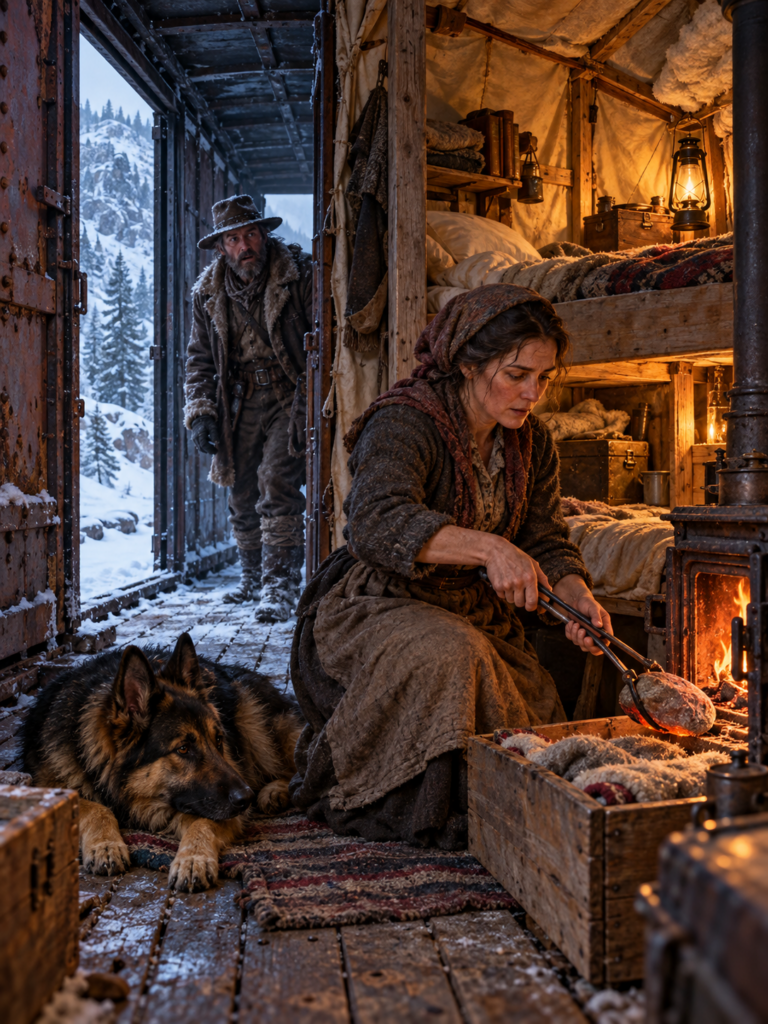
He looked toward the little stove.
“And all this warmth comes from that?”
“The stove provides heat. The insulation slows its escape. The stones store a little of it. Every part matters.”
Voss inspected the raised bed again.
There was nothing expensive about its construction.
Salvaged timber.
Collected riverstones.
Discarded wool.
Old canvas.
Yet the arrangement was clearly deliberate.
One of the miners standing behind him took off his hat.
“It’s warmer here than in our cabin.”
Nobody laughed.
That troubled Voss more than an argument would have.
He had spent years warning miners not to mistake confidence for preparedness.
Now he was being forced to examine whether he had made the same mistake in reverse.
He had mistaken an unusual shelter for an unprepared one.
“How long has it held this temperature?” he asked.
“Several days since I finished the main partition.”
“And the stove?”
“Small, controlled fires. I watch the fuel and temperature.”
He reached toward the horizontal stovepipe, stopping short of touching the hot metal.
Then he noticed the thermometer fastened to the wooden bulkhead.
He studied it.
The warmth was not merely an impression.
Vera had been measuring and maintaining it.
For the first time, he looked around the room without searching for something to condemn.
He was trying to understand what worked.
The younger miner at the rear of the group, Clem Argery, caught Vera’s eye.
He was twenty-two and had previously visited the railcar to ask about the insulation.
Unlike most of the men, Clem had listened before forming an opinion.
He had already worked out why the canvas must not touch the metal walls.
Vera had recognized a familiar kind of curiosity in him.
It reminded her of Edmund.
But there was another difference.
Edmund had taught her ideas.
Clem had been watching her put them into practice.
Voss finally stood.
He looked at his companions.
“We’re leaving her here.”
One of the men frowned.
“What about the council?”
“I’ve seen the shelter.”
“Reverend Sutter won’t like it.”
Voss glanced at the thermometer once more.
“He can come see it himself.”
The men filed through the cold outer compartment.
Clem remained briefly in the doorway.
“That north wall still needs another anchor,” he observed.
“I know.”
“I might have some wire.”
Vera nodded.
“If you find any worth using.”
He left.
Vera closed the inner door and returned to her work.
She did not feel triumphant.
Voss had accepted the evidence before him, but the blizzard had not arrived.
Her shelter had passed an inspection.
It had not yet survived its greatest test.
And there was something she had not told the men.
Several nights earlier, she had almost given up.
She had lain awake thinking about the council’s warning.
If the shelter failed, anyone attempting to reach her might die in the rescue.
Her determination could place other people in danger.
She had considered walking downhill and accepting Mabel Finch’s offer of space in her family’s cabin.
Then she had risen, lit a candle, and inspected every seam.
Not because inspection could remove every risk.
Because that was what she could do.
She had learned from Edmund to respond to uncertainty by examining what might fail.
But the decision to remain had been hers.
That evening, Vera checked the last anchors and adjusted the wool packing.
Kaiser, who had been resting near the bed, suddenly stood.
He walked toward the outer door.
His ears pointed north.
Vera watched him.
Then she took Edmund’s worn survey notebook from her trunk.
The notebook had accompanied her since his death.
She opened it beside the stove, turning toward the passage she returned to whenever her confidence weakened.
Her finger stopped beneath the last lines about insulating a room within a room.
Outside, the wind changed direction.
Kaiser did not move.
Vera reached for her charcoal and crossed another day from the countdown above the door.
The charcoal left a dark line across the number, and Vera stepped back to examine what remained.
The countdown had become more than a record of approaching weather.
It was a measure of how much work she could still accomplish before the mountain decided the schedule for her.
Aldis, the seventy-year-old miner whose weather judgment carried unusual weight in camp, had predicted a serious storm before the new moon.
Vera did not know exactly when it would arrive.
She knew only that each clear day was worth using.
The following morning, Clem Argery returned to the railcar before she had finished preparing the stove.
He carried news from the camp.
Reverend Sutter remained unhappy about her decision to stay.
Voss had withdrawn his immediate support for forcing her downhill, but the council was still watching.
“Some of them think you got lucky with the temperature,” Clem explained.
Vera placed another stone near the stove.
“Lucky for how many days?”
Clem smiled faintly.
“That’s what I asked.”
She inspected the stone for cracks before warming it.
A stone damaged by heat was not worth the risk of keeping near her bed.
The task demanded attention, and Vera gave it.
Clem waited until she finished.
“Is there anything you need?”
“Nothing you have to carry up today.”
He looked at the north-facing canvas.
She noticed.
“You can ask.”
“Does the wind ever pull the anchors loose?”
“One did.”
His expression sharpened.
“What happened?”
“I found it and replaced it.”
“Could it happen again?”
“Yes.”
Vera appreciated the question.
Most visitors treated the shelter as either proof of genius or proof of madness.
Clem understood that it was neither.
It was a working structure with weaknesses that had to be identified before they became dangerous.
She showed him how the canvas was suspended away from the cold metal.
She explained why the inner compartment was deliberately small.
A larger room would need more fuel and offer more surfaces through which heat could escape.
The outer car served as a barrier against wind and drifting snow.
The inner nook provided the insulation.
The stove replaced lost heat.
The riverstones helped smooth the temperature changes between firings.
And the platform kept her bedding above the coldest portion of the enclosure.
Clem examined the system carefully.
“Your husband was an engineer?”
“Railroad survey engineer.”
“Did he build one of these?”
“Not this one.”
She glanced toward the trunk holding his notebook.
“He talked about doing something similar when we traveled in winter. I remembered enough to try.”
Clem studied the rows of stones.
“And the parts you didn’t remember?”
“I had to work those out.”
He nodded.
That answer seemed to satisfy him more than any detailed story about Edmund.
Later that afternoon, Vera found herself remembering the winter of 1882.
She had traveled to visit Edmund at one of his survey camps.
The freight car they stood inside had been miserable in the cold.
Even with supplies stacked along the walls, the iron seemed to draw warmth from everything near it.
Edmund had knocked a hand against the metal and explained the principle of insulation.
He had spoken about building a smaller living space away from the iron.
At the time, Vera had understood the explanation.
But she had not known that six years later she would depend on it.
Nor had Edmund ever stood inside the abandoned car at Sierra Pass and decided how thick the wool should be packed, how high the bed should stand, or where the stove would work best.
Those choices belonged to her.
His knowledge had given her a starting point.
Her labor had made it real.
That distinction mattered.
Since Edmund’s death from typhoid fever in 1886, people had often treated Vera as though the central fact of her existence was that she had lost him.
They spoke to her carefully.
They offered shelter.
They assumed she must be searching for someone to take responsibility for decisions Edmund once helped her make.
Vera was grateful for kindness.
But gratitude did not require surrendering her independence.
She had spent seventeen years beside a man who thought carefully about difficult problems.
Now she wanted to discover what she could do with what she had learned.
That evening, Mabel Finch came up the slope carrying a covered dish.
Her seven-year-old daughter, Ren, walked beside her.
Kaiser greeted the child with his usual patient acceptance.
Ren sat near him while Mabel placed the food on Vera’s small table.
The girl soon noticed the difference between the outer iron compartment and the warm nook.
She touched the canvas wall.
Then she asked why one space was cold and the other was not.
Vera considered how best to explain.
“Think about standing outside in winter,” she said. “Then think about putting on a good coat.”
Ren looked at the canvas.
“You made the inside wear a coat?”
“In a manner of speaking.”
Ren tested another section of wall.
“Does the floor have one?”
Vera glanced down.
The platform was elevated and the stones beneath it supplied warmth, but the boards underfoot remained noticeably colder.
Ren had identified something worth improving.
“Not enough of one,” Vera admitted.
The child returned to Kaiser, satisfied.
Mabel watched her daughter with a small smile.
Then she looked at Vera.
“The council’s concern hasn’t entirely gone away.”
“I know.”
“Voss respects what you’ve made. But people are frightened of this winter.”
“They have reason to be.”
Mabel hesitated.
“If you change your mind, there’s still room in our cabin.”
Vera looked around the tiny space.
It was comfortable, but it could not accommodate an entire household.
That was one of its limitations.
“I’m grateful,” she said. “But I’m staying.”
Mabel accepted the answer.
Before leaving, she promised to return when she could.
Vera remained beside the doorway as mother and daughter descended toward the camp.
For the first time since arriving, she realized that her decisions were no longer passing unnoticed.
The people below were watching.
Some were worried.
Some were curious.
And a few had begun to learn.
She repaired the remaining anchors before nightfall.
The next morning, she began insulating the floor more carefully.
It was an improvement she might have postponed without Ren’s question.
Two days later, Mabel returned with thick wool socks.
“Ren insisted,” she said.
Vera accepted them.
This time she did not pretend the gesture was unnecessary.
The child had noticed a problem.
The mother had offered a small solution.
Both deserved acknowledgment.
Vera added wool felt over the floorboards and tested the result.
The difference was modest but real.
She wrote Ren’s name beside the charcoal countdown.
Not as decoration.
As a reminder that useful questions could come from unexpected people.
Then came the preliminary storm.
It struck during the night, dropping heavy snow and driving hard wind across the ridge.
From inside the nook, Vera listened as the old freight car rang and shuddered.
The iron shell sounded far less dependable than the insulated room felt.
She checked the thermometer.
The temperature remained steady.
Kaiser slept beneath the edge of the bed.
The stove burned carefully measured fuel.
The canvas did not move except for a slight vibration along the north wall during the strongest gusts.
Six hours later, the wind began to weaken.
By morning, the worst had passed.
Vera opened the outer door and surveyed the ridge.
Snow lay thick across the abandoned track.
Farther below, a section of fencing had fallen.
Roofing material had blown loose from another structure.
The storm had been strong enough to cause damage.
But Aldis had warned of something much larger.
Vera inspected the railcar.
She found no major damage.
Still, she checked every anchor, the stove vent, the door track, and the rope bindings.
She discovered one minor weakness near the upper shell where the wind had worked a loose metal edge.
It did not immediately threaten the living compartment.
She repaired it anyway.
Edmund had taught her that a problem ignored because it seemed small could eventually become a serious one.
Vera had learned the same lesson through experience.
She was beginning to think about returning inside when Kaiser lifted his head.
He stared north.
Beyond the ridge, the clouds had gathered into a low dark bank.
The air carried a sharp, unfamiliar stillness.
She followed the dog’s gaze.
Then she went back into the railcar.
That evening, Clem arrived carrying a spool of wire and a length of strong rope.
He placed them inside the outer compartment.
Vera looked at the supplies.
“What are these for?”
“The main door.”
He explained his concern.
If snow accumulated against the lower track, the sliding iron door might become impossible to move.
The railcar could remain warm while its only usable exit became blocked.
Vera had considered the problem but had not yet found a reliable answer.
Clem showed her how the rope might be arranged to pull against the lower part of the mechanism.
Together they examined the track.
He did not insist on directing the work.
He simply offered an idea and the materials to test it.
Vera fitted the rope through the steel loop and checked how the force would be applied.
She tested the arrangement.
The sliding door shifted.
Not far.
But enough to show that the mechanism might help break a packed drift.
She reinforced the north-wall anchors with the wire.
When she finished, Clem was still standing near the doorway.
“Does it work?” he asked.
“So far.”
He nodded.
“That seems to be the answer to everything up here.”
“Until the weather gives us a better test.”
He left before dusk.
Vera stood alone in the outer compartment, studying the door mechanism.
It was one more line of defense.
One more problem addressed before it became urgent.
That night, the wind stopped completely.
There was no gradual easing.
One moment the railcar hummed faintly beneath the winter breeze.
The next, the ridge was silent.
Kaiser rose from his resting place and faced the door.
Vera checked the temperature.
Sixty degrees inside.
The stove burned low and steady.
The riverstones beneath the platform were warm.
For a moment she allowed herself to think of Edmund without pushing the memory away.
She pictured him working at his survey desk in Nevada, measuring distances, examining notes, and considering the possibility of error before committing himself to a conclusion.
He had died before she could imagine life without him.
For two years, she had carried his notebook as though it were a final conversation she had not finished.
But she was beginning to understand something.
The notebook was not an instruction to remain where grief had left her.
It was knowledge she could continue using.
She opened it and examined the familiar observations about temperature, building materials, and the value of creating barriers against cold.
Then she placed it carefully back inside the trunk.
Outside, the first gust struck the side of the railcar.
The iron rang so loudly that Kaiser lifted his head.
Vera turned toward the stove.
A second gust followed.
Then another.
Snow began striking the metal walls.
The sound intensified until she could barely distinguish individual gusts.
At midnight, the predicted blizzard had arrived.
Vera moved to the inner doorway, checked the latch, and pressed her palm against the sealed wooden partition.
The outer car was already growing colder.
The eight-foot room remained warm.
She pulled the inner door firmly shut.
The inner door settled against its frame, and Vera listened as the wind began testing every exposed surface of the abandoned railcar.
A long metallic vibration traveled from one end of the forty-foot shell to the other.
Kaiser stood beside the raised bed, his ears forward.
Vera checked the thermometer.
Sixty-one degrees.
She watched the needle for several moments before turning down the lamp.
There was no reason to waste light merely because the storm was frightening.
Outside, snow swept across the ridge so violently that the iron car rang beneath each gust.
Inside, the little stove gave off a steady heat.
The contrast was remarkable.
But Vera knew better than to confuse a comfortable first hour with victory.
The blizzard might last days.
Her supply of fuel was limited.
The seals might loosen.
The stove vent might become obstructed.
The door could freeze shut.
Every part of the shelter that had worked during ordinary winter weather would now face conditions more severe than those in which she had tested it.
She began the routine she had prepared.
Check the stove.
Check the thermometer.
Check the wall coverings.
Listen for changes.
Then rest while the system was stable.
Kaiser eventually settled beside the platform.
Vera sat above him, her hands resting on the edge of the bed.
She remembered the first afternoon when Voss warned that iron would conduct the cold directly into her living space.
He had been correct about the material.
Where he had been mistaken was in believing that the bare material defined the finished shelter.
Vera had never intended to sleep against uninsulated metal.
The iron shell was the outer barrier.
The wooden partition, packed wool, suspended canvas, raised floor, and carefully managed stove formed the protected interior.
The stones helped retain warmth between firings.
It was not one clever trick.
It was a collection of modest decisions, each solving part of the same problem.
By dawn, snow had buried the railcar’s wheels.
The sliding door was already difficult to move.
Vera checked the inner wall and found no new draft.
The temperature remained comfortable.
She fed the stove a measured piece of wood and allowed herself a small breakfast.
Kaiser ate beside her.
Neither had any reason to leave.
The storm continued.
On the second day, the wind shifted.
Its force struck the forward end of the car rather than the broad side, producing a higher metallic sound.
Vera had learned the normal noises of the structure during the preceding weeks.
This one was different.
She listened carefully.
The north-wall canvas trembled during the strongest gusts.
She examined the anchors.
They held.
She did not attempt an unnecessary repair while everything remained secure.
By the third day, the blizzard briefly weakened.
For several hours, the ridge grew almost silent.
Vera opened the inner door just long enough to check the outer compartment.
The iron ribs were covered in frost.
Her breath became visible immediately.
She closed the door and returned to the insulated nook.
There, the air felt entirely different.
The thermometer confirmed what her skin already knew.
The room was still holding its warmth.
She thought about the councilmen who had stood in this exact place before the storm.
Some had come expecting to persuade her to leave.
They had departed without asking her to abandon the shelter.
But the greatest test had only begun afterward.
And nobody outside knew how she was faring.
***
On the fourth day, the temperature inside began falling faster between stove firings.
It was not a collapse.
The thermometer dropped a few degrees below its usual reading.
But Vera noticed.
She checked the stove’s draft, the ventilation opening, and the nearest canvas seams.
Nothing appeared damaged.
The increased heat loss was consistent with the severe conditions outside.
She added fuel somewhat earlier than her usual schedule, without allowing the stove to burn excessively.
Gradually, the temperature recovered.
Vera recorded the adjustment in her mind.
The shelter was working, but maintaining it required attention.
That was another lesson the miners had not seen when they inspected the finished room.
Insulation did not eliminate labor.
It changed the amount and kind of labor necessary to remain safe.
A poorly protected room demanded constant fuel.
Her smaller insulated nook required less, but it still had to be watched.
That evening, Vera took Edmund’s notebook from the trunk.
She read several pages about materials, measurements, and the importance of accounting for failure.
She remembered how he had spoken during their years together.
He rarely announced that a solution was perfect.
He wanted to know what might happen when conditions changed.
When he died of typhoid fever, Vera had thought that part of her life had disappeared with him.
But sitting in the warm nook, surrounded by the evidence of her own work, she began to see his influence differently.
Edmund had not left her a finished shelter.
He had left her knowledge.
And she had done something with it that neither of them had once imagined.
The shelter had survived four days of a major Sierra blizzard.
She had made it work.
That fact belonged to her.
***
On the fifth morning, Vera discovered a problem she could not ignore.
The main sliding door would not move.
She had gone into the cold outer compartment to examine the track.
The metal lever shifted slightly beneath her hands, but the door remained jammed.
Packed snow pressed against it from outside.
She tried again.
Nothing.
For a moment, she stood in the freezing compartment and considered the implications.
The shelter might be warm.
The stove might still work.
But an exit that could not be opened was a serious danger.
Then she remembered Clem Argery’s rope.
He had brought the material before the storm because he had anticipated exactly this difficulty.
Vera examined the line secured through the door’s interior fitting.
She checked that it remained properly seated.
Then she braced herself and pulled.
The first effort achieved almost nothing.
She adjusted her position and tried again, using the arrangement to apply greater leverage.
The track gave with a sharp crack.
The sliding door moved a short distance before packed snow stopped it again.
Cold air entered through the narrow opening.
Beyond it stood a nearly solid wall of snow.
Vera did not attempt to crawl outside.
There was nowhere useful to go.
But she had confirmed that the door could be shifted, and the mechanism was no longer completely seized.
She closed it as far as possible, secured the outer compartment, and returned to the insulated room.
Kaiser greeted her with a quiet movement of his tail.
She knelt beside him and rested one hand against his shoulder.
“Clem thought of that,” she murmured.
The dog accepted the observation without interest.
Vera smiled.
She had spent months learning what she could manage alone.
Now a young man’s small, thoughtful contribution had solved a problem she might otherwise have faced without the right materials.
There was no shame in that.
Independence did not mean rejecting useful help.
It meant retaining responsibility for her decisions while recognizing the value of other people’s knowledge.
She added that lesson to everything the abandoned car had taught her.
***
By the sixth day, the mountain had become almost entirely silent beneath the noise of the storm.
Vera could no longer see the camp.
She could not know which cabins had survived.
She could not know whether the men who had doubted her were warm, hungry, exhausted, or struggling with damaged roofs.
The uncertainty troubled her.
She checked the stove and water again.
The shelter still held.
Then Kaiser rose.
He moved to the inner door and stood with complete attention.
Vera watched him.
She listened.
At first, she heard only the familiar wind striking the outer shell.
Then another sound emerged.
A dull metallic impact.
A pause.
Another impact.
The rhythm continued.
It was not the railcar shifting beneath the wind.
Someone was working outside.
Vera stood.
She put on her coat, checked that the stove was safe, and approached the inner door.
The sound grew clearer.
Shovels.
Metal against packed snow.
She waited while the labor continued.
At last, the outer sliding door moved with a long, rough groan.
Cold air entered the uninsulated compartment.
Then a familiar voice called her name.
“Harlon Voss.”
Kaiser barked once.
Vera lifted the inner latch.
She opened the door.
Harlon Voss stood in the outer compartment with snow covering his coat and ice clinging to his beard.
Behind him were Clem Argery and three other men.
They looked exhausted.
Voss had plainly prepared himself for the possibility of finding her in serious trouble.
Instead, he saw her standing comfortably inside the nook.
Warm air reached him through the doorway.
He stopped.
For several seconds, nobody spoke.
Then his eyes moved to the thermometer.
Fifty-nine degrees.
Six days into one of the worst storms the camp had faced.
He looked from the thermometer to the stove.
Then to the raised platform.
Finally, he crouched and removed his glove.
His hand reached toward the riverstones.
One was still warm.
Voss remained crouched.
He did not appear angry or embarrassed.
He appeared to be reconsidering everything he had believed about what an abandoned iron freight car could become.
“How?” he asked quietly.
Vera gestured around the room.
“The walls slow the heat loss. The stove replaces what’s lost. The stones help carry warmth between firings.”
He touched the stone again.
He had heard the explanation before.
But hearing something and trusting it after six days of violent weather were not the same experience.
Voss rose.
“I told the others grief had clouded your judgment.”
Vera watched him.
“You were concerned about the weather.”
“I was sure you’d fail.”
“That was a different thing.”
He nodded slowly.
For a moment, she expected an apology.
Instead, he reached into his coat and removed a small notebook and pencil.
“How thick is the packing?”
Vera understood.
He was no longer searching for reasons the shelter could not work.
He wanted to learn how it had worked.
She explained the wool packing, the suspended canvas, the raised platform, the stove’s modest fuel requirements, and the importance of closing gaps.
Voss wrote down each useful detail.
Clem stood near the doorway.
He did not interrupt.
When Voss finished, Vera asked about the camp.
His expression darkened.
Two cabins had suffered serious structural damage.
Other shelters were bitterly cold.
People were running short of dry fuel.
Everyone had survived so far, but several residents were having difficulty getting warm.
Vera looked around her small nook.
It could not safely house the entire camp.
Too many bodies crowded inside would obstruct the stove and interfere with the space she had worked so carefully to maintain.
But it could provide temporary relief.
“Bring the people who need warming most,” she said. “Small groups. A few minutes at a time.”
Voss nodded.
Clem was already moving toward the entrance.
***
The visitors came in groups.
Some were miners whose hands had grown painfully cold.
Others had spent nights in cabins where the wind entered through damaged walls.
They crossed the frozen outer compartment and stepped into the warm nook with expressions Vera would remember long afterward.
A few stood perfectly still.
Others stretched their fingers toward the warmth of the stove, keeping a safe distance.
Several looked repeatedly at the thermometer.
They could scarcely believe that this small room inside an abandoned railcar had remained more comfortable than their larger cabins.
Vera explained the arrangement when someone asked.
Otherwise, she let them warm themselves.
One older miner named Hess stood beside the stove, slowly flexing his stiff fingers.
His eyes filled with tears.
He did not speak.
Vera did not require him to.
When Reverend Sutter arrived, he examined the room with particular attention.
The same man had brought a petition demanding that Vera come down from the ridge.
Now he could see that the shelter he had condemned had survived the blizzard.
He looked at the insulated walls.
The raised bed.
The thermometer.
The quiet dog lying near the stove.
Finally, he turned toward Vera.
“I was wrong about the danger.”
She considered his words.
“Your concern for the people who might have to rescue me was reasonable.”
Sutter lowered his eyes.
“I failed to examine what you’d built before deciding it could not protect you.”
Vera nodded.
That distinction mattered.
He had not been wrong to take winter seriously.
He had been wrong to assume that her preparations were inadequate without understanding them.
The Reverend stood silently for another moment, then took his leave.
Mabel Finch came with one of the final groups.
Ren accompanied her.
The little girl crossed the nook and immediately sat beside Kaiser.
Then she stretched out her palm against the canvas.
“It’s still warm.”
“It is,” Vera answered.
“Because of the coat.”
Vera smiled.
“Because of the coat.”
Ren glanced toward the floor.
“And you fixed that part.”
“Thanks to you.”
Mabel looked at her daughter, then at Vera.
She rested a hand briefly against the widow’s arm.
There were many things either woman might have said.
None seemed necessary.
***
The blizzard ended on the seventh morning.
The silence that followed was so complete that Vera woke expecting to hear something wrong with the stove.
Instead, she heard Kaiser breathing beside her.
The thermometer remained steady.
The stones beneath the platform retained their familiar warmth.
Outside, the wind had stopped.
Vera dressed and entered the outer compartment.
The men had cleared a passage through the snow during their visits, allowing her to reach the exposed slope.
She stepped into daylight.
Sierra Pass had disappeared beneath white.
The landscape was barely recognizable.
The mining camp below was mostly buried.
Only the upper portions of buildings and thin columns of chimney smoke broke the snow’s surface.
Two rooflines had visibly failed.
The Henderson family’s cabin was among the worst damaged.
Yet the news Clem had brought remained true.
Nobody had died.
Vera stood beside Kaiser, looking down at the settlement.
Behind her, the abandoned railcar remained almost entirely covered.
From outside, it resembled a forgotten piece of machinery the mountain had nearly swallowed.
Only the stove pipe and the opening cleared through the snow suggested that someone lived inside.
A few weeks earlier, the miners had believed the car was useless.
Now people had crossed the ridge in dangerous weather to experience its warmth.
Harlon Voss came up the cleared path.
He stood beside Vera and surveyed the camp.
After a while, he pointed toward the Henderson cabin.
“I’m going to rebuild that place before next winter.”
Vera looked at the damaged structure.
The family had three children.
They had survived by taking shelter with the Finches after part of their cabin collapsed.
Voss continued.
“Double walls. Proper packing. Better seals.”
“You don’t need iron to make the idea work,” Vera said.
“Timber will do?”
“With the right construction.”
Voss considered that.
“Clem knows someone who can supply cedar.”
“Then you have somewhere to start.”
He looked down the ridge.
“This shouldn’t be the only warm room in the camp.”
Vera followed his gaze.
For the first time, she understood that the railcar might become useful in a way she had never intended.
She had built the nook for herself and Kaiser.
Now its design could help families who had far fewer resources than they needed to face another winter.
She had not planned to become a teacher.
She had wanted only a place of her own.
But knowledge that remained locked inside one person’s shelter could protect only that person.
Knowledge shared could become something larger.
***
That afternoon, Vera walked down to the camp.
It was the first time she had willingly entered the settlement since arriving at Sierra Pass.
Kaiser accompanied her.
The Henderson cabin stood partly open to the winter air, its damaged north wall exposing belongings that had once been protected inside.
Mabel Finch was near the communal fire with Ren.
When Mabel saw Vera, she smiled.
“I’m glad you came.”
Vera looked around the camp.
Men were clearing snow.
Others were sorting usable timber from damaged structures.
The work was difficult, but purposeful.
Clem was examining measurements near the Henderson cabin.
Voss was already organizing repairs.
The settlement no longer seemed like a collection of strangers waiting for her to fail.
It seemed like a place where she might have something to contribute.
She stood beside Clem as he measured a section of damaged wall.
“You’re planning the double framing?”
“That’s the thought.”
“Leave enough room for the packing. The thickness matters.”
He nodded.
Then he asked about the most efficient way to secure the interior covering.
Vera explained what she had learned from the railcar.
Not only what Edmund had once taught her.
What she had discovered during the weeks of building, adjusting, and testing.
Clem listened.
Then he made a small correction to his measurements.
She watched him work.
The exchange felt natural.
There was no argument about whether she belonged.
No assumption that she needed permission to understand construction.
They were two people solving a problem.
Vera realized how much she had missed that kind of conversation.
***
Later, Clem told her about a man who could supply cedar for the rebuilding.
Vera advised him to request enough material for more than one structure.
Voss intended to improve several cabins.
The camp would need a consistent plan rather than a hurried repair to one damaged house.
Clem agreed.
Then he looked toward the ridge.
“I thought your room would work.”
“Before you saw it?”
“After you explained the idea.”
Vera considered that.
“Most people prefer to see something succeed before they trust it.”
Clem smiled.
“Someone has to build it first.”
She laughed quietly.
It was a small sound.
But it startled her.
She could not remember the last time she had laughed with another person without immediately thinking about the silence that followed Edmund’s death.
She did not feel that she had stopped grieving him.
She did not think grief was something a person completed and left behind.
But she was beginning to live beside it rather than entirely within it.
That difference had taken longer to learn than anything about insulation.
When the afternoon light began fading, Vera said goodbye and climbed back toward the ridge.
Kaiser walked beside her.
The path was packed with snow from the rescue parties.
The old railcar emerged slowly against the pale sky.
She opened the sliding door, crossed the cold outer compartment, and entered the warm nook.
Her first action was the same one she had performed every day since completing the shelter.
She checked the stove.
Then the thermometer.
Then the stones.
They were still warm.
She sat on the edge of the platform and took Edmund’s notebook from the trunk.
The pages were worn from years of handling.
She opened it to the passage she remembered most clearly.
It described the value of building a protected room within an exposed one.
The larger structure might face the full force of winter.
The smaller space, correctly insulated and maintained, could remain livable.
Vera placed her hand against the wooden partition.
She remembered Edmund explaining the principle in a cold railroad car years earlier.
She had listened.
She had understood.
And then life had taken him away before either of them knew how necessary that knowledge would become.
For two years, his notebook had represented something finished.
A life interrupted.
A conversation she could not resume.
But the railcar had changed the meaning of the pages.
The ideas had continued beyond the man who wrote them.
They had become tools in another person’s hands.
Her hands.
Hands that had carried stones until the skin hardened.
Hands that had packed wool into the partition.
Hands that had repaired failing anchors, built a stove, adjusted a door mechanism, and kept the little room functioning through six days of relentless winter weather.
Edmund had taught her the principles.
Vera had designed and maintained the shelter.
And now the camp below was beginning to use what she had learned.
She closed the notebook.
Outside, the late sunlight moved across the snow.
Within the car, the stove burned steadily.
Kaiser rested at her feet.
Spring would eventually expose the rails and the great iron wheels again.
The miners would rebuild damaged cabins.
Clem would continue learning and sharing what he discovered.
Voss would approach the next winter with better information.
Ren would remember a tiny room she had compared to a coat, and perhaps ask new questions that grown people overlooked.
And Vera would remain on the ridge for as long as the place continued to suit the life she was building.
She no longer thought of the railcar as a strange coincidence delivered by grief.
The familiar railroad designation had given her a reason to look twice.
The cold interior had given her a problem to solve.
Edmund’s knowledge had supplied the beginnings of an answer.
And her own work had supplied the rest.
The car’s iron walls still conducted cold.
Nothing had changed their nature.
What changed was the space Vera built inside them.
She had not defeated the Sierra winter.
She had learned how to live within it.
And she had discovered something that no engineer, miner, or council could have handed her.
She did not need to become the person she had been before Edmund died.
She could become someone shaped by what they had shared, strengthened by what she had learned, and still capable of building something entirely her own.
Vera placed the notebook carefully into her trunk.
Then she adjusted the blanket over the bed, checked the stove one final time, and sat down beside Kaiser.
Below the ridge, the faint sound of hammers traveled through the winter air.
People were rebuilding.
Inside the railcar, the room remained warm.
And for the first time in two years, Vera was not waiting for her old life to return.
She was living the one she had made.