
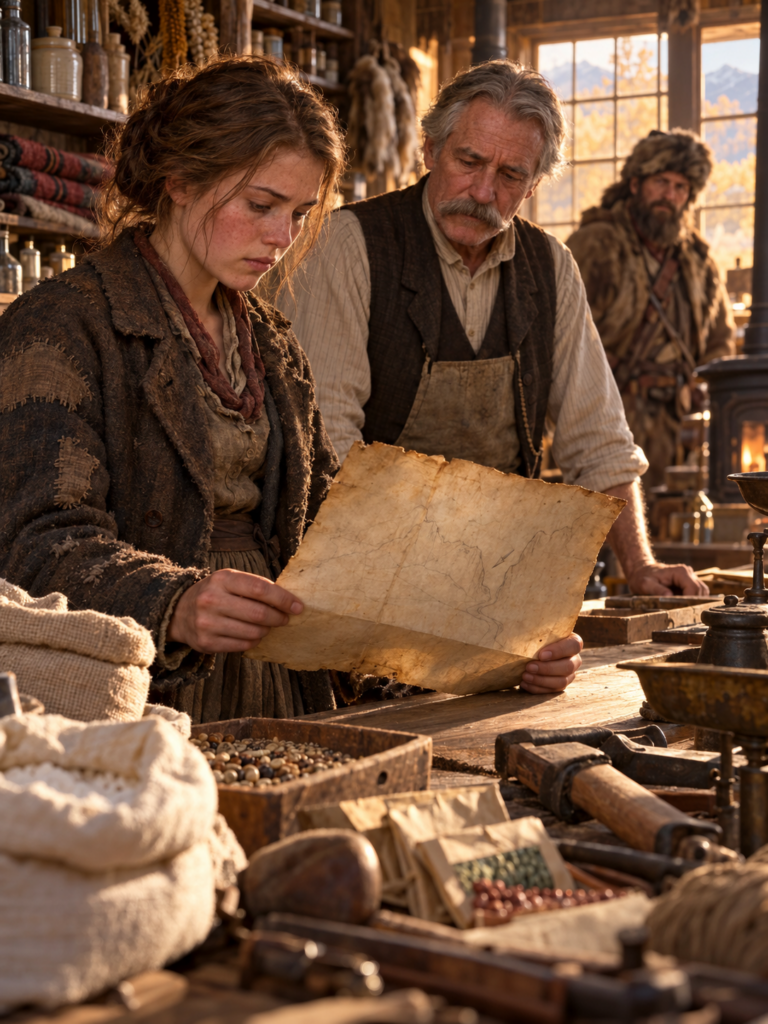
The firelight passed across the paper, and the marks became clear enough for Jessimine to follow.
The large oval was the cave’s main chamber.
She recognized the entrance, the narrowing passage, and the far wall where the darkness deepened beyond the reach of her small flame.
But the drawing did not stop there.
A narrow line extended through the stone into a second chamber.
Jessimine leaned closer.
Below the arrow, the faded word finally resolved.
KEEP.
She read it twice.
Keep what?
The land?
The chamber?
Something placed inside it?
Her grandmother had possessed the deed for decades. The map was not a surveyor’s ordinary boundary sketch. Whoever drew it knew the cave from within.
And Birdie Tanfield knew there was something worth concealing.
Jessimine stood and carried the paper toward the cave entrance.
Behind her, the new fire crackled through the stone hearth.
Ahead, the interior chamber lay almost completely dark.
She could make out the water basin and the far wall, where a narrow break in the rock disappeared into blackness.
She had noticed that opening on her first night.
She had never explored it.
Now the map gave her a reason.
She took several steps inward before stopping.
Her legs were exhausted from weeks of construction. The cabin still required constant attention, and the first serious winter weather was gathering over the mountains.
An injury deep inside the cave could leave her unable to tend the fire or gather wood.
She folded the deed.
Whatever Edith had hidden had waited for years.
It could wait until Jessimine had secured her shelter.
Through the next weeks, she turned the cave into the working center of her homestead.
She carried soil from the ravine into shallow growing beds near the entrance, where daylight could reach. She planted lettuce and carrots, then experimented with a tarnished mirror found among the rocks, angling it to direct more sunlight toward the plants.
She trapped small animals, prepared their pelts, and returned to Haskell’s store to trade.
The shopkeeper was plainly surprised to see her alive.
Cotter Bry appeared even more surprised when she requested four laying hens, a ewe, a ram, and additional salt.
The pelts covered the purchase.
It was an important moment.
Jessimine had arrived with a deed everyone considered useless.
Now she was trading something produced by that same land.
She brought the animals back through the ravine and sheltered them in pens inside the cave.
The hens settled onto their roost.
The sheep lay down on the dry floor.
The first winter snow began covering the hillside outside.
For a while, the life she had built demanded so much attention that the map remained folded in her pocket.
Then, six weeks into the bitter cold, a rider appeared at her cabin.
He was well dressed, mounted on a strong chestnut horse, and carried himself with the assurance of a man accustomed to getting answers he liked.
“My name is Leland Stowe,” he said.
He owned a large spread south of the hollow.
He examined the cabin, its chimney, and the surrounding cliffs.
Then he made an offer.
Fifty dollars for her land.
Jessimine felt the significance of the amount.
She had begun with $17.
Fifty dollars could purchase freedom from hunger and uncertainty somewhere far from the mountains.
But Stowe had not ridden through winter snow to acquire a worthless patch of rock out of generosity.
“Why do you want it?” she asked.
Stowe gestured toward the cliff.
“The groundwater.”
He explained that the spring inside her cave was connected to a reliable source that mattered to his cattle.
Jessimine understood at least part of his interest.
The hidden water was more valuable than the barren surface suggested.
“The land isn’t for sale,” she answered.
Stowe did not argue.
Instead, he raised another matter.
Her grandmother’s claim, he said, might not have been properly registered. If the documents were deficient, Jessimine’s ownership could be challenged.
He had already consulted an attorney.
And he intended to investigate further.
After he rode away, Jessimine stood in the doorway holding the deed.
Now there were two possibilities.
Edith had concealed something so valuable that she feared others would take it.
Or she had preserved something necessary to prove that the land belonged to her.
The map might answer either question.
But Jessimine still could not afford to enter the narrow passage.
Winter had sealed the ravine, and her food and firewood demanded careful rationing.
Then the greatest blizzard of the season descended upon Split Rock Hollow.
Snow buried the window.
Wind pressed against the cabin door.
Near midnight, someone began pounding from outside.
Jessimine lifted the wooden brace and pulled the door inward.
A nearly frozen man collapsed across her threshold.
She dragged him inside, removed the ice-stiff scarf, and recognized Cotter Bry.
His lips barely moved.
“Wagon overturned,” he whispered. “Haskell and his wife… still out there.”
Jessimine looked toward the blizzard, then toward her fire.
The man who had mocked her was alive because she had opened the door.
Two more lives now depended on whether she would open it again.
She reached for her rope and lantern.
Jessimine wound the rope around her shoulder, lifted the lantern, and stepped into the storm.
The wind nearly tore the door from her hand.
She forced it shut behind her and turned toward the ravine, keeping close enough to the cliff to use its dark surface as a guide.
Cotter Bry had managed to tell her where the wagon overturned.
Half a mile east.
In clear weather, the distance would have been manageable.
Now the air was filled with snow moving sideways, and the lantern illuminated scarcely more than a few feet.
She counted her steps.
When the ground dropped suddenly beneath one boot, she caught herself against the rock and stood motionless until her breathing steadied.
She could not rescue anyone if she became lost herself.
At last she saw the overturned wagon.
Mr. Haskell and his wife had sheltered against its side.
They were barely responsive.
Jessimine pressed the warm pot she had carried into Mrs. Haskell’s hands, helped the couple upright, and pointed toward the faint direction of the cliff.
They moved together through the drifts, stumbling, resting, and continuing.
Mrs. Haskell fell repeatedly.
Mr. Haskell could barely support himself.
Jessimine kept moving because there was no other useful choice.
When the cabin finally emerged from the white darkness, all three fell through its doorway.
Cotter was sitting near the fireplace, wrapped in a blanket.
He stared at the couple without speaking.
Jessimine closed the door, restored its brace, and set about warming her guests.
Nobody mentioned the things that had been said in the mercantile.
For a while, there was only the sound of breathing and wet clothing being pulled away from frozen skin.
By the following day, Mr. Haskell was strong enough to explore the shelter.
He looked into the cave and found sheep resting behind sapling fencing, hens perched above the floor, vegetable beds growing near the entrance, and clear water collecting in a natural basin.
He turned slowly toward Jessimine.
“You did all this?”
She nodded.
He examined the walls of the cave again.
“I never went inside,” he admitted.
It was a small confession, but it explained much of the town’s certainty.
People had judged the hollow without understanding it.
The blizzard continued for three days.
When it finally released the mountains, Jessimine watched the three survivors prepare to return to Drover’s Bend.
Cotter shook her hand.
Mrs. Haskell embraced her.
Mr. Haskell placed a gold coin into her palm.
He insisted it was payment for the shelter, food, and assistance she had provided.
Jessimine accepted it.
The money mattered.
But something else mattered more.
Three people who had expected her to fail now knew exactly what stood behind her cabin door.
News of the rescue spread through Drover’s Bend.
By February, even people who had never visited Split Rock Hollow were speaking of the young woman who had built a winter refuge inside a supposedly useless cave.
Jessimine continued with her work.
Then, one bitter morning, she heard another set of footsteps approaching.
These were not the deliberate steps of a rancher or trader.
They were uneven and stumbling.
She opened the door.
A thin boy stood outside without a proper coat.
For a moment, she could not speak.
“Thomas?”
Her younger brother tried to answer, but his teeth were chattering too violently.
She pulled him inside.
The story came after warm water, stew, and time beside the fire.
Their father had sold the family homestead.
The money had disappeared into drinking.
Then Reuben had vanished, leaving Thomas alone in a house that no longer belonged to them.
The boy had waited.
When his father did not return, he began walking.
He had come to Split Rock Hollow because it was the only place he could think to go.
Jessimine looked at the small figure wrapped beside her fire.
Months earlier, she had been the child driven out of that household.
Now she was being asked to become its refuge.
“Can I stay?” Thomas asked.
She looked toward the cave, where the sheep were moving quietly behind their fence.
“You can,” she said. “There’s work to be done.”
He nodded immediately.
It was the first time in months that Jessimine could share the labor of keeping the homestead alive.
Thomas learned how to tend the fire, collect eggs, feed the sheep, and repair the chinking where winter had opened small cracks.
He listened when she explained what worked.
He listened even more carefully when she explained what had failed.
And slowly, the hollow became a home for two people.
But the approaching spring brought another threat.
Birdie Tanfield arrived one morning as the deep snow began to recede.
She sat near the fireplace, accepted a warm drink, and delivered the news without ceremony.
Leland Stowe had formally challenged the Whitmore claim.
His petition raised two objections.
First, he questioned whether Edith’s original land registration had been properly witnessed.
Second, he argued that the property had been abandoned long enough to weaken its claim.
A hearing was scheduled for April.
Jessimine felt the familiar pressure of uncertainty, but this time there was something she could examine.
The deed.
The map.
The chamber.
Birdie watched her glance toward the cave.
“Edith expected trouble over that land,” the old woman said.
“Did she leave proof that it was hers?”
Birdie rested a hand on her walking stick.
“She left things where she thought they would remain safe.”
“Inside the cave?”
Birdie did not deny it.
Jessimine leaned forward.
“Why won’t you tell me what’s there?”
“Because I made her a promise.”
“Even if I lose the land?”
Birdie’s expression tightened.
“You need to see it yourself.”
After she left, Jessimine removed the deed from its place beside the hearth.
Thomas watched her study the map.
“Is that Grandmother’s writing?”
“I think so.”
“What does it mean?”
“I intend to find out.”
The winter had taught Jessimine one lesson repeatedly: uncertainty became more dangerous when it was ignored.
Stowe had money.
He had an attorney.
He had access to records she had never seen.
She had the original claim handed down through her family, a map that pointed beyond the cave she knew, and an elderly witness who had guarded Edith’s secret for 30 years.
That was not yet enough to win a hearing.
She chose a morning when the sun reached far into the cave entrance.
Thomas was instructed to remain near the cabin and tend the fire and animals.
Jessimine filled her lantern, took her knife and rope, and placed the deed in her pocket.
Then she crossed the main cavern toward the narrow opening in its far wall.
Cool air moved from the passage.
The draft confirmed that the gap led somewhere beyond the stone she could see.
She turned sideways and entered.
At first, the passage was manageable.
Then the ceiling lowered.
She crouched, knelt, and finally began crawling.
The stone pressed against her shoulders.
She pushed the lantern ahead carefully, afraid of damaging it in the narrow space.
When she reached the tightest section, she stopped.
There was scarcely room to move her arms.
For an instant, she imagined becoming trapped beneath the weight of the mountain.
She controlled her breathing, shifted one shoulder forward, and pulled herself along the smooth, water-worn floor.
A few more difficult feet passed.
Then the passage widened.
She emerged into a smaller chamber.
Jessimine stood slowly.
The room was approximately twenty feet across, with a flat floor and walls that glittered faintly where her lantern struck them.
Green-blue mineral staining followed irregular lines through the rock.
She had seen similar colors discussed by prospectors who traded in Drover’s Bend.
Her attention moved along the wall to a natural stone shelf.
Someone had placed objects there.
A small tin box.
Three pieces of rock.
The stones were arranged in a neat row, each showing reddish metal and green staining on its broken surface.
Jessimine approached them.
She picked up one specimen.
It was unexpectedly heavy.
Copper.
She was almost certain of it.
That explained part of the chamber’s importance.
But not why Edith had hidden it.
If the vein extended farther through the rock, the discovery might make Split Rock Hollow far more valuable than Stowe had admitted.
Jessimine returned the specimen to its place.
Then she examined the tin box.
Its clasp had rusted, but the lid remained intact.
She lifted it carefully and found a journal wrapped in oilcloth.
The cover bore the wear of many years.
She untied the wrapping and turned the first pages.
They contained dates, measurements, and observations about the cave.
Then she found descriptions of the copper deposits.
Edith had discovered them years after establishing her claim.
She had studied the rock, collected samples, and tried to understand the extent of the mineral vein.
Jessimine turned another page.
A later entry concerned men who had come to the hollow with an offer to acquire mining rights.
They had returned more than once.
And each time Edith had refused.
Jessimine stared at the passage.
Her grandmother had apparently possessed something valuable enough to attract mining interests.
Yet she had spent the rest of her life living alone in a cave.
Why?
Jessimine moved the lantern closer, turned the next page, and began reading the explanation Edith had written for anyone who eventually found her hidden chamber.
The next page was covered in Edith Whitmore’s careful handwriting.
Jessimine read slowly, tracing each line with the light of her lantern.
The entries described the copper deposit in practical detail.
Edith had concluded that the mineral vein extended deep into the cliff. Its potential value was considerable.
She had compared the samples against geological descriptions, recorded their appearance, and considered what the deposits might bring if sold.
Jessimine remembered the three stones resting beside the tin box.
For years, her grandmother had lived with the knowledge that valuable copper lay within her property.
She had never tried to profit from it.
A later entry described representatives of a mining company who had visited the hollow.
They had made offers.
When Edith refused, they returned with arguments about mineral development and the rights of those who wanted to extract the ore.
But the journal recorded why Edith remained opposed.
The copper ran through rock that also sheltered the cave and its water source.
Mining would mean cutting into the mountain.
Blasting might fracture the channels carrying the spring.
The waste and disturbed material could foul the water.
And the cave itself, protected from winter’s extremes by the surrounding stone, might be damaged beyond use.
Edith’s observations did not establish that every possible mining operation would certainly destroy the entire hollow.
They explained why she believed the danger was too great to accept.
She had lived there long enough to know that the land possessed another kind of value.
The water.
The shelter.
The steadiness of the underground temperature.
The possibility of surviving when the surface became almost uninhabitable.
Jessimine looked around the hidden room.
The copper-colored stains in the walls now seemed less like a promise of wealth than a warning of the decision that wealth might demand.
She remembered the night she first entered the cave.
She had nearly turned away.
Without the spring and the protected chamber, she might not have survived her first winter.
Neither might Cotter Bry.
Or the Haskells.
Thomas would have arrived to find an empty, frozen hollow.
The copper could be sold once.
The shelter, if preserved and maintained, might support generations.
She closed the journal and opened it again at the earlier entries.
Edith had not simply rejected money because she disliked strangers or feared change.
She had made a deliberate choice about what the land should remain.
The family had described her as unreasonable.
The townspeople had considered her foolish.
Yet she had built a life on ground everyone else had dismissed.
And Jessimine was now living proof that Edith’s judgment had not been without reason.
She continued examining the journal.
The entries grew less frequent toward the end.
The handwriting changed slightly, revealing age in the unevenness of a few strokes.
Jessimine felt the distance between herself and her grandmother narrow.
She had never known this woman as a person.
Only as an uncomfortable family memory, someone whose refusal to leave Split Rock Hollow had become a story told with lowered voices and disapproving smiles.
Now she had something much closer to Edith’s own account.
Measurements of water.
Notes about stone.
Concerns about mining.
Records of offers refused.
And a conviction sustained over decades.
Jessimine understood why Birdie had guarded the secret.
Yet a troubling question remained.
The copper explained why outsiders might want the land.
It did not prove that Edith’s property registration was valid.
Jessimine needed evidence that could answer Stowe’s actual challenge.
She carefully returned the journal to the tin box.
Then she carried the box back through the narrow passage.
Thomas was waiting beside the cabin fire.
He stood when he saw her emerge.
“What did you find?”
“Grandmother kept records.”
“About the cave?”
“And about why she wanted to keep it.”
Thomas looked at the tin box.
“Does it help with the hearing?”
“I don’t know yet.”
She set the box near the hearth.
There was one person who could explain the older records, if anyone could.
The following morning, Jessimine walked to Birdie Tanfield’s cabin.
The three-mile journey was easier now that the snow had begun melting, though the lower ground remained wet and uneven.
Birdie opened the door.
Jessimine placed the tin box on the table and removed the journal.
Beside it, she arranged the three copper samples.
Birdie examined them in silence.
Then she slowly sat down.
For the first time since Jessimine had met her, the old woman appeared unable to speak immediately.
“Edith showed you this?” Jessimine asked.
Birdie shook her head.
“She showed me enough.”
“Then you knew about the copper.”
“I did.”
“And the mining men?”
“Yes.”
Jessimine sat opposite her.
“Why did you promise not to tell anyone?”
Birdie looked toward the small window.
“Because every time somebody learned what was in that mountain, they stopped seeing the water.”
She turned back.
“Your grandmother could have sold and gone somewhere comfortable. She decided the cave was worth more left alone.”
“Even though everyone thought she was foolish.”
“Especially then.”
Birdie’s voice softened.
“She believed somebody would eventually understand.”
Jessimine glanced at the journal.
“I understand why she protected it. But Stowe says her claim was never properly registered.”
Birdie looked sharply at her.
“Have you read the last pages?”
Jessimine frowned.
“Most of them.”
“Look again.”
She opened the journal near the back.
Several sheets lay close together, and between two of them was a folded document she had not carefully examined in the dim hidden chamber.
She lifted it out.
The paper was old but protected by the journal’s closed covers.
At the top was an official registration heading.
Below were Edith Whitmore’s particulars and the description of the Split Rock Hollow claim.
Jessimine’s eyes moved to the date.
1859.
Then to the territorial land office stamp.
And finally to two witness signatures.
She looked up.
“Birdie.”
The old woman held out one crooked finger and touched the second signature.
It bore her formal name, Bernadette Tanfield.
“I went with her when she filed it.”
Jessimine stared at the document.
Birdie explained that they had traveled to the territorial land office together and that Edith had retained her copy after the claim was recorded.
The record Stowe had questioned was not necessarily missing.
It might simply have been located in a different register from the one his attorney had examined.
Jessimine considered the implications.
This document could establish that her grandmother had properly recorded the original claim.
And Birdie could testify that she had witnessed its filing.
But that was only part of the dispute.
Stowe had also questioned whether the property had been abandoned.
Jessimine thought of her cabin, her animals, her vegetable beds, and the spring.
Every improvement she had made since arriving might now matter for more than survival.
She folded the registration carefully.
“You never told me about this.”
Birdie lowered her hand.
“Edith wanted the evidence kept safe. I promised not to reveal the chamber.”
“And you let me risk losing the land?”
“I told you where to look.”
Jessimine held her gaze.
For a moment, she was angry.
Birdie had known that the documents existed, and her silence had left Jessimine to face an uncertainty that threatened everything she had built.
But the older woman had also given her indispensable construction advice, protected Edith’s secret for decades, and finally directed her toward the hidden chamber.
Both things could be true.
“You could have told me sooner,” Jessimine said.
Birdie nodded.
“Perhaps I should have.”
It was the nearest thing to an apology Jessimine expected.
She collected the registration and the journal.
Now she had work to do.
***
The weeks before the hearing passed quickly.
Jessimine returned to Split Rock Hollow determined to keep the claim in productive use.
Thomas worked beside her.
They repaired sections of the cabin damaged by winter, strengthened the roof, and tended the animals.
The garden had survived.
The lettuce was small but usable, and the carrots were beginning to provide a modest harvest.
The spring continued to collect in its stone basin.
Some mornings Jessimine stopped beside it longer than necessary.
She had once considered that steady dripping a pleasant accident.
Now it represented the reason Edith had turned away offers that might have made her wealthy.
Thomas noticed her attention.
“Why do you keep looking at the water?”
“Because I’m trying not to take it for granted.”
He considered that before returning to his work.
She had not yet explained the copper to him.
The immediate task was to defend their home.
The full burden of the secret could wait until they were no longer facing the possibility of losing it.
When April arrived, Jessimine prepared for the hearing in Drover’s Bend.
She placed Edith’s registered document beside the deed her father had given her.
She also carried the information she could honestly provide about the homestead’s improvements and continuous use since her arrival.
Thomas remained at the cabin to look after the fire and animals.
He was anxious about being left alone.
Jessimine examined the neatly stacked wood and the water he had already carried.
“You know what to do.”
He nodded.
“I’ll keep everything going.”
She touched his shoulder.
Then she began the walk to town.
***
The hearing took place before Commissioner Aldrich.
Leland Stowe attended with his attorney.
Jessimine recognized the confident expression Stowe had worn when he first offered her $50.
His attorney presented the objections.
The original Whitmore claim, he argued, had not been shown in the records he had examined.
And the property’s recent history raised questions about continued occupation and improvement.
Jessimine listened until she was permitted to answer.
Then she took out Edith’s registration.
She placed it before the commissioner.
The official stamp and witness signatures were visible.
Birdie Tanfield’s name appeared clearly among them.
Jessimine explained how she had found the document and what Birdie had told her about the original filing.
The commissioner inspected it closely.
He compared the particulars against the applicable records.
The room became quiet.
Stowe’s attorney asked questions about the document’s provenance.
Jessimine answered plainly.
It had been preserved inside Edith’s journal, which she had recovered from her grandmother’s property.
She did not describe the copper deposit.
It was not necessary to establish whether the deed was valid.
Nor did she need to disclose the mineral vein to prove that the land had been occupied and improved.
The commissioner turned to the second issue.
“What improvements have you made since taking possession?”
Jessimine described the cabin built against the cliff.
The fireplace and chimney.
The animal pens.
The garden beds.
The protected spring.
She explained the work involved and the months during which she had occupied the homestead.
As she spoke, Mr. Haskell rose from his place near the wall.
He asked to be heard.
“I’ve seen the improvements myself.”
The commissioner allowed him to continue.
Haskell described the blizzard, the wrecked wagon, and the shelter Jessimine had provided.
He had seen her cabin and the cultivated space inside the cave.
He had eaten food from her stores and watched her maintain the place through winter.
Then Cotter Bry stood.
His statement was shorter.
He had reached her door nearly frozen.
The cabin had saved him.
Anyone who doubted that the hollow was inhabited, he said, could visit and examine it.
Jessimine listened as the two men who had laughed at her decision months before confirmed the existence of the home they had once considered impossible.
Their testimony did not replace the legal documents.
It supported the facts of her occupation and improvements.
The commissioner examined the evidence and made his determination.
Edith’s registration was valid.
The inheritance was recognized.
Jessimine had established occupation and improvements sufficient to answer the objections before him.
The claim was affirmed.
Stowe’s petition was denied.
For several seconds, Jessimine remained still.
She had imagined many possible outcomes.
She had prepared herself to continue fighting.
But the central threat had ended.
The forty acres still belonged to her.
Stowe gathered his papers.
As he passed her, he remarked that she had inherited Edith’s stubborn nature.
Jessimine looked at him.
“The land came from her,” she replied. “The decisions I make with it are mine.”
He left without further argument.
Outside, the spring sun shone on the muddy street.
Mr. Haskell approached and offered his hand.
He also proposed a practical arrangement.
If Jessimine brought him goods from the hollow, he would trade fairly and extend credit against her production when appropriate.
She accepted.
It was not charity.
It was a way to keep the homestead supplied and productive.
The relationship between them had changed.
He no longer treated her as an unfortunate girl who needed to be persuaded to abandon a foolish idea.
She was a landholder and a trading partner.
That mattered more than an apology.
***
Jessimine reached Split Rock Hollow near dusk.
Smoke rose from the cabin chimney.
Thomas opened the door before she could knock.
His first question was immediate.
“Did we lose it?”
She shook her head.
“No.”
He stared at her.
“We can stay?”
“We can stay.”
His relief was so sudden that Jessimine had to look away.
She had spent months trying to provide enough food, water, and shelter for both of them.
Now she could tell him that the place they had made was still theirs.
Thomas began reporting what he had done while she was away.
The fire had stayed lit.
The animals were fed.
The eggs were collected.
The garden was watered.
Jessimine listened to every detail.
He wanted her to know he had managed.
And he had.
They ate together beside the hearth that evening.
After Thomas fell asleep, Jessimine took a lantern and returned to the cave.
She crossed the main chamber, passed the water basin, and entered the narrow passage once more.
This time she knew every difficult turn.
She emerged into the smaller chamber and approached the stone shelf.
The three copper samples remained where Edith had left them.
The tin box rested beside them.
Jessimine opened the journal to its final entry.
The handwriting was less certain than on the earlier pages, but the meaning was plain.
Edith had written for the person who would eventually discover what the mountain contained.
She explained that the mineral rights might bring considerable money.
Enough to replace a difficult life with comfort.
But she also repeated her conviction that mining would endanger the cave and the water source.
She hoped whoever inherited the land would recognize what was worth preserving.
Jessimine read the entry twice.
For months, she had believed the greatest mystery was why her grandmother had hidden valuable minerals.
Now she understood that this was not the whole question.
Edith had wanted the next owner to make an informed choice.
Not merely to accept wealth because it was available.
Not merely to repeat the decisions of the previous generation without thinking.
But to consider what would remain after the wealth had been taken.
Jessimine thought of her father, who had sold the family homestead and left Thomas without a place to live.
She thought of Stowe, who had sought control of the hollow because of the water that could serve his own ranch.
And she thought of Edith, who had held this smaller property for three decades, even when doing so brought hardship and ridicule.
All three had made choices about land.
The consequences had reached Jessimine.
She could now make a choice of her own.
The copper offered a possibility of money she could scarcely imagine.
She was not indifferent to that.
Her boots still needed replacing.
Her cabin still required work.
Thomas needed food, clothing, and a stable future.
There would be more winters.
More unexpected expenses.
More days when she wondered whether the work was worth the struggle.
But selling mining rights might place the spring, the cave, and everything built around them in danger.
She had seen no evidence that would make such a sacrifice acceptable to her.
So she decided not to sell the mineral rights.
She would not offer the copper for extraction.
Nor would she announce its location to people seeking new mineral claims.
She closed the journal and placed it back inside the tin box.
The three copper samples remained on the shelf.
The secret would stay protected for now.
It was a decision, not a magical guarantee.
Jessimine knew the land would still require careful stewardship, and that future circumstances might bring new pressures.
But she had learned enough to choose the same priority Edith had chosen.
The water before the ore.
The shelter before the sale.
The living place before the money it might briefly produce.
When Jessimine returned to the main chamber, the familiar dripping filled the silence.
She stopped beside the stone basin.
A droplet fell.
Then another.
The same water that had sustained her grandmother was helping sustain her and Thomas.
She cupped a little in her hand and drank.
***
Spring deepened across Split Rock Hollow.
The ewe gave birth to a lamb on a bed of dried grass inside the cave.
Thomas helped care for the animals, following Jessimine’s instructions with the intense concentration of someone discovering that his efforts mattered.
The garden produced more consistently as daylight strengthened.
The small household developed a rhythm that no longer depended entirely on Jessimine’s exhausted hands.
One afternoon, Thomas stood beside the cabin, studying a section of the wall he had repaired.
“Do you think Grandmother knew you would come here?” he asked.
Jessimine considered the question.
“I don’t know.”
“But she left the deed.”
“She kept the land,” Jessimine said. “And she left things that helped us understand it.”
Thomas nodded toward the cave.
“Would she be pleased with what we built?”
Jessimine looked at the chimney, the vegetable beds, and the animals sheltered within the stone.
“I hope so.”
It was enough of an answer.
She could not know what Edith had imagined when she drew the map.
She could not claim her grandmother had foreseen the precise hardships that would bring an eighteen-year-old girl to Split Rock Hollow with $17 and nowhere else to go.
But Edith had preserved evidence and knowledge that allowed another person to make a different future there.
That was what Jessimine had inherited.
Not simply forty acres.
Not simply a cave.
And not the buried copper.
She had inherited the chance to understand a place that other people had judged too quickly.
As summer approached, Jessimine continued working.
She repaired tools, planned improvements, tended the garden, traded what she could spare, and taught Thomas the things she had learned through mistakes that still showed in the scars on her hands.
Some evenings they sat outside the cabin, watching the light move across the ravine.
Other evenings they stayed beside the hearth, listening to the quiet sounds of the animals and the water beyond the cabin wall.
The mountains remained difficult.
The soil was still thin.
The journey to town was still long.
Nothing about the land had become easy because a commissioner had affirmed her claim.
Yet Jessimine no longer measured its worth through the opinions of men who had never lived there.
She measured it in food stored for winter.
In firewood stacked dry.
In the spring that continued to flow.
In the sound of Thomas working nearby.
And in the knowledge that the land could remain whole.
The deed stayed carefully folded among her important belongings.
On its back, the old pencil map still pointed toward the hidden chamber.
The word beneath the arrow had once seemed like a warning she could not understand.
KEEP.
At first, she had thought it meant to guard whatever treasure lay inside.
Now she understood it differently.
Edith had kept the land when others wanted to buy it.
Jessimine had kept the shelter alive when winter threatened to destroy her work.
She had kept her door open when people needed help.
And when Thomas arrived with nowhere else to turn, she had kept a place for him.
The copper remained in the mountain.
The water continued to fall into its stone basin.
And the cabin stood at the entrance, its chimney sending a thin thread of smoke into the evening sky.
One day, Thomas might have to decide what the hollow meant to him.
Jessimine could not make that decision in advance.
She could only teach him what Edith had left behind, what she herself had discovered, and why some things were worth preserving even when they could be sold.
For the first time since her father had closed the door behind her, Jessimine did not wonder where she belonged.
She was standing on land she had defended.
Beside a home she had built.
With a family she had chosen to protect.
And the grandmother once remembered as foolish had finally given her something no amount of money could have purchased outright.
A place where she could remain.


