
the county told a boy his six hundred dollars of dead mill iron was worthless — then a wet october shut the co-op down and the cows were still hungry
Part 1
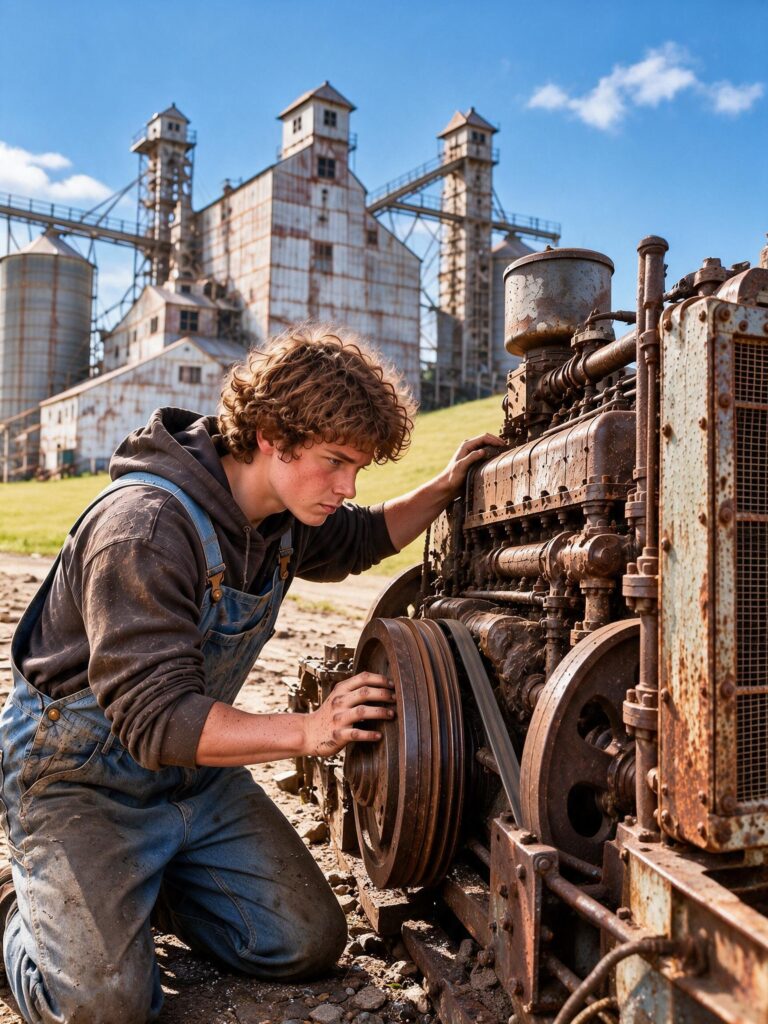
Stan Polarski had sold wrecked combines for thirty-one years, and he had never watched a customer do what the boy in the gravel was doing. The boy was seventeen. His name was Kurt Halverson, and he sat cross-legged in the June sun with a foot-long piece of steel shaft across his knees and a row of pillow-block bearings in front of him, all of them pulled off the ends of dead Gleaner combines. He slid one onto the shaft, turned it, felt it, and pulled it off again. Then he set it down on the left or the right. The left pile had six bearings in it. The right pile had seven.
“A bearing’s a bearing, kid,” Stan said. “They’re the same on the outside.”
Kurt held one up to the light and looked through the bore. “This one ran dry for a couple of seasons. You can see it in the race. That one’s a little loose on the shaft.”
Stan looked at what was already in the bed of the pickup. Two cast-iron pulleys, each about the size of a tractor tire. A combine radiator. A rusted tangle of arms and brackets with a small pulley on it, which Stan had thrown in for free that morning, mostly because he was tired of stepping around it. He had sold parts to men building hay elevators and grain carts and flatbed trailers, and all of that made sense to him. None of this was going back on a combine. None of it looked like it was going on anything.
“What are you building?”
“I don’t know that I’m building anything yet. There’s a mill out at Vesper Corners. Branvold’s.”
“That place has been shut thirteen years. Lars has been dead four. There’s nothing in it but pigeons.”
“There’s a line shaft and a hammermill that still turns.” Kurt wrapped the six good bearings and the piece of shaft in a feed sack. “I don’t know what it’s good for. I want to find out.”
Stan wrote up the ticket. Sixty-two dollars for the bearings and the pulleys. He watched the pickup pull out onto the county road with its load riding low on the springs, and he could not have told anyone what he had just sold.
Kurt lived four miles from the corners on a dairy farm his father had worked since 1968. Ron Halverson milked forty-six Holsteins and farmed two hundred and twenty acres of corn, oats, and hay, and he raised most of what his cows ate. What he did not do was grind it. Every few weeks he hauled shelled corn twelve miles to the co-op in Hadley, and the co-op ground it, mixed in the protein supplement, and sent a truck to blow it into his bin. Grinding and delivery ran eleven dollars a ton. Ron paid the bill on the first of every month, all at once, without comment. The check went out with the milk check the way the electric bill went out, a cost of keeping cows alive that a man did not argue with if the cows were eating.
Lars Branvold had built the mill at the corners in 1946. Three stories of board and tin beside the county road, with a drive-through on the south side and a bucket elevator everybody called the leg that climbed forty-six feet to the roof line. For thirty-three years it ground feed for every farm within eight miles. Then the co-op built a new mill in Hadley with a three-hundred-bushel-an-hour hammermill, a dryer, and a fleet of trucks. Branvold’s customers left one at a time, each with a reason that made sense. Faster. Cleaner. A ticket you could take to the bank. Lars shut the doors in December of 1979, sold his motor to a limestone quarry, and never went inside again. When he died in 1988, the building went to a nephew in Tucson who had never seen it.
Kurt rode the school bus past the mill twice a day. In January the drive-through door had blown open and a drift had come in across the floor, and through the gap he could see a steel shaft running the length of the wall on iron hangers. He did not know the name of what he was looking at, but he could see how it worked. A shaft turned. A belt carried the turn to a wheel. Corn went in one end and meal came out the other. He thought about it on the ride home, with his geometry book on his knees and the bus heater blowing warm air at his boots, and he thought about it again at evening milking, standing in the pit with the mixer running and the smell of the co-op’s ground corn coming up out of the bin.
In March a notice went up on the door. The nephew’s lawyer had accepted an offer from a scrap dealer, four hundred and eighty dollars for the iron inside, and the building would come down whenever the lot sold. Kurt read it twice on the way to school and twice on the way home. That night he counted the money in the cigar box on the top shelf of his closet. Three summers of putting up other people’s hay. Six hundred dollars and a little over, in tens and twenties, some of them soft from being folded.
He took the bus to the county seat on a Friday and walked into the lawyer’s office with the envelope in his jacket. The office smelled like paper and radiator heat. The lawyer was a man in his fifties with reading glasses on a cord, and he looked at the envelope for a while before he looked at the boy.
“The scrap man offered four-eighty for the iron,” he said. “You’re offering six hundred for the machinery and nothing for the building.”
“Yes, sir. I don’t want the building. I want what’s in it.”
“The lot won’t sell before next spring. The building can’t be insured, and it won’t be my concern if a wall comes down on you. If a boy wants to spend a year in it, that’s between the boy and his father.” He wrote a short agreement on a yellow sheet and had Kurt sign it, and he put the envelope in a drawer without counting it in front of him. “Don’t die in there. I don’t want the phone call.”
Ron did not say no. He said it at the kitchen table after milking, with his boots off and his socks damp and the milk sheet still in his shirt pocket. He was a wide man who talked the way he drove, steady and without extra turns.
“The cows come first,” he said. “I won’t be paying for any of it. You can use the old Farmall M with the belt pulley whenever there’s no hay to cut and the mixer’s caught up. If the mill might grind our corn for less than eleven a ton, I’d like to see the arithmetic that includes a seventeen-year-old’s Saturdays.”
“I don’t have the arithmetic yet.”
“Then don’t spend money you can’t get back until you do.” He looked at his son a moment. “And don’t tell your mother I said you could. She already thinks that place is going to fall on you.”
Kurt’s mother had said as much at supper, not unkindly. She had grown up two townships over and remembered the mill when it ran, the leg ticking and the meal smell on the road, and she also remembered a man in Hadley who had lost three fingers to a hammermill screen in 1974. She set the potatoes down and said a building full of corn dust was a match waiting on a floor, and then she did not say it again. In that house a thing said once was a thing heard.
The first Saturday he went in with a flashlight and a pair of leather gloves. The drive-through had a steel grate over the receiving pit, and down in the pit sat the boot of the leg, a boxed steel housing with a belt running up out of it. He followed the leg up through the ceiling. On the second floor the hammermill sat on a concrete pad, a squat cast-iron drum with a hopper above and a chute below. Along the north wall ran the line shaft, twenty-four feet of steel on four iron hangers bolted to the ceiling beams. Where the motor had been there was a timber platform and four rusted anchor bolts. Above it all, a wooden bin held nothing but dust.
The dust lay over everything like gray felt, and the whole place smelled of old corn and cold iron. Pigeons had been in the head. Their mess was white on the spout. A nest of mice had used a feed sack in the corner until the sack gave out. Kurt stood in the middle of the mill floor and listened. The building ticked as the morning warmed the tin. Somewhere in the wall a bird moved. He put his gloved hands on the rim of the biggest pulley on the line shaft and pulled.
It resisted. Then the whole shaft turned, ticking through all four hangers, and it kept turning for a quarter of a revolution after he let go.
He went to the hammermill next. He opened the inspection door, took hold of the pulley on the rotor shaft, and spun it as hard as he could. The rotor came up to speed and kept coasting. He counted seven seconds. He did not yet know that a rotor with a bad bearing stops in two. He only knew that this one did not want to stop, and that a thing which did not want to stop had not been finished by thirteen years of sitting.
Beside the hammermill someone had nailed a cedar shingle to a post. Pencil marks in a square hand read one-quarter, forty-one. Three-eighths, fifty-eight. One-half, seventy-four. Under that were the initials LB and November 1979. It took Kurt a minute to understand it. Those were bushels per hour by screen size. He looked in the rack beside the mill. The half-inch screen sat in its slot. The three-eighths had a crack along one edge. The quarter-inch was gone.
He copied the three numbers onto the back of an envelope and stayed until the flashlight went yellow. When he came out, the June light on the county road was hard and ordinary, and the mill behind him was a dark mouth with a grate across it. He drove home in the pickup with corn dust on his gloves and the numbers in his pocket, and he did not tell his father yet that the shaft still turned. He wanted to be sure he had felt what he thought he had felt.
Part 2
Amos Tvate found him in the pit two Saturdays later. Kurt was scooping thirteen years of packed corn dust into a wheelbarrow when a Ford pickup from the late sixties stopped on the gravel. The man who got out was seventy-four, long and thin, with bad knees and a habit of standing on one leg and resting the other. He had been Lars Branvold’s millwright and general hand from 1952 until the doors closed, and after that he had repaired combines at the implement dealer in Hadley until 1988. He stood at the edge of the grate with a toothpick in his mouth and looked at the shovel, the wheelbarrow, and the boy.
“You’re the Halverson kid.”
“Yes, sir.”
“Somebody told me you bought the iron.”
“I paid six hundred. Scrap man offered four-eighty.”
Amos shifted his weight. “What are you going to do with it?”
“See if I can make it run.”
“Make what run?”
Kurt thought about it. “All of it.”
“Then tell me where the corn goes.”
So Kurt told him. A truck backs over the grate and dumps into the pit. The leg’s boot picks the corn up in steel cups on a belt and carries it to the head, where the cups throw it into a spout that drops it into the bin on the top floor. A slide gate lets it fall into the hammermill, which beats it through the screen, and the meal drops down a chute to a wagon waiting on the drive-through floor.
“What turns the leg?”
“The line shaft.”
“Through what?”
Kurt pointed to an iron case in the corner of the mill floor. It was a worm-gear reducer, and a freeze in some forgotten winter had split it open and let the oil run out black across the boards.
“That.”
“So it doesn’t turn.”
“No, sir.”
“How fast does that head pulley need to go?”
“I don’t know.”
Amos took the toothpick out and looked at it. “Then that’s your first job.”
He came back the next Saturday and the one after. He could not climb the leg ladder anymore, so he stood at the bottom and sent Kurt up, and every question Kurt asked him got answered with another question, usually a better one. Over three Saturdays they sorted the mill into what would work, what would wear out, and what was finished. The line shaft was straight, but two of its four hangers had cracked babbitt bearings and grease cups packed with something like tar. The hammermill’s rotor was sound. Its hammers, flat bars of hard steel with a hole at each end, were worn on one corner, and Amos showed him that each could be turned around to a fresh one. The leg’s belt was stiff as a boot and cracked across the surface, and nine of its hundred and forty cups were missing.
Amos bent the belt double against his knee and let it spring back. “A belt like that could go another ten years,” he said, “if nobody ran it wrong. A new one would cost eleven hundred, which settles the question of the belt.”
The reducer was finished. The motor was in a quarry. Everything else was arithmetic.
Merl Dah drove out in May. He did not get out of the car at first. He managed the co-op mill in Hadley, a man of sixty-one in a pressed shirt with a pen in the pocket, and he had worked for Lars Branvold for twelve years before the co-op hired him away. When he did get out, he walked around the drive-through with his hands behind his back and looked at the pit, the leg, and the hammermill without touching any of them.
“Fifty-eight an hour on the three-eighths,” he said. “Lars had that on a shingle.”
“Yes, sir.”
“Our mill does three hundred. You’d grind in a day what mine does in two hours. And I’m not counting the months you’d spend on the leg. Lars lost nine thousand his last year, and he had a motor and a belt that worked.” He said it evenly, the way a man reads a figure off a ledger. “Have you talked to an insurance man about a wooden building full of corn dust?”
“There won’t be electricity in it. I’m going to run it off an engine outside the wall.”
Merl studied him. “Well. At least you thought of that.” He looked at the hammermill a while longer. “I’m not telling you to quit. I’m telling you what it costs. Somebody ought to.”
He drove away. Kurt stood in the drive-through and went back over it and could not find a piece to argue with. The numbers were the numbers. A mill that did a fifth of the co-op’s work, in a building nobody would insure, for customers who had already left once, was not a business. It was a Saturday. He went home and wrote Merl’s figures on the back of the same envelope as Lars’s shingle numbers, and he set them side by side, and neither column made the other one false.
By the end of May he had built a reducer out of what he had. A coffee can of sprockets and thirty feet of chain from Stan’s yard had cost nineteen dollars in April. He hung a countershaft and set up two stages of chain, a twelve-tooth sprocket driving a twenty-four and a twelve driving a forty-eight. That gave him eight turns of the line shaft for every turn of the leg’s head shaft. The belt pulley on Ron’s Farmall turned about a thousand revolutions a minute, and he had worked out that the leg would lift more corn the faster it went. Eight to one was what his sprockets could give him.
On the last Saturday of the month he backed the tractor up to the north wall. Amos had an old flat belt hanging in his garage that he had never thrown away, and it ran from the tractor’s pulley through the old motor opening to a pulley on the line shaft of the same size. Ten bushels of Ron’s old corn went into the pit. Kurt engaged the belt pulley, and the line shaft ticked up to speed. The leg came alive with a roar and a rattle. Cups slapped into the corn in the boot. Kurt ran to the head with Amos calling up from the bottom, pulled open the inspection door, and looked in.
“Where’s the corn going?” Amos shouted.
“Into the spout.”
“All of it?”
Kurt looked again. Some of it was going into the spout. A lot of it was flying out of the cups and hitting the far wall of the head housing, then falling down the wrong side into the empty buckets on their way back to the boot. Down below, the tractor was lugging. The boot was choked and the belt was slipping on the head pulley. The tractor stalled.
Amos was on the floor below him when he came down. “What throws the corn out of the cup?”
“The turn at the top. The speed.”
“So what happens if you turn faster?”
Kurt looked at the corn still hissing down the down-leg. “It goes past the spout. Back-legging.”
“Lars ran that head at sixty-two and a half. What are you running?”
Kurt did it in his head. A thousand on the line shaft divided by eight. A hundred and twenty-five. Twice as fast as the belt wanted to go, and the exact thing he had thought would help.
He stood there with corn dust on his face and the stalled tractor ticking outside the wall, and he felt the particular shame of a boy who has done the arithmetic and done it wrong in the direction he was proud of. Faster had seemed like the whole point. Faster was why the co-op had won. He had built a machine that was too quick to do the one job it had been built for.
Stan had one more forty-eight-tooth sprocket in the pile. Its hub was bored for a shaft an inch and a quarter, and the head shaft was an inch and three-quarters. Amos put it on his bench lathe and bored it out in an afternoon, then cut the keyway with a broach he had made himself in 1961. Now the first stage was twelve to forty-eight and the second was twelve to forty-eight. Sixteen to one. Sixty-two and a half.
The next Saturday they dumped ten bushels in the pit again. The leg made a soft, steady hiss, like rain on a tin roof, and the corn rose in a curtain and swung over the top and slid into the spout, and nothing came down the far side. Kurt stood at the head and watched all ten bushels arrive in the bin. It was the first time anything in the mill had done what it was built to do.
Amos listened from the bottom of the ladder. “That’s your speed,” he said.
Kurt came down the ladder with his hands shaking a little from the climb and from the rest of it. He did not say much on the drive back to Amos’s place. At the kitchen sink, washing the dust off, he said, “I had it twice as fast as it wanted.”
“Most people do,” Amos said. “They think a machine is a horse you can hurry. A leg isn’t a horse. It’s a cup that has to let go at one place and not before.” He dried his hands on a feed-store towel. “You found it. That’s the job.”
That night at the Halverson table, Ron asked if the ten bushels had made it up.
“All of it,” Kurt said.
“On the tractor.”
“On the tractor.”
Ron nodded once, the way he nodded at a milk weight that was neither good nor bad. “Then you’ve got a leg. You don’t have a mill.”
“Not yet.”
“Cows come first tomorrow. The heifers are through the south fence.”
“I know.”
He fixed the fence in the morning with his father, posts and wire and a staple puller, and the mill sat four miles away with ten bushels of corn in a bin that had been empty for thirteen years. It was not nothing. It was also not feed. The difference between those two things was the rest of the summer, and he could already feel the size of it when he stood up from the last post and looked west toward the corners, where the tin roof caught the light and gave nothing back.
Part 3
That summer the mill turned into a list. The leg worked, but only on borrowed tractor power. Two hangers on the line shaft were cracked, and there was no engine and no way to belt the hammermill to anything. The bearings came first. He replaced all four hangers with combine pillow blocks bolted to oak timbers that Amos cut and squared in his garage, and two more carried the countershaft. That job went as it should have. Amos taught him to stretch a string along the shaft and sight down it, because a bearing out of line by the thickness of a matchbook cooks itself, and Kurt shimmed each block until the string touched the same distance on every one. The shaft turned with almost no sound.
The engine was harder. In July, Stan walked him out to the back row, past combines with grass grown up through their headers, and stopped at an older Gleaner gasoline combine with a flat tire. It had lost its transmission in 1986, and the owner had never come back for it.
“Engine’s good,” Stan said. “I’ve put fresh oil in it every spring, in case. You don’t scrap a good engine. You wait.”
Kurt turned it by hand and it turned free. It was a six-cylinder gas engine with a governor, and Stan wanted a hundred and eighty dollars for it. The hour meter was still on the dash. Ron lifted it onto the pickup with the loader tractor after milking, then paced off how far the exhaust would sit from the wall. Kurt built a lean-to on the north wall out of rough lumber and old tin and set the engine outside the building, where any spark would land on gravel.
The eighteen-inch pulley from Stan’s June pile went on the line shaft and the ten-inch on the engine. He would set the governor to hold about eighteen hundred revolutions a minute, a steady speed he picked for the mill, which turned the line shaft at a thousand, and a six-inch sheave on the hammermill would spin the rotor at about three thousand. V-belts carried the power through a slot in the wall, and a spring-loaded idler pulley on a hinged arm let him slack the belts to start the engine and tighten them to take the load. Two sets of belts cost ninety-six dollars. The radiator had come off the same combine, and with it the tangle of arms and the little pulley, a rotating screen that had spun in front of the radiator to keep chaff from building up on it.
Kurt looked at it for a while. Then he bolted a square of hardware cloth in front of the radiator and set the screen assembly in a nail keg in the corner of the lean-to. The engine was going to be sitting beside a mill, not in a wheat field, and it would only run a few hours at a time. Amos looked at the hardware cloth and said, “Huh,” and did not say anything else.
The first time Kurt started the engine, the governor hunted for forty seconds. The revs swung up and down, and he reached for the throttle, and Amos said, “Let it think.” The engine settled on its own at the eighteen hundred he had set, and Kurt swung the idler in against the belts. The hammermill came up with a rising howl that leveled off into a hum.
The screen was the problem. The half-inch screen was whole, but it made meal too coarse for the hogs and dairy cattle around the corners who were used to the co-op’s three-eighths grind. The three-eighths screen had its crack. Kurt looked at the catalog price of a new one, a hundred and sixty-four dollars, and then at the sheet steel in the grain tank he had bought from Stan for eight. For three evenings after chores he drilled holes. He rolled the sheet around a length of pipe to match the curve of the screen frame and drilled eleven hundred and some three-eighths holes on the drill press at the school shop. Amos stopped by twice, watched, and said nothing.
On the fourth evening he bolted the screen in, started the engine, and poured a shovel of corn into the hopper. For about four seconds the mill made meal. Then the sheet steel bulged inward under the hammers, tore along a row of holes, and a strip of it wrapped around the rotor. The mill shuddered and the belt screamed. Kurt threw off the idler and the rotor spun down grinding.
Amos walked over and looked at the wreckage. “Look at the old screen.”
Kurt did. It was three times as thick as the sheet he had drilled. And when he flexed the edge of it against the bench, it bent and came back.
“Spring steel,” Amos said. “Corn doesn’t cut like you’d think. It hits. Ask that sheet how many times it can take a hit.”
A hundred and sixty-four dollars from a supplier in Minneapolis. Three weeks for delivery. No refund. Kurt had spent a little over a thousand by now on the machinery, parts, engine, belts, and lumber, and had a little over six hundred left of the sixteen hundred and forty he had put by from hay and from a winter of weekend work at the implement dealer. After the screen he would have a little over four hundred. The mill could lift corn and spin a rotor, and it could not yet produce one bushel of meal. There was no promise the next problem would be smaller.
He sat at the kitchen table that night with the catalog open and the checkbook beside it. His mother was finishing the dishes. Ron was in the barn for a cow that had not cleaned. The house was quiet in the way a dairy house is quiet between milkings, a pause and not a rest.
“You don’t have to,” his mother said, without turning around.
“I know.”
“Your father won’t say it. I will. You’ve already got more in that building than the scrap man offered for the whole of it. You could stop and still have done more than anybody asked.”
“The number on the shingle might be true.”
“And it might not.” She dried her hands. “I’m not telling you which one to pick. I’m telling you the four hundred that’s left is also yours, and winter is not a theory.”
He wrote the check anyway and mailed it the next morning, telling himself he only wanted to find out whether the number on the shingle was true. The want was real. So was the other thing under it, which he did not say at the table: he had told Amos he was going to make all of it run, and he had not yet made the part that turned corn into feed. A leg that lifted corn into a bin was a trick. A mill that made meal a cow would eat was a job. He wanted the job more than he wanted the four hundred dollars, and he knew that was not the same as knowing he was right.
The screen came on the twelfth of September. He bolted it in on a Saturday with Ron standing in the drive-through and Amos on his bucket by the pit, and poured forty bushels of Ron’s old corn into the pit. He started the engine. It hunted for forty seconds and settled. The leg began its hiss. The corn climbed. The slide gate opened and the hammermill took the first load with a rising note that dropped a little, then leveled off into a steady drone. Meal fell out of the chute onto the drive-through floor.
Kurt caught some in his glove. It was yellow and coarse and warm, and it smelled like a cow’s breath. Forty bushels took forty-two minutes, which came to fifty-seven bushels an hour. That was one under the number on the shingle.
Ron picked up a handful of the meal and rubbed it between his fingers. “Coarser than the co-op’s,” he said. “About right for the heifers.” Then he filled a five-gallon bucket and took it home, and the heifers ate it.
For the next three weeks the mill ran on Saturdays and a few evenings. Ron’s corn went through, then a neighbor named Dale Reinhold, who milked eighty cows and liked the price. Then another neighbor with twenty-five head of beef cattle. By the first week of October the mill had ground six hundred and forty bushels at nine dollars a ton. That came to a hundred and sixty-one dollars, and gasoline cost fifty-one. Kurt had put in forty-five hours over those three weeks, counting cleaning, greasing, and sweeping. He worked it out on the back of the same envelope. Two dollars and forty cents an hour.
He drove out to the corners one evening and sat on an upturned bucket by the hammermill. The co-op’s truck was still coming to the farm twice a week. Nobody around the corners was short of anything. Merl’s numbers came back to him one at a time, and each was correct. The lot would sell in April and the mill would come down. He had spent a summer and twelve hundred dollars on a machine that did a job the county no longer needed done.
Amos came out to help him close up. Kurt said, “Merl was right. The co-op does it better.”
“How much better?”
“Five times as fast.”
“Did you check the belts this week?”
Kurt had not. He went and checked them. Two of the six had stretched a quarter inch, and he took the slack out of them and greased the pillow blocks before he went home. The work did not answer the question. It only kept the machine from answering it for him by failing on a Saturday when Dale Reinhold was in the yard. He drove back in the dark with the window down and the smell of meal still in his jacket, and he did not know whether he had built a mill or a very expensive way to learn what a shingle already knew.
Part 4
The rain started on the ninth of October. Three inches fell in a week, then another two, and the fields stayed too wet to hold a combine. By the last week of October, harvest was three weeks behind, and the corn that did come off was standing at twenty-six percent moisture, wet enough to spoil in the bin unless it was dried. Every farm in the county wanted its corn through the co-op’s dryer at once. The dryer ran day and night. Trucks lined up at the pit in Hadley, and the feed trucks fell behind.
Ron mentioned at supper that the co-op had come Wednesday instead of Tuesday, and then Thursday instead of Friday. A notice went up in the co-op’s window saying deliveries were running three to five days late because of harvest. To keep up, Merl ran the hammermill twenty hours a day. It had been built for twelve.
On the morning of Monday, the sixteenth of November, the bearing on the drive end of the rotor shaft seized. The shaft was scored and the rotor was bent. The manufacturer quoted seven weeks for a new rotor assembly, which meant the eighth of January. The co-op had no second mill. The nearest one that could help was another co-op in Leal, thirty-eight miles east, and Leal could spare seven hundred bushels a day. The ring of farms around Hadley used about twelve hundred. A man with a portable grinder-mixer truck two counties over was booked through the end of the year. Farmers with their own PTO grinders had mostly sold them in the eighties, when the co-op’s price was low and its trucks were reliable. And it was November, so the cows and hogs were in the barns and eating.
Lois Engel called the Halversons’ kitchen the next evening. She raised about four hundred hogs and thirty sows, and she was fifty-two years old and talked fast, and she had gotten a rationing slip from the co-op that said she would receive thirty percent of her normal order until further notice. Her bins would run dry on Saturday.
“Hogs can eat whole corn,” she said. “But they eat more and gain slower, and four hundred hogs on whole corn will cost me about the price of a truck by Christmas. Ron, does that boy’s mill run?”
“It runs on Saturdays.”
“Could it run on a Tuesday?”
Ron handed the phone to Kurt. Kurt did not know. He said so. The longest the mill had ever run was three hours.
Lois said that was more hours than she had, and asked how many bushels an hour, and when he told her she did the arithmetic out loud. Four hundred hogs ate about thirty-six bushels a day. A week’s feed was two hundred and fifty bushels, and the mill could grind that in a morning. She did not ask him to promise. She asked him what time she should be there, and he heard himself say six, and then she was gone and the kitchen was the kitchen again.
He hung up and sat at the table. Ron looked at him.
“Can it run more than three hours?”
“I don’t know.”
Amos came over that night and the three of them sat at the kitchen table and went through it. There were twenty-nine farms inside eight miles of the corners, and most of them were small. There was corn in their bins. There was gasoline. There was an engine that did not need the electric co-op. Amos did not say the mill was ready. He said the leg, the belts, and the bearings were the things that would tell them, and that nobody knew what a machine would do at hour eight until it had done hour seven.
Merl drove out to the corners on Wednesday morning while Kurt was greasing the pillow blocks. He stood in the drive-through and listened to a test run with his arms folded. The leg hissed. The hammermill rose and leveled off.
“The ring around here eats about three hundred bushels a day,” Merl said. “Leal gives us seven hundred for seventy farms. You’d be closing the gap for the ones nearest you.” He looked up the leg. “Ours went at hour nineteen. Watch the bearings. That’s what goes first. And sweep every hour. Keep dust off the floor and keep the pit grate clear.”
He did not say anything about May, and Kurt did not bring it up. When Merl’s car was gone, Amos said, “He didn’t have to come.”
“He came to tell me what fails.”
“That’s the same as coming.”
On Saturday the twenty-first of November, the first trucks were in the yard at six, waiting in the dark. Kurt wired four sealed twelve-volt combine lamps off the engine’s alternator out in the drive-through where the dust was thinnest, and those gave him light until evening. The hour meter on the engine read three thousand two hundred and forty-seven. Amos was on his bucket by the pit at first light with a thermos and the moisture tester Ron had lent. One farmer arrived with a load of nineteen-percent corn, and Amos ran the tester and said it would plug the screen, and the farmer argued for about ten seconds before he turned the truck around.
Lois Engel came herself in a grain truck with a bad muffler, and she did not get out of the cab until Amos waved her forward over the grate. She looked the mill over the way she looked at a hog she was thinking of buying. When her corn went through the pit and meal began to fill her truck box, she asked Kurt which screen he was running, then asked what the moisture had been, and wrote both answers in a feed-store notebook.
“I’ll be back Thursday,” she said.
She did not say thank you, and Kurt figured out later that it was because she had already made the mill part of her week. A thing you thank is a favor. A thing you write in a notebook is a plan.
By nightfall the mill had ground six hundred and four bushels for nine farms. Lois’s two hundred and fifty went first. By the end of that week, everyone at the corners knew the mill by ear. The leg hissed when the corn was running right. The engine hunted for forty seconds and then settled, and nobody touched the throttle until it did. The hammermill rose to a note and held it. And when the note dropped a half step on Tuesday afternoon, Kurt shut the engine down before anyone told him to. One of the belts had stretched and was slipping. He took it up a quarter inch and started again. It cost six minutes.
The last week of November turned unseasonably mild, forty-four degrees at noon, and the line of trucks grew. On Monday the thirtieth, Kurt ran twelve hours. At the pit, Amos kept the corn moving. Meal poured out of the chute into wagons and trucks. Sometime after two in the afternoon, Kurt glanced at the temperature gauge on the combine’s dash and saw it sitting at two hundred and five. It had been at one hundred and eighty on every run so far. Twenty minutes later it read two hundred and ten. He shut the engine down. Steam ticked out of the radiator cap, and the line of trucks in the yard sat and waited.
He walked around to the front of the radiator and found the trouble at once. The hardware cloth was wearing a coat of gray felt half an inch thick. Dust from the grinding leaked out around the belt slot and drifted through the lean-to, and the fan had pulled it against the mesh all day until it made a mat. Air was barely passing through.
“What’s the gauge telling you?” Amos asked from behind him.
“It’s telling me it can’t breathe.”
Kurt borrowed the air compressor from Ron’s shop and blew the mesh clean with a nozzle. The gauge dropped to one hundred and eighty in ten minutes. He started the engine and went back to work. An hour later the felt was back, thinner, but there, and the gauge was at one hundred and ninety-five. He cleaned it again. That became the pattern. Every hour, ten minutes with the compressor. Ten minutes out of every sixty cut the mill’s output by a sixth, and the line of trucks in the road grew. He sealed the belt slot with canvas to keep the dust out of the lean-to, and that helped by about a third. It was not enough.
At nine that night he sat down on the pit grate after the last truck left and looked at the radiator. Snow was forecast for Wednesday. The co-op’s new rotor was still five weeks away. If the mill kept losing an hour and a half a day, Lois would be the first one short, and after her Dale Reinhold, and the others. He looked at the felt on the mesh. A stationary screen would fill up. That was why the combine had not had one.
He looked at the nail keg in the corner of the lean-to, where he had put the tangle of arms and the little pulley in July.
Part 5
It was a rotating screen that spun in front of the radiator and kept shedding whatever collected on it, and a combine spent every day of its life in chaff and dust. He had not thought a mill was the same place. He pulled it out of the keg. The assembly was rusted, but the bearing in the spinner still turned. It had been driven by a small belt off the fan pulley. He needed a bracket to hold it in front of the radiator and a place for the belt to run.
Ron came over after evening milking with a flashlight and a hacksaw. Kurt cut and drilled angle iron, and Ron held the light and passed him bolts. Amos sat on his bucket and said nothing, and after midnight he left and came back with a length of the right size of belt from his garage. They finished at two in the morning. The bracket was crooked, and Kurt drilled another set of holes to square it.
The reason it would work was easy enough to see now that he was looking. A fixed screen has one face, and whatever the fan pulls against it stays there and builds until the air stops. A rotating screen keeps every spot on its face moving, so whatever lands on it gets shed before it can build. Whoever designed the combine had known that. Kurt had been keeping the answer in a keg since July, because he had decided a mill was not a wheat field, and the dust had spent the day proving him wrong in the only language an engine has.
He started the engine to test it. The screen began to turn. He held a scrap of cardboard in front of the radiator and watched dust settle on the turning screen and get shed off before it could build. On Tuesday the gauge climbed to one hundred and eighty and stayed there for twelve hours. The rotating screen wore a thin film that never thickened. The trucks moved through faster than they had all week, and by night the mill had ground six hundred and fifty bushels.
For the rest of December the mill ran six days a week. Farmers stopped asking whether it would hold up. Snow came and went. Kurt learned to take the temperature of the pillow blocks by spitting on the housing and listening to how long the drop took to sizzle. He turned the hammers to fresh corners twice, and he watched the cups on the leg and replaced one that had cracked. He slept in pieces. Morning milking still belonged to the cows, and the mill belonged to the hours after, and the hours after belonged to whoever was short. His mother started packing a second sandwich without being asked. Ron did not say the arithmetic had changed. He showed up with the compressor when the canvas seal wanted tightening, and he stood in the drive-through on the coldest mornings and counted trucks the way he counted heifers, to know what he had.
On the sixteenth of December, Merl drove up in his pickup before daylight. He had a brown paper sack in his hand. He came into the drive-through and stood by the hammermill and looked at the belts and at the pillow blocks on the line shaft and then up at the leg.
“What are you running the head at?”
“Sixty-two and a half.”
“Yeah.” He nodded once. “That’s right. I ran it at seventy once. And seventy-four. Belt slipped every fall.” He put the sack on the bench and took out a hammermill screen. It was a quarter-inch. The perforated steel was heavy and dark with age and a little bent at one corner. Someone had stamped a number on the frame. “It was in the back of my shop. I don’t know why I took it. Lois says the hogs want a finer grind. That should fit. I checked it against the frame.”
Kurt turned it over in his hands. He knew the number stamped on the frame. It was the same as the one stamped inside the mill.
“Anything that’s the co-op’s patrons, send the tickets to the office,” Merl said. “The co-op pays the toll.” He looked at the hammermill again. “I’ve been at that shop thirteen years, and I never scrapped that screen.”
He left after that. He did not say anything about May. Kurt bolted the quarter-inch screen in before the first truck, and when Lois came she wrote the new size in the notebook without comment, the way a person writes a thing that has become ordinary. The hogs, she said later, gained the way the September sheet said they would. That was the thanks. It arrived as a number and not as a speech.
By the time the rotor arrived, the mill had ground nine thousand three hundred bushels for twenty-nine farms. The hour meter on the engine had gone from three thousand two hundred and forty-seven to three thousand four hundred and seventy-six in thirty-one days, and the mill had averaged just under fifty-three bushels an hour across all three screens. That was about two hundred and sixty tons. It took roughly seven hundred gallons of gasoline. At a hundred and fifty bushels a load, the farms around the corners had avoided about sixty-two truck trips to Leal, roughly forty-seven hundred miles of driving. Lois’s hogs went to market on the schedule she had drawn up in September. Dale Reinhold’s milk check did not drop. Ron’s herd never missed a feeding.
On the last Saturday, Dale came by with an envelope of cash he had already counted twice and asked whether the mill would run again next fall. Kurt said he did not know who would own it by then. Dale left the envelope on the bench anyway. At nine dollars a ton after fuel and belts and oil, the mill cleared a little over thirteen hundred dollars. That put back most of what Kurt had spent since March.
The co-op’s new rotor arrived on the eighth of January on a flatbed from Ohio, and Merl’s crew had it turning by the following Tuesday. On the ninth, Kurt ran the mill for the last day. A handful of farmers came through with the last of their loads. Lois wrote a check for her final delivery and stood a minute by the chute and drove home. Amos sat on his bucket by the pit and asked whether Kurt had greased the head bearing that morning. He had. Amos asked again about the boot bearing down in the pit, and Kurt went down and checked it, and it was fine. That was as far as Amos went with any of it, and Kurt found he did not need him to go further.
When the last truck left, Kurt shut down the engine, and it took a few moments for the metal to stop ticking. The mill smelled of hot iron and meal. The dust in the drive-through was already settling on the floor in the yellow light of the four lamps. And for the first time in seven weeks, there was no line of trucks in the road.
Ron drove him home that night. About halfway there he said he had done the arithmetic, and it had come out different from what he had expected. He did not say what he had not counted the first time. Kurt thought he knew. The first arithmetic had counted bushels and gasoline and a seventeen-year-old’s Saturdays. It had not counted a bearing that seized at hour nineteen, or a county that had sold its own grinders because the trucks were reliable, or the week in November when reliable was a word and not a truck. A machine that is not needed in May can be the only machine left in November. The difference is not in the machine. It is in the month.
In March the co-op board bought the building and the lot from the nephew in Tucson for thirty-six hundred dollars. Merl had asked for the vote, and it passed five to two. No one made a point of it. The co-op spring newsletter carried a small notice on the back page. Branvold Mill, standby grinding during harvest, and by appointment Saturdays. Ask for Kurt. Kurt would be paid six dollars an hour. Amos said he would come by for the coffee.
It was a Saturday in April, before planting, when Kurt went out to the corners to grease the pillow blocks. He was eighteen by then. The mill smelled the way it always had, warm dust and cold iron. Amos had already been in and left a thermos on the bench. The engine was outside in its lean-to, and in the nail keg beside it there was nothing at all. He climbed the steps to the mill floor and checked the belts by pressing them with his thumb, and turned the line shaft once by hand. The foot-long piece of shaft he had carried to Stan’s yard all summer sat on the bench with its feed sack folded under it, where he had left it in September, and where no one had moved it.
Then he went to the post by the hammermill where the cedar shingle was nailed. Below Lars’s last line, dated November of 1979, he wrote the date, the screen, and a number in pencil. It was within three of the one written above it, thirteen years before.
He capped the pencil and put it in his pocket. Outside, the county road was dry and the fields were waiting on a planter, and the leg hung quiet in its housing the way a tool hangs when the work is done and not finished. Merl had been right in May. Every figure he gave had been a true figure about a county that did not need a second mill. November had not argued with those figures. It had added one Merl did not have in his ledger: the day the first mill stops, the second one is no longer a hobby. It is the difference between hogs on schedule and hogs on whole corn, between a milk check that holds and a milk check that doesn’t.
Kurt greased the last pillow block, wiped his hands, and drank the coffee Amos had left. It was still warm. On the shingle the two lines of pencil sat one under the other, Lars’s hand and his, thirteen years and a wet October between them, and the numbers close enough that a man who knew mills would not have called either of them a lie.
the county told a boy his six hundred dollars of dead mill iron was worthless — then a wet october shut the co-op down and the cows were still hungry
Disclaimer: This story is fictional and created for entertainment purposes only.
Any names, characters, places, or events are fictitious or used fictitiously.
No real person or organization is intended to be portrayed.
Share:


