
Part 1
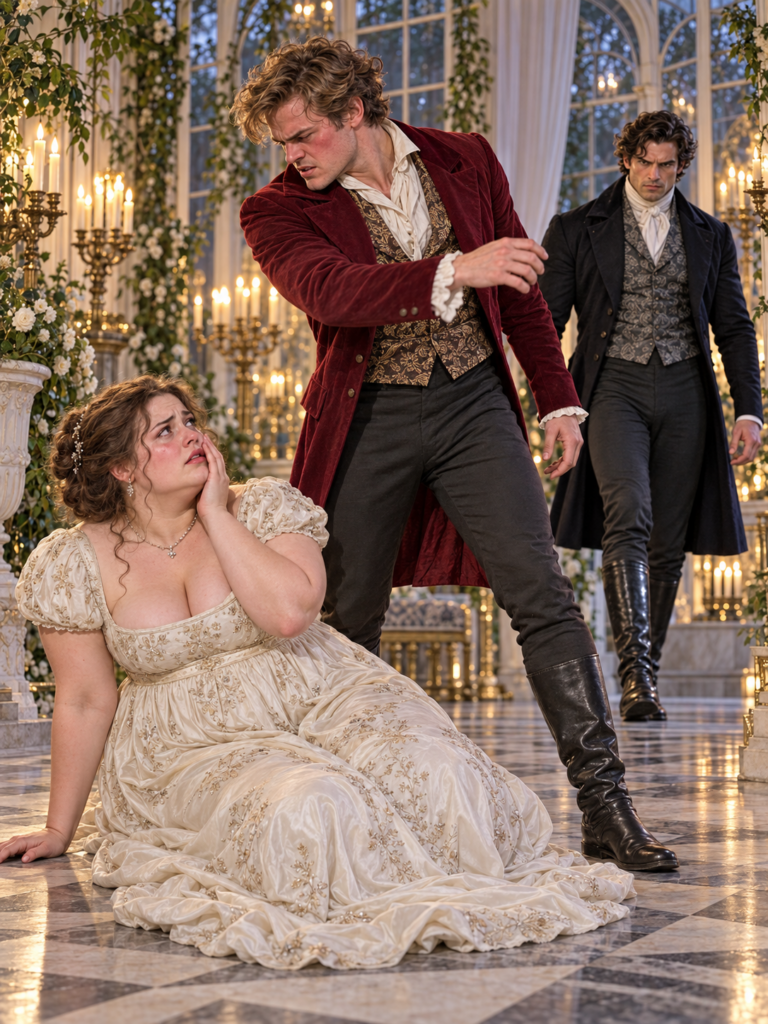
The slap came just as the orchestra began its final waltz.
For one terrible instant, Eleanor Ashcombe heard nothing at all.
Not the violins drifting through the adjoining ballroom. Not the rain tapping against the tall windows of Haversham House. Not even the startled gasp that escaped her own lips.
She heard only the sharp, unmistakable sound of a man’s hand striking her face.
Her head turned with the force of it.
The pearl comb securing her dark hair slipped loose, scattering several ivory-colored pearls across the polished floor. Her shoulder struck the corner of a marble table, and she caught herself against its edge before she fell.
Lord Sebastian Vale stood before her, breathing heavily.
His expression was one of furious satisfaction.
“You should have remembered your place,” he said.
Eleanor pressed her fingers against her burning cheek.
For six years, she had imagined confronting the man who had nearly destroyed her life. In those imagined encounters, she had always spoken with perfect composure. She had exposed his cruelty, reminded him of his failures, and walked away without giving him the satisfaction of seeing her frightened.
But imagination had never accounted for the taste of blood.
Or the sudden, humiliating return of a fear she thought she had conquered.
Sebastian adjusted his cuffs.
“Perhaps that will teach you not to forget the people who made your good fortune possible.”
Eleanor lowered her hand.
“You mistake yourself, my lord,” she whispered. “You had nothing to do with my good fortune.”
His expression hardened.
“I could have ruined you.”
“You tried.”
“I could still ruin you.”
“Then you have learned nothing.”
Sebastian took another step toward her.
And a man’s voice spoke from the doorway.
“That will be quite enough.”
The words were quiet.
So quiet that Sebastian did not immediately understand what he had heard.
Then he turned.
The Duke of Blackthorn stood beneath the archway, one gloved hand resting against the dark wooden frame.
He was a tall man, broad through the shoulders, dressed in a severe black evening coat that seemed entirely unsuited to the extravagance of the gathering.
His silver-gray eyes were fixed upon Sebastian.
Not on the blood at Eleanor’s lip.
Not on the scattered pearls.
On Sebastian.
For a moment, no one moved.
Then the duke stepped into the room.
And Lord Sebastian Vale discovered that there were several different kinds of silence.
There was the polite silence of society.
The uncomfortable silence of an exposed lie.
And there was the silence of a powerful man deciding precisely what another man’s actions would cost him.
This was the third kind.
“Your Grace,” Sebastian managed.
The duke did not answer.
He crossed directly to Eleanor.
“Are you hurt?”
She almost laughed at the absurdity of the question.
Her cheek burned. Her shoulder ached. Blood had gathered at the corner of her mouth.
But what hurt most was the knowledge that Sebastian had managed, with one careless movement, to drag her backward into the life she had escaped.
“I believe I shall survive,” she said.
The duke’s gaze rested upon her face.
“That was not my question.”
Eleanor looked away.
“No bones broken, I think.”
He removed a clean handkerchief from his pocket and offered it to her.
She accepted it.
Only then did he turn toward Sebastian.
“Did you strike my wife?”
Sebastian swallowed.
“Your Grace, there has been an unfortunate misunderstanding.”
“Did you strike her?”
“It was a private disagreement.”
The duke waited.
Sebastian glanced toward Eleanor.
“She spoke to me in a most provoking manner.”
“Did you strike her?”
The question had not grown louder.
Somehow, that made it worse.
Sebastian’s eyes flickered toward the doorway, calculating whether he could reach the ballroom before the duke stopped him.
“I may have lost my temper.”
The duke nodded once.
“Then you have answered me.”
He stepped aside.
For one hopeful second, Sebastian thought he was being dismissed.
“Come with me,” the duke said.
Sebastian frowned. “Where?”
“To the ballroom.”
Eleanor looked up sharply.
“Edward.”
Her husband turned.
She knew that look upon his face. She had seen it when a dishonest steward presented false accounts, when a railway contractor concealed a fatal accident, and once when a tenant family was threatened with eviction despite having paid their rent.
It was not the expression of a man preparing to shout.
It was the expression of a man who had decided.
“Please,” Eleanor said softly. “I do not want a spectacle.”
Something changed in his eyes.
He looked down at the bloodstained handkerchief in her fingers.
Then he looked back at Sebastian.
“My wife has asked me not to create a spectacle,” he said. “You are fortunate that I intend to respect her wishes.”
Sebastian released a trembling breath.
“But you will remain at this house,” the duke continued, “until I have spoken with Lord Haversham and obtained his account of your presence here.”
“Surely that is unnecessary.”
“Do not leave.”
There was no threat in his voice.
There did not need to be.
The duke offered Eleanor his arm.
She took it.
And together they walked away, leaving Sebastian standing among the scattered pearls.
Only when they reached the corridor did Eleanor realize that her husband’s hand was shaking.
Not visibly.
Not enough that anyone else would have noticed.
But beneath her gloved fingers, the great Duke of Blackthorn was trembling.
Six months earlier, Eleanor had married Edward Ashcombe in a small stone chapel outside York.
There had been no grand celebration.
No elaborate breakfast.
No fashionable guests eager to admire a wedding between two distinguished families.
There had been Eleanor, wearing a borrowed ivory gown, and Edward, looking as though he would rather negotiate the purchase of a railway than stand before an altar.
The marriage had been arranged in less than three weeks.
Her father, Sir Lionel Harcourt, had died leaving behind a devastated estate, unpaid servants, and debts large enough to swallow what remained of the family’s reputation.
Sebastian Vale had held most of those debts.
He had offered Eleanor a solution.
Marriage to him.
She had refused.
Sebastian had smiled.
Then he had explained what would happen to her father’s estate, what would become of her younger sister’s inheritance, and how little protection an unmarried woman possessed against a determined creditor.
He had spoken gently throughout.
That had made his cruelty worse.
Eleanor had gone home that afternoon and packed a small traveling case.
She had intended to leave England.
She possessed twenty-seven pounds, two dresses, and a letter of introduction to a distant cousin in Edinburgh.
Instead, Edward Ashcombe arrived at her father’s house the following morning.
He was thirty-eight years old, recently elevated to the dukedom after his uncle’s death, and reputed to be one of the wealthiest industrial proprietors in northern England.
He had known Sir Lionel through a disastrous investment in a canal company.
He asked to examine the debts.
Eleanor had expected another lecture.
Instead, he spent two hours reviewing the papers in silence.
Then he set down the final document.
“Lord Vale has made you an offer?”
“Yes.”
“Do you wish to accept it?”
“No.”
Edward nodded.
“Then you should not.”
Eleanor stared at him.
“You cannot possibly understand.”
“I understand that you are being pressured into marriage by a man who believes financial desperation gives him rights over your person.”
She had never heard anyone describe her circumstances so plainly.
“What do you propose?”
“I can purchase the outstanding obligations and place the estate under responsible management.”
“And what would you require in return?”
Edward hesitated.
“I have been considering marriage.”
It was such an extraordinary answer that Eleanor almost smiled.
“To me?”
“If you are agreeable.”
“Why?”
He regarded her with an uncomfortable seriousness.
“Because you are intelligent, practical, and capable of speaking honestly to me. I require someone willing to manage a large household and its charitable obligations. My position has obligations for which I am poorly suited.”
“And affection?”
“I cannot promise something I do not yet feel.”
“And children?”
“We can discuss that when we know one another better.”
His directness disarmed her.
Most men she had encountered considered marriage a purchase disguised as courtship.
Edward spoke as though she were a person whose agreement actually mattered.
But she was desperate.
And desperation made even reasonable offers difficult to evaluate.
“Will my sister be secure?” she asked.
“Yes.”
“Will my father’s servants receive their wages?”
“Yes.”
“Will Lord Vale retain any claim upon the property?”
“Not when the transfers are completed.”
Eleanor studied him.
“Then I accept.”
Six months later, she was Duchess of Blackthorn.
Yet there were evenings when she wondered whether she had merely exchanged one obligation for another.
Edward was never cruel.
He never raised his voice to her.
He asked rather than commanded, and when she disagreed with him, he listened with an attention that often startled her.
But he remained difficult to know.
He spent long hours with railway managers, mine owners, solicitors, and engineers. He preferred his northern estates to London, and his conversations were more likely to concern drainage systems than music or poetry.
Still, there had been moments.
The morning he noticed she disliked having servants enter without knocking, and quietly changed the household instructions.
The afternoon he discovered her younger sister wanted to study mathematics and arranged for suitable books without mentioning the expense.
The evening he returned from Leeds to find Eleanor asleep beside the library fire, and placed a blanket over her so carefully that she woke only when he whispered goodnight.
They were small acts.
But Eleanor had spent most of her life surrounded by men who believed that large declarations excused small cruelties.
Edward had made no declarations.
He simply remembered things.
And over six months, remembering had begun to resemble tenderness.
Now, in the privacy of their carriage, Eleanor watched the duke sitting opposite her.
The city moved past the windows in wet streaks of lamplight.
Neither spoke for several minutes.
At last Edward leaned forward.
“Eleanor.”
She looked at him.
“I witnessed the entire exchange.”
Her stomach tightened.
“From when?”
“From before he struck you.”
“Then you heard what I said.”
“I did.”
She stared out into the rain.
“It was unladylike.”
Edward’s expression changed.
“What?”
“I called him a contemptible coward.”
“An accurate observation.”
She turned toward him.
“He was furious.”
“He was furious because you refused to be frightened by him.”
“I was frightened.”
“I know.”
The simple acknowledgment unsettled her more than reassurance would have.
Edward shifted forward, resting his forearms upon his knees.
“I should have intervened earlier.”
“You could not have known he would strike me.”
“I knew enough to see he had cornered you.”
“And you hesitated.”
“Yes.”
Eleanor looked at him.
He did not excuse himself.
He did not blame the arrangement of the room or the noise of the party.
“I thought you wanted the opportunity to dismiss him yourself,” he said. “I should have remained close enough to prevent him from touching you.”
For some reason, the admission made her throat ache.
“You are not responsible for Sebastian’s behavior.”
“No,” Edward said. “He is.”
The carriage stopped.
Blackthorn House rose beyond the iron gates, its illuminated windows reflected across the wet courtyard.
Edward reached for the door handle.
“One more thing,” he said.
Eleanor waited.
“Whatever I do next, I will not conceal it from you.”
She felt a chill.
“What do you intend?”
He looked directly at her.
“To discover why Lord Vale believes he can still claim authority over you.”
By morning, the duke’s London study had become a place of relentless activity.
Solicitors arrived before breakfast.
Messengers departed with sealed letters.
A clerk from the family office appeared carrying a leather case filled with documents recovered from Sir Lionel’s estate.
Edward sat behind his desk, studying an old ledger.
Across from him, Mr. Nathaniel Bell, the duke’s chief solicitor, adjusted his spectacles.
“There is something decidedly unusual here, Your Grace.”
Edward looked up.
“Explain.”
“The obligations we purchased from Lord Vale were not, as we believed, all secured against Sir Lionel’s property.”
“Go on.”
Bell opened another volume.
“At least three were secured against assets that had already been transferred into a separate trust. One contains a signature that does not match the records supplied by the family’s former solicitor.”
Edward became very still.
“Are you suggesting forgery?”
“I am suggesting we examine the original instruments before making that accusation.”
Edward turned toward the window.
For months, he had believed Sebastian to be nothing more than a ruthless creditor exploiting a vulnerable family.
But if Bell’s suspicions were correct, the matter was considerably darker.
“And this?” Edward asked, indicating a narrow column in the ledger.
Bell leaned forward.
A payment had been entered three years earlier.
The sum was substantial.
Beside it were four handwritten words:
Settlement received. E. Harcourt.
Edward read them twice.
Then he looked at Bell.
“My wife knows nothing of this payment.”
“Perhaps her father concealed it.”
“Perhaps.”
Bell turned another page.
A loose sheet slipped from the binding and fell onto the desk.
It was an inventory of securities, accompanied by a short memorandum bearing Sir Lionel’s signature.
Edward read the first line.
Then the second.
His face changed.
“Mr. Bell.”
“Your Grace?”
“Send for the former steward of Harcourt Hall.”
“Immediately?”
“Immediately.”
Edward held up the memorandum.
“And find out who witnessed this document.”
Bell glanced at the name.
His eyebrows rose.
“Good heavens.”
The witness was Sebastian Vale.
Beneath his signature appeared a second name.
Eleanor Harcourt.
But Eleanor had been in Scotland on the date written beside it.
And Edward knew that because she had shown him a letter from that journey only three evenings earlier.
He slowly closed the ledger.
Sebastian Vale had not merely tried to force Eleanor into marriage.
He might have manufactured the desperation that made such a marriage possible.
And the proof was beginning to emerge from a book he had assumed no one would ever open.
Part 2
When Eleanor entered the breakfast room the following morning, every conversation stopped.
Her maid, Agnes, had attempted to disguise the swelling along her cheek with a little powder, but there was no concealing the split at her lip.
The housekeeper looked away quickly.
The footman became fascinated by the silver coffee service.
Edward rose from his chair.
“You should still be resting.”
“I have been resting for eleven hours.”
“The physician recommended another day.”
“The physician also recommended broth, darkness, and silence. I have endured two of the three.”
Edward regarded her.
Then, unexpectedly, he smiled.
It was a small expression, barely visible.
But Eleanor felt herself respond to it before she could stop herself.
“Sit down,” he said. “I have something to tell you.”
She took the chair beside him.
On the table lay a narrow leather ledger.
She recognized its cracked spine immediately.
“That belonged to my father.”
“It did.”
“Where did you find it?”
“In the estate papers.”
Eleanor touched the cover.
Her father had kept several account books, each recording another attempt to recover fortunes lost through reckless speculation.
She had hated those books.
Their columns had seemed capable of deciding whether she could keep her home, whether her sister could remain at school, whether servants who had worked for the family for decades would be paid.
“What have you discovered?”
Edward told her.
He explained the questionable securities, the disputed signatures, and the mysterious settlement that might have satisfied part of the debt years before Sebastian demanded payment.
Eleanor listened without interrupting.
When he finished, she remained motionless.
“May I see the memorandum?”
Edward handed it to her.
She studied the signatures.
Then she shook her head.
“That is not mine.”
“We know.”
“No. You do not understand.”
She held up the paper.
“Whoever wrote this knew how I formed the capital E. They copied the unusual loop in the first stroke.”
Edward frowned.
“But?”
“But I stopped forming it that way when I was seventeen.”
She looked up.
“My father hired a French governess who insisted that my handwriting looked childish. I changed it to please her.”
Edward leaned closer.
“Lord Vale would have known your earlier handwriting?”
“He visited Harcourt Hall frequently during my childhood.”
“And had access to your correspondence?”
“He was forever borrowing books from Father’s library. Sometimes he returned them with my letters still between the pages.”
Edward looked toward the doorway.
“Bell!”
The solicitor appeared a moment later.
Eleanor held up the document.
“Find a letter I wrote before my eighteenth birthday,” she said. “There will be several among the correspondence retained at Harcourt Hall.”
Bell looked from her to the duke.
“Your Grace, I had not realized the duchess would be assisting in the inquiry.”
“Neither had I,” Edward replied.
Eleanor turned toward him.
A challenging silence settled between them.
Then he reached for the bellpull.
“Bring Her Grace another cup of tea,” he told the footman.
Eleanor lowered her eyes to hide a smile.
Over the following days, she discovered that her husband possessed a talent for investigations that was both impressive and exasperating.
He could summon solicitors from distant counties, obtain bank records, and persuade men who had ignored requests for years to answer questions within hours.
But he also believed that once a woman had been injured, the most reasonable course was to protect her from every possible inconvenience.
On the second morning, he instructed the servants not to disturb her.
On the third, he attempted to cancel her appointment with the former Harcourt steward.
On the fourth, he suggested she remain upstairs while Mr. Bell reviewed several unpleasant letters.
Eleanor finally confronted him in the library.
“Edward, am I your wife or a decorative vase?”
He looked up from a document.
“I beg your pardon?”
“A vase. Something valuable, easily broken, and best left upon a high shelf.”
He removed his spectacles.
“You were assaulted less than a week ago.”
“And therefore my judgment has become unreliable?”
“That is not what I said.”
“It is certainly what your arrangements suggest.”
Edward set down the spectacles.
For a moment, she thought he would become angry.
Instead, he leaned back.
“What would you have me do?”
“Tell me what you know. Let me help. And stop behaving as though protecting me requires making every decision on my behalf.”
He considered her words.
Then he nodded.
“You are right.”
Eleanor blinked.
She had prepared several more arguments.
Edward pushed the ledger toward her.
“Tell me what you make of this.”
It was such a swift surrender that she became suspicious.
“You are not merely humoring me?”
“No.”
“Edward.”
He met her gaze.
“Eleanor, I can be stubborn without being entirely foolish. You have explained the problem. I intend to correct it.”
She sat opposite him.
And for the first time since their marriage, they began working not as benefactor and beneficiary, nor as duke and duchess, but as partners.
The former steward arrived from Surrey two days later.
Mr. Samuel Finch was a thin, elderly man whose hands shook whenever he reached for his tea.
He had served the Harcourt family for thirty-seven years.
Eleanor remembered him teaching her to identify trees along the estate’s western boundary.
Now he sat in Blackthorn House looking as though he expected to be arrested.
“I never wished harm upon your family, Your Grace,” he whispered.
Eleanor leaned forward.
“Then tell us what happened.”
Finch swallowed.
“Your father borrowed heavily, as you know. But not every debt was his doing.”
Edward remained silent.
“Lord Vale began handling certain transactions on Sir Lionel’s behalf. At first, it seemed useful. He understood money. Your father did not.”
“And then?” Eleanor asked.
“Then the accounts became difficult to follow.”
Finch withdrew a folded piece of paper from his coat.
“I kept copies.”
Edward’s expression sharpened.
“Of what?”
“Payments sent from the estate to Lord Vale’s agent.”
He laid the paper on the table.
Several payments were recorded, each bearing a date and amount.
Eleanor studied the list.
“Why were these not entered in my father’s books?”
“They were, ma’am. In the earlier volumes.”
“Yet the debts remained unchanged.”
Finch nodded miserably.
“His lordship said the payments covered interest and penalties. But I began to suspect he was counting the same obligations more than once.”
Edward looked at the steward.
“Why did you not inform Sir Lionel?”
“I tried.”
“What happened?”
Finch’s hands twisted together.
“Lord Vale showed Sir Lionel letters suggesting that I had been stealing from the household. He said he would expose me unless I resigned.”
Eleanor felt cold.
“You would never have stolen from us.”
Finch’s eyes filled.
“Thank you, my lady.”
“Why did you not tell me?”
“You were scarcely twenty. Your father was ill. And I was ashamed.”
Edward examined the payments.
“Do you possess the original receipts?”
“Some.”
“And the others?”
Finch hesitated.
“I believe Lord Vale took them.”
The room fell silent.
Then Eleanor remembered something.
A narrow wooden cabinet in her father’s study.
Three locked drawers beneath the writing desk.
He had never allowed anyone to open the lowest one.
“Mr. Finch,” she said, “when the estate was emptied, what became of Father’s writing desk?”
“Sold, ma’am.”
“To whom?”
The steward frowned.
“A dealer in Bath, I believe.”
Edward looked at her.
“What are you thinking?”
Eleanor stood.
“My father distrusted banks, lawyers, and anyone who suggested reducing his expenses. But he trusted locked furniture.”
She turned to Bell.
“Find that desk.”
While the duke’s solicitors investigated, London’s fashionable society discovered a new subject of fascination.
Lord Sebastian Vale had disappeared from several of his customary clubs.
There were whispers of unpaid debts.
Rumors circulated about an altercation at Haversham House.
Some claimed that Sebastian had insulted the Duchess of Blackthorn.
Others maintained that he had challenged the duke to a duel and subsequently lost his courage.
No one knew the truth.
And because no one knew, the inventions became increasingly extravagant.
Lady Cressida Wetherby arrived one afternoon ostensibly to inquire after Eleanor’s health.
She was a widow with three married daughters, an immaculate reputation, and a talent for transforming confidential conversations into public scandals.
“My dear duchess,” she began, looking meaningfully at Eleanor’s bruised cheek, “you have given us all such a fright.”
Eleanor sat beside the drawing-room fire.
“How thoughtful of you to call.”
“I heard you were unwell.”
“Recovering, thank you.”
Lady Cressida leaned closer.
“One hears the most distressing things.”
“I am sure one does.”
“A gentleman mentioned that Lord Vale had been involved in some unpleasantness.”
Eleanor raised her teacup.
“Did he?”
“And that His Grace was furious.”
“My husband has a remarkably even temper.”
“Of course, dear. But powerful men occasionally act without considering the consequences.”
Eleanor set down her cup.
“Lady Cressida, is there something you wish to ask me?”
The older woman hesitated.
“Only whether the rumors are true.”
“Which rumors?”
“That there has been a serious disagreement between the duke and Lord Vale.”
“There has.”
Lady Cressida brightened.
“Over what?”
Eleanor smiled.
“A matter of character.”
The widow waited.
Eleanor said nothing more.
At length, Lady Cressida rose.
“Well. I sincerely hope the unpleasantness passes.”
“So do I.”
After the visitor departed, Agnes entered carrying fresh tea.
“Shall I bring another cup, Your Grace?”
“No, thank you.”
The maid hesitated.
“Was that Lady Wetherby?”
“Yes.”
“Then half of London will hear about your conversation before supper.”
Eleanor looked toward the door.
“Fortunately, she has very little to report.”
Agnes smiled.
But Eleanor did not.
For all her composure, she knew that silence could not protect her forever.
Sebastian had allies.
And men who possessed influential friends could often turn their own misconduct into accusations against the women they had harmed.
That evening, Edward found Eleanor standing alone in the upstairs gallery.
A large portrait of his grandmother hung above the staircase.
The painted duchess wore emerald silk and an expression of formidable disapproval.
Eleanor had been studying her for several minutes.
“She looks as though she would have disliked me,” Eleanor said without turning.
Edward came to stand beside her.
“She disliked nearly everyone.”
“Did she dislike you?”
“Especially me.”
“Why?”
“I was interested in machinery.”
Eleanor glanced at him.
“Machinery?”
“She considered it an unfortunate enthusiasm for a gentleman.”
“And you inherited the title anyway.”
“To her lasting disappointment, I imagine.”
Eleanor laughed softly.
Edward watched her.
Then his expression grew serious.
“Bell has obtained further evidence.”
She turned.
“Good evidence?”
“Enough to suggest that Lord Vale used false documents to extend his control over your father’s estate.”
“And enough to prove it?”
“Not yet.”
Eleanor nodded.
She turned back toward the portrait.
“Do you ever wonder whether we married for the wrong reasons?”
Edward did not answer immediately.
“Often,” he said.
The honesty stung.
Eleanor lowered her eyes.
“I see.”
“No,” he said. “You misunderstand me.”
He moved around until she faced him.
“I wonder whether I offered you marriage before giving you any genuine opportunity to choose another future.”
“You saved my family.”
“I purchased the debts. That did not entitle me to ask for your hand.”
“You did not demand it.”
“But you had little freedom to refuse.”
Eleanor studied him.
“Why did you ask?”
He looked toward the window.
Below, London glittered beneath the fog.
“At first, I told myself it was practical.”
“Was it?”
“Partly.”
“And the rest?”
His expression became strangely uncertain.
“I had seen you at Harcourt Hall before your father’s death. You were arguing with an estate agent about the wages owed to a stable boy.”
Eleanor remembered.
“The boy’s horse had been sold. He had worked three months without payment.”
“You threatened to sell your own jewelry to pay him.”
“Someone had to.”
“I admired you.”
She stared.
Edward continued quietly.
“Then I learned what Vale intended. I thought of that young woman standing in a collapsing house, defending someone who possessed even less than she did.”
He paused.
“I could not bear the thought of him crushing that spirit.”
Eleanor felt the familiar defenses rising.
“And now?”
“Now I am terrified that my desire to protect you may become another means of limiting your freedom.”
She had no answer.
Edward reached for her hand.
He stopped before touching her.
“May I?”
She placed her fingers in his.
His palm was warm and rough.
“I do not need you to rescue me from every difficulty,” she whispered.
“I am beginning to understand that.”
“But I should like to know that you will stand beside me when they come.”
Edward lifted her hand to his lips.
“Always.”
It was the closest either of them had come to speaking of love.
And somehow, neither dared go further.
Three days later, the missing writing desk arrived from Bath.
It had been purchased by a retired naval captain, whose widow had agreed to sell it back after Bell explained that certain family papers might still be concealed within it.
The desk was carried into the duke’s study.
Eleanor recognized it immediately.
Its dark walnut surface bore the same burn mark her father had caused by overturning a candle when she was fourteen.
The brass handles were scratched.
The lower drawer remained locked.
Bell produced a small collection of keys.
None fitted.
Edward summoned a cabinetmaker.
The man spent an hour examining the construction before discovering a concealed spring beneath the decorative molding.
With a faint click, the lowest drawer opened.
Inside were several bundles of correspondence, a small silver watch, and a narrow blue envelope.
Eleanor reached for the envelope.
Her father’s handwriting covered its surface.
For Eleanor, should I fail to put matters right.
She went very still.
Edward watched her.
“You need not read it now.”
“Yes,” she whispered. “I do.”
She broke the seal.
The letter was dated four months before her father’s death.
At first, it contained the familiar apologies of a man who had spent a lifetime promising to change.
He admitted to gambling.
He acknowledged his reckless investments.
He confessed that pride had prevented him from seeking help.
Then the letter changed.
There is something you must know about Vale.
Eleanor’s fingers tightened.
Her father explained that Sebastian had persuaded him to sign several complicated financial instruments.
Later, Sir Lionel discovered that some obligations had been altered after his signature was obtained.
When he protested, Sebastian threatened to expose his gambling losses and accuse him of fraud.
Sir Lionel had attempted to gather evidence.
He believed the original settlement records were concealed among papers held by a former business associate.
The letter ended with a single instruction.
Ask Mr. Whitcomb about the blue register. He knows where the final account was kept.
Eleanor lowered the paper.
“Whitcomb.”
Bell leaned forward.
“Mr. Thomas Whitcomb?”
She nodded.
“He handled Father’s canal investments.”
Edward’s face darkened.
“Whitcomb died last winter.”
The room became silent.
For a moment, Eleanor felt the familiar sensation of hope collapsing beneath her.
Then Bell said, “His business did not.”
Edward turned.
“What?”
“His eldest daughter continued the office after his death. I encountered her name in correspondence concerning the Yorkshire railway claims.”
Eleanor looked up.
“A daughter?”
“Miss Margaret Whitcomb.”
Edward reached for a sheet of paper.
“Then we shall write to her.”
But before he could begin, a footman entered.
A letter had arrived by special messenger.
It bore Sebastian Vale’s seal.
Edward opened it.
His eyes moved steadily down the page.
Then he passed it to Eleanor.
The letter was brief.
Sebastian denied all allegations of misconduct.
He claimed Eleanor had attempted to defame him because of a former romantic attachment.
And he declared his intention to bring the matter before a court if the duke continued interfering in his financial affairs.
At the bottom, he had added a final sentence.
Her Grace would do well to remember that certain family histories are better left buried.
Eleanor read the words twice.
Then she folded the letter.
“He is frightened,” she said.
Edward looked at her.
“What makes you certain?”
“Because Sebastian never threatens to reveal the truth when he possesses it.”
She set the letter down.
“He threatens only when he fears someone else is about to speak.”
Margaret Whitcomb arrived in London four days later.
She was a plainspoken woman of approximately thirty, dressed in a dark blue traveling coat and carrying a battered leather portfolio.
She did not appear intimidated by the duke’s residence.
Nor did she appear particularly impressed by its occupants.
“My father left instructions,” she said once they were seated, “that if anyone connected with the Harcourt estate came asking about Lord Vale, I was to examine certain records.”
Eleanor leaned forward.
“Did he tell you why?”
“He said a dishonest man might someday attempt to destroy an innocent woman.”
She opened the portfolio.
Inside lay a small ledger bound in faded blue leather.
“The original settlement register,” Margaret said.
Edward sat forward.
“And what does it show?”
Margaret turned to a marked page.
“Sir Lionel’s debts were partially satisfied through the sale of canal securities. Lord Vale received the proceeds as his authorized agent.”
“How much?” Eleanor asked.
Margaret named the sum.
It was enough to have prevented the foreclosure of Harcourt Hall.
Eleanor felt a sharp pain beneath her ribs.
“Then Father had already paid him.”
“A substantial portion, yes.”
“And Sebastian continued demanding the full amount.”
Margaret nodded.
“There is more.”
She produced three documents.
Each bore Sebastian’s signature.
Each recorded the transfer of funds.
And each contradicted the debt schedule he had later presented to Eleanor.
Edward examined them carefully.
“Why did your father not come forward?”
Margaret looked uncomfortable.
“He intended to. Then he suffered a stroke.”
“And afterward?”
“Lord Vale threatened to accuse my father of mishandling the securities. By then Father was gravely ill. He feared a scandal would ruin the business and leave my mother and me without an income.”
Eleanor looked at the woman across from her.
For the first time, she understood that Sebastian’s cruelty had not been confined to her family.
He had exploited anyone whose circumstances made resistance difficult.
Her father.
The steward.
The Whitcombs.
Perhaps others.
Edward looked up.
“Would you be willing to testify?”
Margaret met his gaze.
“Yes.”
There was no hesitation.
“Even if Lord Vale attempts to damage your reputation?”
“My father spent his last months afraid of that man. I have no intention of spending the rest of my life the same way.”
Eleanor reached across the table.
She took Margaret’s hand.
“Thank you.”
The woman smiled faintly.
“Do not thank me until we have finished.”
Then she withdrew one final document.
“This was found among Father’s private correspondence.”
It was a copy of a letter Sebastian had written to one of his agents.
Edward read it.
His expression became severe.
Eleanor watched him.
“What does it say?”
He hesitated.
Then handed it to her.
Sebastian had instructed the agent to delay acknowledging certain payments until Sir Lionel’s position became untenable.
The final paragraph was worse.
Once Harcourt is sufficiently pressed, the daughter will have little choice but to accept the arrangement I have proposed. Her father’s embarrassment should prove a useful inducement.
Eleanor’s vision blurred.
Not from tears.
From fury.
For years, she had blamed her father’s recklessness for the disaster that engulfed them.
Now she could see how Sebastian had exploited that weakness and deliberately prolonged the family’s distress to force her hand.
Edward rose.
“Bell, prepare the evidence.”
The solicitor nodded.
“For prosecution, Your Grace?”
“For the appropriate authorities, and for any civil proceedings necessary to recover what was taken.”
Eleanor looked up.
“And Sebastian?”
Edward turned toward her.
“He will be required to answer for his actions.”
She stood.
“Then I intend to be there.”
Part 3
The confrontation took place not in a ballroom, but in a solicitor’s chamber overlooking Lincoln’s Inn.
Eleanor had insisted upon that.
She had no wish to provide fashionable society with another afternoon’s entertainment.
She wanted records, witnesses, and consequences.
Sebastian arrived shortly after eleven.
He entered wearing an expensive gray coat and a smile that faltered when he saw Eleanor seated beside her husband.
Mr. Bell stood near the fireplace.
Margaret Whitcomb occupied a chair beside the window.
Two additional solicitors waited at the far end of the long table.
Sebastian looked from one face to another.
“What is this?”
Edward remained seated.
“An opportunity for you to understand the evidence against you.”
Sebastian laughed.
“A rather theatrical gesture, Blackthorn.”
“Sit down.”
“I will not be ordered about like a servant.”
“Then remain standing.”
Eleanor watched Sebastian’s expression harden.
For the first time since the attack, she felt no urge to retreat.
He turned toward her.
“My dear Eleanor, surely you cannot wish this unpleasant business to continue.”
“Do not call me that.”
He smiled thinly.
“We have known each other for many years.”
“Yes,” she replied. “Long enough for me to recognize when you are lying.”
Bell opened the blue register.
“Lord Vale, we have obtained original records concerning your transactions with the late Sir Lionel Harcourt.”
Sebastian glanced at the ledger.
His expression altered almost imperceptibly.
Bell continued.
“These records establish that several sums you represented as outstanding had already been paid.”
“An accounting discrepancy.”
“We also possess correspondence directing your agent to conceal the receipt of those payments.”
Sebastian’s jaw tightened.
“An unfortunate interpretation.”
“Then perhaps you can explain the signature attributed to Her Grace on a document executed while she was in Scotland.”
Sebastian’s eyes darted toward Eleanor.
She met his gaze without speaking.
For several seconds, the room remained silent.
Then Sebastian turned to Edward.
“This is absurd. You cannot seriously believe you can threaten a peer of the realm with a collection of ancient papers.”
Edward leaned back.
“I have no need to threaten you.”
“Then what do you want?”
“Restitution. A full accounting. And your written acknowledgment of the false claims made against my wife’s family.”
Sebastian gave a short laugh.
“You expect me to confess?”
“I expect you to decide whether you would prefer these matters examined privately or in open court.”
“You would destroy my reputation.”
Eleanor spoke before Edward could answer.
“You did not concern yourself with reputations when you threatened mine.”
Sebastian turned toward her.
His face grew ugly.
“You should be grateful. Your father was a fool, and without me—”
“Without you,” Eleanor interrupted, “he would still have made dreadful mistakes.”
Her voice was steady.
“But those mistakes did not give you the right to steal from him.”
Sebastian stared.
“Nor did they give you the right to decide whom I married.”
“You were nobody before Blackthorn took pity on you.”
Edward shifted.
Eleanor raised one hand.
He stopped.
She looked at Sebastian.
“I was my father’s daughter. I was my sister’s guardian. I was the person who kept that household functioning while you stripped it of everything you could carry away.”
Sebastian’s face reddened.
“You were desperate.”
“Yes.”
He opened his mouth.
Eleanor continued.
“And you mistook desperation for consent.”
The words hung in the quiet room.
Sebastian looked away first.
Bell slid another document across the table.
“This is a proposed acknowledgment and settlement. It requires you to surrender the improperly obtained proceeds, correct the affected accounts, and cooperate with the relevant inquiries. It does not prevent the authorities from pursuing any offenses disclosed by the evidence.”
Sebastian stared at the paper.
Then he looked at Edward.
“How much have you spent investigating me?”
“Enough.”
“You would waste a fortune over one slap?”
Edward’s expression became cold.
“No.”
He rose.
“I would have intervened over the assault alone. But this inquiry has uncovered years of deliberate exploitation. You used another man’s weaknesses to take money you had already received, and then attempted to use his daughter’s fear as leverage.”
Sebastian swallowed.
Edward rested both hands upon the table.
“You believed everyone could be bought, Vale. What you failed to understand is that some people will stand against you even when it costs them.”
Sebastian’s gaze shifted toward Eleanor.
Something like hatred appeared in his eyes.
Then it faded.
He looked exhausted.
For the first time, she saw him without the armor of inherited importance.
A man accustomed to obedience.
A man who had confused fear with respect.
A man whose power had depended upon other people’s silence.
He sank into a chair.
“What happens if I refuse?”
Bell answered.
“The evidence will be submitted through the proper channels regardless. You have the right to legal representation and to contest any allegations. But the records will not disappear.”
Sebastian stared at the papers.
After a long silence, he spoke.
“I want my solicitor.”
Edward nodded.
“That is sensible.”
The proceedings did not end in a single afternoon.
Matters involving false accounting, disputed securities, and allegations of forgery required careful examination.
Witnesses gave statements.
Financial records were reconciled.
Several transactions once represented as legitimate debts were challenged.
Sebastian retained counsel and disputed much of the evidence.
But the blue register remained.
So did Sir Lionel’s letter.
And the signatures on the altered documents could not be made genuine by indignation.
By the end of the season, Sebastian’s creditors had begun demanding payment, his business partners were withdrawing their confidence, and the estate transactions were under formal scrutiny.
Eleanor followed the developments closely.
She refused to celebrate each new humiliation.
She wanted the truth established and the money wrongfully taken restored.
What happened afterward would be Sebastian’s burden, not hers.
One evening, Edward found her reviewing a list of payments owed to former Harcourt servants.
“You have been at this for hours,” he observed.
“So have you.”
“I am notorious for poor judgment.”
“And I am beginning to understand why we suit each other.”
He laughed.
Eleanor looked up.
It was a wonderful sound, deep and unexpected.
She had heard it so rarely during their marriage that she sometimes thought of it as a private discovery.
Edward came to stand beside her.
“Bell believes the first recoveries can be distributed next month.”
“Good.”
“The Harcourt tenants will receive the sums improperly collected.”
“And Mr. Finch?”
“His reputation has been formally cleared with the parties who received the accusations against him.”
Eleanor closed the account book.
“Thank you.”
Edward shook his head.
“You did as much as I.”
“Not quite.”
“You recognized the handwriting. You remembered the desk. You understood Vale’s letters.”
She smiled.
“You supplied the solicitors.”
“And the tea.”
“An essential contribution.”
He looked at her for a long moment.
Then his smile faded into something gentler.
“Eleanor, there is another matter I wish to discuss.”
She straightened.
“That sounds ominous.”
“Perhaps.”
He reached into his coat and withdrew a narrow envelope.
She recognized the seal of the family solicitors.
“What is it?”
“A deed.”
Her heart quickened.
“To what?”
“Harcourt Hall.”
She stared.
Edward placed the envelope on the table.
“The property was sold during the settlement of your father’s estate. Bell has negotiated its repurchase.”
Eleanor remained silent.
“The property has been settled for your benefit under an arrangement designed to keep it separate from my control. The solicitors will explain the provisions to you.”
She looked up sharply.
“You bought my home?”
“I arranged for it to be restored to you.”
“Why?”
He hesitated.
Then said, “Because I wanted you to have something that was yours.”
She looked at the envelope.
For years, Harcourt Hall had represented failure.
Her father’s failures.
Her own helplessness.
The day the creditors arrived, she had stood in the hall listening to furniture being inventoried while her younger sister cried upstairs.
She had believed that losing the house meant losing the last proof that her childhood had existed.
Now Edward was offering to return it.
But not as another possession under his name.
As hers.
“Edward,” she whispered, “this must have cost a fortune.”
“Less than the new railway bridge.”
She looked at him in disbelief.
“That is not reassuring.”
“I did not intend it to be.”
She touched the envelope.
“Have you read the terms?”
“Yes.”
“And you approve?”
“They were drawn according to my instructions. Your own solicitor should review them before you sign anything.”
“My own solicitor?”
“You will need one.”
Eleanor stared at him.
He looked suddenly uncertain.
“Have I offended you?”
“No.”
She swallowed.
“No, Edward. You have astonished me.”
He sat opposite her.
“There is something I should have said before we married.”
She waited.
“I understood that you had very little choice about your future. I believed I could offer you security, and I wanted to do so. But I have often wondered whether you would have chosen me if circumstances had been different.”
Eleanor felt her chest tighten.
He continued.
“I do not want gratitude to bind you to a life you never wanted.”
She looked at the deed.
Then at the man seated across from her.
“What are you saying?”
“That Harcourt Hall will be yours. Whatever becomes of our marriage, the property will remain for your benefit under the settlement.”
“Whatever becomes of our marriage?”
Edward nodded.
“You will have an income independent of me. You may live there if you wish.”
Eleanor stared at him.
“Are you asking me to leave?”
His expression changed.
“No.”
“Then what?”
His voice became very quiet.
“I am giving you the freedom to decide whether you wish to stay.”
For several seconds, she could not speak.
All her life, men had told her what she must do.
Her father had told her she must preserve the family name.
Sebastian had told her she must marry him to protect it.
Even society had insisted she must remain grateful to the duke who rescued her.
Now Edward was offering her the one thing none of them had considered.
A choice.
And he was offering it with an expression that revealed how deeply he feared her answer.
Eleanor stood.
Edward rose immediately.
She crossed the room.
“Do you love me?” she asked.
He became still.
His eyes searched hers.
“Eleanor—”
“Please.”
He swallowed.
“Yes.”
It was barely louder than a whisper.
But she heard it.
“I love you more than I have ever known how to express. I loved your courage before I knew your kindness. I loved the way you stood beside the servants at Harcourt Hall. I loved how you argued with my railway managers and made them improve the cottages near the works. And every morning, when I hear your footsteps outside the breakfast room, I find myself absurdly relieved that you are still here.”
Eleanor’s eyes filled.
Edward looked away.
“I do not expect you to say the same.”
She reached for his hands.
“Then you are a very foolish man.”
His gaze returned to hers.
“I married you because I was desperate,” she said.
“I know.”
“But I remained because you listened to me when no one else would. Because you never made me afraid of your anger. Because when I disagreed with you, you considered what I had said.”
A tear slipped down her cheek.
“And because I fell in love with you while you were too busy worrying about everyone else to notice.”
Edward closed his eyes.
For a moment, he seemed incapable of moving.
Then he lifted one hand and gently wiped away her tear.
“Eleanor.”
She smiled.
“Yes?”
“I have wanted to kiss you for an unconscionably long time.”
She laughed through her tears.
“Then I suggest you stop talking.”
He kissed her.
Not with the awkward restraint of their wedding day.
Not with the uncertainty of two strangers fulfilling an obligation.
But with all the tenderness that had grown, slowly and silently, between them.
When they separated, Edward rested his forehead against hers.
“Will you stay?”
Eleanor took his face between her hands.
“Yes.”
He released a breath.
“But not because I owe you anything,” she continued.
“I know.”
“And not because you are a duke.”
“That is fortunate. I am told the title has made me disagreeable.”
“Quite.”
She kissed him again.
“I shall stay because I love you, Edward Ashcombe. And because I have finally discovered that a home is not merely a place one inherits.”
He held her close.
Outside, rain began to fall against the windows.
For once, neither of them heard it.
They traveled north before the end of October.
Blackthorn Hall stood on a wooded rise above a Yorkshire valley, surrounded by stone walls, dark fields, and the distant smoke of Edward’s industrial works.
Eleanor had visited only twice before.
The first occasion had been shortly after their wedding, when she had been too uncertain of her position to take an interest in anything beyond the household.
The second had been during a bitterly cold week when Edward was occupied with a railway dispute and she had spent her days beside the drawing-room fire.
This time was different.
She arrived with a notebook.
Edward discovered this fact as they stepped from the carriage.
“What is that?”
“My notebook.”
“I gathered as much.”
“I have plans.”
He looked alarmed.
“For the house?”
“Among other things.”
Edward considered her.
“Should I warn the servants?”
“Only if they are opposed to clean chimneys and properly repaired windows.”
“An unreasonable prejudice, but I shall make inquiries.”
Within a fortnight, Eleanor had met with the housekeeper, inspected the kitchens, visited several tenant cottages, and discovered that the village school required a new roof.
She also took an interest in the foundries.
At first, Edward objected.
“The works are dangerous.”
“Then I ought to understand the dangers.”
“There is coal dust.”
“I have encountered dust before.”
“And machinery.”
“I am not proposing to operate it.”
He regarded her.
She regarded him.
At last he sighed.
“Very well. But you must remain with the foreman.”
Eleanor smiled.
“I shall endeavor not to overthrow your entire industrial enterprise before luncheon.”
The following morning, she stood beside Edward on a raised walkway overlooking the foundry floor.
Below them, men moved through smoke and furnace heat, directing heavy equipment with practiced precision.
Edward explained the machinery.
Eleanor listened.
Then she asked why a particular safety barrier had not been repaired.
Edward looked toward the foreman.
The foreman became uncomfortable.
“It was scheduled for replacement next quarter, Your Grace.”
Eleanor glanced at the workers.
“And until then?”
The man hesitated.
Edward studied the damaged rail.
“Replace it tomorrow.”
The foreman nodded.
“Yes, Your Grace.”
Eleanor said nothing.
Edward looked at her.
“Was there something else?”
“Several things.”
He sighed.
But his eyes were smiling.
By winter, the estate began to change.
A new school roof was commissioned.
Several cottages received repairs.
The foundry managers were instructed to review machinery safeguards and report hazards directly to the estate office.
Eleanor spent evenings reading household accounts while Edward examined engineering drawings.
Sometimes they argued.
Frequently, they disagreed.
But the disagreements no longer frightened her.
They had become evidence that she was free to speak.
And Edward discovered, to his considerable surprise, that sharing responsibility did not diminish his authority.
It improved his judgment.
One December evening, a letter arrived from London.
Mr. Bell reported that the proceedings concerning Sebastian Vale had advanced and that several disputed sums were being recovered.
The matter was not yet concluded, but the evidence had survived scrutiny.
Eleanor read the letter beside the library fire.
Edward watched her from his chair.
“Good news?”
“Reasonably.”
“Will you tell me?”
She handed it to him.
He read the first page.
Then set it aside.
“Does it satisfy you?”
Eleanor considered.
“I do not think there will ever be a day when I can look back upon what happened and feel grateful for it.”
“Nor should you.”
“But I no longer wake wondering whether Sebastian will find another way to destroy us.”
Edward leaned forward.
“He cannot undo what we have established.”
“No.”
She looked toward the fire.
“And there is another thing.”
“What?”
“For years, I believed that surviving cruelty meant never allowing anyone to see I had been hurt.”
Edward said nothing.
“I thought strength meant enduring everything alone.”
She smiled faintly.
“Apparently, I was mistaken.”
Edward rose and crossed to her chair.
He knelt beside her.
“You were strong long before I met you.”
“I know.”
“Then what changed?”
She brushed a strand of dark hair away from his forehead.
“I learned that strength does not have to be lonely.”
His expression softened.
He took her hand.
They remained beside the fire for a long while, listening to the wind moving through the trees beyond the windows.
In spring, Eleanor returned to Harcourt Hall.
The house had been repaired.
Its neglected gardens were beginning to recover, and the old stable clock had been restored to working order.
Her younger sister met her at the front steps.
The servants who had once feared losing their livelihoods stood smiling in the entrance hall.
Eleanor walked slowly through the familiar rooms.
Nothing was exactly as it had been.
Some furniture had been sold and could not be recovered.
The walls had been repainted.
New books stood beside old ones in the library.
But the house was no longer a monument to loss.
It had become a place where another kind of future could begin.
She decided to retain it as a family home and provide accommodation for her sister while she continued her education.
The estate’s income would support its maintenance and a small charitable fund for the local school.
When she told Edward, he nodded.
“A sensible arrangement.”
“You approve?”
“It is your property, Eleanor.”
“I know.”
She smiled.
“I simply wanted your opinion.”
Edward looked pleased.
An hour later, they walked through the orchard.
The apple trees had begun to blossom, and the breeze carried the clean scent of damp grass.
At the far end of the path, Eleanor stopped.
“This is where Father taught me to ride.”
Edward looked toward the meadow.
“Was he a good teacher?”
“Terrible.”
He laughed.
“He frightened the horses by shouting. Then he blamed them for becoming nervous.”
She smiled at the memory.
“For all his faults, he loved this place.”
“I believe he did.”
Eleanor looked back toward the house.
“I thought losing it was the worst thing that could happen to me.”
Edward remained quiet.
“Then I met Sebastian, and I discovered there were worse things than losing property.”
She took a breath.
“And then I met you.”
Edward looked at her.
“You came into my life at the moment when I had the least reason to trust anyone. You offered me security, but you never demanded that I surrender myself in exchange.”
He lowered his eyes.
“I was hardly perfect.”
“No.”
She smiled.
“You were stubborn, difficult, and sometimes so determined to protect me that I wanted to strike you with a cushion.”
“Only a cushion?”
“On most occasions.”
Edward laughed.
Eleanor stepped closer.
“But you learned. And so did I.”
He wrapped his arms around her.
Behind them, Harcourt Hall stood beneath the pale afternoon sky.
Before them lay the orchard, the fields, and the winding road leading north.
Eleanor thought of the ballroom.
Of Sebastian’s raised hand.
Of the terrible instant when she had believed that old fear would govern her life forever.
She had once thought the most important thing Edward could do was punish the man who harmed her.
But the greater gift had come afterward.
He had listened.
He had trusted her judgment.
He had helped uncover the truth without demanding control of her future.
And when the danger had passed, he had given her the freedom to choose whether she wanted to remain his wife.
She had chosen him.
Not out of desperation.
Not out of gratitude.
But because love, she had learned, was not the surrender of freedom.
It was the discovery of someone with whom freedom could be shared.
Edward kissed her forehead.
“Ready to go home?”
Eleanor looked once more toward the old house.
Then she turned to her husband.
“Yes.”
He offered his arm.
She took it.
And together they walked toward the waiting carriage, beneath the flowering branches of an orchard that had survived winter.
The duke had once believed that protecting his wife meant standing between her and every danger.
The duchess had once believed that safety meant needing no one.
In the end, they discovered something neither had expected.
He did not have to imprison her to keep her safe.
She did not have to stand alone to remain strong.
And the marriage that had begun as an arrangement to escape a cruel man’s power had become something no contract could create.
A life freely chosen.
A love freely given.
And a home to which they both wished to return.


