
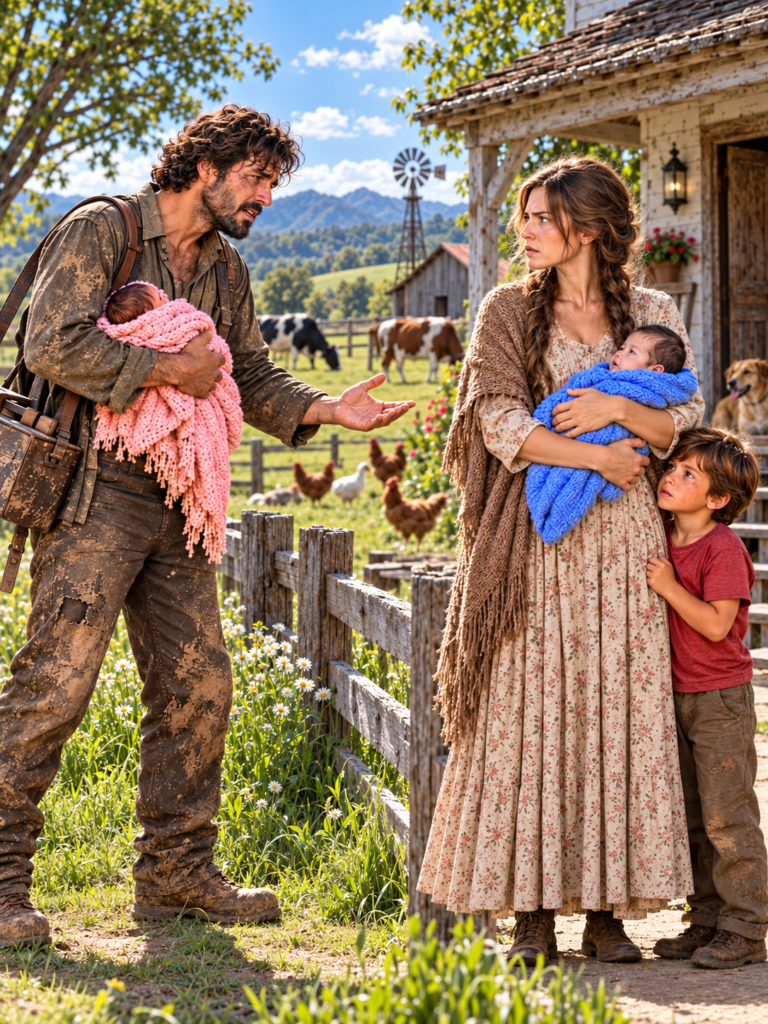
When Inácio knocked on Amália’s door, he made a request that was hard to forget.
“Ma’am, please, help my little girl, and I’ll fix your house.”
She accepted, thinking it would only be for a few days. What she didn’t imagine was that while Inácio rebuilt the roof, the porch, and the windows, he would start to occupy a space that wasn’t part of that deal.
And just when the house was almost ready, a car appeared on the road. Amália knew the man who stepped out of it very well. What she didn’t know yet was why he had returned.
There were nights when Amália Ferraz calculated the bills at the kitchen table until the candle almost went out, wondering if she had been foolish to stay. Alone with two children on a farm that only brought expenses, she no longer knew if it was courage or stubbornness that kept her there.
The Boa Esperança farm was located in a rural area of São Bento do Sapucaí, in the interior of São Paulo. It had belonged to her grandparents and then became hers. A one-story, old house with light-colored walls, a small vegetable garden, some fruit trees, a wooden shed, and a long porch that had needed repairs for too long.
Nothing worth a second glance from those passing by on the road, but it was all she had.
Bento, seven years old, remembered his father quite well. Tomás was still breastfeeding and slept clinging to her.
Renato, the boys’ father, had left when she was pregnant with the youngest. For years, he complained that the farm was a bottomless pit, that the house swallowed money, and that he was wasting his life in that godforsaken place.
When a job opening appeared in the capital, he left, promising to send money and promising to come back for everyone. He called twice in the first few months. Then the phone fell silent.
Amália learned to fend for herself however she could. She made sweets, jams, and preserves to sell at the market. She tended the garden and took in sewing jobs here and there.
The house was always last on the list. When it rained hard, she would place two basins on the floor, one in the hallway and the other in the bedroom. The living room window would only stay shut if propped with a piece of wood. A corner of the porch was giving way a little bit each month.
After several days of nonstop rain, the small bridge on a side road was closed off.
On a cold afternoon, as the sky was already darkening, Amália heard a voice calling at the gate. She stopped, holding the spoon. Nobody ever showed up at that hour.
She went to the door with Tomás in her arms and Bento clinging to the hem of her dress.
At the gate was a man she had never seen in her life. Clothes dripping, an old toolbox in his hand, and against his chest, wrapped in a blanket, a tiny thing she took a moment to realize was a baby.
“Ma’am, I’m sorry,” he said, his voice raspy with exhaustion. “I wouldn’t be bothering you if there was any other way.”
Amália didn’t open the gate. She held her own children firmly and stared.
“What do you want?”
“My name is Inácio. Inácio Leme.”
He paused for a moment before continuing.
“My wife didn’t make it after the delivery. It happened a short while ago. I was trying to reach town with the little one, but the bridge down the road collapsed. A young man from a nearby property said your house was the closest one with people living in it.”
She heard everything. Fear told her to send that man away. Two children alone at home, night falling, and a stranger at the door.
“I don’t know you,” she replied coldly.
“I know, you’re absolutely right.”
He didn’t even try to step forward.
“But my daughter is hungry and I don’t know what else to do.”
At that moment, Tomás began to squirm in her arms, looking for her breast, whimpering softly.
Inácio looked and understood. He turned red, lowered his eyes, and for a second, it seemed he would give up and vanish into the rain.
“You are still nursing,” he said in almost a whisper. “I don’t have money to offer. I have nothing. I’m just asking for tonight, only until the bridge opens.”
Amália looked at Bento, then at the stranger, and finally at the bundle on his chest, that blanket rising and falling ever so slowly.
The right thing was to say no, she knew that, but the little girl was innocent of everything.
“You are not coming into my house,” she said at last. “Wait on the porch.”
Inácio agreed immediately, as if that were already more than he had hoped for.
Amália handed Tomás to Bento to hold for a moment, went to the porch, and with her heart pounding, reached out her arms.
“Give her to me.”
He hesitated. Then he placed his daughter in the arms of that woman he had just met.
And when Amália felt the warm weight of the baby against her body, she realized the blanket was far too cold and the girl barely had the strength to cry.
The girl took to the breast with a hunger that would break the heart of anyone who saw.
Amália sat on the porch bench, sheltered from the rain by the eaves, while Inácio remained a few steps away. Every so often, he checked on his daughter, still not believing that a stranger had agreed to help them.
“How long has it been since she fed properly?” Amália asked.
“Since yesterday morning. I tried a few things in town before the bridge fell, but she spat everything out.”
Amália didn’t answer. She adjusted the girl and continued.
The rain grew heavier. Bento appeared at the door, curious, and kept peeking at the strange man.
“Is he going to sleep here, Mom?”
“He’ll sleep in the shed, just for tonight.”
Inácio heard and nodded, without complaining about anything.
Amália started making conversation, more to calm herself down than out of politeness.
“Do you not have anyone? Family, someone who can come for you?”
He took a moment to answer.
He told her bit by bit. He was raised only by his mother, who had passed away some years ago. He never knew his father and had no siblings.
His wife, Lina, was from Minas. Her parents were already elderly, and her sister lived far away with three small children.
“Everyone already knows what happened,” he said. “But no one can get here right now. We had only moved to this region a few months ago. I took a carpentry job on a farm, which is why almost no one knows us.”
Amália listened to it all in silence.
That man was not a man with no one in the world. He was a man who, at that very moment, had landed in the wrong place, on the wrong night.
“You can sleep in the shed,” she repeated. “Tomorrow, when the bridge opens, you can head on.”
“May God repay you, Mrs. Amália.”
He took his daughter back with a care that she noticed. Many men don’t hold a baby like that.
Then he went to the shed, and she locked the house door with the usual two turns.
Lying in bed, Amália had a hard time sleeping. She listened to the rain and thought about that child.
At dawn, the leak in the hallway started again. She got up with Tomás in her arms, placed the basin in the usual spot, and noticed a puddle forming near the living room window.
She sighed, put down a cloth, and went back to bed.
When day broke, she found Inácio examining the crooked window frame.
“Good morning,” he said. “You might call me meddlesome, but I can fix this window in a flash if you let me.”
“I have no way to pay you.”
Inácio looked at his daughter, who was sleeping in a small basket.
“You fed my girl tonight,” he said softly. “I also have no way to pay for that.”
Amália was left without an answer. She nodded, granting permission.
He opened the toolbox. Within minutes, the window that always got stuck with a wooden block was closing on its own, perfectly, just as it hadn’t in years.
Then, without asking for anything else, he saw a loose porch plank and fixed that too.
The bridge was reopened mid-morning.
Inácio took his daughter to be treated in town, got advice on the girl’s diet, bought what he needed, and returned late in the afternoon to get what he had left in the shed.
But upon arriving, he noticed the patched roof, the crooked fence, and the porch sagging on one side.
“Ms. Amália,” he called out. “How long have these things been needing repairs?”
“Too long,” Amália replied.
Inácio remained silent for a moment. Then he said something she didn’t expect, which would change them both without either of them realizing it.
“I will need to stay here for a few more days, until Lina’s family can arrive. If you help me with my girl when I need it, I’ll fix this house, at least everything I can while I’m here.”
Amália looked at him suspiciously.
“The whole house?”
“Whatever is within my reach. Roof, window, porch. I know how to work with that. You took care of my daughter when I had no one else to ask. Let me do something for you too.”
“You sleep in the shed, and don’t enter my house without calling. Nothing more than that.”
“It’s a deal!” Inácio replied and extended his calloused hand over the gate.
She shook it lightly.
Quickly, Inácio started with the roof because he knew another heavy rain could ruin what was still repairable for good.
He worked with the wood he had, swapped a rotten piece for a reclaimed one, covered the weakest spots, went up early in the morning, only came down when the sun got too hot, and returned after lunch.
Amália went on with her life, tended the garden, stirred the sweet pots, breastfed both babies, hers and his, and avoided being near that man more than necessary.
One afternoon, Inácio noticed that a kitchen chair had a wobbly leg. He fixed it without saying a word.
The next day, when Amália saw the chair was firm, she didn’t go as far as thanking him. She just placed a larger mug of coffee near his tools.
Days later, one of his shirts tore at the shoulder while he was pulling a beam. He left the piece folded on top of a crate in the shed.
The next morning, he found the shirt mended, the tear closed with thread almost the same color.
Neither one said anything, but both noticed.
Bento was the one observing everything.
At first, the boy didn’t take to Inácio. When he saw the man pick up an old chisel that had been his grandfather’s, he turned red with anger.
“Put that down!” he shouted. “That was my grandfather’s.”
Inácio dropped the tool immediately without arguing.
He didn’t laugh at the boy, didn’t ask why a child was bossing him around, didn’t try to please him.
“Sorry, I didn’t know,” he said.
A few days later, he needed exactly that chisel.
He went over to Bento, who was playing near the vegetable garden.
“Bento, this chisel of your grandfather’s is good for wood. Can I use it? I promise to take care of it.”
The boy looked at him suspiciously.
“You can,” he finally said, “but put it back afterwards.”
“In its rightful place,” Inácio replied.
From then on, the boy started hanging around the work. He sat on a crate and watched, asking question after question.
“Why does this board crack and the other one doesn’t? Why did this one dry crooked?”
“Wood needs to rest before it can become something else.”
Inácio taught the boy how to hold the sandpaper, how to choose a good piece, and how to run his hand over the wood to feel where it was rough.
And Bento, who had been quiet for months, started talking again.
Inácio’s baby girl started getting some color, gaining weight, and sleeping better.
He decided she would be named Lina, just like her mother.
Amália found it strange.
“You’re going to name your daughter after your wife? Isn’t it painful to be reminded all the time?”
Inácio set the sandpaper aside and looked at the girl in the basket.
“I don’t want my daughter to grow up in a house where her mother’s name cannot be spoken,” he replied. “She will know who Lina was. She will know she existed, that she was good, that she laughed easily.”
It was one of the first times he had spoken of his wife.
He said little, soon changed the subject, picked up the sandpaper again, and the noise returned to fill the yard.
That answer came back to Amália’s mind several times throughout the day.
The house changed in front of everyone.
The roof was almost finished. The porch stopped sagging. The fence stood upright again, and without fully realizing it, the family began to mark the hours of the day by the sound of the tools outside.
When the noise stopped, she would look out the window, just to see if everything was okay.
On a sunny afternoon, she brought a pitcher of lemonade out to the porch.
Inácio drank it in one gulp, thanked her, and went back to work.
She lingered for a bit before heading back inside.
“You do that very well,” she said, feeling a bit awkward.
“Fixing things is what I know how to do,” he replied. “Fixing takes work, but it’s easier than many things in life.”
The weeks went by.
Amália’s help with little Lina was no longer as necessary. Inácio had managed to organize the girl’s feedings perfectly, and his in-laws, the parents of the late Lina, finally arrived to meet their granddaughter.
They were two soft-spoken elderly people. They stayed in town for a few days and came to the farm during the day.
The grandmother would hold the girl in her arms and cry softly, calling her daughter’s name.
Amália left the three of them be and made sure there was always enough coffee and food.
“You were an angel to my son-in-law,” the old woman said, holding Amália’s hand tightly. “God brought you into each other’s paths at a time like this.”
Amália felt embarrassed and changed the subject.
The in-laws were not in a position to take care of the girl forever. They were elderly and tired. Lina’s sister offered, but she lived far away and her own house was full.
In the end, the one who was going to raise that child was Inácio alone.
He decided to stay in the region.
He told himself it wasn’t because of Amália. He had taken on a carpentry job before everything happened and still needed to finish it. Besides, he had promised to fix up the farm, and a man who makes a promise keeps it.
Late one night, Amália saw a light on in the shed.
She went over there, thinking he had forgotten the lamp.
She found Inácio leaning over a small wooden bed, carefully sanding the edges.
“Are you still awake?”
“I couldn’t sleep.”
He ran his hand over the wood.
“It’s for Lina. She’s already getting too big for the basket.”
Amália moved closer.
The little bed was simple but well-made, with all the corners rounded off to prevent injury.
“I have an old crib in storage,” she offered. “It was Tomás’s. Can I lend it to you?”
“Thank you, but I prefer to make it.”
He smiled.
“It keeps my mind occupied.”
She agreed and went back to the house.
But a few days later, she saw that he had started another little bed. This one was different, larger.
“Who is that for?” she asked, surprised by the size of the bed.
“For Tomás,” Inácio replied, without looking up. “I noticed he still sleeps in a small bed. A boy that size deserves a bigger bed.”
Amália found it strange.
“That wasn’t part of the deal.”
Inácio stopped his work and looked at her.
“I know.”
It was the first thing he did there that wasn’t to pay off any debt.
And they both knew it.
Bento also noticed the house was changing too fast. He walked around quietly, watching the man work.
One afternoon, while Inácio was finishing a piece of the porch, the boy asked out of the blue, “When you finish everything, are you going away?”
Inácio stopped with the plank in his hand.
He didn’t lie to the child.
“That’s what I agreed upon with your mother.”
Bento didn’t answer. He got up from his crate and went into the house stomping his feet.
At the end of that same week, a car appeared on the road.
A silver car, dusty from the dirt road, slowed down and stopped right in front of the gate.
Bento, who was playing in the yard, recognized it before anyone else, dropped his toy, and took off.
“Dad! Dad!”
Amália was coming from the vegetable garden with a basket of kale when she recognized Renato.
The basket slipped from her arms and the kale rolled across the dirt.
Renato stepped out of the car with two bags in his hands and an awkward smile.
He was thinner, his hair was shorter, his city clothes clashing with the mud of the yard.
Bento arrived first and threw himself at him.
Renato dropped the bags, knelt down, and hugged the boy tightly.
And it was precisely that hug that disarmed Amália.
For months, her son had sworn with his head held high that he didn’t need his father anymore.
Seeing the boy clinging to Renato’s neck, crying with joy, she realized it was all a lie.
Bento still wanted his father back. He always had.
“Wow, look how you’ve grown, kid,” said Renato, his voice choked up. “You’re quite a little man.”
Then he looked at Amália, still standing near the scattered kale.
“Hi, Amália.”
She didn’t answer. She adjusted Tomás on her hip.
Renato approached, looking at the youngest.
“Is this Tomás?”
“Yes.”
He reached out a finger, and the baby grabbed it.
Renato’s eyes filled with tears instantly, and that seemed sincere.
He was meeting his youngest son right at that moment, months after the boy had been born.
That made everything more difficult for Amália.
If he were a cold man, it would be easy to send him away. But there stood an emotional father, and she had two children who deserved a father.
“I was wrong, Amália,” said Renato, still watching the baby. “São Paulo wasn’t what I imagined. I went from job to job, lost money, got tied up in debt, and took too long to admit this was the right place to be.”
She listened to everything without saying a word.
She didn’t welcome her ex with open arms, but she didn’t turn him away either.
“Do you want to come in?” she asked coldly. “You’ve come such a long way.”
That was when Renato saw a man on the porch across the yard, hammer in hand, standing there watching the scene.
Renato’s smile faded.
“Who is that?”
Amália took a deep breath and explained the essentials. The storm, the bridge, the girl, the agreement for the repairs.
Renato listened to the explanation until the end.
“I see,” was all he said. “It’s good that someone showed up to help.”
Inácio climbed down from the porch, greeted him from afar with a nod, and disappeared into the shed.
He didn’t want to be in the way.
In the following days, Renato started showing up all the time.
He brought a toy car for Bento, some clothes for Tomás, and bags of groceries for the house.
He would sit on the living room floor and play with the boys for hours on end.
Bento was radiant, laughing loudly, running around the yard, and showing his father every corner of the house.
“Look, Dad, Inácio taught me how to sand this. Look how smooth it is.”
Renato looked at the board and gave a forced smile.
“That’s great, son.”
Inácio noticed all of that.
Little by little, he started pulling back.
He stopped having coffee on the porch in the mornings. He no longer lingered around the house after work. He spent his free time in the shed with his daughter.
Amália noticed the change and, one afternoon, went over there.
“Are you avoiding me?” she asked, half-joking, half-serious.
Inácio set his tool aside.
“Renato is the father of your boys, Miss Amália. If he’s back to set things right, it’s not my place to get in the way.”
That polite response irritated Amália. More than it should have.
She opened her mouth to reply, but couldn’t find the words and walked back home, stomping her feet.
That same afternoon, Renato knelt in front of Bento, held the boy’s shoulders, and spoke loud enough for anyone to hear.
“Now Dad is here to stay, you see, son? I’m not leaving anymore.”
From the shed, Inácio heard every word.
The chisel was forgotten in his hand as Bento wore the biggest smile Amália had seen on him in a long time.
And watching that smile, Inácio made a quiet decision.
He would finish the repairs as fast as he could and leave before getting in the way of that boy’s happiness.
Renato started talking about the future every time he showed up.
He sat on the new porch, tapped his hand on the firm wood, and spoke of how the farm had improved, how Amália had done well taking care of the place.
“You are stubborn, but you are a hard worker. That, I always knew,” he said one afternoon, drinking the coffee she had made. “And look, that stubbornness of yours might pay off now.”
Amália, sitting with Tomás on her lap, waited for him to continue.
“A company has appeared, interested in land in this region because of the road construction and the growing tourism on this side of the mountain range. They are paying well, Amália. Very well. I know a man who is brokering some of these purchases.”
He mentioned a figure.
Amália went quiet.
It was more money than she had ever seen in her life. Money to pay off all her debts, buy a modest house in the city, save a reserve, and still put Bento in a better school.
“It’s a lot,” she murmured.
“It’s your chance, woman.”
Renato spoke softly, without rushing.
“How much longer are you going to live off selling sweets at the market? Look at how much this house eats in repairs. That man over there won’t keep fixing it for free forever.”
He pointed with his head to the corner of the porch that Inácio hadn’t finished yet.
For the first time in a long while, selling didn’t feel to Amália like abandoning what was hers.
It felt like security. It felt like an exit.
Renato wasn’t speaking with cruelty. He spoke of money, of the children, of the bills, and of everything he knew worried Amália.
“Think about the boys,” he added. “Not about me, not the past, the boys.”
Amália didn’t reply that she would never sell. She also didn’t reply that she would sell.
She only said one thing.
“Give me some time to think.”
Renato smiled and agreed, satisfied.
He stood up, kissed Tomás’s forehead, and left, saying he would be back the next day.
That night, Amália couldn’t sleep.
She sat on the edge of the bed, watching her two children, doing math in her head.
In the morning, she ran into Inácio in the yard and told him.
She needed to tell someone, and there was no one else.
“Renato found a buyer for the farm,” she said. “He’s offering good money.”
Inácio listened, let the saw rest on the bench, and wiped his hands on a cloth.
“And are you going to sell?”
“I don’t know. Maybe it’s the right thing for the boys.”
Inácio didn’t answer immediately.
“Aren’t you going to say anything?” she asked.
“About what?”
“About me selling it.”
Her voice came out louder than she intended.
Inácio let his eyes wander over the roof he had redone, the garden, and the dirt road.
“The land is yours, Mrs. Amália.”
“Is that all?”
She was expecting something else.
She expected him to say not to sell, that this was her place, that she would regret it.
“Is that really all you have to tell me?”
Inácio picked up the saw again, but didn’t go back to cutting.
“You’ve already lived too long with a man telling you what you had to do,” he said without raising his voice. “I didn’t come here to do the same thing. The decision is yours. Whatever it is, I respect it.”
The answer didn’t resolve anything.
On the contrary, Amália went back home irritated, even though she couldn’t quite explain why.
That night, she looked at her sleeping children again and thought maybe Renato was right.
Maybe staying on that farm was just an attachment. Maybe security was worth more than a grandfather’s memory, more than the garden, more than the basin in the hallway when it rained.
She was almost convinced.
The next day, Renato returned excited, full of talk.
He asked about the boys, played a bit, and then, as naturally as could be, in the middle of another sentence, he let it slip.
“Oh, and tell me one thing, do you know where the farm documents are? The deed, things like that? It’s just so I can get a head start with the folks, speed things up when you decide.”
Amália, who was filling a pitcher with water at the sink, stopped with the tap running.
She found that strange, very strange.
He hadn’t even waited for her to say yes and already wanted the deed in his hands.
“They’re put away,” she replied, turning off the tap. “Why the rush?”
“No rush at all.”
Renato laughed, scratching the back of his neck.
“It’s just so we don’t waste the buyer’s time. You know how it is.”
She changed the subject, but Renato’s rush for the documents kept bothering her.
After the talk about the documents, Amália started paying closer attention to Renato.
Renato knew too many details about the region’s appreciation. He knew about road work, company names, things that outsiders don’t just find out out of the blue.
He would always ask tactfully if anyone had approached Amália directly.
He wanted to know if she had already signed any papers, if she had spoken to anyone else.
She would answer, but with each new question, she found his interest in the subject even stranger.
On a Saturday morning, Amália went down to town to sell sweets at the fair, just like she did every week.
She was arranging the jam jars at the stall when Mr. Osvaldo, the store owner, a man who had known her since she was a girl, came over to buy a dozen eggs and struck up a conversation.
“How’s it going, Ms. Amália? Have you decided if you’re going to accept the offer?” he asked, shuffling the eggs. “The one for the land. Mr. Renato came by the store a few weeks ago saying you were going to sell.”
Amália froze with the jar in her hand, mid-air.
A few weeks.
Mr. Osvaldo realized right away he’d said more than he should have.
He turned red, changed the subject, paid for the eggs, and left almost apologizing.
That was how she found out.
In the middle of the market, among the sweet jars, with the street noise all around, Renato had been talking about that land before coming back to see the kids, before hugging Bento, before meeting Tomás, before saying he was wrong, before any apology.
Amália packed up the stall early that day.
She went back to the farm, replaying in her mind every conversation she’d had with Renato since his return.
When she arrived, Renato was there playing ball with Bento in the yard.
She didn’t make a scene.
She called her ex over to talk away from the children, behind the shed.
“You mentioned selling this farm at Mr. Osvaldo’s store,” she said directly. “Weeks ago. Before you got here.”
Renato stopped, thought quickly, the way he always did.
“Amália, calm down. One thing has nothing to do with the other.”
“It doesn’t?”
“I heard about the appreciation while in São Paulo from an acquaintance,” he rushed to explain. “And that’s precisely what made me think of you. It made me remember what I had left behind. It was that news that brought me back, you understand? I didn’t mean any harm.”
Amália almost believed him.
He had always known how to make her doubt herself.
She wanted to believe it for the sake of the boys, for Bento’s smile.
So she asked the right question.
“And have you spoken to the buyer? Have you promised anything to anyone?”
Renato hesitated before answering.
It was enough to fuel her suspicions.
“I talked,” he admitted. “Anyway, I gave them an early sign that it would probably work out.”
Amália kept looking at him.
“What did you gain from this, Renato?”
This time the answer took a while.
“The man brokering the purchases promised me a commission if the deal went through. But that’s not why I’m saying you should sell. The value remains good for you and the boys.”
That was when Amália understood why he knew so much, why he was in such a hurry, and why he had asked for the documents even before she accepted the proposal.
“I’m not robbing you, woman,” he said, seeing the look on her face. “I just want you to be rational. This money is good for everyone.”
For a moment, Amália almost backed down.
But not this time.
“I’m not selling now.”
“Amália—”
“I said no, Renato.”
It was just a firm no, so different from the Amália of before that even she was surprised by her own voice.
Renato realized that this time Amália wouldn’t give in, so he didn’t insist anymore that day, turned around, and went to play with Bento as if nothing had happened.
Late in the afternoon, he walked near the shed, where Inácio kept his tools, and stopped at the door with a smirk.
“Fixing a few boards made you the owner of the house, huh?” he provoked.
Inácio didn’t even look up from his work.
“I’m not the owner of anything here.”
Renato laughed, satisfied with the answer.
Then Inácio put his tool away, looked at him, and finished calmly.
“That’s why I never needed to take anything from her to be able to stay.”
Renato lost his smile, and on the other side of the shed wall, without either of them knowing, Amália heard every word.
Renato understood he wouldn’t convince Amália at that moment.
He still tried to stay around for a few more days playing with Bento, but he was losing his patience.
He didn’t talk so much about rebuilding the family anymore. He talked more about missed opportunities, and how people didn’t know how to take advantage of good things when they appeared.
One morning, he packed his suitcase and announced he needed to sort some things out in São Paulo.
Bento, who was eating breakfast, dropped his bread on the plate.
“Dad, are you leaving again?”
“Just for a while, son. I’ll be back.”
“But you said you had come to stay.”
The boy’s voice came out soft and tearful.
“You said you weren’t going to leave anymore.”
Renato leaned down and brushed his son’s hair.
“I need to fix some things there first, then I’ll come back for good, I promise.”
Bento didn’t throw a tantrum, didn’t cry in front of his father. He just got down from his chair, went into his room, and closed the door.
Renato kissed Tomás, gave a curt nod to Amália, and got into the car.
The silver car disappeared down the dirt road kicking up dust, and this time, Amália felt nothing but exhaustion.
After his father left, Bento spent days quiet, hovering around the shed where Inácio worked and going back to sit on his usual crate, but he didn’t ask question after question like before.
Inácio didn’t try to console him with words, didn’t say things would be different.
He didn’t promise to be better than Renato. He didn’t speak ill of the boy’s father.
He just kept on working, letting the boy stay close, handing him a piece of sandpaper now and then.
Until one afternoon, Bento asked softly, “Are you going to leave too?”
Inácio stopped hammering and looked at the child.
“When I finish what I agreed to with your mother.”
Inácio looked toward the house.
The porch was done, the roof was finished, the fence had been raised. Only two windows and the kitchen door remained.
The more beautiful the house became, the closer Inácio was to leaving.
Amália noticed this too and, in the following days, began to take note of every task he completed.
One window finished, then the other.
With every repair finished, she grew more restless.
Each completed task reminded her that the goodbye was drawing near.
One night, after the children had fallen asleep, the two ended up sitting on the porch talking.
Lina was sleeping on her father’s lap, and without her asking, Inácio began to speak of his wife.
He told how he met Lina at a church festival in Minas. How she used to laugh at him because he would measure the same board three times before cutting it, fearing a mistake.
She would say, “Inácio, if you measure one more time, this wood is going to rot,” he said, and laughed softly at the memory.
Amália smiled.
“You know what’s the strangest part?” he said. “There are days I spend the whole afternoon working, laughing with Bento, and only at night do I realize I haven’t thought of her all day. And then, a terrible guilt hits me.”
Amália didn’t tell him he had to forget, didn’t say life goes on, or any of those empty phrases.
She only asked, “Did she like strong coffee?”
Inácio looked at her, surprised by the question.
He said she liked it very strong, without sugar. She used to say that sweet coffee was ruined coffee.
And he laughed as he remembered her.
It was the first time she had heard him speak of his wife and smile in the same conversation.
The two remained quiet for a moment, far too close.
The lantern light hit his face, and Amália noticed it had been a long time since she felt the urge to be near someone in that way.
He leaned in slightly.
She did not pull back.
That was when Tomás started crying inside, a hunger cry that couldn’t be ignored.
Amália got up quickly, adjusted her clothes, and went to see her son, her heart pounding.
The moment passed.
The next morning, without saying a word, Inácio began working on the last thing left: the kitchen door.
The kitchen door was old, heavy, made of solid wood, and warped from swelling with the humidity.
It hadn’t closed properly for years.
It would hit the frame, get stuck at the bottom, and let the cold in during winter.
Inácio looked at that door and knew he could fix it in a day.
Change a hinge, plane the base, adjust the frame, and done.
But it took him two days.
He worked slowly, measuring, sanding, stopping, and measuring again.
He planed a little bit, tested it, and planed a little more.
Amália noticed.
She knew his work rhythm and knew that shouldn’t take two days, but she said nothing.
Bento also noticed and also said nothing.
As long as that door wouldn’t close, Inácio still had a reason to stay.
On the third morning, there was nothing left to plane.
He fitted the last hinge, put in the screw, and tested it.
The door swung smoothly and closed with a perfect click, flush with the frame, no gaps at all.
He opened it, closed it again.
Opened, closed. It was perfect.
Inácio kept his hand on the doorknob for a few seconds.
The door was done, and so was the job.
Then he began to gather his tools, putting each one back in its place.
By the old toolbox, Bento appeared in the hallway, barefoot, his hair messy from sleep.
“Are you finished?”
Inácio looked around. The whole house fixed, secure, whole.
“I am.”
The boy looked at the closed toolbox.
“So now you’re leaving?”
Inácio took a while to answer.
He knelt down to be at the boy’s height.
“That’s what I agreed upon with your mother, Bento.”
The boy pressed his lips together in a stubborn way that was just like his mother.
“But you only agreed to fix the house.”
His voice caught a little.
“Nobody asked us if we wanted you to leave.”
Inácio didn’t know how to respond at that moment.
He gripped the boy’s shoulder.
“Some things are decided by adults, son. But I promise you one thing. I won’t disappear without saying goodbye to you. I won’t do that.”
Bento waited a few seconds as if to be sure.
Then he nodded and went back to his room.
From the kitchen, Amália heard the whole conversation.
When Bento went back to his room, she stayed there for a few seconds, thinking about what her son had just said.
That afternoon, she saw Inácio taking apart the makeshift bed in the shed, folding the blanket, and gathering his few things into a bag.
She wanted to go over and ask him to stay.
She almost did.
But then she thought of Lina, his wife, who had passed away such a short time ago.
She thought that perhaps Inácio was confusing gratitude with something else.
She thought that maybe he only wanted to stay because of Bento and Tomás, not because of her.
She thought of Renato, who had promised to stay twice and left both times.
In the end, she said nothing.
At dusk, she went to the shed.
Inácio was sitting on the edge of a crate with his daughter in his lap.
“When are you leaving?” she asked.
“Early tomorrow.”
He didn’t even look up.
“I’ve packed almost everything.”
Amália swallowed the answer she really wanted to give. The one that said, “Don’t go.”
“All right,” was all she said. “Safe travels.”
And she went back home.
That night, a light winter rain began to fall.
Amália lay down and waited for the sound of water dripping in the hallway, the usual sound to get up and grab the basin.
The sound didn’t come.
For the first time since Inácio had arrived, no basin needed to be placed on the floor.
The roof was dry. The house was whole.
Amália should have been happy about that.
It was what she had always wanted, a house that wouldn’t let the rain in.
Instead, she sat in the dark kitchen in the middle of the night and cried alone, making no sound so as not to wake the boys.
The next morning, it was no longer raining.
Inácio put his toolbox and bag into the bed of an old truck borrowed from an acquaintance in town.
He secured little Lina in a small basket on the seat.
Amália went out to the porch with Tomás in her arms.
Bento followed, sulking, and stopped near the gate, kicking the dirt.
The goodbye was short.
“Thank you for everything,” said Amália, doing her best not to let her voice falter. “For the roof, the windows, the porch, the door that now closes.”
“Thank you, ma’am,” Inácio replied. “For my daughter. You saved her that night. I won’t forget that as long as I live.”
He reached out his hand.
Amália shook it quickly.
Inácio got into the truck, started the engine, and Bento asked with red eyes, “Is that it, then?”
“Get in, Bento,” said Amália softly. “Let the man continue on his way.”
The truck engaged and began to descend the dirt road slowly, because of the potholes.
Amália stood still on the porch, watching.
She didn’t call out.
The vehicle drew closer to the gate.
There was still time.
She knew there was still time.
Even so, she didn’t call out.
Then Bento turned to his mother.
“If you didn’t want him to go, why did you let him leave?”
Amália opened her mouth to answer and realized she had no reply.
She kept looking at her son, and then at the pickup truck that was disappearing.
Renato had left years ago, deciding on his own something that changed all their lives, without asking anyone.
And now she was doing something similar, driven by that very same fear.
She was letting someone leave without saying how she felt, hoping the other person would guess so she wouldn’t risk exposing herself.
She didn’t want to be like that.
Not after everything.
Amália handed Tomás to Bento to hold.
“Hold your brother for a second,” she said firmly.
Then she walked, then ran toward the gate.
“Inácio!” she shouted. “Inácio, wait!”
The truck stopped.
The door opened.
Inácio stepped out, confused as to why she had called him, and walked back toward her.
Amália reached him, breathless.
“I don’t know if we’ll work out,” she said, stumbling over her words. “I don’t even know if you’re ready for anything right now. I know you still miss Lina, and my boys have a father in the twisted way that Renato is. But there is one thing I do know.”
Amália continued.
“I don’t want you to leave just because the kitchen door finally closed.”
After a few seconds, Inácio replied, “I don’t want to leave just because the job is over, either.”
Inácio didn’t rush to hug her, nor did he try to hurry that moment.
They stood there for a few seconds, and it was enough for them to understand that neither of them wanted to end that story on the road.
But Inácio didn’t take his things back and move into Amália’s house.
They both decided not to rush things.
Inácio kept living in the area, and some time later, he managed to rent a small shed where he opened his own carpentry shop.
He remained close to Amália and the boys, but they each still had their own homes and routines.
Renato continued to be a father to Bento and Tomás.
Sometimes he showed up, often he was absent.
Amália learned not to build her children’s lives on his promises and to let the boys love their father without depending on him.
Bento kept calling Renato “Dad” and calling Inácio “Inácio,” but over time, he stopped asking when he was going to leave.
A year passed.
Amália and Inácio decided to get married at a small party, right at the Boa Esperança farm, under the fruit trees, with neighbors, the elderly in-laws from Minas, and children running around everywhere.
One afternoon, shortly after the wedding, a heavy rain fell on the property.
Amália walked into the kitchen and, out of pure habit from so many years, went to look for one of the old basins in the cupboard.
There was no water on the floor. The roof was dry.
The closed kitchen door kept even the wind out.
She found one of the old basins, stored high up in the cupboard, all dusty.
She just stared at it.
Inácio walked in and saw his wife standing there with that old basin in her hands.
“Still keeping that?” he asked, smiling. “You don’t need it anymore. You can throw it away if you want.”
Amália held the basin against her chest and shook her head.
“Not this one.”
From outside, Bento called them both excitedly, because Lina and Tomás, now a bit older, were playing together on the porch, the two babies from that rainy night, now grown and laughing out loud.
Amália put the basin back high in the cupboard and held Inácio’s hand.
The rain kept pounding hard on the roof all afternoon, but this time, not a single drop got inside the house.


