
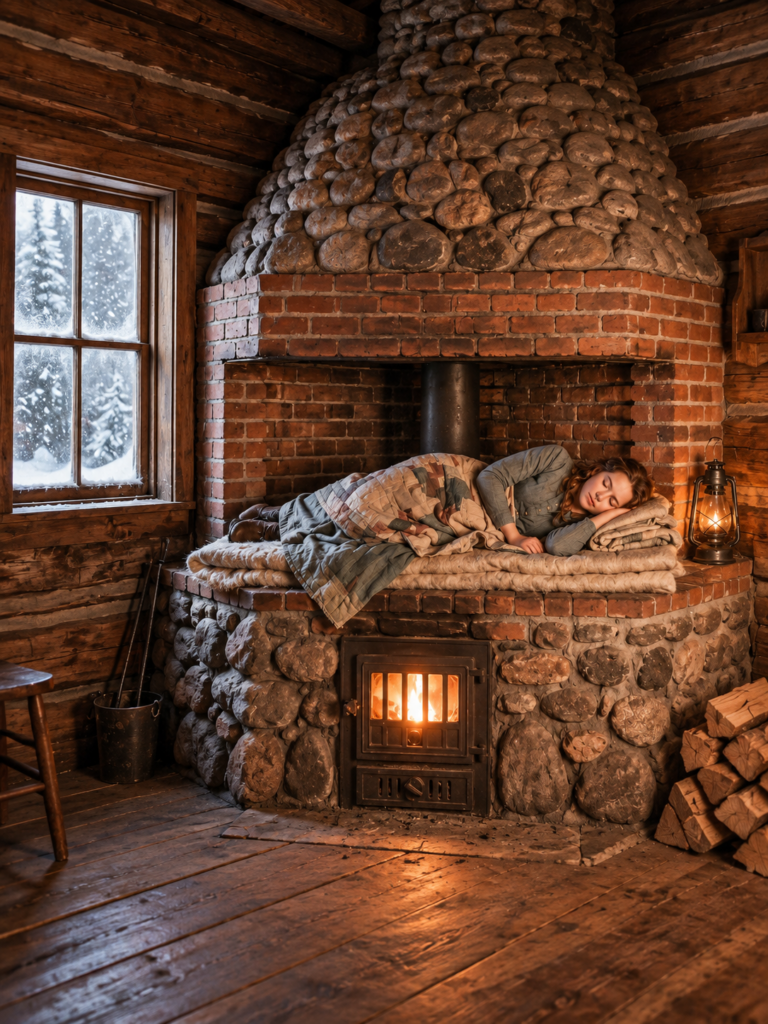
she pried up the floor of her cabin and built a five ton brick stove to keep her grandmother alive through the deadliest montana winter while the man next door offered to buy her out
Part 1
In the first week of November 1888 the wind came down off the divide and went hunting for every unchinked log in Tamarack Crossing. Old snow already lay in white seams along the fence lines of the Big Hole Valley, packed there by the season’s first hard blow out of the north. Every household along the creek was getting ready for what came next. Lyman Puit had his new cast-iron box stove set up in less than two days. By week’s end smoke rose from his chimney every evening, steady and gray against the hills. Amos Toiver, the settlement’s blacksmith, spent those same days going from cabin to cabin with a sack of tools over his shoulder. He tightened stovepipe joints, tested dampers, and made sure every stove on the creek would draw when it mattered.
Only the Hollinger cabin had nothing new to show for the season. Inside it Willa Hollinger knelt where the floor used to be. She had pried up a broad square of planks with a bar and a hammer, stacked them against the wall, and left the bare earth open beneath the rafters. In her right hand was a mason’s square, its wooden handle worn smooth as a creek pebble. She had scratched a rectangle into the packed ground with its corner. Now she was setting flat creek stones inside the lines, bedding each one in gravel, checking it, then reaching for the next.
She was twenty-three, strong through the shoulders from a summer of hauling, with chestnut hair pinned up out of her way and gray-blue eyes that missed very little. At the moment her cheek was smudged with lime. A canvas apron gone gray with mortar dust covered the front of her plain white dress. A shadow fell across the doorway. Lyman Puit stood there with his hat in his hand, a big man of forty-eight with a rancher’s squint and a sheepskin collar turned up against the wind. His eyes traveled from the stones to the open ground, then to the cracked cook stove in the corner whose pipe rose cold through the ceiling. Out by the shed a long mound of salvaged brick waited under a canvas sheet weighted down with rocks. He looked back at the hole in her floor.
“Are you heating a house, Miss Hollinger, or building another room inside it?”
Willa did not answer. She set the next stone, laid the square against it, nudged it a quarter inch, and reached for another.
Within weeks men up and down that valley would be stumbling out of bed in the dark to keep their fires alive night after night until they could hardly remember what an unbroken sleep felt like. Willa would sleep. On that gray November morning nobody in Tamarack Crossing had any reason to believe it. Least of all the man standing in her doorway.
“Your grandmother know what you’re doing to her floor?”
“Her grandmother is sitting right here, Mr. Puit.” The voice came from the rocking chair beside the cook stove, dry as kindling. “And it is not my floor. It belongs to the government until we prove up.”
Katherina Hollinger did not look up from her knitting. She was seventy-two, small and straight-backed in charcoal wool, a black shawl pinned at her throat. Rheumatism had swollen her knuckles, and her eyes had clouded enough that she knitted mostly by feel. The needles never lost their rhythm. Lyman’s mouth twitched. He settled his hat back on his head, touched the brim to the old woman, and stepped out into the wind.
Willa listened to his boots crunch away across the frozen meadow toward the Puit place two hundred yards off. She set another stone.
“He means well.”
Gran’s needles clicked on.
Willa wiped her hands on the apron. “I know he does. That’s what makes him so hard to listen to.”
The claim had been her father’s idea. Henry Hollinger had brought the three of them west from Pennsylvania in the spring of 1885, four years after Willa’s mother was laid to rest in the churchyard outside Reading. Stonework back east had grown thin. He’d heard that the Montana valleys had money in them for a man who could lay a true foundation, and he’d been right. For two years he built footings and chimneys for half the ranchers along the Big Hole. Then in February of 1887 he came home from a job soaked to the skin in a sleet storm, took to his bed with a fever, and was gone in nine days. The ground was frozen too hard to bury him until April. Willa had been twenty-one. The winter just past was the first she’d faced without him.
The cook stove in the corner had a crack across its firebox, and Amos Toiver had warned her not to trust it through another cold season. It was all they had. Willa fed it through every night of that winter, rising in the dark every two hours to shake down the grate, add wood, and lie back down to listen for the fire to catch. The iron cooled the moment she let it. By February she had learned there was a kind of tired that sleep no longer reached. In March Gran took pneumonia. For eleven days the old woman fought for breath under every quilt they owned. Willa paid a neighbor’s hired man to ride to Dillon, more than sixty miles over the pass. The doctor came by cutter, stayed two nights, and left behind a brown bottle of medicine and a bill for fifteen dollars. On the doorstep, out of Gran’s hearing, he told Willa that her grandmother’s lungs had come through by a thread. Another winter of cold nights and stove smoke, and he would not answer for them.
Gran was up by May. She was slower afterward. Some mornings she coughed until she had to sit down. By autumn Willa had eleven dollars. The merchant in Dillon wanted twenty-two for a cast-iron box stove like Lyman’s, plus freight over the pass. Every neighbor who knew their situation offered the same advice in different words. Take rooms in town for the winter and come back in the spring. But the claim had three years of work in it, and a homestead left empty for more than six months could be called abandoned. If Willa and her grandmother walked away from the cabin in November, nobody could promise it would still be theirs in May.
So Willa had gone looking for another answer. She found it nine miles down the valley at Willow Gulch. A man named Sautell had built a brick kiln there in 1886, certain the valley would soon want brick houses. It hadn’t. He went broke that spring, and the man he owed money to was glad to sell off whatever was lying around. For four dollars Willa bought a wagonload of fire brick torn from the kiln’s own lining, a long pile of common brick, and three barrels of lime. Then she spent the summer bringing it home. Each trip took three hours out and three hours back behind Fritz, the mule her father had bought the year they arrived. Fritz had firm opinions about the fort at Willow Gulch and expressed them every single time. Willa loaded every brick with her own hands, stacked them in the wagon bed so they wouldn’t shift on the grade, and unloaded them again in the yard by lantern light. By August her palms had gone hard as harness leather. By September she had stopped counting trips. She had seven dollars left. She also had a plan that nobody in Tamarack Crossing understood.
By the end of the first week the stone footing filled the rectangle and the first courses of brick had begun to rise. Willa hung a canvas wagon sheet from the rafters to make a tent around the work. With the cook stove’s corner inside it she kept a low fire going beneath the cracked firebox day and night, just enough to keep the mortar from freezing before it could set. Gran watched the brick claim more of the room each day. She never once called it foolish. She asked harder questions instead.
“Where will the table go?”
“By the window. It can move.”
“And when the brick cracks?”
“Then I open it and mend it.” Willa pressed the fire brick into its bed and cut away the squeezed mortar with her trowel. “Brick doesn’t break all at once, Gran. It tells you first.”
“And when the chimney won’t draw?”
“I’ll test it before the hard cold comes.”
The needles clicked twice. “And if the hard cold comes before your mortar is dry?”
That was the one Willa had lain awake over. She sat back on her heels. “Then I fire it slowly. A little more every day. Brick has to be given time.”
They were her father’s words, and both of them knew it. The old woman’s hands went still on her knitting. Willa had learned the trade at Henry Hollinger’s elbow, mixing mortar for bake ovens and chimneys in the farm country outside Reading. Before she was tall enough to see over the wheelbarrow she had never been apprenticed, never been paid as a mason, never called herself anything at all. She knew only what her hands knew: how a course ought to sit, how mortar felt when it was right, how heat moved through stone when nobody was watching it.
“Give me that square a moment.”
Willa put it into her grandmother’s hands. Gran turned it over and found the handle with her thumb. Two letters were cut into the wood there, so worn by years of use that they were easier to feel than to see. KS. Willa had grown up hearing that the square once belonged to her great-grandfather, Conrad Staler, Gran’s father, who had built stoves and ovens in Berks County when Pennsylvania was young. She had never thought to question it. Gran’s thumb passed over the letters twice. Her voice came out lower than before.
“This square has built more than you know.”
Then she handed it back, picked up her knitting, and asked whether Willa intended to eat supper tonight or only mortar.
That evening they moved the table together. Willa took one end and Gran took the other, though the old woman’s share of the weight was mostly stubbornness. They carried it to the window and set it beneath a frosted pane. When Willa turned around the unfinished heater stood alone in the middle of the cabin. It was already the largest thing they owned, and it was still growing.
Part 2
Over the next two weeks the heater found its shape. The firebox sat low, lined with Sautell’s fire brick, which could stand heat that would crack ordinary brick to pieces. Around it Willa laid common brick and flat creek stone and bound everything with a mortar of slaked lime and the gray clay she dug from the bank below the cabin. At its base the mass measured a little over five feet by nearly five. Finished it would stand taller than she could reach without a box. Close to five tons of brick and stone resting on its own footing in the earth. The plank floor would have splintered under it in a day. That was why the floor had come up first.
The bench came next. Willa carried the masonry outward along one side of the heater until it formed a broad ledge about the height of a kitchen table. She kept the top level with the square, course after course, then smoothed it with her trowel until it was flat enough to lay a mattress on. Lyman came by on a gray afternoon to return a post maul her father had lent him two summers back. He stopped in the doorway again. For a long moment he studied the new ledge.
“At least you remembered somewhere to sit.”
Willa shook her head. “Somewhere to sleep, too. On the coldest nights.”
He laughed, not unkindly. “You’re building a bed into the stove.”
She kept working. There was nothing she could say yet that would make sense to him. The laughter did not stay in her doorway. When Willa rode Fritz down to the store by the creek crossing for salt and lamp oil she found that the whole valley had heard about the brick pile in the Hollinger cabin. A freighter’s wife asked, sweet as molasses, whether it was true that Willa was building herself a bake oven to live in. Two ranch hands by the cracker barrel stopped talking when she came in, then started again lower. Once she turned her back she caught the words—that Hollinger girl and laying brick like a hired man—and she paid for her salt without looking at either of them. Pity was the one crop in that valley that never failed. Willa had grown used to it after her father died. She had not expected to be laughed at, and she found the laughter harder to carry home than the salt.
Only Amos Toiver asked her a real question. He caught her at the hitching rail outside, a broad man of fifty with forge-scarred forearms and a gray beard trimmed short so it wouldn’t catch sparks.
“What are you using for mortar?”
“Lime and creek clay.”
He grunted. “Not cement?”
“Cement’s too hard. Brick has to move a little when it heats. Lime lets it.”
Amos studied her for a long moment, then nodded once as if he had filed the answer away somewhere he could find it later. He didn’t tell her she was right. He didn’t laugh either. In that valley that winter it counted for something.
That night Willa lay awake under the quilts, listening to the wind work at the eaves and thinking about a wall. She had been seven, staying the winter in Gran’s farmhouse in Berks County. The kitchen there had a great plastered stove built right into the wall, so large she’d believed as a child that the house had been built around it. One January morning she came downstairs before anyone else was awake. The fire had been out since the night before. Frost furred the inside of the window panes. Shivering, she pressed her palm against the stove wall, expecting cold. It was warm. Not hot. Warm the way a loaf is warm an hour out of the oven, steady and deep, as if the wall had been holding something back for her all night long. She stood there with both hands flat against it until her fingers stopped aching. That memory had stayed with her longer than any fire she’d ever seen.
In three Montana winters she had watched her neighbors fight the cold the other way. They fed their iron stoves hour after hour, and the iron answered beautifully, roaring hot within minutes. Then the fire weakened and the room began to cool almost at once. On bitter nights her father used to stand in the yard watching smoke pour out of every chimney along the creek. “They burn the heat, then stand there in the cold and watch it leave.” He had always meant to build something better. He never had the money or the time. Willa had the brick now. She meant to find the time.
A few days later Lyman sent word across the meadow, inviting her over to see what a simpler answer could do. Willa suspected Mercy had shaped the invitation so that it sounded neighborly rather than like a challenge. She went anyway. The Puit cabin was half again the size of theirs, with a plank floor nobody had pried up and a braided rag rug laid before the new stove. Mercy Puit met her at the door in dark green wool, her brown hair going gray at the temples, and took Willa’s shawl as though she were Sunday company. Amos was already there, warming his hands and admiring the pipe joints he had fitted himself.
The stove needed no long explanation. Lyman laid kindling beneath split lodgepole pine, struck a match, and opened the draft. Flames climbed fast. The iron ticked and creaked as it warmed. Within twenty minutes heat had spread into every corner of the room, and Willa felt her cheeks begin to burn. Mercy set the kettle on the top plate. Before long steam lifted from its spout. Amos regarded the stove the way another man might regard a good saddle horse. Metal made sense to him. He worked it every day. Give iron fire and it gave heat back without argument.
Lyman turned to Willa. “A man comes home in a wet coat when it’s ten below. He’s been out with the cattle since first light. He needs warmth now, Miss Hollinger. Not three hours from now.”
There was nothing foolish in it. Willa had come home wet and frozen herself more times than she could count, and she knew exactly what that first rush of heat was worth. She stepped closer and held her palm a few inches from the iron. The heat was fierce enough to make her pull it back.
“It does that well.”
Lyman waited. Her eyes went to the stovepipe. “Mine is meant to answer a different question.”
“What question?”
“What happens four hours after the flame is gone.”
Lyman barely hesitated. “You add another log.”
Something crossed his face as he said it, quick as a bird’s shadow passing a window, and then it was gone. Amos nodded. To men who had come through a dozen frontier winters the answer was practical, familiar, and proven. Willa didn’t argue. She watched Lyman open the firebox door and feed in another split log. The iron grew hotter. The room grew warmer. Her gaze followed the stovepipe up to where it passed through the ceiling, carrying a share of all that heat out into the November sky where no one would ever feel it again.
Mercy poured coffee. For a while the talk drifted to hay prices and the state of the freight road from Dillon. Willa let herself enjoy the warmth and the company more than she had expected to. Then Lyman set down his cup.
“I’ll say this plainly, since I’d rather say it now than in January. I’ll buy your claim, Miss Hollinger. Fair price. Better than fair. You and your grandmother can winter here in the back room. Come spring you’ll have money enough to go wherever you please.”
The coffee went bitter in Willa’s mouth. She studied him. The Hollinger claim held the only spring on that stretch of creek that never froze over, and its north line ran straight along the edge of Lyman’s best hay meadow. Any rancher in the valley would have been glad of both. She chose her words with care.
“That’s generous. But we’ll be staying. Our home is the one place in this valley where nobody can tell us to leave. I’d like to keep it that way.”
Lyman held her gaze a moment longer. Then he nodded and looked away toward the window. He didn’t press her. That surprised Willa more than the offer had. When she turned to thank Mercy for the coffee she found the older woman watching her husband instead of her guest. Mercy’s hands were folded tight against her apron. She did not meet Willa’s eyes.
Walking home across the frozen meadow Willa found herself turning over something she had never paid much mind to before. She had lived beside the Puits for three winters. In all that time, on every cold night she could remember, she had never once seen their window go dark after midnight.
Back in her own cabin Willa finished the part of the heater nobody would see once the outer courses were closed. Above the firebox she built a hollow chamber shaped like an upturned bell. Hot gases from the fire would rise into it first and spread out against the brick instead of rushing straight up a pipe and into the sky. As they cooled they would sink and fall through a narrow passage down one side of the heater before they ever reached the chimney. Every foot of that journey meant heat left behind in the masonry instead of lost to the air. The idea was simple enough. Once Gran had made her explain it twice. Iron held very little heat compared with a great body of brick and stone. It warmed quickly because there was so little of it to warm, and it cooled just as quickly when the fire weakened. Masonry was slow. It took hours to heat through. But once it held that heat it let it go the way the wall in Berks County had. Slowly. Steadily. For hours after the last flame was gone.
Willa did not want a small fire kept alive all night. She wanted one hard, hot, clean burn, and then no fire at all. The flame would do its work once. The brick would go on doing it afterward. She fitted the damper, an iron plate set into the passage to close it once the fire was spent, and slid it back and forth through its travel. Nothing scraped. Nothing caught. Gran listened with her head tilted the way she used to listen to a horse’s gait for a hint of lameness.
“Again.”
Willa worked it again. Gran nodded, satisfied.
Outside the weather turned. The first heavy snowfall of the season came across the valley in the last week of November, settling on the fence rails, filling the wagon ruts, heaping high on the canvas over the last of the salvaged brick. Willa worked until the window light went gray. Then she lifted the final brick for the upper chamber, buttered it with mortar, and pressed it home. She stepped back. The hem of her white dress had gone stiff with dried lime, and her knuckles were cracked where the mortar had eaten at them. The heater rose above her head, now solid and silent in the middle of the room, the long bench running out along its side.
Gran’s rocker creaked. “Well. Now it has to dry.”
For the next ten days Willa gave the brick its time. She built the smallest fire she could in the new firebox. A few sticks the first day, a few more the next, letting the masonry warm by degrees while the damp worked its way out. The canvas tent came down. The cracked cook stove went back to doing nothing grander than boiling water and frying bacon. Each morning Willa pressed her palm to the brick and found it a little drier, a little more sure of itself.
On the last night of November she couldn’t sleep. She lit the lamp, walked once around the heater, worked the damper through its travel, and ran her fingers along every mortar joint she could reach. Gran watched her from the bed without a word. When Willa finally blew out the lamp the old woman’s voice came softly out of the dark.
“You checked it yesterday, too. I know. It will be the same brick tomorrow, child. Go to sleep.”
Part 3
On the first day of December Willa decided it was ready for a real fire. She filled the firebox in the late afternoon with seasoned lodgepole split thin, kindling laid underneath, and struck a match. The fire caught cleanly. Flames filled the box and roared up into the chamber she had built for them. An hour passed. The cabin was still cold. Willa could hear the fire working inside the masonry, a deep and steady breathing behind the iron door, but almost none of its heat had reached the room. She laid her hand on the bench. It was barely warm.
“It’s warming itself first. That’s how it’s meant to go.”
Gran pulled her shawl tighter and said nothing, which was its own kind of answer.
Partway into the second hour a knock sounded on the door frame. Lyman stepped inside with snow on his shoulders. He didn’t take off his coat or even unbutton it. He stood by the door with his hat in his hand and looked at the heater, which had been swallowing wood all afternoon and giving almost nothing back. He didn’t remind her that his own cabin had been warm for two hours. He didn’t need to. Willa knew it as well as he did. She opened the firebox door and reached for another split log. Smoke curled out into the room. Not much at first. A gray roll along the top of the door, drifting lazily toward the ceiling. Willa froze with the log in her hand. Then the wind struck the cabin hard and a second roll followed the first, thicker this time, pouring out of the firebox as though something were pushing down on it from above. She shoved the log in and slammed the door. Too late. Smoke kept coming, seeping from the seam around the door and curling up out of the ash pit. Another gust struck the roof. The flame inside bent sideways, flattened, and the room began to fill with a gray haze that stung her eyes.
Behind her Gran began to cough. Willa spun around. The old woman was bent forward in the rocker, one hand pressed against her chest, the cough coming from deep down the way it had come in March. Willa started toward her. Before she could cross the room the knitting slid from Gran’s lap and she sagged sideways against the arm of the chair, her face gone the color of ash. Lyman reached her first. He crossed the cabin in three strides, lifted Gran out of the chair as easily as a sack of oats, and carried her straight out the door into the snow. Willa ran after them. Outside he set the old woman down on the chopping block, stripped off his heavy sheepskin coat, and wrapped it around her, keeping one arm firm across her back to hold her upright. His voice was low and steady.
“Breathe, ma’am. Just breathe. Clean air. That’s all you have to do.”
Willa dropped to her knees in the snow and took both of her grandmother’s hands. They were cold. Gran’s eyes were shut. For a moment there was nothing but the wind moving across the meadow. Then Gran coughed again, raw and hard, and drew in a long, ragged pull of winter air. Her eyes opened. She looked at Willa, then up at the man holding her, and her mouth set in a firm line.
“I can sit up on my own, Mr. Puit.”
“Yes, ma’am.” He did not let go.
Willa stayed on her knees until a little color came back into the old woman’s cheeks. Then she wiped her eyes with the back of her wrist, stood, and turned to look at the roof. The wind was coming out of the northwest, sliding over the ridge line of the cabin. She watched it closely. Each gust poured across the peak of the roof and spilled straight down the far side, right over the top of her chimney, where it pressed against the rising smoke like a hand clamped over a mouth. Three more gusts came across the ridge while she stood there in the snow. Every one did the same thing. The chimney ended too low. She had built it to the height that had always served the old cook stove, and she had not thought hard enough about the roof. A short stovepipe could get away with a lazy draft. A heater that needed a steady pull through every one of its passages could not. The flaw lay in her own work. The wind had simply found it.
Smoke still drifted out of the open doorway in slow gray coils. Somewhere inside all that brick the mass was finally beginning to warm. It no longer mattered. Lyman helped Gran to her feet and kept his coat around her shoulders. When Willa came back to them he looked at her over the old woman’s head. The look was not unkind. It was something harder to stand against. It was certain. His voice stayed quiet.
“Next time this thing smokes I’ll carry her to my house, and she won’t be coming back here.”
Willa met his eyes. She didn’t argue. There was nothing to say to a man who had just carried her grandmother out of a smoke-filled room in his own arms. She propped the door wide and let the cold scour the smoke from the cabin. When the air had cleared enough Lyman carried Gran back inside himself and set her on the bed in the far corner, as far from the heater as the cabin allowed. Only after Willa had piled every quilt they owned on top of her did he lift his coat from the old woman’s shoulders and shrug it back on. Then he walked home across the meadow through the falling snow. He offered no joke this time and no argument. His silence followed Willa back into the cabin like a third person standing in the room.
Above the firebox door a long black stain had climbed the new brick. Along the bench, under a haze that had not yet found its way out, the masonry was quietly growing warm, too late to do anyone any good. Willa sat down on the edge of the bed. Her hands were black with soot. She looked down at them and could not think of one thing to say. Gran found her hand in the dim light and gripped it with a strength that surprised them both.
“Don’t you dare give up on it. I have not lived seventy-two years to be carried off by a man in a sheepskin coat.”
A laugh broke out of Willa before she could stop it. It came out cracked down the middle. “You heard him, Gran.”
“I heard him.” The old woman’s grip did not loosen. “Now you hear me. A thing done wrong is not a thing done for.”
Outside the snow kept falling over the half-buried brick pile and the dark meadow beyond it. Willa sat in the cooling cabin with her grandmother’s hand in hers, staring at the black stain above the firebox, and knew she had been given exactly one more chance.
Gran’s voice came again, softer now but no less sure. “Fix it.”
Willa was on the roof before the sun cleared the eastern hills. She had slept perhaps two hours, sitting up against the bedpost with her grandmother’s breathing in her ear, waking every time it hitched. Now she crouched on the frozen shakes beside the chimney. Her shawl knotted at her waist so the wind couldn’t snatch it. Soot had spread a dark fan across the roof on the lee side of the flue. She studied the stain, then crept higher toward the ridge and held still, watching the morning breeze come over the peak. It behaved exactly as it had the evening before. Air rolled over the ridge, tumbled down the far slope, and the top of her chimney sat squarely where it landed. The answer was height. The flue had to climb out of the eddy the roof made, high enough that wind crossing the ridge would draw the smoke along instead of shoving it back down. She had brick enough left under the canvas. What she lacked was weather. Lime mortar laid on an open chimney top in December would freeze before it ever set, and frozen mortar crumbled to sand by spring.
So Willa climbed down, built up the cook stove, and set water and a bucket of sand to heat on it. At midday, with the sun as high as it would climb that time of year, she was back on the roof with the mortar steaming in its bucket. Course by course she raised the chimney nearly thirty inches. When the last brick was set she wrapped the fresh work in burlap sacking and went below to light a small fire in the heater. The gentle warmth rising through the flue would keep the new joints from freezing overnight.
Amos Toiver came up the lane that afternoon with something tucked under his arm. He had heard about the smoke. The whole valley had. Without being asked he had cut and riveted a hood of sheet iron at his forge, a little peaked roof on four legs that would sit over the chimney and turn the wind aside. He passed it up the ladder and stood with his fists on his hips while she fitted it.
“Fixing your pipe doesn’t prove your brick mountain.”
Willa tapped the last leg down with the heel of her trowel. “Not yet.”
His beard shifted in something that might have been a smile. He didn’t stay to see a fire. On his way out he set a cloth-wrapped bundle on the doorstep. Letty had sent a loaf of bread, still faintly warm, with a note in careful pencil: for Mrs. Hollinger to keep up her strength. Gran made Willa read it to her twice.
Two days later, with the new mortar cured, Willa lit the second fire. This time the draft held. When she opened the firebox door to add wood the flame leaned inward toward the chamber, steady as a compass needle. Not one thread of smoke crept into the room. She kept the door open longer than she needed to, only to watch it. By bedtime the bench had grown warm beneath the hand. Gran was already lowering herself onto the mattress laid across it, Henry Hollinger’s old wool tick, which had lain rolled up in the loft since the winter he died.
“You did the building. I’ll do the sleeping. Somebody in this family ought to get some use out of it.”
Willa took the bed in the corner. She meant to stay awake and listen. She was asleep before the lamp smoke cleared.
Gran’s voice woke her, low and urgent out of the dark. “Willa. Do you smell that?”
She did the moment she sat up. Hot wool, sharp and wrong. Willa threw off the quilts and struck a match. In its small flare she saw Gran sitting bolt upright on the bench and beneath her, the ticking at the near end of the mattress scorched brown as a burnt crust. A thin gray thread rose from it.
“Up. Gran, up now.”
She had the old woman on her feet and across the room in a breath. Then she hauled the mattress off the bench, dragged it to the door, and heaved it out into the snow. It landed with a hiss. Willa stood over it in her stocking feet, packing snow onto the smoldering end with both hands until nothing rose from it but steam. No flame had ever shown. Gran was unhurt. For a long minute Willa couldn’t make herself go back inside. When she did Gran stood beside the heater with one palm laid flat on the bench. She drew it slowly from the firebox end toward the far end. Near the firebox she pulled her hand away fast. Halfway along she let it rest. At the far end she frowned.
“Hot here. Barely warm there. It isn’t spreading, Willa. It’s running.”
Willa checked it herself by lamplight. The old woman was right. Heat was moving through the bench, but unevenly. Somewhere inside the hot gases were taking a shortcut, rushing past the near end instead of working their way along its length. She sank onto the edge of the bed. The chimney had drawn perfectly. The room had warmed, and by every sign she knew to look for the second firing had been a success. It had nearly set her grandmother’s bed on fire.
When she finally spoke her voice was quiet. “A mistake that smokes, anybody can see. It’s the ones that look like success you have to watch for.”
At first light the mattress lay in the yard with its charred end turned up, plain as a flag to anyone who glanced across the meadow. Lyman glanced. Within the hour he was at the door, Mercy beside him in her green wool, carrying a basket that seemed to be mostly an excuse. Lyman didn’t wait to be asked in. He went straight to the bench, laid his hand on the near end, and took it back. Then he stood looking out the doorway at the ruined mattress.
“An iron stove needs a pipe and a damper. That’s all it ever needs. This thing has needed a new chimney and a tin hat. Now it’s tried to burn the bed out from under her. What’s it going to want next?”
Willa had an answer and she knew how it would sound. “A few days’ work inside.”
He turned to the rocking chair. “Mrs. Hollinger, I’ll say this once in front of your granddaughter. Mercy has the back room made up. Warm. Dry. And a fire that doesn’t need a mason to keep it honest. You’d be welcome till spring.”
Mercy stepped forward. “We’d be glad of the company. I mean that.”
Gran sat very straight. For a moment she gave no answer, and Willa saw that the old woman was not deciding. She was choosing her words. “Mr. Puit, you carried me out of this house the other night and I have not forgotten it. I won’t. But I have buried a husband, a son’s wife, and a son. I crossed half a continent at an age when most women are content to sit by a window. I will choose where I sleep.”
Lyman’s jaw worked. His eyes moved from the old woman to Willa, and what she saw in them was not anger. It looked more like fear, a fear that had nowhere to go. Willa stood.
“I’ll fix it. And then I’ll fire it once more. If it fails—if it smokes or scorches or the room goes cold by morning—I’ll bring her across the meadow myself. You won’t need to carry her.”
Gran drew breath to object. Willa shook her head gently, and the old woman let it go. Lyman studied her a long moment. Then he gave a single nod. “One more.”
Mercy left the basket on the table, a crock of butter and a jar of chokecherry jelly. At the door she touched Willa’s arm just briefly and followed her husband home.
Willa let the heater go cold. It took the better part of two days for the masonry to give up the heat it held, and she spent that time marking the scorched end of the bench with chalk and thinking. When the brick was cool enough to work she took a cold chisel and began carefully to remove outer courses near the firebox. Behind them lay the passage she had built. She held a lantern into the opening and found the trouble almost at once. The brick partition meant to divide the rising gases from the falling ones stopped a few courses short of where it should. Heat had been spilling over its top and plunging straight past the near end of the bench, never traveling the length of it. She rebuilt the partition higher, shifted it, and lengthened the path the gases would have to follow before they could reach the chimney. Then came the slowest part. Every brick she’d pulled out wore a crust of hardened mortar that had to come off before it could go back in. Willa sat on an upturned bucket with a hammer and chisel and knocked each one clean, turning it in her hands, chipping, brushing, turning it again. By the second evening her knuckles had split and bled. Gran wrapped them each night in strips torn from flour sacking without a word of complaint about the waste.
On the third afternoon Gran pulled another bucket close and sat beside the opening with her palm resting on the exposed brick. There. She pressed two fingers against a joint. “That one’s thinner than its neighbors.”
Willa leaned in with the lantern. A hairline gap ran along the mortar where it had shrunk in drying, so fine she would have missed it. She looked at her grandmother. “How did you know that? You can hardly see the wall.”
“Old women know a good many things nobody bothers to ask them.” Gran took her hand back and folded it in her lap. “Fill it.”
Willa filled it. While the last courses cured she took down the canvas wagon sheet from the loft, cut it, and sewed a new tick in the evenings, stuffing it fat with fresh hay forked from Fritz’s stack. Gran sniffed it and declared it would smell of summer all winter long. Neither of them mentioned the mattress still lying in the snow.
Part 4
On the evening of the fifteenth of December her father’s old thermometer by the door read eight degrees above zero. Willa filled the firebox with seasoned lodgepole and let it burn hard. For two and a half hours the flames roared through the rebuilt chamber while the brick drank in their heat. She fed it steadily and watched the bench, moving her hand from one end to the other every quarter hour. Near the firebox it grew warm, then warmer, and stopped there. Far along the bench the warmth crept out to meet it. By nine the last flames were sinking. Willa crouched before the open door and watched the bed of coals. Small blue flames still danced along the surface, and she waited them out because her father had taught her that a damper closed on blue flames shut bad air into the house. When the coals had dulled to a steady orange glow with nothing dancing above them she slid the damper closed at the mark she’d scratched on the brick. Then she added nothing.
Across the meadow Lyman Puit stood at his window and saw the last smoke thin above the Hollinger chimney. He believed the cabin would be cold before morning. It was a reasonable thing to believe. There was no fire left over there to tend.
The room did not cool quickly. Willa sat on the edge of the bed with the lamp turned low and waited for the drop she’d felt every winter of her life once a fire died. It didn’t come. The heater went on giving back what it had taken. Slowly, the way a stone holds a summer afternoon after the sun goes down. When she laid her palm on the bench it was warm from end to end with no scorching spot near the firebox. She spread the new hay tick over it and helped Gran settle in.
Around two in the morning Gran woke. The cabin was silent. No wood cracked in the firebox. No orange light moved across the log walls. For a moment she lay still, listening, before she understood what she wasn’t hearing. She had not coughed since she lay down. She pushed one foot out from beneath the quilts. The stone beneath the mattress was still warm. Gran lay back in the dark. After a while tears ran down into her hair and she let them come without a sound because the girl on the other side of the room had earned her sleep, and the old woman did not intend to steal one minute of it.
At dawn the cabin was cool but comfortable enough to dress without rushing. The kettle Willa had left on the upper ledge of the heater had no skin of ice across its water. She opened the firebox. Nothing remained but pale ash. She took a stub of chalk and drew a line on the brick beside the heater to record when she’d closed the damper. Late that afternoon, when the masonry finally began to lose its useful warmth, she drew a second. Gran watched her do it.
“Good. Write it down. Memory flatters.”
Toward noon Mercy Puit walked across the meadow with no basket at all. She found Gran in the rocker with color in her cheeks, a cup of coffee in her hands, and the look of a woman who had slept the night through. They talked a while. Mercy left smiling. Lyman came at dusk. He stood at the door with snow on his hat and didn’t come in.
“Mercy says your grandmother slept.”
“She did.”
He looked past her at the heater, at the chalk lines, at the dark firebox. “Eight above. One night at eight above proves nothing, Miss Hollinger. Wait till it’s forty below.”
Willa didn’t argue. When the door had closed behind him she stood looking at the two chalk marks for a long time. Being right in December wouldn’t count for much if the brick was wrong in January.
The days that followed were cold but not yet cruel. Christmas came and went quietly with Letty’s bread, Mercy’s jelly, and a small roast hen through ordinary winter weather. Lyman’s iron stove worked beautifully. The Puit cabin warmed within minutes each morning and Mercy could have water boiling before breakfast. But as the nights settled near zero the true price of that quick heat began to show in the wood piles. To keep the iron hot the fire had to burn without stopping. One morning Lyman stood in the snow behind his house and dragged his boot heel across the spot where his stack of lodgepole had ended three weeks earlier. It now ended a good deal closer to the door. By day he forked hay to his cattle on the river meadows. By night he rose to feed the stove at midnight, again around two, and again before dawn. Mercy felt the mattress shift every single time.
Down the creek the Toivers had begun to lose their corners. Amos’s stove threw a fierce circle of heat around itself and very little beyond it. Frost lingered on the window sills, and Letty in her faded blue calico with a brown apron tied over it moved the drying line and the bread bowl into the middle of the room. The far ends of the house became storage for anything that didn’t mind the cold. A quarter mile up the creek lived Ezra Callaway, sixty-three, who had kept his own house since his wife died in ’85. Ezra had cut too little wood that autumn. His shoulder had been bad and he’d told himself the winter would be soft. His dry pine was gone by Christmas. Now he burned cottonwood dragged from the creek bottoms, damp wood that hissed and spat and sent thick dirty smoke up his stovepipe. Willa saw the result on her way to the store a few days into the new year. Where Ezra’s stovepipe passed through his roof a black tarry stain had bled through the seam and run down the outside of the pipe. Her father had shown her that stain on other men’s chimneys. He’d called it the warning a chimney gives you only once.
She reined Fritz in at Ezra’s door. “Mr. Callaway, that pipe needs cleaning. Soon. That black on the outside means it’s choked on the inside and it can catch.”
Ezra stood in his doorway, a lean man with white stubble and a red wool muffler, and looked at her as though she’d offered to teach him to tie his boots. “I was keeping my own fires before your paw was out of short pants, miss. I’ll see to it in the spring.”
The door closed. Willa sat on the mule a moment longer, then rode on.
At the Hollinger cabin a different rhythm had taken hold. Willa fired the heater hard from late afternoon into evening, and on the coldest mornings added a small charge of pine. Their wood pile in the lean-to hardly seemed to shrink. Damp kitchen cloths left near the bench were dry by morning without anyone striking a match. The outer walls stayed cold and frost still crept into the corners, but the center of the room had become a steady refuge that did not fade when the flames did. Willa had traded a warmer room for unbroken sleep, and she would have made the trade a hundred times over. A wood pile was the most honest ledger on the frontier. It never lied about what a winter cost.
In the first week of January Gran finished a shawl she had been knitting since the night of the smoke, a deep soft gray worked tight against the wind. She wrapped it in brown paper and gave it to Willa. “For Mr. Puit. For carrying me out. He’ll say he doesn’t need it, and he’ll be lying.”
Willa carried it across the meadow at noon under a hard blue sky. Mercy opened the door before she could knock and laid a finger to her lips. Lyman sat in the chair beside the stove, his boots still laced, chin dropped to his chest, asleep in the middle of the day. His hat had slid off his knee onto the rug. He didn’t stir when the door opened. Mercy led Willa to the kitchen end of the cabin where the stove’s heat barely reached. Willa set the parcel on the table and explained it in a whisper. Mercy unwrapped the shawl and ran her fingers along the stitches for a long moment.
“He’ll wear it. He’ll pretend he isn’t.” She folded it again with great care. “Your grandmother is a kind woman.”
Willa glanced back at the sleeping man. “I didn’t think anybody in this valley slept at noon except the cattle.”
“He doesn’t sleep at night.” Mercy kept her eyes on the shawl. “Not in winter. Not for nine years.”
Willa waited. Mercy seemed to weigh something, then sat down at the table and motioned for Willa to sit across from her. “Before me Lyman had a wife. Sarah. They had a claim shack on the Jim River in Dakota Territory. In January of 1880 she took a fever and the same week a storm scattered his stock. He spent two days and most of two nights bringing them in. When he got home he sat up with her and kept the fire going. Sometime before dawn he fell asleep in his chair.” Mercy’s voice stayed level as if she had practiced saying it. “When he woke the fire was out and the room was bitter. Sarah had lain there chilled for hours. She died two days later.”
The kitchen was very quiet. Across the room Lyman breathed slow and heavy in his chair. “He never forgave the fire or himself. Some men keep a fire, Willa. Lyman keeps a vigil.”
Willa looked down at her split knuckles. She thought of the offer at this same table. The back room. The fair price, better than fair. She had heard a rancher who wanted a spring and a hay meadow. Heat crept into her face. “When he offered to buy our claim—”
“He told me afterward he couldn’t lie awake listening for one more chimney. He meant yours.” Mercy met her eyes at last. “Every night he watches your chimney, Willa. Every night since you moved in.”
Willa didn’t trust herself to answer. Mercy laid her hand over hers. “Don’t tell him I told you. He’d never forgive me either.”
“I won’t.”
She walked home across the meadow slowly, the snow squeaking under her boots. Inside the heater stood where it always stood, warm along its bench, two chalk lines beside its door. She looked at it for a long while. It had been a way to keep her grandmother alive. Now she understood it was also an argument with a grieving man, one he could not afford to lose and that she could not afford to win with words. Only the brick could do that.
Part 5
By the middle of January the sky began to change before the storm arrived. The old hands at Tamarack Crossing noticed it first. The northwest horizon flattened into a hard band of steel gray. The wind shifted, then steadied. Amos’s barometer at the forge fell all morning, and he walked the length of the creek at noon telling anyone who would listen. At sunrise the thermometer by Willa’s door read five above. By noon it read lower. Nobody needed the warning twice. Lyman spent the afternoon splitting more lodgepole and carried armload after armload inside, stacking it beside the woodbox so he would not have to cross the yard after dark. Then he strung a rope from his back door to the barn, knotting it to every post along the way. Amos carried another bucket of coal into the shop, then stopped himself from filling the stove too full. The last freight wagon from Dillon had turned back at the pass, and nobody knew when the next would come. Up the creek Ezra dug through his cottonwood pile, searching out the driest pieces and carrying them in one load at a time. By the last trip he was breathing hard.
Willa came up the lane pulling a hand sled heaped with split pine from the lean-to. He looked at the wood, then at her. “Keep it. I have more than we’ll burn.”
“Then you’ll have it in March.” He shut the door gently, which was somehow worse than slamming it.
Willa pulled the sled home. She moved three days of dry pine into the lean-to on the leeward side of the cabin, close enough to reach without wading into the open. She forked extra hay into Fritz’s shed and lashed the door. Inside Gran was running her fingertips along the heater’s mortar joints, the damper, the bench, the area around the firebox. “Nothing has failed.”
Willa hung her shawl on its peg. “That doesn’t mean nothing will.”
Before sunset the snow came across the valley. Fine grains first, hissing against the windows, then thicker flakes that the northwest wind caught and drove sideways against walls and doors. Lyman lit his stove early. Willa began the evening firing. Amos shuttered the forge. Up the creek Ezra carried in his last arm. Darkness came. By then the snow had thickened so much that the fence posts appeared and vanished in it. Willa looked through her window toward the Puit place. The house was still there. She simply could no longer see it.
At the Puit cabin the iron stove fought the storm the way it had been built to fight, with force. That force required a man awake. Near midnight the fire dropped and the cold began pressing through the walls. Lyman left his bed, stirred the coals, added wood, and waited for the draft to catch. Heat returned quickly. Around two he did it again. Near four again. Each time the flame weakened the room surrendered a little ground before he could win it back. Mercy lay beneath the blankets listening to the scrape of the poker and the low rush of the fire coming up.
Down the creek Amos stuffed a horse blanket under the rear door and gave up the shop side of the house entirely. Ezra could not burn hard at all. Every time he opened the draft the choked chimney pushed smoke back into the room, so he throttled the fire low and sat close to it in his coat. At the Hollinger cabin the main firing had ended after supper. The firebox was dark. Gusts shook the walls and somewhere overhead the iron hood rattled on its legs. Gran slept on the bench without stirring. Willa lay on the bed in her white dress beneath the quilts, half expecting to need to rise in the night. She never did.
By dawn the storm hadn’t moved on. Willa awoke after hours of uninterrupted sleep and opened the firebox. Nothing but ash. She laid her palm against the outer brick. It was cooler than it had been at bedtime, but a steady warmth still lived beneath the surface. She added a modest charge of pine and let the masonry begin taking in heat again. Across the valley her neighbors were already worn thin. Lyman was rebuilding his fire for the fourth time since the evening before. At the Toiver house Letty found a thin rim of ice around a water pail left in the corner. Up the creek a gust drove smoke down Ezra’s chimney so thick that he had to crack his door to breathe, and the little warmth he’d saved went out into the storm.
The storm refused to leave. On the second day and into the third the temperature didn’t need to fall further. The cold became dangerous simply by outlasting everyone. Every trip to a wood pile was a fight through drifts that reached a man’s waist. Ezra was down to his worst green wood and his chimney grew blacker with every load. Amos shut his forge entirely to hoard what coal he had left. Lyman’s life had narrowed to a rope and a firebox. By day he hauled himself hand over hand along the line to the barn and fed his cattle where they bunched in the lee of the haystacks. By night he served the stove. He slept only until the iron cooled, then woke, fed it, and waited. On the afternoon of the third day exhaustion finally caught him. He sat in his chair beside the stove, a split log ready in his hand, waiting for the last load to catch. His eyes closed. The log slipped from his fingers and rolled onto the rug. Beside him the stove began slowly to cool. Mercy crossed the room without a sound, picked up the log, knelt, and fed the fire herself. Then she sat down across from her husband and let him sleep.
Across the meadow Willa kept her simple routine. A hard evening burn, a small morning charge, and twelve to fourteen hours of useful warmth between them. On the morning of the third day she didn’t even bother with her coat to check the damper. The brick was buying her time. More than that, it was buying her rest.
Toward sunset that third evening the wind died. The clouds tore apart and slid away east, and behind them the sky was clear and enormous, pricked with hard white stars. The snow lay glazed and silent under a rising moon. With nothing left to hold it in, the cold came straight down out of that sky. By midnight the thermometer outside the Puit cabin read thirty-eight below zero. Lyman kept his stove hot through those hours but never dangerously so. He had learned the iron well enough by now to respect its limits, and he fed it a steady measured share. Midnight again after two, near four. He pushed back the blankets, laced his boots, and crossed to the woodbox. He added another load and waited by the stove until the draft strengthened. Then he went to the window. Moonlight lay across the meadow, bright enough to see the fence post two hundred yards off. He could make out the Hollinger cabin, black against the snow, and its chimney standing up against the stars. There was no smoke. He stared at it. He looked away, then looked again. Nothing rose from the chimney under its little iron hood. The fire was out. Somewhere beneath that dark roof lay an old woman on a bed of brick. At thirty-eight below with no fire at all.
Lyman snatched his coat from its peg and reached for the lantern. Mercy was out of bed before he had the chimney of the lantern lifted. She put herself between him and the door, a shawl clutched around her nightdress, her face pale in the moonlight.
“Lyman, it’s thirty-eight below.”
“Her fire’s out.”
“Then it went out hours ago. And one more hour won’t change what you’d find.” She didn’t move. “You’d be wading drifts to your waist in the dark with one lantern. That’s how men die out here. And if you don’t come back I’ll be feeding the stove alone, watching two chimneys instead of one.”
He stood with the coat in his hands. Mercy reached out and took the lantern from him very gently and set it on the floor. “Wait for light. Please.”
Lyman sat down in the chair by the window. He kept his boots on and laid the coat across his knees. The first gray of dawn was an hour and a half away. He spent every minute of it watching a chimney that gave him nothing back.
The first gray light came up behind the eastern hills at a quarter to seven. Lyman was out the door before it reached the meadow. He went without the lantern. The snow had crusted hard under the clear sky, and in places it held his weight for a step or two before he broke through to the knee. The cold went into his lungs like a blade. Wound twice around his throat, under the sheepskin collar, was a deep gray shawl that Mercy had laid in his lap the week before without a word of explanation. He had put it on that morning without thinking about where it came from. Halfway across he saw that there was still no smoke. He walked faster.
The Hollinger door stood open a hand’s width. In front of it a figure in a brown coat was shoveling a path through the drift that had built up against the logs. A white hem showed beneath the coat, dark and stiff with snow. Willa heard him coming and straightened, the shovel planted in the drift. She looked tired, as anyone in the valley looked tired after three days of storm. She did not look like a woman who had been up every two hours of the night. Lyman stopped a few yards off. His breath smoked between them.
“When did you feed it last?”
She leaned the shovel against the wall. “After supper. Nothing since.”
He looked past her at the open door. Willa stepped aside and let him go in first. The firebox was dark. No flame moved behind the iron door. The room was cool. He could see his breath faintly in the air near the window. On the bench, under a mound of quilts, Katherina Hollinger lay asleep with her face turned to the wall. Her breathing was slow and even. She did not cough. Willa crossed to the bench and laid her palm flat on the brick near the old woman’s feet. After a moment Lyman pulled off his glove and did the same. It was not hot. It did not need to be. Deep in the masonry a warmth remained that had not come from any fire in the last ten hours. Steady as a pulse under his hand. It was enough to take the bite out of the room. It was enough to keep a sleeping woman beneath her blankets until morning at thirty-eight below.
Lyman left his hand there. Willa said nothing. She took a cup from the shelf, lifted the kettle from the upper ledge of the heater, and poured. The tea was not hot either, only warm, and she put it in his bare hand without asking whether he wanted it. He drank it standing, his other palm still resting on the brick. He did not tell her she had been right. Willa found she did not need to hear it. Watching him stand there with his hand on her bench she understood that he had not come across the meadow to settle an argument. He had come to find out whether he was too late, and the answer had turned out to be no. She noticed the gray shawl at his throat and kept that to herself as well. She also kept what Mercy had told her.
At the door he paused, settling his glove back on. The sun was just clearing the hills, turning the crusted meadow a blinding white. “It doesn’t need to be hot, Mr. Puit. It only needs to stay.”
He looked at her for a moment, then nodded once and stepped outside. “Go home and sleep. I’ll keep an eye on your chimney today.”
That night, after the midnight feeding, Mercy took the poker out of her husband’s hand and told him the two o’clock was hers. He began to argue. She pointed at the bed. Lyman lay down fully dressed, meaning to listen for her. He slept three hours without moving. Mercy fed the stove at two, then sat in the chair by the window and did not wake him at four either. She spent the rest of the night listening to him breathe, a sound she had not heard all the way through a winter night in seven years of marriage.
The clear weather did not hold. By the afternoon of the fourth day the wind had come back out of the northwest. It brought no fresh snow. It didn’t need to. It lifted what already lay on the ground and drove it across the valley in long hissing sheets, filling every path that anyone had cleared. Up the creek Ezra Callaway had not run out of wood. That was not his problem. His larger stack still stood behind the shed, but the returning wind had built a drift across the path to it, packed hard as a snowbank in March. What remained within reach was the dregs of the cottonwood, damp, dirty, burning short. His chimney was worse each hour. When the wind veered the draft weakened. If Ezra burned the stove hard enough to warm the cabin smoke pushed back into the room. If he banked it low the room grew cold. There was no good choice left. By the fifth day he had stopped trying to make one.
Late that afternoon Lyman took a shovel and walked up the creek. He told Mercy only that he wanted to see how Callaway was getting on. In nine winters he had never once had the hours in a day to go see how anyone was getting on. He found Ezra in a chair beside his stove, wearing his coat, hat, and red muffler. A gray haze hung under the ceiling. The fire inside the stove was a sullen glow. The cabin was nearly as cold as the woodshed.
“Ezra—”
“Don’t start.” The old man did not look up. “I’ve heard it from the girl already.”
Lyman opened his mouth. Before he could answer a sound came out of the stovepipe overhead. A low rumble like a freight wagon rolling across a plank bridge. The pipe ticked. Then it began to roar. At the elbow where it bent toward the roof the iron took on a dull red glow that spread as he watched. The creosote had caught. Lyman hauled Ezra up out of the chair by his coat. The old man swayed on his feet, his eyes watering, his face gray. He had been breathing that haze for hours. Lyman got an arm under his shoulders, kicked the door wide, and half-carried him out into the blowing snow.
Across the meadow and a quarter mile down the creek Willa was coming out of the lean-to with an armload of pine when she saw the sparks. They fountained up out of Ezra’s roof and streamed away eastward on the wind, bright against the dusk. She dropped the wood where she stood. “Gran, stay inside. Stay by the brick.” She ran into the cabin, pulled the sack of coarse salt from the pantry shelf, and went out again before her grandmother could ask what was happening. The quarter mile took her longer than it ever had. The drifts had reshaped the path and twice she went in past her knees. Her coat flapped open and snow packed into the folds of her skirt until the white wool hung heavy and wet against her legs.
Amos reached the Callaway place at nearly the same moment, coming up from the other direction with a coal shovel in his fist. He had seen the glow from his forge yard. Lyman had Ezra propped against the woodshed wall out of the worst of the wind. The old man was coughing hard but upright, his hands pressed against the logs. Willa went straight past them into the cabin. The smoke inside was thicker now and the roar from the pipe filled the room. The elbow glowed cherry red. Her father had told her once, standing in another man’s smoke-filled kitchen, that a burning chimney wanted two things: air and panic. Willa gave it neither. She shut the stove’s draft. She cracked the firebox door no wider than her palm, tipped half the sack of salt onto the coals, and shut it again. Then she reached up with a fold of her coat around her hand and turned the pipe damper closed. No water. Water on red iron would split the pipe and fill the room with scalding steam.
Outside Amos had already climbed from the woodshed roof onto the cabin roof. Lyman handed up the shovel he’d brought, then climbed after him. The two men began heaping snow onto the shakes around the stovepipe where the sparks were landing and the wood beneath had started to smoke. Willa came back out and stood in the yard with the half-empty sack, watching the pipe. For a long minute the roar held. Then it faltered into a mutter. The fountain of sparks thinned. The red at the elbow dulled to brown, then to black. At last nothing came out of the pipe but a thin gray breath that the wind tore away. The cabin was standing. The shakes around the pipe were scorched but not burning, buried under a mound of snow.
Inside, when the iron had cooled enough to touch, Willa found the stovepipe split open along a seam at the elbow, wide enough to slide a finger into. It would not carry another fire. A new length would have to come from Dillon, and nothing was coming from Dillon until the pass opened in spring. Ezra sat on a chopping stump in the lee of the woodshed with Lyman’s hand on his shoulder. The gray was going out of his face. Through his open door he could see his own stove, cold and useless, a hole in the dark. Weeks before, Lyman might have pointed toward his own cabin, his own iron, his own wood pile, and trusted them to carry the old man through. He did not.
“You’re coming to Miss Hollinger’s until this wind drops.”
Ezra stared at his stove a moment longer. Then he nodded. Lyman turned to her. “Willa, go on ahead and make room. We’ll be along.” He had never called her by her first name. She went.
Lyman walked Ezra as far as his own cabin, settled him in Mercy’s kitchen for ten minutes with a cup of coffee, and went out to his wood pile. He chose the best of what he had left, straight-grained lodgepole that had been seasoning under cover since August, and tied a dozen pieces into a bundle with a length of rope. Then he took Ezra by the arm and the two men crossed the last two hundred yards together, Lyman with the bundle under his free arm. Willa opened the door. Her eyes went first to Ezra, then to the wood under Lyman’s arm. Behind her in the rocker Gran turned her head toward the wall of the lean-to where their own stack stood. There was enough. Gran knew there was enough, but January was not finished asking and February would have its turn. Lyman stepped onto the threshold, bent, and set his bundle of dry pine against the wall inside the door. Only then did Ezra step in. Nobody mentioned the brick mountain. Nobody mentioned the bed built into a stove. Willa opened the door wider and let them both inside.
Ezra sat down on the bench without taking off his coat. For several minutes nothing seemed to happen. No roaring fire waited to meet him and no wall of heat broke over him the way it would have at an iron stove. Warmth simply came up through the brick beneath him, slow and patient, the way water rises in a well. After a while he pulled off his gloves and laid them beside him. Later he unbuttoned his coat. At dusk Mercy and Letty came across the meadow together, Mercy in her green wool under a heavy cloak, Letty in a brown knit hood over her faded calico. They brought bread, dried beef, and a covered pot of stew between them, and their mittens were soaked from wading the drifts. Willa hung the mittens on pegs near the masonry instead of over an open flame. Within the hour they were dry. The kettle on the upper ledge was still warm though Willa’s morning charge had burned out before noon.
Gran pulled her rocker near the bench where Ezra sat. They had known each other by sight for three years and had never exchanged more than a dozen words at the store. Now they talked about Martha who had made the best dried-apple pie on the Big Hole and could not abide a man in muddy boots, and about Jacob Hollinger who had been dead thirty years and still turned up in Gran’s sentences as though he had stepped out to the barn. “A man lives alone long enough,” Ezra admitted, looking at his own hands, “he forgets it’s a thing that can stop.”
Gran patted his knee without looking, finding it on the first try. “Pride makes a poor blanket, Mr. Callaway. I tried it for years.”
Lyman sat on the far end of the bench and watched Willa prepare the evening firing. One load of dry pine—his pine—laid in the firebox with kindling beneath. She lit it and let it burn hard and clean. There would be no midnight feeding. When the coals stopped dancing blue she would close the damper and let it die. Letty had been studying the bench with her hands folded under her apron. “Where does it stay hottest? And for how long?” She tipped her head toward the stew pot. “I mean when is it good for keeping a pot warm, or for finishing bread that came out of the oven too soon?”
Willa took her to the chalk marks beside the heater. Some recorded the hour of each firing. Others marked how long useful warmth had lasted after the flames were gone. She showed Letty the spot on the ledge that held heat longest and the spot where a covered pot would keep without scorching. Near the firebox door the old soot stain from the first failed firing still darkened the brick. Letty touched it with one finger. “You never scrubbed this off.”
“No.” Willa looked at it too. “I leave it there so I remember it didn’t start out right.”
Gran’s voice came from the rocker. “A thing that hides its mistakes will make them twice.”
Before the evening fire had burned itself down Ezra’s head had lowered against the warm brick wall behind him. His gloves lay beside him on the bench. His coat hung open. A few minutes later he was asleep. Nobody woke him.
The wind blew itself out over the next two days. When the valley finally lay still and the paths could be cleared again the questions in Tamarack Crossing changed. Amos came to the Hollinger cabin carrying a spring scale and a small notebook bound in oilcloth. He no longer asked whether the heater worked. He wanted numbers. How much wood went into one firing? How many hours did the masonry stay useful afterward? How high was the chimney now? Why had one end of the bench overheated on the second try, and what exactly had she changed inside? Willa answered every question, including the ones that made her look foolish. She showed him on the roof where the original flue had ended. She described the smoke rolling out of the firebox. She took a sheet of brown wrapping paper and a stub of pencil and sketched the bell chamber, the passage, and the partition she had raised and shifted. Amos copied all of it. Then he asked Lyman for a favor. That evening at the Puit place Amos weighed every stick of wood stacked by the woodbox. At dawn he weighed what remained. He did the same with Willa’s single evening charge and her small morning load. The figures did not make the iron stove useless. Lyman’s stove still threw heat faster on a cold morning than anything in the valley, and on those mornings that mattered. The difference was what happened afterward. Lyman had to rebuild that heat three or four times through a bitter night, and he had burned nearly three times as much wood doing it. Willa built hers once, stored it in the brick, and slept while it came back to her. Amos wrote down the last figure and closed the notebook. He looked at the heater for a long moment, past the iron door, past the chimney, at the mass of it.
“How wide did you make that upper chamber?”
The argument was over. Now he wanted the dimensions.
By the middle of March the snow had begun to pull back from the south-facing walls and the creek ran loud beneath its rotting ice. Lyman came across the meadow one evening, sat down at the Hollinger table by the window, and told Willa what he meant to do. He was not getting rid of the iron stove. It heated quickly, it cooked well, and on the mornings he came in from the cattle soaked to the bone nothing else would do. But he had served it through his last winter of nights. He would move it inward toward the middle of the house and build a compact mass of brick behind it so the iron could give him quick heat and the brick could catch what was left and give it back slowly. Amos was already forging new damper hardware for it. Letty had been across the meadow twice to sit with Gran and learn the timing of stored heat—when to set the bread to rise, when to slide the stew pot onto the ledge, how long the warmth would keep a crock of milk from freezing. Then Lyman asked Willa whether she would help him lay the first course.
On the morning they were to begin Willa took the old square down from its peg by the door. Gran’s voice stopped her before she reached the latch. “Before you hand that to anyone you ought to know whose it is.”
Willa turned. Her grandmother sat in the rocker with her shawl around her shoulders and her swollen hands folded in her lap, very still. “It was great-grandfather Conrad’s. You always said so.”
“Your father always said so. I let him.” Gran held out her hand and Willa laid the square in it. The old woman’s thumb found the two letters at once. “Conrad Staler had his own square and it went into the ground with him in 1851. This one he made for me the spring I turned fourteen. KS. Katherina Staler.”
Willa did not move.
“I built stoves alongside him from the time I was a girl. Heated walls. Bake ovens. Chimneys. Half the farms between Reading and the Blue Mountains. Every one of them went in under his name because no farmer in Berks County would have paid a girl to lay his brick. After he died they went in under no name at all.” Gran’s thumb moved over the letters again. “I taught your father. He taught you. The stove wall you put your hands on that morning when you were seven—the one that stayed warm all night—that was mine.”
Willa sank onto the bench, which still held the last of the morning’s warmth. “All those questions. Where the table would go. Whether the chimney would draw. I was asking whether you knew.”
Gran’s mouth softened. “You did.”
“Why didn’t you ever tell me?”
“Because a thing you’re told is borrowed. A thing you work out with your own hands is yours.” Gran held out the square. “It was always a woman’s square, Willa. Now it’s yours to give.”
Willa took it. She sat a long moment with her thumb resting on the worn letters, feeling them as her grandmother had felt them for fifty-eight years. Then she pinned on her bonnet, tied her coat closed over her white dress, and walked across the soft snow of the meadow to the Puit place. There was no apology. There were no neighbors gathered to watch. Mercy stood at the window with her hands in her apron, and Amos had left the damper hardware on the table that morning and gone home. In the middle of the floor, behind the space where the iron stove would stand, Lyman had dug down to firm ground and laid a stone footing, level and true, under Willa’s direction over the past two weeks. A stack of brick and a mortar box waited beside it. Willa held out the square. Lyman looked at it, then at her, before he took it.
Together they spread mortar across the footing. Willa lowered the first brick into place. Lyman knelt and pressed the square against its edge, frowning. The brick sat slightly out. He nudged it, checked it again, and frowned harder. He shifted it once more a hair’s breadth and laid the square against it a third time. This time it sat straight. He stayed on his knees, looking at it. The man who had laughed at a bed built into a stove was measuring the first course of his own.
“Sarah would have liked a warm bench.”
He did not explain who Sarah was. Willa did not ask. Over by the window Mercy turned and went into the kitchen. They laid three courses that day. At dusk Lyman wiped the square clean on his sleeve and held it out to her. Willa shook her head.
“You’ll want it for the upper courses.”
“Then I’ll borrow it again for those.” He put it into her hand and closed her fingers around it. “It goes home with you. It belongs there.”
By early October of 1889 Tamarack Crossing looked much as it had the autumn before. The hay was stacked. The cattle were down off the high summer range. The valley had gone to the polls the week before to vote for statehood, and the men at the store argued about it in the same voices they had used for the price of beef. But some of the stoves along the creek were not what they had been. One afternoon a rancher from the east side of the valley drew his team up in front of the Puit place. His wagon was loaded with brick from the Sautell kiln, the last of what Sautell’s creditor still had to sell. He had heard about the changes Lyman made after the long winter, and he had come twenty miles to see them. Lyman showed him the iron stove standing now near the center of the room, then the compact mass of brick behind it with its own small bench along one side. The rancher asked about the damper, the passage, and how long the brick held. He took measurements with a folding rule and wrote several figures in a pocket notebook. Lyman answered every question. When he didn’t know an answer he said so and gave the figure Amos had recorded. Nobody went to fetch Willa. There was no reason to.
Up the creek a new length of stovepipe gleamed on Ezra Callaway’s roof. It had come over the pass in April, and he cleaned it now on the first of every month whether it needed cleaning or not. On Sunday afternoons he walked down to the Hollinger cabin and sat on the bench beside Gran, and the two of them argued about pie. Across the meadow Willa was splitting lodgepole beside her cabin, her sleeves pushed back and the hem of her white dress gray with chips and dust. The wood pile under the lean-to was a good deal smaller than any of her neighbors’ and would be enough. Through the open door behind her the brick heater stood in the middle of the floor, taking up the same space the valley had once called a waste. Gran sat on the bench in the slant of afternoon light from the doorway, knitting by feel. On its peg beside the door hung the old square.
The heater had not been proven right because the way it was built was old. Lyman’s iron stove had not been proven wrong because it was new. The winter had settled something plainer than that. Heat made quickly had its value. Heat that stayed when a tired person needed to sleep had its value too. The rancher climbed back onto his wagon, turned his team, and started east along the creek road. The Sautell brick went with him. Willa set another round of pine on the chopping block, raised the axe, and split it clean through, and she did not look up as the wagon rolled out of Tamarack Crossing.


