
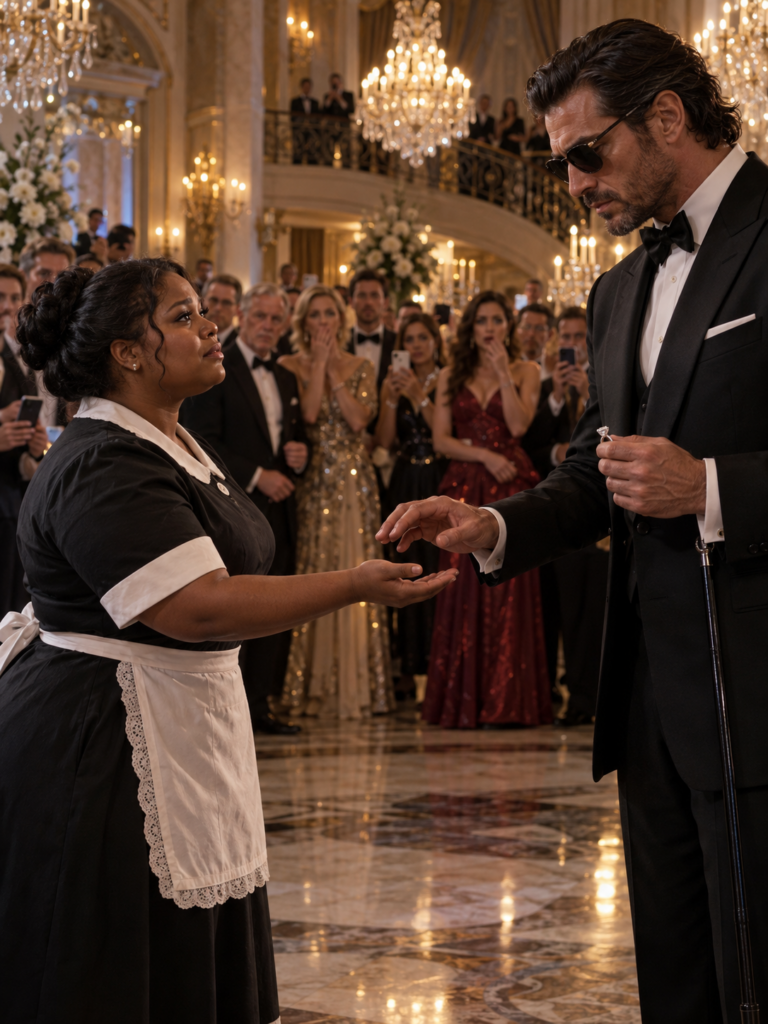
The library door opened before Winnie could answer.
Giani Valtieri entered carrying a leather folder.
He was handsome, impeccably dressed, and smiling with the effortless confidence of a man accustomed to controlling every conversation.
“Cousin,” he said warmly. “I’ve been looking for you.”
Then he noticed Winnie.
His smile remained.
His eyes changed.
“Well, if it isn’t our famous dancer.”
Winnie lowered her hands.
“Good afternoon, Mr. Valtieri.”
“I imagine you’re enjoying all the attention.”
“Not particularly.”
Giani gave a quiet laugh.
He approached Nico’s chair and touched his shoulder.
“I have the Holland’s freight renewal. Nothing complicated. We just need your signature before five.”
Nico extended his hand for the folder.
Winnie looked at the documents.
Twenty-two pages.
A contract Giani had already decided wasn’t worth explaining.
She remembered Josephine sitting helplessly at her kitchen table while relatives summarized bank letters without telling her what they actually said.
Before she could reconsider, Winnie spoke.
“I could read it aloud.”
Giani stopped smiling with his eyes.
“That’s very kind, but unnecessary.”
Nico remained still.
Giani continued.
“I’ve handled his paperwork for eighteen months.”
Winnie glanced toward Nico.
She knew she was crossing a dangerous line.
But she also knew that being blind didn’t mean a person should receive only the information somebody else considered convenient.
“It would only take some time,” she said.
Giani laughed softly.
“Twenty-two pages, Miss Dubois.”
Nico lowered his hand.
“Then I suppose we’ll need some patience.”
Winnie looked at him.
Giani’s expression tightened.
“Nico, surely—”
“I’d like to hear the whole agreement.”
For several seconds, nobody moved.
Then Giani placed the folder on the desk.
“Of course. I’ll collect it later.”
He left.
The door clicked shut.
Nico leaned back.
“You’ve just annoyed my cousin.”
“I’m sorry.”
“Are you?”
Winnie hesitated.
“No.”
A small sound escaped him.
Almost laughter.
“Good. Read.”
She began with the opening definitions.
She wasn’t a lawyer.
Some provisions required careful reading, and twice Nico explained terminology she didn’t recognize.
But Winnie continued without skipping anything.
She had spent years helping Josephine understand medical bills, disability paperwork, and insurance correspondence.
She knew that documents often became dangerous where ordinary people stopped paying attention.
Forty minutes later, they reached page nineteen.
Winnie slowed.
The contract described a change to the account receiving freight payments.
She read the provision again.
Nico straightened.
“Which company?”
“Ridgeline Transport Partners.”
Silence.
“Read that entire section again.”
She did.
Nico’s face became unreadable.
“Has Giani mentioned that company?”
“Not to me.”
“He hasn’t mentioned it to me either.”
Winnie looked at the folder.
The payment destination wasn’t a minor administrative detail.
It could change where substantial revenue was deposited.
“Should I keep going?” she asked.
“Yes. Every word.”
When the final page was finished, Nico left the document unsigned.
He sat quietly for a long moment.
Then he asked whether she would return tomorrow.
“To read another contract?”
“Among other things.”
Winnie frowned.
“I’m a housekeeper.”
“And apparently you’re the first person who’s read me an entire agreement in eighteen months.”
He offered to pay her twice her usual hourly wage for two hours of daily reading.
The amount would make an enormous difference to her family.
Her mother, Marguerite, worked two jobs despite a painful knee.
Winnie could already imagine the bills they might finally pay.
But she hesitated.
“I have one condition.”
Nico’s eyebrows lifted.
“Go on.”
“If I help you read, you have to let me teach you how to read things independently. Screen-reading technology, accessible files, whatever works for you.”
He stiffened.
“I employ people for that.”
“I noticed.”
The answer seemed to irritate him.
Winnie continued.
“And I want you to learn to move around your own home without waiting for someone to escort you.”
Nico turned toward the window.
“You make a great many demands for someone who’s just been offered a promotion.”
“It’s not a promotion if you become dependent on me instead of your cousin.”
The room fell quiet.
Eventually he nodded.
“All right.”
Winnie exhaled.
“Then tomorrow we’ll begin.”
“With what?”
“Your coffee.”
He looked toward the cup beside him.
“What’s wrong with my coffee?”
“It’s been cold for hours.”
For the first time, Nico laughed.
It was brief, rough, and startlingly human.
As Winnie gathered the papers, she realized something important.
She had changed how a powerful man would receive information.
And Giani would not forgive her for it.
She left the library carrying her folded apron.
On the back staircase, Giani stood waiting near the landing.
His friendly expression was gone.
“I hear the reading went well.”
“Yes, sir.”
He moved one step closer.
“Mr. Valtieri is vulnerable right now. He’s inclined to confuse kindness with loyalty.”
Winnie remained silent.
Giani lowered his voice.
“You should remember who has kept this family functioning since the accident.”
She looked at him.
“I understand.”
“Do you?”
He smiled again.
Then he asked a question that made her blood run cold.
“Tell me, Miss Dubois. How much of my telephone conversation did you hear that night?”
Winnie’s fingers tightened around her apron.
He had been watching her more closely than she realized.
And he wasn’t finished.
Winnie held Giani’s gaze.
“What telephone conversation?”
His smile remained perfectly arranged.
“The one near the ballroom service corridor.”
She could hear someone moving dishes in the kitchen below.
For one irrational moment, she wanted to call out.
But she knew that if she panicked, Giani would understand exactly how much she remembered.
“I was cleaning up that night,” she said. “I heard plenty of conversations.”
Giani considered her.
Then he stepped aside.
“Good. Let’s hope they stay unimportant.”
Winnie walked past him without hurrying.
Only when she reached the laundry room did she realize her hands were shaking.
The next afternoon, she returned to the library.
Nico had moved his coffee to the edge of the table.
“Are we starting with another contract?”
“No,” Winnie said. “We’re starting with the coffee.”
He was visibly unimpressed.
“You’re serious.”
“Completely.”
For the next half hour, Winnie helped him practice a safe, repeatable method of preparing and pouring his own drink.
He disliked the equipment.
He disliked asking questions.
And he particularly disliked making mistakes.
When he spilled coffee across the table, he swore.
Winnie handed him a towel.
“Josephine once threatened to throw an entire coffee pot out the window. You’re being relatively polite.”
Nico went silent.
Then he laughed.
A real laugh.
Tomas, passing outside the library, stopped so abruptly that his shoes squeaked.
Inside, Nico looked almost embarrassed.
“Don’t tell anyone.”
“I think the entire house heard.”
Over the following weeks, their lessons continued.
Winnie helped Nico configure accessible features on his phone and computer. He began learning the routes through his house using a white cane.
Some days he was patient.
Other days he was furious.
He had spent eighteen months believing the accident had permanently reduced him to someone who needed permission to move through his own home.
Independence felt unfamiliar.
And it frightened him more than he expected.
Winnie never pretended the process would be easy.
She also refused to treat him like a child.
By the end of the second week, he could make his own coffee.
By the third, he could travel from the library to the kitchen independently along a familiar route.
The kitchen staff stared the first time he appeared.
Nico asked what was being prepared for dinner.
The cook nearly dropped a saucepan.
Later, Winnie found Nico sitting in the library, quietly pleased with himself.
“You’re smiling,” she said.
“Am I?”
“A little.”
“Don’t tell Tomas.”
She laughed.
Their afternoons began extending beyond practical lessons.
They talked about books.
About childhood.
About Josephine’s stubbornness.
About the fear of becoming a burden.
Nico admitted he had stopped listening to music after the accident because every song reminded him of a life he could no longer live in the same way.
Winnie brought him an audiobook and introduced him to a mystery series she loved.
He complained about the narrator.
Then asked for the next book.
Yet the more Nico trusted Winnie, the more isolated she became among the household staff.
Two younger housekeepers began mocking her openly.
They suggested she was using the viral dance to attract Nico’s attention.
One morning her cleaning cart disappeared.
Another day someone taped a weight-loss pamphlet to her locker.
Winnie reported both incidents to Dorene Pratt, the head housekeeper.
Dorene offered little assistance.
She suggested Winnie had drawn attention to herself by spending so much time with the family.
Winnie left her office furious.
She had agreed to help Nico regain independence.
She had not agreed to become everybody’s entertainment.
Unknown to her, Walter, the elderly gardener, had witnessed the mistreatment.
He mentioned it to Tomas.
Tomas told Nico.
The next morning, the staff received a formal notice that harassment and interference with another employee’s work would not be tolerated.
Nico did not publicly connect the notice to Winnie.
He also did not demand gratitude.
When Winnie eventually learned what had happened, she found herself thinking about it long after her shift ended.
For a man who had built his reputation on control, he was beginning to understand that protecting someone didn’t require controlling their response.
But he was still a man with dangerous responsibilities.
Winnie never forgot that.
And neither did Giani.
As the weeks passed, Winnie continued reading documents.
She noticed that three Valtieri trucking companies had reported persistent losses since the explosion.
Before that, each had operated profitably for years.
The same unfamiliar company kept appearing in the paperwork.
Ridgeline Transport Partners.
Winnie began comparing dates and figures.
She wasn’t a financial specialist, but she recognized patterns.
Every lost contract seemed to benefit the same business.
Late one evening, she searched the Pennsylvania business registry.
Ridgeline had been established twenty months earlier.
Two months before the explosion that blinded Nico.
Its listed owner was Christina Valtieri.
Giani’s wife.
Winnie stared at the screen.
She remembered Giani’s phone call after Arabella abandoned Nico.
His satisfaction.
His statement that the dance had complicated something.
She began to suspect the engagement humiliation and the financial irregularities were connected.
But suspicion wasn’t evidence.
And accusing the man who effectively controlled the family’s operations could put her in danger.
Winnie saved the information and continued working.
One afternoon, Nico interrupted her reading.
“Winnie?”
“Yes?”
“What do you look like?”
She froze.
Nobody had asked her that question with such direct curiosity in years.
She could have offered a vague answer.
Instead, she told him.
She described her brown skin, rounded cheeks, and the hair she kept in a bun for work.
She told him she was plus-size and had been since childhood.
Then she told him something she hadn’t intended to say.
“People have spent my whole life acting as though my body is a mistake I’m supposed to correct.”
Nico was quiet.
“I can’t judge your appearance,” he said. “But I know how people speak when you enter a room.”
Winnie looked toward the window.
“And what do they sound like?”
“Sometimes foolish.”
She laughed softly.
He continued.
“I know you’re patient with me when I’m learning something difficult. I know you ask questions other people are afraid to ask. And I know you don’t confuse agreement with respect.”
For several seconds, she couldn’t speak.
He asked whether he had upset her.
“No,” she said.
“Then what?”
“You’ve been paying attention.”
His expression softened.
Winnie realized she wanted to tell him about Ridgeline.
About Christina.
About the conversation she’d overheard.
She opened her mouth.
Then Giani entered with another folder.
He said the family trust required an urgent signature.
Routine paperwork.
Only eleven pages.
Nico asked Winnie to read it.
Giani objected.
“It’s a family matter.”
Nico remained calm.
“It’s my family’s trust. I should know what I’m signing.”
Giani left the folder on the desk.
Winnie read it that evening.
On page eight, she found a provision granting Giani broad signing authority over the Valtieri business accounts.
Nico asked her to repeat it.
She did.
He did not sign.
Instead, he instructed her to leave the folder where Giani had placed it.
“Why?” she asked.
“Because I’d like to know what he’ll do when he thinks I’m still unaware.”
Winnie felt a chill.
The next evening, Giani intercepted her on the back stairs.
This time he didn’t bother pretending to be friendly.
He knew she had been in the corridor during his call.
He knew she had questioned the freight agreement.
And he knew about her mother.
“Marguerite Dubois,” he said conversationally. “Still working at the bakery in Oakmont?”
Winnie stopped breathing.
Giani mentioned her mother’s second job.
Her painful knee.
The financial difficulties that made losing either job impossible.
He suggested that unfortunate things could happen to employers who depended on Valtieri business connections.
Then he gave Winnie an instruction.
She would stop reading for Nico.
She would return to ordinary housekeeping.
And she would never mention the documents again.
“Otherwise,” Giani said, “your mother may find life considerably harder.”
He walked away.
Winnie remained on the staircase until her legs stopped trembling.
That night she drove to Homewood.
Her mother was asleep on the couch, still wearing her bakery uniform.
Winnie stood in the doorway and stared at the woman who had worked herself exhausted trying to give her daughter opportunities.
She could walk away from the Valtieri estate.
She could pretend she had never noticed anything.
Giani might leave her family alone.
But she remembered Josephine.
The day at the church picnic when everyone ignored an elderly blind woman standing alone.
Winnie had promised herself she would never become one of those people.
The following morning, she arrived at Nico’s library early.
He had poured his own coffee.
The cup was on the table.
And for the first time, the room felt like it belonged to him again.
“Winnie?”
She closed the door.
“I have to tell you something.”
He heard the tension in her voice.
“Sit down.”
She did.
Then she told him everything.
The conversation after the engagement party.
Giani’s remarks about Arabella.
The suspicious freight contracts.
Ridgeline’s registration.
Christina’s name.
The new trust document.
And the threat against Marguerite.
Nico listened without interrupting.
When she finished, Winnie felt sick.
“I know he’s your family,” she said. “And I understand if you don’t believe me.”
Nico removed his dark glasses.
For the first time, she saw his eyes clearly.
Then he told her something that changed her understanding of the previous three months.
His vision had begun returning in a limited way.
Not recognizable faces.
Not readable documents.
But differences in light and dark.
Large shapes.
Movement near windows.
He had kept the improvement private because he feared Giani was involved in the suspicious circumstances surrounding his accident.
Before the explosion, his driver Paulie had warned him that someone had been asking about their regular travel routes.
Paulie died shortly afterward.
Nico had never forgotten.
“I didn’t know whether I could trust my suspicions,” he admitted.
“And now?”
“Now I know I can’t ignore them.”
Winnie looked toward the window.
“Can you see me?”
“A shape. Your movement. Not your face.”
She nodded.
He continued.
“I’ve been frightened of trusting anyone since the accident. And I allowed that fear to make me dependent on the wrong person.”
Winnie took a breath.
“Then we’ll need evidence.”
Nico agreed.
He hired an independent forensic accountant named Ruth Adami to examine the records.
He also offered protection for Marguerite because the threat had originated inside his household.
Winnie insisted her mother be informed and allowed to decide what security arrangements she would accept.
Nico agreed without argument.
Over the following days, Winnie reduced her visible reading duties.
Giani believed his warning had worked.
She returned to ordinary housekeeping.
Her coworkers whispered that she had lost her privileged position.
But privately, she continued helping Nico compare documents through a trusted channel arranged with Tomas.
Ruth examined the records.
And the financial pattern was worse than Winnie had imagined.
Millions of dollars in freight contracts had been diverted.
The payment trail repeatedly pointed toward Giani’s control.
Then, on Friday morning, Winnie opened her locker.
Inside lay Nico’s expensive gold watch.
She had never touched it.
Dorene appeared behind her with a security guard.
Giani had reported the watch missing.
Winnie protested.
Nobody believed her.
She was escorted from the estate in front of the kitchen staff.
Someone filmed her humiliation.
Giani’s message was unmistakable.
She was disposable.
And he wanted everyone to believe she was a thief.
Winnie sat in her car, struggling to breathe.
Then her phone rang.
Nico.
She answered.
“I didn’t take it.”
“I know.”
Her voice broke.
“Everybody thinks I did.”
“I’ll correct it.”
“Not yet,” she whispered. “If you expose what we know now, Giani will change everything before Ruth finishes.”
Nico remained silent.
Then he apologized.
Not for the theft.
For allowing his investigation to leave her vulnerable.
He told her Giani would be confronted at the foundation gala the following evening, where Ruth could present the documented financial findings.
Winnie looked down at her discarded apron.
“That gala has outside catering staff, doesn’t it?”
“Yes.”
She wiped her eyes.
“Then there’s a way I can be there.”
The next evening, Winnie entered the hotel ballroom wearing a borrowed catering uniform.
Three hundred guests filled the room.
Nico arrived using his white cane publicly for the first time.
Giani stood near the head table beside Christina.
He smiled when Nico approached.
He had no idea Ruth Adami was present.
And he had no idea the woman he’d dismissed as a thief was standing behind the bar.
At eight twenty, the ballroom doors opened.
Arabella Stroud walked in wearing silver.
She saw Nico.
Then Winnie.
Her expression turned cruel.
“So this is where you’ve ended up,” she called. “Serving champagne after being fired for stealing?”
The room went quiet.
Arabella approached the bar.
She mocked Winnie’s appearance.
Then Nico’s blindness.
Then the dance they had shared.
For a moment, Winnie felt the familiar urge to disappear.
Instead, she put down her tray.
She took a folded sheet of paper from her apron.
And asked Arabella one question.
“Who paid you to abandon Nico at his engagement party?”
Arabella’s face changed.
Across the room, Giani stopped smiling.
Winnie unfolded the paper.
And began to speak.
Winnie held the paper steady despite the tremor in her fingers.
“I was in the service corridor after the engagement party,” she said. “I overheard Mr. Giani Valtieri discussing the way Arabella had ended the engagement.”
Giani laughed.
“Is this some kind of joke?”
Winnie continued.
“He said she had followed their plan. He also said my dancing with Nico had caused a problem.”
Arabella took one step backward.
People began whispering.
Giani crossed his arms.
“This woman was dismissed for stealing from my cousin. I suggest everyone remember that before taking her accusations seriously.”
Winnie felt the old humiliation return.
The locker.
The security guard.
The faces of people who had worked beside her for years and refused to believe her.
But she wasn’t standing there to defend her reputation alone.
She had something concrete.
“Ridgeline Transport Partners,” she said.
Giani’s expression sharpened.
“The company was established two months before the explosion on Route 65. Since that explosion, it has acquired freight business lost by three Valtieri trucking companies.”
She turned toward Christina.
“The company is registered in your name.”
Christina’s champagne glass slipped from her fingers.
It shattered on the floor.
She stared at her husband.
“What company?”
Giani’s jaw tightened.
“Winnie is confused.”
“No,” Winnie said. “I can explain the contracts I’ve read.”
Giani started toward her.
Nico raised one hand.
Tomas and the security staff moved between them.
Giani stopped.
His face changed.
For the first time that evening, he looked uncertain.
Nico removed his dark glasses.
His eyes were directed toward the indistinct movement of his cousin’s body.
“I know you’re standing there, Giani.”
Giani tried to laugh.
“Nico, you’re exhausted.”
“Don’t speak to me like I’m a child.”
The words carried across the room.
Nico explained that he had experienced a partial improvement in light perception.
He could detect shapes and some movement, but he still could not identify faces or read print visually.
Giani had not known.
“And while you were telling me I couldn’t understand my own affairs,” Nico said, “I was learning how to examine them without relying on you.”
Then Ruth Adami stood.
She carried a leather portfolio to the front of the room.
Her report identified approximately $4.1 million in business diverted from Valtieri operations through questionable contract changes.
She had traced approvals and account activity back to systems controlled by Giani.
These were documented findings, not simply Winnie’s suspicions.
Giani denied everything.
Ruth presented the relevant records.
Then Arabella began crying.
She admitted Giani had approached her weeks before the engagement party.
He had convinced her that Nico would soon lose control of his businesses.
He had described their future together as one in which she would become the permanent caretaker of a powerless husband.
And he had offered her two hundred thousand dollars to end the engagement publicly.
The humiliating speech had been rehearsed.
Arabella had agreed.
Nico stood motionless.
Winnie wanted to approach him.
But he had asked her to let him handle his own part of the confrontation.
So she waited.
Christina suddenly spoke.
“I never created Ridgeline.”
Everyone turned.
She explained that Giani had repeatedly asked her to sign household and tax-related documents without explaining their contents.
She had trusted him.
Now her name appeared on a company registration she didn’t recognize.
When Ruth showed her the recorded signature, Christina noticed that even the middle initial was incorrect.
The room erupted.
Giani’s denial became increasingly strained.
He accused everyone of conspiring against him.
But the documents existed.
Arabella had admitted being paid.
And Nico was no longer prepared to accept his cousin’s explanations without verification.
Local authorities arrived after receiving the financial allegations and supporting materials.
Giani was taken away as the investigation continued.
He stopped near Winnie.
“You don’t know what you’ve gotten yourself into.”
Winnie looked straight at him.
“I know exactly what I reported.”
He left under escort.
Only then did she realize she was shaking.
Nico approached with his cane.
“Winnie?”
“I’m here.”
“Are you safe?”
“Yes.”
He breathed out.
For a moment, neither spoke.
Then he said, “Thank you.”
Winnie shook her head.
“This isn’t finished.”
She was right.
The next morning, Ruth discovered a transfer that had taken place shortly before the explosion.
Eleven thousand dollars had moved from an account linked to Giani to a mechanic named Dale Kowalik.
Dale had worked at the garage that serviced Valtieri vehicles.
He had left his job immediately after the explosion and relocated to Arizona.
Nico listened to Ruth’s report in the library.
Winnie sat nearby.
For a long time, the room remained silent.
Finally Nico said, “Paulie warned me about someone asking questions concerning our driving routes.”
His driver had worked for the family for nineteen years.
He had two daughters.
He had trusted Nico.
And he had died in the explosion that changed Nico’s life.
Winnie could hear the effort it took for Nico to remain calm.
He told her that his father would have handled a betrayal like this through the family’s own methods.
Violence.
Revenge.
A private punishment that nobody outside the organization would ever fully understand.
Winnie didn’t tell him what to do.
She waited for him to decide.
Then Nico picked up the telephone.
He contacted federal prosecutors and provided the audit findings, the transfer information, and the evidence concerning the suspicious business transactions.
It meant submitting his own affairs to scrutiny.
It meant accepting that investigators might uncover other matters he would rather keep private.
And it meant rejecting the kind of retaliation people expected from a man with his reputation.
When he ended the call, his hands were unsteady.
Winnie placed a glass of water on the table within his reach.
“You’ve made your choice.”
“Yes.”
“Then you can live with it.”
He nodded.
That choice was not an instant redemption.
Nico still operated in a dangerous world.
He still had responsibilities and business relationships that Winnie did not want to share.
But she recognized the significance of what he had done.
For once, power had not been used to bury a truth.
It had been used to make a truth available for examination.
Three days later, Walter the gardener provided another important piece of evidence.
He had maintained a small camera near the upstairs hallway to monitor a recurring problem with animals entering the attic.
The recording showed Giani entering Nico’s dressing room on the morning the watch disappeared.
Later footage placed him near the staff locker area.
The footage did not independently show every action involved in planting the watch, but it undermined Giani’s account and supported further investigation.
Dorene Pratt reviewed it.
Then she called Winnie.
Her apology was difficult to hear.
Not because Winnie doubted its sincerity.
Because Dorene admitted she had allowed the younger staff to mock and isolate Winnie for months.
She had found it easier to blame Winnie for attracting attention than to confront the cruelty.
Winnie listened.
She accepted the apology.
But she also asked for the video of her dismissal to be deleted and for the employees involved to acknowledge what they had done.
Dorene agreed.
The next day, Kayla called.
She apologized through tears.
Winnie didn’t humiliate her.
Instead, she told her to remember what it felt like to discover she had participated in hurting someone who had done nothing to deserve it.
“I hope the next time somebody gets laughed at,” Winnie said, “you’ll be the person who stops it.”
The following Friday, Nico invited Winnie to the library.
She entered through the front door of the estate for the first time in four years.
Tomas held it open.
Nico had made two cups of coffee.
Both were hot.
He asked her to sit down.
Then he offered her a position as his personal assistant.
The salary was five times what housekeeping had paid her.
She would review correspondence, help coordinate meetings, and provide the honest perspective he had come to trust.
Winnie listened to the entire offer.
Then she said no.
Nico went very still.
“You haven’t heard all the benefits.”
“I’ve heard enough.”
“Is the salary inadequate?”
“The salary would change my family’s life.”
“Then why refuse?”
Winnie leaned forward.
“Because I don’t want to become the next person you can’t function without.”
Nico said nothing.
“I spent months helping you learn how to make your own choices. I won’t turn that progress into another arrangement where somebody controls which information you hear.”
His expression tightened.
“You believe I’d let that happen?”
“I believe people develop habits. And you spent eighteen months surrounded by people who thought controlling your life was the same as helping you.”
Nico considered that.
Finally he asked what she wanted instead.
Winnie had been thinking about the answer for weeks.
The Valtieri Foundation raised substantial funds for low-vision rehabilitation across Western Pennsylvania.
Much of its support went to medical and clinical services.
Those programs mattered.
But Winnie knew another need existed.
When Josephine lost her vision, the hardest challenges often happened at home.
Cooking.
Sorting medicines.
Reading correspondence.
Traveling familiar routes independently.
Learning new technologies.
Understanding that blindness didn’t erase adulthood.
“I want to develop an independent-living program,” Winnie said.
Nico listened.
“A program focused on practical skills, accessible technology, home orientation, and support from qualified specialists.”
“You want me to fund it?”
“I want the foundation to consider it.”
“Then you should run it.”
“I want to apply for the job.”
Nico frowned.
“Apply?”
“Through a proper hiring process. With other candidates.”
“You’re the person who proposed it.”
“That doesn’t mean you should appoint me.”
He was quiet.
She added one final condition.
“You must stay out of the selection process.”
A slow smile appeared.
“You don’t make things easy.”
“No.”
“All right.”
The foundation approved the proposal.
A position was advertised.
Thirty-one people applied.
Winnie interviewed before an independent panel.
She brought practical records from the years she had helped Josephine.
She brought examples of the paperwork she had navigated and a detailed outline of independent-living challenges.
She made no claim to be a clinical expert.
Instead, she explained what she knew, where her experience began and ended, and how she would work alongside trained rehabilitation professionals.
The panel appreciated her honesty.
On December second, her phone rang.
Dr. Leah Okafor, one of the interviewers, congratulated her.
Winnie had been selected.
She was going to direct the new program.
Her mother screamed when she heard the news.
Winnie laughed and cried on the kitchen floor.
The same kind of worn linoleum floor where she had learned to dance with Josephine.
But this time, nobody had selected her because they pitied her.
She had competed for the position.
She had explained her experience.
And she had earned it.
The Valtieri Independent Living Program opened in February in a modest rented storefront on Penn Avenue.
There were two desks.
An accessible demonstration kitchen.
Equipment for training and practice.
And a slightly crooked handmade sign Walter insisted on contributing.
Winnie’s first client was Harold Biggs, a seventy-one-year-old retired steelworker who had lost his remaining sight to diabetes.
He arrived with his daughter and a furious expression.
“I don’t need a program,” he said. “I need my eyesight.”
Winnie sat across from him.
She didn’t argue.
“What do you miss doing for yourself?”
Harold stared toward the sound of her voice.
Then he admitted he missed cooking breakfast.
His wife had died years earlier.
Every morning he had prepared eggs in the same cast-iron pan.
After losing his vision, he had stopped.
His daughter now came over to prepare his meals.
He hated feeling dependent.
Winnie listened.
Then she arranged for him to work with the program’s qualified instructors.
They began with safe kitchen orientation and accessible methods of completing familiar tasks.
Progress took time.
The first attempt was messy.
So was the second.
But Harold kept practicing.
The morning he prepared his own breakfast again, his daughter cried.
Winnie watched quietly.
She thought about Josephine.
And about how much dignity could fit inside an ordinary domestic moment.
By spring, the program had twenty-six clients.
By June, two more instructors had joined the team.
One was Tess Duca.
Paulie’s eldest daughter.
She had trained in occupational therapy and had spent years working in elder care.
Winnie had been nervous about interviewing her.
The Valtieri name carried a painful history for the Duca family.
But Tess made her feelings clear.
She blamed the people responsible for her father’s death.
Not the man who had been injured beside him.
Tess proved to be an excellent instructor.
When Nico visited the program and met her, he stood and offered his hand.
They remained together for a long moment, remembering Paulie.
Winnie stepped into the hallway to give them privacy.
Meanwhile, the investigation into Giani continued.
Dale Kowalik was arrested in Arizona.
Investigators established his involvement in deliberately compromising the Valtieri vehicle before the explosion.
His statements connected Giani to the scheme and the payment.
The revelation was devastating.
Paulie had not been the accidental victim of an ordinary mechanical failure.
The crash had been connected to a calculated betrayal.
Nico gave investigators everything he possessed that could assist the case.
He also made sure Paulie’s daughters were treated as people whose loss mattered, rather than names buried inside a criminal file.
Giani’s trial began in September.
His defense team attacked the reliability of witnesses and challenged the financial findings.
When Winnie testified, his attorney attempted to undermine her credibility.
He emphasized that she had worked as a housekeeper.
That she had no accounting degree.
That she had been accused of stealing.
Then he suggested she had invented parts of her story because she enjoyed the attention that followed her public dance with Nico.
Winnie listened without interrupting.
When it was her turn to answer, she acknowledged that she had spent much of her life being overlooked.
She acknowledged the rumors.
She acknowledged that the viral video had brought attention she had never sought.
Then she explained that none of those things changed the documents, the company registry, the recorded transactions, or the independent evidence gathered afterward.
She had not invented the financial pattern.
She had noticed inconsistencies and asked questions.
The attorney pressed harder.
Winnie didn’t retreat.
She answered only what she knew.
And when she didn’t know something, she said so.
That honesty mattered.
The case did not depend solely on her testimony.
Ruth’s forensic work, the business records, Arabella’s evidence, Christina’s account, and Dale’s statements provided independent support.
Giani was convicted.
The family that had once treated him as indispensable now had to confront what his ambition had cost them.
For Nico, the verdict brought relief.
But not uncomplicated peace.
Paulie was still gone.
Eighteen months of his own life had been stolen.
His trust had been shattered.
And the organization he inherited still required difficult choices.
Winnie never pretended love could erase those things.
She had her own work.
Her own responsibilities.
Her own future.
She also had her own growing feelings for the man who had listened to her when nobody else would.
Those feelings developed slowly.
They met outside the estate.
Coffee became dinners.
Dinners became long conversations.
Nico visited the independent-living program but never interfered in staffing or budgets.
Winnie declined an expensive gift because she didn’t want their relationship measured by what he could buy.
He respected that.
She also told him she wouldn’t participate in criminal operations, accept hidden obligations, or abandon the program for his convenience.
He accepted those boundaries too.
They disagreed sometimes.
Especially when his instinct was to make decisions quickly and privately.
But he had learned something from the woman who once asked him to dance.
Before acting on someone else’s behalf, he needed to ask what they wanted.
And then listen.
Almost a year after the engagement party, the Valtieri Foundation held its annual gala.
Winnie arrived as the director of a successful program, not as a member of the household staff.
She wore an elegant dark blue dress she had chosen herself.
Her hair was pinned softly above her shoulders.
She wasn’t trying to look smaller.
She wasn’t trying to disappear.
Yet the ballroom still made her nervous.
She remembered the trays.
The laughter.
The guests lifting phones to film a blind man being abandoned.
For a moment, she instinctively looked toward the service entrance.
Then Tomas approached.
“Ms. Dubois, your place is at the head table.”
Winnie stared.
“My what?”
He guided her toward the front.
A place card identified her as the independent-living program’s director.
She stood behind her chair for several seconds before sitting.
Nico had not told her about the arrangement.
She wondered whether she should be irritated.
Then she realized it wasn’t a romantic surprise.
Her professional position warranted the seat.
And everyone at the table treated her accordingly.
When Nico rose to speak, he used his white cane to reach the podium.
He had learned to read braille.
Slowly, with practiced movements, he delivered his speech from prepared pages.
He spoke about Paulie.
About Tess and Maria.
About Harold Biggs learning to cook again.
About the many people who had discovered that losing vision did not mean losing the right to make decisions.
Then his voice changed.
“Last year, at an event in this room, I found myself standing alone.”
The audience became silent.
“I had spent months believing that independence was something I’d lost forever.”
He paused.
“But someone reminded me that needing information is not the same as needing permission.”
Winnie’s eyes filled.
Nico continued.
“A woman who worked in my home walked across this floor and offered me a choice. She gave me enough information to make that choice for myself.”
He looked toward the area where he knew Winnie’s table was situated.
“That act of respect changed the way I understood everything that followed.”
The room applauded.
Winnie wiped her eyes.
She thought about Josephine, who had taught her that a person deserved to know where the furniture was before being expected to move through a room.
She wished her grandmother could see what those lessons had become.
But the evening wasn’t finished.
After dinner, the band began playing a familiar waltz.
Winnie recognized it immediately.
Her heart jumped.
It was the music Josephine had taught her to dance to.
The same music that had played when Arabella walked away.
She looked toward Nico.
He was already standing.
With his cane, he navigated toward her.
He stopped beside her chair.
Then he held out his hand.
“Winnie, would you dance with me?”
She smiled through her tears.
“You already know the answer.”
“I’d still like to ask.”
She rose.
He waited until she placed her hand in his.
They walked onto the floor.
This time, Nico didn’t need Winnie to describe every obstacle.
He understood the space.
He had practiced navigating it.
He knew the music.
He knew the steps.
And he knew the woman beside him wanted to be there.
Before they began, he leaned closer.
“I need to tell you something.”
She grew still.
“All right.”
“My neurologist doesn’t expect my vision to recover enough for me to see your face clearly.”
Winnie squeezed his hand.
“I’m sorry.”
“I’m not telling you because I need sympathy.”
“Then why?”
“Because I used to believe I couldn’t fall in love without being able to see the person in front of me.”
Her breathing caught.
Nico continued quietly.
“I was wrong.”
He told her he loved her.
Not because she had rescued him.
Not because she had become useful to him.
And not because he needed someone to replace the control Giani once held.
He loved the woman who told him uncomfortable truths.
Who helped build something valuable for strangers.
Who stood up to people who underestimated her.
Who had the courage to walk away from an offer that didn’t match her own ambitions.
He also understood that loving her did not entitle him to an answer.
Winnie looked at him for a long moment.
Then she placed her other hand against his shoulder.
“I love you too.”
Nico let out a breath.
She smiled.
“But you don’t get to make decisions for me.”
“I know.”
“And my program stays mine.”
“I know.”
“And sometimes I’m going to disagree with you.”
“I’d be worried if you didn’t.”
Winnie laughed.
Then Nico asked whether she was ready.
She nodded.
He began to lead.
The waltz carried them across the ballroom.
A year earlier, Winnie had counted the steps for him.
Now she could simply dance.
They moved slowly at first, then with growing confidence.
Nico remained attentive to the floor beneath him and the rhythm they shared.
Winnie followed when she wished, adjusted when she needed, and trusted him to do the same.
The guests watched.
But for Winnie, the room no longer felt like a place where her worth would be decided by strangers.
She had her career.
Her family.
Her independence.
Her own hard-earned place in the world.
And beside her was a man who had learned that trust meant allowing another person to remain fully themselves.
Nico couldn’t see the blue of her dress.
He couldn’t read the joy in her eyes.
But he knew when she smiled because he could hear it in her breathing.
He knew when she relaxed because her hand became warmer in his.
And he knew, without needing anyone to tell him, that she had chosen to stay.
When the song ended, Winnie kept holding his hand.
For the first time, neither of them needed the music to continue.
They had already decided what came next.
Together.
By choice.
And with enough room for both of them to live their own lives.


