
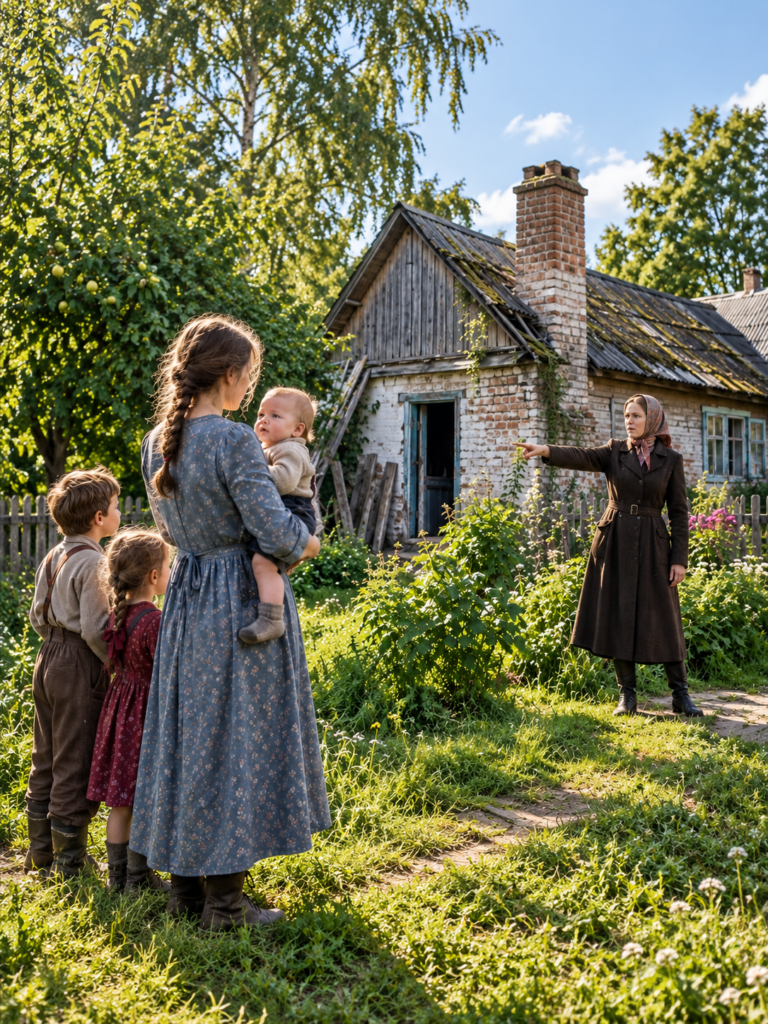
the poor widow inherited her mother’s abandoned farmhouse and one hidden wall in the bedroom held a fortune that changed everything for her children
Part 1
The eviction notice had been taped to the apartment door for six days. Sarah Bennett stared at it every time she came home from the part-time job at the grocery, the paper already curling at the edges from the damp hallway air. Inside, the one-bedroom unit smelled of reheated soup and the baby’s formula. Michael, four years old, sat on the floor with his fire truck, rolling it back and forth without making the usual engine noises. The baby, Paul, was eight months old and cried whenever the wind rattled the cheap windows.
Six months earlier her husband had died in a mill accident. The insurance money had covered the funeral and two months of rent. After that the bills stacked up faster than she could work. She had stopped answering the landlord’s calls. She had stopped answering most calls.
The notary’s office called on a Tuesday morning while she was packing diapers into a plastic grocery bag. Her mother had died. There was an inheritance. Sarah’s first thought was money—enough to buy another month, maybe two. She left Michael with the neighbor who sometimes watched the children and took the bus downtown.
The envelope contained no check. Only a set of rusted keys and a deed to a house on a dirt road outside the small mountain town where she had grown up. The house where her mother had raised her alone after Sarah’s father left. The house she had left at eighteen after a fight so loud the neighbors had come onto their porches. She had sworn she would never go back.
She had no choice. The landlord wanted the apartment empty by the end of the week. She packed what would fit into two backpacks and a diaper bag, folded the stroller, and bought bus tickets with the last of the grocery-store tips.
The ride took most of the day. The bus climbed out of the valley and into the foothills, past bare fields and stands of oak already turning brown. Paul cried until he exhausted himself. Michael stared out the window the way he had since the funeral, quiet, one thumb hooked in the strap of his backpack. Sarah held the baby with one arm and rested her other hand on Michael’s head. She did not feel the confidence she was trying to give him.
She had not been home in ten years. Ten years of not speaking, of Christmas cards returned, of pride on both sides. Now her mother was in the ground and the only thing left was the house. Sarah could not name what sat in her chest—guilt, anger, or plain grief. Maybe all three.
The bus stopped at the small station at the edge of town just before sunset. No one waited for her. She asked an older man for directions. He looked at the children, then at her face, and said, “That place has been shut up for years. Your mother never went back after you left.”
Sarah nodded and walked. The town was smaller than she remembered. Wooden houses, a white church, people on porches who watched her pass. After fifteen minutes she reached the gate. The blue paint on the house had faded to gray. The windows were crooked. The iron gate hung on one hinge. The yard was waist-high in dry grass. The cherry tree she used to climb was dead, its branches twisted against the sky.
Michael tugged her sleeve. “Mama, are we going to live here?”
She made herself smile. “For now, sweetheart.”
The key turned hard in the lock. The door opened with a long creak and the smell of mold and closed rooms hit her. She pushed the stroller inside and told Michael to stay by it while she opened windows. Late light came in across furniture covered with yellowed sheets. The clock on the wall had stopped at three-fifteen. On the dining table, centered as if someone had just set it down, lay a white envelope with her name written in her mother’s shaky hand.
Sarah opened it with cold fingers.
Svetlana—no. Sarah. Daughter. If you are reading this I am gone. I was hard on you. I know I hurt you. Everything I did was to protect you even if you never saw it. This house holds more than bad memories. It holds a truth I never had the courage to tell. What you need is where you cried the most. Forgive me. Your mother.
She read it three times. Where she cried the most. She had cried in the kitchen, in the yard, in the bedroom at the end of the hall. Tears came without warning. She crumpled the letter, then smoothed it again because Michael was watching.
That night she made beds on the living-room floor with the cleanest sheets she could find. Paul slept after he nursed. Michael curled around the stuffed bear he had carried since the city. Sarah sat on the old couch in the dark because the power was off and listened to the house settle. The phrase kept turning in her mind until the memory arrived whole: the bedroom. The room at the back of the house where she had run when her mother’s voice rose, when the loneliness felt too large. She had cried there until there were no tears left.
She lit a candle and walked the dark hall. The floorboards complained under her boots. At the last door she stopped, turned the knob, and pushed. The door dragged across the floor. Inside, the single bed was still there under a coat of dust. The dark wardrobe stood against the wall. Moonlight came through the small window. She stepped in and the years came back: twelve and crying because she could not go to a friend’s house; fifteen and crying because she felt ugly; eighteen and crying because she was leaving and never coming back.
In the corner behind the wardrobe the paint was a different shade, newer, as if someone had patched it. She set the candle down and put her shoulder to the wardrobe. It was heavy. She pushed until it shifted a few inches, then again, until she could see the wall. A vertical line ran down the plaster, not a crack but a cut. She ran her fingers along it. The plaster gave. She pulled pieces away with both hands. Behind it the bricks were loose, set without mortar. She lifted one, then another. When the hole was large enough she held the candle to it.
The space between the walls was empty except for what her mother had left. An old metal safe sat against the back. Beside it was a wooden box with a small lock. Cloth bundles tied with twine lay on the floor. One had come open. Something inside caught the candlelight.
Sarah reached in and pulled the bundle free. Her hands shook so hard she almost dropped the candle. She untied the string. Inside were stones—rough, uncut, green and pink and pale blue. She had seen enough nature programs to know what she was looking at. Emeralds. Tourmaline. Aquamarine. Raw stones from the old mountain mines.
She sat down hard on the floor. Her heart hammered in her ears. She opened another bundle. More stones. Dozens. She forced herself to clear more of the wall until she could drag the safe out. The lock was old. She remembered the small key that had been in the envelope with the house keys. She ran back to the living room, found it, and returned. The key turned. Inside were yellowed papers, photographs of people she did not know, and a black notebook. The first page was dated 1943. The handwriting was not her mother’s.
Anna Bennett. Her great-grandmother. A woman Sarah had heard mentioned only in fragments, always with a kind of silence around the name.
She read by candlelight until her eyes burned. Anna had worked the gem mines when women rarely did. She had an eye for good ground. She had hidden the best stones from the buyers who cheated the diggers. When the easy ground played out and the camps grew rough she had moved to this house and buried what she had saved. She meant to tell her daughter. She died before she could. The daughter—Sarah’s grandmother—lived and died poor, never knowing. Sarah’s mother had found the diary years later while repairing the bedroom wall. She had rebuilt the wall and kept the secret. She was afraid of what greed would do to the family. She waited for the right time. The right time never came. When Sarah left after the fight, her mother decided the secret would die with her—until the illness came and she wrote the letter instead.
Sarah closed the notebook. Tears ran down her face and dripped onto the page. Her mother had not been cruel. She had been careful. The house was not a punishment. It was a last lesson. Sarah had to come back. She had to stand in the room where she had cried the most. Only then could she find what her mother had left.
She looked at the open wall, the stones, the safe. All of it belonged to her now. To Michael and Paul. It was the rescue she had prayed for. It was also a danger. She did not know how to turn raw stones into money without being cheated. She did not know who else might already suspect what the closed house held.
Outside, the town was quiet under a clear mountain sky. For the first time in months Sarah felt something steadier than hope. She had a chance. She would not waste it. She also knew the path would not be safe. Someone in town had already noticed lights in a house that had been dark for years.
Part 2
Michael woke her by tugging her sleeve. “Mama, I’m hungry.” Sunlight came through the dusty living-room window. Paul was crying in the stroller. Sarah had slept only a few hours, sitting on the bedroom floor with her back against the wall as if she could guard the hole by staying awake.
Before she fed the children she moved everything. The stones, the safe, the wooden box, the papers—she carried them to the old wardrobe and buried them under decades of clothes at the bottom. She pushed the wardrobe back against the wall as far as it would go. It was not perfect. It would have to do.
She made breakfast from what she had carried on the bus: crackers, the last of the bread, a juice box for Michael. Paul nursed and settled. While Michael ate she thought about the next step. She could not walk into a jewelry store in a town this small and set raw emeralds on the counter. She needed someone she could trust.
A knock came at the front door. Sarah froze. Michael stopped chewing. She went to the door and looked through the crack. A man in his fifties stood on the porch, cap in his hands, work clothes, a serious face.
“Morning,” he said when she opened the door a few inches. “Name’s Steve. I was a neighbor to your mother. Came to say I’m sorry for your loss and to ask if you need any help with the place.”
Something in the way he tried to see past her made her keep the door narrow. “Thank you. We’re managing.”
“House has been closed a long time. Bound to need work. I’m handy if you want.”
“No, thank you. Still unpacking.”
She started to close the door. He put his hand on the frame. “This place has stories. Your mother kept to herself. Never let anybody in. Folks thought it was odd. If you need anything—anything at all—I’m just down at the corner. Call out.”
The words sat heavier than they should have. Sarah nodded, shut the door, and locked it. Michael watched her with the too-careful look he had learned since his father died.
“Who was that?”
“Just a neighbor. Finish your crackers.”
She did not sit still. She walked outside with the weak phone signal and searched for her old classmate Andrew. He had left town years ago and worked in mineral consulting in the city. She found his profile and sent a message. He answered in fifteen minutes and called at eleven.
She took the call in the yard while the children played under the dead cherry tree. “Andrew, I need help. It’s serious.”
She told him only what she had to. Stones. A lot of them. She thought they were emeralds and tourmaline. He went quiet, then said, “Don’t show them to anyone there. The market up here is full of people who will take advantage or worse. I can get you to a certified gemologist I trust, but you have to bring them to the city. Hide them well. Tell no one.”
They set a time for the next morning. Sarah spent the afternoon at the small store in town buying bread, milk, and diapers with the last of her cash. The woman behind the counter recognized her.
“You’re Margaret’s girl. Sorry about your mother. She was quiet but she paid on time. House must need a good cleaning after all these years.”
Sarah paid and started to leave. The woman added, “There’s a man who’s asked about that place for years. Steve. Always wanted to buy the lot. Said he wanted to put up rental houses. Offered your mother money more than once. She never sold.”
Sarah’s stomach tightened. She thanked the woman and walked back fast.
That night, after the children slept, she chose the best stones she could identify by eye, wrapped each in clean cloth, and put them in an old backpack she found in the wardrobe. She slid the pack under the makeshift bed. The rest stayed hidden. At two in the morning she woke to a sound at the back of the house—wood creaking, metal shifting. Someone was trying the kitchen door.
She rose without turning on a light, took the mop handle from the corner, and moved down the hall. The door moved again. She drew a breath and shouted, “Get off this property. I’ve already called the sheriff.”
The noise stopped. Footsteps hurried through the tall grass and were gone. Sarah locked every door and window, braced a chair under the back knob, and sat the rest of the night with the mop handle across her knees.
At first light she woke the children, shouldered the backpack, and left. She would not wait to learn who had tried the door. The bus to the city left at seven. She reached the station early, bought tickets with what little money remained, and chose seats at the back. The pack stayed between her feet. Michael slept with his head on her leg. Paul nursed and slept. She watched the road and did not close her eyes for long.
Part 3
The city bus station was loud and bright after the mountain quiet. Sarah texted Andrew. He sent an address near the old square. She used the last of her credit to call a taxi. The driver helped with the stroller and asked no questions. Twenty minutes later she stood in front of a brick building with a modest sign: Bennett & Partners, Gemology and Mineral Consulting. She carried Paul up the stairs while Michael climbed beside her.
The man who opened the office door was past sixty, gray-haired, glasses, a calm face. “Sarah. I’m Paul. Andrew told me you were coming. Please sit.”
She set the children down and opened the backpack. One by one she unwrapped the stones on the desk. Paul leaned forward. He picked up a dark green emerald the size of a walnut, held it to the light, then to a loupe. He was silent for nearly a minute.
“Do you have any idea what you are holding?”
She shook her head.
He set the stone down carefully. “These are exceptional. Old mountain material, most likely. I need to run a full analysis, but from what I see here you are looking at a substantial sum. Fifty to a hundred thousand dollars, possibly more, depending on the market and the rest of the parcel.”
The room tilted. Sarah gripped the edge of the chair. Tears came without permission. Michael stood and put his arms around her leg. “Mama, why are you crying?”
“Good tears,” she managed. “Very good tears.”
Paul gave her a tissue and waited. Then he explained the next steps. Full documentation would take several days. After that they could talk about buyers—private jewelers or a specialized auction. Everything had to be legal. Provenance mattered. He photographed each stone, wrote a detailed receipt, and locked them in a wall safe.
“Your phone works?” he asked. “I’ll call when I have numbers. Until then live quietly. This kind of material draws the wrong attention.”
Andrew met her on the sidewalk. “How did it go?”
“I think it went well. Thank you.”
He saw the look on her face when she realized she had nowhere to stay. “I have a small apartment a few blocks from here. Couch and a bed. You and the boys can use it until this is settled.”
She cried again, quieter this time. For the next five days she stayed in the apartment, cared for the children, and waited. Andrew came home in the evenings with food and ordinary talk that kept the fear from rising too high. On the fifth day Paul called. “Come in tomorrow morning. The news is good. Better than good.”
She left the boys with Andrew and went alone. Paul had a thick folder. Photographs, charts, certificates. He slid a paper across the desk. The number was written clearly: one hundred fifteen thousand dollars.
Sarah read it twice. It was more than she would earn in twenty years at the grocery. It was the difference between the eviction notice and a future.
Paul leaned back. “You have choices. I have three serious buyers. A direct sale can close in a week. An auction might bring more but will take months. There is also the legal side—proving inheritance, paying the proper taxes. I can recommend a lawyer who handles mineral and estate matters. It will cost a few thousand, but you do not want to receive this money and then lose it to the government or a lawsuit.”
She thought of the boys in Andrew’s apartment, of the house on the dirt road, of the man who had tried the back door. “I want it done quickly. Direct sale.”
Paul nodded. He wrote down the lawyer’s name. “Call him today. And Sarah—discretion. Do not announce anything. Do not change your life overnight. Sudden money draws eyes.”
She called the lawyer from the sidewalk. They met the next day. He was straightforward, in his forties, and walked her through inventory, declaration, and tax filings until the process made sense. She signed what he needed.
Three days later Paul called again. A jewelry house in the city wanted the entire parcel. They would pay one hundred fifteen thousand once the papers cleared. Two weeks after that the bank called. The transfer had arrived. Sarah stood in the middle of Andrew’s living room with the phone in her hand while Michael built a tower of blocks on the rug. She picked him up and held him until the shaking stopped.
That evening she took Andrew to a simple restaurant and insisted on paying. He asked what she planned to do next.
“Rent a decent apartment here first. Nothing flashy. A place where the boys can sleep through the night. The house in the mountains—I don’t know yet. Part of me wants to sell it. Part of me feels I owe my mother something. Maybe I’ll fix it. Bring the boys sometimes so they know where they came from.”
Andrew smiled. “I like that.”
She invested most of the money the way a financial advisor Andrew knew recommended. Enough set aside for monthly expenses. Enough for the boys’ future schooling. The rest in steady accounts. She bought no new car and no expensive clothes. She kept her head down the way Paul had advised. Still, the house and the man named Steve stayed in her mind. She bought bus tickets back to the mountain town.
Andrew tried to talk her out of it. “You have the money now. Sell the place from here and never go back.”
“I need to close it properly,” she said.
Part 4
She arrived on a Saturday morning and went first to the small sheriff’s office. A deputy with a thick mustache listened while she described the night someone tried the back door. She gave Steve’s name. The deputy wrote it down and said a patrol car would pass the road more often.
At the house everything was as she had left it—locked, quiet, full of dust and memory. She opened the windows. While the boys played in the yard she stood in the bedroom and looked at the hole in the wall. She ran her fingers along the edges of the loose bricks and said, quietly, “Thank you, Mama. I understand. I forgive you.”
The weight she had carried for ten years shifted. It did not vanish, but it moved.
Steve came to the door that afternoon. The deputy was with him. Steve took off his cap and looked at the porch boards. “I’m sorry. I didn’t try to break in, but I got curious when I heard you were here. I always wanted that lot. Your mother wouldn’t sell. If you’re interested I’ll make a fair offer.”
Sarah looked at him for a long moment. “It’s not for sale. Thank you for the offer.”
He nodded, disappointed, and left with the deputy. Sarah stood in the doorway and felt the mountain wind on her face. She had already decided what she would do.
Over the next months she rented a three-bedroom apartment in a quiet part of the city. Michael had his own room. Paul had a proper crib. For the first time in a long while she slept through the night without calculating how many days of food remained. She did not change her life in ways that would draw notice. She simply stopped being afraid of the mail.
The house in the mountains would not leave her. She hired a small local crew to repair it without turning it into something it had never been. They painted the outside, replaced broken windows, fixed the roof, and cleared the yard. They took down the dead cherry tree and planted a young one. Inside, she turned the bedroom where she had found the stones into a quiet memorial. She framed photographs of Anna, of her grandmother, of her mother. She placed Anna’s diary in a glass case. Beside it she set her mother’s letter.
The work took three months. When it was finished she brought the boys up on a bright Saturday. They ran in the yard. Michael climbed the new cherry tree even though it had no fruit yet. Paul crawled on the soft grass. Sarah sat on the repaired porch with a cup of coffee and felt, for the first time in years, that she belonged to the place instead of running from it.
That evening, after the boys were asleep in the freshly painted rooms, she walked through town. People who had watched her arrive months earlier now nodded. She was no longer only the daughter who had left. She was the woman who had come back.
On the porch she found a basket of fruit and a note from the older woman two houses down. Your mother would be proud. Welcome home. If you need anything, call.
Sarah smiled. She would not sell the house. It would be a place for weekends and summers, a place where the boys could learn the names of the women who had come before them.
Part 5
There was one more thing she wanted to do. She spoke with the pastor, the school principal, and a few people who had known her mother. With part of what remained after the taxes and the repairs she started a small center in town. It was not large. It offered after-school help for children whose families could not pay for tutors, a weekly craft afternoon for women, and a modest fund for small loans so someone could buy a used sewing machine or fix a truck well enough to take a job in the next county. She named it the Anna Bennett Center.
On the day it opened she stood in the front room with Michael’s hand in hers and said a few plain words. “My great-grandmother worked hard and kept something safe for people she would never meet. My mother protected that something even when it cost her. I received it. Now I want to share what I can, because money by itself is not the inheritance. The inheritance is the chance to keep going and to help someone else keep going.”
People clapped. For the first time since her husband died Sarah felt she had a purpose larger than survival.
Months passed. Michael started school in the city and came home with drawings he wanted to show her. Paul learned to walk and then to say a few clear words. Sarah made new friends. She repaired old ones in the mountain town. She even began to think about the classes she had never been able to take. With the money set aside she could.
A year after she found the stones she sat on the porch of the repaired house and watched the sun go down behind the ridges. The boys played in the yard. The wind carried the smell of the young cherry tree’s first small fruit. She opened her phone and looked at an old photograph of her mother—one of the few she had kept—taken years ago, her mother offering a small, careful smile to the camera.
Sarah touched the screen. “Thank you,” she said. “For teaching me that the most valuable things are not always the ones you can see right away. For teaching me that forgiveness is a kind of freedom. For teaching me that family is what you leave behind on purpose.”
A tear slid down her cheek. It was not a tear of sorrow. She had found more in the old house than stones. She had found the courage to stand in the room where she had once cried and to leave it different than she found it. She had found a way to give her sons a childhood that did not begin with an eviction notice. She had found, at last, a home she carried with her whether she was in the city apartment or on this porch.
The sun dropped behind the mountains and the sky turned the color of ripe peaches. Sarah called the boys in for supper. They came running, grass on their knees, and she held the door open for them. The house was quiet except for their voices. Outside, the new cherry tree stood straight in the last light, already taller than it had been in the spring. No one could take that from them.


