
Lyman Lumis gave Iris Gilroy her ring back on the Leadville stage office platform with 40 people watching. Then he climbed onto the last stage east with the assayer’s daughter.
The driver kicked off the brake. By noon, the pass was closed behind them, and the only man left going over the mountain was the one every mother in town told her daughters to cross the street from.
The widow who kept the Chestnut Street boarding house did not wait for Saturday.
When Iris came in from the washhouse at supper, her trunk was already out on the porch, snow settling on the lid.
“I don’t keep a jilted girl,” the widow said through the crack of the door. “Your $50 went east with him, Miss Gilroy. Don’t look at me like I took it.”
The bolt slid home.
Her hands shaking, Iris tied her shawl, her good shears, and a cake of lye soap into a blanket and left the rest.
In the mail carrier shed at the foot of the Mosquito Road, a man straightened from a pair of snowshoes until his head touched the rafters.
Isach Thorvald was 42, dark-bearded, the biggest man she had ever seen.
Her heart was pounding in her throat.
“Take me over the pass,” she said. “To my sister in Fairplay.”
His eyes went down to her thin town boots.
“You’ll slow me down.”
“I’ll carry my own bundle. I won’t ask you for anything but the way.”
He dropped a second pair of snowshoes at her feet.
She carried her own bundle for nine miles in the dark and then the gray, stepping in his tracks, her breath burning.
Twice she fell.
Twice she got up before he could turn around.
When the halfway cabin rose out of the snow, he shouldered the door open and struck a match.
A stove, a table, a tin cup on a nail, one narrow bunk against the far wall.
He dropped his pack beside it.
“One bed,” he said. “And it’s mine.”
Iris did not move.
The fear came up through her like cold water.
She was 26 years old, alone in a cabin with the man the whole town was afraid of, and nobody on earth knew where she was.
She sat down on her bundle by the stove, her back to the wall, her shears in her fist under her shawl.
She did not close her eyes.
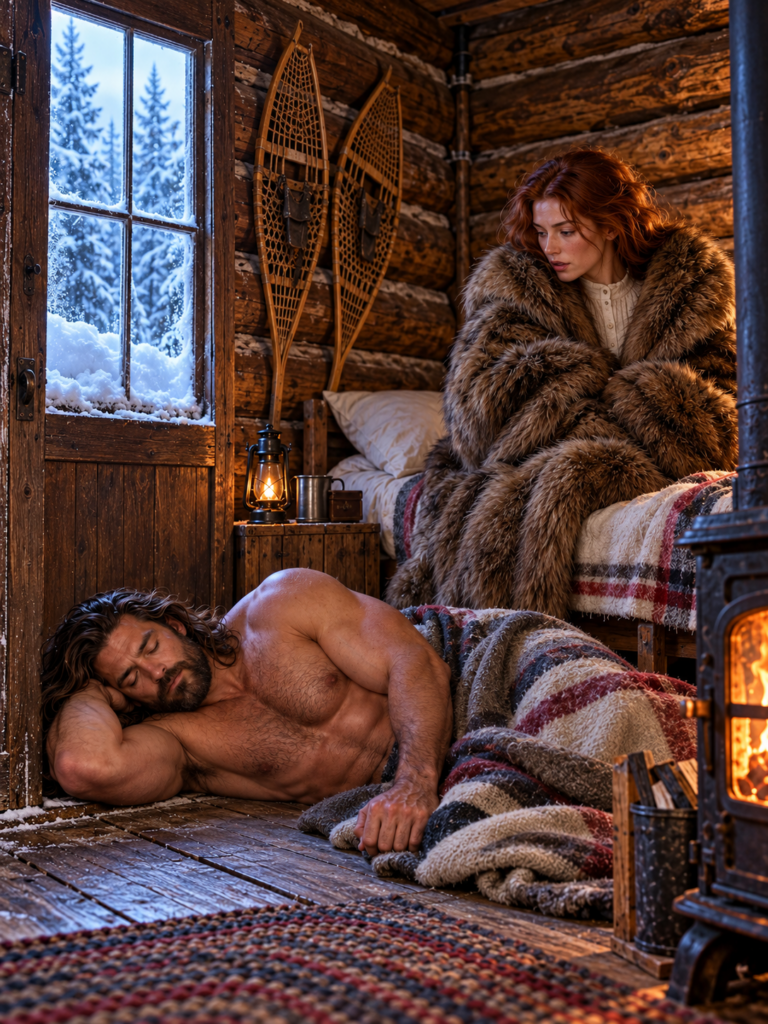
He fed the stove until it roared. Then he pulled his wet shirt over his head, hung it steaming on the stove rail, and took a trade blanket from his pack.
He did not go to the bunk.
He lay down on the plank floor across the door with his back to her.
“Lamp,” he said, and turned it down to nothing.
She waited in the red dark for him to rise.
Every creak of the walls made her flinch.
He did not rise.
By midnight, she was shaking so badly her teeth knocked.
At last, she crept to the empty bunk in her boots and lay down on top of the blanket, stiff as a plank, the shears under her cheek.
“I’ll only rest,” she thought.
She woke to gray light and warmth.
The window was white with frost, snow drifted high against the glass, and the stove was glowing.
Something lay over her from her chin to her boots, heavy and soft, smelling of wood smoke and pine.
His coat.
His great fur coat was spread over her, heavy as a bear.
Somebody had tucked it around her shoulders while she slept.
She sat up with the coat clutched to her throat, her hair loose around her face, her heart racing.
He was still on the floor, still across the door.
He lay on his side with one arm under his head and the trade blanket pulled to his waist, and his broad back and shoulders were bare in the cold.
His shirt hung steaming on the stove rail.
His snowshoes leaned against the wall beside hers.
He was asleep.
He had slept all night on the bare boards where the draft came in under the door with nothing but a blanket so that she could have his coat.
Iris sat very still, wrapped in the fur, and stared at him.
He had not come near the bed.
He had lain down across the only door.
Nobody could have come in without stepping over him.
Her hands were not shaking anymore.
When he woke, he rose without a word, pulled his shirt off the rail, and dragged it on.
He put more wood in the stove.
He set the kettle on.
Then he glanced at her once, sitting up in his bunk in his coat.
“You said it was yours,” Iris said.
Her voice came out rough.
“It is.”
“Then why am I in it?”
He poured coffee into the tin cup and held it out at the full length of his arm so she would not have to come close to take it.
“It’s mine,” Isach said. “I say who sleeps in it.”
She took the cup.
Her fingers did not touch his.
Outside, the wind rose again.
Snow came past the window sideways.
He went to the door, opened it a hand’s width, and a white wall of wind came in at him.
He shut it.
“Pass is closed,” he said.
“For how long?”
“Till it opens.”
She drank the coffee.
It was strong and bitter and hot, and it went down into her like fire.
She held the cup in both hands long after it was empty.
And she kept his coat on.
The first day she would not sit still.
She could not.
If she sat still, she thought about the platform, about Lyman’s hand opening, the little gold ring dropping into her palm, about the assayer’s daughter in her blue velvet bonnet, smiling down from the coach, about 40 faces watching, and not one of them coming forward.
So she worked.
She swept the cabin with a broom of pine boughs.
She scrubbed the table with snow.
She found a sack of flour on the shelf, a slab of salt bacon, a tin of dried apples, and a sack of coffee beans.
And she counted them twice in her head and said nothing.
She aired the striped blanket in the cold wind at the door and beat the dust out of it with her palms.
She wiped the frost off the inside of the window with a rag, and it came back in feathers almost at once.
She sorted the kindling by size.
She scraped the black crust off the bottom of the kettle with a flat stone until the tin showed through.
The cabin smelled of pine and cold ashes and then slowly of warm iron and coffee.
Every time the big man shifted on his bench, her shoulders went tight.
Every time his boots crossed the floor, her breath caught.
She kept her back to the wall when she could, and she kept the table between them when she could not, and she hated herself a little for it.
He watched her from his bench, mending a strap.
He did not tell her to stop.
At noon, she asked for his shirts.
He looked up.
“You’ve been walking that pass in the same wool since the snow started,” she said. “I can smell it from here. I’m a laundress. Give them to me.”
He did not move.
Then he reached into his pack and pulled out two shirts and a pair of wool socks and held them out again as far from his body as his arm would reach.
She melted snow in the big kettle.
She shaved her lye soap into it with her shears, and the sharp, clean smell of it rose up in the steam and filled the cabin.
She scrubbed his shirts against the table’s edge with her knuckles until her hands were red and raw.
She wrung them and hung them on a line of twine over the stove.
It was the first time since the platform that she felt like herself.
When she turned around, he was standing close behind her, reaching past her shoulder for the coffee sack on the shelf.
She flinched so hard she struck her elbow on the wall.
He stopped.
Everything about him stopped.
His hand stayed in the air.
Then slowly he took it back, and he stepped away two long steps until the table was between them.
“I’ll ask,” Isach said, “when I need past you.”
She could not answer.
Her arm was throbbing and her face was hot with shame.
He took the coffee sack down himself from the other end of the shelf and ground the beans with his back turned.
He never said another word about it.
That night he lay down across the door again.
She lay on the bunk in her shawl and his coat, and she kept her shears under the pillow.
She listened to him breathe.
She listened to the wind.
She thought he could get up any time.
He is bigger than any man in Leadville.
There is nobody for nine miles.
He did not get up.
The second day the storm did not lift.
The snow came down thick and quiet, and the world outside the window was only white.
They ate bacon and flatbread at noon, and she made the flour go further by thinning the batter with snow water and a pinch of the dried apples, so the bread came out sweet.
He ate three pieces.
He did not say it was good.
He just reached and then stopped his hand in the air and looked at her.
“Go on,” she said. “It’s yours.”
His mouth moved.
It was nearly a smile.
In the afternoon, she noticed his hands.
They were huge, and they were ruined.
The knuckles were split open from cold and rawhide and rope, and the cracks were black with pitch and old blood.
When he closed his fist around the axe handle, one of them opened again and bled.
“Let me see those,” she said.
He looked down at his own hands as if he had never seen them.
“They’re fine.”
“They’re not fine. I’ve seen washerwomen lose the use of their fingers from hands like that. Sit down.”
He sat.
She took a lump of pine pitch from the resin running down the cabin’s corner timber, and she warmed it in a spoon over the stove with a knob of bacon fat until it ran clear and golden.
The cabin filled with the smell of it, sharp and sweet, like a Christmas tree left too near the fire.
She held out her hand for his.
And then she stopped because to put the salve on, she would have to touch him.
Her heart began to beat hard again.
He was sitting so close.
His hands were the size of shovel blades.
He must have seen it in her face.
He didn’t lift his hand.
He only laid it palm down on the table between them, open, and took his own fingers away from it and waited.
He waited a long time.
At last, she took up the spoon and dipped a rag in the warm pitch and dabbed it into the cracks of his knuckles.
She did not hold his hand.
She only touched the wounds one at a time, as lightly as she knew how.
He did not move once.
He did not even flinch when the pitch went into the deep split over his first knuckle, though she knew it stung like fire.
When she was done, he looked at his hand for a long time.
“Nobody’s done that,” he said.
“Somebody should have.”
That night, when he turned the lamp down, she lay awake on the bunk.
She did not reach under the pillow for the shears, but she knew exactly where they were.
On the third morning, the snow stopped for an hour and the whole mountain went silent and blue.
He went out to split wood.
After a while, she followed him because the cabin was too quiet without him in it, and because she would not be the kind of woman who sat by the stove while a man worked.
The woodpile stood against the back wall under a crust of ice.
He had a maul and a wedge.
She gathered the split pieces in her arms and carried them in and came back and carried them in again.
The cold bit through her shawl.
The frozen bark scraped the insides of her wrists where her sleeves rode up until the skin was torn and bleeding in thin red lines.
She did not say anything.
She had carried heavier loads than this in worse cold with worse to come home to.
But on the fourth trip, he set down the maul.
“Stop,” Isach said.
She stopped, her arms full of wood.
His eyes went to her wrists.
The blood had frozen in the scratches.
Her hands were blue.
“Give me your hands,” he said.
The old fear rose up in her so fast it took her breath.
He was so big.
The cabin was so far from anywhere.
She stood in the snow with the wood clutched to her chest and she could not make her arms move.
He did not step closer.
He did not reach for her.
He stood where he was with his breath smoking in the cold.
And he waited just as he had waited at the table with his open hand.
At last she let the wood fall into the snow, and she held out her hands to him.
He unwound the long gray scarf from his own throat.
It was warm from his skin.
He wrapped it around her left wrist once, twice, over the torn places, so gently she could barely feel it.
Then he wrapped the other end around her right wrist and tucked the ends in.
His fingers were rough with the pitch she had put on them, and very careful.
They did not hold on.
They did not linger.
When he was done, he let go at once and stepped back.
“Wood’s heavy,” he said. “Carry less.”
She stood there with her wrists bound together in his warm scarf, and her eyes stung for no reason she could name.
It was the first time in her life a man had touched her and asked nothing for it.
That night, the dream came.
She was on the platform again.
The coach was pulling away.
Lyman was laughing at something the assayer’s daughter said, and all the faces turned toward her, 40 of them, then a hundred.
And she could not find her ring and her hands were full of cold water.
She woke with a cry, sitting bolt upright in the bunk with her heart slamming against her ribs.
She was shaking all over.
For a terrible moment, she didn’t know where she was, only that it was dark and there was a man in the room.
“Iris.”
His voice came from down by the door.
Low, not moving.
“You’re in the cabin,” he said. “On the pass. It’s the wind, nothing else.”
She pressed both hands over her mouth.
She was trembling so hard the bunk creaked.
He did not come to her.
He did not light the lamp.
She heard him turn over on the boards and then his voice again, closer to the floor than to her, as if he knew that his height itself would frighten her.
“I’m by the door,” he said. “I’ll be by the door all night. You can go back to sleep.”
She lay down again slowly.
She listened to the wind.
She listened to him breathe steady and slow down there across the only way in.
And after a long while, she took the shears out from under her pillow and laid them on the shelf beside the bunk, out of reach.
She slept until morning.
When she woke, the fire was going and the coffee was on, and he was sitting with his back to her, mending one of her snowshoes where she had broken a strand of webbing on the climb.
He didn’t mention the night.
Neither did she.
But she saw the shears still lying on the shelf where she had put them.
And she saw him see them and look away.
After that, it was different between them.
Not warm.
Not yet.
But different.
She began to talk.
Little things at first.
How to get pitch out of wool.
How her mother used to rub goose grease into her own chapped hands before bed.
He listened.
Sometimes he nodded.
Once, when she told him how the Chestnut Street widow had set her trunk out in the snow, his jaw went tight, and he looked at the fire for a long time.
The storm came back that afternoon, heavier than before.
The snowshoe with the broken webbing was only half mended when his big fingers fumbled the wet rawhide.
“Let me,” she said.
He handed it over.
She had never mended a snowshoe in her life, but she had darned a thousand socks and set a thousand patches, and a weave was a weave.
She soaked the rawhide in warm water until it was soft and slippery.
She drew it through the frame over and under, pulling each strand tight with her teeth.
He watched her the whole time with his elbows on his knees.
When she handed it back, he turned it over in his hands.
He pulled on the webbing hard.
It held.
“That’s better than mine,” Isach said.
She laughed.
She had not heard herself laugh since the platform.
It startled them both.
That evening, while the wind screamed round the cabin, she asked him the question.
“Why are they afraid of you in town?”
He was quiet a long time.
“There was a man,” he said at last. “A miner, two winters back. He started over the pass in a storm and didn’t come down. I found him near the top, sitting in the snow like he was resting.”
He turned the tin cup in his hands.
“Frozen through.”
The cabin was very still.
“I carried him down,” Isach said. “On my back. Nine miles. So his wife would have something to bury.”
“And they said…”
“They said I’d robbed him. His pockets were empty. He’d lost his poke somewhere up on the rocks.”
He shrugged, one huge slow movement.
“A big man comes down the mountain with a dead man on his back. Folks decide what they want to decide.”
Iris looked at his hands on the cup.
The split knuckles healing now under her salve.
“They cross the street,” she said.
“They cross the street.”
“Did his wife cross the street?”
He looked at her then, straight at her for the first time.
“No,” he said. “She brought me a pie.”
Iris felt something turn over inside her chest.
“Then she knew,” she said.
He did not answer, but he did not look away.
It was her turn the next night.
He did not ask.
She told him anyway.
Sitting on the bunk wrapped in his coat with her bound wrists healing under his scarf.
She told him about her father, a sawyer, who had saved $50 in a coffee can and handed every cent of it to Lyman Lumis that summer for her dowry, so his girl would be married proper and never have to stand at a washtub again.
He had died in the autumn, content.
She told him how Lyman had come courting every Sunday in a clean collar and brought her ribbons and called her sensible.
“He liked that I was sensible,” Iris said. “He liked that I could do sums. He said a clerk’s wife ought to be good with money.”
She was quiet a moment.
“Then the assayer came to Leadville with his daughter. She’s 23. She has a velvet bonnet and a laugh like a bell. And Lyman stopped coming on Sundays.”
The stove ticked.
“He didn’t have to do it on the platform,” she said. “He could have written me. He could have told me at the door. But he waited until the whole street was there to see the coach off, and he handed me the ring in front of all of them. He wanted them to see.”
“And the money?”
“He kept the $50.”
Isach said nothing, but in the firelight, she saw his hand close slowly on his knee.
“Sometimes I think I should have fought,” she said. “Shouted, made them all look at him instead of me.”
“You walked nine miles uphill in town boots,” he said. “In a blizzard with your own bundle.”
She looked at him.
“That’s a fight,” Isach said.
On the fourth evening, she asked him for a kettle of hot water, and then she stood holding it and could not find the words for the rest.
He understood before she did.
He took his coat down from the peg.
He took his hat.
He went out into the snow and pulled the door shut behind him.
At first, she did not move.
Then she knelt by the stove, took the pins out of her hair, and washed it in the kettle with the last shavings of her lye soap.
The water ran hot through her fingers.
The smell of the soap filled the cabin, clean and sharp, the smell of every good day she had ever worked.
She scrubbed until her scalp tingled and wrung her hair out and sat close to the stove with it hanging over her shoulder to dry, red as the coals.
Through the frosted window, she could see him.
He was standing out by the woodpile in the blue dusk, turned away from the cabin, his hands in his coat, snow gathering on his hat and his shoulders.
He did not turn round or step toward the window.
He only stood there in the cold like a post driven into the drift and waited for as long as she needed.
When at last she called him in, his beard was white with frost.
“You could have come in,” she said.
“Sooner, you didn’t call.”
He stamped his boots and came in and went straight to the stove to warm his hands.
He didn’t look at her hair, but once when she turned her head, she saw him glance at it quick and then look hard at the fire.
She lay awake a long time that night, listening to him breathe by the door.
By the fifth day, she knew how he moved.
He put wood in the stove before it needed it.
He ground the coffee every morning, even though there was only a little left.
He went out twice a day to check the trail down to the cache where he left the mail sacks under a tarpaulin.
And each time he came back, he stamped the snow off his boots before he opened the door so it would not blow in on her.
And every night, without a word about it, he lay down across the door.
He had paid nothing for her.
He had asked nothing of her.
He had given her his bed and his coat, and he slept on the floor.
She stood at the window that afternoon, watching him go down the slope toward the cache, huge and dark against the white.
The sky had turned a strange yellow-gray.
The air was too still.
And then she heard it, a sound like a sheet tearing high up on the mountain.
Then a long, low roar like every ore wagon on Harrison Avenue rolling at once.
She knew that sound in her bones.
The snow above the trail was moving.
She saw it slide.
She saw the whole white slope below the rocks break loose and come down in a smooth, terrible rush, slow and then fast.
And she saw it pour across the trail where he had been walking.
Then the roar stopped, and there was nothing on the slope but new snow heaped and smoking with powder.
He was gone.
Iris did not remember opening the door.
She did not remember snatching up the fire shovel.
She was just out in the snow up to her knees, then to her waist, floundering down the slope with the shovel in her fists and his name tearing out of her throat.
“Isach! Isach!”
Nothing.
The powder hung in the air.
Everything was white and silent.
She made herself stop.
She made herself look.
He had been on the trail by the big split rock.
The slide had come from the left.
It would have pushed him down and to the right.
She saw it then.
A dark scrap at the edge of the new snow.
His scarf.
No, her scarf.
His scarf, the gray wool he had taken back that morning.
She threw herself down beside it and dug.
She dug with the shovel until the blade struck something hard, and then she threw the shovel away and dug with her hands.
The snow was packed like wet sand.
Her fingers went numb, then burned, then went numb again.
She clawed it away in great heaps.
She found wool, a sleeve, an arm, a shoulder, his face.
His eyes were closed.
His beard was packed with ice.
His lips were blue.
“No,” she said. “No, you don’t. You don’t.”
She scraped the snow from his mouth and nose with her fingers.
She held her cheek down against his lips, the way her mother had taught her to do with the sick.
For a long moment, she felt nothing.
Then a breath, faint and cold against her skin.
“Isach,” she said. “Isach, wake up. You have to help me.”
His eyes opened.
They were dazed and far away.
Then they found her face and cleared.
“Iris,” he said.
It took her the rest of the light to get him out.
His legs were locked in the packed snow to the knees, and the snow had set around them like mortar.
She fetched the shovel back from where she had flung it.
She cut down beside his hip and then along his thigh a little at a time because she was frightened of striking his leg with the blade.
When the shovel was too clumsy, she knelt in the hole and scooped with her forearms.
Snow went down her collar and up her sleeves.
Her skirt froze stiff as bark.
Twice the side of the hole slumped in on them both, and twice she dug it out again, sobbing for breath and never once stopping.
He tried to help.
He pushed with his hands against the sides of the hole.
But his fingers would not close, and each time he moved, a gray look went over his face, and he pressed his mouth shut on the pain.
“Stay still,” she told him. “Let me do it.”
The sun went behind the ridge.
The cold came down out of the sky like a lid.
Her own hands had gone past burning into a dull wooden ache, and she could no longer tell where the snow ended and her fingers began.
At last, his right boot came free.
Then the left.
She hauled his arm over her shoulders and braced her feet, and he came up out of the snow onto his knees with a groan she felt in her own ribs.
The cabin was only 60 yards up the slope.
It looked like a mile.
He could not put weight on his left foot.
The ankle had twisted under him when the snow took him, and it was swelling already inside the boot.
So she got under his arm and he leaned on her, and they went up the slope one step at a time with her shoulder jammed into his side and his great weight bearing down on her until she thought her knees would fold.
They did not fold.
She got him through the door.
She got him down on the boards beside the stove because she could not lift him to the bunk and did not try.
She built up the fire until the iron glowed.
She cut the frozen laces of his boot with her shears and eased it off while he gripped the bench and breathed through his teeth.
His hands were the worst.
They were white and hard as candle wax.
“Don’t put them near the stove,” she said. “My father lost two fingers doing that. Give them here.”
He held them out.
He didn’t wait for her this time, and she did not make him.
She put a pan of snow water on the floor, barely warm, and she held his hands in it.
And then she took them out and held them between her own.
She rubbed them slowly, palm to palm, the way you warm bread dough.
She breathed on them.
When the feeling came back into them, it came back hard, and he groaned low in his chest and bowed his head over her hands.
“I know,” she said. “I know it’ll pass.”
She held on until it passed.
When she finally looked up, he was watching her.
His face was very close.
His eyes were gray, the color of the sky before snow, and they were wet.
“You came out,” he said. “Into the slide.”
“You’d have done the same.”
“That’s different.”
“Why?”
He did not answer.
He only turned one of his big hands over inside hers slowly until his palm lay against her palm, and he left it there.
She did not take her hand away.
That night, she made him lie on the bunk, and he was too tired to argue.
She sat on the floor beside it with her back against the frame and his coat over her knees.
And she kept the fire up until dawn.
Once near morning, he said her name in his sleep.
Just her name, nothing else.
She sat in the darkness and listened to it.
And she felt it go all the way through her like warmth into frozen hands.
On the sixth day, the wind died.
She woke to the sound of water.
It was dripping from the eaves, steady and bright.
And when she opened the door, the sun came in off the snow so hard she had to shade her eyes.
Icicles hung from the roof like glass teeth.
The whole mountain was steaming.
Isach was up already, sitting on the bench with his bad foot wrapped in her spare shirtwaist, looking out.
“Thaw,” he said.
And then from far below them on the Fairplay side came the long brassy note of a coach horn.
The first coach up from Fairplay reached the halfway cabin a little after noon.
It came slow, lurching through the soft snow, the driver shouting and the wheels throwing up slush.
There were three men and a woman inside.
A miner and his wife, a salesman in a checked coat with a sample case.
And one more.
Up on the box beside the driver sat his grown son handling the brake.
Iris was at the woodpile when the door of the coach swung open.
She looked up.
Lyman Lumis stepped down into the slush in his good town shoes and his clean collar.
Everything in her went cold.
Her arms went slack and the wood she was carrying dropped into the snow.
He saw her.
For a moment, his face went blank with surprise.
Then he looked from her to the cabin door where Isach stood on one foot with his shoulder on the frame and back again.
And a slow smile spread across Lyman’s face that she had never seen there before.
“Well,” Lyman said loudly. “Well, well, Iris.”
She did not answer.
Her heart was pounding so hard she could not hear the dripping of the eaves.
“The assayer’s girl changed her mind,” he said as if she had asked. “Her father decided a clerk wasn’t good enough for her after all. Sent me back over the mountain with my hat in my hand.”
He smiled wider.
“Lucky then. I have something that belongs to you.”
He reached into his coat and drew out a folded sheet of paper, creased and soft from handling.
She knew it at once.
She had watched her father sign it at the kitchen table with his tongue between his teeth because he was not good with a pen.
“Your father’s $50,” Lyman said. “Paid to me in full to see you married, and your name right under his. It’s a promise, Iris. You gave your word. I mean to hold you to it.”
“You gave me back the ring.”
“I’ve changed my mind. A man can do that.”
He looked her up and down.
Slow.
“You’ll come back down to Leadville with me on this coach tomorrow. We’ll be married at the Methodist church on Sunday, and you’ll go on doing laundry for the boarding houses, and the money will come to me, the way it should.”
“No,” Iris said.
His smile did not move, but his eyes went hard and flat.
“Think about it before you say no,” he said.
And now he said it loud enough for the miner’s wife to hear.
“You’ve been five nights up here alone with him. Five nights.”
With that, he jerked his chin toward the door.
“The man who robbed a dead miner. You know what Leadville will say. No decent man will look at you after this. No decent house will have you. I’m the only one who will take you now. And I’m doing you a kindness.”
The miner’s wife put her hand over her mouth.
Iris stood in the snow with her face burning and her hands shaking at her sides.
She felt it all come back at once.
The platform, the 40 faces, the trunk on the porch.
“And if you won’t come,” Lyman said softly, “I’ll tell them all, every word. Every night of it.”
Then he walked past her to where her bundle lay on the bench by the woodpile, airing in the sun.
And he picked it up.
He carried it to the back of the coach and threw it into the boot with the mail sacks and the salesman’s case.
“There,” he said.
Isach stood behind her in the doorway.
He straightened.
He didn’t come down the step.
He could not on that ankle, but he stood up to his full height, filling the whole door, and he laid one flat hand on the frame beside him.
He didn’t raise his voice.
“She’ll say where it goes,” Isach said.
Lyman looked at him.
Something in his face flinched.
Then he laughed, short and ugly, and turned away and went to ask the driver about supper.
The coach could not go on that day.
The road down toward Leadville was still buried under the slide, and the driver said they would have to dig through it in the morning, so they would all stay the night at the halfway cabin.
Lyman, too.
Iris walked round to the back of the cabin where nobody could see her, and she leaned her forehead against the cold timber and shook.
She did not know how long she stood there.
When she lifted her head, she heard the sound of an axe.
She came round the corner of the woodpile and stopped.
Isach was splitting wood on one foot with his bad ankle braced against a stump, swinging the maul in long, slow arcs.
He had pulled off his shirt in the sun, the way men did at a thaw, and steam was rising off his bare back and shoulders.
His chest was broad as a door, and his arms were thick with muscle, and every time the maul came down, the wood split clean and flew.
She should have looked away.
She did not look away.
She stood by the corner of the cabin in the melting snow and watched him, and she felt her face grow warm for a reason that had nothing to do with shame.
She thought of his hand turning over in hers.
She thought of him on the floor by the door night after night with nothing but a blanket.
He must have felt her watching.
He set down the maul and looked round.
For a long moment, neither of them said anything.
“You shouldn’t be on that foot,” she said at last.
“Somebody has to keep the stove going.”
“I can split wood.”
“I know you can.”
He wiped his forehead with the back of his wrist.
“I’ve seen you carry it.”
He reached for his shirt and pulled it on, and the moment was gone.
But she could not stop thinking about it.
Supper was bacon and flatbread and the last of the dried apples stretched to feed eight.
She made it go round.
The miner’s wife helped her and said nothing, but once, handing her a plate, she squeezed Iris’s fingers quickly and let go.
Lyman sat at the head of the table and talked.
He talked about Leadville.
He talked about the price of silver.
He talked about his cousin who was a clerk in Denver.
And every so often he looked at Iris and then at Isach and smiled.
Isach sat on the bench by the stove with his foot up.
He did not speak once.
Later, when Iris knelt to bank the stove for the night, Lyman came and crouched beside her, close as if to warm his hands.
He smelled of bay rum and coach dust.
“You think he wants you?” he said under his breath, so only she could hear. “A man like that? He wants a washerwoman who works for nothing. I know what you’re worth, Iris. I’ve got it in writing.”
She kept her eyes on the coals.
Her hands had begun to tremble on the poker.
“Tomorrow,” Lyman said softly, “you’ll climb into that coach, or every boarding house in Leadville hears how you paid your way over the mountain. I’ll tell it at the stage office. I’ll tell it on the platform. I’ll tell it to the assayer’s daughter.”
He stood and smiled down at her and went back to the table.
Iris stayed on her knees by the stove until her legs went numb.
When she finally looked up, Isach was watching Lyman, only watching.
His face was as still as the mountain, but his big hand had closed on the bench so hard she heard the timber creak.
When the lamp was lowered, the salesman and the miner bedded down near the stove.
The miner’s wife took the bench.
Lyman stretched out by the table with his coat rolled under his head.
And Iris stood in the middle of the cabin and looked at the bunk and then at the door and then at Isach.
He looked back at her.
He stayed where he was.
She understood.
He was letting her say.
“The door,” Iris said quietly.
He got up slow and careful on his bad foot and lay down across it where he had slept every night but one.
She lay down on the bunk under his coat, and for the first time she was not afraid of anything in the room but Lyman Lumis.
And she was not even very afraid of him.
She lay awake a long time thinking.
At dawn, before anyone else was stirring, Isach woke her by saying her name.
Just once, low from the floor.
She sat up.
The stove was lit.
The coffee was on.
He was sitting on the edge of the bench, dressed, with his coat folded on his knees.
She had pushed it to the foot of the bunk in her sleep.
He held it out to her at the full length of his arm, the way he had held the first cup of coffee.
“I’ll say this once,” Isach said very low so that no one else would wake. “The road’s open today. You can go anywhere you like.”
She did not take the coat.
“Down to Leadville on the coach if you want. Over to your sister in Fairplay if you want. I’ll carry your bundle either way. I’ll walk you to any door on this mountain.”
He looked down at the coat in his hands.
“Wherever you say.”
“And if I say here?”
He was very still.
“Then here,” he said.
The sun came up over the pass.
The whole cabin filled with gold light.
When everyone was up and the coffee was poured, Lyman stood at the head of the table with the folded sheet in his hand.
The driver was lacing his boots.
The miner’s wife had her shawl on.
The salesman was yawning into his cup.
The driver’s son was already out at the coach hitching the team.
“Well,” Lyman said, “coach leaves in an hour. Get your shawl on, Iris.”
He held the paper out to her across the table as if he were handing her a bill she owed.
Everyone turned to look at her.
Iris stood up.
She walked round the end of the table.
She took the folded sheet out of Lyman’s hand.
He let her take it.
He was smiling.
He thought she was going to fold it into her pocket and follow him out.
She walked past him to the stove.
She opened the iron door.
The heat came out at her face and the coals were white and orange inside.
And she put the paper in.
She did it in front of everyone.
She did not hurry.
She held it by one corner until the flame caught the edge.
And then she let it go.
And she watched it curl and blacken and go up in one bright breath of fire.
Her father’s shaky name, her own name under it.
$50 gone to ash.
Nobody moved.
The room went so quiet she could hear the eaves dripping outside.
Then she shut the stove door with a clang and turned round.
“My father paid you $50 to marry me,” she said to Lyman. “You kept it. Keep it. That’s the price of me never having to look at you again.”
Lyman’s face went red, then white.
“You can’t. That was a promise. You gave your word.”
“I gave it to a man who’d stand by me. You gave me back the ring in front of the whole town. You don’t get to take it back up a mountain.”
She turned away from him.
She walked across the cabin, past the miner’s wife, past the salesman with his mouth open, to where Isach sat on the bench with his bad foot up and his coat on his knees.
He hadn’t moved.
He was looking up at her as if he had never seen anything like her in his life.
“You said wherever I say,” Iris said.
“I did.”
“Then I say you.”
Her voice shook.
She let it.
“I’m going over the pass with you to Fairplay to see my sister, and then wherever the mail goes. And I’m coming back up this mountain with you after, if you’ll have me.”
For a moment, Isach did not speak.
Then he set the coat aside slowly and he held out his hand.
Open palm up.
And he waited.
She put her hand in his.
He stood on one good foot and she stood with him, and she did not flinch at how big he was or look away.
She laid her forehead against his chest.
She felt his heart under her cheek, pounding as hard as hers.
Then he bent his head and she lifted her face, and in front of everyone in that small warm cabin, he kissed her carefully.
The way he had wrapped her wrists, as if she were the one precious thing he had ever carried down a mountain.
The miner’s wife began to cry.
The salesman cleared his throat.
The driver said, “Well, I’ll be.”
And went out to the coach.
And Lyman Lumis picked up his hat and walked out the door without a word.
And nobody in the cabin turned to watch him go.
The driver’s son set her bundle down in the snow by the door.
The coach went on down toward Leadville with Lyman sitting alone in the back of it, staring at his shoes.
They waited three more days at the halfway cabin for his ankle to mend.
She would not let him walk on it sooner.
He grumbled about the mail.
She told him the mail had waited a week already and could wait three more.
And he stared at her and then laughed.
A deep, surprised sound she had never heard from him before.
On the fourth morning, they went over the top together.
She wore his scarf around her throat and her own mended snowshoes on her feet.
He carried the mail sacks.
She carried her own bundle.
He did not offer to take it, and she loved him a little more for that.
The climb above the cabin was steep and slow.
The snow had a crust on it now from the thaw and the hard frost after, and it squeaked under their snowshoes.
He went first as he always had, breaking the trail.
But every 20 steps he stopped and looked back, and waited until she caught up, and only then went on.
Once, where the path crossed a bare ledge glazed with ice, he held out his hand without a word.
She took it.
He let go on the far side.
The moment her feet were sure.
At the summit, the world lay below them, white and blue and shining.
Range after range of mountains going off into the sky.
The wind was sharp and clean.
She stood beside him at the top of the pass and felt as if she could see all the way to the rest of her life.
Fairplay was a small town of plank houses and smoke strung out along the river under the snow.
Her sister’s house was the yellow one at the end of the street.
Her sister was 31, married to a quiet man who ran the feed store, and she opened the door with flour on her hands and screamed when she saw Iris standing there.
Then she saw Isach behind her filling the whole path, and she stopped screaming.
“Iris,” her sister said faintly. “Who is that?”
Iris reached back without looking and found his hand and held it.
“This is…” she said. “He carries the mail.”
Her sister looked at their hands, then at Iris’s face.
Then she stepped back from the door.
“Well,” she said, “you’d both better come in and get warm.”
They stayed a week.
Her sister fed Isach until he could hardly stand.
And her husband, who had heard the stories from Leadville, watched him for two days, and then shook his hand at the gate and asked him to come back in the spring to help raise a barn.
On the last night, her sister found Iris alone by the kitchen stove.
“Are you sure?” she asked quietly. “He’s so big, and they say such things about him.”
Iris thought about it.
She thought about a coffee cup held out as far as a long arm could reach.
About an open hand laid on a table and waiting.
About all those nights on the bare boards across a door.
“He’s the safest place I’ve ever been,” she said.
They were married in Fairplay in the little plank church by the river with her sister crying in the front pew and her husband grinning beside her.
Isach wore a clean shirt that Iris had washed and pressed herself.
He had to duck his head to get through the church door.
Then they walked back up the mountain.
That winter and every winter after, the halfway cabin on the pass was their cabin.
Isach carried the mail over the top on his snowshoes, and Iris kept the stove lit for him and for every traveler who came stumbling in out of the storm.
She washed their shirts and warmed their hands and fed them flatbread and dried apples.
Word went down the mountain on both sides.
By the next spring, the miners in Leadville had a new name for the halfway cabin.
They called it Iris’s.
Nobody crossed the street from Isach Thorvald anymore.
Not after the miner’s wife from the coach told every woman in Leadville how Iris had put the paper in the stove and what the big man had said and how he had stood up on one good foot to kiss her.
And every night when the wind came down off the pass, Iris lay down beside him in the one bed.
But on the coldest nights, when he fell asleep first, she still got up in the dark and took his great fur coat from its peg by the door.
And she spread it over him from his shoulders to his feet and tucked it round him as he had once tucked it around her.
Then she lay back down with her hand on his chest and listened to his heart and slept.
She had never been a jilted girl with her trunk on the porch.
She was the woman who walked nine miles uphill in town boots, who dug a buried man out of a snowslide with her bare hands, who burned her own price in a stove in front of witnesses.
And she was the only one who ever slept in his bed.


