Part 1
The inheritance was worth $3.
That was how Beatrice Hastings chose to describe it, and because the Hastings family had always understood that humiliation was most effective when dressed as procedure, the amount had been printed neatly into the transfer documents before Norah ever entered the room.
$3.
The conference room overlooked Manhattan through a wall of rain-streaked glass. Far below, taxis crawled between towers polished by mist, their roofs glimmering yellow in the wet streets. Inside, everything was mahogany, leather, brass, and money old enough to have lost the need to announce itself.
Norah sat at one end of the table and watched the pendulum of an antique clock swing in the corner.
Left.
Right.
Left.
Right.
She concentrated on the small mechanical movement because grief had made everything else unreliable.
It had been 21 days since Leo had died on their kitchen floor.
He had been standing at the counter making coffee. Norah remembered that much with terrible clarity. She remembered the gray T-shirt he wore, the chipped blue mug near his hand, the rain beginning against the windows of their apartment. He had turned toward her as if about to say something and then his expression changed.
There had been no warning.
No slow illness.
No final conversation.
One moment he had been there.
The next, the body she loved had become an emergency.
Norah had worked in hospitals long enough to understand what was happening even while she refused to believe it. She had called for help. She had done everything she had been trained to do. She had counted compressions. She had listened for instructions from the dispatcher even though she already knew them. She had heard the sirens. She had watched strangers take over.
Nothing had been enough.
An aneurysm, the doctors told her.
Catastrophic.
There was language for every stage of dying except the moment the surviving person understood that the world had divided permanently into before and after.
For 21 days, Norah had moved through the after.
Coffee turned cold in untouched cups. Leo’s shoes remained beneath the entryway bench. His jacket still hung inside the closet and still smelled faintly of rain, detergent, and whatever soap he used without ever remembering the brand. Twice Norah had awakened in the dark and reached toward his side of the bed before consciousness returned.
People called grief sadness.
Norah had discovered that sadness was too gentle a word.
Grief felt like a head injury.
It distorted distance. It slowed thought. It made ordinary sounds arrive from far away. It left her staring at simple objects because anything more complicated was too painful to process.
Across the table, the Hastings family displayed none of the same damage.
Beatrice, Leo’s mother, wore charcoal wool cut with severe elegance. Her silver-blond hair was pinned with architectural precision. A phone lay in one manicured hand. Every few seconds, her thumb moved upward across the screen.
Graham, Leo’s older brother, checked his watch.
Cecilia, the youngest, had positioned herself sideways in her chair and was looking out at the wet skyline with the air of someone waiting for an inconvenient meeting to end.
None of them looked at Norah unless circumstance required it.
The family attorney, Mr. Gable, cleared his throat and straightened the documents before him.
He was a gray-haired man with the posture of someone who had spent decades explaining unpleasant facts on behalf of richer people. He had been courteous to Norah since she arrived, but his courtesy possessed the careful softness of a person approaching an injured animal.
“We have reached the matter of secondary properties held through the Hastings family trust,” he said. “Specifically those assets grandfathered into the trust before Leo’s death.”
Graham leaned forward.
“Can we move this along?”
Gable glanced at him.
“I am moving as quickly as the documents allow.”
“I have a flight.”
“Then I suggest we avoid interruptions.”
For the first time that morning, Norah almost smiled.
Graham did not.
Gable adjusted his glasses and turned toward her.
“As you know, Mrs. Hastings, Leo retained an interest in a portion of the family’s unliquidated real estate holdings. He did not execute a new will after your marriage. His personal interest therefore passes to his legal spouse, subject to the conditions already established by the trust.”
Norah heard the words without feeling attached to them.
Money had never mattered to Leo.
That had been one of the unforgivable things about him.
The Hastings family had spent generations constructing wealth into a form of identity. Their company holdings reached through commercial real estate, shipping, manufacturing, financial services, and several things Norah had never clearly understood because Leo rarely discussed them.
He had left the family firm 10 years earlier.
His mother called it betrayal.
Leo called it breathing.
He had taken a consulting job with ordinary hours, moved into an apartment his family considered embarrassingly small, and eventually married a nurse.
Beatrice had never forgiven any of those decisions.
Gable continued.
“The trust permits the reallocation of certain liabilities associated with specific inherited properties.”
The word reached Norah through the fog.
“Liabilities?”
Her voice sounded dry.
Beatrice looked up from her phone.
“Don’t pretend not to understand legal language, Norah.”
Norah looked at her.
“I asked what he meant.”
Beatrice placed the phone on the table.
“Leo spent years insisting he wanted nothing from us. Now that he’s gone, the trust has to be settled. We are trying to respect his independence.”
Graham gave a faint, humorless laugh.
“That’s one word for it.”
Gable’s expression tightened.
He slid a thick document across the table.
“The family has elected to satisfy Leo’s portion through transfer of the Ironwood estate.”
Norah looked down.
IRONWOOD PROPERTY TRANSFER AGREEMENT.
The name meant nothing.
“Ironwood?”
Graham laughed again, more openly this time.
“Don’t get excited.”
Beatrice’s eyes remained on Norah.
“It isn’t one of the Hamptons properties.”
“What is it?”
“An old parcel upstate,” Graham said. “Grandfather acquired it decades ago. House, acreage, outbuildings. Most of it should have been condemned years ago.”
Gable spoke carefully.
“The property includes a large manor residence and several ancillary structures. All are in significant disrepair.”
“How significant?”
Gable hesitated.
Norah noticed.
“How significant?”
“There are outstanding municipal obligations.”
“How much?”
“Approximately $400,000.”
Silence filled the conference room.
Even Cecilia turned away from the window.
Norah stared at Gable.
“You’re giving me $400,000 in debt?”
“The sum includes unpaid property taxes, code violations, accumulated penalties, and environmental remediation requirements.”
“What environmental requirements?”
Gable removed his glasses and cleaned them although they did not appear dirty.
“Asbestos is present in the main residence. There may also be lead contamination and fuel storage issues associated with former outbuildings.”
Norah looked toward Graham.
He had stopped pretending to be bored.
“You knew.”
“Of course we knew.”
“And you’re transferring it to me.”
“The trust is transferring an asset to Leo’s widow.”
“It’s not an asset.”
Beatrice leaned back.
“That depends on one’s perspective.”
“My perspective is that I don’t have $400,000.”
“We know.”
The answer was so calm that Norah finally understood.
This was not accounting.
It was revenge.
The Hastings family had never considered her good enough for Leo. Beatrice had referred to Norah’s nursing career at their first dinner as admirable public service in the same tone another woman might use for volunteering at an animal shelter. Graham had once asked whether Norah’s parents had “ever owned anything,” then seemed genuinely puzzled by her answer.
Leo had laughed about them afterward.
“Money makes them stupid,” he had said.
Norah had not believed him.
Now she did.
“Leo’s medical bills took almost everything we had,” she said.
No one answered.
“I can’t pay those taxes.”
Beatrice opened her handbag.
“You have options.”
“What options?”
“Sell the land.”
“You just said no one wants it.”
“Then perhaps you’ll discover an entrepreneurial streak.”
Cecilia spoke without looking at her.
“Sell a kidney. You work in a hospital.”
Gable closed his eyes briefly.
“Cecilia,” Beatrice said.
There was no anger in her voice.
Only amusement carefully disguised as correction.
Beatrice removed a leather wallet from her handbag.
“There is one technical matter.”
She opened the wallet and withdrew 3 bills.
“To establish the transfer under the arrangement drafted by counsel, the property is being conveyed for consideration.”
She placed 3 single-dollar bills on the table.
The paper looked startlingly cheap against the polished wood.
“The county’s present assessment of viable equity, after liens and required remediation, is effectively negligible. The consideration has therefore been recorded as $3.”
She pushed the bills toward Norah.
They slid across the mahogany and stopped beside her hands.
“Buy yourself a coffee.”
Graham smiled.
Something inside Norah became very still.
She understood suddenly why they had wanted her in the room.
Documents could have been sent.
Lawyers could have handled signatures.
This was theater.
They wanted to see her take it.
They wanted a memory of the nurse accepting a ruined estate with half a million dollars in obligations for the price of a convenience-store coffee.
Norah looked at the papers.
She could refuse.
She could find her own attorney.
She could fight.
She could spend months or years disputing provisions in a trust created by people with more lawyers than most companies had employees.
She could use whatever remained of her savings.
She could give the Hastings family another portion of her life.
But she was tired.
Not ordinary tiredness.
The kind that seemed to have entered her bones.
She wanted to go home.
She wanted Leo’s jacket.
She wanted the 3 weeks since his death to vanish.
She wanted one thing in the world not to require a fight.
Gable placed a pen beside the documents.
“Yellow tabs,” he said quietly.
Norah signed.
Her name appeared again and again in blue ink.
Norah Hastings.
Norah Hastings.
Norah Hastings.
Each signature seemed to belong to someone else.
Gable turned pages.
She signed those too.
There was fine print.
She did not read it.
When the last page was finished, Norah put down the pen.
The 3 bills remained untouched.
“Keep them,” she said.
Beatrice’s mouth curved almost imperceptibly.
Norah collected her copy of the deed and walked toward the door.
She was almost through it when a champagne cork popped behind her.
Graham’s voice followed.
“Good luck at Ironwood.”
Norah stopped.
“Try not to choke on the asbestos.”
She continued walking.
The door closed.
In the corridor, the silence was immediate.
Norah stood alone with the deed folded in one hand.
For several seconds she stared at the carpet.
Then she walked to the elevator.
She did not cry.
She had used most of her tears elsewhere.
What remained was colder.
Ironwood sat outside Oakhaven, New York, approximately 6 hours from Manhattan by Norah’s route.
The town appeared first as a faded water tower above bare trees, then as a scattering of low brick buildings along a road patched more often than repaired. November had stripped the landscape to browns, grays, and the dark green of pines. Abandoned storefronts stood between surviving businesses. A gas station advertised prices on a sign missing several numbers. The old mill beside the river was mostly broken windows.
Oakhaven was not ruined.
It was simply becoming less alive each year.
Norah stopped at a diner.
The waitress refilled her coffee before Norah asked.
“Passing through?”
“I’m looking for Ironwood.”
The woman’s hand stopped above the cup.
“County?”
“No.”
“Insurance?”
“No.”
Norah stared into the black coffee.
“I own it.”
In a booth near the wall, 2 old men stopped speaking.
The waitress studied her.
“You own Ironwood?”
“As of 3 days ago.”
“Well.”
The woman set the coffeepot down.
“That’s unfortunate.”
Norah almost laughed.
“Can you tell me how to get there?”
“Route 9 past the mill. Follow it north until the pavement quits. Then keep going.”
“How far?”
“You’ll know.”
“How?”
“It’s the ugliest house in the valley.”
The old men resumed speaking only after Norah left.
Route 9 narrowed beyond town.
Pavement became gravel.
Gravel became rutted dirt.
Trees crowded closer until their branches met overhead like fingers. Dead weeds scraped the underside of Norah’s sedan. The sky pressed low and metallic above the valley.
Eventually the road ended.
A pair of wrought-iron gates stood across what had once been a formal entrance.
Rust covered them.
A thick chain held them shut.
Norah got out.
The air smelled of cold mud and leaves.
She climbed over a low section of stone wall and followed the drive on foot.
The manor appeared gradually between the trees.
For a moment Norah thought the waitress had been exaggerating.
Then she saw the whole structure.
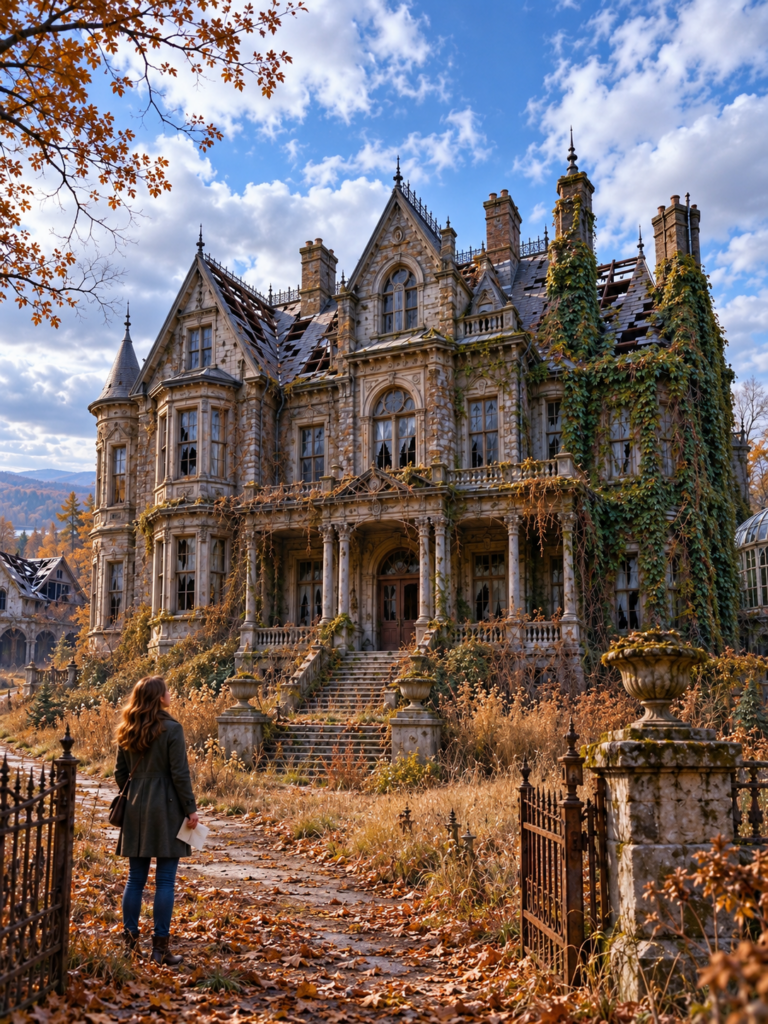
Ironwood Manor was enormous.
3 stories of dark stone spread across the top of a shallow rise, its architecture an uneasy combination of Victorian ambition and industrial severity. Ivy had swallowed much of the east wing. Gutters hung loose. Sections of slate roof were missing. Several chimneys leaned at angles that seemed physically unsustainable.
Windows stared blankly through broken glass.
Behind the house stood the remains of a carriage building, part of its roof collapsed inward. Farther beyond it, the iron frame of an old greenhouse rose from weeds.
The grounds had once been landscaped.
Now nature had begun erasing the distinction between garden and forest.
Norah crossed the courtyard.
Nothing moved.
Not even birds.
She stood facing the house and tried to calculate what she was seeing.
Roof replacement.
Structural repairs.
Asbestos removal.
Taxes.
Demolition.
Environmental work.
Every direction she looked seemed to contain another expense she could not afford.
The Hastings family had been right.
They had given her a ruin.
Norah entered through the front door.
It opened after a long push against warped wood.
Inside, the air was colder.
The entrance hall retained traces of former grandeur beneath decay. A curved staircase rose beneath a ceiling blackened by water damage. Plaster had fallen away in long sections, exposing wooden lath beneath like bones beneath torn skin.
Trash covered the floors.
Beer cans.
Broken furniture.
Graffiti.
Old newspapers swollen by damp.
The house had become a destination for bored teenagers and people who wanted shelter without questions.
Norah spent hours walking through it.
A ballroom.
Bedrooms.
A dining room with no table.
Servants’ passages.
A kitchen stripped of fixtures.
An office containing mold where books once stood.
At last she entered the library.
The fireplace had partially collapsed.
One remaining windowpane admitted gray evening light.
Norah stood there for a long time.
Then something inside her broke open.
She screamed.
It was not language.
It had no shape beyond pain.
The sound tore through the empty room and traveled into corridors where no one had lived for decades.
She screamed at Beatrice.
At Graham.
At the hospital.
At the surgeon who had looked at her with practiced sorrow.
At every person who had said Leo had not suffered, as though that solved anything.
Finally she screamed at Leo.
“You left me.”
Her voice broke.
“You left me here.”
Norah picked up a loose piece of brick and threw it.
The last intact pane in the library exploded outward.
Glass fell onto the dead veranda.
Then Norah went to her knees.
She cried with both hands pressed against her chest.
She cried until breathing hurt.
Until her face was wet with dust and tears.
Until the room darkened around her.
Eventually there was nothing left.
Norah sat on the floor, exhausted.
The ruined house was silent again.
She wiped her face with her sleeve.
“I hate you,” she whispered.
She did not know whether she meant the Hastings family, Leo, or the house.
Perhaps all 3.
Then she stood.
She would not give Beatrice the satisfaction of being right.
Norah did not know how to save Ironwood.
But she could dismantle it.
Copper had value.
Brick had value.
Old fixtures had value.
Scrap steel had value.
Even broken buildings could be converted into something.
She would sell every salvageable piece if necessary.
She would reduce the manor to bare ground with her own hands before she allowed the Hastings family to watch her collapse beneath it.
The next morning, she entered Oakhaven Hardware just after opening.
A man in a faded flannel shirt stood behind the register.
His name tag read WYATT.
He was broad through the shoulders, somewhere in his late 50s, with gray beginning in his beard and hands marked by old cuts.
Norah placed gloves, a flashlight, a crowbar, heavy trash bags, and a sledgehammer on the counter.
Wyatt scanned the items.
“Renovation?”
“Something like that.”
He glanced at the sledgehammer.
“Demolition?”
“Also something like that.”
He looked at her more closely.
“You’re the Ironwood woman.”
Norah sighed.
“Is there a newspaper I’m not aware of?”
“No. Town’s small.”
He continued scanning.
“County’s wanted that place down for years.”
“So I’ve heard.”
“Old Ironwood was strange.”
“How strange?”
Wyatt shrugged.
“Rich-man strange. Thought everyone was coming for something. Built walls. Installed locks on locks. Bought machinery he didn’t need. Kept warehouses full of parts.”
“When did he die?”
“1960s.”
“And the Hastings family?”
“Never did much with the place. Paid people to check it for a while. Then stopped.”
Norah lifted the crowbar.
“I’m cleaning it.”
Wyatt stared at her.
“By yourself?”
“Yes.”
“You walk through the wrong floor in that main house, we’ll be pulling you out of the basement.”
“I’ll be careful.”
“The carriage house is worse.”
“I’ll be careful there too.”
He seemed about to argue, then stopped.
“$84.”
Norah paid.
For the next 7 days, Ironwood consumed her.
She worked from morning until light failed.
The labor was punishing enough to quiet her thoughts.
She hauled lumber.
Separated metal.
Filled bags.
Dragged ruined furniture out of damp rooms.
She learned which floorboards bowed and which beams could still carry weight.
At night she returned to the motel with hands trembling from exhaustion.
She slept because her body gave her no choice.
On the 8th morning, hard frost silvered the fields.
Norah worked in the carriage house.
Most of the roof had collapsed years before, leaving one half open to weather. She had begun removing damaged floorboards to assess the stone beneath them.
She drove the crowbar into a seam.
Pulled.
The wood cracked.
Norah expected dirt.
Instead, something gray reflected beneath the splintered boards.
She crouched.
Metal.
She cleared more wood.
A sheet of steel extended beneath the floor.
Norah stared.
She picked up the sledgehammer and smashed through another section of boards.
Then another.
Dust rose around her.
The steel continued.
At least 8 ft across.
At the center of the exposed surface sat a recessed mechanical wheel large enough to require both hands.
Norah dropped the hammer.
For several seconds she simply listened to the echo fade.
It was not flooring.
It was a door.
A massive steel door hidden beneath the ruined carriage house.
Norah knelt and brushed dirt from the central mechanism.
The metal beneath remained remarkably clean.
She gripped the wheel.
Pulled.
Nothing.
She tried again.
The mechanism did not move.
Norah sat back.
Wyatt had called the old owner paranoid.
A hoarder.
A man who built locks on locks.
Norah looked around at the collapsed building.
Then back at the steel.
For the first time since inheriting Ironwood, ruin was no longer the only thing she could see.
Part 2
Wyatt listened without interrupting.
When Norah finished, he folded his arms across his chest.
“You want what?”
“A cutter.”
“No.”
“A generator.”
“No.”
“A winch.”
“Definitely no.”
Norah took 3 $100 bills from her wallet and placed them on the counter.
Wyatt looked at the money.
“That’s not going to make what you’re asking any smarter.”
“It’s almost half the cash I have left.”
“Then you should keep it.”
“I found a vault door.”
He looked up.
“An actual vault door.”
“Under the carriage house.”
“What kind?”
“I don’t know. Steel. Huge. A wheel in the middle.”
Wyatt’s expression changed only slightly.
“How huge?”
“About 8 ft across. Maybe more.”
He rubbed one hand over his beard.
“Could be old fuel storage.”
“With a bank-vault wheel?”
“Could be civil defense.”
“Can you open it?”
“That isn’t the right question.”
“What is?”
“Whether opening it kills us.”
Norah stared at him.
Wyatt sighed.
“Sealed underground spaces collect gas. Methane. Carbon monoxide. Could be no oxygen down there. Could be flooded. Could have structural failure. You cut into something you don’t understand, things get complicated fast.”
“I understand.”
“No, you don’t.”
Norah leaned forward.
“I signed away whatever life I had 3 weeks after burying my husband. I owe a county $400,000. I am living in a motel that charges extra for heat. That door is the first thing I’ve found on the property that wasn’t actively collapsing.”
Wyatt remained silent.
“I need one thing not to be worthless.”
That ended the argument.
Wyatt took the money.
“I close at noon.”
At 2, the quiet at Ironwood ended beneath the growl of a diesel generator.
Wyatt parked his flatbed as close to the carriage house as the ground allowed. He brought cables, cutting equipment, chains, a gas detector, ventilation fans, masks, and enough tools to make Norah realize how little she understood about what she had asked.
He examined the exposed steel.
Then he whistled.
“What?”
Wyatt crouched beside the edge.
“This isn’t a farm installation.”
“What is it?”
“Military-style blast door. Maybe early Cold War. Look.”
He pointed toward the perimeter.
Under the cleared boards, the steel frame disappeared into a heavy ring of reinforced concrete.
“Whoever put this in expected pressure.”
“From what?”
“That’s the interesting question.”
“Can we open it?”
Wyatt looked at her.
“Eventually.”
He spent nearly an hour exposing the mechanism.
The central wheel controlled locking pins buried inside the frame. Time had frozen everything in place.
Wyatt lowered a welding mask.
“Stand back.”
The plasma cutter ignited.
Blue-white light filled the ruined carriage house.
Metal shrieked.
Sparks bounced over frost-darkened stone.
Norah watched from behind a column while the smell of heated steel filled the cold air.
What if it was empty?
The thought arrived after the first half hour.
What if the door protected nothing more than forgotten machinery?
What if an eccentric millionaire had built a shelter and stocked it with spoiled food?
What if she had just spent $300 to discover another expense?
Wyatt finally switched off the cutter.
“Pins are clear.”
He wrapped a thick chain through the wheel and attached it to the truck’s winch.
“Whatever happens, stay away from the cable.”
Norah nodded.
The winch engaged.
The chain straightened.
Steel groaned beneath them.
The truck rocked against its suspension.
Nothing moved.
Wyatt increased tension.
A low metallic vibration entered the floor.
Then the seal broke.
The sound was violent.
A sharp report followed by a long scream of steel.
The door lifted several inches.
A current of air escaped.
Not damp air.
Dry air.
Ancient dust swirled upward.
Wyatt immediately stopped.
They waited while instruments checked the atmosphere.
Then the fans ran.
The gap widened to approximately 3 ft.
Norah lowered herself beside it.
“Wait.”
Wyatt’s warning came too late.
Norah switched on her flashlight and squeezed through.
She landed on steel grating.
The smell surprised her.
No mildew.
No standing water.
Oil.
Old preservatives.
Dry concrete.
A stairwell descended ahead.
Wyatt came through behind her.
“You’re going to get me killed.”
“You came voluntarily.”
“That’s what concerns me.”
Their flashlights moved down the stairs.
At the bottom, Norah stopped.
The chamber extended far beyond the carriage house.
Concrete walls vanished into darkness. Industrial shelving lined both sides. Wooden crates had been stacked with a care that suggested inventory rather than storage.
And beneath heavy canvas covers, forms waited in rows.
Long.
Low.
Metallic.
Wyatt whispered something.
Norah did not hear it.
She approached the nearest covered object.
Dust had gathered on the canvas, but the material itself was intact.
She gripped one corner and pulled.
The cloth slid away.
Chrome returned the flashlight beam.
Beneath it lay deep midnight-blue paint so smooth it seemed wet.
The automobile had enormous sweeping fenders, a long hood, polished exhaust pipes, and the sculptural proportions of something built before engineering separated itself completely from art.
Norah stared.
“What is it?”
Wyatt had removed his cap.
His mouth was slightly open.
“Don’t touch anything else.”
“What is it?”
He stepped closer.
“A Duesenberg.”
That meant almost nothing to Norah.
“Is that good?”
Wyatt turned toward her.
“Good?”
He gave a small incredulous laugh.
“This is a Model J.”
“How much is it worth?”
“I don’t know.”
“You just said—”
“I know what it is. I don’t know what this one is worth because cars like this don’t show up under collapsed buildings.”
Norah moved toward the next tarp.
Wyatt caught her wrist.
“Slow.”
They uncovered it together.
Another Duesenberg.
Silver.
Convertible.
The next car was stranger still: low, fluid, almost impossibly elegant.
Wyatt stood motionless.
“Bugatti.”
“What kind?”
“Type 57.”
He moved the flashlight over the bodywork.
“Oh, my God.”
Norah looked beyond him.
There were more covered vehicles.
Crates.
Motorcycles.
Shelving filled with sealed parts.
Blueprint tubes.
Equipment wrapped in waxed fabric.
The bunker had been built not as a refuge for people but as a refuge for machines.
Old Ironwood had preserved an entire collection beneath the estate.
Wyatt began examining crates.
“Factory parts.”
He moved to another.
“Indian motorcycle components.”
Another.
“Aircraft drawings.”
He looked at Norah.
“Whoever stocked this knew exactly what he was doing.”
“How much?”
“I told you, I don’t know.”
“Guess.”
Wyatt exhaled.
He pointed toward the midnight-blue Duesenberg.
“To the right buyer? Millions.”
“How many?”
“10. Maybe more.”
Norah said nothing.
Wyatt gestured toward the Bugatti.
“That could be worth more.”
“How much more?”
“If the provenance is clean, if it’s original, if the condition is what I think it is…”
He stopped.
“Wyatt.”
“Tens of millions across the collection.”
Norah stared at him.
“Tens?”
“Could be $50 million. Could be $100 million. I don’t know until somebody who lives in that world sees it.”
The scale refused to enter her mind.
$400,000 had been enough to ruin her.
Now Wyatt was speaking of sums larger than entire hospitals’ annual budgets.
Norah looked down at the blue fender.
In its polished surface, her own reflection appeared distorted by the curvature.
Dirty hair.
Grease on her cheek.
Work gloves.
A woman standing underground because her husband’s family had wanted to punish her.
$3.
She remembered the bills sliding across mahogany.
Buy yourself a coffee.
Graham laughing.
Don’t choke on the asbestos.
Something unfamiliar happened inside Norah’s chest.
She smiled.
It was not a happy smile.
Not yet.
But it was the first one since Leo died.
The next several days changed Ironwood completely.
Wyatt contacted a specialist he trusted.
The specialist contacted someone else.
Within 48 hours, Norah found herself speaking by encrypted video call with a collector-car broker in Chicago who asked questions she could barely answer.
Vehicle numbers.
Storage humidity.
Original paint.
Documentation.
Ownership chain.
The deed became suddenly important.
Norah read it properly for the first time.
All 53 pages.
Then she hired an attorney.
Not a Hastings attorney.
Her own.
The property language was astonishingly broad.
Graham’s legal team had drafted it that way to ensure the family trust could never again be held responsible for environmental costs.
All physical property.
All structures and substructures.
All fixtures and contents.
Known and unknown.
All future liabilities and benefits arising from possession.
The language was designed as a shield.
It became Norah’s title to everything underground.
The first priority was the tax lien.
A collateral lender agreed to advance enough to clear the county obligations against a small portion of the collection’s estimated value.
The wire transfer went through on a Tuesday morning.
In Manhattan, Graham Hastings received notice before lunch.
He had placed an electronic alert on the Ironwood property weeks earlier.
At first, the alert meant nothing.
Then he read it twice.
$400,000 in county obligations had been paid in full.
Graham stared at the screen.
His assistant stood near the office door.
“Who paid it?”
“A holding company.”
“Whose?”
“Chicago.”
“Why?”
“I don’t know.”
Graham opened another window.
The lien status had changed.
Clear.
His first instinct was irritation.
His second was suspicion.
Norah had no money.
Leo’s medical expenses had nearly emptied their savings. That had been part of the reason Ironwood seemed so perfectly chosen. Norah could neither maintain the property nor clear its debts.
Yet someone had just put almost half a million dollars into it.
No professional lender did that without collateral.
Graham stood.
For years, his grandfather’s notebooks had circulated in fragments through family storage. The old man had written obsessively about machinery. About preservation. About industrial heritage.
About “the legacy in the rust.”
The Hastings children had treated the phrase as evidence of senility.
Graham suddenly remembered it with extraordinary clarity.
He called Beatrice.
She answered on the second ring.
“What is it?”
“We made a mistake.”
“About what?”
“Ironwood.”
Silence.
“The lien was paid.”
“So?”
“Norah doesn’t have $400,000.”
Beatrice understood immediately.
“What did she find?”
“I don’t know.”
“Then find out.”
Graham looked at the deed saved on his computer.
“We need to reverse the transfer.”
“You said it was permanent.”
“We need a loophole.”
“Do we have one?”
“I’ll make one.”
2 days later, a black Mercedes G-Wagon struggled through the mud beyond Oakhaven.
Graham drove.
Beatrice sat beside him.
The road offended both the suspension and their expectations.
As they rounded the final bend, Graham braked.
The old gates were gone.
A new perimeter fence stood across the property.
8 ft high.
Floodlights had been installed along temporary poles.
Security cameras turned toward the road.
Heavy equipment operated beyond the fence.
A crane lifted collapsed roof material from the carriage house while crews in protective equipment moved between temporary structures.
Graham stared.
“What the hell?”
Beatrice removed her sunglasses.
2 security contractors stood beside the locked gate.
Graham got out.
“Open this.”
The taller guard checked a list.
“Name?”
“Graham Hastings.”
The guard looked again.
“No.”
Graham’s face changed.
“This is Hastings property.”
“No, sir.”
“I am executive trustee of the Hastings family trust.”
“Property owner listed on our documents is Norah Hastings.”
Graham stepped closer to the fence.
“Open the gate.”
“I can’t.”
“You can and you will.”
“The sheriff was here yesterday.”
Norah’s voice came from inside the property.
Graham turned.
She walked toward them from behind stacks of salvaged stone.
For a moment he barely recognized her.
She wore canvas work pants, boots, and a heavy sweater. Her hair was tied back. There was no makeup on her face.
More important, the numbness was gone from her posture.
She no longer looked like the woman who had sat in the law office unable to follow conversation.
She looked awake.
“The sheriff reviewed everything,” Norah said.
Graham gripped the fence.
“What are you doing?”
“Cleaning.”
“With armed security?”
“They’re not armed.”
“They’re security.”
“People started getting curious.”
“Who is paying for this?”
Norah smiled faintly.
“A lender.”
“What did you find?”
There it was.
No greeting.
No question about how she was surviving.
No mention of Leo.
Only value.
Norah looked at Beatrice.
The older woman’s composure had thinned.
“You found the collection,” Beatrice said.
Norah’s expression changed.
So they did know something.
“Collection?”
“My father-in-law’s things.”
“Interesting.”
Beatrice stepped closer.
“Norah, you need to let us in.”
“No.”
“This is family property.”
“You sold it.”
“We transferred a liability.”
“Same deed.”
Graham’s patience broke.
“The deed conveyed the surface estate and associated obligations. It did not convey undisclosed underground assets intentionally severed from ordinary property use.”
Norah reached into her sweater.
She unfolded a photocopy.
“I had an attorney explain this part to me.”
She held the document against the fence.
Graham knew the language immediately.
His own team had insisted on it.
ALL PHYSICAL PROPERTY, STRUCTURES, SUBSTRUCTURES, FIXTURES, CONTENTS, MATERIALS, KNOWN OR UNKNOWN.
They had wanted no ambiguity.
Environmental agencies were notorious for pursuing former owners.
Graham had demanded the broadest transfer possible.
Norah lowered the paper.
“You didn’t transfer the surface.”
She looked at him.
“You transferred everything.”
“We didn’t know about the vault.”
“I know.”
“Then the transfer was made under false assumptions.”
“Your assumptions.”
“It belongs to the trust.”
“No.”
“My grandfather purchased those assets.”
“And then your family sold them to me.”
“For $3.”
“Yes.”
Beatrice stepped forward.
Her voice softened.
“Norah.”
Norah turned toward her.
“We handled the meeting badly.”
“Badly?”
“We were grieving.”
“So was I.”
“People say things in grief.”
“You brought champagne.”
For the first time, Beatrice looked away.
Norah continued.
“You didn’t come to Leo’s funeral.”
“I had obligations.”
“You had a charity gala.”
“That is unfair.”
“No. It’s accurate.”
Beatrice’s face tightened.
“Leo loved his family.”
“Leo spent 10 years trying to get away from what his family turned people into.”
The sentence landed harder than shouting.
Graham struck the fence with his palm.
“You have no idea what you’re dealing with.”
Norah looked at him.
“I have a lawyer.”
“You’ll need 20.”
“Then I’ll hire 20.”
“We can keep this in court for years.”
“Do it.”
“I’ll freeze every asset.”
“Try.”
“You think finding some old cars makes you one of us?”
Norah’s eyes remained steady.
“I don’t want to be one of you.”
Graham leaned toward the mesh.
“You’re a nurse.”
“Yes.”
“A nobody.”
Norah looked at him for several seconds.
Then she turned away.
Behind her, machinery continued working.
The crane engine drowned Graham’s next words.
He shouted her name.
She kept walking.
Beatrice did not call after her.
The new fence stood between them.
For the first time since Norah had entered the Hastings family, they were the ones outside.
Part 3
The lawsuit arrived 4 days later.
Then another filing.
Then an emergency motion.
Then requests for injunctions, asset freezes, discovery orders, geological surveys, trust interpretation, and temporary control of the Ironwood collection.
Graham kept his promise.
The Hastings family attacked from every legal direction available.
They claimed the transfer had been induced by mistake.
They claimed the underground vault constituted a separate property interest.
They argued that the original collector had lacked mental capacity when he sealed the vehicles away.
They claimed the contents belonged to the trust independently of the land.
They raised questions about inheritance.
Mineral rights.
Storage rights.
Fixture doctrine.
Abandoned property.
Fraud.
Unjust enrichment.
Norah’s attorneys answered each argument with the same basic fact.
The Hastings trust had drafted the deed.
The Hastings trust had demanded complete severance.
The Hastings trust had transferred all structures, substructures, contents, known and unknown.
The language existed precisely because Graham wanted no path by which future obligations could return to the family.
He had succeeded.
The judge read the documents.
Then read them again.
The request to seize the collection was denied.
The next injunction failed.
The Hastings attorneys appealed.
They failed again.
Months passed.
Ironwood itself was stabilized.
Engineers reinforced the carriage house.
Environmental crews began abatement work in the manor.
Professional conservators entered the vault wearing gloves and expressions of disbelief.
The collection was larger than Norah and Wyatt first understood.
There were 2 Duesenbergs.
The Bugatti.
Several historically significant American automobiles.
Indian motorcycles still protected in original shipping material.
Factory parts never installed.
Blueprints.
Tooling.
Documentation.
Correspondence.
Aviation materials.
Components manufactured before wartime production transformed American industry.
Old Ironwood had not merely collected expensive objects.
He had collected engineering.
He had acquired examples of mechanical work he believed would disappear and then built a climate-controlled underground structure to preserve them.
Some objects turned out to be ordinary.
Others did not.
Collectors began calling.
Then museums.
Then auction houses.
Norah rejected private offers.
She wanted independent valuation.
She wanted provenance research.
She wanted every title clean.
Most of all, she wanted the Hastings family to have no opening.
Wyatt became an unlikely constant through the process.
He refused Norah’s first attempt to pay him beyond the $300.
“You hired me to open a door.”
“And the door contained several fortunes.”
“Wasn’t my door.”
“You found the method.”
“That’s what tools are for.”
Eventually Norah solved the argument by giving him 5% of the eventual net proceeds connected to the first group of vehicles.
Wyatt nearly refused that too.
His wife convinced him not to be stupid.
By spring, the legal fight was effectively over.
The court ruled that the deed was unambiguous.
The family had not been defrauded.
They had possessed the property for decades.
They had every opportunity to inspect it.
They had chosen not to.
They had knowingly transferred unknown contents along with known liabilities.
A party could not write a contract broad enough to escape all future loss, the ruling observed, then demand narrow interpretation when the same language produced an unexpected gain.
Graham read the decision in his office.
He threw a glass against the wall.
Beatrice said nothing.
6 months after Norah crossed the rusted wall at Ironwood for the first time, she stood beneath chandeliers in Monterey, California.
The collector-car world had transformed the Ironwood cache into an event.
The story had spread well beyond automotive circles.
A forgotten estate.
A sealed underground vault.
Cars unseen for nearly 80 years.
Original paint.
Original parts.
Documentation.
Preservation bordering on the impossible.
The ballroom was filled with people whose relationship to money differed fundamentally from Norah’s.
They did not calculate groceries.
They did not delay dental work.
They did not know what it meant to consider whether a $900 emergency could destabilize a household.
A number on an auction board could rise by $1 million and barely alter their expressions.
Norah stood near the back.
She wore a black suit.
No diamonds.
No expensive watch.
No visible attempt to imitate the world around her.
Wyatt stood beside her in a rented tuxedo.
He pulled at his collar.
“This thing’s trying to kill me.”
“It’s a bow tie.”
“Exactly.”
Norah smiled.
Wyatt looked at her.
“You nervous?”
“No.”
“You should be.”
“Why?”
“Because this is insane.”
That was true.
The curtains opened.
Conversation stopped.
The midnight-blue Duesenberg Model J stood on a rotating platform beneath warm light.
For months, preservationists had worked without altering the essential originality of the car. Dust had been removed. Surfaces carefully cleaned. Mechanical systems assessed. Everything possible had been done to preserve rather than restore.
The result was extraordinary.
The car did not look new.
It looked untouched by time.
The auctioneer approached the podium.
“Ladies and gentlemen, we come now to the first major offering from the Ironwood Collection.”
A camera image of the Duesenberg appeared on large screens.
“Hidden from public view for nearly 8 decades and preserved in controlled underground storage, this 1930 Duesenberg Model J remains one of the most remarkable surviving examples to emerge in recent memory.”
Norah listened without absorbing much.
Her attention had gone elsewhere.
3 rows from the front sat Graham and Beatrice.
They had come.
Norah had not invited them.
They required no invitation.
The sale was public, and perhaps there were forms of suffering people chose because absence would be worse.
Graham sat rigidly.
Beatrice’s hands rested together in her lap.
Neither turned around.
The auctioneer began.
“$5 million.”
A paddle rose.
“5 million, thank you. 6?”
A telephone bidder entered.
“6 million.”
Then 7.
The numbers moved so quickly they lost meaning.
Norah watched Graham.
Each bid tightened his shoulders.
At $12 million, Wyatt quietly swore.
At $14 million, Beatrice lowered her eyes.
At $16 million, only 2 bidders remained.
The auctioneer scanned the room.
“$17 million.”
A paddle rose near the aisle.
“17 million.”
Silence.
“18?”
No movement.
The auctioneer waited.
Norah heard only the faint shifting of people in chairs.
“At $17 million.”
The gavel lifted.
“Once.”
Graham’s head bowed almost imperceptibly.
“Twice.”
The gavel struck.
“Sold.”
Applause filled the ballroom.
Norah did not clap.
She looked at the car.
For several seconds, she remembered not the vault but the conference room.
3 dollar bills.
Mahogany.
Champagne.
Don’t choke on the asbestos.
She expected triumph.
Instead she felt tired.
The next vehicle came.
Then another.
The silver Duesenberg reached $12 million.
The Bugatti produced the evening’s most aggressive bidding.
2 collectors fought in increments large enough to make Wyatt stare.
$18 million.
$19 million.
$20 million.
Then $22 million.
The gavel fell.
Parts followed.
Motorcycles.
Blueprints.
Smaller vehicles.
Rare components purchased by collectors and institutions.
Hours passed.
At the end, the total appeared above the stage.
$68,400,000.
Wyatt stared at it.
“That’s a phone number.”
Norah laughed.
A waiter passed with champagne.
She took sparkling water instead.
Across the room, Graham had already gone.
Beatrice remained seated.
For a moment, Norah considered walking over.
She could have said something.
She could have mentioned the $3.
She could have asked whether the champagne tasted better in Manhattan.
She could have delivered one perfect sentence and carried it for the rest of her life as proof that she had won.
Norah stayed where she was.
The urge passed.
Because the truth had become clearer over the preceding months.
Graham and Beatrice had lost long before the auction.
They had lost when Leo learned that affection in their family was conditional on obedience.
They had lost when he left the firm.
They had lost when they treated his marriage as embarrassment.
They had lost when a charity gala mattered more than their son’s funeral.
The cars were only money.
Money was the only language they trusted, so this was the first loss they could understand.
Norah no longer needed them to understand anything else.
Wyatt nodded toward the reception doors.
“You staying for whatever rich people call the thing after this?”
“No.”
“Where are you going?”
“Outside.”
The Pacific air was colder than she expected.
Norah walked down a stone path toward the beach.
Music from the resort weakened behind her.
At the sand, she removed her shoes.
The water was black beyond the surf.
Waves arrived and collapsed beneath a pale moon.
Norah walked until the lights of the hotel were distant enough to blur.
$68.4 million.
The number should have changed how the world felt.
It did not.
Leo was still dead.
That was the most stubborn fact in her life.
No contract altered it.
No court ruling touched it.
No auctioneer could increase a bid high enough to reach backward 6 months and keep an artery from rupturing in a Manhattan kitchen.
Norah stood ankle-deep in cold sand and remembered him.
Not the funeral.
Not the hospital.
Not the kitchen floor.
Leo before all of that.
His laugh when something surprised him.
The smell of coffee on his breath.
The way he danced badly when music came on while they were cooking.
The way he forgot umbrellas and returned home soaked.
The way he said her name when half asleep.
The way he looked relieved every time they closed their apartment door behind them after visiting his family.
Years earlier, Norah had once asked him whether walking away from the Hastings money frightened him.
“Constantly,” he said.
She had expected another answer.
“Then why did you?”
Leo thought for a moment.
“Because I watched them confuse having things with being safe.”
Norah had laughed then.
Standing on the California coast, she understood.
Old Ironwood had buried his fortune underground.
The Hastings family had buried itself beneath money in a different way.
Both had believed preservation could defeat uncertainty.
One built steel walls.
The others built trusts, corporations, lawyers, and social position.
None of it stopped death.
None of it protected love.
None of it kept Leo in the world.
Norah looked toward the horizon.
She had imagined, during the lawsuit, that winning would feel like revenge.
Sometimes it had.
When Graham’s injunction failed, she celebrated.
When the court upheld the deed, she opened a bottle of wine with Wyatt and his wife.
When the security gate closed in Graham’s face, she had felt something close to satisfaction.
But revenge had a limit.
It could return power.
It could restore dignity.
It could prevent someone else from choosing the terms of your life.
It could not resurrect anyone.
That required a different kind of decision.
Norah began making those decisions before she left California.
She established a foundation in Leo’s name.
A substantial endowment went to the hospital where she had worked, particularly toward emergency neurological care and support for families facing sudden catastrophic illness.
She funded scholarships for nurses.
Oakhaven received money for equipment its local government had postponed replacing for years.
A new fire engine.
Road repairs.
Emergency services.
The old downtown clinic received renovation funds.
Wyatt used part of his share to expand the hardware store, then complained that expansion meant more paperwork and therefore had probably been a mistake.
Norah kept Ironwood.
People assumed she would sell the land after the collection was gone.
She did not.
The manor remained difficult.
Asbestos remediation took months.
Sections of the roof required complete replacement. Parts of the east wing could not be saved.
Norah did not restore it into a mansion.
She had no desire to live in 40 rooms or turn herself into the sort of person who required staff merely to exist inside her own house.
Instead, she preserved what was structurally sound.
Several rooms became offices for the foundation.
The former library was rebuilt.
The shattered window was replaced.
Norah stood there on the day the new glass was installed.
The room looked nothing like the place where she had collapsed months earlier.
Yet she could still locate the exact spot.
She remembered kneeling there, dust on her face, believing she had been handed the final proof that the world had decided to finish breaking her.
She remembered promising the empty room she would dismantle Ironwood brick by brick before surrendering.
She had not known then what lay below the carriage house.
But perhaps the vault was never the most important discovery.
The greater discovery had been made before the first floorboard cracked.
It was the understanding that exhaustion and helplessness were not the same thing.
Norah had been exhausted.
She had been grieving.
She had been financially frightened.
She had been humiliated.
But she had not been finished.
Beatrice tried contacting her once.
The message arrived almost a year after Leo’s death.
It was polite.
Restrained.
There was no apology in it.
Only a request to discuss certain family matters and perhaps establish a more civil relationship going forward.
Norah read the message twice.
Then deleted it.
Graham never contacted her directly again.
The Hastings family survived.
They did not become poor.
Their companies continued operating.
They retained homes, investments, lawyers, memberships, influence.
Losing Ironwood did not destroy them.
But the story followed them.
Articles about the auction invariably mentioned the peculiar transfer.
The $3 deed became part of the collection’s mythology.
Journalists enjoyed the irony too much to omit it.
A family trying to dispose of an unwanted liability had transferred a fortune to the very woman they intended to burden.
The story simplified with repetition.
People called it revenge.
Norah understood why.
It had the shape audiences wanted.
Cruel rich family humiliates widow.
Widow discovers hidden treasure.
Family returns.
Family loses.
Widow becomes wealthy.
Justice.
Real life was less tidy.
The Hastings family had not caused Leo’s death.
The vault did not heal Norah’s grief.
Money did not purify anyone who received it.
There were mornings when she woke at Ironwood and cried before getting out of bed.
There were birthdays that hurt.
There were songs she stopped playing.
There were moments when she turned to tell Leo something and felt the old concussion return.
Healing did not mean absence of pain.
It meant pain no longer controlled every room.
On the first anniversary of Leo’s death, Norah returned alone to the carriage house.
The original blast door had been preserved.
Engineers had installed a safer modern entrance beside it, but the steel wheel remained where she had found it.
Norah sat on the rebuilt floor.
The underground chamber was empty now.
Only shelves and documentation remained.
Museum specialists had cataloged everything.
Some objects had been sold.
Others had been donated.
A few remained under foundation ownership for future exhibition.
The great secret had become ordinary through knowledge.
That happened to mysteries.
Once opened, even a vault became architecture.
Norah rested her hand on the steel.
It was cold.
She thought about the improbable chain of decisions that brought her there.
Old Ironwood had spent a fortune hiding machines from time.
The Hastings family inherited the property and never bothered to look.
Graham saw only liability.
Beatrice saw an opportunity for humiliation.
Gable placed a pen beside yellow tabs.
Norah signed without reading.
Any one of those choices could have changed everything.
She wondered what Leo would have said.
Probably something irritatingly reasonable.
He would have disliked the public story.
He would have hated the auction spectacle.
He would have laughed at Wyatt’s tuxedo.
He would have insisted that Norah keep enough money to stop working night shifts.
He would have been embarrassed by the foundation carrying his name.
Most of all, he would have told her not to let his family remain the center of her life merely because they had once hurt her.
Norah closed her eyes.
“I know,” she said.
Her voice echoed faintly in the old carriage house.
Outside, Oakhaven moved into spring.
The valley that had looked dead in November had begun turning green.
Trees budded.
Water ran beside the road.
Birds returned to Ironwood.
Norah noticed them because on the first day she arrived, there had seemed to be none.
She eventually moved into a modest renovated section of the manor.
Not the grand rooms.
A former guest wing overlooking the east lawn.
She kept a small kitchen.
A bedroom.
A study.
More space than the Manhattan apartment, less than the Hastings family would consider respectable.
Leo’s jacket hung inside the entry closet.
For a long time she could not decide what to do with it.
Then she realized she did not have to decide.
Some things could remain.
Not everything needed to become a symbol.
Years of work lay ahead for Ironwood.
The estate would never be inexpensive.
Old stone required maintenance. Historic structures possessed endless appetites.
But the property was no longer a punishment.
Norah turned part of the grounds into public space.
The greenhouse was rebuilt.
The carriage house became a small engineering archive documenting the Ironwood collection and the industrial history of the region.
A plaque near the original vault door told visitors where the cars had been found.
Norah insisted that the plaque contain one line the foundation’s lawyers initially wanted removed.
THE PROPERTY WAS TRANSFERRED TO NORAH HASTINGS FOR $3.
Visitors smiled when they read it.
Some photographed it.
Norah did not.
She no longer needed the reminder.
The 3 bills Beatrice had pushed across the table remained in Manhattan.
Norah had left them there.
For a while she regretted that.
They would have made a satisfying display.
Eventually she was glad she had not taken them.
She did not want Beatrice’s money framed on a wall.
The deed had been enough.
On summer evenings, Norah sometimes sat on Ironwood’s restored veranda as darkness settled over the valley.
From there, the property no longer looked monstrous.
The roofs had been repaired.
Stonework cleaned.
Paths reopened.
Warm light shone from a handful of windows rather than all of them.
Beyond the lawn, the carriage house stood beneath trees.
No one passing the estate would have guessed that nearly $70 million in forgotten machinery had once slept underneath it.
That chapter was over.
The money had moved into museums, hospitals, roads, bank accounts, scholarships, and private collections.
The objects had gone back into the world.
Norah had gone back into it too.
That mattered more.
One evening, rain began shortly after sunset.
Norah remained outside.
The scent of wet stone reminded her suddenly of Manhattan.
Of Leo.
The memory hurt.
But it did not knock her down.
She listened to rain move across the grounds and thought about the meeting where Beatrice had believed she was handing Norah a ruin.
Perhaps she had been.
Ironwood was a ruin then.
So was Norah, in certain ways.
Neither condition had been permanent.
The Hastings family had seen only decay because decay was all they believed had value in the transaction.
They understood taxes.
Liability.
Marketable assets.
They failed to understand neglected things.
A neglected place could contain history.
A neglected person could contain resolve.
A door beneath rotten floorboards could contain an impossible collection.
And a life that appeared to have collapsed could still conceal rooms not yet opened.
Norah never called what happened fate.
Leo had hated that word.
Fate made every accident sound planned.
His death had not been part of a design.
Neither had Ironwood.
There had been loss.
Cruelty.
Luck.
Bad judgment.
Work.
Chance.
And one decision after another.
That was enough.
When the rain became heavier, Norah finally stood.
She stepped inside and closed the door.
Leo’s jacket hung beside her.
For a moment she touched the sleeve.
Then she turned off the porch light and walked deeper into the house.
Not the house Beatrice had given her.
Not the ruin Graham had laughed about.
Her house.
Her life.
Neither had cost $3.
They had cost much more.
And, at last, they belonged entirely to her.