
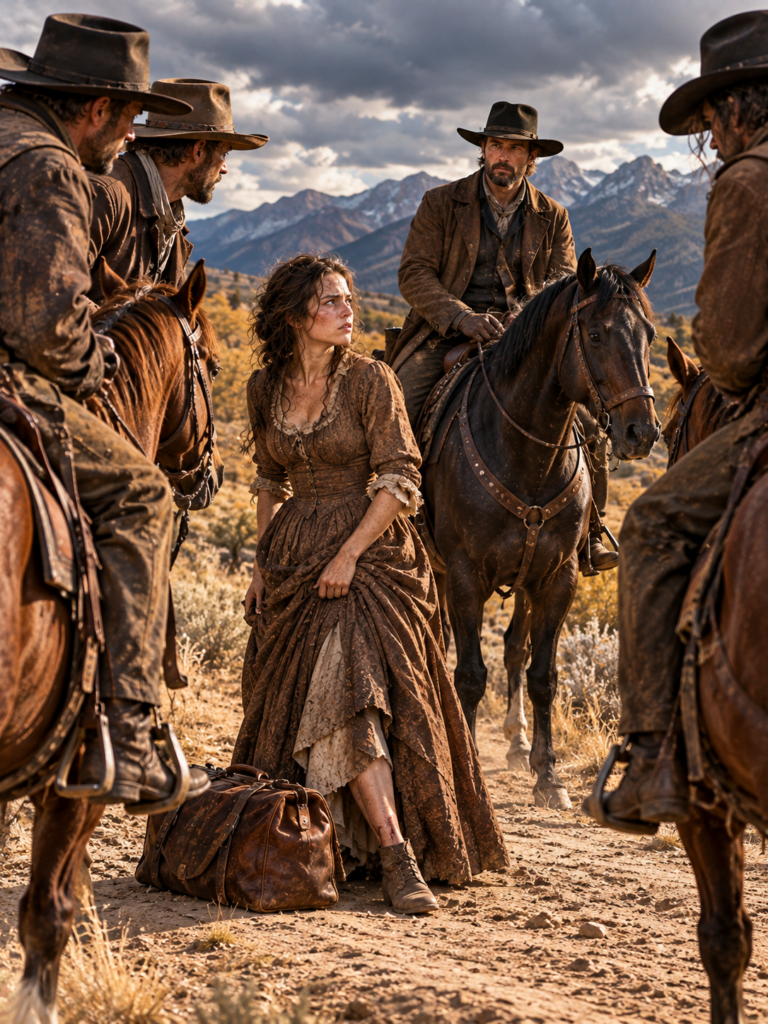
The pencil moved rapidly across the paper as Clara compared one feed invoice with another.
Ryder leaned forward.
“What have you found?”
“Possibly an error. Possibly something more. I need to see the older entries.”
He reached for the second ledger.
She stopped him.
“Let me finish this column first.”
He withdrew his hand immediately.
Clara noticed.
For years, the men in her life had interrupted her whenever her work became inconvenient to them.
Ryder simply waited.
At last, she turned the book toward him.
“You’re being charged for quantities that don’t match what you recorded receiving. I can’t say yet whether it’s deliberate, but the discrepancy is there.”
He examined the figures.
“I never caught that.”
“Most people wouldn’t. That’s why accounts need keeping.”
She closed the ledger.
Her injured heel was beginning to throb beneath the table.
Ryder noticed her wince.
“Those books can wait until morning.”
“There’s more to check.”
“And there’ll still be more tomorrow.”
He collected the supper dishes, leaving the account books where she had arranged them.
Clara watched him carry the bowls to the basin.
A man offering her paid work was unusual enough.
A man who did not expect her to cook his supper merely because she was a woman living beneath his roof was something she hardly knew how to judge.
“Mr. Cole?”
He turned.
“If I accept this position, I want the wages stated plainly. I also want my own room, and I want to be free to leave if the arrangement no longer suits me.”
“You’ll have all three.”
“I don’t want charity.”
“It isn’t charity if you’re working for your wages.”
“And if I decide to go to Mil Haven?”
“I’ll help you find transportation when your foot allows it.”
Clara lowered her eyes to the ledger.
Such simple answers should not have unsettled her.
Yet they did.
Because Harlon Sutton had always made even ordinary kindness feel like a debt that would eventually come due.
Ryder returned to the table carrying coffee.
“You needn’t make a decision tonight.”
She looked toward the faded drawing on the wall.
“Who made that?”
His expression changed.
Not sharply, but enough for her to notice.
“Someone who lived here.”
He offered nothing further.
Clara did not press him.
Outside, a horse stamped in the yard.
Wind moved along the house, and the lamp flame bent slightly.
Ryder added another piece of wood to the stove.
“You said someone took advantage of me over those invoices.”
“I said they may have.”
“There’s a difference?”
“A considerable one. A careless merchant makes mistakes. A dishonest one counts on his customer never checking.”
He looked toward the books.
“Which sort do you think I’ve got?”
“I’ll know when I’ve finished.”
He nodded.
Clara rubbed her thumb over the edge of her mother’s handkerchief.
She had spent the last seventeen days listening to her uncle describe the wonderful future awaiting them.
Not once had he asked what kind of future she wanted.
Now a stranger was offering her the chance to earn one.
She wanted to accept.
That frightened her.
“Six years ago,” Ryder said unexpectedly, “somebody gave me work when I had little to recommend me.”
Clara looked up.
“Who?”
“A man willing to judge what I could do instead of where I’d come from.”
“Did you ever repay him?”
“I tried.”
“How?”
“By making something of the chance.”
He rose and took his empty cup.
Clara sat very still.
She was beginning to understand that Ryder Cole’s quietness was not indifference.
He heard more than he said.
And he appeared to mean what he offered.
But there was another truth, one she had carried all the way from Missouri.
Her uncle had not merely abandoned her.
Before leaving St. Louis, Harlon had persuaded her to sign documents concerning property inherited from her mother.
Clara had trusted him.
She now suspected that trust had cost her far more than the contents of a stolen purse.
She could not explain that tonight.
Not yet.
Ryder placed a fresh cup of water beside her.
“Get some rest.”
Clara looked at the bedroom door, then at the ledgers.
For the first time, the future seemed to contain more than one possible road.
She rose carefully, lifted her bag, and walked toward the little room.
At the threshold, she turned.
“I’ll give you my answer in the morning.”
Ryder nodded.
“Morning will do.”
Clara closed the bedroom door, laid her bag on the narrow bed, and took out her mother’s handkerchief.
She was about to put it beneath her pillow when she noticed the faint impressions of the folded legal papers she had once kept wrapped inside it.
The papers themselves were gone.
Harlon had taken those too.
She sat on the edge of the bed.
Then, instead of allowing the memory to stop her, she reached for the pencil she had brought from the table.
On the blank inside cover of her small notebook, she began writing down everything she remembered about the documents her uncle had made her sign.
Clara wrote the date first.
March 1874.
Then her uncle’s name.
Harlon Sutton.
She worked backward through the memory of his office in St. Louis: the stack of papers, the place where he had pointed, his reassuring explanation that her mother’s land would be better protected during their journey if he handled the necessary arrangements.
She remembered signing.
She remembered asking whether the property would remain hers.
And she remembered him answering without hesitation.
Of course it would.
Clara stopped writing.
A man who could leave his niece beside a trading post without money could certainly lie about a deed.
But suspicion was not proof.
Her father, a land attorney before his death, had taught her that distinction.
She closed the notebook and put it into her traveling bag.
Whatever Harlon had done, she would need records to challenge it.
And she would need money to obtain those records.
By morning, her decision had become clear.
Ryder was outside feeding the horses when Clara entered the kitchen.
Coffee stood warming on the stove.
She poured herself a cup, sat down, and waited until he came inside.
“I’d like to accept the bookkeeping position,” she said.
“For how long?”
“Through winter, initially. I want to put aside enough money that I can choose what comes afterward.”
He nodded.
“Fair enough.”
“I’ll need access to the invoices, sales records, and correspondence.”
“You’ll have them.”
“And we should agree on wages before I begin.”
They settled the amount at the table.
Ryder made no attempt to bargain her down because she had arrived penniless.
When they finished, Clara said, “I would prefer that people know I’m employed here.”
“That’s what you are.”
“And I expect to be treated accordingly.”
His mouth moved as though he might smile.
“Miss Sutton, if you can straighten those books, you’ll have earned every dollar.”
It was the first agreement she could remember entering without feeling that something important had been concealed.
She wrote down its terms.
Then she began work.
During the first week, Ryder discovered that his new bookkeeper was more exacting than any merchant he had ever dealt with.
She questioned unexplained totals.
Demanded receipts.
Reconstructed missing balances.
And refused to accept an entry simply because he remembered making it.
“This amount can’t be correct,” she told him one evening.
“Why not?”
“Because you couldn’t have bought feed on that date. You were driving cattle to market.”
He stared at the page.
“That’s true.”
“Then either the date is wrong or the charge is.”
She turned to the next invoice.
“And this merchant appears to have charged you twice for the same delivery.”
By the end of the week, she had documented discrepancies totaling forty-three dollars and seventy cents.
Ryder studied her calculations.
“That’s more than I expected.”
“It’s more than you should have paid.”
He took her written accounting into Mil Haven.
Two weeks after her arrival, he returned with the disputed money and a written acknowledgment from the merchant.
Clara counted the coins twice.
“You recovered all of it?”
“Every cent.”
She looked up.
“Did he argue?”
“Until I showed him your figures.”
Something escaped her then.
A laugh.
Brief, astonished, and entirely unguarded.
Ryder looked at her.
Clara immediately composed herself.
He noticed that too.
“You can laugh here,” he said.
She looked down at the coins.
“I wasn’t aware I’d asked permission.”
“You didn’t.”
He poured himself coffee.
“I just thought you ought to know.”
She carried the coins to the account box, hiding a smile as she went.
Life at the ranch gradually found a rhythm.
Ryder tended cattle, repaired fencing, cared for the horses, and rode into town when business required it.
Clara balanced accounts, prepared correspondence, helped with supplies, and took on household tasks by choice rather than assumption.
Sometimes Ryder cooked.
Sometimes she did.
When disagreements arose, they discovered that neither was particularly willing to surrender a sensible position merely to keep the peace.
One morning, Clara told him that a particular expense should be reduced.
He disagreed.
They compared the figures until he understood her reasoning.
“You’re right,” he admitted.
“That must have hurt.”
“Considerably.”
She smiled openly this time.
And he smiled back.
The ranch also brought Margaret Hail into Clara’s life.
Margaret owned a neighboring property several miles west.
She was forthright, observant, and entirely unimpressed by appearances.
When she came upon Clara hanging washing behind the house, she introduced herself and studied the younger woman.
“You’re the one Ryder found on the road.”
“I’m the one he hired to manage his accounts.”
Margaret’s expression softened with amusement.
“That sounds like a correction.”
“It is.”
“Good. He needs someone who knows the difference.”
Before leaving, Margaret invited her for coffee.
She also warned Clara that some people in Mil Haven would gossip about an unmarried woman living in a rancher’s house.
Clara’s face warmed.
Margaret waved the matter aside.
“Let them talk. A person’s work and conduct count for considerably more than a stranger’s speculation.”
That Thursday, Clara accepted the invitation.
The two women discussed ranch accounts, local merchants, and the difficulties of doing business across long distances.
For the first time since arriving in the territory, Clara began forming a friendship independent of Ryder.
That mattered.
She wanted belonging.
She did not want dependence dressed up as belonging.
As the weeks passed, she also noticed the things Ryder did not speak about.
The flowers beneath the window, which he tended faithfully.
The faded drawing beside the Bible.
The extra chair at the table.
And a photograph she discovered while organizing supplies.
It showed a serious young woman with dark hair.
On the reverse was a name and year.
Eleanor, 1871.
Clara returned it to its place.
She had learned enough about loss to recognize when a question belonged to another person’s private grief.
Then, one evening, Ryder came home carrying news that changed the direction of everything.
Seven cattle were missing.
The northern fence had been cut.
Clara listened as he described the damage.
“Was it theft?”
“Looks that way.”
“Do you suspect someone?”
“An adjoining landowner. Aldis Crane.”
Ryder explained that Crane had been pressuring him to surrender control of certain water rights along Ridgeline Creek.
Crane had repeatedly made offers.
Ryder had repeatedly refused.
Since then, unexplained problems had troubled the ranch.
Missing cattle were the latest.
“Have you made a complaint?” Clara asked.
“The sheriff and Crane are friendly.”
“That doesn’t mean the documents are useless.”
Ryder looked at her.
“What documents?”
“Your water rights filing. The original agreement. Any correspondence from Crane.”
He hesitated.
“There’s an old deed in the lockbox.”
“Then bring it to me.”
Ryder sat down slowly.
“Clara, this isn’t a feed invoice.”
“I know.”
“It concerns land.”
“So did much of my father’s work.”
She explained that she had spent years copying legal documents in his office.
She had learned to distinguish original grants from later interpretations, understand property descriptions, and identify clauses that changed the meaning of an agreement.
For a moment, Ryder looked at her with open surprise.
“You never mentioned that.”
“You never asked whether I could read a deed.”
He considered the answer.
Then he went to retrieve the papers.
They worked late into the evening.
The original filing dated from 1869.
Crane possessed limited downstream access for watering cattle during specified months.
But the agreement did not grant him control of the northern tributary crossing Ryder’s pasture.
Clara read the language several times.
Then she examined Ryder’s description of a dam Crane had constructed.
“This may be his mistake,” she said.
Ryder leaned closer.
“How?”
“He has been treating access to one part of the creek as though it gives him rights over another.”
She pointed to the relevant paragraph.
“The original agreement doesn’t say that.”
Ryder read it.
Then he read it again.
His expression tightened.
“He’s been claiming that water for years.”
“That doesn’t make the claim lawful.”
She suggested submitting the original documents and a statement of the dam’s location to the appropriate land office in Helena.
Ryder could travel there.
She could prepare the correspondence.
He looked toward the papers.
“What happens if Crane learns we’re challenging him?”
“Then he’ll know you’ve stopped relying upon his interpretation.”
She paused.
“That may be enough to make him unpleasant.”
Ryder gave a humorless smile.
“He’s already unpleasant.”
Clara collected the papers.
“Then we may as well be accurate.”
Over the following days, she prepared copies, checked dates, and organized the material into a clear account of the dispute.
Ryder brought her coffee while she worked.
Neither spoke about the growing closeness between them.
But it lived in the ordinary details.
He remembered how she preferred her coffee.
She noticed when he came home tired and adjusted supper without making a performance of it.
When he struggled over a written response, she helped him choose words that were firm without becoming reckless.
And one evening, when their hands met above the papers, neither immediately moved away.
Then came Aldis Crane himself.
Clara heard his horse enter the yard.
From the kitchen, she could hear him speaking to Ryder.
His voice was smooth, confident, and threatening beneath its politeness.
He spoke of the water rights.
Of the ranch’s isolation.
Of how difficult it could become to keep a small operation prosperous.
Then he mentioned the missing cattle as though such losses were unavoidable.
Clara rose.
She opened the front door and stepped outside.
Both men turned.
Crane was older, carefully dressed, with a manner that suggested he seldom heard the word no.
Clara held the copied documents in her hand.
“Mr. Cole,” she said, addressing Ryder, “I’ve finished arranging the papers for Helena.”
Crane’s eyes moved to the documents.
Clara continued.
“The original filing is clear about the tributary. I’ve also prepared a statement concerning the dam and the interference with your property.”
She looked at Crane.
“I’m Clara Sutton. I manage Mr. Cole’s accounts and correspondence.”
Crane studied her.
“And you’ve taken an interest in this matter?”
“An interest in keeping accurate records.”
“That’s a dangerous interest in some circumstances.”
Clara remained composed.
“Only for people who depend on inaccurate ones.”
Ryder’s expression did not change.
But Clara could feel him standing beside her.
Not in front of her.
Beside her.
Crane eventually turned his horse and rode away.
Only after he had disappeared did Ryder speak.
“You’ve given him a reason to learn your name.”
“He would have learned it eventually.”
“He may try to use it.”
Clara looked toward the eastern road.
For a moment, she remembered her uncle’s office and the papers she had signed there.
“I know.”
Ryder studied her.
“Is there something you’re not telling me?”
“Yes.”
He waited.
Clara looked at the documents in her hand.
“And I will. But not while we’re standing in the yard wondering what Crane may do next.”
He accepted that.
They went inside and finished preparing the papers.
Three days later, Ryder left for Helena.
He carried the deed, the water agreement, and Clara’s carefully arranged statement in a leather satchel.
She watched him ride away.
Then she returned to the table and resumed work.
Margaret came the following morning.
After listening to Clara’s account of Crane’s visit, she offered her a place to sleep while Ryder was away.
Clara initially resisted.
“I can take care of myself.”
“I don’t doubt it,” Margaret replied. “That doesn’t mean you need to prove it every night.”
Clara considered the distance between the two ranches.
Then she agreed.
She would work at Ryder’s place during daylight and stay with Margaret after dark.
It was a practical arrangement.
It also reminded Clara that she now had more than one person willing to stand by her.
On the fourth day of Ryder’s absence, Crane returned.
This time he brought two men.
Clara was alone in the house, sorting correspondence.
She heard the horses stop.
When she opened the door, Crane smiled.
“Miss Sutton. I’ve learned something interesting about your family.”
Her stomach tightened.
He reached into his coat.
Then he held up a folded paper.
“Your uncle Harlon Sutton seems very concerned about you.”
Clara stared at the document.
Crane unfolded it.
“He claims you left Missouri in a confused state. He’s made a formal complaint questioning your judgment.”
For several seconds, the only sound was the wind moving through the yard.
Then Crane added quietly:
“And it appears he also holds documents giving him control over property that once belonged to your mother.”
Clara felt every carefully buried fear return at once.
But she did not step aside.
“That property is mine,” she said.
Crane smiled.
“That may be considerably harder to prove than you think.”
Clara placed one hand on the door.
“Mr. Crane, whatever my uncle has told you, it changes nothing about Mr. Cole’s 1869 filing.”
“It may change how seriously people take the woman preparing his case.”
She looked at the folded paper.
Then at the two men behind him.
And understood exactly what Crane wanted.
He wanted her frightened enough to persuade Ryder to abandon the complaint.
Instead, Clara drew herself upright.
“The filing is already being examined in Helena.”
Crane’s smile disappeared.
“And you, Miss Sutton, are making a dangerous choice.”
“No,” Clara answered. “I’m making one that belongs to me.”
She stepped back into the house.
And closed the door between them.
The door settled into its frame with a dull wooden sound.
Clara remained beside it, listening.
Outside, Aldis Crane said nothing.
For one suspended moment, she could hear the restless movement of the horses and the faint creak of leather.
Then someone mounted.
Hooves struck the hardened earth.
The men rode away.
Only when the sounds disappeared did Clara let go of the latch.
Her fingers were trembling.
She looked down at them without embarrassment.
Being frightened did not make her decision wrong.
She crossed to the table, sat down, and opened the notebook in which she had recorded everything she remembered about her uncle’s documents.
Harlon had underestimated her once.
Crane was making the same mistake.
That evening, Clara told Margaret everything.
The inherited Missouri land.
The papers signed before the journey.
The complaint questioning her competence.
The possibility that Harlon had arranged to take possession of her property before abandoning her.
Margaret listened carefully.
“Does Ryder know?”
“Not all of it.”
“He should.”
Clara stared at her hands.
“I know.”
“Then tell him before somebody else does.”
Clara wrote a letter that night.
She gave Ryder the facts without trying to excuse her silence.
She explained what she feared Harlon had done and how Crane had learned of it.
Most importantly, she told Ryder that she intended to challenge the transfer.
Margaret helped arrange its delivery to Helena.
For the next several days, Clara continued keeping the ranch accounts.
She returned to Margaret’s house at night.
She worked.
She waited.
And she began making inquiries concerning the original Missouri deed.
Her father had been careful with records.
If the property had passed to her mother and then to Clara, the chain of ownership should still exist in the county files.
Harlon’s signed instrument could be challenged.
But she would need legal assistance.
She wrote down the necessary questions and calculated what she could afford.
When Ryder returned on the eighth day, Clara was sitting at the kitchen table.
He entered carrying his satchel.
“The complaint’s been received in Helena,” he said.
She looked up.
“And?”
“The office has opened the matter. An inspector will come.”
Relief passed through her.
Then Ryder set down the satchel.
“I received your letter.”
Clara put aside her pen.
“I should have told you sooner.”
“Yes.”
The answer hurt because he did not soften it.
Ryder pulled out the opposite chair.
“But I want to understand why you didn’t.”
Clara considered him.
“My uncle taught me that every weakness I admitted could become something he used.”
Ryder listened.
She described the years following her mother’s death, the dependence, the expectations, and the documents Harlon had pressed upon her.
She explained that she had trusted him because, at the time, she believed she had nowhere else to turn.
Then she told Ryder how it had felt to hear the wagon leaving.
For a long time, he said nothing.
Finally, he asked, “Do you want to recover that land?”
“Yes.”
“Then what records do we need?”
Clara stared at him.
She had expected sympathy.
Possibly disappointment.
Even anger.
She had not expected him to treat the recovery of her inheritance as a practical undertaking she was capable of leading.
“I’ll need the original deed,” she said. “And the later transfer instrument. Then an attorney who knows Missouri property law.”
“Can you write for them?”
“Yes.”
“Then start there.”
She looked down at her hands.
“Crane may use the complaint against me.”
“He may try.”
“And if it becomes difficult?”
“It already is difficult.”
He leaned forward.
“Clara, I need you to tell me the whole truth when it affects what we’re doing together. But I’m not going to let a claim made by the man who abandoned you determine what I believe about you.”
She met his eyes.
There was no grand promise in his voice.
Only a decision.
Clara found herself more moved by that than she could comfortably admit.
Later that evening, Ryder stood beside the window while Clara reorganized the papers.
“There’s something I haven’t told you either,” he said.
She looked up.
“The photograph you found.”
Clara went still.
“I didn’t mean to intrude.”
“I know.”
He drew out the chair.
“Her name was Eleanor.”
He explained that Eleanor had been his wife.
They had married in 1871.
Fourteen months later, fever had taken her.
For a moment, Ryder looked toward the little drawing on the wall.
“She made that.”
Clara followed his gaze.
“The drawing?”
“She liked putting ordinary things on paper. Said a house ought to have something beautiful in it besides what came through the windows.”
He glanced toward the flower box.
“Those flowers were my mother’s. Eleanor liked them too.”
Clara waited.
Ryder rubbed his hands together.
“When Eleanor died, I kept the place running. Cattle still needed tending. Fences still needed repairing. The work was easy to understand.”
“And the rest?”
He gave a small, sorrowful smile.
“The rest took longer.”
Clara looked around the kitchen.
The carefully maintained walls.
The organized shelves.
The drawing left where Eleanor had placed it.
She suddenly understood why the house had seemed both welcoming and unfinished when she arrived.
Ryder had never stopped caring for it.
He simply had not known what kind of future could exist there.
“I’m not asking you to forget her,” Clara said.
“I wouldn’t know how.”
“I wouldn’t want you to.”
He looked at her for a long moment.
Then she spoke about the thing neither had yet named.
“I care for you, Ryder. But I don’t want what is happening between us to become another reason somebody can control either one of us.”
He nodded slowly.
“Neither do I.”
“Then we finish what we’ve started.”
“The land disputes.”
“Both of them.”
And they returned to the table.
It was the beginning of a partnership neither had planned.
Over the following weeks, the territorial inspection confirmed that Crane’s dam interfered with rights not granted to him in the original agreement.
The finding required him to address the unauthorized structure.
It also weakened his effort to force Ryder into surrendering the water.
Crane came to the ranch again.
This time, Clara met him in the yard.
She had already contacted the St. Louis County office.
The original deed records existed.
She had also begun corresponding with a land attorney in Bozeman.
Crane tried to raise her uncle’s complaint.
Clara answered without hesitation.
“The title history can be examined. So can the circumstances of the transfer my uncle filed.”
Crane watched her carefully.
“You sound very certain.”
“I’m certain there are records. That’s where an honest inquiry starts.”
Ryder came out of the barn but remained behind her.
Clara did not turn.
Crane saw that she would not be frightened into withdrawing.
Eventually, he left.
Clara watched his horse disappear.
Then she went inside and wrote a formal letter to Harlon.
She informed him that she intended to contest the property transfer through counsel.
She would not return to Missouri merely because he demanded it.
Any further discussion could be conducted through her attorney.
She signed the letter with her own name.
No apology.
No request for permission.
Clara Sutton.
For a long moment, she looked at the signature.
Then she sealed the envelope.
The work against Crane grew beyond Ryder’s ranch.
Margaret helped Clara contact other landowners along the Ridgeline Creek corridor.
Several had experienced suspicious delays, contested access claims, or offers to purchase land at unfavorable prices.
Clara compared their documents and dates.
The same pattern appeared repeatedly.
Crane had been pressuring individual ranchers while information about future railroad development made the territory increasingly valuable.
His methods varied.
The purpose did not.
He wanted landowners to become too exhausted or financially strained to keep resisting.
Clara assembled the evidence.
She prepared summaries for each rancher, showing how apparently separate incidents might be connected.
At Margaret’s house, the affected ranchers gathered around a crowded table.
They read the papers.
They asked questions.
And gradually, they understood.
Ryder stood beside the fireplace while Clara explained the documents.
He did not interrupt her.
When someone asked whether he had prepared the case, he answered plainly.
“Miss Sutton did.”
The group agreed to submit a joint statement seeking federal review.
It was the first time Crane had faced more than one rancher acting in isolation.
As autumn moved toward winter, the pressure increased.
There were further incidents along neighboring fence lines.
The ranchers documented damage and preserved testimony.
Clara kept copies of everything.
Ryder and Margaret helped coordinate the work.
Clara also continued her own legal correspondence.
Her father’s original property records had been located.
The Missouri attorney believed there were substantial grounds to challenge Harlon’s transfer.
The news brought relief.
But it also brought a more difficult feeling.
Anger.
Clara had spent years believing that her safety depended upon being agreeable, useful, and quiet.
Now she could see how thoroughly Harlon had benefited from that belief.
One evening, she sat at Ryder’s table studying the latest letter.
“I should have read those papers,” she said.
Ryder looked up.
“You know more about them now.”
“That’s not the same thing.”
“No.”
She appreciated that he did not pretend the mistake had been harmless.
“I trusted someone who had every reason to deceive me.”
“And now?”
“Now I intend to examine every document he filed.”
Ryder nodded.
“Sounds like a sound plan.”
Clara smiled faintly.
“It would be nice if you occasionally told me to leave well enough alone.”
“Would it?”
“No.”
“I suspected as much.”
Their laughter came easily now.
So did their disagreements.
When Clara wanted to continue working after midnight, Ryder reminded her that exhaustion caused mistakes.
When Ryder delayed repairing a troublesome section of fence to attend to another chore, Clara pointed out what the delay might cost.
Neither always liked being corrected.
But both learned to listen.
And slowly, affection became something expressed not only through quiet looks but through choices.
Ryder began asking for her judgment before making decisions affecting the ranch’s finances.
Clara stopped assuming that she must handle every problem alone.
They ate together because they wanted to.
They worked together because they were effective.
They began spending evenings together even when the ledgers were closed.
One night, while the first winter cold pressed against the windows, Ryder told her about the man who had helped him years before.
He had arrived in the territory without secure work or useful connections.
An older rancher had offered him employment and judged him by what he did afterward.
That experience had stayed with him.
“When I saw you on the road,” he said, “I remembered what it was to need somebody to stop.”
Clara looked at him.
“You didn’t have to.”
“No.”
“Why did you?”
Ryder considered the question.
“Because I could.”
She reached across the table and took his hand.
This time, he did not withdraw it.
The federal investigation moved forward.
An investigator named Forsythe reviewed the material assembled by Clara and the ranchers.
He examined the original filings, the survey chronology, and the repeated complaints.
Then he followed the administrative delays back through the Helena office.
There, the investigation uncovered payments Crane had made to a land clerk named Willis.
The money had bought delays in processing important filings.
Those delays had weakened landowners who were already struggling against Crane’s pressure.
Further inquiries uncovered related dealings in Wyoming and Idaho.
What had begun as a dispute over one tributary was now part of a much larger land-fraud case.
When Forsythe returned to the ranch with the findings, Clara read his report carefully.
She asked questions about the evidence and what could be proved.
Ryder asked about the dam.
Its removal had been ordered at Crane’s expense.
The counterclaim against Ryder’s original water rights would not stand.
For the first time in years, the rancher’s claim to the creek was no longer being held hostage by Crane’s demands.
Ryder sat very still.
Then he took a long breath.
Clara understood what it meant.
She had felt something similar when the first records arrived from Missouri.
Forsythe credited her work with helping investigators recognize the broader pattern.
She accepted the acknowledgment without pretending the achievement belonged to someone else.
The ranchers had supplied their records.
Margaret had organized people.
Ryder had pursued the original complaint.
But the connections between those accounts had been Clara’s work.
She had given the evidence a shape people could understand.
And in doing so, she had discovered a purpose larger than managing one ranch’s books.
That winter, after the worst uncertainty surrounding Crane had lifted, Ryder spoke to her beside the kitchen table.
Snow was gathering outside.
The stove warmed the room.
The drawing Eleanor had made still hung beside the Bible.
Ryder looked unusually nervous.
“Clara, there’s something I want to ask you.”
She set down her book.
“Then ask.”
He smiled a little.
“You’ve made this place better. Not because you’ve kept the accounts or helped with the house. Though I’d be in considerable trouble without those ledgers.”
“That much is obvious.”
He laughed softly.
Then his face grew serious.
“You’ve brought your own life here. Your own plans. Your own mind. I don’t want those things to disappear.”
Clara waited.
“I’d like you to stay,” he said. “Not because you need a roof or a job. Because I want us to keep building this life together.”
For a long time, she said nothing.
Her eyes moved toward the window.
Somewhere beyond the snowy fields lay the road on which her uncle had abandoned her.
For months, she had imagined that her final victory would be reaching a place where nobody could leave her behind again.
Now she understood something different.
She did not have to spend the rest of her life preparing to be abandoned.
She could choose people who had shown they would respect her freedom.
And she could still keep that freedom.
“I want to stay,” she answered.
Ryder exhaled.
“But I want us to understand what that means.”
“Tell me.”
“I’ll continue earning my own money. I’ll pursue the Missouri case until it’s settled. And if opportunities come that require me to travel, I won’t give them up merely because we’ve made a home here.”
Ryder looked directly at her.
“I wouldn’t ask you to.”
“Then I want you to keep building this ranch. And I want to keep building my work. We can make room for both.”
He held out his hand.
She took it.
For the first time, Clara allowed herself to believe that choosing another person did not require surrendering herself.
Outside, snow gathered along the windowsill.
Inside, the small house held two people who had decided to face the future together.
Spring brought the results of the investigations.
Crane faced federal land-fraud charges connected to dealings across three territories.
His effort to secure control over Ryder’s water had failed.
The disputed dam was ordered removed, and the original rights were upheld.
The ranchers who had joined the complaint could begin planning their livelihoods without the same deliberate interference.
Then, on one clear spring morning, two letters arrived for Clara.
She opened the first at the kitchen table.
It came from her attorney.
The Missouri court had ruled in her favor.
The transfer instrument Harlon had relied upon was invalid.
Her mother’s property had been restored to her.
Clara read the letter again.
She laid it down carefully.
For so long, Harlon had controlled the story of her life.
He had told her what she owned, what she owed, and what she was capable of deciding.
Now a formal record confirmed what she had struggled to establish.
The property was hers.
But the deeper victory was not simply the land.
It was that she had pursued the truth herself.
With help freely given.
Without giving up the person she had become.
The second letter came from the General Land Office.
Clara opened it expecting a routine acknowledgment of her work on the Crane investigation.
Instead, she found an offer.
Officials were interested in employing her to assist with land-fraud investigations in the western territories.
The work would be paid.
It would involve examining documents, organizing evidence, preparing testimony, and traveling when necessary.
Clara read the letter twice.
Ryder came inside from the yard and stopped when he saw her expression.
“What’s happened?”
“The Missouri ruling came.”
He crossed the room.
“Good news?”
“The land is mine again.”
Ryder smiled.
Then he noticed the second letter.
“And that one?”
Clara handed it to him.
He read carefully.
When he finished, he looked up.
“Do you want this work?”
She hesitated.
Not because she doubted the answer.
Because the answer would change the comfortable future she had only recently begun to imagine.
“Yes,” she said.
“Then take it.”
“It would mean traveling.”
“Sometimes.”
“And leaving you here.”
“For a time.”
She looked at him.
“You make it sound simple.”
“It won’t always be.”
He set the letter down.
“But I didn’t ask you to stay so you could become less than you are.”
Clara felt her eyes sting.
She looked toward the window.
The flowers beneath it had begun to grow again.
Ryder followed her gaze.
“My mother planted those years ago,” he said. “I keep them because they belong to the history of this place.”
He glanced around the room.
“Eleanor’s drawing belongs here too.”
Then he looked back at Clara.
“And so does what you’re building. There’s room for all of it.”
She smiled through the emotion she had been trying to contain.
“I’ve spent so much of my life thinking I needed permission to go where I wanted.”
“You don’t need mine.”
She reached for his hand.
“I know.”
And she did.
In the months that followed, Clara accepted the position.
The ranch remained her home with Ryder, but her work reached beyond its boundaries.
Sometimes she traveled to review disputed filings.
Sometimes she returned with more papers than clothes in her traveling bag.
She continued to help with the ranch accounts when she was home, while Ryder took responsibility for the work that had to be done during her absences.
Their life required adjustments.
Missed suppers.
Long letters.
Plans revised around travel and the demands of cattle and land.
But each return made their partnership more deliberate.
They were not held together by necessity.
They were held together by choice.
Margaret remained a frequent visitor and a valued friend.
The ranchers who had joined the complaint against Crane remembered Clara not as the abandoned woman from the road, but as the person who had helped them make sense of the records threatening their livelihoods.
And Clara learned that she could accept their gratitude without allowing it to define her worth.
One afternoon, after returning from a journey, she found Ryder tending the flowers beneath the front window.
He glanced up as she approached.
“Road treat you well?”
“Well enough.”
“Find anything interesting?”
“Several things. Most of them buried in very badly kept records.”
He grinned.
“Sounds familiar.”
She set her bag on the porch.
For a moment, she stood looking across the land.
The yard.
The barn.
The pastures beyond.
The road leading east.
Once, a wagon had carried away everything she believed she depended upon.
Now she had work, property, friends, and a home she had chosen.
Ryder approached, stopping beside her.
“Glad you’re back,” he said.
Clara took his hand.
“So am I.”
Then she picked up her traveling bag and carried it through the open doorway.
She did not need to promise that she would never leave again.
She had already learned that leaving and returning could both belong to a free woman.
And Ryder had learned that a home could become larger, not smaller, when the person he loved was allowed to follow her own road.
On the wall, Eleanor’s drawing remained.
Beneath the window, the flowers grew.
At the kitchen table, there were still two chairs.
And when Clara set down her bag, one of those chairs was waiting for her.
Not because somebody had kept her there.
Because she had decided to come home.


