
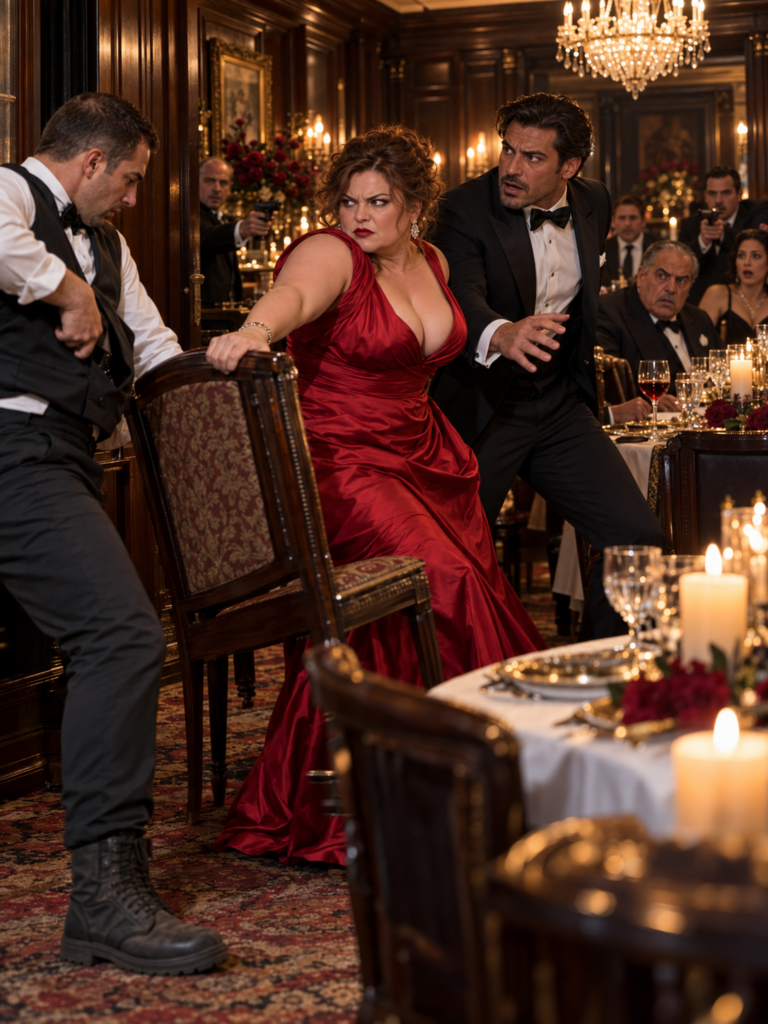
Plates, silverware, half-full wineglasses, and a heavy centerpiece crashed into the gunman as Meline threw herself sideways.
The attacker stumbled.
Rugierro reached her a heartbeat later.
“Gun!”
His guards moved.
So did Fior’s.
Meline hit the floor behind the overturned oak table while two armed men tackled the attacker against the wall.
Another shot struck plaster.
Then silence.
Broken crystal tinkled onto the carpet.
Rugierro dropped beside Meline.
“Are you hit?”
“No.”
His hands went to her shoulders.
“Meline.”
“I said I’m fine.”
She caught both his wrists.
“Look at me.”
He did.
Raw panic had erased every trace of the cold man who had negotiated with her the day before.
“I’m fine,” she repeated.
His breathing slowed.
Only then did Meline look toward the attacker.
Alive.
Pinned.
Good.
Fior’s face had gone gray.
Vitali stood several feet away, staring at the weapon.
Tasaro bent to inspect the fake waiter’s vest.
“He’s Austin crew.”
Rugierro’s eyes became lethal.
The Austin faction was a rival organization.
Meline did not care about syndicate politics.
She cared about costumes.
She pushed herself upright.
Fior stared at her.
“You saw him.”
“His uniform was wrong.”
“What?”
“The trousers.”
Everyone looked.
“The other servers are wearing lightweight wool. He’s in tactical twill. And those shoes have combat soles.”
Fior looked at the gunman.
Then at Meline.
“You noticed shoes while discussing international freight.”
“I dress actors for a living. One wrong shoe can ruin an entire scene.”
Something like wonder entered Fior’s expression.
Then he laughed once, incredulous.
“You brought me a woman who sees what armed men miss.”
Rugierro was not laughing.
He stood close enough that Meline could feel the heat coming off him.
Fior gestured to the contract folder.
“We sign tonight.”
Vitali started.
“Uncle, after this?”
“Especially after this.”
Meline watched Vitali.
His objection was too fast.
Too sharp.
Then she remembered something.
Five minutes before the attack, Vitali had left the table.
He had returned only after the waiter entered.
No.
Not returned.
He was still standing beside the sideboard.
His chair remained empty.
Directly across from Fior.
Directly where the gunman would have needed space for a clear shot.
Meline’s skin prickled.
She looked at the service door.
Then at Vitali.
He caught her staring.
For one brief second, his face changed.
Fear.
Then charm returned.
“Meline,” Rugierro said.
She turned.
Not yet.
She needed certainty.
Thirty minutes later, Fior signed.
The assassin was removed alive for questioning, and the party separated under heavy security.
Inside Rugierro’s armored car, the rain blurred Manhattan into streaks of gold.
Meline removed her ruined heels.
Rugierro sat beside her in complete silence.
Finally he took her hand.
“The contract is done,” she said.
“Yes.”
“So tomorrow I leave.”
His grip tightened.
“No.”
Meline looked down at his hand.
Then up at him.
“Excuse me?”
“You were seen. The Austin faction will know who stopped their man.”
“Our contract said clean break.”
“The situation changed.”
“My consent did not.”
Rugierro’s expression hardened.
“You could have a bounty on you by morning.”
“Then tell me that. Offer protection. Give me options.”
His jaw flexed.
“I am not letting you walk into danger.”
“And you are not deciding my life because you’re frightened.”
That landed.
He released her hand.
Meline breathed once, steadying herself.
“I may accept protection,” she said. “I may even stay tonight. But I will choose it.”
Rugierro stared through the dark car.
Then nodded once.
“Stay tonight.”
“Why?”
“Because the attacker’s organization may already know your name.”
“That is information. Better.”
His mouth tightened.
“I can put security at your apartment tomorrow.”
“Without entering it?”
“Yes.”
“Without telling Broadway who I am supposedly married to?”
“Yes.”
“Without turning me into your prisoner?”
A pause.
“Yes.”
Meline looked back toward the disappearing restaurant.
Then she remembered Vitali’s empty chair.
“Rugierro.”
“What?”
“I think your assassin had help.”
His entire posture changed.
Meline leaned forward.
“And I think the man who helped him was sitting at our table.”
Rugierro did not ask Meline whether she was certain.
He asked why.
That earned him more respect than immediate agreement would have.
“Blocking,” she said.
His brows drew together.
“Theater term.”
“I know what blocking means.”
“Then think of dinner as a stage.”
She shifted toward him despite the ache beginning in her knees from the fall.
“Fior sat at the head. You were on his right. I was next to you. Vitali sat directly across from me.”
Rugierro’s eyes narrowed.
“Five minutes before the waiter came in, Vitali left.”
“To use the restroom.”
“Maybe.”
“He was gone when the shooting started?”
“Yes.”
“So what?”
“The service door opened behind his chair.”
Rugierro stopped breathing for half a second.
Meline continued.
“If he had been sitting there, the attacker would have had to move farther around the table to get a clean angle on Fior. That means more time. More bodies between them. More opportunity for someone to notice.”
“The chair had to be empty.”
“Yes.”
Rain clicked against the bulletproof windows.
Tasaro, seated opposite them, swore softly.
Rugierro pulled out his phone.
Meline put a hand on his wrist.
“Not yet.”
His gaze dropped to her fingers.
“What?”
“If Vitali is involved, he knows whether the assassin succeeded. If Fior confronts him too quickly, you lose whatever else he knows.”
Tasaro frowned.
“You want us to leave him alone?”
“I want you to stop behaving like men in bad crime movies and think.”
Tasaro stared at her.
Rugierro’s mouth twitched despite himself.
Meline looked between them.
“The attacker entered in a waiter’s uniform. That means someone knew the staff layout, the service entrance, probably the table arrangement.”
“Fior’s people arranged the room,” Tasaro said.
“Exactly.”
Rugierro understood first.
“Vitali may not be the only leak.”
Meline nodded.
“Now you’re breathing.”
He almost smiled.
Back at the penthouse, Rugierro assembled four lieutenants in his office.
Meline had changed into loose black trousers, a silk blouse, and flat shoes from the emergency garment case she had brought the day before.
She had also returned the diamond ring.
Rugierro noticed immediately.
“Why?”
“Because the performance ended.”
His face shuttered.
Meline set the ring box on his desk.
“We have another problem to solve first.”
Tasaro arrived with information from Fior.
Vitali claimed he had felt ill and stepped away from dinner.
The restaurant’s service manager confirmed that a temporary waiter had been added to staff only ninety minutes before the meal.
Requested by whom?
A catering coordinator who had received authorization from Fior’s office.
Under Vitali’s credentials.
Rugierro’s men wanted to move immediately.
Meline watched the room change.
Every man except Rugierro seemed eager for the permission to become violent.
“Stop.”
Four lieutenants looked at her as though furniture had spoken.
Tasaro rubbed his forehead.
“Meline.”
“What?”
“This is syndicate business.”
“Then explain something.”
She walked to the digital floor plan displayed on the wall.
“If Vitali intended to kill his uncle and Rugierro, why leave documentation tied directly to himself?”
One lieutenant shrugged.
“Because he’s stupid.”
“Stupid people still understand self-preservation.”
Rugierro leaned against the desk.
“Continue.”
Meline pointed to the layout.
“The attacker’s uniform was almost perfect.”
“Almost?”
“The vest matched. Shirt matched. Apron matched. Even the polished shoes looked right from above.”
“Meaning?”
“Someone researched the restaurant carefully enough to copy visible details but did not understand professional wardrobe.”
She tapped the screen.
“The Austin faction prepared him.”
Tasaro nodded impatiently.
“We know that.”
“But the credentials bother me. If Vitali knowingly authorized the waiter, that is an obvious trail.”
“Unless someone used his access.”
Rugierro straightened.
Meline looked at him.
“Exactly.”
Tasaro’s phone rang.
He answered.
Listened.
Then his expression changed.
“Fior found something.”
Within the hour they were on a secure video line with Salvatore Fior.
The old man looked murderous.
“Vitali is gone.”
Rugierro swore.
“He left?”
“His apartment is empty.”
“Then Meline was right.”
Fior shook his head.
“Not entirely.”
He held up a printed access report.
“My nephew’s credential was used to approve the waiter. But Vitali was at a card room in Jersey until three hours before dinner. The authorization was issued before he returned to Manhattan.”
Meline leaned toward the screen.
“Who else could access his account?”
“His assistant.”
“Where is the assistant?”
“Missing.”
Rugierro looked at Meline.
“That explains the credentials.”
“No,” she said slowly. “It explains how they were used.”
Everyone waited.
“Vitali still left his chair.”
Fior’s face darkened.
“Yes.”
“Did he receive a message before he stood?”
Fior looked to someone off-camera.
A minute later, an answer came.
Yes.
A single encrypted message.
Vitali claimed it warned him of a problem with his car outside.
Meline folded her arms.
“So somebody wanted him away from that chair whether he was involved or not.”
“Which means?” Tasaro asked.
“The attacker’s path was staged.”
Rugierro looked toward the wall map.
“Someone choreographed the room.”
“Exactly.”
Fior’s gaze sharpened.
“Signora, what are you suggesting?”
Meline glanced at Rugierro.
Then corrected the old man.
“Meline.”
Fior’s expression softened faintly.
“Meline, then.”
“The Austin faction knew where everyone would sit. They knew Vitali’s chair had to be empty. They knew his credentials could be used. If Vitali is innocent, someone built the entire attack to make him look guilty afterward.”
Silence.
Fior looked suddenly older.
“My nephew is many things.”
“You don’t have to defend him to me.”
“But betrayal…”
His voice hardened.
“He would not sell me to the Austins.”
Meline believed him—not because she trusted Vitali, but because the evidence was too elegant.
Too visible.
Good backstage work disappeared.
Bad backstage work drew attention to itself.
Whoever designed this had wanted an investigation to end at Vitali.
Rugierro ended the call with Fior after arranging for Vitali to be located alive.
Then he dismissed his men.
When the door closed, Meline sagged into a chair.
Adrenaline had finally run out.
Rugierro noticed.
“You should rest.”
“That sounded dangerously like an order.”
“A suggestion.”
“Better.”
He poured her water.
Not whiskey.
Another point in his favor.
Meline drank half the glass.
Then she noticed his left sleeve.
Blood.
“You’re injured.”
“It’s nothing.”
“Sit.”
He blinked.
“Excuse me?”
Meline pointed at the sofa.
“I spend my career keeping shows running while actors insist they can perform through concussions. Sit down.”
To her surprise, Rugierro obeyed.
She retrieved the first-aid kit from the bathroom and rolled up his sleeve.
A jagged cut crossed his upper arm where flying chandelier glass had sliced him.
“This needs cleaning.”
“I’ve had worse.”
“That is a useless sentence.”
Meline dabbed antiseptic over the wound.
Rugierro watched her.
Not her body.
Her face.
That somehow felt more intimate.
“You saved Fior’s life,” he said.
“And yours.”
“Yes.”
“You would have done the same.”
He considered that.
“Yes.”
“Then don’t turn it into debt.”
“I wasn’t.”
“Good.”
Meline taped gauze into place.
Rugierro’s hand lifted toward her waist.
Then stopped before touching.
“May I?”
Her breath caught.
That one question changed the entire room.
“Yes.”
His palm settled lightly against her side.
Warm.
Steady.
No pulling.
No possession.
Meline looked at him.
“You learn quickly.”
“When the teacher threatens to abandon me after twenty-four hours, motivation improves.”
She smiled despite herself.
His expression softened.
“I meant what I said in the car badly.”
“That is one way to describe it.”
“I was frightened.”
“I know.”
“I am not accustomed to fear.”
“That explains a lot.”
He almost laughed.
Then his gaze became serious.
“I don’t want you to leave.”
Meline’s pulse quickened.
“But?”
“But our contract says you can.”
There it was.
The thing that mattered.
Meline leaned back slightly.
“And if I choose to stay tonight?”
“I will be grateful.”
“Separate rooms.”
His eyebrow rose.
“You sound disappointed.”
“I am.”
She laughed.
“And honest.”
His hand left her waist without complaint.
“Tomorrow,” he said, “I will arrange security at your apartment if you want it. You choose the people. They remain outside unless invited.”
“That is acceptable.”
“And the two million is yours regardless.”
“It already cleared?”
“It will by morning.”
Meline stared at him.
“You really intended to honor the agreement.”
“Yes.”
She stood.
“Good night, Rugierro.”
“Meline.”
She stopped at the door.
“I would like to kiss you.”
Every nerve in her body reacted.
She turned.
“But?”
“I am asking.”
Meline walked back.
She stopped close enough to feel his breath.
“Then yes.”
The kiss began carefully.
No performance.
No witnesses.
No ring.
No role.
When Meline kissed him back, Rugierro’s restraint tightened rather than vanished.
His hand stayed at her waist only where she had allowed it.
When she stepped away, he let her.
That mattered even more than the kiss.
At nine the next morning, Tasaro hammered on her guest-room door.
Meline opened it in a white robe, annoyed.
“What?”
“We have a problem.”
“That sentence should be prohibited before coffee.”
“The Austin faction put three million dollars on you.”
She stared.
“On me?”
“They think you’re some kind of trained security asset.”
Meline burst out laughing.
Tasaro did not.
“That is objectively ridiculous.”
“You knocked an assassin down before twenty armed men reacted.”
“He wore the wrong shoes.”
Tasaro stared.
Meline’s laughter faded.
“All right. Coffee first. Then panic.”
In the office, Rugierro stood over a map surrounded by his senior men.
He looked at Meline.
No public kiss.
No arm around her shoulders.
He simply said, “You were right.”
“About?”
“Vitali.”
She approached.
“He was found at a private apartment in Chelsea. Terrified, not fleeing. Someone sent him instructions to disappear after the attack.”
“From whom?”
“Unknown.”
Meline looked at the floor plan again.
Then at photographs from the dining room.
One image stopped her.
The waiter entering.
The service door.
The angle of the room.
And, half-visible through the doorway, a man in catering blacks.
Meline leaned closer.
“That jacket.”
Tasaro sighed.
“Please don’t tell me we are solving treason through tailoring.”
“The sleeve.”
“What about it?”
“There’s no cuff button.”
Rugierro looked at her.
“So?”
“The restaurant uniforms had functional surgeon cuffs.”
Blank faces.
Meline tapped the image.
“That man isn’t restaurant staff either.”
Tasaro enlarged the photo.
The face remained partly hidden.
But one detail became clear.
A distinctive silver watch.
Rugierro went still.
He knew it.
“Marco.”
One of the four lieutenants from the meeting the previous night.
Meline looked at him.
“The man who said Vitali was a fool.”
Rugierro’s expression became cold.
“He supervised security coordination for the dinner.”
There it was.
The missing answer.
Marco knew the seating chart.
Marco knew Fior’s service routes.
Marco had access to information about Vitali’s staff.
And Marco had been the first man eager to blame Vitali afterward.
Rugierro reached for his phone.
Meline caught his wrist.
“What are you ordering?”
He looked at her.
“To bring Marco in.”
“Alive?”
A pause.
“Yes.”
Tasaro watched them both.
Rugierro changed the phrasing.
“Alive. Unharmed unless he resists. I want answers.”
Meline released him.
Tasaro left to make the call.
Rugierro looked down at her.
“You are checking me now.”
“Yes.”
“Will that continue?”
“If this continues between us?”
“Yes.”
“Then I suppose I should become accustomed to it.”
Meline folded her arms.
“And if you cannot?”
His answer came after a long moment.
“Then you should leave.”
It was painful.
It was also exactly what she needed to hear.
Marco was not found.
His Manhattan apartment had been emptied overnight.
His office safe was open.
Two phones were missing.
But a third remained behind beneath a false drawer in his desk, and the records on it turned suspicion into something much uglier.
Marco had been selling information to the Austin faction for nearly a year.
Not enough to destroy Rugierro outright.
Enough to create pressure.
A delayed shipment here.
A compromised meeting there.
A customs inspection timed perfectly.
A rival warned minutes before DeLuca men arrived.
Small cuts.
The kind designed to weaken an organization without revealing the hand holding the knife.
The dinner had been different.
Marco had decided to make one decisive move.
Kill Fior.
Kill Rugierro.
Frame Vitali as the collaborator.
Then step into the chaos as the loyal lieutenant who could stabilize what remained.
Meline stood inside Rugierro’s office while Tasaro read the recovered messages aloud.
One message concerned her.
THE WIFE IS UNPLANNED.
Another followed.
IGNORE HER. DECORATIVE.
Meline stared at the screen.
“Well.”
Tasaro winced.
“What?”
“I’m offended.”
Rugierro turned toward her.
“That is your reaction?”
“They called me decorative.”
“Meline.”
She looked at him.
Behind the anger in his face was genuine fear.
Not for his power.
For her.
Marco had transmitted her full name within twelve minutes of the dinner ending.
Her workplace.
Her Queens address.
Theater schedules.
Two known relatives.
The Austin faction had enough information to find her.
The three-million-dollar bounty was real.
Rugierro paced once across the room.
“You cannot return home.”
Meline’s expression hardened.
He stopped.
Closed his eyes briefly.
Then started again.
“Your apartment is known. I believe returning there would put you in immediate danger.”
Better.
“What are my options?”
“My penthouse is secure. So is an apartment in another building that is not publicly connected to me. You can stay there alone with outside security. Or we can move you somewhere outside the city.”
“My job?”
“Your choice.”
“You are going to hate my answer.”
“I already do.”
“I’m not abandoning the theater.”
Rugierro’s jaw tightened.
“The bounty—”
“Exists whether I quit or not.”
“Meline.”
“Listen.”
He did.
“I spent twenty years building a career people think is frivolous because it involves fabric.”
She stepped toward him.
“That career is why Fior is alive. It is why you are alive. It is why we found Marco.”
Rugierro said nothing.
“You do not get to praise my competence when it saves your life and then ask me to surrender the life that built it.”
His face changed.
The argument left him.
“You’re right.”
Tasaro stared openly.
Meline glanced at him.
“Is this historically significant?”
“Yes.”
Rugierro shot him a look.
Tasaro looked away.
Meline continued.
“I’ll stay at the separate apartment until the immediate threat is contained.”
Rugierro nodded.
“I accept security outside the theater.”
Another nod.
“They do not enter the wardrobe department unless there is an actual threat.”
“Yes.”
“They do not interfere with performers.”
“Yes.”
“They do not carry visible weapons backstage.”
“Meline—”
“Visible.”
“Fine.”
“And no one calls me your wife.”
That one landed harder.
Rugierro looked at her.
“Because I’m not.”
“I know.”
“Do you?”
His expression tightened.
“I want you to be.”
Silence.
Tasaro abruptly decided he had somewhere else to be.
The office door shut behind him.
Meline folded her arms.
“We kissed once.”
“Twice.”
“The second one barely counts.”
“It counts to me.”
She fought a smile.
“This is exactly what I mean. You jump from wanting something to assuming you can build the whole future around it.”
Rugierro took that without defense.
“What would you prefer?”
“To find out whether we can survive dinner together when nobody is trying to murder us.”
“An ambitious experiment.”
“Then perhaps coffee.”
“I can arrange—”
“No.”
He caught himself.
“Would you like coffee with me?”
Meline smiled.
“Yes.”
Marco was captured forty-eight hours later.
Not by Rugierro’s men.
By federal agents.
That surprised everyone except Meline.
She had asked the obvious question during a security meeting: if Marco intended to seize power, why had he left his phone behind with evidence tying himself to the Austins?
The answer was that he had not intended to leave it.
Someone had copied the evidence and replaced the device.
Fior’s people.
Salvatore had decided that killing Marco would trigger retaliation he did not want while his own organization was unstable.
So he had sent the evidence anonymously to federal investigators and tipped them to Marco’s location.
Old men survived long careers by knowing when a courtroom was more useful than a bullet.
Marco was arrested at a private airfield before boarding a chartered plane.
The Austin faction denied involvement.
Nobody believed them.
But denial created space.
Without Marco’s intelligence, their ability to target Rugierro’s organization collapsed quickly. Fior froze their access to European distribution networks. Rugierro cut commercial ties and isolated their remaining partners.
He did not “dismantle them brick by brick.”
Meline specifically asked him not to.
“What do you expect me to do?” he demanded one evening over coffee.
“Win without turning half of New York into a battlefield.”
“That is an unreasonable limitation.”
“You hired me because I solve impossible problems.”
“You were hired for one dinner.”
“And apparently I exceeded the job description.”
He laughed.
The sound was becoming less rare.
Weeks passed.
Meline returned to Broadway with two discreet security professionals stationed outside the stage door.
They learned quickly not to touch garment racks.
One of them nearly lost a finger to Meline’s shears after reaching over her cutting table without warning.
Rugierro heard the story and sent flowers.
Meline sent them back.
The card had said:
TO MY LIONESS.
She replaced it with one of her own.
TRY AGAIN.
The next morning, coffee arrived instead.
The card read:
TO MELINE. NO ANIMAL METAPHOR. I AM LEARNING.
She kept that one.
Their relationship grew in smaller moments.
Rugierro attended a technical rehearsal and lasted twenty-three minutes before whispering that the director was an idiot.
Meline whispered back that everyone already knew.
She attended a legitimate shipping-board dinner and quietly pointed out that three executives were wearing identical cuff links.
“Meaning?”
“They’re either in a club or someone bought executive gifts.”
Rugierro investigated.
One vendor had been bribing them.
He began calling her his most expensive internal audit system.
She charged him consulting fees when the observation benefited his legal companies.
He paid without argument.
That was romance, Meline decided.
Not diamonds.
Invoices.
Four months after the dinner, Salvatore Fior returned to New York.
Not for business.
For a small celebration marking the final restructuring of the shipping partnership.
The contract had survived the assassination attempt.
More importantly, the legitimate freight operation had expanded enough that Rugierro began moving significant assets away from the criminal businesses that had once defined his power.
Meline did not pretend she had transformed him through love.
Men did not become different simply because women loved them properly.
Rugierro changed because consequences had finally become personal enough that he chose to change.
There was a distinction.
Meline respected it.
She still had her own apartment.
Still had her own money.
The two-million-dollar payment remained untouched except for taxes, investment accounts, and one indulgence: she bought the small Queens building where her mother had once rented a cramped alterations shop.
She turned the ground floor into a costume workshop for young designers who could not afford Manhattan studio space.
Rugierro offered to finance renovations.
Meline refused.
He accepted the refusal.
Another milestone.
On the night Fior returned, Meline wore emerald green.
Not because anyone styled her.
Because she liked the color.
Rugierro met her outside the private club.
No armored convoy in sight.
Security remained discreetly down the block.
He looked at her for several seconds.
“You’re staring.”
“Yes.”
“Why?”
“You are beautiful.”
She adjusted his tie.
“That is acceptable.”
He offered his arm.
Meline took it.
Inside, Fior stood to greet her.
“Signora DeLuca.”
Meline raised one eyebrow.
Fior sighed dramatically.
“Meline.”
“Much better.”
Vitali stood beside him.
Alive.
Embarrassed.
His arrogance had not disappeared, but nearly becoming the corpse blamed for his uncle’s murder had reduced it considerably.
He extended his hand.
“I owe you an apology.”
“For the dress insult or for being generally unpleasant?”
Rugierro coughed into his fist.
Vitali reddened.
“Both.”
Meline shook his hand.
“Accepted.”
He looked surprised.
“Just like that?”
“No. I’ll remember forever. But I accept it.”
Fior laughed.
Dinner passed without gunfire.
A remarkable improvement.
After dessert, Fior raised a glass.
“To partnership.”
Rugierro looked at Meline.
She caught the weight in that glance.
Later, in the private car home, he seemed unusually quiet.
“What?” she asked.
“I have something for you.”
“If it is a diamond, I’m opening the door while the car is moving.”
“It is not.”
“Good.”
He handed her a folded document.
Meline opened it.
A contract.
She read the first paragraph.
Then again.
“What is this?”
“An offer.”
“For?”
“Chief operating adviser for the legitimate DeLuca logistics companies.”
She stared.
“You invented that title.”
“Yes.”
“You want me to work for you?”
“I want you to work with me.”
Meline kept reading.
Independent authority over vendor compliance.
External reporting rights.
No involvement in criminal activities.
Ability to terminate without penalty.
Her own counsel had apparently reviewed it.
She looked up sharply.
“You contacted Evelyn?”
“To ask whether she would be willing to review an employment proposal if you wanted one.”
“You didn’t send it?”
“No.”
Meline looked back down.
Salary.
Equity.
An absurd signing bonus.
She shook her head.
“The salary is ridiculous.”
“Too low?”
“Rugierro.”
“I am negotiating.”
“You are showing off.”
“That too.”
She folded the contract.
“I’ll consider it.”
His expression revealed disappointment.
Then he nodded.
“Take whatever time you need.”
Meline studied him.
Six months earlier, he would have expected an answer.
Four months earlier, he would have tried to persuade.
Now he waited.
She tucked the document into her bag.
“There is something else.”
He looked wary.
“Should I be concerned?”
“Yes.”
She removed a smaller envelope.
Inside was a ticket.
Broadway.
Front row.
Rugierro stared at it as though she had handed him an explosive device.
“What is this?”
“You complained that you don’t understand why I love theater.”
“That was not a complaint.”
“It was definitely a complaint.”
She smiled.
“So you’re coming to opening night.”
“Meline.”
“No armed men in the orchestra section.”
His face hardened.
“One.”
“No.”
“One.”
“Outside.”
“Lobby.”
“Outside.”
“Mezzanine?”
She laughed.
“No.”
He looked genuinely pained.
“Fine.”
The opening night went perfectly.
Mostly.
One actor missed an entrance.
A zipper failed thirty seconds before curtain.
A prop tray disappeared.
Meline solved all three without leaving backstage.
Rugierro watched the performance from the front row with the expression of a man witnessing a civilization he did not understand.
Afterward, he found her in the wardrobe department surrounded by garment bags.
“You liked it,” she said.
“It was loud.”
“You liked it.”
“The staging was inefficient.”
“You loved it.”
He looked around.
Costume assistants hurried past.
Steam hissed from an iron.
Someone shouted for a missing hat.
Meline stood at the center of it all.
Calm.
Commanding.
Entirely herself.
Rugierro’s expression softened.
“Yes.”
Meline smiled.
He reached into his pocket.
She immediately pointed a finger.
“If that is jewelry—”
“It is not.”
He produced a key.
Meline frowned.
“To what?”
“My penthouse.”
Her smile faded slightly.
Rugierro saw it.
“Not ownership.”
He held the key flat on his palm.
“Access. Yours to use or not use.”
Meline did not take it immediately.
“What does it mean?”
“That you may come whenever you want.”
“And leave whenever I want?”
“Yes.”
“No staff reporting my movements?”
“Yes.”
“No assumption I’m moving in?”
“Yes.”
She took the key.
“That is the most romantic thing you have ever given me.”
“I bought you dinner in Paris.”
“This is better.”
He looked offended.
“It was an excellent restaurant.”
“Still better.”
She closed her fingers around the key.
Then kissed him.
Six months after their fake marriage began, Rugierro invited Meline to dinner on the penthouse terrace.
No guests.
No negotiations.
No guns visible.
New York burned gold beneath them.
Meline arrived directly from the theater in black trousers, red lipstick, and comfortable shoes.
Rugierro had cooked.
Or attempted to.
She looked at the slightly damaged risotto.
“You made this?”
“I supervised.”
“So Tasaro made it.”
“He assisted.”
“I see.”
They ate anyway.
Afterward, Rugierro set his glass down.
“I want to ask you something.”
Meline narrowed her eyes.
“Your tone sounds expensive.”
“It is.”
He reached into his jacket.
This time she did not threaten him.
The velvet box was familiar.
The same emerald-cut diamond from the fake dinner.
He placed it on the table unopened.
Meline stared at it.
Rugierro remained seated.
Not kneeling.
She noticed.
“The first time I gave you that ring,” he said, “it was a prop.”
“Yes.”
“The second time I wanted to give it to you, I was afraid enough to confuse wanting you with having the right to keep you.”
Meline said nothing.
“I don’t want that anymore.”
“What do you want?”
“A life you can leave.”
Her throat tightened.
“That is an unusual proposal.”
“I am an unusual man.”
“You certainly are.”
Rugierro looked almost nervous.
“I want you to choose me while the door remains open.”
There it was.
Not stay because enemies existed.
Not stay because money had been paid.
Not stay because he could protect her.
Choose.
Meline touched the velvet box.
“And my work?”
“Yours.”
“My workshop?”
“Yours.”
“My apartment?”
“Keep it.”
“My name?”
“Yours unless you want mine.”
“My opinions?”
He sighed.
“Apparently unavoidable.”
She smiled through sudden tears.
“And if I tell you no?”
“I will be miserable.”
“Anything else?”
“I will respect it.”
That was the answer.
Meline opened the box.
The diamond caught the terrace lights.
She looked at Rugierro.
“I have a condition.”
His mouth twitched.
“Of course you do.”
“I design my own wedding dress.”
“I assumed that was inevitable.”
“And Fior does not get to call me your stabilizing influence.”
“I will personally inform him.”
“And Tasaro is forbidden from choosing flowers.”
Rugierro frowned.
“That sounds oddly specific.”
“He thinks beige is a color.”
“It is a color.”
Meline stared.
“We have work to do.”
He laughed.
Then grew serious.
“Is that a yes?”
Meline slipped the ring onto her own finger.
Not because he placed it there.
Because she chose to.
“Yes.”
Their wedding months later was not an underworld coronation.
Meline refused that framing entirely.
It was held in a restored Broadway theater on a dark Monday when no performance was scheduled.
Half the guests came from Rugierro’s world.
The other half came from hers.
Dock executives sat beside costume cutters.
Salvatore Fior argued amiably with a lighting designer.
Tasaro served as best man and, under strict supervision, managed not to order beige flowers.
Meline’s dress was ivory Duchess satin with broad architectural folds and a dramatic cape.
It did not conceal her.
It did not minimize her.
It did not correct anything.
When the dressing assistant asked whether she wanted shapewear beneath it, Meline laughed so hard she nearly ruined her lipstick.
“No.”
She looked into the mirror.
For most of her life, other people had treated clothing like an apology women could wear.
Smaller waist.
Longer line.
Darker fabric.
Less body.
Less presence.
Less woman.
Meline had built an entire career rejecting that idea for other people.
Now she rejected it for herself.
She walked down the aisle alone.
Not because there was nobody who could escort her.
Because she wanted the walk.
Rugierro waited onstage.
The most feared man in half the city looked terrified.
Meline enjoyed that immensely.
When she reached him, he took her hands.
No grip.
No ownership.
Simply contact.
“You look…”
“Choose carefully.”
He smiled.
“Exactly like yourself.”
Her eyes burned.
“That was the correct answer.”
Their vows were short.
Rugierro did not promise to destroy anyone who threatened her.
He had finally learned she did not experience threats as devotion.
Instead he promised something harder.
“I cannot promise I will never be afraid for you,” he said. “I cannot promise every instinct in me will become reasonable overnight. I can promise that fear will not become permission. I will ask. I will listen. I will tell you the truth even when the truth gives you the freedom to leave.”
Meline blinked back tears.
Then she spoke.
“You hired me because you needed someone convincing enough to make powerful men believe you could build a future.”
Soft laughter moved through the theater.
“You thought that required a wife who would make you look stable.”
Rugierro smiled.
“You were wrong.”
More laughter.
“You needed someone willing to tell you when your lapels were metaphorically buckling.”
Fior laughed loudest.
Meline squeezed Rugierro’s hands.
“I promise to stand beside you when standing beside you remains my choice. I promise to challenge you when you mistake control for care. I promise to protect what we build together without disappearing inside it.”
Her voice softened.
“And I promise never to let Tasaro approve formalwear without supervision.”
“Unnecessary,” Tasaro muttered from behind them.
The room laughed.
When the officiant pronounced them married, Rugierro did not seize her.
He waited.
Meline raised an eyebrow.
“Are you going to kiss me?”
“May I?”
She smiled.
“You may.”
He kissed her.
The theater erupted.
Months later, the diamond from their fake dinner still sat on Meline’s hand.
But it no longer symbolized the role she had been paid to perform.
Neither did the penthouse key beside her own keys.
Neither did Rugierro’s surname, which she used socially but had not added professionally.
At work she remained Meline Hollister.
At home she remained Meline.
And when she accepted the operating-adviser role in Rugierro’s legitimate companies, she negotiated every clause herself.
The first major meeting she attended included twelve senior executives who expected the mob boss’s wife to sit quietly.
Meline entered wearing brilliant red.
She placed a folder on the table.
“Your Newark contractor is overbilling you by eighteen percent.”
Silence.
Rugierro leaned back in his chair.
One executive looked at him.
“Mr. DeLuca?”
Rugierro glanced at Meline.
Then smiled.
“Why are you looking at me?”
Meline opened the folder.
For the next forty minutes, she took apart the contractor’s invoices line by line.
Nobody interrupted her twice.
Afterward, she and Rugierro rode the elevator alone.
“You enjoyed that,” he said.
“Very much.”
“You terrified my chief financial officer.”
“He’ll recover.”
Rugierro slipped his hand into hers.
Meline let him.
The elevator doors opened onto the lobby.
Six months earlier, he had hired a woman to play a role that would make him look powerful.
Instead, Meline Hollister had shown him something his empire never had.
Power that did not require another person to become smaller.
She walked beside him toward the doors.
Not behind.
Not ahead.
Not protected like property.
Not displayed like a prize.
And when Rugierro paused to ask whether she wanted the car or preferred to walk the three blocks to dinner, Meline smiled.
“We’ll walk.”
He nodded.
Outside, Manhattan roared around them.
Meline took up exactly as much space as she pleased.
This time, nobody expected otherwise.


