
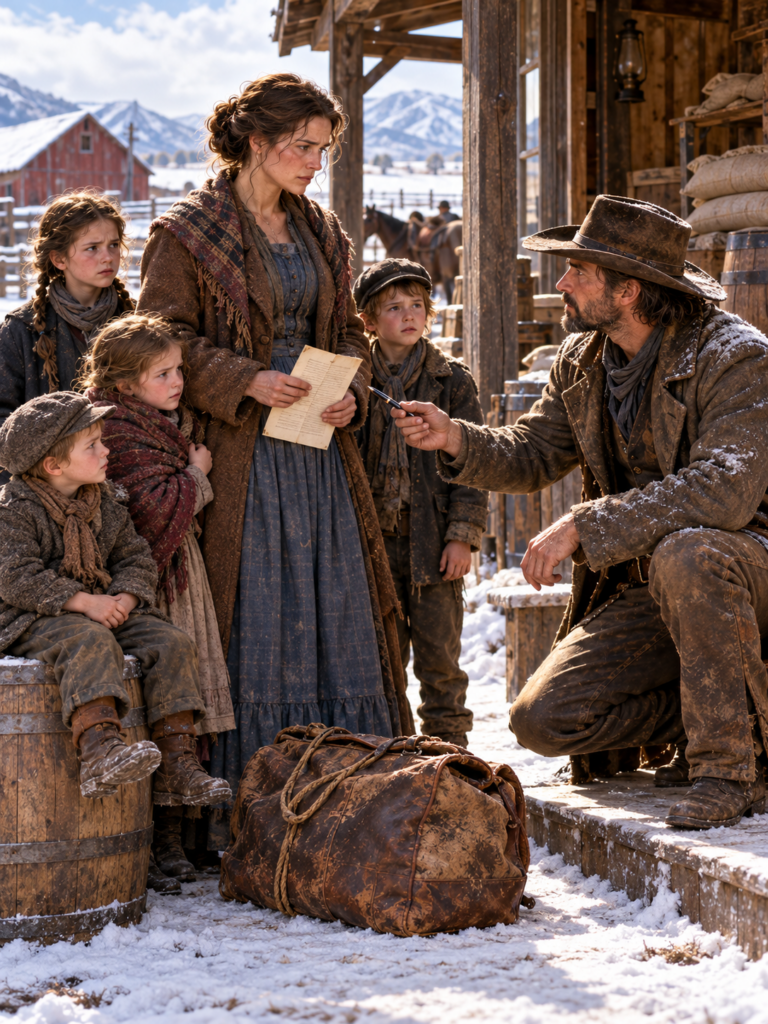
The unfinished wooden horse rested in Amos Kerr’s open palm.
Its body had been carefully carved, but the mane was missing, and one side still showed the rough marks of the knife.
Hannah looked from the little horse to Amos’s face.
“Did you make that?”
He nodded.
“Some time ago.”
“For a child?”
His fingers closed around it.
The expression that crossed his face made her wish she had waited before asking.
“Yes.”
Behind her, Peter appeared in the doorway.
“Mama, Sarah says there’s only one blanket for the little bed.”
Hannah turned immediately.
“I’ll come arrange it.”
Amos put the horse away.
“There are more blankets in the cupboard by the stove,” he said. “Take what you need.”
She thanked him.
When she looked back, he was already walking toward the barn.
Hannah watched him go.
Whatever had happened in that house, it had not finished happening inside the man who owned it.
But she had four children to settle, and questions could wait.
That night, the children slept together beneath the buffalo robe in the front room.
Hannah lay nearest the door.
She listened to the stove settling, the wind searching the roof, and the sound of the barn door opening once in the distance.
The house was warm.
Warmer than anywhere they had stayed in months.
Yet she kept their trunk closed.
In the morning, she began working before Amos came in from feeding the horses.
She cleared the old ashes, examined the chimney, and set water heating.
Ruth helped Sarah dress.
Micah carried small pieces of firewood.
Peter watched everything with serious brown eyes.
When Amos entered, Hannah had soot on her sleeve and flour on the table.
“Chimney needs attention,” she told him.
“So does the roof over the north room.”
“I noticed.”
He glanced at the children.
“They’re welcome to help with chores suited to them. But they’re not part of your wages.”
Hannah paused.
“Thank you.”
She had expected to defend that distinction.
Instead, he had made it himself.
By the end of the first week, the kitchen had begun to change.
There was bread cooling on the counter.
The supplies were stored properly.
The draft beneath the north window had been blocked.
At supper, Hannah set places at the long table.
Amos washed his hands, took his food, and remained standing beside the stove.
“There’s a chair,” she said.
“I’m comfortable.”
She didn’t argue.
On the third evening, Peter carried his plate across the room and stood beside Amos.
The little boy could barely see over the stove’s warming shelf.
Amos looked down at him.
“What are you doing?”
“Eating with you.”
“Wouldn’t you rather sit?”
Peter shook his head.
“You don’t.”
The next evening, Amos sat at the table.
Nobody mentioned the change.
But Hannah saw Ruth notice it.
And she saw Amos wait until Peter was seated before beginning his meal.
A few days later, Peter discovered the unfinished wooden horse in Amos’s coat pocket.
He brought it to supper and placed it beside the man’s cup.
The room went still.
Hannah reached toward her son.
“Peter, that isn’t yours.”
Amos lifted a hand.
“It’s all right.”
Peter examined the carving.
“Why doesn’t it have hair?”
“Because I haven’t finished it.”
“Will you?”
Amos looked at the horse for a long moment.
“I don’t know.”
Peter accepted that answer.
He returned to his supper.
The following morning, Hannah found the carving on the kitchen windowsill, facing the corrals.
She did not touch it.
That same afternoon, she discovered something else.
Amos had spread several feed invoices across the table.
While drying a pan, she noticed identical quantities of oats recorded on two different dates.
“Mr. Kerr, you’ve been charged twice.”
He frowned.
“Those were separate deliveries.”
“The weights are exactly the same, and one was entered without the clerk’s usual mark.”
He brought out older bills.
Hannah examined them.
There was another duplicate charge.
Twelve dollars and forty cents across the accounts.
More than her monthly wage.
Amos rode to town, confirmed the errors, and returned with a credit.
He offered her half.
She refused.
“You hired me for twelve dollars a month. If you’d like additional bookkeeping, we can discuss new terms.”
He looked at her.
Then he put the money away.
“Fair enough.”
Hannah returned to the kitchen.
She did not notice Amos watching her with the first genuine warmth his face had shown in years.
But later, as she passed the hallway, she noticed the dust-covered door again.
Something about it no longer seemed merely neglected.
It seemed protected.
That evening, after the children slept, Hannah went to put away the clean linen.
She stopped when she found Amos standing before the closed door.
One hand rested on its handle.
He had not opened it.
When he heard her footsteps, he turned.
“Mrs. Vance.”
She glanced at his hand.
Then at the unfinished wooden horse visible in his other palm.
“I won’t ask about the room,” she said quietly.
His expression tightened.
Hannah continued, “But my children need to know which places they may enter. And I need to know what arrangements you intend for us when the thaw comes.”
Amos lowered his hand from the door.
“That room is not to be used. I’ll arrange the sleeping quarters properly.”
“And after spring?”
He looked at her for a long moment.
“I don’t know yet.”
Hannah drew a steady breath.
“Neither do I.”
She started to turn away.
Then the wind caught the loose shingle above the hallway, and both of them heard water dripping into the north room.
Hannah reached for the linen basin as Amos moved toward the roof ladder.
Neither noticed Peter standing in the doorway behind them, holding the wooden horse and staring at the closed room.
Peter held the wooden horse against his chest while Hannah placed the basin beneath the leaking ceiling.
“Peter,” she said, “bring that back to Mr. Kerr.”
The little boy looked toward Amos, who had stopped at the foot of the ladder.
“Can I keep it until it’s finished?”
Amos looked at the carving.
Then at the child’s hopeful face.
“Not yet.”
Peter handed it over without complaint.
Amos put it carefully into his coat pocket.
“I’ll mend the roof in daylight,” he told Hannah. “For tonight, that basin will have to do.”
She nodded.
It was a small problem, and the house had many small problems.
Hannah knew how to manage those.
What she did not know was how to live in a house filled with another person’s unspoken sorrow.
***
In the second week, Hannah found herself learning the ranch’s habits.
Amos rose before sunrise.
He fed the horses before eating.
He checked the corrals twice when the wind was strong.
He repaired things before they failed when he could, but years of managing the place with only Dub Mercer had left work undone.
Mercer was a quiet hired man who preferred the company of animals.
He seldom joined conversation unless someone addressed him directly.
But the children gradually learned that his silence was not unkindness.
Micah watched him repair tack.
Ruth helped Hannah keep track of supplies.
Sarah began laughing again while helping prepare bread.
And Peter followed Amos whenever he was permitted, taking his place beside the corral fence and studying the horses with grave concentration.
Hannah noticed something important.
Amos did not attempt to become their father.
He answered their questions.
He told them when something was dangerous.
He listened when they spoke.
And he never demanded affection in exchange for food or shelter.
That, Hannah thought, was a better beginning than any grand promise.
***
At the end of the month, Amos paid the twelve dollars exactly as agreed.
Hannah counted the money and entered it in her account book.
He watched her from the doorway.
“Don’t you trust me to remember?”
“I trust the writing.”
He considered that.
“Fair enough.”
She placed her wages in a small cloth purse.
Eggs and butter from the household’s modest production had also begun bringing in money at Pike’s store.
That income belonged to her, exactly as the contract stated.
For the first time since Elias died, she could count more than a few coins that no creditor or landlord had already claimed.
She began thinking about spring.
About a permanent position.
About the possibility of renting rooms in town if she saved enough.
She did not let herself think about staying at the Kerr ranch.
Their agreement was temporary.
And Hannah had learned to respect the difference between an arrangement and a home.
***
The trouble arrived in the third week of February.
The wind shifted, the road became passable, and a man named Corliss drove into the Kerr yard with another fellow beside him.
Hannah recognized him immediately.
Her stomach tightened.
Corliss had once been involved in the freight business where her husband, Elias Vance, worked.
Elias had died the previous spring when a load of heavy iron shifted at the railroad siding.
The accident had left Hannah with four children and debts she had spent months settling.
She had paid the livery.
She had paid the freight agent.
She had sold their house to meet the remaining obligations.
What little survived had barely kept her family fed.
Now Corliss stood beside the corral with a folded document.
“Mrs. Vance,” he said pleasantly. “I’ve been looking for you.”
Amos came out of the barn.
“Something wrong?”
“Private business,” Corliss replied. “Between myself and the widow.”
Hannah stepped forward.
“Then say what you’ve come to say.”
Corliss unfolded his paper.
He claimed Elias had owed him four hundred and sixty dollars against the freight teams.
Hannah stared at him.
“That debt was never established.”
“Your husband and I had an understanding.”
“Show me his signature.”
Corliss smiled.
“Men in business don’t always put every agreement on paper.”
“Then show me any record of a payment or advance.”
His smile weakened.
“I’ve been patient with you, Mrs. Vance.”
“You haven’t contacted me before today.”
“That doesn’t mean the debt disappeared.”
Hannah felt anger gathering beneath her ribs.
She had spent nearly everything she possessed settling obligations that could be proven.
This man was demanding an amount large enough to swallow years of wages.
And he had offered nothing but his word.
Corliss glanced toward the house.
“Surely a woman in your circumstances would prefer a quiet arrangement.”
Amos stepped closer.
“What kind of arrangement?”
Corliss looked at him.
“One that doesn’t involve unnecessary proceedings.”
His meaning remained deliberately vague.
Hannah understood the pressure behind it.
He wanted her frightened enough to pay or yield without evidence.
“I will not acknowledge a debt you cannot prove,” she said.
Corliss folded the paper.
“I’ll be staying in Medicine Bow for two weeks.”
“Then you have two weeks to find Elias’s signature.”
Amos pointed toward the gate.
“Our business is finished.”
Corliss departed without raising his voice.
That made Hannah fear him more.
Men who threatened openly could sometimes be answered openly.
Men who smiled while spreading lies could turn an entire town into their instrument.
***
By early March, the whispers began.
The story told in Medicine Bow was not that Hannah had found honest employment.
It was that a widow with four children had moved into a solitary rancher’s house without a marriage.
A notice about Elias’s insolvent estate was repeated as evidence that she could not be trusted.
Soon Nathan Pike stopped accepting her eggs at the store.
Other buyers followed.
The explanation was always polite.
Not enough room.
No demand.
Maybe next week.
Hannah returned from town one afternoon with the entire basket unsold.
She set it on the kitchen table.
Amos looked at it.
“What’s happened?”
“Pike doesn’t want the eggs.”
“Why?”
“You know why.”
His jaw tightened.
“I’ll speak with him.”
“No.”
“Hannah—”
“You can’t order people to respect me.”
He stopped.
She lifted one egg from the basket.
“This is my income, Amos. Not yours to restore by threatening a shopkeeper.”
“I wasn’t going to threaten him.”
“I know. But if he takes the eggs only because he’s afraid of offending you, what happens when the next man decides not to?”
Amos had no answer.
Hannah replaced the egg.
“I need an honest buyer. Or another position.”
He looked away at the mention of leaving.
She saw it.
And because she saw it, she grew afraid.
Her children were becoming attached to this house.
To Mercer.
To the horses.
To Amos.
Peter had stopped asking every morning whether they had to go.
Hannah had begun sleeping through the night without listening for the sound of an angry landlord outside the door.
Those were dangerous changes for a family whose employment lasted only until the thaw.
***
Then Dr. Haynes sent word of an opening at a hotel in Rawlins.
Eighteen dollars a month.
Two rooms above the kitchen.
The proprietor would accept Hannah and all four children.
The position was honest, and the offer had a deadline.
Hannah read the message twice.
The work would be harder.
The rooms would be smaller.
But the wages were better, and she would no longer live under the town’s suspicion concerning Amos.
She had nearly decided to accept when Sarah fell ill.
The fever began in the afternoon.
By evening, the little girl was burning hot and could scarcely keep water down.
Hannah recognized the danger.
She placed Sarah in bed and began cooling her face.
Amos rode for Dr. Haynes during the night.
The road was treacherous with patches of ice.
He returned with the doctor before morning.
Haynes examined Sarah, gave instructions for nursing her, and remained long enough to make sure Hannah understood what signs would require him to return.
For several days the household moved around the sickroom.
Ruth helped with meals.
Micah carried water.
Mercer took over additional chores.
Peter remained unusually quiet.
Amos checked on Sarah without intruding, asked what supplies were needed, and made sure Hannah had food when she forgot to eat.
On the third night, Sarah’s fever finally broke.
Hannah sat beside the bed until she was certain the improvement would hold.
Then she went into the kitchen.
It was two in the morning.
Amos sat at the long table with his hands resting on the wood.
The lamp was turned low.
He looked as tired as Hannah felt.
“She’s sleeping,” she said.
He nodded.
“Good.”
Hannah sat opposite him.
For a while, they listened to the stove.
Then she asked the question she had carried since the hiring fair.
“Why did you choose me?”
Amos closed his eyes briefly.
“Hannah.”
“You wrote my name before we spoke. You walked past a woman with no children who could have done the work.”
He looked toward the hallway.
“Is it because of that room?”
The silence answered before he did.
“My wife was Ellen,” he said at last.
Hannah remained still.
“Three winters ago, she was expecting our first child.”
He spoke slowly.
There had been a storm.
Ellen had gone into labor.
The doctor could not reach the ranch in time.
When he finally arrived, both Ellen and the baby were gone.
Hannah felt her throat tighten.
Amos stared at the table.
“I buried them above the creek.”
She did not interrupt.
“I had built that room for the baby. Put the window low so a little one could watch the horses from the floor.”
He looked toward the closed door.
“I haven’t opened it since.”
Hannah thought of the wooden horse.
“The carving?”
“I started it before Ellen died.”
He rubbed his hands together.
“Never finished the mane.”
For a while, neither spoke.
Then Hannah asked, “And the hiring fair?”
Amos drew a breath.
“I was there to buy wire.”
He explained how he had seen the men count her children.
How he had watched Ruth endure the humiliation without allowing herself to cry.
How something about the little girl’s determined expression had made him set the wire aside.
“Pike had your name on the fair list,” he said. “I read it from the counter.”
Hannah looked down.
“So you didn’t know me.”
“No.”
“You weren’t looking for a wife.”
“No.”
“What were you looking for?”
Amos took a long time answering.
“I think I wanted the house to sound alive again.”
The words were so unguarded that she could barely look at him.
“I told myself I needed a cook. And I did. But there were other cooks.”
He swallowed.
“I saw your children and wanted them to have somewhere warm. And I wanted to hear someone talking at that table again.”
Hannah pressed her hands together.
“That isn’t the same as wanting a family.”
“I know.”
“You cannot hire a family.”
“I know that too.”
He looked at her.
“And I am sorry if I let you believe I expected something more from you than the work we agreed upon.”
Hannah shook her head.
“You haven’t.”
But the town’s accusations remained.
Her egg money was gone.
The Rawlins position was still available.
And Ruth was growing old enough to understand every ugly implication people made about her mother.
Hannah took the letter from her pocket.
“I have to think of the children.”
Amos read the offer when she handed it to him.
He could not argue against eighteen dollars and two rooms.
Not without making her dependent on his wishes.
“You should take it if it’s what you think best,” he said quietly.
Hannah nodded.
She hated how much the words hurt.
***
The next morning, she packed the trunk.
Forty minutes.
That was all it took.
The children stood against the wall in the familiar order.
Ruth noticed first.
“You always pack it, Mama.”
Hannah stopped.
“Ruth.”
“We weren’t even in trouble at some of those places.”
Her daughter’s voice trembled.
“And we had to leave anyway.”
Hannah wanted to explain.
Instead, she closed the trunk.
Amos loaded it into the wagon.
Nobody cried loudly.
That would have been easier.
Peter simply refused to put on his coat until Hannah knelt and helped him.
They traveled four miles toward Medicine Bow.
Then, rounding a bluff, they met Corliss’s hired buggy coming in the opposite direction.
The second man was driving.
Hannah glanced into the back of the buggy.
Something beneath the seat caught her attention.
A canvas satchel.
Old.
Familiar.
With her husband’s name marked across the flap.
Her hand closed around Amos’s sleeve.
“Stop.”
He drew the horses up.
Hannah stared after the passing buggy.
“I know that satchel.”
Amos followed her gaze.
“What is it?”
“It belonged to Elias.”
Her voice grew steadier.
“I sold it after he died. To a freight clerk named Pruitt.”
She looked directly at Amos.
“There was a receipt book inside.”
“Receipts for what?”
“Every debt Elias paid. Every advance he took. Everything he owed.”
She gripped the side of the wagon.
“Corliss’s name was never in that book.”
Amos considered the road behind them.
Then he turned the horses toward the ranch.
“We’ll go to the marshal with what you know.”
Hannah looked at the trunk.
Then at her children.
She had spent eighteen months moving away whenever trouble appeared.
This time, she had something worth turning back for.
They returned to the Kerr house before dark.
Hannah left the trunk in the wagon for a moment, then had it brought indoors.
She opened it, took out her old accounts, and sat down at the kitchen table.
There she began writing every amount Elias had paid, every name she remembered, and every date she could establish.
By the time the lamp burned low, she had prepared a record of the debts that had taken her home.
She laid the paper beside the old employment contract and said to Amos, “Tomorrow I want the marshal to hear this from me.”
Amos Kerr looked at the page Hannah had placed on the table.
Then he nodded.
“Then that’s what he’ll hear.”
He did not tell her what to say.
He did not offer to speak for her.
Instead, he gathered the necessary supplies for the trip into Medicine Bow and asked whether she wanted all four children to accompany them.
Hannah considered it.
“Yes,” she said.
Ruth had heard enough whispered accusations to deserve the truth.
And the younger children had already spent too much of their lives watching their mother disappear into offices and boarding houses, returning with worse news than when she left.
This time, Hannah wanted them to see her defend what was rightfully hers.
***
They reached the marshal’s office the following morning.
Hannah entered first.
Amos followed with the children.
She laid her written account on the desk.
“My name is Hannah Vance,” she began. “A man named Corliss claims my late husband owed him four hundred and sixty dollars. I have asked for proof. He hasn’t produced any.”
The marshal examined her statement.
“He showed you a paper?”
“Yes. He wouldn’t let me verify it.”
“And what are you asking me to do?”
Hannah drew a breath.
“A freight clerk named Pruitt bought my husband’s old satchel and receipt book. I saw that satchel yesterday in the buggy used by Corliss’s man.”
She placed her finger on the account sheet.
“The book records Elias’s debts. I believe Corliss obtained it because he wanted to know what my husband had written.”
The marshal listened.
“You think the book disproves the claim.”
“I believe it will help establish what my husband did and didn’t owe.”
He questioned her carefully about the sale.
She supplied Pruitt’s name, the approximate date, and the price she had received.
One dollar and fifty cents.
The marshal sent for Pruitt.
***
The freight clerk arrived before noon.
At first, he seemed bewildered by the attention.
Then he acknowledged buying Elias Vance’s satchel and the old receipt book it contained.
He also admitted selling both to Corliss for four dollars.
“Didn’t see any harm in it,” he said.
Hannah looked at him.
“Did Mr. Corliss explain why he wanted my husband’s receipts?”
Pruitt shifted uncomfortably.
“No, ma’am.”
“Had you read the book?”
“Not much.”
“Did you know it contained a record of settled debts?”
He looked down.
“I knew it was an old account book.”
The marshal requested the book.
Once it was produced, the men gathered in the office watched Hannah open it.
Her hands were steady.
Page after page bore Elias’s familiar writing.
Amounts.
Dates.
Names.
Payments.
She recognized the careful way he formed his numbers.
For one painful moment, she remembered the evenings he had spent bent over that same book, recording the day’s transactions while their children slept.
Then she continued examining it.
The livery account was marked paid.
The freight agent’s advances had been entered.
Other obligations appeared in the orderly sequence Elias had maintained.
But Corliss was not listed as a creditor.
Not once.
His name did not appear among the unpaid amounts.
Nor did the supposed four-hundred-and-sixty-dollar advance.
Hannah placed the book before the marshal.
“This is the record my husband kept. If Mr. Corliss has evidence of another debt, I want him to produce it.”
Corliss was called in.
His pleasant manner diminished when he saw the receipt book on the desk.
He repeated that he and Elias had reached a private understanding.
But he could produce no signed note, no corresponding payment record, and no convincing explanation for the amount.
The paper he had been showing around town established nothing.
The marshal declined to accept his unsupported demand.
There was no dramatic arrest.
No pistol drawn.
No shouting match.
Corliss simply found that his threat no longer carried the weight it had the day he arrived at the ranch.
He left Medicine Bow soon afterward.
And the men who had witnessed the examination carried a different account back into town.
Hannah Vance had challenged a claim against her dead husband.
She had shown the records.
And Corliss had failed to prove his demand.
***
By Thursday, Pike’s store was accepting Hannah’s eggs again.
Mrs. Pike greeted her with the careful politeness of someone hoping an earlier refusal might be forgotten.
Hannah placed her basket on the counter.
She accepted the payment.
She counted it.
And she entered the amount in her ledger.
There was no reason to humiliate the shopkeeper.
Hannah had not come to town to punish everyone who had doubted her.
She had come because her children needed a livelihood that could not be ruined by one man’s unsupported accusation.
But she did not pretend the damage had been harmless.
The weeks without egg money had frightened her.
The gossip had reached Ruth.
And the hotel position in Rawlins had nearly carried them away from a place where her children were beginning to feel safe.
The truth had restored her standing with some people.
It had not erased the experience.
She knew she would remember it for a long time.
***
The ride back to the ranch was quieter than the trip into town.
Hannah carried Elias’s receipt book in her lap.
For months she had believed the debts of his estate were settled.
Now, finally, she possessed the records that could answer any further attempt to reopen them.
Ruth sat beside her.
“Does this mean we aren’t leaving?” the girl asked.
Hannah looked toward Amos.
He kept his attention on the horses.
Their employment contract still had an ending.
The Rawlins offer had not been withdrawn.
And the arrival of spring would not magically turn temporary wages into permanent security.
“I haven’t decided yet,” Hannah answered.
Ruth lowered her eyes.
“I like it here.”
“I know.”
“Peter likes the horses.”
“I know that too.”
“And Mr. Kerr is kind.”
Hannah touched her daughter’s hand.
“Yes, he is.”
Ruth considered her mother’s face.
“You’re happy here sometimes.”
Hannah felt tears rise.
She looked away toward the fields.
“Yes, sweetheart.”
Ruth rested her head against Hannah’s shoulder.
“Then I hope we can stay.”
Hannah had no answer that would not promise too much.
So she put her arm around her daughter and held her until the wagon reached the ranch gate.
***
The children hurried toward the house.
Peter was the first through the door.
His boots made a loud thumping sound across the kitchen floor.
Sarah followed, laughing at something Micah had said.
Ruth carried the basket inside.
Amos helped Hannah down from the wagon.
She stood in the yard with Elias’s receipt book pressed against her coat.
The wind moved through the grass.
For a while, neither spoke.
Then Amos said, “Hannah.”
She turned.
He looked uncomfortable.
It was the first time she had seen him so uncertain while standing on his own land.
“The other night,” he began, “I told you I hired you because I wanted the house to have voices in it again.”
She nodded.
“That was true.”
“I know.”
“But it isn’t the whole truth anymore.”
She waited.
Amos looked toward the house.
Through the kitchen window they could see the children moving around the table.
Peter had climbed onto his usual chair.
Mercer stood near the stove holding a cup.
Ruth was telling Micah where to put the basket.
It was an ordinary household scene.
Amos watched it as if it were something almost beyond belief.
“When Ellen died,” he said, “I thought the best I could do was keep everything the way she left it.”
Hannah remained silent.
“I shut that room. I stopped sitting at the table. I went to the barn before daylight and came back after dark because I couldn’t bear to see all those empty chairs.”
He swallowed.
“Then you arrived.”
Hannah looked down at the receipt book.
“You brought the children, and you brought rules, and you told me my feed accounts were wrong.”
A small smile touched his face.
“You made me sit at my own table.”
“Peter did that.”
“Yes,” Amos said softly. “He did.”
Then the smile disappeared.
“And somewhere along the way, I stopped looking forward to the sound of the children just because it filled the silence.”
Hannah’s heart began beating harder.
Amos stepped closer but kept enough distance for her to turn away if she wished.
“I started looking forward to hearing you come into the kitchen. I started noticing whether you’d had enough supper. I started wondering what you thought about things before I made decisions.”
She looked up.
“I’ve grown to love you, Hannah.”
He said it plainly.
Without flourish.
Without claiming she belonged to him.
“I don’t expect you to stay because I gave you employment. I know there’s another job waiting in Rawlins. And if that’s the better future for you and the children, I’ll help you get there.”
Hannah pressed her lips together.
He continued.
“But I would like to ask you to stay because I want a life with you. Not because the house needs a cook.”
The wind stirred the edge of her coat.
She remembered the first night at the ranch.
The closed door.
The lonely supper plate.
The man who had stepped outside rather than explain himself.
Now that same man stood before her, offering the truth even though he knew it might send her away.
Hannah looked at the receipt book in her hands.
For so long, her life had been measured in debts.
What she owed.
What Elias had owed.
What she could pay.
What her children needed.
She had become skilled at making certain she accepted nothing that might later be used against her.
But love was not a debt.
And the future Amos offered did not have to erase her independence.
At last she said, “I’ll want it in writing.”
Amos blinked.
Then she smiled.
“You’re proposing a rather substantial change to our original agreement.”
For one astonished second he stared at her.
Then he laughed.
A real laugh.
The sound seemed to surprise him as much as it did her.
“Hannah, are you saying yes?”
“I’m saying I love you too.”
His expression changed.
“And I’m saying that if we’re going to build a family, we’ll discuss how the household is run. I intend to keep earning money. The egg and butter business will remain mine to manage.”
“Of course.”
“And the children will be treated as children. Not unpaid hands because you married their mother.”
“They already are.”
“I know.”
She stepped closer.
“And I won’t have you shutting yourself away every time you’re sad.”
He looked toward the house.
“I can’t promise never to grieve.”
“I wouldn’t ask you to.”
She took his hand.
“I only ask that you let us live here with you.”
Amos closed his fingers around hers.
For the first time in years, he did not look like a man standing outside his own home.
***
They married on April eleventh.
The ceremony took place in the front room of the Kerr house.
Dr. Haynes attended.
Dub Mercer stood beside Amos.
Ruth held the flowers.
Sarah wore a dress Hannah had carefully altered for the occasion.
Micah stood straight and serious throughout the ceremony.
Peter attempted to be equally solemn.
He managed for a while.
Then he walked across the room, caught hold of Hannah’s skirt with one hand and Amos’s trouser leg with the other, and refused to move.
The minister paused.
Hannah looked down at her youngest child.
Peter stared back.
“I’m staying here,” he announced.
A ripple of laughter passed through the room.
Amos bent and rested a hand on the boy’s shoulder.
“Then stay.”
The minister continued.
And when Amos and Hannah exchanged their promises, Peter remained between them, holding on to both.
***
The thaw came.
The creek began running again.
The roads grew passable.
And for the first time since Elias’s death, Hannah did not need to pack her trunk.
The hotel in Rawlins was informed that she would not accept the position.
She sent the message herself.
Not because Amos had instructed her to.
Not because she had nowhere else to go.
But because the terms of her life had changed through a decision she made freely.
She had chosen to build a household with a man who treated her children with tenderness and her work with respect.
She still kept accounts.
She still counted every egg sold.
She still argued when Amos ordered supplies without checking the prices.
And she still insisted that money earned by her business remained clearly recorded.
Amos learned that love did not mean asking fewer questions.
Often it meant asking better ones.
***
In May, Hannah approached the closed door at the end of the hallway.
Amos stood beside her.
“Are you certain?” she asked.
He looked at the worn handle.
“No.”
She waited.
“But I’d like you to open it.”
Hannah turned the handle.
The door resisted slightly.
Then it swung inward.
The room smelled of dust and old wood.
A narrow window sat low in the wall, exactly as Amos had described.
From that height, a small child could look directly toward the corrals.
The room had been built for a baby who had never come home.
Hannah understood why Amos had been unable to enter.
She did not rush to rearrange it.
Together they opened the window.
Fresh air moved across the floor.
Amos stood silently for a long time.
Then he touched the windowsill.
“Ellen wanted the baby to see the horses,” he said.
Hannah nodded.
“Then it’s a good window.”
He looked at her.
She met his eyes.
“We don’t have to forget why it was built.”
“I know.”
“And we don’t have to leave it empty forever.”
Amos drew a long breath.
“No,” he said. “We don’t.”
They cleaned the room together.
By the end of the month, Sarah slept there, with the low window overlooking the corrals.
The room held a child’s bed again.
Not the child Amos and Ellen had lost.
Not a replacement for that lost life.
But a living child who needed somewhere safe to sleep.
Amos could speak of Ellen without falling silent for the rest of the evening.
And Hannah could hear him without believing the past made their present love smaller.
***
The business Hannah had begun with a few eggs and jars of butter slowly grew.
She kept her own records.
She negotiated with buyers.
She learned which deliveries were profitable and which cost more in travel than they earned.
Amos helped when she asked.
Sometimes he drove supplies into town.
Sometimes Ruth accompanied her mother.
Sometimes Mercer repaired a crate or helped load the wagon.
But the work remained Hannah’s to direct.
By 1889, the road carried a sign naming Vance and Kerr.
Hannah’s name came first.
That was not an accident.
Amos had insisted that her work be recognized because the business had grown from the income she had claimed in their first agreement.
The woman who once stood unwanted at a hiring fair now sold goods to customers who came specifically for her products.
Mrs. Pike was among them.
So was the minister’s wife.
Neither spoke of the days when the town had turned its back.
Hannah did not require them to.
But she remembered.
And when she encountered women struggling to find work, she never forgot what it had felt like to stand at the end of that cold wall while strangers counted her children.
She did not always have employment to offer.
But she offered honest prices, information, and help when she could.
And she never treated a woman’s children as proof that the woman had nothing useful to contribute.
***
Years passed.
The children grew.
Ruth became capable of managing accounts as carefully as her mother.
Micah learned the practical demands of ranch work.
Sarah remembered little of the house’s early silence.
Peter remembered almost none of it.
To him, the Kerr ranch was simply home.
But Amos remembered.
He remembered the child who once stood beside him at the stove because he refused to sit at the table.
He remembered the little wooden horse Peter had discovered in his coat pocket.
For years, the carving had remained unfinished.
Then, one March morning in 1891, Hannah came into the kitchen and saw it standing on the windowsill above the basin.
Its mane had finally been carved.
The rough edges were smoothed.
The wood had been rubbed with oil until the grain showed dark and warm.
Beside it stood another horse.
Smaller.
Less skillfully made.
But unmistakably the work of someone who had watched and learned.
Peter, now ten, stood nearby with a carving knife Amos had allowed him to use under supervision.
Hannah lifted the smaller horse.
“Did you make this?”
Peter nodded proudly.
“Amos showed me how.”
Amos stood in the doorway.
Peter looked toward him.
“He says you do the mane last.”
Hannah glanced at her husband.
Amos smiled.
“That’s right.”
“Why?”
Peter answered before Amos could.
“Because you ought to be sure the horse is staying before you finish it.”
Hannah felt tears gather.
She looked at the two carvings.
One made for a child who had never lived to hold it.
The other made by a boy who had once slept in church cellars and asked every morning when they would have to leave.
Both stood on the same windowsill.
Both belonged to the history of their family.
Neither canceled the other.
***
Peter eventually stopped asking how long they were staying.
There was no memorable day when the question disappeared.
He simply stopped needing to ask.
One summer evening, the family gathered around the long kitchen table.
All six chairs were occupied.
The windows were open.
The air smelled of bread and warm grass.
Peter was telling Micah about something one of the horses had done that afternoon.
He reached for the loaf in the center of the table.
“Papa, pass the bread.”
Amos reached for it.
Then his hand paused.
The word had come so naturally that Peter did not seem to notice he had said anything unusual.
Neither did the other children.
But Hannah saw Amos’s face.
He passed the bread.
“Here you are, son.”
And the conversation continued.
That was the whole beauty of it.
A word that might once have seemed impossible had become ordinary enough to pass unnoticed.
***
One evening, when the chores were finished and the children had gone to bed, Hannah found Amos sitting on the porch.
She carried two cups of coffee.
He took one.
They watched the dark settle over the corrals.
“Do you ever think about the hiring fair?” she asked.
“Sometimes.”
“You never told me whether you regretted offering twelve dollars.”
He smiled.
“I probably should’ve offered thirteen.”
She laughed.
Then her expression softened.
“I was so frightened that day.”
Amos looked at her.
“I know.”
“I thought I was being careful by refusing anything that wasn’t written down. I thought if I owed nobody anything, nobody could hurt me.”
He waited.
“And perhaps that helped us survive when there wasn’t much else I could do.”
“It did,” he said.
“But I spent so long preparing to leave that I almost forgot how to stay.”
Amos reached for her hand.
“I spent three years keeping a door closed because I thought opening it meant losing Ellen again.”
Hannah leaned against him.
“Turns out we were both guarding empty places.”
He considered that.
“Seems so.”
Inside the house, the completed wooden horse stood on the kitchen windowsill.
The other stood beside it.
Down the hallway, Sarah slept in the room that had once remained untouched for three winters.
And near the kitchen wall stood a trunk that no longer needed to be packed at a moment’s notice.
Hannah still owned that trunk.
She still knew how to pack it quickly.
But she no longer measured safety by how fast she could disappear.
She measured it by the honesty of the life she and Amos had built.
By wages fairly paid and work fairly recognized.
By children free to laugh loudly.
By a husband who could speak his grief and still welcome joy.
By a home whose doors opened because the people inside had chosen one another.
On that winter afternoon in Medicine Bow, Hannah had believed she was bargaining for four months of shelter.
Amos had believed he was hiring a woman to bring sound back into a silent house.
Neither had understood how much their lives could change.
He had four horses and no wife.
She had four children and no home.
And in time, with trust earned through work, truth, and freely given love, they made a home where all six chairs at the table were finally filled.


