
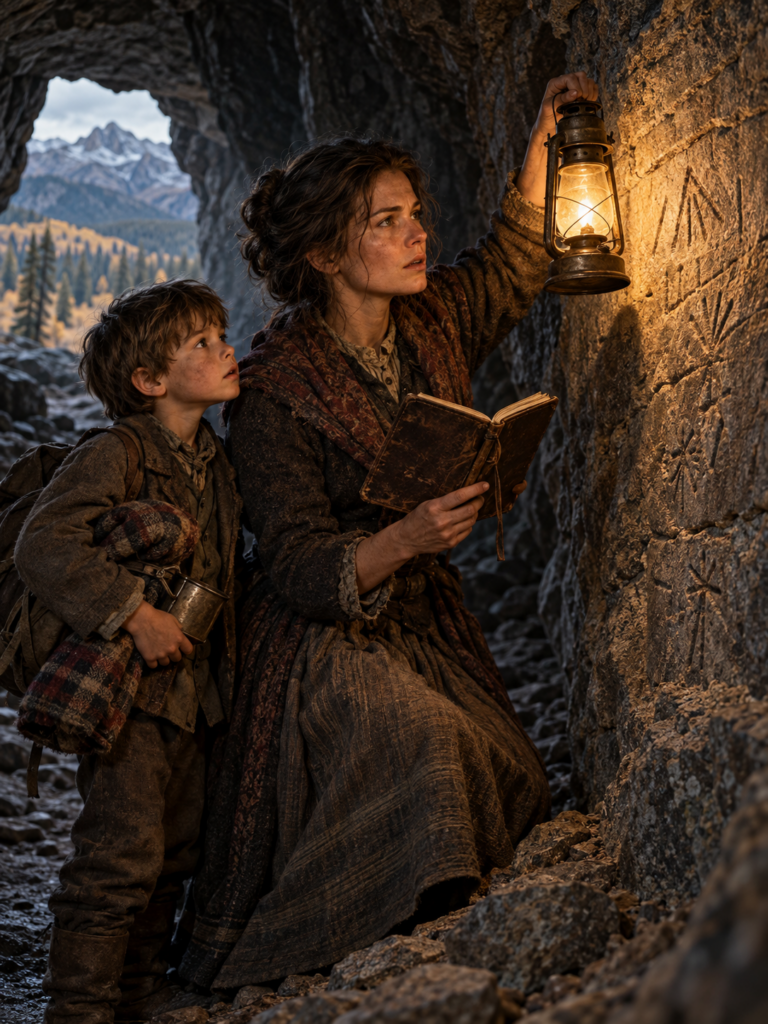
Her fingertips brushed the rough edge of the fissure, and she felt a faint current of air moving upward.
Marin lowered her hand.
She studied the crack again.
It was not merely a fracture in the ceiling.
The opening continued beyond the reach of the lantern, and the air movement suggested that it connected with the cliff outside.
That was what Signe had described.
A natural passage capable of drawing smoke away from a fire.
Marin turned to the notebook.
Her grandmother had not simply recorded finding shelter.
She had written observations about making it usable.
Where wind struck the cliff.
Which portion of the cave floor remained dry.
How a doorway might be fitted to the irregular stone.
Where a fire should sit so smoke could rise through the fissure rather than gather around anyone sleeping inside.
These were not the observations of a casual visitor.
They were the practical notes of someone who had expected to stay.
Marin looked around the chamber with new attention.
There was room for bedding against the rear wall.
The creek provided a nearby water source.
Stones along its bank could be gathered for a floor.
A doorway might protect the low entrance from winter winds.
But none of that meant the cave was ready.
It was cold.
Unfurnished.
Exposed.
The natural smoke passage had not been tested.
And Marin had brought one child into a place that would become dangerous if she made the wrong decisions.
She returned to the page dated 1836.
Several entries described Signe’s winter preparations.
Others revealed fragments of her circumstances.
A young woman.
A small daughter.
A marriage she had fled.
The repeated fear that a particular man might discover where she was hiding.
Marin felt an uncomfortable recognition.
She had grown up knowing Signe as a woman whose voice rarely rose above conversation.
Someone who taught children to count when frightened and to examine a thing before deciding it was worthless.
She had never imagined that grandmother once sitting alone beside a cave fire, listening for someone who might come looking.
Now the notebook suggested a different beginning to the life Marin remembered.
Signe’s gentleness had not necessarily come from an easy past.
It may have been something she cultivated after surviving a difficult one.
Emmett approached the marked wall.
“Was she scared here?”
Marin looked down at him.
“I think she was.”
“Did she stay anyway?”
“Yes.”
The boy considered that.
“Then we can try.”
Marin wished the decision were as simple as he made it sound.
But the notebook gave her information she could test.
And the deed gave her a place where the town could not simply order her away because someone else wanted the rooms.
She walked back toward the cave entrance.
Outside, the sky was changing.
Heavy gray cloud covered the northern ridge.
The cold had a sharpness that reminded her of her grandmother’s weather notes.
Signe had called such skies a warning that a substantial storm system might be developing beyond the mountains.
Marin could not know how severe the coming winter would be.
But she knew they had limited time to prepare.
She inspected the area around the entrance.
Loose stones littered the slope.
Cottonwood grew near the creek.
Dry wood could be gathered.
The notebook described a way of laying flat stones over packed earth and sealing their joints with clay.
Marin looked at the handcart.
Then at her small son.
The practical task was enormous.
They needed a floor.
A door.
A safe hearth.
Food storage.
Fuel.
And protection against wind.
But the place had something the rented house in Dunore no longer offered.
A chance to stay.
She went back inside and opened Signe’s notebook near the middle.
One passage described the old woman’s first winter in the cave.
Marin read it again, slowly.
The account established something important.
Signe had not discovered a comfortable refuge.
She had made an inadequate place survivable through careful work.
Her success was evidence that the cave could be used, not a guarantee that Marin would repeat it.
Still, there was a fact she could no longer dismiss.
The inheritance had brought her to the exact refuge her grandmother once occupied.
Whether Uncle Alden understood that connection remained uncertain.
He had specifically named the cave in the bequest.
But the notebook had never been in his possession, and Marin had no proof of his intention.
She would not pretend to know his mind.
What she knew was enough to act.
Emmett had been watching her.
“What do we do first?”
Marin closed the notebook.
She crossed to the mouth of the cave and inspected the dry ground where they could unload the handcart.
“First we bring everything inside before dark.”
“And after?”
She looked at the flat stones near the creek.
“We build a floor.”
The boy nodded and went toward the cart.
Marin followed, then stopped.
There was one more passage she needed to read before beginning.
She reopened Signe’s notebook at the earliest dated entry.
Beneath the description of the cave, her grandmother had written about why she chose not to return immediately to the life she had fled.
Marin lifted the lantern, brought the fading ink closer, and began reading the account of the winter her family had almost forgotten.
Marin read the faded passage twice.
Signe had been afraid of being found.
The notebook did not describe every argument or every injury of her marriage. It named no precise incident that Marin could reconstruct confidently.
But the meaning of its repeated warnings was clear.
Signe had taken shelter in the cave because returning to her husband had felt more dangerous than facing winter in the mountains.
She had brought her young daughter.
Marin’s own mother.
The realization changed the way Marin understood her family.
She had known her grandmother as a survivor of hardship, but not as someone who had deliberately hidden herself and a child from her husband.
Marin lowered the notebook.
Emmett was outside arranging the small things he could carry.
She watched him through the cave entrance.
Her own son was safe from the marriage she had left, but they were still learning what safety required.
She closed the book and joined him.
The first days were devoted to making the interior fit for living.
They gathered flat stones from the creek and carried them toward the cave one load at a time.
Marin fitted the largest slabs into the packed floor.
Emmett collected smaller stones and helped fill the gaps with clay.
They worked only where the surface was reasonably level, building a firm area for bedding and daily use.
It was exhausting labor.
Marin’s hands blistered.
Then cracked.
At night, she reread Signe’s instructions by lantern light and compared them with what she had actually accomplished.
Some directions worked immediately.
Others required adjustment.
Her grandmother had emphasized allowing the floor joints to dry before putting them under heavy use.
Marin followed that advice as closely as the cold allowed.
Then came the door.
The cave entrance did not form a regular rectangle.
Its sides bulged in different places.
The overhead lip sloped awkwardly.
Marin cut cottonwood and began fitting a frame.
Her first attempt left a wide gap on one side.
The second leaned.
On the third, she stopped trying to make the stone conform to her measurements.
She measured the actual opening, trimmed the wood, and fitted the pieces against the rock.
Signe’s notebook had warned against treating a cave like a house built of squared timber.
Granite would not yield to a carpenter’s preferences.
Marin learned to work around it.
The most surprising discovery came when she opened the sack of flour Tobias Ren had loaded onto their cart.
Buried beneath the remaining flour was a bundle wrapped in burlap.
Inside were three iron hinges, a latch, and a turned wooden handle.
Tobias had given her more than food.
He had anticipated that she might need a proper door.
Marin sat on the newly laid floor holding the hardware.
She remembered Tobias carrying firewood to her rented house after the divorce.
He never asked for anything in return.
He had simply noticed what needed doing.
Now, without requiring her permission or gratitude, he had made one more practical kindness possible.
That evening, Marin hung the door.
It was not elegant.
But it closed.
And the wind that had previously crossed the chamber directly became something she could partly keep outside.
Emmett tested the latch three times.
Then he smiled.
“We have a door.”
Marin touched the frame.
“Yes, we do.”
She did not say how much that meant.
The next major task was a hearth.
The notebook described a low firebox aligned with the ceiling fissure.
Marin built an initial version from river stones and clay.
When she tested it, smoke gathered beneath the roof.
She extinguished the fire and ventilated the cave.
Then she examined the position of the firebox.
The second arrangement drew better, but not reliably enough.
She changed the angle and allowed the clay to dry again.
After several attempts, the smoke rose through the constructed throat and moved into the natural fissure.
Marin watched for changes as the fire settled.
The draw remained steady.
Only then did she allow Emmett to sit nearby.
He closed his eyes and held his hands toward the warmth.
It was the first time she had seen him entirely at ease since they left Dunore.
Marin looked at the patched floor, the door, the hearth, and the notebook resting on the shelf.
Signe’s observations had become a working household.
But the deeper question remained.
Why had the old woman never told Marin the full story of her winter here?
Perhaps she had wanted the past to remain private.
Perhaps writing it down had been easier than speaking.
Marin could not know.
Then, in early November, a visitor arrived.
A weathered man near sixty emerged from the aspens with a lightly loaded mule.
He introduced himself as Cormac Reeve.
He had heard rumors that a divorced woman and her son were living in Calder’s Folly.
He looked over the fitted doorway, stacked wood, and organized supplies.
Then he went inside and noticed the old initials carved on the wall.
He stopped.
For a long time, he said nothing.
When he turned, his expression had changed.
“Signe Calder,” he said.
Marin went still.
“She was my grandmother.”
Cormac looked at the initials again.
“I knew her.”
Marin gripped the edge of the shelf.
“Here?”
He nodded.
Then he told her about the winter of 1836.
He had been twelve years old.
His father had died on the trail, and his mother had gone seeking help during a severe spell of mountain weather.
She had not returned.
Cormac, cold and exhausted, had found shelter in the cave.
Signe discovered him there.
She built a fire.
Shared provisions she could barely spare.
Helped him recover enough to travel.
When the weather allowed it, she took him down to a freight road and arranged for him to continue toward the settlements.
Cormac had never seen her again.
But he remembered the woman who had refused to leave him freezing in the mountains.
Marin listened without interrupting.
The account changed the meaning of the notebook.
It had already revealed that her grandmother had been hiding.
Now another person could confirm that Signe had lived here.
And that even while struggling to protect herself and her daughter, she had helped a child who needed rescue.
Cormac’s recollection did not explain every part of Signe’s marriage.
But it strengthened the link between the written account and the place.
Marin showed him the notebook.
He recognized the description of the cave and the period she had recorded.
Then he pointed toward the carving.
“I’ve thought about that winter for most of my life.”
He did not claim to remember every word Signe had spoken.
He remembered her actions.
The food.
The fire.
The journey to the freight road.
And being given another chance to grow old.
Before leaving, Cormac set a smoked ham on the flat stone outside.
“I’ll take potatoes in exchange next spring.”
Marin understood the offer.
He was giving help without making her feel she had lost the right to offer something in return.
She accepted.
When he disappeared among the trees, Emmett took her hand.
“Grandma Signe saved him.”
“Yes.”
“And now he’s helping us.”
Marin looked toward the ridge.
“Yes.”
She stood for a while beside the cave entrance, considering the distance between those two winters.
An act of kindness in 1836 had returned to Signe’s granddaughter nearly half a century later.
The days grew shorter.
Marin collected edible roots and dried berries.
She rendered fat and stored it in containers.
She counted their remaining provisions each morning.
Emmett learned to count them with her.
The cave gradually became less like an improvised camp and more like a household.
Then another discovery changed what Marin believed the property could provide.
She had been deepening a storage pit near the back wall, following a faint sketch in Signe’s notebook.
The spade entered a pocket of wet clay.
Marin reached into the opening.
The water against her wrist was unexpectedly mild.
Not hot.
But warmer than the winter air.
She cleared more material carefully.
A small seep emerged from the rock.
Water continued collecting even as the outer creek grew colder.
Marin checked the notebook.
Beside the sketch, Signe had noted that water from this part of the cave remained unfrozen during severe weather.
Marin realized the source could prove important if Whistle Creek iced over.
She watched the seep and its drainage before using it.
Then she collected a little water and examined the clay surrounding it.
The material was smooth and relatively free of grit.
Useful clay.
She worked a handful between her fingers.
Later, she shaped small bowls and a lidded jar, drying them before attempting to fire them in the hearth.
The first pieces were imperfect.
Some failed.
Others hardened successfully.
Marin kept the usable ones and studied the causes of the failures.
In the evenings, Emmett worked alongside her, pressing his small thumbs into the clay.
The discovery offered more than another household material.
Properly made vessels could be traded.
The cave might provide a modest means of earning food and supplies after winter.
The land the valley considered worthless contained a dependable shelter, a water source, and material Marin could work with her own hands.
None was a hidden fortune.
All were useful.
In late November, Emmett developed a cough and fever.
Marin cared for him closely, cooling his forehead, giving him fluids, and watching his breathing.
She consulted Signe’s plant notes and checked the descriptions against plants she had gathered earlier.
Emmett himself noticed that one plant Marin had initially considered did not match the notebook’s drawing.
She thanked him for correcting her.
She used the leaf preparation described in the book as part of the care she could provide, although the notebook alone could not prove it would cure his illness.
By the following day, his fever had begun subsiding.
His breathing eased.
He asked for broth.
Marin stayed beside him until she was satisfied he was recovering.
The relief left her exhausted.
She had managed to keep him warm and hydrated through a frightening illness far from a physician.
And she had learned again that careful observation mattered more than confidence.
By early December, the sky over the northern ridge had developed the metallic appearance Signe had described in her weather notes.
Cormac returned with a warning.
He had been reading the conditions in the higher mountains.
A major storm system was approaching.
It might last an entire week.
Possibly longer.
Marin listened.
Cormac warned her that snow could accumulate heavily against the low cave entrance, burying the doorway even while the stone chamber remained intact.
She would need fuel, water, provisions, and a tightly fitted door.
He advised waiting after the storm ended before attempting to break through the packed snow.
Marin began preparing immediately.
She doubled the wood supply.
Then added more.
She sealed gaps around the door and inspected the hearth’s draw.
She filled vessels with water from the inner seep.
She inventoried their food with Emmett.
She placed tools where they could be reached if the entrance became blocked.
And she reread every relevant page of Signe’s notebook.
The first night of the storm, the wind struck the cliff with astonishing force.
Emmett sat close beside her.
Marin kept the fire controlled and watched the smoke.
The stone walls held.
The door remained secure.
For three days, the storm continued.
Daylight disappeared behind accumulating snow.
They rationed food and fuel.
Marin taught Emmett his letters and numbers.
They counted provisions.
Checked the water.
Maintained the fire.
On the fourth day, she found him beside the carved wall.
He was studying Signe’s initials and their own charcoal marks.
When Marin asked what he was doing, he said he had been telling his great-grandmother how the door had held and how his mother had repaired the hearth.
Marin smiled.
Then she noticed a change in the fire.
The smoke no longer rose as cleanly.
She watched the draft.
It weakened further.
A thin haze began gathering near the ceiling.
Marin looked up toward the fissure.
For weeks, that natural crack had allowed smoke to leave the cave.
Now the storm had likely packed snow and ice across its upper opening.
The passage was becoming blocked.
And the fire they depended upon could no longer burn safely unless the smoke had somewhere to go.
Marin extinguished the flames and opened the safest available ventilation.
Then she studied the fissure.
It rose nearly twenty feet through a narrow section of rock.
Somewhere above, beyond the reach of her lantern, the exit was obstructed.
She looked at Emmett.
The boy understood from her expression that something was wrong.
“Mama?”
Marin took a coil of rope from the shelf.
“I need to clear the opening.”
He looked upward.
“How?”
She placed her hand against the stone.
“From inside.”
Then she fastened the rope around herself, checked the first foothold in the fissure, and prepared to climb.
Marin tested the first foothold before putting her weight on it.
The rock was cold and irregular.
She would have to climb slowly, using narrow projections inside the fissure while carrying the hatchet she needed to break the obstruction.
Below, Emmett watched with the notebook held against his chest.
Marin had told him to remain on the floor.
He had listened without arguing, which frightened her almost as much as the task ahead.
She knew how carefully her son watched her.
He understood that this was not an ordinary repair.
She looked down at him.
“Stay clear of the firebox. Don’t come after me.”
He nodded.
Marin tightened the rope.
It was not proper climbing equipment, and she knew it offered limited protection.
But it could help her maintain the position of her body in the narrow passage.
She began moving upward.
The first few feet were manageable.
Then the fissure narrowed.
She turned sideways and searched for places to brace her boots.
Stone scraped her sleeves.
Her shoulder pressed against one wall while her knee found a hold on the other.
Below, the small lantern illuminated only a section of the opening.
She climbed beyond it into colder darkness.
The air smelled of damp granite and wood smoke trapped below the obstruction.
Marin paused.
Listened.
The storm still battered the cliff outside.
But through the narrow stone passage, its noise was muted into a deep, irregular rumble.
She continued.
At the upper section of the fissure, the rock became slick.
A pale crust filled the exit.
Snow and ice had packed themselves into the opening.
Marin reached toward it.
The surface was hard.
Her first strike with the hatchet chipped away only a little.
She adjusted her position and struck again.
Fragments fell past her shoulders.
She turned her face to avoid them.
The work was awkward because she had almost no room to swing.
Her fingers were beginning to lose feeling.
She rested them briefly beneath her coat before continuing.
Below, Emmett called her name.
“I’m still here,” she answered.
She struck the ice again.
A small gap opened.
For a moment, air moved through it.
Then snow shifted against the outside opening and blocked part of the gap once more.
Marin stopped.
She had found the obstruction.
But simply striking harder would risk bringing a heavy mass of snow down into the passage.
She needed to clear the exit gradually.
Working with the hatchet edge, she enlarged the opening a little at a time.
Loose ice fell past her.
She waited after each movement to judge whether the packed snow beyond was stable.
Her shoulder began cramping.
Her boots slipped against the narrow ledges.
Still she worked.
Eventually, a stronger current of air moved through the gap.
Marin held still.
She could feel it against her cheek.
The passage was beginning to draw again.
She removed another loose section of ice.
Then another.
The opening widened enough for the trapped air to escape more freely.
She waited, listening to the movement through the stone.
The draft was returning.
She had done what she climbed to do.
Now she had to get down.
Marin carefully reversed her position.
She lowered one foot toward the next ledge.
Then her other.
The descent demanded more concentration than the climb.
She was tired.
Her hands were stiff.
And looking down through the dark passage made the distance seem longer.
About ten feet above the floor, her boot slipped.
Her body dropped abruptly.
She caught herself against a projection of rock, but the sudden movement wrenched her shoulder.
A cry escaped her.
Below, Emmett shouted.
“Mama!”
“I’m all right.”
She paused until she could move again.
Then she descended the remaining distance.
When her feet finally reached the floor, her legs gave way.
She sat heavily against the stone.
Emmett crossed the cave and threw his arms around her.
For the first time since they left Dunore, he began crying without trying to stop himself.
Marin held him.
“I’m here.”
He pressed his face into her coat.
She understood that the boy had been carrying more fear than he ever admitted.
He had watched the divorce.
The loss of their rented house.
The long journey.
The repairs.
His own illness.
And now his mother had disappeared into the ceiling of their home while he waited below.
She held him until his crying slowed.
Then she checked the airflow again.
The fissure was drawing.
The chamber had begun clearing.
Only when the smoke had dispersed sufficiently did she rebuild a small fire and observe whether it exhausted correctly.
The draw remained steady.
The danger had passed for the moment.
Marin sat beside Emmett until exhaustion overcame her.
Later, she woke to find the fire still burning carefully.
Her son had added small pieces of hardwood just as she had taught him.
He was asleep against her side.
She pulled the blanket over him and let herself rest.
The storm continued for two more days.
The repaired chimney held.
They rationed supplies.
Marin checked the water seep and the door.
Emmett continued recording their food count.
Neither spoke much about the climb.
They had work to do.
On the seventh day, the storm stopped.
The change was so sudden that Marin noticed the silence before she understood what had happened.
For days, the wind had been a constant presence.
Now the cave was quiet.
Emmett looked up.
“Is it finished?”
Marin remembered Cormac’s warning.
“The wind is. We still have to wait.”
They remained inside for two more days.
The compacted snow outside needed time to settle.
The door remained closed.
They repaired clothing.
Checked provisions.
Read from the notebook.
Emmett added another charcoal drawing below the family initials.
A woman.
A boy.
And a taller figure joining their hands.
Marin understood that he was trying to give a shape to the family history he had learned in the cave.
She did not ask him to explain.
On the third morning after the storm ended, Marin began opening the door.
Ice had formed around its edges.
She worked it loose with the hatchet.
Then she moved the door carefully.
Packed snow stood directly outside.
It had buried the entrance.
Marin examined it.
The material was dense and heavy, not loose powder that could simply be pushed aside.
She began cutting a narrow passage upward through the drift.
Emmett helped carry manageable pieces back into the colder storage area.
They worked steadily, changing positions whenever fatigue made their movements less precise.
Hour after hour passed.
The digging felt endless.
Then Marin’s tool broke through into an open pocket.
Daylight entered.
For a moment, she could barely look at it.
After seven days of storm and two more days inside the sealed cave, even the weak winter sun seemed brilliant.
She widened the hole.
Checked the stability of the surrounding snow.
Then climbed out first.
Above her, the sky was clear.
The Selwin Valley had changed beyond recognition.
Drifts rose in huge sculpted banks.
Low structures had disappeared.
The road toward Dunore was buried beneath packed snow.
Marin turned toward the cliff.
The entrance to her home was invisible beneath the enormous drift.
Only the narrow passage she had opened marked where the cave lay.
She reached down and helped Emmett emerge.
He stood beside her, taking in the white landscape.
Then he crouched and picked up a smooth gray stone.
He placed it in her hand.
It resembled the one he had given her on the porch of their rented house in October.
Marin put them together in her coat pocket.
One stone from the day they had lost their home.
Another from the day they emerged from the winter that had nearly buried them.
They had survived.
But Marin could see that the valley below had suffered badly.
Smoke rose from only a few places.
Roofs had collapsed.
The church bell tower was broken.
She knew people would need help.
She and Emmett began walking toward Dunore.
The nine-mile journey took most of the day.
The road had vanished beneath snow, forcing them to navigate by the remaining landmarks.
When they reached the town, they found damaged buildings and exhausted residents clearing debris.
Tobias Ren was working near the remains of the livery.
He looked up.
For a moment, he did not move.
Then he crossed the snow toward them.
“Marin?”
She nodded.
His expression showed how little he had expected to see them alive.
“We were in the cave,” she explained.
Tobias looked toward the ridge.
“The cave held?”
“It did.”
He turned to Emmett.
“And you helped your mother?”
Emmett nodded.
“We helped each other.”
Tobias smiled briefly.
Then his face changed.
“There is something you should know.”
Marin waited.
“A boy is missing.”
She felt her stomach tighten.
“Who?”
“The Larkin boy. He disappeared during the second day of the storm.”
Tobias explained that the child had last been seen heading toward the schoolhouse root cellar.
The schoolhouse had collapsed.
Snow and wreckage buried the entire area.
People had been digging since the storm ended.
They had not found him.
Marin asked where the cellar entrance had stood.
Tobias said it was beneath the old north porch.
She thought immediately of the cave.
Of the difference between a roof falling and a solid stone space remaining intact beneath it.
The schoolhouse could have collapsed while the root cellar survived.
If the child reached it in time, he might have taken shelter there.
Marin could not know whether he was alive.
But she knew there was a specific place worth checking.
“Take me to the porch,” she said.
Tobias hesitated.
“There’s nothing left of it.”
“Then show me where it stood.”
Marin brought Emmett to a familiar woman with a gray dog who was helping the survivors.
She asked him to stay there.
He nodded.
“Go find him, Mama.”
Marin followed Tobias through the snow.
At the ruined schoolhouse, the Larkin boy’s mother was waiting near a mound of wreckage.
Her face was gray with exhaustion.
Marin approached and asked her to describe the original entrance.
The woman pointed toward a section of the debris.
Marin asked her to walk out the approximate position of the north porch as she remembered it.
The woman’s movements gave them a more precise location.
Men from the settlement gathered with shovels.
Marin explained her reasoning.
The schoolhouse had fallen.
But a cellar cut into the ground might remain intact beneath the collapse.
The entrance could simply be blocked.
They began digging.
The work was slow.
Heavy snow had frozen around broken timber.
Marin directed the workers toward the approximate location of the cellar door rather than sending them in several directions without a plan.
Each cleared load brought them closer to the buried structure.
By late afternoon, a worker struck wood.
They widened the opening.
A section of the cellar door appeared.
Marin helped clear the last packed snow.
Then she lifted the door enough to look below.
Cold air rose from the opening.
It smelled of stored roots and enclosed earth.
For a moment, nobody spoke.
Then a small voice called from below.
The Larkin boy was alive.
He had reached the cellar before the storm became too severe.
He had closed the door, wrapped himself in available sacking, eaten from the stored provisions, and waited.
He was cold, hungry, and frightened.
But he had survived.
His mother descended to him.
When she emerged holding her son, the people around the excavation fell silent.
Marin stepped aside.
She had known only that the cellar might still be intact.
The boy’s own decision to seek shelter had made his survival possible.
She had helped the town look in the right place.
For the first time since she returned, Marin felt the full consequence of what she had learned at Calder’s Folly.
The cave had taught her how a protected stone space could withstand weather that destroyed structures above it.
That understanding had helped save another child.
A piece of practical knowledge preserved by her grandmother had traveled forward into a moment nobody could have planned.
Later that afternoon, Marin saw Ambrose Vane sitting outside the wreckage of his house.
His expensive clothing had been replaced by borrowed garments.
The great storage barn he had recently constructed had collapsed under the weight of snow.
The church tower associated with her uncle’s public generosity had also fallen.
Vane looked exhausted.
When he saw Marin and Emmett, his expression changed.
He remembered the woman he had handed a deed to in October.
The woman whose inheritance he had barely considered worth describing.
Now she stood before him alive, with her child beside her, after surviving the same storm that had destroyed much of the settlement.
For a moment, he appeared to search for something to say.
Nothing came.
Marin did not humiliate him.
She did not offer forgiveness he had not requested.
She let the facts stand as they were.
The cave had survived.
His admired buildings had not.
And the woman he once regarded as incapable of managing her own affairs had helped rescue a child after the storm.
Marin took Emmett’s hand and continued walking.
That evening, Cormac Reeve arrived from the eastern mountains.
He examined the buried cave entrance and the narrow passage Marin had dug.
Then he listened to her account of the storm.
She told him about the smoke passage icing over.
About climbing the fissure.
About Emmett keeping watch below.
Cormac looked toward the boy.
“You did your share.”
Emmett stood a little straighter.
Cormac reached inside his coat and removed a small cloth pouch.
“There is something I’ve carried for a long time,” he said.
Marin watched him open it.
Inside was a dried apple slice.
He explained that Signe had given him food before sending him down the freight road in 1836.
She had told him to remember that kindness could be passed on.
Cormac had eaten that original piece of fruit years earlier during another difficult season.
But afterward, he had developed the habit of keeping a dried slice with him.
A reminder of the woman who had once shared what little she possessed.
He held it toward Marin.
“I think it belongs with you now.”
She accepted it.
The little piece of fruit was nothing remarkable to look at.
But its meaning was unmistakable.
Signe had helped a freezing boy.
The boy had grown into an older man.
That man had returned to the cave with food and warnings when Signe’s granddaughter needed help.
Now the reminder of the original kindness had reached the next generation.
Emmett studied the dried apple.
“Will we keep it?”
Marin nodded.
“For now.”
She looked toward the distant ridge.
Then toward the town where the Larkin boy had been reunited with his mother.
What Signe had done in one winter had continued influencing lives long after she died.
And the cave was only part of that inheritance.
In the weeks that followed, Dunore rebuilt.
Its residents cleared snow.
Repaired roofs.
Recovered damaged supplies.
And counted what had been lost.
The meaning of Calder’s Folly changed.
People who had once dismissed it began traveling toward the northern ridge.
The settlement’s well had been damaged by the freeze, and ordinary water sources were difficult to use.
But the seep in Marin’s cave continued providing water.
She shared it with people who needed it.
She also gave away some of the fired clay vessels she had made.
The woman once treated as an embarrassment became a neighbor others could approach for practical help.
Marin did not ask them to apologize before filling their containers.
She had no desire to make another person earn access to something necessary for survival.
One afternoon, Tobias Ren came up the trail carrying a folded paper.
He also brought seed beans, honey, and a pair of warm boots for Emmett.
“There’s a petition circulating,” he told her.
Marin looked at the document.
It asked the county land office to confirm her claim to the seventeen acres and to consider a period of tax relief because of the property’s character and the circumstances of the winter.
More than twenty residents had signed it.
Some signatures were written confidently.
Others were uneven and painstaking.
Near the bottom was a name Marin recognized immediately.
Ambrose Vane.
She stared at it.
The same lawyer who had handled her inheritance with visible disdain had added his name to the petition supporting her claim.
It was not proof that he had become a different man.
Nor did his signature undo his earlier contempt.
But it was a concrete action.
A public acknowledgement that the property deserved protection.
Emmett leaned over her arm.
“That’s the lawyer.”
“Yes.”
“Why did he sign?”
Marin considered the question.
She remembered his damaged house.
His ruined barn.
The silence between them in the snow.
“Maybe he understands its value now.”
Emmett traced the name with his finger.
“Can I keep this?”
Marin let him fold the petition carefully.
He placed it among his stones and small belongings.
That evening, after he fell asleep, Marin opened Signe’s notebook.
For months, she had been reading the old woman’s words.
Now she turned to an unused page.
She sharpened a pencil and began recording their own winter.
She described the inheritance.
The journey from Dunore.
The initials carved into the wall.
The floor and doorway.
The mistakes she had made while building the hearth.
The old man who remembered Signe.
The spring water.
The week of wind and snow.
The blocked smoke fissure.
And the child found alive beneath the ruined schoolhouse.
She wrote about what the cave had taught her.
That fear could be faced through careful work.
That a small observation might become valuable decades later.
That people sometimes preserve knowledge without knowing who will eventually need it.
She also wrote about what she could not know.
Why Uncle Alden had specified the cave in his will.
Whether he understood its connection to Signe.
Why Signe chose never to explain her winter directly to her granddaughter.
Those questions remained.
Marin did not invent answers.
But the important truth was no longer uncertain.
Her grandmother had once sought refuge in that cave with her daughter.
She had survived.
She had saved a boy named Cormac.
And she had left a record of what the place required.
Marin had inherited those observations along with the land.
The town saw seventeen acres of rock.
Signe had known a shelter.
Marin had made it a home.
And Emmett would grow up knowing what both women had done.
When she finished writing, Marin closed the notebook and returned it to the shelf beside the clay jars.
The fire burned steadily.
Emmett slept beneath the blankets.
Outside, winter still covered the northern ridge, but the worst of the storm had passed.
Marin crossed to the back wall.
She rested her hand beside Signe’s carved initials and the smaller charcoal marks Emmett had placed beneath them.
A grandmother.
A granddaughter.
A child.
Three generations connected through a refuge that the valley had nearly forgotten.
Marin no longer wondered whether the cave was worth inheriting.
She knew.
Its value had never been measured correctly by acreage, pasture, or the opinions of people who had never entered it.
It lay in what the stone could shelter, what the notebook could teach, and what one generation could leave for another.
She returned to the hearth and sat beside her sleeping son.
For the first time in many months, she did not count the days before they would have to leave.
There was nowhere they had to go.
They were home.


