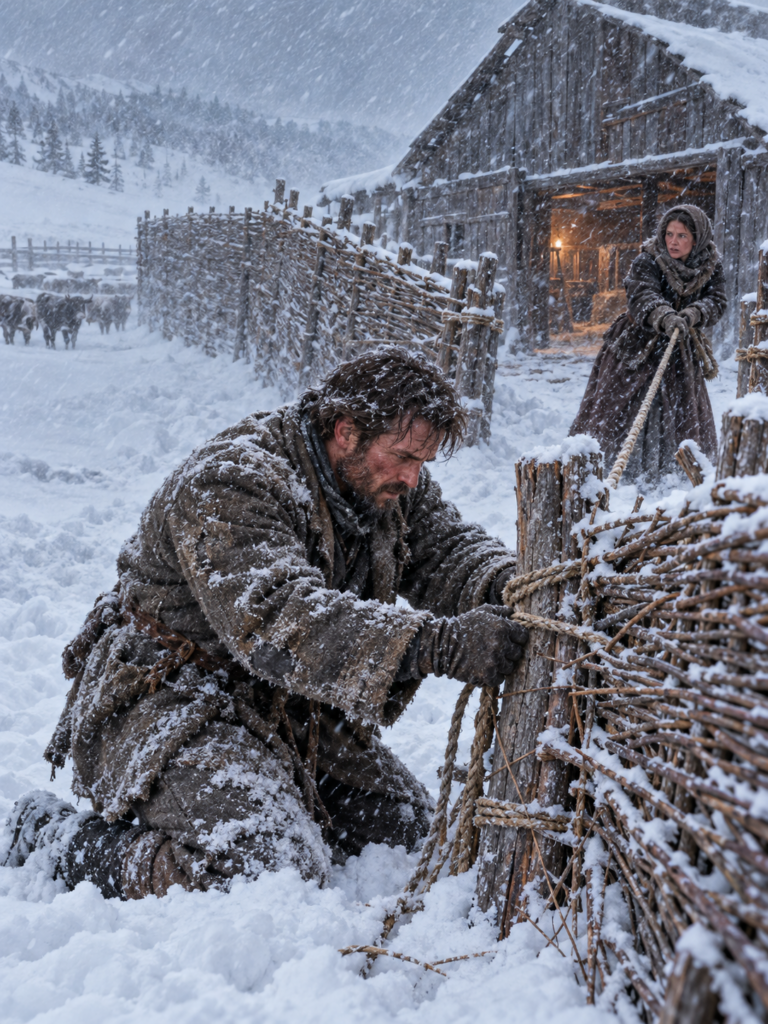
Harlon pushed the willow pole through the frame at a diagonal angle, then pulled its flexible end between two upright posts.
Mara stood behind the barrier watching the narrow cloth strips tied to the branches.
The next gust struck.
Instead of rising sharply and dropping behind the wall, much of the moving air passed through the loosened weave.
The strips still fluttered.
But the wind had lost some of its force before reaching the barn.
Mara stepped toward the doorway.
No fresh snow was gathering across the threshold.
“Better,” she said.
Harlon looked at the altered frame.
“Because we’re letting some of it through.”
The lesson was important.
A completely solid wall could create another dangerous drift.
The windbreak did not need to stop the entire storm.
It needed to reduce its force in the places where that mattered.
They finished the revised section before dark.
Then they discovered another problem.
The offset entrance Harlon had built was too narrow for one of the older milk cows.
The animal refused the tight turn and backed away, pulling against its lead.
Mara studied the passage.
“Open that angle.”
Together they shifted the gate and widened the turn.
They hung a lantern where the enclosed corner had been too dark.
When they tried again, the cow walked through.
Harlon had come to the ranch promising repairs.
Now Mara was doing more than allowing him to work.
She was improving his plans.
And he had begun listening to her without treating correction as an insult.
A week later, county livestock inspector Edwin March arrived.
He had heard about the rebuilt windbreak and the alterations to the barn.
Unlike Silas, March did not ridicule the work.
He inspected it.
He warned that a warmer barn could develop dangerous moisture if ventilation was inadequate.
The raised hay platform might still trap heat if the material was packed too tightly.
A water system that remained full during freezing weather could fail despite extra insulation.
And a canvas partition near a stove would require careful placement.
Harlon listened.
He showed March the ventilation openings, the bedding, the hay channels, and the drain arrangement.
March examined the work but refused to declare it successful.
“Keep records,” he instructed.
Temperatures.
Firewood.
Hay use.
Moisture.
Water freezes.
Mara hung a ledger beside the kitchen door.
Eli was given the pencil.
For the next three weeks, they would measure the results rather than argue about appearances.
The first cold spell provided an unpleasant surprise.
Harlon’s new chinking pulled away from the farmhouse logs.
He had used too much clay.
The draft returned.
He reached for his scraper.
Mara stopped him.
She remembered the mixture Calder had learned from her father.
More fiber.
Less clay.
A rough first layer to help the second grip.
They remade the mixture together.
This time the seams held.
Later, a coupling on the cattle water line froze even though the buried pipe remained open.
It was the weakness Inspector March had warned about.
Harlon worked beside Mara until nearly midnight, protecting the exposed fitting and improving the drainage.
The next morning, water flowed.
Then the line emptied properly.
Their ledger gradually reflected the changes.
The house consumed less firewood.
The hay stayed drier.
Water remained available.
Milk production held steady.
But just as the measurements began supporting Harlon’s work, Silas Gley returned.
He had control over a freight road Mara depended upon.
He warned that once winter closed the route, he would not allow her to use it unless she signed spring water rights over to his herd.
Mara refused.
After Silas left, Harlon asked how much hay remained.
“Nineteen days by the old figures,” she answered.
“And by the new ones?”
“Possibly longer.”
Harlon examined the ledger.
“Prepare for twenty-six.”
Mara wrote the number beneath the latest entry.
Three days later, the sky began changing.
The cattle turned away from the northwest.
The wind died.
And a hard gray front advanced over Red Wash Basin.
Harlon and Mara stopped improving the ranch.
They began preparing it for what was coming.
They installed marker posts between the house and barn.
They checked the willow lashings.
They filled the cistern.
They stored hay close enough to reach without exposing the main stack.
They stretched a guide rope between the buildings.
And they placed a repair bag beside the door.
Eli helped mark the route.
Mara brought out an old stake carrying Calder’s hand-cut mark and placed it near the house.
Harlon reinforced the repair bag with a leather strap Lydia had sewn years earlier.
Their pasts were present in the work, but neither spoke about it.
That evening, a warning arrived from Inspector March.
A severe blizzard was approaching.
The predicted winds could exceed sixty miles an hour.
When the storm arrived, no one should leave shelter unnecessarily.
Harlon went outside one last time.
He looked toward the strange willow structure he had built and rebuilt with Mara.
There were still imperfections.
But now the measurements had been made.
The obvious weaknesses had been repaired.
Everything they could reasonably prepare had been prepared.
He pulled the barn doors closed and fastened the final latch.
Beyond the willows, the first driving snow began crossing the basin.
He put his hand on the guide rope and turned toward the house.
The rope went taut in his grip as the first violent gust struck the ranch.
The guide rope tightened sharply against Harlon’s palm.
He braced his boots in the frozen yard as the gust tore past.
Snow lifted from the ground in a white sheet.
For a few seconds, the farmhouse disappeared.
Then the gust weakened, and Harlon could see the next marker post through the drifting snow.
He moved toward it, keeping one hand on the rope.
Behind him, the willow windbreak bent under the pressure.
It did not collapse.
The first test had begun.
By dawn, the White Horn blizzard had swallowed Red Wash Basin.
Wind drove snow horizontally across the fields.
Fence posts vanished beneath drifts.
The horizon disappeared.
From the farmhouse window, Eli could barely make out the nearest marker beside the path.
Nell slept behind the canvas partition Lydia had once sewn for Harlon’s freight camp.
The thick material helped separate the children’s sleeping area from the colder main room.
Mara tended the stove.
Harlon checked the door before leaving for the barn.
They had agreed not to cross the yard without fastening themselves to the guide rope.
Even a short distance between buildings could become dangerous in a whiteout.
Harlon clipped his line into place.
Mara checked the fastening.
Then he stepped outside.
The wind struck immediately.
He moved from one marker to the next until he reached the offset entrance.
The willow wall was doing its job.
Snow had accumulated along the outer barrier, away from the barn doors.
The widened passage allowed him to turn into the sheltered approach.
Inside, the cattle stood on dry bedding.
The trough contained water.
When the animals finished drinking, the protected line drained properly.
Harlon checked the coupling that had frozen during the earlier cold snap.
The new housing remained intact.
He returned to the house and recorded the findings.
Mara added the amount of hay used.
Eli wrote down the temperature.
The storm continued.
By midday, one of the outer marker posts disappeared beneath accumulating snow.
The next remained visible because of the strip of cloth fastened to its top.
Harlon noted the difference.
The route still worked, but only just.
Late that afternoon, he heard pounding beyond the windbreak.
It was faint beneath the roar.
At first he thought a branch had come loose.
Then it came again.
Three irregular blows.
Harlon took the guide rope and moved toward the sound.
Snow struck his face.
He could barely see the ground.
He followed the marker posts, stopping at each one to listen.
Near the outer section of the willow wall, he found a man half buried beside a post.
The stranger’s horse was gone.
His clothing was crusted with snow.
His face was dangerously pale.
Harlon recognized him.
Noah Pike.
One of Silas Gley’s ranch hands.
Noah had been among the men who laughed at the strange willow construction weeks earlier.
Now he lay against one of its marker posts, barely able to speak.
Harlon knelt.
“Can you stand?”
Noah tried.
His legs failed.
Harlon caught him under the arm.
They began working back toward the barn, moving slowly along the markers.
Noah stumbled twice.
Harlon held him upright.
By the time they reached the offset entrance, both men were coated with snow.
Mara helped bring Noah inside.
She moved him to the farmhouse, removed his frozen outer clothing, and began warming him gradually.
The ranch hand lay beside the stove, too exhausted to speak clearly.
When he recovered enough, he told them what had happened.
He had become separated from Silas’s crew.
The north barn at Gley’s ranch had been taking the full force of the wind.
Snow was entering the building.
The cattle were crowded into one end, trying to escape the drafts.
Noah had tried to reach shelter but lost his bearings.
Then he saw one of Harlon’s marker cloths moving through the snow.
He followed it.
Without the posts, he said, he would never have found the ranch.
Eli stood quietly beside the stove.
He remembered Silas laughing at his father’s work.
Now one of Silas’s own men was alive because he had followed it.
Harlon did not mention the irony.
He covered Noah with another blanket.
The man needed rest more than humiliation.
Outside, the wind grew stronger.
The next morning, Mara entered the barn and found Maple, the oldest milk cow, restless and straining.
The animal had gone into labor weeks earlier than expected.
Mara examined her carefully.
Something was wrong.
The calf was not properly positioned.
Normally they would have called Dr. Amos Keen, the veterinarian serving the basin.
But every road was buried.
No one could reach Cold Water Reach.
Mara had helped with difficult births before, and Dr. Keen had shown her how to manage a calf whose forelegs needed repositioning.
She warmed water and prepared clean straps.
Then she asked Eli to hold the lantern.
His hands trembled.
“Keep the light steady,” she told him.
He moved closer.
Mara worked carefully, taking time to correct the calf’s position rather than pulling against the obstruction.
Maple strained.
The other cattle shifted uneasily behind the partition.
Harlon entered after checking the water line.
He saw Mara’s expression and moved beside her.
When the calf was positioned properly, they worked together through the final delivery.
The calf slid onto the straw.
It lay motionless.
Mara cleared its mouth.
Harlon rubbed its body with dry straw, trying to stimulate breathing.
Eli passed them a clean towel.
For several seconds, nobody spoke.
Then the calf moved.
Its ribs expanded.
A weak breath escaped.
Mara continued rubbing it.
The newborn breathed again.
Maple lowered her head toward it.
Harlon sat back on his heels.
Eli let out a long breath.
There was no cheering.
The moment was too fragile for that.
Mara checked Maple carefully, then helped settle the calf on clean straw.
Only afterward did they step away.
Every repair they had made suddenly mattered.
The offset entrance had reduced the wind in the barn.
The bedding had remained dry.
The water system had provided clean water when they needed it.
The widened passage allowed the frightened cattle to move without becoming trapped.
The lanterns gave Eli enough light to help.
None of those repairs had seemed dramatic when they were being made.
Together, they had given the newborn calf a chance.
Back in the house, Noah Pike was sitting upright beside the stove.
Nell had begun crying.
He drew her cradle closer to the warmth and helped prepare a bottle while Mara cleaned up after the birth.
Eli watched him.
The man who had once mocked his father’s work was now helping care for his sister.
Something about the change seemed to settle in the boy.
Noah was no longer simply one of Silas’s men.
He was another person trying to get through the storm.
The third day brought the worst wind.
By afternoon, the temperature had fallen far below zero.
Snow drove against the buildings so heavily that the barn roof disappeared behind swirling white.
Harlon checked the window overlooking the willow barrier.
One section was moving differently.
The north panel jerked each time a gust struck it.
Then the upper lashing snapped.
The woven branches pulled free.
Harlon watched the loose section twist toward the barn.
If the panel failed completely, the wind could enter the offset passage from the wrong angle.
Drifting snow might pile against the doorway.
The cattle could become trapped inside.
He reached for the repair bag.
Mara saw what he intended.
“You can’t see three posts beyond the house.”
“I know.”
“The wind could take you off the line.”
“I’ll stay attached.”
She studied the damaged wall through the window.
The loose panel struck the frame again.
Neither of them wanted him outside.
But leaving the damaged section to fail could undo weeks of preparation.
Mara took the heavy rope.
Harlon fastened one end securely around his waist.
He checked the knot.
Then he placed the remaining coil in Mara’s hands.
They established the signals before he opened the door.
A steady pull meant he was returning.
Three short tugs meant he needed more line.
If the rope went completely slack for too long, she was to check from shelter before deciding what could safely be done.
Harlon opened the door.
Wind forced it back against him.
He leaned into the whiteout.
Mara held the rope.
One marker appeared beyond his shoulder.
Then another.
Then he disappeared.
Outside, Harlon crouched low and moved from stake to stake.
Snow battered his face.
The damaged panel slammed repeatedly against the wooden frame.
When he reached the first broken post, a gust struck the willow lattice.
It swung toward him.
He tried to duck.
The panel caught his shoulder and knocked him into the snow.
The repair bag tore open.
Several tools scattered into the drift.
For a moment, Harlon could not move.
The wind pressed him against the ground.
He heard the loose branches cracking above him.
Then he felt the strap across his shoulder.
Lydia’s leather stitching had caught the bag before it could blow away entirely.
He pulled the damaged satchel close.
His fingers found a spare willow pole.
He could not rebuild the whole section.
Not in that wind.
Not with his hands already stiffening.
He needed only to brace the opening until the storm weakened.
Harlon dragged himself toward the frame.
He positioned the spare pole diagonally across the loose panel.
Then he tightened the available rope around the upright posts.
The wind struck again.
The improvised brace shifted.
He adjusted its angle.
Another gust hit.
This time the panel held.
Harlon pulled on the repair rope and secured the final fastening.
He waited through another blast.
The barrier remained standing.
He reached for his guide line.
Then he gave three short tugs.
Inside the house, Mara felt them.
She fed out more rope.
Seconds passed.
The line tightened again.
Then it grew still.
Mara stared at the white doorway.
She pulled carefully.
There was resistance.
She pulled again.
A figure appeared beyond the nearest marker.
Harlon was crawling, one hand dragging through the snow while the other followed the line.
Mara braced herself and helped him reach the house.
He came through the door covered in ice.
His face was nearly white.
She shut the storm outside and helped remove his outer coat.
“Did it hold?”
He nodded.
“Until morning, I think.”
Mara looked toward the window.
The loose panel no longer swung into the passage.
“Morning is enough.”
She guided him toward the stove.
For several minutes, neither spoke.
The repaired wall had survived another gust.
But the ranch would not be safe until the wind weakened and they could see what remained.
Harlon reached for the notebook beside the door.
Mara placed her hand over it.
“Not yet.”
He looked up.
She kept her hand there.
“First, get warm.”
For once, he did not argue.
He sat beside the stove, feeling the warmth return painfully to his fingers, while outside the storm continued testing every wall they had built.
Harlon stayed beside the stove until he could close his hands without pain.
Mara brought him something warm to drink.
The children remained behind the canvas partition, and Noah Pike rested nearby.
Outside, the blizzard continued through the night.
The willow wall bent beneath repeated gusts.
Snow accumulated along its outer edge.
The new brace held.
By the fourth morning, the wind finally began to weaken.
Harlon woke before dawn.
He listened.
For the first time in days, he could hear individual sounds beyond the house.
A creaking board.
A cow calling from the barn.
Snow sliding from the edge of the roof.
The continuous roar was gone.
He rose carefully and pulled on his boots.
Mara was already awake.
Neither suggested that the storm had ended completely.
They checked the conditions before opening the door.
Then they stepped outside together.
The basin looked unfamiliar.
Snow had buried most of the fences.
The old wagon track was gone.
Drifts rose along the outer side of the willow barrier, exactly where the revised design had directed them.
The barn entrance remained accessible.
Harlon walked toward it slowly.
He studied the north section where he had made the emergency repair.
The spare willow brace had shifted slightly, but the framework still stood.
Several branches were broken.
One post leaned.
The wall would need rebuilding.
But it had not collapsed.
Mara opened the barn doors.
Inside, the cattle were standing.
They counted each animal.
Every main animal had survived.
Maple stood beside her newborn calf.
The calf had a small patch of frost damage on one ear but was breathing and moving.
The bedding remained dry.
The trough still worked.
Hay from the raised platform smelled clean.
Harlon checked beneath the lowest layers for signs of spoilage.
There was none.
The system had not performed perfectly.
But it had performed well enough.
That distinction mattered.
He opened his notebook.
One brace had been too light.
Two marker posts needed to be set deeper.
The cloth strips required stronger stitching.
The housing around the water coupling needed better protection against blowing snow.
He wrote each observation.
Mara watched him.
“You’ve counted everything that failed,” she said.
“Not everything.”
He looked toward the damaged willow section.
“There’s more to inspect.”
“And the cattle?”
“Counted.”
“The calf?”
“Alive.”
“The water?”
“Running.”
She stepped closer.
“The children?”
Harlon looked back toward the farmhouse.
Warm smoke rose from the chimney.
Inside, Eli was helping Noah prepare breakfast while Nell slept in Calder’s old cradle.
“They’re safe.”
Mara let the words settle.
“Then remember that too.”
Harlon closed the notebook.
The ranch had survived.
And so had the family that had begun forming inside it.
Later that day, the sky cleared enough to reveal the hills beyond Red Wash Basin.
The weather remained bitterly cold, but the worst of the storm had passed.
Harlon and Mara worked through the remaining damage.
They checked the doors, cleared essential paths, and reinforced the weakened panel.
Noah helped when he could stand comfortably.
He worked without his former joking confidence.
Harlon noticed but did not press him.
The man had nearly died.
That was lesson enough.
When the roads finally reopened, the first visitors arrived at Cold Water Reach.
County livestock inspector Edwin March came to examine the changes Harlon had made.
Dr. Amos Keen followed to check the cattle and Maple’s newborn calf.
Other neighboring ranchers arrived after hearing how the property had endured the storm.
March did not begin by congratulating anyone.
He opened the ledger.
He read the temperature records.
The hay consumption.
The number of times the trough required attention.
The amount of firewood used.
Then he walked through the buildings.
He examined the dry bedding, checked the ventilation, studied the hay platform, and inspected the repaired water coupling.
The evidence was not merely that the buildings remained standing.
The records showed that the system had reduced waste and maintained more stable conditions.
Hay use was lower than before the repairs.
The house required fewer armloads of firewood during comparable cold periods.
The water line had remained usable after the exposed coupling was corrected.
The barn entrance had stayed open despite deep snow around the property.
March examined the willow barrier last.
He studied the thirty-four-foot separation from the barn and the open weave of the panels.
The snow had gathered along the wall rather than sealing the doors.
He looked at Harlon.
“The distance made a difference.”
Harlon nodded.
“The first version was too tight.”
“I heard.”
“We changed it.”
March looked toward Mara.
“Who suggested the diagonal weave?”
“She did.”
Mara crossed her arms.
“It was his design. We fixed the mistakes together.”
The inspector made another note.
Then he closed the ledger.
The improvements had worked under conditions severe enough to reveal their weaknesses.
That was stronger evidence than any promise Harlon had made when he arrived with his handcart.
Noah Pike spoke while the others were inspecting the marker posts.
He told them how he had become separated from Silas Gley’s men.
How the snow erased the road.
How he had followed the fluttering cloth from one post to the next.
Without the markers, he said, he would never have reached the ranch.
The group fell quiet.
Harlon remembered Eli helping place those posts before the storm.
The boy had asked why they needed both a rope and markers.
Now the answer stood before him in the form of a living man.
A few days later, Silas Gley appeared at the gate.
His own ranch had suffered badly.
Part of his north barn roof had been damaged.
He had lost cattle.
His water system had failed during the coldest part of the storm.
Silas dismounted and walked toward the willow barrier.
For a long time, he examined the bent branches and the compacted snow beside them.
Harlon approached.
Silas pointed toward the barn.
“How far from the doors?”
“Thirty-four feet through the middle. We adjusted the rest to the ground.”
Silas studied the openings in the woven branches.
“Why didn’t you fill those gaps?”
“Because the wind needs somewhere to go.”
Harlon showed him the strips of cloth still fastened to several posts.
“The first design was too solid. Snow collected behind it. We removed some of the willow and changed the angle.”
Silas looked toward the barn doors.
They were clear.
The ranch had been struck by the same storm that damaged his own buildings, yet its principal livestock shelter remained functional.
He did not apologize for mocking the work.
He did not praise Harlon.
Instead, he asked to see how the frame was anchored.
Harlon showed him.
They walked along the barrier together.
The conversation was practical.
Post depth.
Spacing.
Where to leave openings.
How to watch snow movement before deciding whether a section needed adjustment.
Silas listened.
For Harlon, that was enough.
He did not need the man to acknowledge every insult.
He needed the work to be understood.
Later, neighboring ranchers began adopting parts of the Cold Water Reach winter plan.
Some copied the offset barn entrances.
Others raised their hay storage or improved trough drainage.
Several rebuilt windbreaks farther from their buildings, paying careful attention to the prevailing direction of winter storms.
Not every ranch used the same design.
The ground was different from one property to another.
Harlon insisted that people observe the wind and the snow rather than copy measurements blindly.
He had already learned the danger of treating a first design as though it could not be wrong.
The most successful changes came from watching, testing, and correcting.
And each improvement made Red Wash Basin a little better prepared for the next hard winter.
But the most important change at Cold Water Reach was not visible from the road.
It happened inside the farmhouse.
After the visitors had gone and the urgent repairs were complete, Mara asked Harlon to join her in the ranch office.
The ledger lay open on the desk.
Beside it was a folded agreement.
Harlon stood near the door.
Mara turned the paper toward him.
It granted him a share of the ranch’s profits.
It also assigned him continuing authority over structural repairs, water systems, and winter preparation.
He read the terms twice.
Then he reached the final provision.
Eli and Nell would always have a home at Cold Water Reach, regardless of what happened between the two adults.
Harlon looked up.
For several moments, he could not speak.
He had arrived six weeks earlier with a nearly empty handcart.
He had asked for milk because he could no longer bear watching his children go hungry.
Now Mara was offering something far beyond wages.
She was giving the children a place that could not be withdrawn simply because their father was no longer useful to the ranch.
“Why?” he finally asked.
Mara rested her hands on the desk.
“Because they live here.”
Harlon looked down at the agreement.
He thought of the three ranches that had turned him away.
The men who wanted his labor but not his children.
The nights when Eli hid food.
The mornings when Nell woke hungry.
He had grown accustomed to believing that shelter always came with a condition.
Mara had begun breaking that belief the first evening she placed bread beside Eli’s plate.
And now she was putting the promise into writing.
Harlon took the pen.
He signed.
Mara signed beneath him.
The agreement changed the ranch.
But it also acknowledged something that had already happened.
Harlon was no longer a temporary hand trying to earn one more week’s shelter.
Eli no longer counted every piece of bread.
Nell reached for Mara whenever she entered the room.
And Mara, who had spent three years managing the property alone, had learned that sharing responsibility did not mean surrendering it.
That evening they sat beside the stove.
Two tin cups rested on the hearth.
Mara had begun placing them there again after telling Harlon how Calder used to set out two cups every morning.
For a long time after his death, she had put only one cup beside the stove.
The second had felt unbearable.
Now the sight of two cups no longer seemed like a betrayal of his memory.
It was simply a place set for someone else who lived in the house.
Harlon looked toward the children’s room.
Nell was asleep in the cradle Calder had never finished.
Eli lay beneath a blanket, his hands open beside his pillow.
There was no bread hidden in his coat.
Harlon noticed that absence every evening.
It still moved him.
“I came here asking for milk,” he said.
Mara nodded.
“You did.”
“I didn’t expect any of this.”
“Neither did I.”
He stared into his cup.
“I thought if I couldn’t earn enough, I’d lose the children.”
Mara waited.
“I couldn’t travel with the repair crews anymore. Every ranch wanted me to choose between a job and being their father.”
He looked toward the canvas curtain.
“You were the first person who didn’t ask.”
Mara held her cup between both hands.
“The children were hungry. That was enough.”
The stove settled softly.
Harlon looked at her.
“I’d like to stay.”
Mara glanced toward the window.
The snow outside remained deep against the fence.
“Until spring?”
“Longer.”
She met his eyes.
“Then stay.”
There was no dramatic declaration.
They had already spent weeks making decisions together.
They had worked through broken pipes, failed chinking, frightened cattle, exhaustion, and a blizzard that nearly destroyed the windbreak.
They had seen each other frightened and tired.
They knew neither was perfect.
And neither expected the other to become perfect before being trusted.
Spring brought more work.
The damaged north section of the willow barrier needed rebuilding.
Fence rails had shifted beneath the weight of snow.
Several trough fittings required replacement.
Harlon began making improvements that would last beyond another single winter.
Mara adjusted the ranch accounts and organized the labor.
Eli helped measure posts and record supplies.
Nell grew stronger, pulling herself upright against the edge of Calder’s cradle.
The arrangement suited them.
It did not erase the people they had lost.
Lydia remained part of Harlon’s memories.
Mara still spoke about Calder’s work when she repaired something he had built.
Neither treated the past as a rival.
Sometimes Harlon found Mara touching the old cradle rail.
Sometimes Mara noticed him running his fingers along Lydia’s stitching on the canvas curtain.
They left those moments alone.
Grief did not disappear because love returned.
It became part of the house.
In early May, Harlon and Mara married quietly.
Dr. Amos Keen and Inspector Edwin March served as witnesses.
The ceremony was small.
There was livestock to tend and work waiting in the yard.
Silas Gley did not attend.
But a neat bundle of straight willow stakes appeared beside the fence, useful timber of the kind Harlon had been requesting.
Nobody claimed responsibility for delivering it.
Harlon accepted the wood without making a spectacle of the gesture.
He had learned that some people expressed respect more easily through useful things than through apologies.
After the wedding, Eli began considering what to call Mara.
He asked one evening while she was checking the household ledger.
“Do I have to call you something different now?”
Mara looked up.
“No.”
He studied her.
“Not even because you married Pa?”
“You call me what feels right.”
Eli nodded.
For a time he continued saying Mara.
She never corrected him.
Then one spring afternoon, he tripped near the marker posts.
He scraped his hands against the ground and cried out.
Mara hurried toward him.
As she knelt to help, he began calling for her.
The first sound was uncertain.
Then he said something close to “Ma.”
Mara paused only long enough to make sure he was not badly hurt.
She cleaned the dirt from his hands and helped him stand.
She did not ask him to repeat the word.
It had to belong to him.
A few weeks later, Nell began taking her first steps.
She was outside near the barn while Mara carried feed to the calves.
The little girl pulled herself upright against a low rail.
Harlon noticed and called quietly to Mara.
They watched Nell steady herself.
Then Mara knelt a few feet away.
The child took one step.
Then another.
Her arms stretched forward.
“Ma,” she said.
Mara did not rush toward her.
She waited, smiling, allowing Nell to finish the distance herself.
When the little girl finally reached her, Mara gathered her close.
Harlon stood nearby, watching them.
Beyond the yard, the repaired willow wall rose against the open basin.
It was not beautiful in the way the first plans had promised.
Several branches bent at odd angles.
A few posts had been replaced with timber of a different color.
The emergency brace from the blizzard had been removed and rebuilt properly.
But the wall stood where it needed to stand.
The barn doors opened freely.
The water system worked.
The hay remained dry.
And the people living at Cold Water Reach no longer treated every coming winter as a threat they had to face alone.
Harlon looked across the property.
“We still have work to do.”
Mara reached for the second tin cup resting on the fence rail.
She handed it to him.
“Of course we do.”
He smiled.
There was no embarrassment in saying it anymore.
The ranch would always need repairs.
Boards would rot.
Water pipes would freeze.
Willow branches would break.
Storms would return.
But those were problems that could be watched, understood, and repaired.
Harlon had once believed he needed to solve every problem himself to deserve a home for his children.
Mara had believed she needed to carry every burden alone to protect what Calder left behind.
Neither belief had survived the winter.
They had not saved the ranch through one miraculous invention.
The willow wall mattered because they tested it, admitted where it failed, and changed it before the blizzard arrived.
The protected water line mattered because they found and corrected the frozen coupling.
The hay crib mattered because they measured the moisture and preserved the feed.
Even the marker posts mattered because one exhausted ranch hand could find his way toward shelter when everything else disappeared.
And the family that emerged from the storm had formed in much the same way.
Not through grand promises.
Through repeated acts of practical care.
Milk placed before hungry children.
Bread left on a table without being counted.
Gloves set near a stove.
A cradle brought down from storage.
A mistake corrected without humiliation.
A rope held firmly while someone worked beyond sight.
On the day Harlon first arrived, he had asked Mara for enough milk to keep his children fed.
She had given them that.
Then she gave him a chance to work.
He gave the ranch his knowledge and persistence.
Together, they built something neither had possessed alone.
A home strong enough to make room for grief, mistakes, responsibility, and new love.
And when the wind rose again over Red Wash Basin, the willows bent as they had been designed to bend.
They did not pretend the storm was harmless.
They simply stood together in the right place, allowing the worst of its force to pass.