
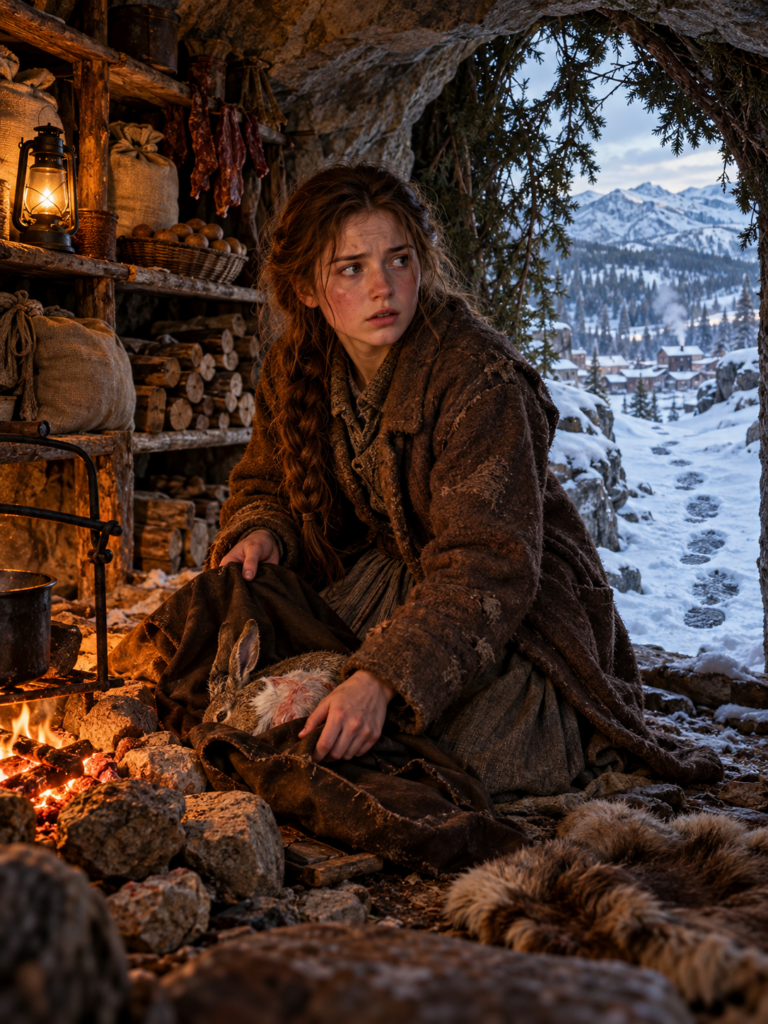
The lantern light reached across the rear wall, catching the uneven edges of the rock and the wooden shelves built against it.
Ren stood still.
No person emerged.
She moved closer, careful to keep the cave entrance behind her and a clear route back to the fire.
The passage narrowed beyond the shelves, then disappeared into shadow.
She examined the ground.
There were marks in the grit, but nothing she could confidently identify as recent footprints.
The scrape she had heard the previous evening might have come from someone moving there.
It might also have been loose stone shifting beneath an animal.
She would not turn uncertainty into proof merely because she was frightened.
Still, the rabbit was real.
The bootprints outside were real.
And somebody knew the cave.
Ren returned to the hearth.
She carefully inspected the meat, then set about cooking it.
Whoever left it had apparently intended to help rather than steal.
That was worth remembering.
As the fire grew, Ren thought about the cave’s original construction.
The pine shelves were fitted more carefully than anything she could have made with her limited tools.
The iron hooks had been placed where heat and smoke could help preserve meat.
Near the entrance, a length of strong rope hung on a peg she had scarcely noticed when she first arrived.
There was also a sturdy hatchet that had been there before she returned.
Her father had shown her how to use such things.
But had he actually built this place?
She had always assumed so.
Now she recognized the difference between something he had told her and something she had simply believed.
She ate the rabbit that evening, saved what she could, and resumed preparing the shelter.
The next morning she returned to Cold Water Bend.
She bought the little she could afford at Whitlock’s general store.
The old shopkeeper added a sack of dried corn to her purchase without charging her.
Ren tried to protest.
He waved it away.
“You’ll have use for it.”
That small kindness stayed with her as she pulled the sled through town.
Outside the eating house, several men laughed about her repeated trips into the mountains.
Ren stopped and warned them about the approaching weather.
She advised them to store extra food and firewood and protect their water supplies.
Frank Dawson, a rancher, asked what made a seventeen-year-old girl so certain she understood the mountains better than experienced men.
Ren did not claim certainty.
She explained the signs she had observed.
The birds.
The elk.
The wind.
The unusually persistent cloudbank.
Most dismissed her concern.
But as she left, Prudence Gale followed her outside.
The elderly woman had lived near Elhorn Ridge for decades.
She studied the northern sky for a long time.
Then she told Ren she had seen similar conditions before a terrible winter storm years earlier.
The families who had prepared had been able to help those who had not.
“Keep doing what you’re doing,” Prudence said.
Ren returned to the cave and worked until her arms shook.
She stacked more wood.
Filled the remaining jars.
Raised her bedding above the cold stone.
Checked the smoke vent and packed clay into the cracks along the lower wall.
Then she counted the food.
It was enough for one person through a difficult stretch of winter, provided she rationed carefully.
One person.
The words bothered her.
She remembered Cornelius Vane’s ledger.
Four people could survive.
The fifth had to leave.
Ren looked around the cave.
She had arranged everything for herself.
But if someone appeared at the entrance freezing, how would she answer?
She thought about her father’s lessons.
He had taught her that preparation mattered.
He had also spent much of his life working beside miners who depended on one another when trouble came.
Ren set two additional blankets near the fire.
She did not know whether she would need them.
She wanted them ready.
That night, the first serious wind arrived.
It moved across the northern peaks and struck the ridge with a force that shook loose needles from the juniper branches.
Ren checked her supplies once more.
Then she walked toward the entrance.
The stars had disappeared behind an unbroken ceiling of cloud.
Snow began striking her coat.
From somewhere below came a low rumble of weather moving through the valley.
Ren turned back toward the cave.
She was reaching for the hide covering she had hung across the passage when she noticed the strong rope on its peg again.
She took it down, tested its condition, and looked toward the trail leading to Cold Water Bend.
Someone had left that rope here before she arrived.
Someone who had also left tools, shelves, and a place where a person could survive.
But had they intended to return?
Ren placed the rope beside the entrance, within easy reach.
Then she pulled the hide across the opening as the first hard gust drove snow through the juniper.
Snow struck the hide covering hard enough to push it inward.
Ren caught the lower edge, secured it against the stone, and stepped backward into the chamber.
The little fire bent toward the incoming draft before recovering.
She checked the smoke vent above it.
The rising smoke continued finding its way through the natural fracture in the ceiling.
For now, the shelter remained safe.
Outside, the wind gained force.
It came in heavy bursts, each one followed by a short interval of relative quiet.
By midnight, those intervals had almost disappeared.
Ren sat beside the hearth with her father’s coat buttoned to her throat.
Every so often she fed another piece of wood to the fire.
The mountains had always sounded different in storms.
But she had never heard this sustained, violent noise from inside the stone.
She thought of Cold Water Bend.
The town lay below the ridge, exposed to wind moving through the valley.
She imagined the smoke being torn from chimneys, snow collecting against doors, and people hurrying to bring in firewood they had expected to gather the following week.
She hoped her warning had persuaded someone to prepare.
There was nothing more she could do for them that night.
She remained awake until exhaustion finally forced her to rest.
When morning arrived, only a weak gray light filtered through the entrance.
Ren rose, checked the fire, and moved the hide covering aside.
Snow had piled against the juniper.
She forced an opening wide enough to look outside.
The landscape had changed almost beyond recognition.
The trail was buried.
The lower pines disappeared into drifts.
The valley beyond was largely white.
Only the roof of the church and a few dark chimneys were visible where Cold Water Bend should have been.
Ren stood staring.
The storm had come sooner and harder than even she had expected.
Then she saw movement.
Far below, two dark figures struggled along the buried trail.
One appeared to be carrying something.
The other shape moved unevenly through the drifts.
Ren watched until she could distinguish a man.
He was climbing toward the ridge with another person slung across his shoulders.
He stumbled.
Fell to one knee.
Then struggled upright again.
Ren hurried inside.
She took the heavy rope from its peg and fastened one end around the solid stone column beside the entrance.
She tested the knot carefully.
Then she tied the other end around her waist.
She picked up the hatchet to help secure her footing and stepped out into the storm.
The cold struck immediately.
Snow filled the openings around her scarf.
The drifts were deep and uneven, with hard crust concealing softer powder beneath.
Ren kept the rope behind her and advanced slowly.
She was not far from the cave when she recognized the man.
Jonah Redford.
The owner of the grist mill.
He had been among the townspeople who dismissed her preparations.
Now he could barely stand.
Across his shoulders lay his young daughter, Posie.
Ren reached them as Jonah sank into the snow.
“Our roof came apart,” he managed.
His voice was weak.
“The fire went out.”
Ren touched Posie’s cheek.
The child’s skin was dangerously cold, but she was conscious.
“Can you hold on to me?”
Posie nodded faintly.
Ren helped the girl down from Jonah’s shoulders and supported her against her side.
With her other arm, she steadied the exhausted man.
The climb back to the cave was slow.
Twice Jonah slipped.
Ren used the rope to keep their route connected to the entrance.
When the juniper finally appeared, she felt an overwhelming rush of relief.
She brought Posie inside first.
Jonah followed on his knees, shaking with exhaustion.
Ren secured the hide covering and guided them toward the fire.
She removed wet outer garments, provided dry coverings, and warmed them carefully.
Posie’s shivering gradually eased.
Jonah sat against the stone, staring at the shelves.
He saw the firewood.
The preserved meat.
The sacks of food.
The water jars.
He looked at Ren.
“You were right to prepare.”
She handed him a warm cup.
“Drink this slowly.”
He accepted it.
For several minutes, neither spoke.
Then he said, “I should have listened.”
Ren continued tending the fire.
Her father’s lessons had saved her.
Now they had helped save someone else.
Before afternoon ended, more people arrived.
Amos Tanner appeared with his wife and two sons.
The blacksmith who had joked about her mountain castle stood at the entrance with snow crusted across his face.
His family had been driven from their damaged home.
Ren stepped aside.
“Come in.”
Amos looked at her for a long moment.
Then he brought his family inside.
By nightfall, eight people crowded around the fire.
Ren spread the extra blankets.
She divided the food carefully.
Nobody complained.
Outside, the blizzard continued.
The next day brought additional survivors.
Hetty Combes, a widow.
Cole, a ranch hand who had injured his leg.
The elderly Sadderly brothers.
Prudence Gale.
And a young couple carrying an infant wrapped against the cold.
Ren had placed a rope along the most dangerous section of the upper trail to help approaching survivors find the entrance.
By the time everyone had settled, fourteen people sheltered inside the hidden chamber.
Fourteen.
Ren counted them twice.
Then she counted the food.
Her stomach tightened.
She had stocked the shelter for one.
Now more than a dozen people depended on it.
Even with careful portions, the supplies might last only another five days.
And the storm showed no reliable sign of ending.
She stared at the shelves.
Then she remembered the evening Cornelius Vane had opened his ledger.
He had counted the food.
Counted the people.
And decided that one person must leave.
Ren looked at Posie sleeping beside the Tanner boys.
At the young mother holding her infant.
At the elderly brothers curled beneath their blankets.
She understood the terrible temptation of Cornelius’s arithmetic.
The easiest way to extend her supplies would be to turn some people away.
But the consequences were no longer abstract figures on paper.
She knew their faces.
She had helped them inside.
She had watched their strength begin returning.
Ren took a slow breath and began reducing the portions.
She would not decide whose life mattered least.
The following morning, Prudence Gale approached her beside the fire.
“We’re short of food.”
Ren nodded.
“I can stretch it. But not indefinitely.”
Prudence opened a small cloth bag.
Inside were dried herbs, beans, and wild onions she had saved for herself.
“Put these with the rest.”
Ren hesitated.
“You need your food.”
“So does everyone here.”
Ren accepted the bag.
That decision changed the room.
Cole brought out dried fish he had been keeping in his coat.
One of the Sadderly brothers offered smoked bacon.
Hetty divided her remaining biscuits.
Each contribution was small.
Together, they added precious meals to the stores.
For the first time since the survivors arrived, Ren felt the burden begin to shift.
The shelter was no longer being sustained only by the supplies she had carried uphill.
The people inside were taking responsibility for one another.
That evening, the wind weakened slightly.
The change raised hope.
But Ren was still calculating how long the food would last when three deliberate knocks sounded against the stone near the entrance.
She froze.
The rhythm was slow and steady.
It reminded her of the strange movements she had heard in the cave before the storm.
Ren picked up the lantern and hatchet.
She approached the entrance cautiously.
“Who’s there?”
A man’s voice answered through the juniper.
“Someone with supplies.”
Ren lifted the hide covering.
An elderly man stood outside in a weathered buckskin coat.
Frost covered his long gray beard.
Behind him were two sleds piled with food, wrapped hides, and sacks of flour and cornmeal.
Ren stared.
The cargo was far more than one person could easily carry.
The man studied her face.
Then his gaze moved toward the firelight beyond her.
“You’ve made good use of the place.”
Ren tightened her grip on the lantern.
“Who are you?”
“Ezra Holloway.”
She waited.
He looked past her toward the shelves.
“I built much of what’s inside.”
For a moment, she could only stare.
Then her eyes moved toward the rope still secured near the entrance.
“The rabbit,” she said.
Ezra nodded.
“The rope and hatchet?”
“Those were here long before you returned.”
“You’ve been watching me.”
“I saw smoke from this ridge and wanted to know who had found the shelter.”
Ren thought of the bootprints.
The strange noise.
The unexplained food.
All of it had pointed toward someone who knew the cave better than she did.
“Why didn’t you speak to me?”
Ezra looked toward the people gathered inside.
“At first, I wanted to see how you intended to use the place.”
Ren did not answer.
She was relieved to know the truth about the tracks, but she was not entirely pleased that someone had observed her struggle without introducing himself.
Ezra seemed to recognize her discomfort.
“The storm came harder than I expected,” he said. “I brought what I could.”
Ren stepped aside.
They began moving the supplies into the chamber.
The survivors helped carry sacks and parcels.
Children watched as dried meat and flour were stacked against shelves that had been nearly emptied.
Jonah Redford rose from beside the fire.
“You brought enough to keep us alive.”
Ezra shook his head.
“The girl made room for you. I brought food.”
Ren continued sorting the supplies, checking their condition and calculating the new rations.
The immediate danger of hunger had eased.
But another question remained.
Ezra Holloway had built the hidden shelter.
He had stocked it.
He knew its concealed entrance.
And he had been watching since Ren returned.
As the others settled around the fire, Ezra sat on a low stone and accepted a cup of warm soup.
Ren approached him.
“Did my father know you?”
Ezra lifted his eyes.
“Silas Aldridge?”
Hearing her father’s name spoken with such familiarity made her breath catch.
“Yes.”
The old man’s expression changed.
“I knew him very well.”
Ren waited.
Ezra looked into the fire.
“He saved my family once.”
The words landed with unexpected force.
“My father never told me.”
“He wouldn’t have.”
Ren sat opposite him.
“Tell me what happened.”
Ezra glanced toward the storm-dark entrance.
“It’s a long story.”
“Then start.”
He looked at her for a moment.
Finally, he rested both hands on his knees.
“Twenty years ago,” he began, “I lost my ranch. My wife and children had nowhere to go, and winter was already closing the mountain roads.”
Ren leaned forward.
Ezra continued.
“Your father found us on the road.”
Ren remained motionless as Ezra Holloway began telling her about a winter that had come long before she was born.
Silas Aldridge had been a young miner then.
He was working in the number two shaft, earning modest wages and living with few possessions.
Ezra had lost his ranch after the bank called in a debt he could not repay.
His family had been forced onto the road as the weather worsened.
They had little food.
No proper winter shelter.
And two children who could not endure the cold much longer.
Silas encountered them outside Cold Water Bend.
He recognized their condition immediately.
Instead of offering directions toward a town that might have little room for strangers, he took them into Elhorn Ridge.
He knew a sheltered hollow in the limestone.
His own father had taught him about it.
The place had a natural smoke vent, a protected chamber, and enough room for a small family to stay out of the winter wind.
Silas led Ezra’s family there.
Then he helped supply them.
He carried food uphill whenever he could spare it.
He cut firewood.
He showed Ezra how to use the shelter and make the best of what the mountain provided.
Ren tried to picture her father as a young man, before his back had been bent by years in the mines.
She remembered his hands.
Broad, scarred, always carrying the smell of work.
She had never known those hands once hauled provisions through winter for a family whose names she had never heard.
“He did all that?” she asked.
Ezra nodded.
“He had little enough for himself.”
“Why didn’t he tell anyone?”
“He wasn’t doing it to have people talk about him.”
Ren looked toward the entrance.
The storm had weakened, but snow still moved across the juniper branches.
Ezra continued.
His family survived the winter.
When spring arrived, he wanted to repay Silas.
Silas refused money.
Instead, he showed Ezra how to repair and improve the hollow so that it could shelter someone else.
Over several seasons, they worked together.
They cut and installed the pine shelves.
They improved the floor.
They stored tools and wood.
After a spring flood damaged part of the entrance, Ezra rebuilt the affected section.
He continued maintaining the refuge long after his own family had moved on.
Ren slowly turned toward the shelves.
She had believed her father built them.
Now she understood why some parts of the cave appeared older than others.
The hollow had a history extending beyond a single person.
Her father had known the place through his own family.
He had shared it with Ezra.
And Ezra had preserved and improved what they had used.
The two men had not created a hiding place to protect treasure.
They had maintained a refuge for people who might have nowhere else to go.
Ren looked at the fresh food Ezra had brought.
Then at the rabbit he had left before the blizzard.
The pieces of the mystery finally formed a recognizable pattern.
The footprints belonged to a man returning to a shelter he had helped build.
The rabbit had been a quiet gift to its new occupant.
The tools and rope were supplies preserved for emergencies.
The strange movement she had heard from the darkness remained less certain; she had never seen who made it. Ezra admitted approaching and observing the place, but she could not establish exactly what caused that earlier sound.
For the first time, that uncertainty no longer frightened her.
She understood enough.
“Why did you wait before introducing yourself?” she asked.
Ezra looked down at his hands.
“I wanted to know whether the place was being cared for.”
“You could have asked.”
“Yes.”
His answer surprised her.
He looked up.
“I suppose I should have.”
Ren considered him.
He had watched her carry supplies through the cold.
He had also left food, kept his distance, and returned with enough provisions to help fourteen people survive.
She could appreciate what he had done without pretending his secrecy had been entirely necessary.
“Next time,” she said, “I’d rather know who is helping me.”
Ezra smiled faintly.
“Fair enough.”
Then his expression softened.
“Your father would have been pleased to see what you’ve done.”
Ren lowered her eyes.
She had spent two years wondering what Silas would think of her life after his death.
He had taught her to be careful.
To prepare.
To work.
To notice things other people missed.
Yet no lesson had prepared her for being told she was one mouth too many at her own mother’s table.
And now, in the cave he had loved, she was learning something about him that went beyond the skills he had taught her.
He had helped a desperate family before he ever had a daughter.
Ren thought of Jonah and Posie.
Of Amos Tanner’s boys.
Of the infant sleeping near the fire.
She understood what that earlier act of kindness had made possible.
The man Silas once helped was now helping people sheltered by Silas’s daughter.
It was not a mysterious force arranging their lives.
It was the result of choices made many years apart.
Her father had chosen to help strangers.
Ezra had chosen to keep the refuge ready.
Ren had chosen to open it when people came seeking warmth.
Each act made the next possible.
She rested her hand against the stone beside her.
For the first time since Silas died, she felt she had learned something new about the man rather than merely remembered something old.
***
During the night, the youngest child began crying.
Ren woke immediately.
The infant’s mother was sitting near the lower wall, trying to settle the baby.
Cold air had begun slipping through a narrow crack in the limestone where the storm’s force had loosened a patch of clay.
Ren knelt beside the wall.
She placed her fingers near the fissure.
A definite draft passed across her hand.
She had sealed that opening weeks earlier.
The repair had failed.
Ezra woke as she examined it.
He crossed the chamber and crouched beside her.
“That crack needs a better plug.”
Ren looked at the hardened clay.
“We’ll have to clear the loose material first.”
Ezra nodded.
Together they assessed the gap.
Amos Tanner joined them.
He used Ezra’s small pry bar to loosen the unstable packing without damaging the surrounding stone.
Ren twisted strips of hide into a dense plug.
Cole helped warm workable material for the outer seal.
Others held the lantern, passed small stones, and prepared what they needed.
The repair took time.
But they worked carefully.
Once the packing was secure, Ren checked the wall again.
The draft had stopped.
The baby’s crying eased.
Its mother settled the child closer against her chest.
Ren looked around.
Everyone who could contribute had done something.
No one had demanded to know whether another person deserved help.
They had simply found the problem and addressed it.
Ezra sat back beside the repaired wall.
“This was always the point of the place,” he said quietly.
Ren understood.
The shelter could provide stone walls and a steady fire.
But it could not replace people helping one another maintain it.
She looked across the crowded chamber.
When the storm began, she had counted food and worried about how long she could feed one person.
Now fourteen people had survived together because food, labor, knowledge, and supplies had been shared.
Her father’s lesson had become larger than she had once imagined.
***
The wind finally stopped before dawn.
Ren woke to a silence that felt almost unfamiliar.
She listened.
No snow striking the entrance.
No prolonged gusts across the ridge.
Only the soft sounds of sleeping people and the fire settling into its coals.
She approached the juniper.
Daylight passed through the branches.
When she pushed them aside, brilliant sunlight filled the passage.
The sky above Elhorn Ridge was clear.
The valley lay beneath deep, unbroken snow, but movement had returned to Cold Water Bend.
People were digging pathways between buildings.
Smoke rose from surviving chimneys.
The storm had passed.
Ren stood in the entrance for several minutes.
She was seventeen years old.
She had been driven from her home with a bag of provisions and a coat that still reminded her of her father.
She had found shelter where few people thought any could exist.
Then she had watched that shelter fill with neighbors who once considered her foolish.
They were alive.
All fourteen people inside the cave would be able to return to the valley.
Ren went back and began organizing the descent.
The children were wrapped securely.
Those who were still weak would walk with assistance.
The families gathered their possessions and helped clear the entrance.
Jonah lifted Posie onto his shoulders.
The little girl looked stronger now.
She waved as her father carried her toward the light.
Amos and his family followed.
Hetty Combes went with the elderly brothers.
The young couple kept their infant protected between them.
Prudence Gale approached Ren before leaving.
“You’ll come down too?”
“Yes. There’s something I need to do.”
The old woman studied her.
Then she nodded.
Once the others had started their descent, Ren remained beside Ezra.
They sat near the fire.
The chamber felt enormous now that the crowd had gone.
Ezra spoke again about Silas.
He described the young miner’s patience.
His willingness to teach.
The way he refused repayment for helping Ezra’s family.
Ren listened without interrupting.
She did not ask for grand declarations about her father’s goodness.
She wanted details.
What had he been like before she was born?
Did he laugh often?
Was he as careful with food as he later taught her to be?
Ezra answered what he could remember.
Some details had faded.
Others remained clear.
And as Ren listened, she understood that her father had possessed a life far beyond the portion she had known.
He was not merely the man who had died in the mine.
Not merely the father who taught her to understand the mountains.
He had been a young person making difficult decisions long before she existed.
One of those decisions had preserved this refuge.
Another had saved Ezra’s family.
Ren looked at the shelves they had built.
Then she carefully banked the fire.
The supplies Ezra brought remained sufficient to leave the shelter stocked for future need.
Before going, she checked the water, the food, the repaired crack, and the tools.
She wanted the place to remain ready.
Then she pulled on Silas’s coat.
Its familiar scent had grown faint with the years, but she could still detect pine pitch in the wool.
She and Ezra stepped into the bright morning and followed the others downhill.
***
Cold Water Bend looked battered when Ren reached it.
Snow stood against doors and windows.
Several structures had suffered serious damage.
Men worked with shovels.
Women carried hot food to those clearing the streets.
But the town was alive.
When Ren passed the blacksmith’s shop, Amos Tanner removed his hat.
Others did the same.
She was not sure how to respond.
These were people who had laughed at her preparations, dismissed her warnings, or looked away when she carried supplies uphill alone.
Now some seemed almost afraid to meet her eyes.
Ren did not want their embarrassment.
She wanted them to remember what had happened.
At the eating house, Bess Kereday welcomed the survivors and began distributing hot food.
Ren accepted a warm drink.
For once, she allowed someone else to take care of her.
Then she left.
There was one place in Cold Water Bend she had avoided thinking about throughout the storm.
Her mother’s house.
She followed the partially cleared road toward the north end of town.
The Vane property had suffered damage.
Part of the barn roof had collapsed.
A window was covered with a horse blanket.
Thin smoke rose from the chimney.
At least the household had survived.
Ren stood at the entrance to the yard.
She remembered the last time she had been here.
Cornelius sitting at the table with his ledger.
Margaret stirring soup.
The small bag packed at the foot of the loft ladder.
The silence when Ren left.
The door opened.
Cornelius Vane stepped outside.
He looked older than she remembered.
His face was exhausted, and his usual rigid confidence had vanished.
He stared at Ren.
“You’re alive.”
“I am.”
Margaret appeared behind him.
When she recognized her daughter, she hurried into the yard.
She embraced Ren so tightly that Ren could hardly breathe.
For a moment, the girl stood stiffly.
Then she allowed herself to return the embrace.
Her mother began crying.
She said she had searched for Ren when the storm grew dangerous.
Cornelius had brought her back before the conditions became too severe.
Ren listened.
She did not doubt that Margaret had been frightened.
But fear after a decision did not erase the decision itself.
“You let me leave,” Ren said.
Margaret lowered her head.
“I know.”
“You knew what he meant at the table.”
Her mother closed her eyes.
“I knew.”
That admission mattered.
Ren had spent weeks wondering whether Margaret might pretend the expulsion had been a misunderstanding.
Now she was acknowledging what happened.
Cornelius stepped closer.
For once, he did not look toward a ledger or begin explaining the family’s limited supplies.
“I counted what we had,” he said.
Ren waited.
“And I decided we could spare one person.”
His voice was strained.
“I was wrong.”
She looked at him.
The man who had treated her as an expense had survived a storm that nearly destroyed the town.
Now he understood that food and shelter meant little if the people who possessed them refused to recognize one another’s worth.
He did not ask her to move home.
He acknowledged that he had no right to expect it.
Ren believed he regretted his decision.
But regret did not rebuild trust overnight.
She accepted his words without pretending the injury had disappeared.
Then she turned toward Margaret.
Her mother held her hands.
“Will you come inside?”
Ren looked at the familiar house.
The loft.
The kitchen.
The table where she had learned she was no longer wanted.
She shook her head.
“Not today.”
Margaret nodded, though the answer hurt.
Ren pressed her mother’s hands once before stepping away.
She had not returned to reclaim her old place at Cornelius’s table.
She had returned because she needed to face what had happened.
She no longer wanted to carry the uncertainty of whether they understood the harm they had done.
Now she knew.
They understood at least part of it.
What happened afterward would depend on more than words spoken in a snow-covered yard.
Ren walked back toward town.
***
Three mornings later, the people of Cold Water Bend gathered in the church.
Mayor Harlon Booth stood before them.
He spoke plainly about the blizzard.
The town had received warnings.
Many people had dismissed them.
Some had laughed at the person who offered them.
The consequences could have been far worse.
Then Amos Tanner stood.
He acknowledged that he had made jokes about Ren’s supplies and the cave.
His wife and sons had survived because that same cave was prepared.
Jonah Redford spoke about Posie.
Others followed.
Ren sat near the back beside Prudence Gale.
She listened.
The apologies were difficult for some people to make.
That was appropriate.
No one needed to pretend that careless judgments became harmless simply because the people making them later felt ashamed.
Margaret came to sit beside Ren.
She took her daughter’s hand.
Ren let her.
That small gesture did not settle everything between them.
But it left room for a relationship that might be rebuilt more carefully.
Then Prudence Gale rose.
She spoke about what the storm had exposed.
Not only weak roofs and insufficient provisions.
It had revealed how easily people could dismiss an unfamiliar idea or a warning delivered by someone they considered unimportant.
She asked what the town intended to do with that knowledge.
Someone suggested naming the cave in Ren’s honor.
Others agreed.
A marker could be placed near the entrance.
Ren looked toward the front of the church.
Then she stood.
“No.”
The room quieted.
She explained that a named monument was not what the valley needed.
The cave should not become a memorial people admired and then forgot.
It should remain a working shelter.
Ready for the next person who had nowhere safe to go.
She proposed that every family able to contribute should carry supplies up before winter.
Food.
Blankets.
Lamp oil.
Firewood.
Useful tools.
Materials that could mean the difference between survival and exposure.
The town listened.
Ren also explained why it mattered that the shelter remain available without belonging to a single favored household.
She had found it after being turned away from her own home.
If someone in the future needed refuge, they should not first have to prove they were deserving.
Mayor Booth supported the proposal.
The town agreed to maintain and replenish the cave each autumn.
No one opposed it.
Ren sat down.
She had not set out to become a leader.
She had only wanted to survive winter.
But the place that sheltered her could now help people long after she was gone.
***
When spring finally reached Elhorn Ridge, the trail to the cave became busy.
Amos Tanner brought new iron hooks.
Whitlock provided storage barrels.
The Sadderly brothers helped strengthen the entrance.
Families brought food, blankets, rope, and firewood.
Children carried kindling.
Some people contributed very little because they had very little to spare.
Every contribution mattered.
Ren helped organize the work.
She showed others how to store food above the dampest part of the floor.
How to inspect supplies.
How to protect the smoke vent.
How to check the vulnerable crack that had admitted cold near the infant’s sleeping place.
Ezra sometimes watched from the entrance.
He seemed pleased that the cave was no longer dependent on a single person remembering to maintain it.
For years, he had returned quietly, supplying the hollow himself.
Now the town was taking responsibility.
One afternoon, Ren found him sitting on a broad stone ledge overlooking the valley.
She sat beside him.
Below them, Cold Water Bend was recovering.
The snow had withdrawn from the streets.
The creeks ran strongly with meltwater.
Smoke rose from chimneys that had survived the winter.
Ezra watched the settlement for a long time.
“Your father would like seeing that trail busy.”
Ren followed his gaze.
“People know where the cave is now.”
“They do.”
“Does that worry you?”
Ezra considered the question.
“Not the way it once might have.”
He looked toward the entrance.
“Somebody still has to care for it.”
Ren nodded.
“The town will.”
For a while, they sat in silence.
Then she asked whether he intended to remain in Cold Water Bend.
He shook his head.
There were other places he traveled, other people he knew, and a life in the high country that he was not ready to abandon.
Ren felt sadness at the thought of his departure.
He had given her something she could never have found merely by searching through her father’s belongings.
He had given her another person’s memories of Silas.
A glimpse of the young man he had been.
And the understanding that his generosity had affected lives Ren had never known.
“You could visit,” she said.
“I might.”
She understood he was unlikely to settle.
When Ezra finally rose, she stood with him.
He placed one hand on her shoulder.
Then he took his hat and started toward the higher timber.
Ren watched until he disappeared among the trees.
She never saw him again.
In later years, she would occasionally hear stories of an elderly trapper helping isolated families or leaving supplies where they were needed.
She could not know whether every story concerned Ezra.
But she liked to think that at least some did.
***
Years passed.
The children who survived the terrible blizzard grew older.
The Tanner boys learned their father’s trade.
Posie Redford grew up remembering a mountain cave and a girl who had come through the snow to help her father bring her to safety.
The people of Cold Water Bend continued restoring the shelter each autumn.
Some years the supplies were barely needed.
Other years the weather was severe enough that travelers sought refuge there.
But the cave remained stocked.
Its shelves were repaired when they weakened.
Its firewood was replaced.
Its blankets were cleaned and renewed.
Ren never asked anyone to carve her name into the rock.
She wanted the next frightened traveler to see a place prepared for them, not a monument to someone else’s accomplishment.
The old tools remained part of the shelter.
The rope that had helped her rescue Jonah and Posie was replaced as needed.
The hatchet was sharpened.
The shelves Ezra and Silas had built were maintained by hands that had never known either man.
Ren sometimes returned alone.
She would stand beside the fire pit and remember the first winter she spent there.
The hunger.
The cold.
The laughter from town.
The strange footprints outside the juniper.
The rabbit wrapped in deerskin.
At seventeen, she had believed those signs meant someone might be watching her with intentions she could not understand.
Now she knew most of the explanation.
An old man had recognized the shelter he once built.
He had seen a young girl using it carefully.
And when the greatest danger came, he had returned to help.
But the deeper truth had never belonged to Ezra alone.
The cave existed because Silas Aldridge helped a struggling family long before Ren was born.
Ezra preserved the shelter because that kindness had mattered.
Ren found it because her father had taught her where to look.
And the town continued maintaining it because fourteen people survived a storm that might otherwise have taken their lives.
Each generation had added something.
Knowledge.
Labor.
Food.
Care.
Ren came to understand that this was her father’s most important inheritance.
Not a secret location.
Not an expertly arranged set of shelves.
Not even the ability to recognize approaching storms.
It was the conviction that preparation meant more when it could protect people other than oneself.
And the cave, hidden behind juniper on the shoulder of Elhorn Ridge, became the place where that conviction continued to live.
Each October, before the first serious snow, families climbed the trail carrying supplies.
There was no ceremony.
No need for speeches.
They simply brought what they could and placed it where someone might one day need it.
A sack of flour.
A folded blanket.
A bundle of dry wood.
A length of rope.
Small things.
Ordinary things.
But Ren had learned how much those ordinary things could matter.
She had once entered that cave because it was the only shelter left to her.
Now it stood ready because she had chosen not to keep it for herself.
And somewhere in that simple difference lay the truth her father had never needed to speak aloud.
A shelter’s greatest value was not that it could keep one person safe.
It was that someone could leave it ready for the next person who needed a place to survive.


