
The bundle slid free, leaving a narrow clean mark through the dust.
It was a notebook.
Not a Bible or a personal diary, but a thick, soft-covered volume containing drawings, measurements, and several different kinds of handwriting.
I carried it to the fireplace.
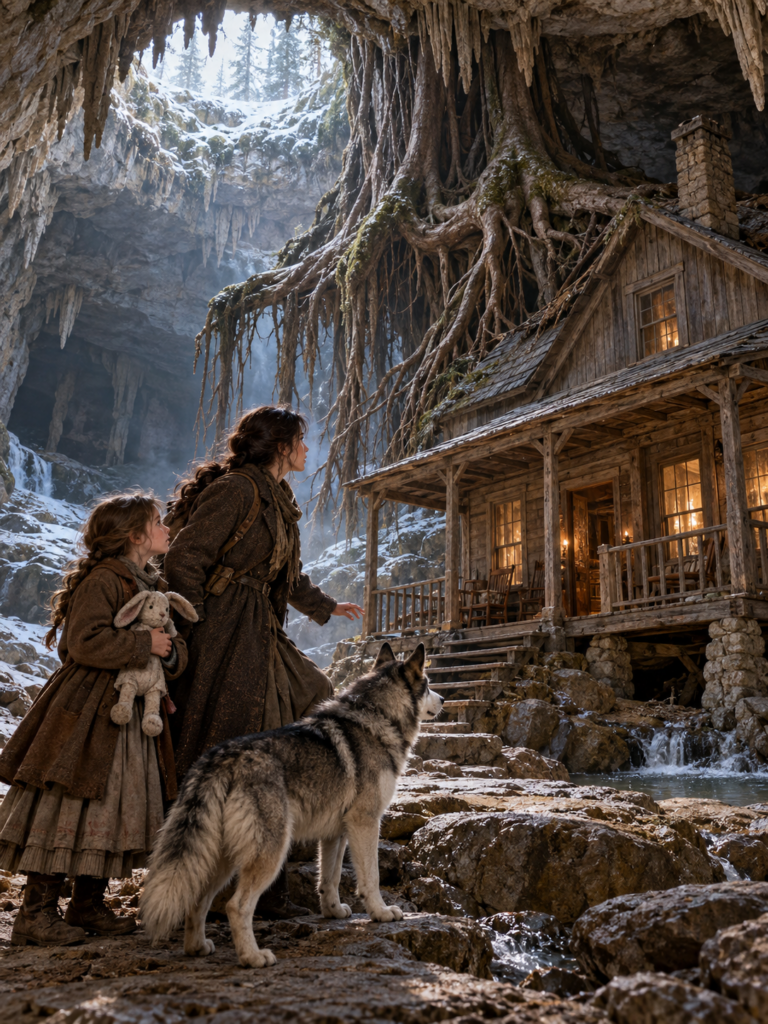
June joined me, her cloth rabbit tucked under one arm.
The first pages contained detailed instructions for the roof, chimney, water pipe, and timber joints.
The writer explained which materials had been used and how to repair them.
His name was Obadiah Morrow.
I recognized the initials.
O.M.
The same letters carved into the kitchen beam.
He had built the house.
But the notebook did not end with him.
About twenty pages later, the handwriting changed.
A woman named Agnes Pallister had begun adding entries during the winter of 1873.
She wrote that her husband had died earlier that year near Powder River.
She had arrived with two young sons and no secure place to live.
They had found the hidden house.
Just as June and I had.
I turned the pages carefully.
Agnes described repairing the eastern window frame and finding better firewood. She noted which parts of the water system needed attention during freezing weather.
Then I found her warning about the north wall.
The same warning I had discovered in the kitchen drawer.
Suddenly, the pieces fitted together.
The original builder had left his construction instructions.
A second occupant had used them.
Then she had added her own knowledge for whoever followed.
I looked toward the bedroom.
The quilt was hers.
She had written about leaving it behind when she departed in the spring of 1874 for her sister’s home in Cheyenne.
June touched the worn fabric beside her.
“She had children?”
“Two boys.”
“Did they sleep in my bed?”
I looked at the quilt.
“I think they may have.”
June was silent for a moment.
Then she pulled the quilt closer.
I continued reading.
Agnes had left dried herbs and household supplies where she thought they might be useful.
She had repaired what she could and recorded what still needed work.
She hadn’t fled the cave.
She had survived the winter and moved on.
That answered one question.
The house had been occupied by more than one family because previous occupants had deliberately left it usable.
But it raised another.
What had happened to the original owner?
I returned to the kitchen cabinet.
During my earlier search, I had noticed a small gap behind the lower shelf of a glass-fronted cupboard.
This time, I examined it.
A folded paper was wedged between the wood and the back panel.
I opened it beside the window.
It was a land survey.
The property description referred to forty acres around Elkhorn Ridge, including the rock formation and nearby creek.
The owner’s name was Obadiah Morrow.
An earlier date appeared on the document, before Wyoming became a separate territory.
A later handwritten note suggested that Morrow had gone to Oregon in 1863 and left the house behind.
I did not know whether the old survey still established ownership.
I did not even know whether the land had been transferred after he departed.
But I knew the house had a documented history.
And I knew that history mattered.
Uncle Gideon had taken our father’s home by placing papers before officials who did not question him closely.
I had learned what documents could do when only one side possessed them.
Now I held papers that might help me establish where June and I had been living.
For several evenings, I read the notebook again.
Then I found something I had overlooked.
A final entry written not by Obadiah or Agnes, but by a child.
Caleb Pallister.
Eleven years old when his family stayed here.
He described a small wooden dog he had carved and left on a bedroom shelf.
I went to the bedroom and searched the far end of that shelf.
There it was.
Four inches tall.
Roughly carved from pine.
The body of a sled dog, with a broad chest and carefully shaped ears.
I carried it to June.
She studied it beside Flint, who tolerated the comparison while resting near the hearth.
“His ears are almost right,” June said.
“Almost?”
She examined the carving again.
Then she smiled.
“Better than the first ones I drew.”
I watched her put the little dog back on the windowsill.
Someone else’s child had once lived here.
He had left something behind because he wanted another person to find it.
That night, I reopened the notebook.
I turned to a blank page after Caleb’s entry and picked up my pencil.
For the first time, I considered adding our own names.
Then Flint rose abruptly beside the doorway.
His ears pointed toward the passage.
A low warning sound escaped his throat.
I set down the pencil and walked toward the entrance.
Outside, fresh snow covered the ground.
Except for a set of men’s bootprints.
They stopped directly outside the narrow crack leading into our cave.
And then turned away.
Someone had come looking.
I knelt to inspect the marks, wondering whether our hidden refuge had already been discovered by the one man who had a reason to take everything from us again.
I followed the bootprints with my eyes until they disappeared around the bend in the cliff.
One man.
He had approached from the east, stopped close to our entrance, and returned the way he had come.
There were no marks showing that he had entered the passage.
I checked the edges of the tracks, then stepped back.
Whoever he was, he had been there recently.
Flint remained beside me, watching the trees.
I had no proof that Gideon Winslow had sent anyone.
But there was no one else I knew who had an obvious reason to search for us.
Gideon had taken Father’s property using documents I had never properly understood.
He had expected two daughters without money to disappear quietly.
Instead, I was alive.
And at twenty-two, I was the adult daughter of the man whose property was being transferred.
My signature was absent from the papers I remembered seeing.
Whether that was legally decisive, I did not yet know.
But it was a question someone might eventually ask.
I went inside.
June was sitting at the kitchen table, drawing with a charred stick.
She looked up.
“Is somebody there?”
“Not now.”
“Do you know who it was?”
“No.”
She waited.
I had learned that June disliked being given comforting explanations that sounded false.
So I told her the truth.
“Someone came near the cave. I don’t know whether he found the opening.”
She glanced toward Flint.
“Do we have to leave?”
I looked around the room.
The fireplace was burning.
The old quilt lay across the bed.
The spring continued running beyond the house.
“No,” I said. “Not because of footprints.”
But I knew hiding was not enough.
If I intended to keep this home, I had to understand the land papers.
That afternoon, I returned to the documents I had found in the cupboard.
The survey described the forty-acre tract surrounding the cave.
Morrow’s name was recorded.
The marginal note suggested that he had departed years earlier.
But the existence of an old document did not prove that the property was currently unclaimed.
I needed more evidence.
And I needed to know what the territorial land office would accept.
I began keeping a list in the notebook.
The original survey.
The property’s occupation history.
Our improvements.
The date we arrived.
The possibility of a homestead filing.
And the location of the nearest land office in Laramie.
I counted the days.
November 3 had marked the beginning of our ordeal.
By early December, we had been living in the cave for approximately a month.
If six months of residence became important, I would need to remain until early May.
That seemed an extraordinary distance away.
Winter had barely begun.
The weeks passed with little comfort.
I collected firewood from deadfall timber and carried it to the cave.
I fished whenever the creek allowed.
I repaired the wooden water pipe, cleaned the house, and examined every section of wall that might fail.
June sorted the nails in the storage room by size.
She arranged rope on pegs and moved useful tools where I could reach them easily.
Sometimes I returned from working outside to discover she had improved something without being asked.
Her drawings also changed.
At first, she had sketched only the cavern and the house.
Now her map included the creek, fishing places, the hawthorn stand, and the routes to fallen timber.
Flint appeared near the fireplace with the shape of his ears repeatedly corrected.
I found myself looking forward to seeing what she had added.
It was the first thing we had created together that wasn’t strictly required for survival.
Then, during another examination of the north wall, I discovered something buried behind the plaster.
I had been removing the weakened material to make a more substantial repair.
Near the floor, my knife struck something that sounded hollow.
Not loose stone.
Not damaged wood.
A deliberately covered cavity.
I removed the surrounding plaster carefully.
Behind a clay plug was a small tin box.
Its lid was sealed with old wax.
Inside lay a folded paper and a five-dollar gold coin dated 1856.
I unfolded the paper beside the fire.
It was another copy of the Morrow land survey.
Not an identical sheet.
The margins and stamp differed.
But the description, boundaries, and owner’s name corresponded to the document I had found in the cabinet.
Obadiah Morrow had apparently preserved two copies of his property record.
One accessible.
One carefully concealed.
I compared them.
The boundaries aligned.
The creek reference matched.
Both included the rock formation containing the cave.
I understood why the house’s location had mattered to the original builder.
The cave provided insulation and access to water, but the property itself also had a recorded description.
Whether that description remained legally useful required verification.
Still, the second document made accidental misreading less likely.
Someone had cared enough about the record to preserve a duplicate.
I placed both papers inside the oilcloth wrapper with the notebook.
Then I hid them beneath the bedroom mattress.
I did not intend to lose important documents merely because I had found them too late to protect Father’s house.
Later, I discovered another message in Agnes Pallister’s handwriting, written on the inside of the notebook’s back cover.
Unlike her other entries, it contained no instructions about plaster, weather, or food.
She had written about the difference between staying somewhere because one had no alternative and staying because one wanted to.
She had arrived desperate.
She had left with a choice.
I sat before the fire for a long time afterward.
I had entered the cave because June was freezing.
That was the truth.
But I had remained because the house was becoming ours through work.
There was another truth as well.
I was afraid Gideon could take it away.
The hidden papers might help prevent that.
By February, the cold had settled so deeply into the mountains that the creek became harder to fish and every outdoor task demanded preparation.
June began singing quietly while she worked.
Sometimes she sang songs our mother had taught her.
Sometimes she hummed melodies I didn’t recognize.
I never interrupted.
I liked knowing she had enough room in her mind for something besides fear.
One morning, while splitting wood near the creek, I looked up and discovered a man watching me.
He stood perhaps thirty yards downhill.
Middle-aged.
A brown wool coat.
A prospector’s pack.
I set the axe against the chopping block.
He introduced himself as Silas Drum.
Then he said he had been offered two dollars by Gideon Winslow to locate a young woman traveling with a child and a gray-white dog.
My stomach tightened.
“So you found me.”
Silas studied the woodpile, the cleaned ground, and the cut timber.
“I found someone who’s been working here awhile.”
“Are you going to tell him?”
He didn’t answer immediately.
Instead, he explained that his real work involved surveying a lignite seam farther north.
Gideon’s offer had been an addition to that assignment.
He seemed more interested in the mineral deposit than in delivering me to my uncle.
Then he made an observation I hadn’t expected.
Gideon wanted my whereabouts in the middle of winter.
If the problem were merely routine paperwork, Silas suggested, waiting for spring would have been simpler.
I had wondered the same thing.
Before leaving, Silas said he had not yet reported finding me.
Then he walked toward the northern ridge.
I returned to the house shaken.
June noticed.
I explained who he was and what he had said.
“Will he tell Uncle Gideon?”
“I don’t know.”
She considered that.
“Then we have to find out.”
I agreed.
The following weeks gave me time to think.
Silas had not reported me immediately, or at least Gideon had not appeared.
The surveyor continued working near the northern seam.
I found signs of his camp and fresh disturbances where he had been taking samples.
In March, I sought him out.
He was working beside exposed rock when I approached.
“You haven’t reported finding us,” I said.
He looked up.
“No.”
“Why?”
He put down his pick.
Then he explained that my occupation of the cave gave me something Gideon had not expected.
A possible land claim.
If the old Morrow documents supported it and the property remained eligible, I might be able to file for the forty acres.
But I would need someone to attest to the work done there.
Someone who could describe the condition of the property and the evidence of sustained occupation.
Silas could do that.
He had been surveying the ridge since January.
He had seen the cut timber, repairs, cleared paths, and accumulated improvements.
Those details would not establish my exact arrival date on their own.
But they could support my account.
“What do you want?” I asked.
He reached into his coat.
A folded agreement lay in his hand.
It concerned access to the northern lignite seam.
If I established the land claim, Silas wanted specified surveying access and a twenty-percent share of any future mineral extraction revenue.
If the claim failed, the proposed agreement would have no effect.
I read every line.
He wasn’t pretending to help without expecting something.
But neither was he asking me to surrender the house.
I had learned from Gideon that documents should never be signed merely because someone appeared confident.
I studied the proposed terms.
Then I agreed to proceed on the arrangement Silas had offered, subject to the claim being established.
He would serve as my witness.
I would pursue the filing in May.
For the first time since Father died, I had found an ally who was willing to put his own name beside mine.
When I returned, June had reorganized the entire storage room.
Tools were arranged according to use.
The rope was coiled.
Nails were sorted into three small tins.
She explained her decisions without seeking praise.
I looked at the nine-year-old who had walked through the storm beside me.
She had begun to treat the house as something she could improve, not merely somewhere she could hide.
In the third week of March, she developed a fever.
It wasn’t severe at first, but I watched her carefully.
I kept her warm, offered water, and used the supplies and household knowledge available to me.
By evening, she was improving.
During the day, she asked for the old notebook.
I hesitated.
Its pages contained the work of people who had lived there long before us.
Then I remembered Caleb’s entry.
He had been only eleven when he left his wooden dog.
I handed June the book.
She drew an interior view of the cave.
Not a map this time.
A picture of the house standing beneath the ponderosa roots, with daylight falling through the ceiling fractures.
Her proportions were remarkably careful.
Beneath the drawing, she wrote her initials and the year.
1883.
Then she added a short account of being sick there and recovering.
I looked at it for a long time.
Obadiah had contributed construction knowledge.
Agnes Pallister had added repairs and household observations.
Caleb had left a child’s memory.
Now June had joined them.
She hadn’t waited to become an adult before adding something useful.
When April arrived, the snow began retreating.
I spent the month repairing everything I could before going to Laramie.
I strengthened the storage shelves.
Repaired the roof.
Reworked sections of the water pipe.
Checked the north wall.
And counted the days until May 3.
On May 2, I went to Silas’s camp.
“Tomorrow,” I said.
He nodded and began packing his papers.
That evening, I explained the plan to June.
I would travel to Laramie, present the land documents, and ask about filing a claim.
I told her where the supplies were, how to manage the fire, and what to do if a stranger approached while I was away.
Flint remained beside her.
She listened to everything.
Then she asked one question.
“If they say we can’t keep it, will we have to leave?”
I looked toward the little wooden house.
I thought about the years of labor that had gone into building it before we were born.
I thought about the women and children who had found shelter there.
I thought about the records waiting beneath the mattress.
And I thought about my uncle, who had already taken one home from us.
“I won’t give it up without finding out what the law actually says.”
Early the next morning, I took the documents and met Silas on the trail.
We walked toward Laramie.
By afternoon, I stood before a land-office counter, holding two old surveys and nearly six months of work.
The clerk examined the papers.
He began comparing the property description with the territorial records.
And I waited to learn whether the house that had saved us could finally become the place we were allowed to call home.
The clerk laid Obadiah Morrow’s documents beside each other and examined the stamps.
For several minutes, he said nothing.
Silas Drum stood slightly behind me.
I could hear the movement of wagons outside the land office and the occasional creak of the floorboards beneath someone’s boots.
The clerk read the survey boundaries.
He checked the description of the creek and ridge.
Then he turned toward the shelves of official registers behind him.
I tried not to shift my weight.
Everything I had spent the winter protecting seemed to depend on whether the papers before him meant what I hoped they meant.
At last, he closed the register.
“The property has an unusual history,” he said.
I held my breath.
The survey referred to an earlier claim made by Obadiah Morrow before Wyoming’s territorial organization.
The clerk explained that he could find no later transfer or active registration establishing someone else’s present ownership.
According to the records available to him, the parcel could be considered for a homestead filing.
I stared at him.
“So I can apply?”
“You can begin the filing process.”
He asked when I had occupied the land.
“Early November.”
“Have you maintained residence?”
“Yes.”
“Made improvements?”
I explained the repaired roof, restored water system, strengthened walls, and other work completed during the winter.
He wrote as I spoke.
Then he asked whether anyone could support my account.
Silas stepped forward.
He presented a written statement describing what he had observed while surveying the ridge.
He could not personally attest to my presence before January.
He made that clear.
But he had seen substantial work that was consistent with longer habitation, and he had continued observing the property through the following months.
The clerk examined the statement.
Then Silas produced his surveyor’s credentials.
The clerk looked at them carefully before returning to the papers.
His questions became more specific.
What did the eastern entrance look like?
Where was the creek relative to the house?
Which improvements had existed when Silas first surveyed nearby ground?
What had changed by spring?
Silas answered without exaggerating.
I found myself grateful for his restraint.
He never claimed to have witnessed something he had not seen.
He distinguished his direct observations from what I had told him.
That made his statement more useful, not less.
The clerk finished his notes.
Then he prepared a filing document using the property description from the old surveys.
He asked my full name.
“Petra Anne Winslow.”
He recorded it.
He entered the boundaries of the forty-acre parcel.
Then he reviewed the statements about residence and improvements.
Finally, he stamped the papers and slid a copy across the counter.
My hands were shaking when I picked it up.
He explained that the filing would require the appropriate countersignature and remain subject to a sixty-day confirmation period.
It was not the end of every possible legal question.
But it was an enormous difference from the position I had occupied in November.
My name was now attached to an official claim.
For the first time, I had paperwork that could be used to defend our continued residence rather than take it away.
I looked at the document.
Then the office door opened.
A familiar voice spoke from behind me.
“What’s going on here?”
I turned.
Gideon Winslow stood in the doorway.
He was dressed better than when I had last seen him.
His coat was newer.
His boots were polished.
But his expression changed when he saw the stamped paper in my hand.
He looked at Silas.
Then at the clerk.
Then back at me.
“What is she filing?”
The clerk answered.
“A homestead claim.”
Gideon’s face hardened.
“She has no right to make one.”
The clerk studied him.
“On what grounds?”
Gideon pointed toward me.
“She’s a child.”
“I’m twenty-two,” I said.
The clerk confirmed that my age was recorded in the application.
Gideon changed his argument.
He claimed that mineral rights in the northern ridge might already be involved in another transaction.
Silas spoke before I could answer.
He identified himself as the surveyor working the northern seam.
Then he stated that no such filed mineral claim had been established in the records relevant to his work.
Gideon stared at him.
Something passed between the two men that I did not fully understand.
But Silas remained calm.
And Gideon seemed to realize he would not be able to contradict the surveyor without providing evidence.
Then Gideon tried another approach.
He mentioned Father’s property in Sweetwater County.
He suggested that because I had left during an unresolved transfer, my position might affect my right to acquire another tract.
The clerk looked up sharply.
“What transfer?”
Gideon began explaining that Father’s house had been transferred through the county office.
The clerk asked for the supporting documentation.
Gideon said the paperwork had been processed.
The clerk asked whether it included the necessary signature of the adult heir.
The room became very quiet.
I felt the old anger returning.
I remembered standing outside Father’s house while Gideon told us to leave.
I remembered the documents he had waved before me.
The unfamiliar signatures.
The way he had spoken as though asking questions was pointless.
I had never seen the complete legal basis for what he claimed.
Now an official was asking questions Gideon could not dismiss simply by raising his voice.
The clerk reached for his pen.
He asked again about the signatures.
Gideon hesitated.
Then he gave an incomplete answer about the Sweetwater County office.
The clerk said the matter would need to be checked against the records held there.
He intended to write requesting the relevant documents.
Gideon’s expression changed.
For several seconds, he stood without speaking.
Then he turned and left.
No dramatic confession.
No admission that the papers were false.
No announcement that Father’s house would be returned.
Only an official inquiry into a transfer that had never been adequately explained to me.
I watched the door close.
The clerk recorded the exchange.
Then he told me my new filing would continue through its normal process.
I looked down at the claim.
Gideon had not succeeded in stopping it.
The clerk’s inquiry did not yet settle what had happened to our former home, but it meant that Gideon’s assertions were no longer going unquestioned.
I had gained something I hadn’t possessed when Father died.
A record.
An official process.
And an opportunity to speak for myself.
Outside, Laramie’s streets were busy with the ordinary work of a spring afternoon.
Wagons moved through the mud.
A man called to his horses.
Somewhere nearby, metal rang beneath a blacksmith’s hammer.
The world had not changed for anyone else.
For me, it had.
Silas stood beside me on the porch.
He explained that he would follow up with the deputy recorder regarding the countersignature.
I thanked him.
He nodded.
Then we spoke briefly about our proposed agreement concerning the northern lignite seam.
He remained interested in his survey work.
I remained determined to protect the house.
There would be documents to examine and questions to resolve before either of us undertook anything beyond the terms already discussed.
But our understanding had given me help when I needed it most.
Silas went toward the recorder’s office.
I placed my copy of the claim inside my coat.
Then I began walking back toward Elkhorn Ridge.
The journey was long.
Spring mud clung to my boots.
Several times, I stopped to drink water and rest.
But I was no longer walking away from a home.
I was walking toward one.
That difference grew clearer with every mile.
I thought about our first night beneath the fallen pine.
About June shivering beside me.
About Flint stopping before the crack in the rock.
About the impossible sight of a wooden house standing beneath the roots.
And about all the people who had helped preserve it without knowing our names.
Obadiah Morrow had built the house with care.
He had documented its construction.
He had preserved land records.
Agnes Pallister had arrived a decade later with two sons and little security.
She had repaired the house, added her own observations, and left useful belongings behind when her family moved on.
Caleb had left a carved wooden dog.
Now June had added a drawing to the notebook.
Their stories were not identical.
Nor did I know everything about them.
The records did not explain every choice, every journey, or every hardship.
But they showed enough.
Each household had made practical decisions that helped the next.
The documents had survived because someone believed they were worth preserving.
The house had survived because people kept maintaining it.
And we had survived because the door had remained open.
By the time I reached the cliff, evening sunlight was filtering through the trees.
I entered the narrow passage.
The familiar smell of stone and pine needles met me.
Then I emerged into the great cavern.
Light fell through the cracks high overhead.
The wooden house stood exactly where it had stood when I first saw it.
But it no longer looked impossible.
It looked familiar.
Flint came down the porch steps to greet me.
He pressed his broad head against my hand, then turned toward the doorway.
June was waiting at the kitchen table.
Her cloth rabbit lay beside a piece of pine board.
She looked up as I entered.
I could see the question on her face.
I removed the claim from my coat.
She took it with both hands.
She read slowly, sounding out some of the official language beneath her breath.
Then she reached the line naming the claimant and the property.
Petra Anne Winslow.
Elkhorn Ridge.
Forty acres.
She looked at me.
“Does this mean we can stay?”
I sat opposite her.
“The filing has been accepted. There are still steps before it’s completely confirmed.”
June considered that.
“But they didn’t send you away?”
“No.”
“And Uncle Gideon?”
“He couldn’t stop the filing.”
She looked back at the paper.
For months, every plan we made had rested on uncertain ground.
Now we possessed a formal claim to the place we had maintained.
June laid the document carefully on the table.
Then she asked the question I had been waiting for.
“Do you want to live here?”
I looked at her.
It was such a simple question.
Yet I realized I had spent the entire winter trying to answer it without knowing that was what I was doing.
At first, the cave had been the only place we could survive.
Then it became the place where we worked.
Later, the place we feared losing.
Now, when I imagined leaving, I felt no longing for the streets of Sweetwater County.
I remembered Father’s house with affection.
I remembered Mother’s lamp.
I remembered the garden and the small repairs we had made together.
But I did not want to return merely because the old house had once belonged to our family.
I wanted June to grow up somewhere she felt secure.
Somewhere she could learn and build and discover things without worrying that another adult would suddenly declare she had no right to be there.
I looked around our kitchen.
The repaired water pipe.
The shelves.
The fireplace.
The drawing of Flint on the wall.
The little cloth rabbit beside June’s hand.
“Yes,” I said. “I want to stay.”
June nodded, satisfied.
Then she picked up her drawing board.
“I want to make a better picture of the house.”
I smiled.
“What’s wrong with the old one?”
“The roof isn’t right.”
I looked at the drawing.
She had already corrected Flint’s ears three times.
Now she was dissatisfied with the roof.
“Then fix it.”
She examined the wall beside the kitchen map.
“I think I’ll draw it there.”
“On the wall?”
“So we can see it properly.”
I followed her gaze.
There was space beside the map she had been developing since December.
I had watched that map grow from a rough sketch of the cavern into a detailed record of our surroundings.
She had marked the spring, the creek, and the timber.
She had included fishing places and routes through the trees.
It was more useful than anything I could have drawn myself.
Now she wanted to record the house as it stood inside the great chamber.
I thought of the people whose work surrounded us.
Then I handed her the charred drawing stick.
“Go ahead.”
She began sketching.
First the broad outline of the cavern.
Then the house.
The porch.
The roof.
And finally the thick roots hanging from the ceiling above it.
I watched her work for several minutes.
Her concentration reminded me of Mother.
Mother had always known how to look closely at something and notice what needed correcting.
June had inherited that skill.
She had also inherited Father’s patience with difficult tasks.
I realized that much of what I thought had been lost with our parents was still present.
In the way June held her pencil.
In the way she organized tools.
In the way she refused to settle for a drawing that didn’t match what she saw.
Later that evening, after supper, I returned to the notebook we had found behind the storage shelf.
I placed it on the kitchen table.
Its cover was worn.
The corners had softened.
Its pages carried the work of several people across more than two decades.
The earliest entries belonged to Obadiah Morrow.
Precise descriptions of building materials and methods.
Reasons for choosing particular timber.
Instructions for maintaining the chimney and water system.
I looked at the date carved into the kitchen beam.
1859.
Obadiah had built something extraordinary.
Yet the extraordinary part was not that he had constructed a wooden house inside a cavern.
It was that he had left instructions explaining how to keep it standing.
He could have kept that knowledge to himself.
Instead, he had written it down.
When Agnes Pallister arrived with her boys, she was able to use those notes.
She corrected damaged seals and identified useful supplies.
And before leaving, she recorded the weaknesses she had not managed to repair completely.
Caleb added something different.
Not a building technique.
Not a land record.
A small handmade dog.
Its presence said that a child had lived there long enough to learn a skill and leave evidence of it.
I thought about finding that carving.
About June turning it in her hands.
About how carefully she had compared it with Flint.
Those were the discoveries that made the house feel less abandoned.
Not the dates alone.
Not the official papers.
But the signs that ordinary people had once been alive there.
I turned to the pages we had added.
There was June’s drawing of the cavern.
Her initials.
Her account of recovering from her fever.
I smiled at the careful letters.
Then I found my own entry from February.
I had written that we were still there and had not yet decided what the place would become.
At the time, it had been an accurate description.
I hadn’t known whether Gideon would find us.
I hadn’t known whether the records were useful.
I hadn’t known whether we could survive the remainder of the winter.
And I hadn’t known whether I had the right to choose this place for our future.
Now I took out the pencil.
I drew a line through that old uncertainty.
Not because it had been foolish.
Because I no longer lived inside it.
Beneath the entry, I wrote the May date.
I recorded that the homestead claim had been filed.
I noted that Silas Drum had supported the application with his observations and credentials.
I described the repairs completed during the final months of winter.
The north wall.
The roof.
The water pipe.
The strengthened shelves.
I recorded where the important documents were kept.
And I noted that the claim still awaited confirmation.
I did not want the next person to mistake a filing for an unquestionable final title.
I had learned the cost of making assumptions about property records.
Then I looked toward June.
She was still drawing.
“How’s the roof?”
“Almost finished.”
I added one more entry about the drawing she was making on the kitchen wall.
Not because it would help establish our claim.
Because it was another record of how the house had changed while we lived there.
When I finished, I read back through the page.
It was not a grand account.
There was no language about destiny or hidden riches.
Just dates, work, records, and the names of people who had helped.
That seemed appropriate.
The house had survived because previous occupants recorded what mattered.
I wanted our contribution to be as useful.
I closed the notebook.
For months, I had kept it beneath our mattress, afraid someone might take it.
That had been sensible while our circumstances were uncertain.
But I no longer wanted the history of the house hidden where it could easily be forgotten.
I carried it to the storage room.
June had arranged the shelves with careful attention.
Tools occupied the lower section.
Rope hung from pegs.
Small tins held nails.
Two unused hinges lay on the middle shelf.
I placed the notebook beside them.
Then I wrapped the Morrow surveys in oilcloth and set them with it.
The tin box went beside the documents.
The old five-dollar coin remained inside.
It had been left there for a reason I could not establish.
Perhaps it was a reserve for some future need.
Perhaps it belonged with the original papers.
Whatever its purpose, I saw no reason to separate it from the record of the house.
I stood in the storage room for a moment.
Then I returned to the kitchen.
June had almost finished her wall drawing.
The roofline was carefully angled.
The porch steps were proportioned correctly.
Above the house, she had drawn the ponderosa roots hanging through the cavern ceiling.
She had even represented the pale openings where daylight entered the rock.
I was astonished by how accurately she had captured the place.
She pointed toward the unfinished corner.
“Flint goes here.”
The dog lifted his head at the sound of his name.
June smiled.
“And I’m fixing his ears properly this time.”
I laughed.
It was an easy laugh.
The kind that had once seemed impossible when I stood outside Father’s house in the snow.
That night, we ate beside the hearth.
The old quilt remained on June’s bed.
Caleb’s wooden dog stood on the bedroom windowsill.
The spring continued running through the cavern.
The wooden pipe carried water toward the kitchen, though I knew I would have to maintain it as seasons changed.
Nothing about our new life was effortless.
The house still needed repairs.
We still needed food, fuel, and supplies.
The filing still needed to pass through its confirmation process.
And the Sweetwater property matter remained unsettled.
But those were problems I could name.
I had learned that naming a problem was often the first step toward doing something useful about it.
June fell asleep before the fire burned low.
Flint settled near her doorway.
I remained at the table, listening to the ordinary sounds of the house.
The occasional movement of timber.
The small sound of water.
The soft breathing of the dog.
I thought about Uncle Gideon.
For months, I had imagined the moment when I might confront him again.
I had pictured telling him what he had taken from us.
I had pictured demanding explanations.
But the encounter in Laramie had not gone the way I expected.
I had stood before a clerk with documents of my own.
Gideon had arrived assuming his words would settle everything.
And for once, someone had asked him to support his claims.
The outcome of the old property transfer was still unknown.
I would not pretend otherwise.
Yet I had stopped being the young woman standing silently while someone else decided where she belonged.
That was a change no paper could entirely explain.
I looked at the wall drawing.
June had included the narrow entrance passage.
It was the smallest part of her picture.
A thin line connecting the vast cavern to the outside world.
I remembered forcing myself sideways through that crack while holding her hand.
I remembered how frightened I had been.
At the time, I thought we were entering the only shelter available to us.
I had no idea that the house represented years of work by people who had faced their own losses.
A builder who had left his knowledge behind.
A widow who had repaired what she could.
A boy who had carved a wooden dog.
And now two sisters who had arrived with almost nothing.
The house had not been waiting specifically for us.
That wasn’t its secret.
Its secret was that people who would never meet had cared enough to leave something useful for one another.
The first owner had built it.
The second family had maintained it.
And because of their choices, we had survived.
I stood and adjusted the fire.
Then I walked to the doorway and looked into the great cavern.
The light from our windows fell across the stone floor.
High above, the roots disappeared into darkness.
Somewhere beyond the cliff, the spring night was settling over the mountains.
I returned inside and closed the door.
Not to shut anyone out.
Simply to keep the warmth in.
Before going to bed, I glanced once more at the storage room shelf.
The notebook was visible.
The papers were protected.
The tin box rested beside them.
Whoever eventually needed that information would not have to begin by tearing apart the house.
I thought of Obadiah’s inscription on the kitchen beam.
He had built the place with future occupants in mind.
At last, I understood what I wanted to leave behind.
Not a claim that I had solved every difficulty.
Not a story about how brave I had been.
A sound house.
Useful instructions.
Accurate records.
And evidence that we had cared for what others had entrusted to us.
From the kitchen came the faint scrape of June adding one final line to her drawing.
I walked back to see.
She had finished Flint’s ears.
They were round.
Exactly as she wanted them.
The roof was right.
The porch was right.
And for the first time, the house in her drawing looked as though it belonged naturally inside the mountain.
June stepped away from the wall.
“Now whoever comes after us will know what it looked like,” she said.
I put an arm around her shoulders.
“Yes,” I answered. “They will.”
Then I looked around the little wooden house.
The fire was steady.
Flint was asleep.
Our claim had been filed.
And June was already deciding what useful thing she would make next.
We had come to the mountain because we had nowhere else to go.
We stayed because, at last, we had found somewhere we wanted to be.


