
The hatchet struck the wooden kingpin with a sharp crack.
Sarah pulled the blade free and swung again.
On the third blow, the damaged fitting gave way. The front axle loosened beneath the wagon, and its iron hardware dropped against the frozen ground.
She crawled underneath, working at the remaining connections while the enormous clouds rolled closer.
The wagon was no longer something she intended to drive.
It was becoming building material.
And every minute spent taking it apart was a minute the approaching storm could use against her.
She separated the wooden bed from the running gear, removed the damaged sideboard and tailgate, and pried away two heavy floor planks.
Even lightened, the bed weighed far more than she could comfortably move.
She stood looking at it, breathing hard.
Her father’s lessons had always begun with one question.
Not whether a task was difficult.
Whether there was a better way to use what was already available.
Sarah studied the ground.
From the ridge, the prairie sloped gradually toward the sandstone bluffs.
She took the long coil of hemp rope, threaded it through the wagon bed’s front stake pockets, and arranged the ends across her shoulders.
Then she leaned forward.
Nothing happened.
She lowered herself farther, boots slipping against the frozen grass.
The rope tightened painfully across her chest.
For one terrible moment, she thought she had sacrificed the wagon for nothing.
Then the bed shifted.
A low scraping sound came from beneath it.
The wood moved several inches.
Sarah pulled again.
Slowly, the wagon bed began sliding downhill.
She dragged it in short, exhausting stages, pausing only long enough to recover enough strength for another pull.
Twice it caught against buried stones.
Twice she dropped to her knees and freed it.
By the time she reached the sandstone, her palms were split and her shoulders trembled.
The first snow was already falling.
She hauled the bed across the hollow’s entrance and wedged it against irregularities in the stone.
Then she stepped back.
Her stomach tightened.
The wooden bed was only about ten feet long.
The hollow’s mouth was eighteen feet wide.
She had closed the middle, but approximately four feet remained open on either end.
And there was still an opening above the wood, beneath the overhang.
Sarah remembered what her father had said about coastal shelters.
A wall could be substantial and still fail if the wind found a passage around it.
She had not escaped the storm merely by reaching the hollow.
She had brought herself to a place where survival might be possible.
Now she had to finish making it so.
She hurried back toward the abandoned running gear and gathered what she could carry.
Canvas.
Loose boards.
Rope.
Anything that might cover an opening.
She stretched the canvas between the wagon bed and the rock overhead, fastening it with rope and weighting its edges wherever the stone allowed.
Then she gathered dry grass from below the bluff and stuffed it into the gaps along both sides.
She used a flat stone to drive the bundles deeper.
She packed sand beneath the wooden bed, filling the openings where the uneven ground prevented the bottom from sitting flush.
When the canvas sagged, she used one of her wool blankets to close the remaining space.
The light outside was fading unnaturally fast.
Sarah could no longer see the distant ridge.
The storm was nearly upon her.
She looked toward the mule, still trembling beside the juniper.
She could abandon it outside and preserve the small space for herself.
Or she could bring it inside and risk having a terrified eight-hundred-pound animal destroy the wall she had just built.
For a moment, she remembered Cole Briggs offering to buy it.
Then she remembered Thomas, years earlier, leading the mule home when their future had still seemed generous.
Sarah went to the juniper and untied the rope.
She guided the animal through the remaining narrow opening, bringing it sideways into the sheltered recess.
The mule pressed against the back wall, trembling but obedient.
Sarah took her second blanket and began fastening it across the final gap.
Outside, the first powerful gust struck the sandstone.
The canvas pulled tight.
The loose grass shifted.
And Sarah realized that she had made a decision more dangerous than destroying the wagon.
She had closed herself inside a shelter with no proper doorway.
If the wall failed, the wind would find them.
If the wall held and snow buried the entrance, she might not be able to get out.
With the darkness deepening around her, Sarah reached for the last exposed seam and pressed the final handful of grass into place.
The last handful of grass disappeared into the gap between the wagon bed and the sandstone.
Sarah drove it deeper with the heel of her hand.
Then she withdrew her fingers and listened.
For one brief instant, the hollow was almost silent.
The mule stood behind her, breathing hard. Her own breath sounded loud inside the cramped enclosure.
And beyond the makeshift wall, something enormous was approaching.
Sarah lowered herself against the rear stone face.
She had no stove.
No fire.
No lantern she dared depend upon.
Only the wool she wore, the remaining supplies she had managed to bring inside, and the living animal standing close enough to touch.
She pressed a bleeding palm against the sandy floor.
Everything she owned that might have carried her to Buffalo was either broken on the ridge or built into the shelter.
The decision could not be reversed now.
Then the storm arrived.
At first, Sarah heard a deep vibration through the rock, almost too low to identify as sound.
A moment later, the canvas snapped tight.
The roar came so suddenly that she covered her ears.
The wooden wagon bed shuddered.
Sand trembled beneath her hand.
The mule stamped against the stone, and Sarah heard its frightened breathing rise sharply.
Outside, snow and wind struck the sandstone with such force that the sound filled every corner of the hollow.
She could not tell whether the gusts came from one direction or several.
They battered the wall, fell away, and returned.
The canvas strained against its ropes.
Sarah closed her eyes and tried to remember the order in which she had made each fastening.
She had no light with which to examine them.
If something failed, she would have to find the damage by touch.
That realization settled heavily in her chest.
She had built quickly.
She had used damaged materials.
And she had no way of knowing whether the structure could endure an entire night.
She placed one hand against the mule’s flank.
The animal was warm beneath its winter coat.
Its breathing was rapid, but the pressure of her hand seemed to reassure it.
“Steady,” she whispered.
The wind screamed across the opening.
Sarah began counting her breaths.
Four while drawing air into her lungs.
Four while letting it leave.
It was something to control when everything outside her reach had become uncontrollable.
She had kept the rhythm for what felt like forty minutes when a sharp sound broke through the storm.
A knot snapped loose.
The upper corner of the canvas tore away from the sandstone.
Cold air drove into the hollow.
Fine snow sprayed across her face, and the blanket overhead began whipping against its stones.
Sarah threw herself forward.
She crossed the floor on her hands and knees, keeping her head low as the air swept through the opening.
Her fingers found the sideboard.
She followed its edge until she reached the loose rope.
The hemp whipped against her wrist.
She caught it, pulled it down, and searched for the stake pocket where she had originally secured it.
Her hands were so numb that she could scarcely distinguish the rope from her clothing.
She tried once to make the knot.
It slipped.
The canvas rose again.
A fresh blast of snow struck her neck.
Sarah forced herself to stop pulling blindly.
She remembered the movements Anders had taught her beside his workbench.
A fastening did not become reliable because someone pulled on it angrily.
It became reliable because the rope was properly led and the knot correctly formed.
She threaded the loose end through the stake pocket.
Then she secured it with two careful half hitches.
The canvas tightened.
The opening closed.
The rushing air diminished.
Sarah stayed crouched against the wooden wall, breathing through her teeth.
For the first time, she understood how little margin remained between her shelter and the storm.
The wind did not need to tear the entire structure apart.
One failed corner was enough.
She crawled back toward the mule.
The animal pressed its shoulder against her as she settled beside it.
She had barely regained her breathing when the canvas failed again.
The same corner.
The same terrible rush of air.
Sarah did not hesitate.
She crawled forward, found the fastening, and worked it tight once more.
This time she checked the rope’s position before retreating.
When she returned to the rear wall, her hands were stiff and aching.
She tucked them beneath her arms and tried to restore enough warmth to move her fingers.
Then the mule panicked.
A violent gust struck the bluff.
The animal lurched sideways, driving its weight into the wooden wagon bed.
The entire barrier shifted.
Sarah heard the scrape of wood against stone.
For an instant, she thought the wagon bed would slide free and open the hollow to the blizzard.
Instead, the lower edge caught against an uneven place in the rock floor.
The wall stopped moving.
The mule stumbled back and stood trembling.
Sarah held herself motionless, listening for the renewed whistle of air.
She could not hear one.
Slowly, she reached toward the lower seam.
The packed sand had shifted slightly, but the barrier remained in position.
She pressed the loose material back where it belonged.
Then she returned to the mule and rested her forehead against its neck.
“You must stand,” she murmured.
The animal could not understand the instruction, but her voice gave it something familiar amid the noise.
Sarah spoke quietly until its breathing began to settle.
Then she sat down again.
She had expected to fight the wind.
She had not expected to spend the night repeatedly repairing a structure that could be destroyed by a single frightened movement.
The thought of Cole Briggs returned.
He had planned to drive toward Decker’s station, trusting his horses to keep ahead of the storm.
Sarah wondered where he was now.
Perhaps he had reached safety.
Perhaps he had found another sheltered place.
She could not know.
But sitting in the hollow, she could understand why someone might choose speed over stopping.
Running offered the feeling of progress.
Sitting still while a blizzard battered the walls required trusting something far less satisfying.
It required believing that the shelter was doing work she could not see.
Another gust struck.
Sarah reached for the side seam.
And this time she noticed something unexpected.
The narrow draft she had felt earlier was gone.
She moved her hand slowly along the grass-packed gap.
The loose stalks had stiffened.
Moisture trapped among them had begun freezing, binding the fibers together.
She pressed against the seam.
It no longer yielded as easily beneath her fingers.
She checked a second place.
There too, the material had hardened.
Wind-driven snow had lodged in some of the smallest outside openings and frozen against the packed grass.
Sarah listened.
The faint whistle that had troubled her since the wall was built had disappeared.
She moved toward the lower edge of the wagon bed, where the sand had been imperfectly packed.
That gap seemed to be closing as well.
The same storm that had been driving cold air through the smallest openings was helping fill them with ice and compacted snow.
Sarah felt a strange, exhausted relief.
The shelter was not necessarily safe.
A stronger gust could still tear away the canvas.
The mule might panic again.
The temperature remained dangerous.
But the first major weakness she had feared—the steady passage of wind through her hurriedly packed seams—was becoming less severe.
She had not made an impregnable wall.
She had made a wall the storm could reinforce.
Sarah leaned her shoulder against the sandstone.
She could feel the wind striking the outer surface, yet the air around her face was comparatively still.
The distinction was extraordinary.
Outside, the storm remained violent.
Inside, she could finally hear the mule’s breathing between the gusts.
Her father had taught her to use the landscape, but this was the first time she had seen his lesson carried so far.
The shape of the hollow had provided three walls.
Her destroyed wagon had provided the fourth.
And the snow, once feared only as an enemy, was now gathering around the structure and reducing its exposure.
The understanding should have comforted her completely.
Instead, it brought another realization.
The drifts were accumulating outside the entrance.
The more deeply the snow buried the wall, the less wind would reach it.
But every additional foot might also make escape harder.
Sarah studied the darkness where the final opening had been closed.
She imagined the morning.
A roof of frozen canvas.
A wall she could no longer move by hand.
Snow packed against its outer face.
There was no proper door.
And she had used nearly all her strength getting inside.
She reached toward her belt.
The hatchet was still there.
She removed it and placed it carefully beside her, where she could find it without searching.
If morning came, she would have to cut her way out.
Then she rested against the mule.
The wind settled into a deep, uninterrupted roar.
For the first time since she had left the mining claim, there was no work urgently demanding her attention.
No creditor waiting.
No road to travel.
No wagon to repair.
No immediate opening to close.
And into that stillness came the memory she had been avoiding since Thomas died.
The morning she had warned him about the mine.
The timbers she had touched.
The weakness she had recognized.
And the smile with which he had dismissed her.
She remembered standing at the shaft entrance, telling him the supports would not carry the weight above them.
He had refused to stop.
They were close, he insisted, to finding enough silver to recover everything they had lost.
Sarah had watched him descend.
Later, while she was hanging washing outside their cabin, the mountain shook.
She had run toward the claim.
By the time she arrived, the entrance was buried beneath fallen rock.
Thomas was gone.
And now, inside the sandstone hollow, Sarah finally admitted the thought she had punished herself for having.
She had known the mine was unsafe.
She had warned him.
And she had been right.
She began to cry.
Not because she wanted to be right.
Because she had loved him, and knowing the danger had not given her the power to save him.
She cried until her chest ached and her breathing became uneven.
The mule shifted beside her.
She rested one hand against its warm coat.
Gradually, the weeping passed.
She took a small piece of hardtack from her satchel and forced herself to eat.
Her body needed food, whatever her heart might be doing.
Afterward she drank sparingly from the water she had kept close to her clothing.
The hours passed without any reliable measure.
The storm grew quieter, not because the wind had necessarily weakened, but because the accumulating snow increasingly insulated the shelter from the noise.
Sarah realized she was being buried.
She pressed one hand against the frozen canvas.
It had become rigid overhead.
The shelter felt more solid than when she entered it.
That was the answer to one danger.
And the beginning of another.
She drew the hatchet closer.
Then she leaned against the mule, pulled her knees toward her chest, and fought to keep her eyes open.
She tried remembering the names of the boats her father had built.
She imagined the work she would do at Lars’s farm.
She counted her breaths.
But exhaustion gradually overcame every effort.
Her eyes closed.
Her hand slipped from the hatchet handle.
And Sarah fell asleep inside the sealed hollow, unable to know whether the next time she opened her eyes would be in darkness, daylight, or not at all.
Sarah woke because something warm was moving against her shoulder.
For several moments, she could not understand where she was.
There was no light.
No recognizable sound.
Only a deep darkness that seemed to have no boundary.
She tried to move and felt pain in her back, her shoulders, and the soles of her feet.
Then the warmth beside her shifted again.
The mule.
She reached out and touched its flank.
The animal was breathing steadily.
Sarah pressed her hand into its thick coat and listened to the slow movement of its ribs.
She was alive.
The thought came without excitement.
It was too large to feel all at once.
She remained against the animal until she could move her stiff hands.
Then she listened to the hollow.
The violent roar was gone.
Something faint murmured beyond the rock, but the canvas no longer snapped or strained.
Sarah reached toward the wall.
The wood was cold and dry.
She touched the canvas overhead.
What had been flexible material the afternoon before was now stiff with ice.
She pressed harder.
It did not move.
The structure had survived.
And that meant the storm had probably passed.
Sarah searched for the hatchet beside her.
Her fingers closed around the familiar wooden handle.
She drew it into her lap.
The next problem was waiting.
The wall had protected her by remaining closed.
Now she needed it open.
She moved toward the end where she had brought the mule inside, tracing the wagon bed with her hand until she reached the frozen grass that filled the opening.
She struck carefully with the hatchet.
A chunk of ice-bound material broke loose.
She pulled it inward and set it aside.
Then she struck again.
The grass had hardened so thoroughly that it resisted like compacted earth.
Sarah worked slowly, protecting the canvas and avoiding blows that might collapse the snow outside into the hollow.
After several minutes, a narrow opening appeared.
Cold air entered.
It smelled clean and unfamiliar after the stale warmth of the enclosed space.
The mule lifted its head behind her.
Sarah leaned closer.
Through the gap she could see a faint gray brightness.
Daylight.
She felt tears rise but did not let herself stop working.
The mule pressed forward.
“Easy,” she said.
Her voice was rough from cold and disuse.
The animal lowered its head toward the opening.
Sarah braced herself against its neck.
“Not yet.”
She enlarged the gap with short, deliberate strokes.
When there was enough space, she looked outside.
The landscape had vanished.
The ridge where she had abandoned the wagon’s wheels was buried.
The trail was gone.
The grass, the shallow drainage, the stones she had passed the previous morning—all had disappeared beneath wind-shaped snow.
The drift against her wagon-bed wall rose nearly to the upper rail.
From outside, she realized, the shelter would be almost invisible.
Snow had banked against the wood and blended into the sandstone.
A traveler passing nearby might see only a natural hollow filled with drift.
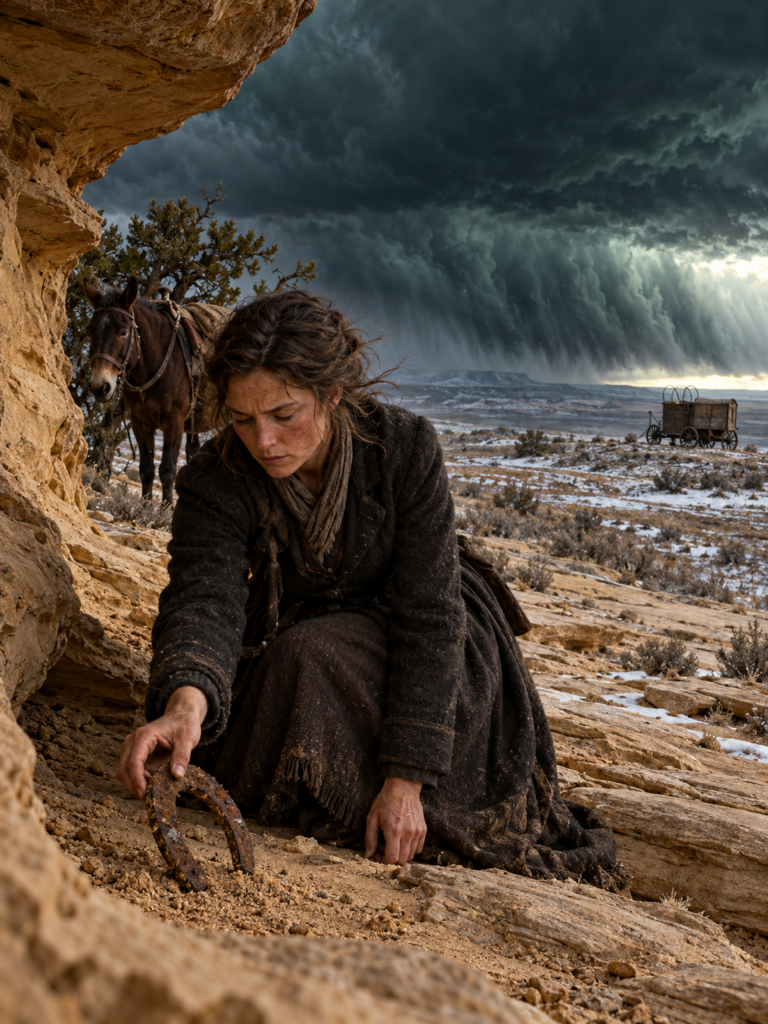
Sarah remembered the rusty horseshoe she had found before the storm.
For a moment she wondered whether its unknown owner had once faced something similar.
Perhaps the animal had merely shed the shoe while resting here.
Perhaps the person who left it had never encountered a blizzard at all.
The object could not answer.
She had placed it against the rock before beginning her work, and somewhere beneath the packed snow and the makeshift wall, it remained.
She looked back at the shelter.
It had seemed like a desperate invention when she began.
Now it appeared as though it had belonged to the bluff all along.
The rock had provided its shape.
The wagon had closed its open side.
The storm had done much of the sealing.
Sarah had supplied the decision to use them together.
She finished widening the exit.
The mule pushed forward, and she held it until the opening was sufficiently clear.
Then she guided it through.
The animal stepped awkwardly into the snow, spread its legs for balance, and raised its head.
Its breath lifted in pale clouds through the still morning air.
Sarah followed.
Standing upright sent pain through muscles that had remained cramped for hours.
She steadied herself against the sandstone.
Then she looked at the sky.
The sun was a weak disc beyond the thinning cloud.
She judged its position and began working out a southerly heading.
Sixty miles still separated her from Lars.
Her wagon could never carry her there now.
Its running gear stood somewhere beneath the snow on the ridge, and its wooden bed had become part of a shelter she had no reason to dismantle.
Sarah had a mule, a little food, a hatchet, and the knowledge her father had taught her about reading direction.
She had survived the storm.
But she had not yet survived the journey.
She recovered what supplies she could from the hollow.
The satchel of food.
Her mother’s Dutch oven.
Her blankets.
She could not retrieve the full wooden tool chest from the dismantled wagon on the buried ridge.
She kept the hatchet close.
Then she took the mule’s lead rope and began walking south.
The first miles were punishing.
Where snow had gathered in deep drifts, each step plunged her leg into soft resistance.
On exposed rises, frozen patches offered firmer ground, but she could not always recognize them before placing her weight.
She stumbled repeatedly.
The mule followed, sometimes resisting when the snow grew too deep.
Sarah stopped often enough to prevent it from exhausting itself.
She understood now why her father had never trusted effort alone.
A person could work furiously and still spend strength without gaining useful distance.
She chose her route carefully, avoiding the deepest accumulations where possible.
By the end of the first day, she had covered only about eight miles.
She was desperately tired.
But rather than force herself onward in fading light, she stopped beside a low creek bank.
Its shape offered partial protection from the wind.
Sarah used the hatchet to loosen snow and scrape out a small recess near the sheltered side.
She packed some of the displaced snow around the exposed opening, making a rough barrier.
It was far less substantial than the sandstone hollow.
There was no wagon bed to close it.
No canvas roof.
No convenient stone overhang.
But the basic problem was familiar.
She needed to reduce her exposure and preserve whatever warmth her body could produce.
She brought the mule close, wrapped herself in her blanket, and ate a measured ration.
Before sleeping, she looked up at the darkening sky.
The previous night had taught her that survival was rarely one grand decision.
It was a sequence of smaller decisions, each made before strength ran out.
She slept beside the mule.
When morning came, the snow had hardened.
Sarah stepped onto the surface and felt it support much of her weight.
She tested another step.
The crust held again.
Travel became easier.
That day she covered roughly fifteen miles.
The third day brought similar progress, although high cloud concealed the sun for several hours.
Sarah maintained her direction by watching subtle changes in light and using the faint breeze as an additional reference.
Whenever the sun appeared, she checked her course.
She had learned these habits as a child in Norway, long before she understood why her father considered them essential.
Now each small adjustment mattered.
She spoke to the mule as they walked.
At first she talked only to hear a living voice.
She described the farm Lars had written about.
The barn he had built.
The young cottonwoods he had planted.
The work she hoped to do when she arrived.
Later she spoke about Anders, about his tools, and about the strange fishing huts built against the rock.
And eventually she began speaking about Thomas.
She told the mule about their early marriage, when his plans had seemed possible and his confidence had made her feel hopeful.
She remembered the first time he spoke about mining silver.
How excited he had been.
How certain he seemed that a little hard work could turn their lives around.
She remembered the slow accumulation of debts.
The claims that failed.
The property mortgaged to finance another attempt.
And finally the unsafe timbers in the last shaft.
She did not tell the story as an accusation.
She told it in the order it happened.
Thomas had loved her.
Thomas had also stopped listening when her judgment contradicted his dreams.
Both things were true.
She had warned him about the mine.
He had chosen to continue working.
She had been unable to prevent the collapse.
For nine weeks, Sarah had carried the belief that someone who truly loved her husband should somehow have found a way to make him stop.
But walking through the snow, she began to understand the boundary she had never allowed herself to acknowledge.
Her knowledge had been real.
Her warning had been honest.
His decision had belonged to him.
She could grieve that decision without claiming responsibility for making it.
By the fourth morning, she was approaching the country north of Buffalo.
The snow stretched ahead in long pale ridges.
She climbed a low rise and saw two dark shapes in the distance.
At first she thought they were animals.
Then she recognized the outlines of men beside horses.
She approached carefully.
The horses were dead.
So were the men.
They had been caught in the open during the storm, their bodies partially enclosed by the frozen drifts.
Their faces were turned south.
Toward Buffalo.
Toward safety they had never reached.
Sarah stood a little distance away, unable to speak.
She thought immediately of Cole Briggs.
The freight driver had trusted his strong horses and his knowledge of the trail.
She did not know whether these were his men or where his wagons had gone.
She could not identify the bodies with certainty.
The sight was not evidence enough to settle his fate.
What she did know was that these travelers had attempted to continue through weather that had overtaken them.
Their destination had been close.
Not close enough.
Sarah examined the surrounding ground and fixed their position in her memory.
She could not bury them.
The earth was frozen, and she had neither the strength nor the means.
But she could describe the location when she reached town.
She stood quietly, speaking a few remembered words from the faith of her childhood.
Then she resumed walking.
The discovery remained with her.
It stripped away the last temptation to describe her survival as a triumph over the storm.
She had been vulnerable in exactly the same way as those men.
She had only chosen a different response.
She had stopped.
She had looked for the protection the land could offer.
And she had accepted that destroying her wagon was preferable to preserving it and losing her life.
Hours later, a thin column of smoke appeared far ahead.
Sarah fixed her gaze on it.
As she approached, the smoke resolved into a homestead.
Then she recognized the unusual pitch of the barn roof Lars had described in his letters.
Beyond it stood a row of young cottonwoods.
She knew those trees.
She had pictured them many times while reading her brother’s descriptions of the property.
Sarah continued down the slope.
Her feet hurt.
Her shoulders ached.
Her clothing was stiff with dried snow and dirt.
She led the mule by its rope, carrying what little she had managed to bring through the journey.
Lars was near the barn, splitting wood.
He looked up when he heard her approach.
The maul stopped in his hands.
For several seconds, he did not move.
Sarah reached the gate.
“Lars.”
He stared.
“It’s Sarah.”
Still he did not move.
She tried to smile.
“I’m here.”
The maul fell from his hands.
He crossed the yard, first slowly, then with sudden urgency.
Sarah took one step toward him.
Her legs buckled.
Lars caught her before she reached the ground.
He carried her into the house and settled her beside the stove.
He brought blankets.
He gave her warm drink.
He kept looking at her hands and face as though he needed to reassure himself that she was real.
Only after she had recovered enough to speak did he explain.
News of the blizzard had reached him.
Several parties had been reported lost on the trail.
Sarah was overdue.
He knew she had been traveling alone.
He had begun preparing himself for the possibility that she would never arrive.
“I thought you were gone,” he told her quietly.
Sarah reached for his hand.
“I’m sorry.”
Lars shook his head.
He was not angry that she had failed to send word.
There had been no way for her to do so.
What troubled him was everything she had endured before reaching his door.
Thomas’s debts.
The loss of their property.
The lonely journey.
And now the storm.
He wanted to know how she survived.
Sarah told him about the sandstone bluff.
The hollow.
The abandoned horseshoe.
The wagon she had taken apart and dragged downhill.
The grass and canvas packed into the opening.
And the mule that had stood with her through the night.
Lars listened without interrupting.
When she described the way the snow had sealed the gaps, he looked toward the stove.
Then he looked back at her.
“Father would have understood that.”
Sarah nodded.
“He taught me where to look.”
For the first time since she arrived, she allowed herself to rest without calculating how long her strength needed to last.
She had reached the place she was trying to reach.
There was no further trail to follow that evening.
No shelter to build before darkness.
No approaching storm requiring a decision.
Her brother was beside her.
And outside, the mule stood safely within the farmyard.
In the days that followed, news of Sarah’s arrival spread.
People had heard about the travelers who died.
Some had already assumed she was among them.
Her return became the subject of conversation throughout the surrounding country.
Sarah disliked the way the story grew in the telling.
She had not conquered the weather.
She had not discovered a secret refuge that guaranteed survival.
She had noticed a useful shape in the rock, remembered an old lesson, and worked with the materials she possessed.
She knew how close the shelter had come to failing.
She remembered both breaches in the canvas.
She remembered the mule striking the wall.
She remembered waking beneath the snow without knowing whether she could escape.
When people praised her courage, she generally redirected their attention toward the practical details.
What mattered was not how frightened she had been.
It was that she had recognized which actions might actually help.
A deputy named Walt Archer later visited the homestead.
He had been involved in recovering the two men Sarah encountered north of town.
Her description of their location had been accurate enough to guide the search.
He asked how she had kept her direction across the snow-covered country.
Sarah described the lessons Anders had taught her about the sun and the movement of shadows.
Archer listened carefully.
He made notes.
Her account circulated among people who understood how unforgiving a plains winter could become.
With each retelling, the details changed a little.
Some made the hollow larger.
Others made the journey shorter.
Some claimed she had built an extraordinary fortress out of the wagon.
Sarah corrected them whenever she could.
The shelter had been small and badly improvised.
Its first version leaked.
It had nearly been broken by a frightened mule.
The materials had become stronger only after the storm began coating them with ice and snow.
She wanted people to understand that survival had depended on ordinary decisions made at the right time.
Through the winter, Sarah remained at Lars’s homestead.
She helped feed the animals, carry water, mend harness, and repair the smaller wooden structures around the farm.
Her hands gradually healed.
The damaged skin thickened where the rope had cut deeply into her palms.
Her feet recovered more slowly.
Some nights she woke suddenly, convinced she had heard the canvas tear.
In those moments she reached instinctively toward the warmth that had been beside her in the hollow.
Instead, she found the edge of her cot.
Lars heard her moving on difficult nights.
He rarely asked questions.
He simply kept the stove supplied with wood.
As the weeks passed, Sarah found she could think about Thomas without returning immediately to the mine collapse.
She remembered their first spring.
Their excitement when they bought the mule.
The years when Thomas had been kind, hopeful, and attentive.
She also remembered the mistakes that followed.
She no longer tried to make one version of him cancel the other.
Grief did not require that she pretend he had been perfect.
Nor did his failures erase the love they had once shared.
Spring came.
The trails opened.
Sarah could have left.
But she had begun building a life at the homestead, and Lars needed her help.
She stayed.
At first she thought of herself as someone earning temporary shelter.
Then, gradually, the place stopped feeling temporary.
She worked because there was work to be done.
She repaired what she could.
She became part of the daily rhythm of the household.
And eventually she understood that she did not need to prove her right to remain.
The mule spent the rest of its life on Lars’s land.
Sarah never offered it for sale.
When it became too old for useful work, she allowed it to rest.
Sometimes she stood beside it in the pasture, resting a hand against its neck.
She remembered the darkness of the sandstone hollow.
The sound of the wind.
The warmth of the animal’s body against her shoulder.
Years later, when the mule died, Sarah buried it herself.
Some neighbors found that unusual.
To them, it was an old work animal that had reached the end of its life.
Sarah understood their reaction.
They had not been in the hollow.
They had not felt the storm pressing against the wooden wall.
They had not awakened in the darkness to the reassurance of another living creature breathing beside them.
When someone asked why she had gone to so much trouble, she answered simply.
“It kept me warm when nothing else could.”
She offered no further explanation.
Meanwhile, the hollow remained in the sandstone bluff.
Its temporary wooden wall endured for a time after the blizzard, partly hidden beneath accumulated snow.
Travelers eventually noticed the strange remains.
They saw weathered wagon boards where no intact wagon could reasonably be driven.
They saw rope, canvas, and packed material fitted against the sandstone.
Without knowing Sarah’s story, they could not identify its purpose.
In time, the remains deteriorated.
The wood cracked and rotted.
The canvas broke apart.
The rope frayed.
The grass loosened and disappeared.
Wind and weather gradually stripped away the evidence of the shelter.
The hollow returned to its earlier appearance: an ordinary depression in a low sandstone formation.
Whatever became of the rusted horseshoe, Sarah never learned.
It had been there before she arrived.
It had reminded her that others had once occupied the same forgotten place.
But it was not a message.
It was not proof that someone had survived another storm.
It was simply an old object left behind, one small piece of a history the land had not preserved completely.
Its meaning to Sarah had always been more personal than mysterious.
The horseshoe made her pause.
The hollow made her look.
Her father’s lessons made her understand what she was seeing.
That combination had given her the possibility of surviving the storm.
In later years, Sarah told the story to younger people in the valley.
She described the sky turning dark.
The sudden death of the wind.
The low sandstone bluffs.
The hollow that faced away from the storm.
And the terrible decision to dismantle her wagon.
She told them how she had dragged the wooden bed downhill until her hands bled.
How she filled the openings with grass.
How she feared that each loosened knot might become the one opening the storm needed.
She told them about the ice forming in the seams.
The snow rising outside.
The morning when she had to use her father’s hatchet to undo the very barrier that had preserved her life.
And she always explained the part people found most difficult to believe.
She had survived not because she was stronger than the storm.
She had survived because she stopped trying to outrun it.
Instead of spending her remaining strength on distance she could not cover, she spent it making the place beneath her useful.
Sarah lived long enough to see Wyoming become a state and the country around Buffalo change.
Roads improved.
New settlements appeared.
More people arrived, many of them unfamiliar with the terrible openness she remembered.
But she never lost her respect for the country beyond the farms and buildings.
She knew what winter could do when weather and distance combined.
She also knew that practical knowledge could outlast the person who first taught it.
Near the end of her life, Sarah passed her father’s tools to one of Lars’s children.
She had guarded them through poverty and grief.
She had refused to surrender them when almost everything else was taken.
And one of those tools—the small hatchet—had helped her dismantle her wagon, build a shelter, and cut her way back into daylight.
She placed the tools into younger hands with the same seriousness Anders had shown when he gave them to her.
She told the child that everyone should know how to make and repair things.
There would be moments in life, she explained, when nobody else could do the necessary work.
The child listened.
Sarah touched the worn handle of the hatchet one last time.
She thought of her father standing above the Norwegian Sea.
Of the fishing huts tucked against the rock.
Of Thomas and the unsafe mine.
Of the wagon she had destroyed.
Of the mule that kept breathing beside her through the longest night she had ever known.
And of the low sandstone hollow, which had contained neither treasure nor any remarkable secret.
The place had been ordinary.
Its importance came from what she recognized in it.
That was the lesson she wanted to leave.
The world did not always offer a strong wall, a safe road, or a reliable way forward.
Sometimes it offered only broken boards, damaged canvas, a handful of dry grass, and the memory of something learned long ago.
Those things could still matter.
Sarah had once believed that losing her husband, her home, and her wagon meant losing the last structure holding her life together.
But the storm had shown her something she could not have understood while grieving in the ruins of the mine.
A life did not have to be restored to its former shape to become livable again.
The wagon had not survived.
The shelter had not survived.
Even the old hollow eventually lost every visible trace of her presence.
But Sarah had reached her brother’s gate.
She had found work, companionship, and a place to remain.
And what Anders taught her on a distant headland had passed through her hands into another generation.
The small hatchet remained among the tools long after the weather had erased her shelter.
Its handle bore the wear of ordinary work.
Nothing about it revealed the storm it had once helped her endure.
But for those who knew Sarah’s story, it represented a simple and lasting truth.
What saves a person is not always what remains unbroken.
Sometimes it is what they are willing to take apart, understand, and make useful again.


