
Clara’s fingers closed around the door latch.
John Mercer caught her eye.
He did not touch her or stop her.
He simply glanced toward Rose and the box hidden beneath the table.
Clara understood.
“Rose,” she whispered, “take that into the kitchen.”
Rose obeyed, carrying the box carefully against her chest.
She slipped behind the inner doorway just as Clara opened the front door.
Silas Crane stood on the porch.
He wore a fine dark coat and a polished expression that seemed perfectly suited to a church pew.
“Mrs. Whitmore,” he said warmly. “Forgive the late visit.”
“Good evening, Mr. Crane.”
“I’ve heard a dreadful story about the stagecoach.”
“So have I.”
Crane removed his hat.
“The driver was carrying a small wooden box. Nothing of great consequence, but it belongs to certain business associates.”
John watched from beside the hearth.
Crane continued.
“I’m offering five hundred dollars for its safe return.”
Clara raised an eyebrow.
“Five hundred dollars?”
“Rather a generous sum, I admit.”
“For a box?”
Crane smiled.
“Sometimes the contents of a box are worth more than the box itself.”
“And what are the contents?”
“Private business papers.”
“Then perhaps your associates should ask the marshal to recover them.”
For a fraction of a second, Crane’s smile stiffened.
Then it returned.
“Naturally.”
He looked past her shoulder.
“A handsome house you have. Many doors.”
Clara’s face cooled.
“Enough to close when visitors have finished their business.”
John almost smiled.
Crane replaced his hat.
“If you hear anything, please send word.”
“Good evening, Mr. Crane.”
She closed the door.
Only when his footsteps faded did Rose emerge.
“Five hundred dollars,” she whispered.
John moved toward the window.
Outside, one of Crane’s men waited beside a tall gray horse.
The horse shifted its weight on the stones.
A loose horseshoe struck the ground with an uneven metallic ring.
John looked up sharply.
“That horse.”
Clara turned.
“What about it?”
“Listen.”
The animal stepped again.
The same peculiar sound rang across the yard.
John watched its left forehoof.
Then Crane mounted and rode away.
“Whose horse?” Rose asked.
“Buck Tolliver’s,” John answered.
“Who is he?”
“A hard man who works for Crane.”
Clara folded her arms.
“That’s not proof of anything.”
“No,” John agreed. “But it’s something worth remembering.”
Rose placed the box on the table.
“What happens when Crane comes back?”
“We don’t leave it where he’ll expect,” Clara said.
Together, they concealed it beneath a loose floorboard in the kitchen.
Rose insisted on choosing the hiding place herself.
“If anyone comes looking,” she said, “I want to know exactly where it is.”
John nodded.
“Fair enough.”
For the first time since the stagecoach attack, Rose felt that someone was listening to her rather than simply deciding what must be done.
The next evening, however, Crane made his move.
He entered the marshal’s office carrying an accusation.
The wooden box, he claimed, contained stolen gold.
And the missing bride had been part of the robbery.
Marshal Abel listened grimly.
Caleb Ward stood nearby.
“Rose isn’t a thief,” Caleb said.
Abel looked at him.
“You haven’t met her, son.”
“I know what she wrote.”
“Letters aren’t evidence.”
Caleb’s face tightened.
Crane watched the exchange with quiet satisfaction.
Abel continued.
“If she’s connected to stolen property, we have to hear her account. Bring her in lawfully.”
Caleb stared at the warrant.
He had spent days searching for Rose.
Now he was being ordered to arrest her.
By the time he reached Clara’s ranch, Rose had spent two days repairing her mother’s wedding dress.
The fabric was stained and torn from the mountain escape, but her careful stitches had restored much of its beauty.
She heard Caleb’s horse before she saw him.
When he stepped into the yard, she knew him at once.
Not from his face.
From the nervous way he removed his hat.
“Rose Callaway?”
She stepped onto the porch.
“Caleb Ward?”
He nodded.
For one brief moment, their eyes met with the wonder of two people who had imagined this meeting for months.
Then Rose saw the warrant in his hand.
She understood.
Clara moved between them.
“Deputy, you’d better explain yourself.”
Caleb swallowed.
“Rose is wanted for questioning in connection with the stagecoach robbery.”
Rose’s heart sank.
“You came to arrest me?”
“I’m required to bring you before the marshal.”
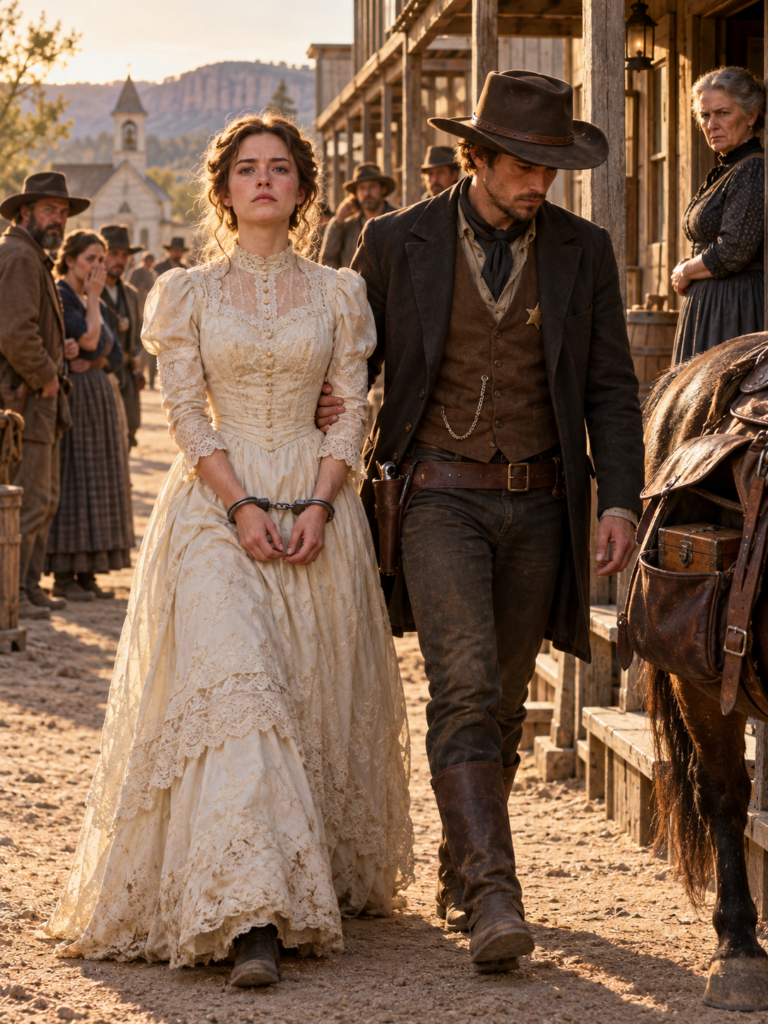
She looked down at her mother’s dress.
Then raised her head.
“I promised you’d see me in it first.”
Caleb’s expression broke.
He had imagined greeting his bride with flowers.
Not handcuffs.
“Rose,” he whispered, “I believe you.”
“Then do your duty properly,” she answered.
She extended her wrists.
Clara protested.
John stepped forward.
But Rose shook her head.
“I’ll go.”
Caleb reluctantly fastened the restraints.
Then he offered his arm to help her down the steps.
She refused it.
“I can walk.”
He stepped aside.
Together, they entered Cedar Bluff.
Every storefront seemed to have someone watching.
Whispers followed them.
Then Agatha Bell, standing outside the general store, called loudly:
“Well, ladies. She ordered herself a husband by post and arrived wearing irons.”
Rose stopped.
Caleb’s face flushed.
But Rose turned calmly toward the woman.
“Mrs. Bell, I believe you have enough troubles of your own without inventing any for me.”
The nearby women fell silent.
Agatha’s smile vanished.
Rose resumed walking.
Caleb kept pace beside her.
At the far end of Main Street, the jail waited.
And as Caleb reached for the key, Rose whispered one question that nearly undid him.
“Did you mean what you wrote me?”
His hand froze.
“Every word.”
She looked at the locked door.
“Then remember that when they tell you what kind of woman I am.”
Caleb opened the cell.
And Rose stepped inside.
Rose turned slowly as Caleb closed the cell door.
The iron lock clicked.
For several seconds, neither spoke.
Then Caleb removed his hat.
“I’m sorry.”
Rose stood beside the narrow cot.
“Are you?”
“More than I can say.”
“Then don’t waste time apologizing. Find out who really attacked that coach.”
He met her eyes.
“That’s what I intend to do.”
Rose studied the young deputy she had crossed a continent to marry.
He was taller than she had imagined.
His face was leaner.
And the uncertainty in his expression was nothing like the confidence of his letters.
Yet the kindness remained.
That was the part she recognized.
“Do you believe I stole anything?” she asked.
“No.”
“Then why put me in irons?”
“Because I had a lawful warrant.”
“And if the warrant was obtained through a lie?”
“Then we’ll prove it.”
She moved toward the bars.
“We?”
Caleb hesitated.
“If you’ll allow me.”
Rose held his gaze.
“I haven’t traveled a thousand miles to marry a man who decides everything for me.”
A faint smile crossed his face.
“That sounds like the woman who wrote me twenty-six letters.”
“Twenty-six from you,” she corrected.
“Twenty-six from me.”
“And I answered every one.”
He nodded.
“I kept them.”
Rose’s expression softened.
“So did I.”
For a moment, the distance between the bars seemed smaller.
Then Caleb looked toward the marshal’s office.
“I’ll bring you supper.”
“I’d rather have answers.”
“I’ll try to bring both.”
***
That evening, Caleb returned carrying a worn copy of Ivanhoe.
Rose stared at the book.
“You remembered.”
“You wrote that you’d never finished it.”
“I also wrote that you should stop apologizing for enjoying novels.”
He smiled.
“I remember that too.”
He sat outside the cell and began reading aloud.
Rose listened.
Twice she corrected his pronunciation.
He accepted both corrections without complaint.
By the third chapter, she was laughing softly.
It was the first time Caleb had heard her laugh.
He stopped reading.
“What?”
“Nothing.”
“Something amused you.”
“Only that the man I intended to marry sounds nothing like the hero in his own letters.”
Caleb closed the book.
“Disappointed?”
She considered.
“No.”
Then her expression grew serious.
“Why did you answer an advertisement for a bride, Caleb?”
He looked down at the book.
“Because in Cedar Bluff, people know me as the deputy. The quiet one. The fellow who does his work and keeps to himself.”
“And?”
“You asked what I thought about things.”
Rose waited.
“You wanted to know what books I read. Why I came west. Whether I liked the mountains. Nobody here ever asked much of that.”
She stepped closer to the bars.
“I asked because I wanted to know the man.”
He looked up.
“And I wanted to know you.”
Rose reached through the bars.
Caleb took her hand.
For a long moment, neither let go.
Then somewhere outside, a horse gave a frightened cry.
A sharp report followed.
Caleb stood.
“What was that?”
Before Rose could answer, glass shattered behind the marshal’s office.
A burning object struck the floor.
Flames spread across the wooden boards.
“Caleb!”
He seized a bucket.
But smoke was already pouring into the room.
From outside came running footsteps.
The attackers were trying to burn the jail.
Rose grabbed the bars.
“Open the door!”
Caleb searched desperately for the keys.
He found them hanging near the desk.
Then a beam cracked overhead.
Smoke filled the corridor.
Caleb coughed and stumbled.
“Stay back!”
“Caleb!”
He reached the cell.
The keys slipped from his fingers.
Rose dropped to her knees, reaching through the bars.
The metal was hot.
She caught the key ring and pushed it back toward him.
“Try the long one!”
He fumbled at the lock.
Nothing.
“The other!”
The mechanism turned.
The door swung open.
Caleb caught her arm.
“Come!”
Together they staggered toward the front entrance.
But smoke blocked the way.
A heavy crash sounded behind them.
Caleb fell beneath a collapsing section of timber.
Rose turned.
“Caleb!”
He tried to rise.
His arm hung awkwardly.
“Go!”
“No!”
She pulled at the fallen wood.
It barely moved.
Then another man burst through the smoke.
John Mercer.
He seized the timber and heaved it aside.
“Get him up!”
Rose helped Caleb stand.
Together, she and John dragged the deputy through the rear passage.
Outside, Clara waited with blankets.
Flames climbed the jail roof.
Rose collapsed onto the ground, coughing.
Caleb knelt beside her.
“Are you hurt?”
She shook her head.
“Your arm.”
He looked at the injury.
“Could be worse.”
Rose stared at him.
“You nearly died.”
“So did you.”
Before either could say more, John returned from the burned hitching rail.
He carried a horseshoe.
The metal was blackened.
One nail had been damaged in an unusual way.
John turned it in his hand.
“Recognize this?”
Rose looked puzzled.
Clara leaned closer.
John pointed toward the left side.
“That gray horse at Crane’s gate. Loose shoe on the left forehoof.”
Caleb frowned.
“Buck Tolliver’s horse.”
John nodded.
“And whoever came here tonight had the same problem.”
It was not enough to prove who had set the fire.
But it was enough to direct their investigation.
***
By sunrise, the jail was a smoking shell.
Marshal Abel arranged temporary quarters for the prisoners.
After hearing the account of the attack and reviewing the weak basis of Crane’s accusation, he allowed Rose to remain at Clara’s ranch while the investigation continued.
The deputy’s injured arm was placed in a sling.
Caleb tried to protest.
Rose folded her arms.
“You can either rest it or explain to the doctor why you made it worse.”
He gave her a reluctant smile.
“You sound like my future wife.”
“That depends on how you behave.”
The words were teasing.
But the warning beneath them was real.
Their future remained unsettled.
Rose had not agreed to marry a man who would decide her innocence for her.
And Caleb had begun to understand that trust required more than affection.
***
At Clara’s ranch, the wooden box remained hidden beneath the kitchen floor.
That evening, Rose asked for a hairpin.
Clara looked at her curiously.
“What do you need it for?”
“The smaller lock inside the box.”
John frowned.
“You couldn’t open it before.”
“No.”
“What makes you think you can now?”
Rose smiled faintly.
“My father printed trade circulars for craftsmen in St. Louis. I spent enough time around their workshops to learn a little about locks.”
Clara brought the pin.
Rose lifted the loose floorboard and retrieved the box.
They set it on the table.
Amos Pruitt had survived the ambush, but he was still recovering from his injuries and had not yet reached Cedar Bluff to explain its contents.
The first lock had already been opened with a brass key he had entrusted to the rescuers.
Inside lay a second compartment secured by a small steel mechanism.
Rose bent toward it.
She worked carefully.
The first attempt failed.
So did the second.
She adjusted the pin.
Then a tiny click sounded.
The compartment opened.
Inside were folded papers.
No gold.
No coins.
No stolen treasure.
Only letters.
Rose unfolded the first.
Her eyes moved quickly across the lines.
Shipping dates.
Routes.
Amounts.
Names.
She opened another.
More dates.
More routes.
The same handwriting.
John leaned forward.
“What is it?”
Rose swallowed.
“Gold shipment schedules.”
Caleb, seated nearby with his injured arm supported, looked up sharply.
“From Denver?”
“Yes.”
Clara took one sheet.
“Why would a stagecoach driver be carrying these?”
Rose examined the handwriting.
Her father had taught her to recognize the distinctive habits of typesetters, printers, and correspondents.
Some men formed their letters with unusual loops.
Others compressed certain strokes.
The papers in the box shared a peculiar formation of several capital letters.
She had seen the same hand elsewhere.
“Crane,” she whispered.
Caleb looked at her.
“What?”
“These letters. I’ve seen his handwriting.”
She searched through the papers.
One bore a signature.
Another used a different name.
But the writing matched.
“Men can change names,” Rose said. “They cannot so easily change the habits of their hands.”
John examined the papers.
“So Crane was receiving shipment schedules?”
“Yes.”
“From whom?”
Rose found another letter.
“A clerk in Denver.”
Caleb’s expression hardened.
“That explains the robberies.”
For two years, gold shipments had been attacked at Ravine Pass.
The outlaws had known when the transports would pass.
They had known which shipments were valuable.
And they had always seemed to strike when the escorts were least prepared.
Someone was giving them information.
These letters showed how.
Silas Crane had been receiving the schedules.
The Denver clerk had eventually become frightened and turned the incriminating correspondence over to Amos Pruitt, the one transport man he trusted to deliver it to the authorities.
Amos had attempted to carry the evidence to Cedar Bluff.
Crane’s men had intercepted the coach.
And Rose had escaped with the proof.
The accusation that the box contained stolen gold had been a lie.
It was designed to make Rose appear guilty before anyone discovered what she actually carried.
Caleb rose.
“Abel needs to see this.”
Rose gathered the letters.
“I’ll bring them myself.”
He nodded.
“Then I’ll ride with you.”
***
Marshal Abel examined the papers late that night.
He read them twice.
Then looked toward Rose.
“Miss Callaway, where did you get these?”
“Amos Pruitt gave me the box during the ambush.”
“And he told you to keep it from Crane?”
“Yes.”
Abel leaned back.
“Then Crane’s accusation against you was meant to recover evidence.”
Rose nodded.
“That’s what I believe.”
John placed the horseshoe on the desk.
“And one of his men appears to have been near the jail when it burned.”
Abel studied the damaged shoe.
“Not enough by itself.”
“No,” John agreed. “But combined with these letters, there’s a trail worth following.”
The marshal folded the correspondence.
“We’ll need Pruitt’s testimony and confirmation from Denver.”
“He’s alive,” Rose said.
“Then we’ll get his account.”
Abel stood.
“At first light, I’ll seek the necessary warrants.”
Rose looked toward Caleb.
He was pale from exhaustion, his injured arm resting in a sling.
But his eyes were steady.
“What now?” she asked.
Caleb glanced at the letters.
“Now we stop the man who tried to make you his scapegoat.”
Outside, the first wind of morning moved through Cedar Bluff.
And somewhere beyond the town, Silas Crane was preparing to run.
***
By dawn, the marshal had secured authority to pursue Crane and his principal accomplice, Buck Tolliver.
But when the deputies reached Crane’s house, they found the front door open.
The office safe stood empty.
The man had disappeared.
John Mercer crouched beside the hoofprints in the yard.
He studied the marks for less than a minute.
Then looked toward the southern hills.
“Red Canyon.”
Caleb reached for his saddle.
Rose caught his good arm.
“You’re injured.”
“I can ride.”
“That doesn’t mean you should.”
He paused.
She lowered her voice.
“I came west hoping to marry you. I’m not eager to lose you before I’ve decided whether I still will.”
A faint smile crossed his face.
“Fair argument.”
“Then promise me something.”
“What?”
“Don’t ride into a trap because you think bravery requires it.”
Caleb considered.
“I promise I’ll use my head.”
Rose looked toward John.
“And you?”
John gave a slight smile.
“I generally prefer keeping mine.”
The men mounted.
Rose watched them ride toward Red Canyon.
She remained with Clara.
The box stayed hidden beneath the kitchen floor.
The letters were now in the marshal’s hands.
For the first time, Rose believed the danger might finally end.
She was wrong.
Because the outlaws had prepared a diversion.
And Silas Crane was already turning back toward the ranch.
The first warning came when the kitchen door opened without a knock.
Rose looked up from the table.
Silas Crane stood in the doorway.
His fine coat was dusty.
His expression was no longer pleasant.
In one hand he carried a revolver.
“Miss Callaway.”
Rose rose slowly.
“Mr. Crane.”
He closed the door behind him.
“I believe you have something that belongs to me.”
“The law has your letters.”
Crane’s mouth tightened.
“The box.”
Rose remained still.
“Why?”
“Because I asked for it.”
She glanced toward the window.
Clara had taken Lily into Cedar Bluff earlier that morning.
John and Caleb were riding with the marshal’s men.
Rose was alone.
Crane noticed where she looked.
“Don’t trouble yourself. No one is coming.”
She kept her voice level.
“Then you’ll have to explain what you want.”
He smiled without warmth.
“You’re remarkably stubborn for a woman who came west looking for a husband.”
Rose lifted her chin.
“I came west because I chose to.”
“And what a choice it turned out to be.”
He stepped closer.
“A stagecoach attacked. A driver nearly killed. A bride accused of theft.”
His eyes narrowed.
“Such a shame.”
Rose felt fear rising.
But she did not move.
“You’re the one who sent those men.”
Crane gave a small shrug.
“You shouldn’t ask questions whose answers can do you no good.”
He extended his hand.
“The box.”
Rose glanced toward the loose floorboard.
Crane followed her gaze.
His smile returned.
“Ah.”
He crossed the kitchen.
Rose stepped between him and the hiding place.
“Stop.”
He raised the revolver.
“Move.”
She did not obey immediately.
“Why do you want an empty box?”
Crane hesitated.
That hesitation told her something.
The man who had controlled Cedar Bluff through favors, donations, and carefully chosen words was now struggling to recover an object whose secrets had already escaped him.
“You don’t know what’s inside,” he said.
“I know enough.”
He took another step.
“Then perhaps you’ll come with me and explain exactly what you know.”
The door opened behind him.
“She won’t be going anywhere.”
Caleb Ward stood on the threshold.
His injured arm remained supported in a sling.
But his revolver was in his good hand.
Crane turned sharply.
For a moment, the two men faced each other across the narrow kitchen.
“Deputy,” Crane said. “You’re a long way from Red Canyon.”
“Not as far as you hoped.”
Rose looked past Caleb.
John Mercer stood outside, moving toward the side of the house.
Crane understood.
The diversion had failed.
He raised his weapon slightly.
Caleb held his position.
“Put it down, Crane.”
“You think you can arrest me with one useful arm?”
“I can ask you to surrender with one.”
Crane laughed bitterly.
“You’re a foolish boy.”
“Perhaps.”
Caleb’s voice remained steady.
“But I’m not alone.”
John appeared at the rear doorway.
His rifle remained pointed toward the ground, but he was ready.
“Mr. Crane,” he said quietly, “there’s nowhere sensible left to go.”
Crane looked between them.
Then toward Rose.
“You little fool. You have no idea what you’ve done.”
She met his eyes.
“I know what you tried to do.”
He hesitated.
She continued.
“You used the town’s trust to hide robberies. You sent men after a stagecoach driver because he carried the truth. And when you couldn’t find the box, you tried to make everyone believe I was a criminal.”
Crane’s face darkened.
“You think anyone will believe a woman who arrived by mail?”
“They already believed your word,” Rose said. “Now they can read your handwriting.”
The words struck him harder than a threat.
He looked toward the papers in his mind, toward the letters that had passed beyond his control.
Caleb took one careful step forward.
“Silas Crane, you’re under arrest in connection with the robberies of the gold transports and the attack upon the mail.”
Crane’s revolver wavered.
“Don’t be stupid.”
“Put it down.”
Outside, hoofbeats approached.
Marshal Abel’s men had followed the tracks back from the canyon.
Crane glanced toward the window.
The sound drew nearer.
For several seconds, Rose feared he would fire.
Then his shoulders sagged.
He lowered the weapon.
John moved forward and took it.
Caleb secured the arrest with the help of the arriving marshal.
And just like that, the man who had frightened half the valley into silence was no longer in command of his own doorway.
***
The rest of the truth came out gradually.
The letters were examined.
The Denver clerk who had supplied shipment schedules gave his account.
Amos Pruitt survived his injuries and testified about the box he had been carrying.
Buck Tolliver was arrested after the failed attempt to draw the lawmen into Red Canyon.
Other evidence connected the gang to the series of gold robberies.
Crane’s wealth and reputation could not explain away the correspondence.
His charitable donations did not erase the crimes.
Nor did the fact that he had once sat in the front pew of the church he had helped build.
He had used respectability as a shield.
And for two years, it had worked.
But the small wooden box had carried something stronger than gold.
It had carried evidence.
The investigation eventually led to convictions and imprisonment for Crane and Tolliver.
For Cedar Bluff, the scandal was difficult to accept.
Many residents had trusted Crane.
Some had defended him when accusations first emerged.
Others had mocked Rose because she seemed an easy target.
She was a stranger.
A woman who had answered a marriage advertisement.
A bride who arrived after a stagecoach robbery.
Then a prisoner marched through town in handcuffs.
The rumors had spread more quickly than the truth.
And when the truth finally came, the town had to decide whether it would admit what it had done.
***
One week after Crane’s arrest, Rose walked down Cedar Bluff’s Main Street again.
This time, there were no handcuffs.
Her mother’s wedding dress had been carefully folded away.
She wore a simple blue day dress.
Caleb walked beside her.
His injured arm was healing, though he still carried it carefully.
People watched them pass.
Some nodded.
Others looked embarrassed.
Near the general store, Agatha Bell stood with two women.
Rose recognized the place immediately.
It was where Agatha had laughed as Caleb led her toward the jail.
She slowed.
Caleb noticed.
“Want to keep walking?”
Rose shook her head.
“No.”
Agatha’s face flushed as they approached.
“Miss Callaway.”
“Mrs. Bell.”
For several moments, neither spoke.
Then Agatha looked down.
“I believe I owe you an apology.”
Rose waited.
“I said things I shouldn’t have said. In front of people.”
“Yes,” Rose replied. “You did.”
Agatha swallowed.
“I was wrong.”
Rose considered.
She could humiliate the woman.
She could repeat the cruel words for the whole street to hear.
But she had not fought for her dignity merely to enjoy taking someone else’s.
“Then I hope you’ll remember that the next time a stranger comes to town.”
Agatha nodded.
“I will.”
Rose offered a small smile.
“Good. Then perhaps you’ll come to the wedding.”
The older woman blinked.
“Wedding?”
Rose glanced toward Caleb.
His face turned bright red.
“We haven’t quite settled that,” he murmured.
Rose’s smile widened.
“Not yet.”
Then she walked on, leaving Agatha staring after them.
Caleb caught up.
“You invited her to a wedding we haven’t planned?”
“I invited her to a possibility.”
“That’s a mighty bold invitation.”
Rose laughed.
“I’ve been told I’m a bold woman.”
“I’ve noticed.”
They continued along the street.
At the edge of the square, Caleb stopped.
“Rose.”
She turned.
He removed his hat.
Her expression softened.
“Yes?”
“I need to ask you something.”
She looked at his nervous face.
“The whole town is watching, Caleb.”
“I know.”
“You hate being watched.”
“I do.”
“Then why stop here?”
He drew a breath.
“Because this is the street where I brought you in handcuffs.”
Her smile faded.
Caleb continued.
“I did my duty that day. But I wish I could have spared you the shame of it.”
“You believed me.”
“I did.”
“And you helped prove the truth.”
“With a great deal of help from you.”
She nodded.
“That’s important.”
Caleb looked toward the ground.
“When I wrote those twenty-six letters, I thought I was asking a woman to come west and share my life.”
He raised his eyes.
“Then you arrived and showed me how much more there is to sharing a life than simply offering someone a home.”
Rose remained quiet.
“I don’t want a wife who has to ask my permission to be brave,” he said. “I don’t want you to stop speaking your mind because I’m wearing a badge.”
Her eyes shone.
“What do you want?”
“You.”
He paused.
“If you’ll still have me.”
Then, despite his injured arm, Caleb lowered himself carefully onto one knee.
A few people nearby stopped walking.
“Rose Callaway, will you marry me?”
Her throat tightened.
She remembered St. Louis.
Her father’s printing shop.
The newspaper advertisement.
Twenty-six letters.
A thousand miles of travel.
The mountain pass.
The locked box.
The jail.
The fire.
And the quiet young man who had read Ivanhoe aloud while she sat behind bars.
She looked down at him.
“Caleb Ward, I traveled a thousand miles because I believed the man in those letters was worth meeting.”
He waited.
“Now I’ve met him.”
A tear slipped down her cheek.
“And I believe he’s worth marrying.”
Caleb smiled.
“Is that a yes?”
Rose laughed.
“Yes.”
The small crowd broke into applause.
Caleb rose and took her hand.
He did not pull her toward him.
He waited.
And Rose stepped forward and kissed him.
For the first time since arriving in Cedar Bluff, the town was watching her for a reason she had chosen.
***
At Clara Whitmore’s ranch, another story was quietly reaching its turning point.
John Mercer had been living there for almost a year.
He had helped Clara save the ranch during a difficult season and stayed afterward, working alongside her.
Every night after supper, he told her good night at the kitchen door.
Then he went to sleep in the barn.
The arrangement had begun as a practical kindness.
Clara needed help.
John needed work and a place to stay.
But over time, they had become something neither had named aloud.
They shared responsibility for the ranch.
They understood one another’s habits.
He knew when Clara was worried about the horses.
She knew when John was troubled by memories he preferred not to discuss.
He helped Lily with the animals.
Lily adored him.
And Clara had grown accustomed to hearing his footsteps near the porch every morning.
One evening, after the house had grown quiet, Clara found John standing beside the barn door.
He was watching the sunset.
“John?”
He turned.
“Evening.”
She folded her arms.
“Why do you stay?”
He looked surprised.
“Here?”
“Yes.”
He considered.
“The work needs doing.”
“There’s always work somewhere.”
He smiled faintly.
“True.”
“Then why here?”
For once, John had no ready answer.
Clara stepped nearer.
“I think you know.”
He looked down.
“I reckon I do.”
She waited.
At last he met her eyes.
“Because I want to be where you are.”
The words were quiet.
But Clara felt them all the way through her.
She took a breath.
“Then perhaps it’s time we talked about something.”
“What?”
“Whether you intend to spend the rest of your life sleeping in my barn.”
John laughed softly.
“I hadn’t meant to presume.”
“That’s one of the things I admire about you.”
She held his gaze.
“But you may ask.”
He stepped closer.
“Clara Whitmore, would you consider building a life with me?”
She smiled.
“I thought you’d never get around to it.”
***
Clara and John married in October, when the cottonwood leaves turned golden.
Lily stood beside her mother.
Rose and Caleb attended, smiling as their friends made promises beneath the autumn light.
John did not suddenly become master of Clara’s ranch.
They continued the work together.
He remained careful about decisions that affected Clara and Lily.
Clara remained the woman who had kept the place alive before he came.
Marriage changed the name of their relationship.
It did not erase the partnership they had already built.
In the following spring, Rose and Caleb stood before their own friends and made their vows.
Rose wore her mother’s wedding dress.
The same dress she had carried across a thousand miles.
The same dress she had torn escaping armed men in Ravine Pass.
The same dress she had repaired beneath Clara’s kitchen lamp while waiting to meet the man who would arrive holding an arrest warrant.
Now it was clean.
Carefully mended.
And worn for the day she had chosen.
Caleb waited for her at the front of the church.
When he saw her, his expression changed.
For a moment, he looked exactly like the nervous young man who had stood before a mirror waiting for a stagecoach that never arrived.
Rose smiled at him.
“I told you I’d wear it.”
He swallowed.
“You did.”
“And I told you I’d let you see me in it first.”
His eyes shone.
“You kept your promise.”
Rose reached for his hand.
“So did you.”
Their vows were simple.
They promised honesty.
Patience.
Mutual respect.
And a life built by two people willing to listen as well as speak.
When the ceremony ended, Caleb took Rose’s hand and led her into the sunlight.
The church doors opened onto Cedar Bluff.
The same town that had once watched her pass in handcuffs now stood waiting to offer congratulations.
Rose remembered how alone she had felt on that first walk.
How frightened.
How uncertain.
She had believed the town might never accept her.
But the people who mattered had learned to judge her by what she did, not by what others claimed she was.
She looked toward the street.
Then toward Caleb.
“What are you thinking?” he asked.
Rose smiled.
“That the first time we walked down this road together, I wasn’t sure whether I could trust you.”
He looked rueful.
“Fair enough.”
“And now?”
“Now what?”
She squeezed his hand.
“Now I trust you to walk beside me.”
Caleb smiled.
“That’s where I aim to stay.”
They walked through Cedar Bluff together.
Not as a deputy escorting a prisoner.
Not as a man claiming a bride because she had answered his advertisement.
But as husband and wife, freely chosen.
Behind them, the church bell rang.
Ahead lay the small house Caleb had described in his letters.
A table with room for two.
Books waiting to be read.
Work to be done.
Arguments they would have to settle honestly.
And a future neither could have predicted when the first letter crossed the miles between them.
Rose had come west to be a bride.
The outlaws had mistaken her for someone helpless.
Silas Crane had mistaken her for someone easily silenced.
And Cedar Bluff had mistaken her for someone whose worth could be measured by a rumor.
But Rose Callaway had carried the truth through a mountain pass, opened the box that concealed it, and stood beside the lawmen who brought it into the light.
She had not needed to become someone else to survive the West.
She had needed the chance to be exactly who she was.
As Caleb opened the door of their home, he stepped aside.
Rose crossed the threshold first.
And this time, no one was waiting to tell her what kind of woman she ought to be.
She had already decided.


