
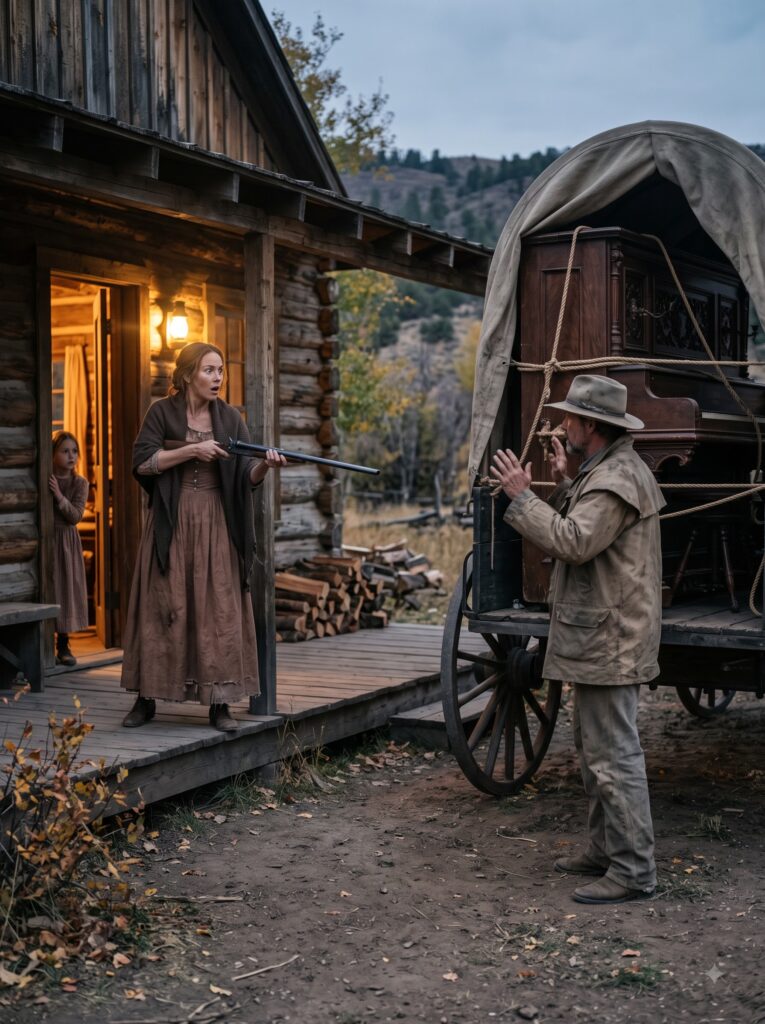
Clara reached toward the folded paper, but Mercer caught its edge before the wind could carry it beneath the wagon.
She withdrew her hand immediately.
“That’s Samuel’s name.”
“Yes.”
“Then I want to know why you have it.”
Mercer looked toward Lily, who was examining the piano’s carved front.
“It’s an old letter,” he answered. “Something your husband wrote years ago.”
Clara felt her throat tighten.
“Sam never mentioned you.”
“No, ma’am. I don’t suppose he had much reason to.”
“Then how did you know him?”
Mercer folded the paper carefully.
“We knew each other a long time back.”
He offered it toward her, but Clara hesitated.
She had seen enough promises written on paper to distrust them.
Bank notices.
Payment demands.
Court orders.
Every one signed by someone who claimed to know what was best.
“Why didn’t you come before now?” she asked.
His eyes moved toward the distant hillside where Samuel lay buried.
“That’s a fair question.”
“And?”
“I came west because of a debt I owed him. I didn’t know until recently that he’d died.”
Clara stared.
“What kind of debt?”
Mercer glanced toward the piano.
“One that can wait until we’ve got this safely indoors.”
For a moment, she considered refusing.
But the evening was cooling, and the instrument stood exposed on the wagon.
“Very well,” she said.
Together they lowered the piano using the wagon’s loading planks, taking the weight slowly while Clara directed its passage through the doorway.
Mercer accepted her instructions without complaint.
Once the piano stood against its familiar wall, Lily touched the cracked key.
“Can Mama play tonight?”
Clara looked at the instrument.
The empty place in the sitting room had tormented her since morning.
Now its return felt almost impossible to understand.
“Perhaps,” she answered.
Mercer stepped back.
“I’ll tend the horses.”
Clara stopped him.
“Mr. Mercer?”
“Yes?”
“You still haven’t told me why you paid so much.”
He hesitated.
“Because I made a promise.”
“To Sam?”
He nodded.
She studied the folded letter still in his hand.
But before she could question him further, a horse sounded outside.
Then another.
Mercer looked through the window.
A rider approached from Cedar Bluff.
It was Horace Pike’s clerk.
Clara’s stomach tightened.
The man stopped beside the porch and called through the open doorway.
“Mrs. Whitmore! Mr. Pike sent me to remind you the full note comes due Saturday.”
Clara stepped outside.
“I know when it comes due.”
“The auction proceeds cleared the overdue charges. That doesn’t settle the remaining obligation.”
“I understand the terms.”
“Mr. Pike would still consider purchasing the property.”
“The land isn’t for sale.”
The clerk looked past her toward Mercer.
“And who might that be?”
“A guest,” Clara answered.
“Mr. Pike won’t be pleased to hear you’ve taken in a stranger.”
Clara felt her face warm.
“Mr. Pike doesn’t choose my guests.”
The clerk gave a thin smile.
“Saturday, ma’am.”
Then he rode away.
Clara remained on the porch.
Mercer came out beside her, keeping a respectful distance.
“How much remains?” he asked.
“Four hundred eighty dollars.”
“And you have?”
“Sixty-three.”
He looked toward the north hills.
Clara noticed.
“What is it?”
“Found something unusual while riding toward town.”
“What?”
“Survey stakes. Beyond the northern pasture. Fresh ones.”
Clara frowned.
“Nobody told me anyone intended to survey that ground.”
“That’s what troubled me.”
He removed his hat.
“There may be a reason Pike wants the property badly enough to keep pressing you.”
She felt anger replace despair.
“I’ve known he wanted this land since Sam died.”
Mercer studied her.
“Has he offered to buy it?”
“Five hundred dollars. Enough to clear the debt and send Lily and me east.”
“And you refused?”
“Yes.”
“Why?”
Clara turned toward the cabin.
“Because my husband and I built this place. Because my daughter was born here. Because I’ve worked too hard to let a banker decide when it stops being home.”
Mercer nodded slowly.
“Then we ought to learn what those survey stakes mean.”
“We?”
He met her eyes.
“Only if you want my help.”
She considered that answer.
It was the first offer in months that had left her free to refuse.
“Tomorrow,” she said. “You can show me.”
He nodded.
“And tonight?”
“You promised to repair a fence.”
A faint smile crossed his face.
“I did.”
“Then I suppose you’ve earned your supper.”
Mercer started toward the barn.
Clara watched him go.
He was limping slightly now.
She wondered what had happened to his leg.
Then she remembered the letter.
“Mr. Mercer!”
He turned.
“The paper.”
He reached inside his coat and brought it out.
Clara stepped toward him.
“Whatever it says about Sam, I want to read it myself.”
Mercer held it out.
She took it.
For a moment, her fingers rested against handwriting she had not seen since her husband’s final illness.
Then she unfolded the first crease.
The old paper opened beneath Clara’s fingers.
Its folds had softened with years of handling.
She recognized Samuel’s handwriting immediately.
The same firm slant he’d used on their household accounts.
The same careful letters that appeared in his rare notes whenever work kept him away overnight.
At the top was a date from years before their move west.
Clara began reading.
The letter was addressed to John Mercer.
Her husband thanked him for a package and spoke briefly of the years since the war.
Then came a passage that made her pause.
Sam wrote that he hoped Mercer had recovered enough to work without pain.
He mentioned that Clara played her mother’s piano every evening.
And he wrote that no matter how difficult life became, he wanted her always to keep that instrument.
Clara looked up.
“Why would Sam write that to you?”
Mercer stood quietly.
“He knew how much it mattered.”
“He knew I loved it.”
“Yes.”
“But why would he tell you?”
Mercer glanced at the folded letter.
“Because he once made me promise something.”
Clara waited.
He seemed to search for words.
“Your husband helped me when I needed help badly. I told him I would repay him somehow.”
“And he asked you to save a piano?”
“Not exactly.”
Mercer looked toward the distant hills.
“He told me that if I ever came west and found your family struggling, I wasn’t to let anyone take away the one beautiful thing you’d carried across the plains.”
Clara stared.
“Sam said that?”
“Yes.”
She looked back at the letter.
For nearly a year, she had felt her husband’s absence in every corner of the house.
His coat remained folded in a chest.
His tools hung in the barn.
The chair he’d built still stood beside the stove.
But she had never known he had made such a request.
“Why didn’t you come sooner?”
Mercer’s expression changed.
“I didn’t know where he’d settled until recently. I’d been trading cattle farther north. By the time I learned about Cedar Bluff, he was already gone.”
Clara studied him.
There was more to the story.
She could see it.
But the letter was enough for one evening.
“I’d better prepare supper,” she said.
Mercer nodded.
“I’ll see about your fence.”
***
The following morning, Mercer rose before daylight.
Clara heard the barn door opening while the house was still dark.
By breakfast, he had removed three broken rails from the eastern fence.
After eating, he returned with fresh timber and worked until afternoon.
Lily followed him with the determined curiosity of a child who had spent too many months hearing adults discuss things she could not change.
“Why do you hit the nail sideways first?” she asked.
“To set it where I want it.”
“Why doesn’t the wood split?”
“Sometimes it does.”
“Do you know everything about fences?”
Mercer laughed.
“Not near enough.”
Clara watched from the kitchen window.
Her daughter had not laughed so freely since Samuel died.
The sound made Clara grateful.
It also made her cautious.
She knew how quickly a child could grow attached to someone who might leave.
That evening, she spoke to Mercer beside the barn.
“Lily takes to people quickly.”
“I’ve noticed.”
“She’s already asking whether you’ll be here tomorrow.”
He set down his hammer.
“Would you rather I kept my distance?”
Clara considered the question.
“No. But I don’t want promises made to her that can’t be kept.”
“Then I won’t make them.”
She appreciated the answer.
“And Mr. Mercer?”
“Yes?”
“She can help you with the horses, but I don’t want her near the tools unless you’re watching.”
“That’s sensible.”
He smiled.
“She’s got a good head for animals.”
“She gets that from Sam.”
Mercer’s expression softened.
“I can believe it.”
***
Two days passed.
Mercer repaired the fence and rehung the barn door.
Clara continued giving piano lessons, gathering eggs, and mending clothing.
She refused his suggestion that she suspend her work while he was there.
“I need the income,” she told him.
“Then you’ll have it.”
He did not argue.
In the evenings, they ate together.
Mercer spoke little about himself, though Clara learned that he had traded cattle in Wyoming and knew the difficulties of maintaining livestock through western winters.
He was competent with tools and animals, but he never pretended to know her property better than she did.
When she corrected him about the best place to stack firewood against the prevailing wind, he listened.
When he noticed a weak hinge on the feed shed, she agreed it needed attention.
They began to work together without discussing what that meant.
One evening after Lily had gone to bed, Clara sat at the piano.
She rested her hands on the keys.
For several minutes, she could not play.
Then she began the familiar melody of “Shenandoah.”
It had been Samuel’s favorite.
He used to whistle it while repairing fences, cutting firewood, or carrying water from the creek.
Clara played slowly.
Outside, Mercer sat on the porch step.
When the music reached him, he lowered his head.
He knew the tune.
And he remembered another man whistling it under circumstances Clara had never heard described.
He remained there until the final note faded.
***
On the fourth morning, one of the calves was missing.
Mercer saddled his horse and rode toward the northern hills.
He found the animal near a narrow draw, caught among scrub and loose stone.
After freeing it, he noticed wooden stakes set along the ridge.
Fresh survey markers.
Each carried a strip of red cloth.
The line crossed ground Clara had always considered part of the Whitmore property.
Mercer dismounted.
He examined the markers.
Nearby, the rock had been broken open.
Within the stone lay bright metallic veins.
Silver.
He crouched beside one of the stakes.
In the dust lay the remains of an expensive cigar.
Gold paper still clung to its band.
Mercer had seen Horace Pike smoke the same kind outside the Cedar Bluff bank.
He looked toward the Whitmore cabin below.
Suddenly, the banker’s persistence made terrible sense.
Pike might not be interested merely in collecting a debt.
He might be trying to acquire land that held valuable minerals.
Mercer returned with the calf and told Clara what he’d found.
She listened carefully.
“Can you prove he ordered the survey?”
“Not yet.”
“Then we shouldn’t accuse him until we can.”
Mercer nodded.
“What would you like to do?”
Clara considered.
“Go into town. Find out whether any mining claim has been filed on my land.”
He studied her.
“I can do that.”
“We’ll do it,” she corrected.
He smiled faintly.
“Very well.”
***
They rode into Cedar Bluff the following morning.
Clara left Lily with a woman she trusted from the church.
At the county records office, they began asking about recent filings.
The clerk was reluctant to speak freely.
But Clara insisted that she was seeking information about her own property.
Eventually, they learned that an application concerning mineral rights on land matching part of the Whitmore acreage had been submitted in Denver.
The name involved was Horace Pike.
Clara felt her hands turn cold.
“He’s claiming mineral rights to land I own?”
The clerk hesitated.
“The filing may be defective. It hasn’t been fully resolved.”
“Then I want a copy of whatever can legally be provided.”
Mercer stood beside her.
He said nothing.
Clara was the one asking the questions.
She was the landholder whose rights were at stake.
She intended to see the matter through.
Outside the office, she stopped.
“Now I understand.”
Mercer waited.
“He knew Sam couldn’t repay the loan after the drought. He knew I’d have trouble keeping up with the interest. And he knew the court would eventually force a sale.”
“You think he wanted the mineral claim.”
“I think he wanted my land cheaply.”
She looked down the street toward the bank.
“And I think he expected me to be too frightened or ashamed to fight him.”
Mercer studied her.
“What will you do?”
Clara raised her chin.
“Find someone with authority to examine those filings.”
***
Horace Pike arrived at the homestead that afternoon.
His fine coat and polished boots looked absurdly clean beside the dusty fence.
He offered five hundred dollars for the property.
Clara refused.
“The land isn’t for sale.”
Pike smiled thinly.
“You’ll find yourself with no choice by Saturday.”
“Then we’ll see what Saturday brings.”
His gaze moved to Mercer.
“And who is this fellow?”
“A guest.”
“Your guest seems remarkably interested in matters that don’t concern him.”
Mercer looked at the banker.
“I make a practice of paying my debts.”
Pike’s expression hardened.
“Do you?”
“Yes.”
“And you believe you can interfere with a lawful note?”
“I believe lawful debts ought to be distinguished from unlawful dealings.”
The banker stared at him.
Clara stepped forward.
“Mr. Pike, if you have nothing more to say about my loan, please leave.”
For a moment, he looked as though he might argue.
Then he mounted his horse.
“Saturday,” he said.
And rode away.
***
That night, three riders approached the Whitmore barn.
Clara woke to the horses’ frightened stamping.
By the time she reached the window, flames had begun climbing the outer wall.
She shouted for Mercer.
He was already moving.
Together they carried water, opened the opposite barn door, and got the animals out while the fire remained confined near the outer boards.
Mercer beat down burning straw with a wet sack as Clara hauled another bucket.
The heat was fierce.
Smoke stung their eyes.
But the wall remained standing.
By dawn, the worst of the fire had been extinguished.
The barn was scorched.
The animals were safe.
And Clara stood in the yard, exhausted, staring at what might have become ashes.
Mercer approached.
“You’re hurt?”
“No.”
He examined the blackened wall.
“Whoever set that fire wanted you frightened.”
Clara looked toward the road.
“Pike?”
“I can’t prove that.”
She nodded.
“But somebody wants this place empty.”
Mercer met her eyes.
“Then we’ll make certain the right people hear about it.”
She looked at him sharply.
“Why are you risking so much for us?”
His expression grew serious.
“Ask me Saturday.”
The answer troubled her.
But before she could press him, Lily appeared on the porch.
“Will the barn be all right?”
Clara went to her daughter.
“We’ll repair it.”
Lily looked toward Mercer.
“Will you help?”
He crouched.
“If your mother wants me to.”
Clara rested a hand on Lily’s shoulder.
“Yes,” she said. “I do.”
***
The next morning, Mercer was gone.
His horse had disappeared from the barn.
His blankets were gone from the hayloft.
There was no note.
Clara searched the yard twice.
Then she stood beside the repaired fence, looking toward the road.
She told herself she had expected this.
Men left.
Samuel had been taken by illness.
Mercer had gone by choice.
She could not afford to build her daughter’s hopes around strangers.
When Lily asked where he was, Clara answered truthfully.
“I don’t know.”
“He’ll come back.”
“I hope so.”
“But he said Saturday.”
Clara looked at her daughter.
“Yes.”
Lily nodded as though that settled the matter.
Clara wished she could share the child’s certainty.
On Thursday, Pike’s clerk nailed a new notice to the gate.
The Whitmore property would be offered for sale on Saturday at noon unless the full debt was satisfied.
Four hundred eighty dollars.
Clara had sixty-three.
The missing sum might as well have been a thousand.
On Friday evening, she opened Samuel’s wooden chest.
Inside lay his old military coat.
The cloth had faded.
She lifted it carefully and folded it atop her few dresses.
Then she closed the chest.
Across the room, the piano stood silent.
Lily climbed onto the bench.
“Will you play, Mama?”
Clara touched the polished wood.
“Not tonight.”
The child slid down without arguing.
Later, when the house was quiet, Clara returned to the sitting room.
She placed both hands on the piano lid.
The instrument had come home.
The stranger had kept that part of his promise.
But tomorrow the land itself might be lost.
And Clara could not understand why John Mercer had returned one treasure only to disappear before the greater danger was over.
At last, she took Samuel’s letter from the drawer and read it again.
Near the end, her husband had written something she’d barely noticed before.
He had spoken of a terrible day during the war.
A young soldier.
A long walk through mud.
A life that might otherwise have ended.
Clara traced the words with her finger.
Then she whispered into the empty room.
“Sam, what did you do for that man?”
Outside, beyond the darkened windows, the road to Cedar Bluff lay empty.
And noon on Saturday was approaching.
Saturday morning arrived clear and cold.
Clara dressed Lily in her best brown dress.
She pinned her own hair carefully and put on the plain dark coat she’d worn to Samuel’s funeral.
The sight of it brought back the hillside burial.
The autumn wind.
The rough wooden marker.
The terrible moment when she had understood that every responsibility they once shared now belonged to her alone.
She looked at her daughter.
“Ready?”
Lily nodded.
“Are they going to take our house?”
Clara knelt before her.
“I don’t know, sweetheart.”
The child looked frightened.
Clara took both her hands.
“But whatever happens, we’ll face it together.”
They traveled into Cedar Bluff with a neighbor who had offered them a place in his wagon.
The town square was already crowded.
The auctioneer stood near the courthouse steps.
Horace Pike waited beside a group of businessmen, dressed in his finest coat.
He looked entirely comfortable.
Clara knew why.
He believed she had no money.
No influential family.
No means of challenging his claim.
And no one willing to stand against him.
The auctioneer began.
“Whitmore property. One hundred sixty acres, including residence, outbuildings, and improvements.”
Lily gripped Clara’s hand.
Pike stepped forward.
“Four hundred eighty dollars.”
The opening bid matched the debt.
Clara felt the square grow quiet around her.
There would be no competing bidder.
Pike would obtain the land for the price of the note.
The auctioneer raised his hand.
Then a voice sounded from the crowd.
“Before you accept that bid, the sheriff has a question.”
Heads turned.
John Mercer stepped into the square.
He wore the same dusty coat.
The same worn hat.
But beside him walked Sheriff Hollis and a county official carrying documents.
Clara’s breath caught.
Mercer looked toward her.
For the briefest moment, their eyes met.
Then he turned toward the auctioneer.
“This sale shouldn’t proceed until the court has considered new evidence.”
Pike’s face tightened.
“On what grounds?”
The sheriff stepped forward.
“Mr. Pike, we’ve received information concerning a mineral claim filed against land belonging to Mrs. Whitmore.”
Pike gave a dismissive laugh.
“Mining business has nothing to do with a mortgage.”
“Ordinarily,” the official answered, “that would depend on the circumstances. But you’ve represented part of the Whitmore acreage as property you control.”
“I intend to purchase it.”
“Intending to purchase land is not the same as owning it.”
A murmur ran through the crowd.
The official continued.
“The filing was made before today’s proposed sale. That requires explanation.”
Pike’s expression hardened.
“This is an outrageous interruption.”
Clara stepped forward.
“No more outrageous than trying to sell my property while claiming mineral rights beneath it.”
He turned toward her.
“You don’t understand the documents.”
“Then let the county examine them.”
The official looked at the auctioneer.
“The proceedings must be suspended.”
The auctioneer hesitated.
Then lowered his hand.
Pike’s face darkened.
Clara felt the first small stirring of hope.
But the debt remained.
Four hundred eighty dollars.
And nothing about a questionable mining filing made the obligation disappear.
Pike seemed to recognize that.
He smiled again.
“Very well. Investigate whatever you like. The note is still due.”
Mercer stepped forward.
“That’s been addressed.”
He removed a folded receipt from his coat.
Clara stared at him.
“What have you done?”
Mercer looked directly at her.
“I paid the outstanding balance.”
The square fell silent.
“Four hundred eighty dollars,” he continued. “Accepted this morning. The note is satisfied.”
The sheriff examined the receipt.
Then showed it to the county official.
The official nodded.
“The debt is paid. There is no basis for today’s foreclosure sale.”
Pike’s confidence vanished.
“You had no right—”
“A creditor may accept lawful payment from another party,” the official replied. “The obligation has been discharged.”
Clara stood perfectly still.
She should have felt relief.
She did.
But anger rose alongside it.
She looked at Mercer.
“You paid my debt without asking me?”
He did not look away.
“Yes.”
“Why?”
“Because the money was due today.”
“That isn’t an answer.”
“No,” he admitted. “It isn’t.”
The sheriff looked toward the gathered townspeople.
“The auction is canceled.”
A low murmur spread through the square.
Some people smiled.
Others watched Pike with new suspicion.
The banker’s dealings were no longer merely rumors whispered among struggling farmers.
They were now matters officials intended to investigate.
Clara tightened her grip on Lily’s hand.
“Mr. Mercer,” she said, “I need to speak with you.”
He nodded.
“Of course.”
She led him away from the courthouse steps.
Lily remained nearby with their neighbor.
When they were out of easy hearing, Clara faced him.
“You cannot simply purchase my troubles and expect me to be grateful.”
Mercer removed his hat.
“I don’t.”
“You’ve paid more money for my piano and land than I can repay.”
“I’m not asking for repayment.”
“That doesn’t mean I want to owe you.”
He looked at her carefully.
“You’re right.”
The answer surprised her.
“I should have told you what I intended,” he continued. “I was afraid there wouldn’t be time.”
“Then you should have trusted me with the truth.”
He nodded.
“I should have.”
Clara folded her arms.
“Why did you do it?”
Mercer was quiet.
Then he reached inside his coat and withdrew Samuel’s letter.
“Because your husband once carried me two miles through mud when I couldn’t walk.”
Clara stared.
“What?”
“Shiloh. April 1862.”
Mercer’s voice lowered.
“I was twenty-two. A rifle ball shattered my leg. When our line broke, I fell where the ground was thick with mud and wounded men.”
He looked toward the distant hills.
“I couldn’t stand. I couldn’t crawl far enough. I thought I was going to die there.”
Clara felt a strange tightness in her chest.
“Sam found you?”
“He did.”
Mercer nodded.
“Your husband was a sergeant then. He’d already been carrying wounded men to safety. When he found me, I told him to leave me.”
“What did he say?”
“He said he’d take his chances.”
Mercer’s eyes grew distant.
“He lifted me across his shoulders. Carried me toward the surgeons while the fighting continued behind us.”
Clara pressed a hand against her mouth.
She knew Samuel had fought at Shiloh.
She knew he’d returned with scars and memories he seldom spoke about.
But he had never told her this.
“Two miles,” Mercer said.
“How could he manage that?”
“I still don’t know.”
He smiled faintly.
“He whistled most of the way.”
Clara’s breath caught.
“What?”
“An old song. Shenandoah.”
For a moment, the sounds of the town square disappeared.
She remembered Samuel standing beside their fence.
Whistling as he worked.
She remembered evenings when he sat near the piano, listening while she played the same melody her mother had taught her.
Mercer continued.
“I asked him afterward why he kept whistling.”
“What did he say?”
“He told me he didn’t want me listening to how much pain we were both in.”
Clara lowered her head.
Tears slipped down her cheeks.
Mercer waited.
“Your husband saved my life,” he said quietly.
She looked up.
“He never told me.”
“Perhaps he didn’t think there was much to tell.”
“That sounds like him.”
Mercer nodded.
“After the war, we corresponded once. I told him I owed him more than I could repay.”
He held out the old letter.
“Sam wrote back that I didn’t owe him anything. But he told me about you.”
Clara looked at the familiar handwriting.
“He said you loved the piano your mother brought west. Said it was the one thing that made any place feel like home.”
Her tears continued.
“He told me if I ever found myself near your family and times were difficult, I ought to make sure nobody took that piano away.”
Clara’s lips trembled.
“That was his promise?”
Mercer shook his head gently.
“No. It became mine.”
For a long while, she could not speak.
Then she asked, “Why did it take you so long?”
“I spent years trading cattle. Trying to make enough money to establish myself. I searched for Sam when I could, but the country is large, and people move.”
He looked toward the ground.
“By the time I learned he’d settled near Cedar Bluff, he was already buried.”
Clara looked at his damaged leg.
“You still suffer from the wound?”
“Some days.”
“And all this time, you remembered him?”
“Every day I walked.”
The answer was simple.
And Clara believed it.
***
The investigation into Pike’s financial dealings continued after the canceled auction.
The questionable mineral filing was only part of the matter.
Records were examined.
Other families came forward with concerns about the banker’s loans and property transactions.
The Henderson family provided documents from the loss of their farm.
Others described penalties and charges they believed had been misrepresented.
The process took time.
It required testimony, accounting records, and officials willing to examine business practices many townspeople had accepted without question.
Clara participated when asked.
She did not allow Mercer to speak for her.
She presented the loan papers Samuel had signed, the statements she’d received, and her own records of payments.
When she was uncertain about a figure, she said so.
When she knew something to be true, she said it plainly.
Pike’s disputed filing became evidence in the broader inquiry.
By the end of the month, he faced serious charges and was taken to Denver under lawful authority.
Several property transactions, including the Henderson matter, were reopened for examination.
The outcome did not erase the losses families had endured.
But it ended Pike’s unchecked control over the valley.
Clara’s homestead was no longer threatened by his note.
And the land beneath the northern hills remained hers.
The possibility of silver did not suddenly make her wealthy.
A mineral claim required more than shining stone.
Clara understood that.
She chose not to rush into any agreement concerning the property.
The farm itself mattered more to her than speculation.
It was where Samuel had planted the aspens.
Where Lily had taken her first steps.
Where she had buried the man who’d helped build it.
And where she intended to remain.
***
Mercer returned to the homestead after the hearing.
But this time, Clara set the terms clearly.
“You’ve paid a debt that I never asked you to pay,” she said.
“I understand.”
“I want that recorded honestly.”
“Then we’ll put it in writing.”
“I also want you to understand something.”
He waited.
“This land stays mine. Lily’s future depends on it.”
“I wouldn’t have it otherwise.”
“And if you work here, we’ll agree on what the work is worth.”
Mercer smiled slightly.
“Fair enough.”
She studied him.
“You don’t seem offended.”
“Why would I be?”
“Some men don’t care to be told where they stand.”
“I’ve met a few.”
“And?”
“I try not to be one.”
Clara laughed despite herself.
It was the first easy laugh she’d shared with him.
She brought him inside and made coffee.
They discussed the repairs still needed.
The scorched barn wall.
The eastern fence.
The dwindling firewood.
The winter stores.
Mercer suggested ways to strengthen the barn.
Clara explained which improvements would help the farm most.
They worked together.
Nothing was taken for granted.
***
Lily quickly discovered that Mercer knew a great deal about horses.
He taught her to approach from the side, to watch an animal’s ears, and to hold a brush so the strokes followed the coat.
She asked him endless questions.
He answered patiently.
Sometimes he said he didn’t know.
Lily found that almost as interesting as his answers.
One afternoon, she asked, “Did you know my papa?”
Mercer paused.
“Yes.”
“Was he brave?”
He looked toward the hillside.
“Very.”
“Was he kind?”
“Yes.”
She considered that.
“Did he make jokes?”
Mercer smiled.
“He did.”
Lily looked pleased.
“Mama says he sang badly.”
“He whistled better than he sang.”
She laughed.
“That’s what Mama says!”
Mercer looked toward the house.
Clara stood near the window, watching them.
For a moment, their eyes met.
She smiled.
He returned it.
Neither looked away quickly.
***
Winter approached.
The barn was repaired.
The fences stood soundly.
Clara’s piano lessons continued, and the income helped the household.
Mercer remained nearby, working with Clara’s permission and contributing what he could.
He did not behave as though purchasing the note had purchased any claim over her life.
When she needed time alone, he respected it.
When she wished to visit Samuel’s grave, he never assumed he should accompany her.
And when she spoke of her husband, he listened without trying to replace him.
That mattered.
Clara had loved Samuel.
She would always love the memory of the man who’d built a life beside her.
But she was beginning to discover that affection could grow again without making the past smaller.
One evening, after Lily had gone to bed, Clara sat at the piano.
She played an old hymn.
Then another.
Finally, she began “Shenandoah.”
Mercer stood on the porch outside.
He had taken to listening from there, reluctant to intrude on a part of the house that held so many memories.
When the last note faded, Clara opened the door.
“Mr. Mercer?”
He turned.
“Yes, ma’am?”
“Would you come inside?”
He removed his hat.
“If you’d like.”
“I would.”
He stepped into the sitting room.
The piano gleamed in the lamplight.
Clara rested her hand on its polished top.
“This belonged to my mother.”
“I know.”
“She brought it across the plains in a wagon.”
“Sam told me.”
“I taught Lily her first notes on it.”
Mercer smiled.
“She has an ear for music.”
“She does.”
Clara looked toward the bench.
“For a long time after Sam died, I couldn’t play.”
Mercer waited.
“I thought the music would remind me too much of him.”
“Did it?”
“Yes.”
She smiled sadly.
“But I’ve learned that remembering him doesn’t have to hurt every time.”
Mercer looked down at his hat.
“That’s good.”
She studied him.
“John.”
He raised his eyes.
It was the first time she’d used his given name without hesitation.
“Would you sit with me?”
He hesitated.
Then crossed the room.
She moved slightly along the piano bench to make space.
He sat beside her.
They remained quiet for a while.
Then Clara began to play.
Mercer recognized the opening notes immediately.
His face changed.
“Shenandoah,” he whispered.
“Yes.”
She continued.
Halfway through, he began humming softly.
Clara glanced at him.
His voice was rough and imperfect.
But the tune was familiar.
It belonged to Samuel’s memory and to Mercer’s survival.
And somehow, in that lamplit room, it no longer belonged only to sorrow.
When the music ended, Clara left her hands resting on the keys.
“John,” she said, “you didn’t come here because you wanted a wife.”
“No.”
“You came because you made a promise to my husband.”
“Yes.”
She turned toward him.
“Why are you still here?”
Mercer looked at her for a long moment.
Then he answered honestly.
“Because I care about you and Lily.”
Clara’s eyes filled.
“And?”
“And because I would like to be part of this household, if that’s something you might someday want.”
She looked down.
He continued gently.
“I know Sam was a good man. I know this is his home as much as yours in the memories you’ve kept. I’m not asking you to forget any of that.”
Clara swallowed.
“Good.”
“And I’m not asking you to decide anything tonight.”
She smiled faintly.
“You’ve learned a little patience.”
“Life’s given me the practice.”
She reached for his hand.
“I think I’d like you to stay for supper tomorrow.”
He smiled.
“I’d be pleased.”
“And the day after?”
“If you wish.”
“And perhaps after that?”
Mercer’s expression softened.
“I’d like that very much.”
***
The months passed.
Clara and John grew closer through ordinary work.
They repaired what needed repairing.
Discussed purchases before making them.
Prepared for winter together.
Lily continued learning the piano and caring for the animals under their supervision.
John became a steady presence in her life, but Clara remained careful that her daughter understood he was not replacing Samuel.
One afternoon, Lily asked her mother whether loving John meant she had to stop missing Papa.
Clara knelt before her.
“No, sweetheart.”
“Can you love two people?”
“In different ways, yes.”
Lily considered this.
“Then I think I’m glad Mr. Mercer came.”
Clara smiled.
“So am I.”
***
The following autumn, when the aspens turned gold again, Clara and John married in the little church at Cedar Bluff.
It was not a hurried arrangement.
They had spent months discussing the life they wanted and the responsibilities they would share.
Clara retained her rights to the homestead, and John made no claim that his earlier help entitled him to ownership.
They chose their partnership openly.
Lily walked ahead of her mother carrying wildflowers.
Several families from town attended.
Some had witnessed the auction that nearly took Clara’s piano.
Others had helped her during the difficult year after Samuel’s death.
The Hendersons came.
So did families whose children had learned music at Clara’s house.
No one laughed when she entered the church.
John stood waiting near the front.
He wore a clean dark coat.
His injured leg troubled him slightly as he shifted his weight.
When Clara reached him, he offered his hand.
She took it willingly.
They spoke their vows without grand declarations.
No promise that hardship would disappear.
Only a commitment to remain honest, faithful, and steady in the life they had chosen together.
Afterward, they returned to the Whitmore homestead.
The barn stood repaired.
The fences marked the fields Clara and Samuel had worked.
The aspens shone gold on the hillside.
And through the sitting room windows, warm lamplight spilled into the autumn dusk.
That evening, Lily sat beside her mother at the piano.
Clara began playing “Shenandoah.”
John stood in the doorway for a moment, hat in hand.
Then Lily turned.
“Come sing with us!”
He laughed.
“You may regret asking.”
“Come anyway!”
John crossed the room.
His singing was rough.
His timing wasn’t perfect.
But he gave the song everything he had.
Clara smiled as she played.
She thought of Samuel.
Of the husband who had carried a wounded soldier through the mud of Shiloh.
Of the promise that had traveled across seventeen years and thousands of miles.
Of the piano her mother had brought west.
And of the stranger who’d arrived with it on a wagon while she stood on the porch holding a shotgun.
She had believed there was nothing left anyone could give her without demanding something in return.
Now she knew kindness could be offered freely.
And love, when it came honestly, did not erase what had come before.
The final notes faded.
Outside, the wind moved softly through the aspens.
Lily rested her head against Clara’s shoulder.
John stood beside them, smiling.
The house was warm.
The piano was home.
The land remained theirs to care for.
And on the hillside beneath the trees Samuel had planted, his memory rested peacefully within a family that had found the courage to grow again.


