
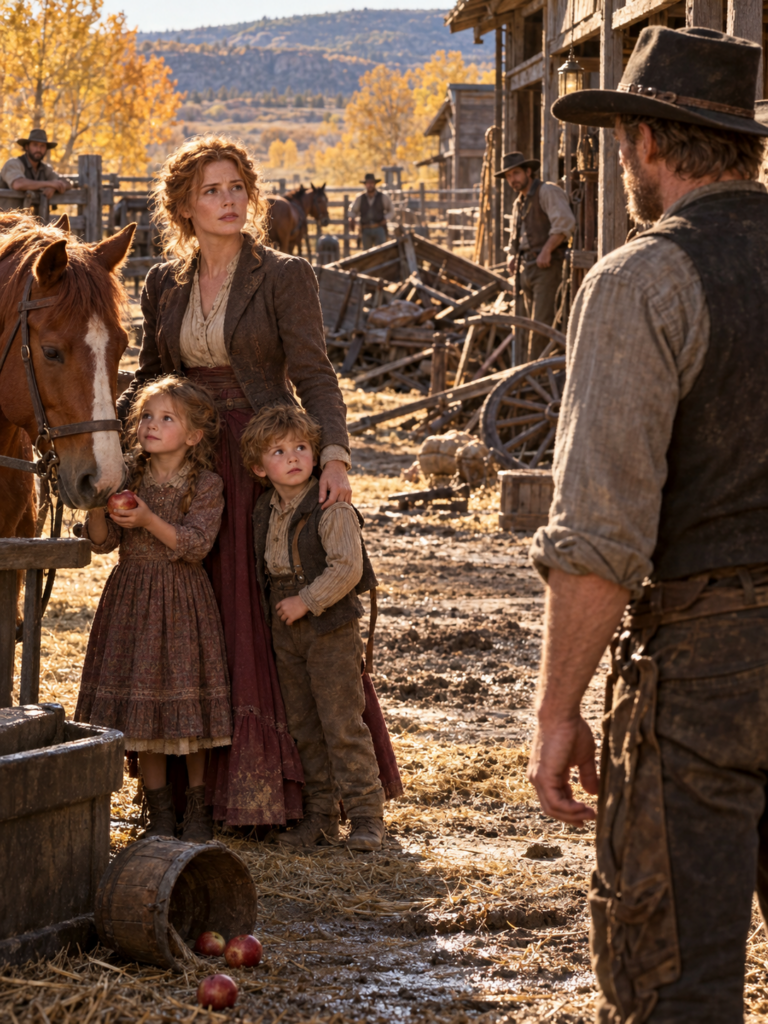
Rhett took one step toward Clara, but she lifted her hand, asking him to stop.
He stopped.
“I didn’t know this was your ranch,” she said.
The words caught him off guard.
“What?”
“Our wagon broke down three miles east. Someone told the driver there was a ranch nearby where the wheel might be repaired. By the time I saw your name on the gate, we were already coming into the yard.”
Rhett looked past her toward the damaged wagon.
A ranch hand was lifting the rear axle while another examined its cracked iron fitting.
“So you weren’t looking for me.”
“No.”
There was no cruelty in her answer.
Only truth.
Somehow that made it harder.
“Where were you going?”
“Bellweather. I’ve accepted bookkeeping work with a freight company there.”
He knew the town.
Roughly twenty miles farther along the road.
Close enough to ride in a day.
Far enough that five years might have passed without their meeting.
“And the children?”
“They’re coming with me.”
He looked at Nell, now standing beside the cook with an enormous biscuit in her hand.
Emmett had already returned to the broken wagon and was asking Caleb whether iron could become tired.
“They’re mine,” Rhett said.
Clara held his gaze.
“Yes.”
He pressed his hand against the stable doorframe.
He had imagined fatherhood someday.
After the house was finished.
After the ranch could survive a bad winter.
After he had enough money to ensure his children would never know the poverty he remembered.
He had never considered that children might arrive before he finished preparing for them.
“You should have told me.”
Clara’s face tightened.
“I did.”
The words were barely louder than a whisper.
Rhett shook his head.
“No.”
“I wrote to you.”
“Clara, I never received—”
“Three letters.”
He fell silent.
“The first came after Doctor Talbot told me I was expecting a baby. The second asked whether you’d received the first. The third told you there were twins.”
Rhett felt cold despite the afternoon heat.
“I didn’t receive them.”
She studied him.
For a moment, he thought she might turn away.
Instead, she asked, “Where did you collect your mail?”
“Coyote Ridge Post Station.”
“That’s where I sent it.”
The answer seemed to settle between them.
Rhett remembered the old station.
The changed stage route.
The months when mail went through the county office irregularly after the bridge farther east became unusable.
He remembered asking about missing letters.
Being told there were none.
“I wrote to you, too,” he said.
Clara’s eyes widened.
“When?”
“Six weeks after I arrived. Again at Christmas. Again in spring.”
She looked as though she had been struck.
“I never received anything.”
“My last letter came back because you’d left your address.”
“Yes,” she whispered. “I moved.”
Rhett drew a shaky breath.
“I thought you’d chosen another life.”
Clara looked toward the children.
“I thought you’d already made that choice yourself.”
A horse stamped behind them.
Neither spoke.
For five years, Rhett had told himself Clara had gone because she would not wait.
For five years, Clara had believed he knew about the children and wanted nothing to do with them.
But now a different possibility stood between them.
What if neither had known?
What if the silence that separated them had never been deliberate?
Rhett looked toward the stable office.
“I kept the old mail records. The papers from when the post station closed. They’re in a box inside.”
“Rhett—”
“Perhaps something was forwarded.”
“You don’t know that.”
“No. But I can look.”
He entered the office.
Clara followed after a moment.
On the workbench stood a wooden box filled with old receipts, land documents, feed invoices, and correspondence.
Rhett removed the lid.
Dust rose into the afternoon light.
He untied one bundle.
Then another.
Clara watched while he searched.
A yellowing envelope slipped from between two papers and fell to the floor.
She bent to retrieve it.
Then froze.
Rhett saw her face.
“What is it?”
She stood slowly.
In her hand was an envelope bearing his name.
Written in her handwriting.
The seal was unbroken.
Rhett reached for it, but stopped before touching it.
Clara turned it over.
Several faded postal markings crossed the back.
The letter had been forwarded after the Coyote Ridge station closed.
Then, somehow, it had ended up among old ranch papers.
Rhett stared at it.
“How long has that been here?”
Clara examined the date.
Her voice broke.
“Almost four years.”
For a moment, he could not move.
The answer he’d waited for had been inside his own stable.
He had built walls and fences around the life he thought Clara had rejected.
And in an old wooden box, beneath worthless receipts, lay proof that she’d tried to reach him.
Clara held out the letter.
“It belongs to you.”
Rhett took it with shaking hands.
He slid one finger beneath the seal.
The old paper began to open.
The paper tore softly beneath Rhett’s finger.
He opened the envelope and withdrew two folded sheets.
Clara stood across the workbench, watching him.
She remembered writing those pages.
The lamp in her rented room had burned low. Her hands had trembled. Outside, the boarding house had been quiet except for the creaking floorboards and an old woman coughing downstairs.
She had been frightened then.
Frightened of becoming a mother without knowing whether the children’s father intended to return.
Rhett began to read.
The letter told him about Doctor Talbot.
About the sickness that had sent her to his office.
About the physician’s belief that she was expecting a child.
It said she did not know what the news would mean for Rhett’s plans.
It said she understood that the ranch mattered to him.
Then came the line that stopped him.
She wanted him to know before either of them decided what came next.
Rhett lowered the page.
“You weren’t asking me to give up the ranch.”
“No.”
“You weren’t asking me for money.”
“I didn’t know what I wanted to ask yet.”
He looked at the date.
The letter had been written only weeks after he left.
He remembered those weeks.
Digging around the old well.
Sleeping in a house where wind entered through the walls.
Counting every dollar before buying nails.
He had thought himself lonely.
Now he understood what loneliness had looked like hundreds of miles away.
“Clara,” he whispered, “you were going through this alone.”
She folded her arms.
“Not entirely. Mrs. Alden helped while I was still at the boarding house. Later my aunt Lydia took me in.”
“Your aunt?”
“My mother’s older sister. She lived north of Fairhaven.”
Rhett shook his head.
“I didn’t know.”
“There are a great many things you don’t know.”
He accepted that.
He looked down at the letter again.
“This was in my own records.”
“Yes.”
“I should have found it.”
“You didn’t know to look for it there.”
“That doesn’t make it better.”
“No,” Clara agreed. “But blaming yourself for a lost letter won’t change what happened.”
He searched through the remaining papers.
For nearly twenty minutes they sorted receipts and correspondence together.
They found no second or third letter.
Rhett remembered the months following the post station’s closure, when a temporary ranch hand had gathered forwarded papers while Rhett was away working with a cattle drive to cover his first winter’s losses.
Some letters had been returned.
Others had been stored.
A few might never have arrived.
There was no way to know the fate of every piece of missing mail.
But the letter on the workbench established something neither could deny.
Clara had written.
Rhett had never opened it.
And both had built five years of understanding around a silence that might never have been intended.
“What happened after you sent the others?” Rhett asked.
Clara leaned against the stable wall.
“I waited.”
He closed his eyes.
“At first I thought the ranch was keeping you busy. Then I wondered whether you were angry. When the second letter went unanswered, I began to think you’d made up your mind.”
“And after the third?”
“I stopped expecting anything.”
He looked at her.
“Did you believe I knew about the twins?”
“Yes.”
The answer was hard to hear.
“I wouldn’t have abandoned my own children.”
“I believe that you’re saying so now.”
He flinched.
Clara softened, but did not withdraw the truth.
“Rhett, I had already heard you explain why the ranch had to come before our life together. When there was no answer, I believed the children had become another part of that life you wanted to postpone.”
He looked toward the open stable doors.
“I thought I was trying to protect you.”
“I know.”
“I didn’t want you living under a leaking roof or carrying water from a nearly dry well.”
“I told you I could bear those things.”
“Yes.”
“You were afraid I’d suffer if you weren’t successful.”
He nodded.
“And you were so certain of what I needed that you never let me decide.”
Rhett stared at the letter.
He remembered his father.
Silas Daugherty, a hired cattleman whose hands had stiffened from years of work.
When Silas died, his possessions barely filled a wooden chest.
Rhett had been determined never to leave a family with so little.
Now he had land, cattle, horses, savings, and a fine house.
And he had not been there when Clara needed him.
“What were the births like?” he asked.
She looked toward the yard.
“The twins came early.”
Rhett raised his head sharply.
“Were they ill?”
“They were small. Emmett had trouble keeping warm.”
He swallowed.
“And Nell?”
“She was stronger, though neither was large.”
“Were you frightened?”
Clara gave him a tired look.
“More than I’ve ever been.”
He wanted to ask a dozen questions.
Who had held her hand?
Who had fetched the doctor?
Who had stayed awake when Emmett struggled?
Who had carried Nell when Clara was exhausted?
Instead, he asked one.
“Were you cared for?”
“My aunt Lydia saw to that.”
He nodded, grateful for a woman he had never met.
Clara looked at him.
“Rhett, you can’t recover every day you missed by hearing about it all in one evening.”
“I know.”
But he was beginning to understand that knowing it would be different from accepting it.
***
The wagon repair was completed before sunset.
The blacksmith had replaced the cracked iron fitting, and Caleb had checked the wheel carefully before declaring it fit for the road.
The travelers decided to remain overnight.
The narrow stretch west of the ranch would be difficult in darkness.
Rhett offered lodging in the house and bunkhouse.
Clara accepted a bedroom for herself and the children.
He did not insist on speaking further that night.
When supper was served, he sat at the far end of the long dining table.
Nell counted the chairs.
“Why do you have eight?”
Rhett looked around.
“Because the carpenter made eight.”
She frowned.
“That’s not a very good reason.”
“No,” he admitted. “I suppose it isn’t.”
Emmett asked whether the stable roof was made of the same timber as the house.
Rhett explained that some of the beams in the stable came from the old barn, while the rest were newer.
The boy listened intently.
Then he asked why Rhett hadn’t used all the old beams.
“Because some weren’t sound enough.”
“Did you break them to find out?”
“Some I could tell by looking. Others I tested.”
Emmett considered this.
“I’d like to test something.”
Clara looked sharply at him.
“Not tonight.”
Rhett nearly smiled.
After supper, the twins grew sleepy.
Nell allowed her mother to lead her upstairs, though she insisted on asking whether the gray horse would still be there in the morning.
Emmett followed with less protest.
Rhett remained downstairs.
He listened to their small footsteps overhead.
His children were sleeping in his house.
He could scarcely believe it.
He had built four bedrooms because the plans looked proper that way.
He had never imagined two of those rooms might someday contain children who already belonged to his life.
That night, Rhett slept little.
He looked at the ceiling and thought of four birthdays.
Four winters.
Four springs.
He wondered when Emmett had learned to walk.
Whether Nell had ever been afraid of horses.
Whether either child had asked about him.
Toward dawn, he stopped trying to sleep.
He dressed and went down to the kitchen.
Clara was already there, holding a cup of coffee.
He sat opposite her.
“I can provide for them.”
She looked up.
“I know you can.”
“I can set aside money for their education. Land when they’re older. Whatever they need.”
“Rhett—”
“The house is large enough. They could each have a room. You could have a room of your own if you preferred.”
She placed her cup on the table.
“Stop.”
He fell silent.
She studied him carefully.
“You learned yesterday that you have two children. And now you’re trying to arrange their whole future before you’ve spent a morning with them.”
“I’m trying to take responsibility.”
“I understand.”
“Then why does it sound as if I’m doing something wrong?”
“Because you’re still trying to build your way out of something that requires you to be present.”
The words struck painfully close to an old wound.
Clara leaned forward.
“Money matters. I know that better than you might imagine. But Nell won’t remember the size of your bank account when she wants someone to listen to her talk about horses.”
Rhett looked down.
“And Emmett won’t need a hundred acres when his little wagon breaks. He’ll need someone willing to sit beside him and help fix it.”
He said nothing.
“They don’t need a house full of things from a man they barely know. They need to know whether he’ll come when he says he will.”
Rhett looked at her.
“What should I do?”
Clara’s expression softened.
“Start slowly.”
He waited.
“Let them know you. Don’t ask them for love before you’ve given them time to understand who you are.”
He nodded.
“And if I come to see them?”
“Then come because you mean to continue coming.”
There was no accusation in the words.
Only the fierce practicality of a mother who had spent four years protecting her children from promises she could not guarantee.
***
The travelers prepared to leave shortly after breakfast.
Rhett had the horses watered and the wagon inspected once more.
Clara emerged carrying her leather case.
Nell held one of her hands.
Emmett carried a small wooden wheel he had found in the discarded pieces from the repair.
Rhett approached carefully.
“Clara, may I visit you in Bellweather?”
She looked at him.
“Why?”
“Because I’d like to know the children.”
“They don’t know who you are yet.”
“I understand.”
“I’ll tell them when we arrive and have time to talk privately.”
“All right.”
“Don’t expect them to understand five years of history.”
“I don’t.”
Clara considered him.
“Sunday afternoon,” she said. “You could visit then.”
Rhett nodded.
“I’ll come.”
Her eyes narrowed.
“Don’t say it just because you’re frightened they’ll leave.”
He looked at Nell and Emmett.
Then back at Clara.
“I’ll make the arrangements I need to make, and I’ll be there.”
She held his gaze.
For the first time, she seemed willing to believe him.
Nell tugged at her skirt.
“Can Mr. Daugherty come see us?”
Clara looked down.
“Would you like that?”
Nell nodded.
“He knows horses.”
Emmett spoke quietly.
“He knows why wheels break.”
Rhett smiled.
“I know a little about both.”
The children climbed onto the wagon.
Clara followed.
For a moment, Rhett stood beside the wheel that had brought them together.
Five years earlier, he had driven away from Clara before sunrise.
He had been the one holding the reins.
Now she sat above him, ready to continue toward a life she’d made without him.
He could not ask her to abandon it.
“Clara,” he said.
She looked down.
“Thank you for letting me come.”
She studied his face.
“Don’t thank me yet.”
Then she settled beside the children.
The driver gathered the reins.
The wagon rolled forward.
Rhett watched until it passed through the gate.
This time, he did not tell himself that everything would begin when his work was finished.
He turned toward the foreman approaching from the corral.
“Caleb, I need to arrange for somebody to cover my duties next Sunday.”
Caleb raised an eyebrow.
“Something important?”
Rhett looked down the road where the wagon had disappeared.
“Yes,” he answered. “Something I should have made time for long ago.”
Caleb removed his hat and studied the ranch owner.
For six years, Rhett Daugherty had been the first man working and often the last to leave.
He inspected cattle before breakfast.
Checked the fences personally.
Rode out when a hired hand could have handled the task.
And complained whenever anything interrupted the day’s work.
“Sunday?” Caleb repeated.
“Yes.”
“What if the west fence gives trouble?”
“Then you repair it.”
“And if the buyer from the county seat arrives?”
“You know the prices.”
Caleb looked almost amused.
“Are you feeling well, boss?”
Rhett smiled faintly.
“For the first time in a while, I think I might be.”
He went inside.
The great dining table stood empty.
Eight chairs.
For five years, he’d imagined that completing the ranch would mean completing his life.
But the house was finished.
The fences stood.
The cattle were healthy.
And the people he loved had learned to live without him.
He understood now that becoming worthy of a family was not the same as participating in one.
***
The following Sunday, Rhett rode to Bellweather.
He carried no gifts.
That had been difficult.
He had passed a shop selling carved wooden animals and nearly purchased two.
Then he remembered Clara’s words.
The children needed to know him.
Not his money.
Not his land.
Him.
Clara lived in a modest rented house near the freight office where she had taken employment.
There was a narrow yard, a small vegetable patch, and a shed where she kept leather tools and supplies.
Rhett noticed a length of harness hanging beside the door.
“You still repair tack?” he asked when she greeted him.
“When the accounts allow time.”
He examined the stitching.
“That’s fine work.”
“I’ve had practice.”
She said it without modesty.
Rhett appreciated that.
The Clara he remembered had been capable and determined, but the woman standing before him now had learned to trust her abilities without waiting for his approval.
He understood that she had become someone new during the years apart.
Someone he would have to learn rather than assume he already knew.
Inside, Nell was arranging carved wooden animals on the floor.
Emmett sat beside a small wagon with a loose wheel.
Clara brought Rhett into the room.
“You remember Mr. Daugherty.”
Nell nodded.
“The horse man.”
Emmett looked up.
“The wheel man.”
Rhett smiled.
“I’ve been called worse.”
Clara knelt beside the twins.
“We’ve talked about your father.”
Nell glanced at Rhett.
“Are you him?”
“Yes,” Rhett answered.
She considered that.
“Why don’t you live here?”
“Because I live at the ranch.”
“Why?”
“Because I bought it and worked there.”
She frowned.
“That doesn’t explain why you weren’t here before.”
Rhett looked toward Clara.
She did not rescue him from the question.
He looked back at Nell.
“Your mother and I lived in different places before you were born. I didn’t know about you then. I found out when we met at the stable.”
Nell thought about this.
Then she looked at Emmett.
“Does that mean he is your father, too?”
Emmett examined Rhett’s face.
“I suppose.”
Clara smiled.
“Yes, sweetheart. He’s father to both of you.”
Nell accepted that with surprising ease.
“Would you like to see my horses?”
Rhett looked around the room.
There were three little wooden figures on the rug.
He sat down.
“I’d be honored.”
For the next hour, he learned that Nell had named one wooden horse Buttercup, another Thunder, and a third Mr. Apple.
Thunder was apparently afraid of bridges.
Buttercup was brave.
Mr. Apple had a dreadful temper.
Rhett listened seriously.
When Nell asked whether real horses were ever afraid of bridges, he told her they sometimes were.
She asked why.
He explained.
Then she asked again, using slightly different words.
He explained again.
By the sixth question, Rhett understood what Clara had meant about giving children an ordinary afternoon.
There was no important decision to make.
No pasture to inspect.
No bargain to negotiate.
Only a little girl who wanted him to listen.
And he was glad to do it.
***
He returned the following Sunday.
And the one after that.
By the fourth visit, Nell had begun waiting by the front window when she knew he was coming.
That frightened Clara a little.
She had spent years making certain her children did not build their happiness around an absent man.
Now she watched them develop expectations.
Rhett noticed her uneasiness.
One afternoon, after the twins had gone outside to play, he spoke to her.
“I know what you’re afraid of.”
She looked up from her ledger.
“Do you?”
“You think I may grow tired of coming.”
“Or that the ranch will become difficult and you’ll decide this can wait.”
He accepted the words without protest.
“I understand.”
“It’s not only you, Rhett. They’ve had a steady life. I can’t ask them to arrange themselves around a promise that might disappear.”
He looked toward the window.
Nell was showing Emmett how to lead an imaginary horse with a piece of string.
“Then I’ll have to show them I’m dependable.”
“Yes.”
“Not tell them.”
“Exactly.”
Rhett nodded.
And for the first time, he understood that trust could not be purchased with one grand gesture.
It had to be earned repeatedly.
***
Winter arrived.
The first heavy cold brought extra work to Daugherty Ranch.
A section of the western fence failed after a hard wind.
Two cattle strayed onto the neighboring pasture.
Caleb sent word that the repairs would take most of a day.
It happened on a Sunday.
Rhett was already preparing to ride to Bellweather.
He considered returning to the pasture himself.
Then he looked at the foreman.
“You know how to handle it.”
Caleb nodded.
“Yes, sir.”
“Then handle it.”
Rhett mounted.
The ride to town was cold.
By the time he reached Clara’s house, his gloves were stiff and his horse needed rest.
Clara opened the door.
“You came.”
“I said I would.”
She looked past him toward the overcast sky.
“I thought the weather might delay you.”
“It slowed me.”
He stepped inside, carrying no parcels.
Emmett emerged from the sitting room holding his wooden wagon.
“The wheel came off.”
Rhett took off his gloves.
“Then we’d better see about it.”
They sat together on the back step, sheltered from the wind.
Emmett showed him the worn wooden peg.
Rhett examined it.
“You see what’s happened?”
The boy shook his head.
Rhett held out the piece.
“Look at the end.”
Emmett frowned.
“It’s smaller.”
“That’s right. It’s worn down, so the wheel slips loose.”
“Can you fix it?”
“We can.”
He showed Emmett how to smooth a replacement peg with a small file, guiding the child’s work and taking care that the tool remained under his supervision.
Emmett concentrated fiercely.
His tongue pressed against one corner of his mouth.
Rhett recognized the expression.
When the peg finally fit, the boy pushed the wagon across the step.
The wheel stayed on.
Emmett looked delighted.
“It works!”
“It does.”
He rolled it again.
Then inspected the wheel carefully.
“I might take it apart later.”
Rhett laughed.
“I expect you will.”
From the doorway, Clara watched them.
There had once been a time when she’d imagined Rhett as a father.
She had pictured him teaching a child to handle tools, explaining how horses moved, answering difficult questions with patient certainty.
Then she’d stopped allowing herself those pictures.
Now one stood before her.
Not as she had imagined it.
Not beginning with a wedding or a nursery in a fine house.
Just a man on a cold back step, helping a little boy mend a wooden wheel.
She looked away before Rhett could see her tears.
***
The months passed.
Rhett learned the children’s habits.
Emmett liked to take apart anything that could be put back together.
Nell loved horses with an intensity that sometimes exhausted everyone around her.
She disliked having her hair combed but would stand patiently while Rhett showed her how to brush a horse’s coat.
She asked questions constantly.
Why did horses move their ears?
Could they remember people?
Why were some afraid of water?
Did mares know their foals when they grew older?
Rhett answered what he knew.
When he didn’t know, he said so.
Nell seemed to respect that.
Emmett preferred to watch before participating.
He would examine a hinge or wheel with intense concentration, then ask one question that showed he’d noticed something the adults had overlooked.
Rhett learned not to rush him.
He also learned how much Clara had accomplished.
She kept the household accounts.
Worked for the freight company.
Repaired harness for extra income.
Managed clothing, meals, schooling preparations, and the countless small responsibilities of raising two children.
She did not complain about the work.
But Rhett began to understand its weight.
One evening, after the twins were asleep, he found her mending a leather strap by lamplight.
“You ought to rest.”
She raised an eyebrow.
“Will the strap repair itself?”
“No.”
“Then there you have it.”
He sat opposite her.
“Could I help?”
She considered him.
“You could cut the replacement piece.”
He reached for the leather.
She showed him where to mark it.
He worked carefully.
For a while, they spoke only about the repair.
Then Rhett asked, “Did you ever think about marrying someone else?”
Clara’s hands became still.
“Why?”
“I wondered.”
She resumed stitching.
“There were men who asked.”
He nodded.
“I expect there were.”
“But I had two children to raise and work that needed doing. I wasn’t prepared to promise anyone a life together merely because he offered comfort.”
Rhett looked down.
“Did you stop loving me?”
Clara paused.
It was the question he’d feared asking for months.
“I stopped waiting for you,” she answered.
He looked up.
“That isn’t quite the same.”
“No.”
She drew the thread through the leather.
“But I’m not the woman you left, Rhett.”
“I know.”
“Do you?”
He considered that.
“I’m beginning to.”
She set down the strap.
“And you’re not the man who rode away.”
“No.”
They sat quietly.
Whatever remained between them was real.
But neither wished to build another future on assumptions.
***
In May, Rhett came to help repair a section of fencing behind Clara’s rented house.
The day was warm.
Nell and Emmett played in the adjoining paddock while Clara and Rhett worked with rails and wire.
Rhett was tightening a fastening when Emmett called from the gate.
“Dad!”
Rhett stopped.
The word hung in the morning air.
He turned slowly.
Emmett was struggling with the lower bolt.
“Dad, this gate won’t open.”
Rhett crossed the yard.
The boy looked annoyed rather than emotional.
The moment meant nothing extraordinary to him.
He simply needed help.
Rhett lifted the gate slightly and freed the bolt.
“See? The weight was pressing it down.”
Emmett tried it himself.
The bolt slid back.
“Oh.”
Then he ran through the gate.
Rhett remained standing there.
His hands rested on the wood.
For four years, he’d missed every moment in which a father might become familiar to a child.
He had imagined the first time one of the twins called him Dad.
In those imaginings, there had sometimes been tears.
Sometimes an embrace.
Sometimes a grand declaration.
Instead, his son had needed a gate opened.
And Rhett had been there.
Clara stood beside the fence holding a coil of wire.
She had heard.
Their eyes met.
She smiled gently.
Rhett swallowed and returned to work.
Neither spoke of it.
Neither needed to.
***
Later that summer, Clara’s sister sent word that she could come for a visit with the children.
Rhett helped prepare the wagon.
He checked the wheels, examined the harness, and made sure the horses were fit for travel.
But when Clara explained her plans, he did not ask her to change them.
“How long will you be gone?” he asked.
“About two weeks.”
He nodded.
“The children will enjoy it.”
Nell looked up.
“Will you come, too?”
“Not this time.”
“Why?”
“Because I have work at the ranch.”
She frowned.
“Will you be here when we come back?”
“Yes.”
Clara watched him.
For the first time, the promise did not make her uneasy.
He had been coming for months.
Through cold and rain.
Through broken fences and difficult weeks.
He had become part of the children’s lives because he kept making room for them in his own.
When the wagon left, Rhett watched it disappear down the road.
He missed the children.
He missed Clara.
But this time, absence was not the same as abandonment.
They knew where he was.
He knew where they were.
And when they returned, there would be more ordinary days waiting.
***
One year after the broken wagon had arrived at Daugherty Ranch, the twins returned to the stable deliberately.
It was early autumn.
The afternoon sun lay golden across the corrals.
Nell was chasing Emmett along the path, insisting that he had hidden something belonging to her.
Emmett denied it while running much too quickly for an innocent boy.
Their laughter reached Rhett before he saw them.
He stepped out of the stable.
“What’s all this?”
“He took my brush!” Nell declared.
Emmett stopped.
“I borrowed it.”
“You hid it!”
“I was fixing something.”
“With a horse brush?”
Emmett considered that.
“It was part of my plan.”
Rhett covered a smile.
Nell planted her feet.
“Dad, tell him he has to give it back.”
He looked between them.
“Emmett, did you borrow your sister’s brush without asking?”
The boy hesitated.
“Yes.”
“Then return it.”
Emmett sighed.
From behind his back, he produced the brush.
Nell seized it triumphantly.
A moment later, they were running again.
Rhett watched them go.
A year earlier, they had called him Mr. Daugherty.
Now they called him Dad without thinking.
He had not earned that word by owning the largest ranch nearby.
He had earned it by arriving.
Again.
And again.
Clara sat on the porch with a ledger open across her knees.
She still lived in Bellweather.
The children still had their rooms in the modest house near the freight office.
Rhett had not asked her to surrender that independence.
Sometimes they visited the ranch.
Sometimes he ate supper in town.
Sometimes the children stayed overnight with Clara.
Their lives had grown connected without anyone being forced to abandon the life already built.
Rhett walked toward the porch.
“Working?” he asked.
Clara looked up.
“Your supply figures.”
He smiled.
“I thought you were going to rest today.”
“I was. Then I saw what you’d paid for feed last month.”
He sat beside her.
“Bad?”
“Not ruinous.”
“That sounds encouraging.”
“It should. You’re improving.”
She closed the ledger.
For a while, they watched the children.
Beyond the corrals stretched the land Rhett had spent six years building.
The original acreage.
The well he’d nearly lost.
The northern pasture where cattle now grazed.
The new stable with its wide doors and sound beams.
The house with its long porch and eight chairs around the dining table.
There had been a time when he believed every acre proved he’d made the right choice.
Now he understood that the land had never been the whole dream.
He had wanted security because he’d grown up without it.
He had wanted a home because his father had worked an entire lifetime without owning one.
Those desires were not wrong.
But he’d mistaken preparation for living.
He looked at Clara.
“Do you ever wonder what would have happened if I’d asked you to come west with me?”
She considered the question.
“Sometimes.”
“I was afraid you’d suffer.”
“I probably would have.”
He smiled sadly.
“The roof leaked.”
“I remember you telling me.”
“The well nearly failed.”
“I know.”
“I lost nine cattle that first winter.”
She looked at him.
“That must have been terrible.”
“It was.”
He paused.
“But I think you would have helped me through it.”
Clara’s expression softened.
“I would have tried.”
“I should have let you decide.”
“Yes,” she answered gently. “You should have.”
He nodded.
There was no need to defend himself anymore.
He had spent too many years doing that.
After a while, he said, “I don’t know exactly what happens with us.”
Clara looked toward the children.
“Neither do I.”
“I love you.”
She turned back.
“I know.”
“I don’t say it expecting an answer.”
“I know that, too.”
Rhett rested his hands on his knees.
“I’m not asking you to move here. I’m not asking you to give up your work. And I’m not asking you to pretend the last five years didn’t happen.”
Clara watched him quietly.
“I only want to keep building the life we have now, whatever shape it takes.”
She looked toward the stable.
Emmett had stopped running and was examining a loose board near the door.
Nell stood beside the gray mare, talking softly as she brushed its coat.
Their children.
Healthy.
Curious.
Loved.
Clara felt the old ache of what had been lost.
But alongside it was something else.
A growing certainty that the future did not have to repeat the past.
She reached across the space between them and took Rhett’s hand.
“Then we keep building,” she said.
He turned toward her.
“Together?”
“As long as we’re both willing to make room for one another.”
Rhett smiled.
“I can do that.”
Clara’s eyes softened.
“You’ve been learning.”
They remained on the porch while the evening light slipped lower.
No wedding was announced.
No promise was made that every hurt had disappeared.
They had children to raise, work to do, and years of change still to understand.
But they had stopped waiting for the perfect moment to begin.
Later, when supper was ready, Rhett called the twins into the house.
Emmett hurried toward the door.
Nell came more slowly, reluctant to leave the horses.
Clara followed.
Inside, the large dining table stood beneath the warm light.
For years, Rhett had sat there alone, surrounded by chairs he’d purchased for a family that had never arrived.
Tonight, Nell chose the chair beside him.
Emmett dragged another closer so he could show his father a small wooden wheel.
Clara sat opposite them.
Rhett looked around the table.
Four people.
Eight chairs.
Nothing was perfect.
Nothing was finished.
But he no longer needed it to be.
Nell interrupted his thoughts.
“Dad?”
“Yes?”
“Why did you build such a big stable?”
He smiled.
“Because I thought one day I might need the room.”
She considered that.
“Were you right?”
Rhett looked at Emmett, then at Clara.
Clara was watching him with quiet affection.
He reached across the table and rested his hand beside hers.
“Yes,” he said.
“I think I was.”
Outside, the horses settled for the night.
Beyond the windows lay the ranch he’d once believed would give him everything.
But the richest part of his life was no longer measured by its fences, cattle, buildings, or acres.
It was measured in the ordinary moments he had finally learned not to miss.
A boy asking for help with a broken wheel.
A girl wanting one more answer about horses.
A woman whose hand rested willingly near his own.
Five years earlier, Rhett Daugherty had left the woman he loved because he believed he needed to build a home before he could offer her a life.
Now he understood what Clara had tried to tell him beside that old stable long ago.
A home was not something a man finished before inviting the people he loved inside.
It was something they made together, day after day, while life was happening.
And this time, Rhett was there to live it.


