
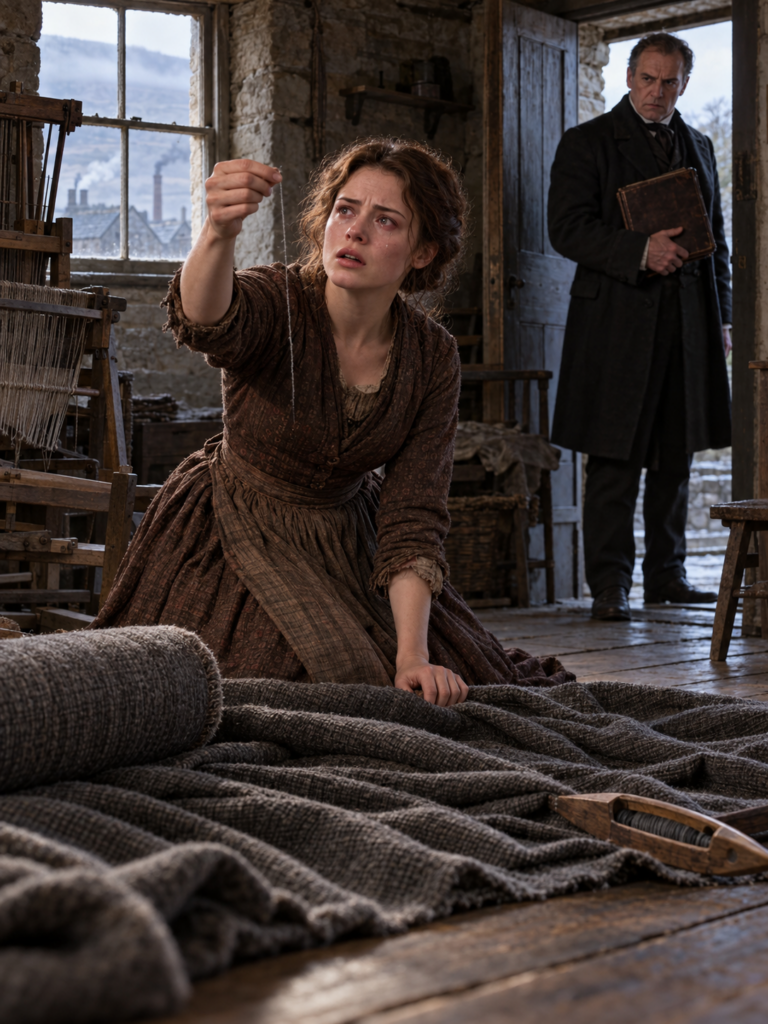
Ruth drew the first column down the page, then another beside it.
Alice steadied the paper while Ruth copied the eleven irregularities.
The ink was barely dry before their first difficulty became obvious.
If the measurements represented money, the figures made no sensible accounts.
Some suggested large sums. Others seemed worth only pennies.
Alice removed her spectacles.
“Perhaps the spaces between the flaws matter less than we thought.”
“But he measured them so carefully.”
“Exactly. They hardly change. A message cannot depend upon a measure that remains almost the same.”
Ruth stared at the wool.
“So the intervals separate the entries.”
“Perhaps.”
“And the wrong threads carry the figures.”
They worked until darkness pressed against the windows.
By then, Ruth’s fingers were stiff from handling the heavy cloth.
Alice persuaded her to stop and brought her home to the schoolhouse, where there was coal enough for a proper fire.
But Ruth could not rest.
The mill had taken the loom.
The cottage would soon follow.
And now her grandfather’s final work seemed to be asking something of her that she could not yet understand.
On the second evening, she nearly abandoned the attempt.
“Perhaps he was simply ill,” she whispered.
Alice looked over her spectacles.
“An ill man’s hand might slip. It would not slip eleven times at measured distances, each time in a different fashion.”
“But what if I’m trying to find a message that isn’t there?”
“Then we’ll discover that by checking, not by surrendering.”
Ruth gave a tired smile.
“That sounds like something Grandfather would say.”
They returned to the figures.
The distances from the cloth’s edge varied widely.
Nine threads.
Fifteen.
Twenty-two.
Thirty-one.
But the lengths of the raised floats followed a peculiar limit.
None exceeded seven picks.
Ruth counted them once more.
“Seven.”
Alice glanced up.
“What?”
“Every float is between one and seven picks.”
“Days of the week?”
“Possibly.”
Alice reached toward an old local almanac.
Then Ruth suddenly gripped her wrist.
“Seven cottages.”
Alice frowned.
“What cottages?”
“Weaver’s Row.”
The schoolmistress went still.
Seven stone houses stood below the weaving sheds.
Seven households whose yarn advances and finished work had long passed through Elias Thorne’s hands.
Her grandfather had lived in the fourth.
He had served as head weaver of that row for years, checking the work and keeping accounts before carrying his totals to the mill office.
“The float length tells us the cottage,” Ruth said.
“And the distance from the edge gives an amount?”
“That’s what I think.”
Alice looked again at the measurements.
“Then perhaps these are debts owed by the families.”
Ruth shook her head.
“Why would he hide debts the mill was entitled to collect?”
The question remained unanswered.
Ruth rose and walked toward the fire.
Then she remembered old Sarah Pike at the seventh cottage, struggling to work her loom when pain had stiffened her hands.
Her grandfather had forgiven Sarah’s yarn arrears.
Ruth had seen him wipe the figures from his chalked tally.
She remembered the Emmett family too, and the winter their child had nearly died.
Elias had forgiven their debt as well.
She turned sharply.
“Alice, what if these aren’t debts still owed?”
“Then what are they?”
“Debts Grandfather had already canceled.”
Alice was silent.
Ruth returned to the table.
“The head weaver could approve those allowances. Grandfather did. I saw him.”
“And the mill accepted them?”
“He reported them to Skerrow.”
She looked down at the wool.
“But what if Skerrow never removed them from the office accounts?”
Alice’s face changed.
Ruth continued, speaking more quickly.
“What if the mill still believes those families owe money? What if interest has continued to grow on debts already forgiven?”
“And your grandfather discovered it?”
“Perhaps.”
Ruth glanced toward the cottage window, beyond which the great sheds stood black against the night.
“That might explain why Skerrow wouldn’t show me his ledger.”
“And why your grandfather hid another record.”
The thought should have brought relief.
Instead, Ruth felt frightened.
If she was right, the cloth threatened a powerful man.
If she was wrong, she was building accusations against someone on nothing but crooked threads.
Alice pointed to the fourth set of marks.
“Then explain this entry.”
Ruth leaned over the page.
The fourth cottage.
Her grandfather’s own home.
Its mark was unlike the others.
A single balanced float, inclined neither left nor right.
She touched it with one finger.
“I don’t know what that means.”
Alice waited.
Ruth looked toward the shawl hanging by the door.
“My grandfather never put anything in his accounts that couldn’t be checked. There must be another rule.”
“Where?”
Ruth lifted the edge of the gray wool.
“I think it’s in the direction of the threads.”
Then she began following each tiny raised bar toward its nearest selvage, searching for the distinction that might tell them whether a number meant pounds or shillings.
Ruth followed the first raised thread toward the right-hand selvage.
The short bar slanted in that direction.
She checked the next.
It leaned left.
The third pointed right again.
Alice moved the lamp closer.
“What do you see?”
“Two kinds of marks,” Ruth answered. “Not merely long and short. Left and right.”
She spread a fresh sheet of paper on the table.
“The length of the float tells us the cottage. But the direction must tell us how to read the money.”
Alice studied the figures.
“Pounds and shillings?”
“That’s my thought.”
They spent another hour comparing the eleven faults.
Ruth counted inward from the appropriate selvage, choosing the nearer edge according to the direction of each mark.
At last a recognizable pattern emerged.
A float leaning left indicated pounds.
One leaning right indicated shillings.
The small count of picks identified the cottage.
The distance from the edge gave the amount.
It was awkward, but Elias Thorne had never been a man who prized elegance above certainty.
He preferred a method that another careful worker could repeat.
Ruth began checking the entries against what she remembered of Weaver’s Row.
The first cottage belonged to the Emmetts.
Their child had been desperately ill during the previous winter. With work interrupted and medicine to purchase, they had fallen behind on the yarn supplied by the mill.
Elias had forgiven two pounds and four shillings.
Ruth still remembered the relief on Mrs. Emmett’s face.
And the cloth contained the corresponding marks.
The seventh cottage belonged to Sarah Pike.
Two pounds forgiven when her hands could no longer work reliably.
Again the figures agreed.
At the third cottage, eighteen shillings had been canceled.
Ruth remembered that account as well.
They worked through the remaining entries.
Each successful reading made the next one easier.
By dawn, the pattern was no longer merely plausible.
It could be checked against events Ruth remembered and against households where Elias had exercised his authority as head weaver.
But the fourth cottage remained different.
Her grandfather’s own.
Its mark leaned neither way.
There was no amount attached.
Ruth stared at it for a long time.
Then she understood.
“He says he owed nothing.”
Alice looked up.
“What?”
“The fourth house is his. And this mark carries no sum. It’s the only entry with neither a pound nor a shilling value.”
She pressed a finger against the wool.
“He put himself into the account to say there was no debt.”
The words brought a sudden ache to her throat.
For weeks, she had heard people describe her grandfather as a failing old man whose accounts had fallen into confusion.
Yet the cloth showed a mind still careful enough to hide numbers inside a woven pattern.
Elias had been recording the truth when others were calling him incapable of managing his own affairs.
Ruth wiped her eyes with the back of her sleeve.
Alice waited until she was ready.
Then she asked the question that mattered most.
“How can we prove Skerrow’s book still carries these sums?”
That was where the danger lay.
The woven account could show what Elias believed he had forgiven.
But unless it could be compared with the mill’s official figures, it would remain an ingenious pattern in cloth rather than proof that the overseer had maintained false entries.
The leather ledger belonged to the mill office.
Skerrow controlled access to it.
And Ruth had already been refused.
They decided to begin with the households.
Not by spreading rumors or accusing Skerrow in the street, but by asking what each family had been told about its account.
Sarah Pike answered first.
The elderly woman sat beside a small fire, rubbing her stiff fingers.
“Your grandfather said my yarn was settled,” she told Ruth.
“And has the mill asked you for money since?”
Sarah lowered her eyes.
“They say there’s interest owing.”
“On the same debt?”
“So they tell me.”
“Have you paid any?”
“A little when I could. I thought perhaps the office had calculated differently.”
Ruth’s stomach tightened.
Sarah looked embarrassed.
“I didn’t want to trouble Elias. He’d been good enough to forgive the first amount.”
“You weren’t troubling him.”
“But Mr. Skerrow had the book.”
Ruth knew how much that sentence explained.
The overseer possessed the figures that the workers were expected to accept.
And a person who challenged them risked looking dishonest, troublesome, or ungrateful.
At the Emmett cottage, the answer was much the same.
Mr. Emmett remembered the forgiven sum.
He also remembered being told that an outstanding balance remained.
He had continued making payments because refusing might endanger the family’s work.
By the time Ruth finished speaking quietly with the affected households, a dreadful possibility had become more substantial.
The debt was being counted twice.
First as money that Elias had forgiven.
Then as money the mill still demanded.
Ruth could not yet prove where any improper payments had gone.
But she could prove that the families understood their debts to have been canceled, while demands against those accounts continued.
That was enough to require an examination.
Alice urged caution.
“Mr. Harmon must hear this.”
Nathaniel Harmon owned Hearts Edge Mill.
He rarely concerned himself with the small accounts of Weaver’s Row, leaving their management to Skerrow and the clerks.
He was not known for kindness.
But he was known for insisting that figures balance.
Ruth considered going directly to him with the wool.
Then she imagined what would happen.
A young woman, recently bereaved, arriving with thirty yards of rejected cloth.
An overseer calmly assuring his employer that an old weaver had grown confused.
A ledger of official accounts on one side.
Eleven irregular threads on the other.
She could almost hear Skerrow’s gentle voice.
The poor girl is grieving.
Her grandfather was no longer himself.
She doesn’t understand the business.
And if Harmon accepted that explanation, Skerrow would know exactly where Elias had hidden his record.
The cloth might be lost.
Or seized.
Or destroyed as useless evidence of a grieving woman’s imaginings.
Ruth could not afford to make the accusation until she had a way to demonstrate the method.
So she decided to weave.
***
She went to the Emmett household and asked to borrow their narrow loom.
Mr. Emmett looked puzzled.
“What for?”
“I need to show a man something about cloth.”
“Will it help settle those accounts?”
“I hope so.”
He studied her.
Then stepped aside.
“Your grandfather helped us when nobody else could. Take the loom as long as you need.”
Ruth thanked him.
For two days and much of a night, she worked.
She purchased a small amount of plain undyed wool, using nearly all the money she had left.
Then she set the loom and wove a short strip.
It was not intended to be beautiful.
It was intended to be understood.
She enlarged the thread irregularities enough that someone unfamiliar with weaving could count them.
First, a float to identify the seventh cottage.
Then a right-leaning mark indicating the appropriate shilling value.
She made a small sample of the same code her grandfather had used, but clearer.
A demonstration.
A key.
On a separate sheet, Alice wrote an explanation in neat schoolroom handwriting.
Number of picks: cottage.
Direction of raised float: pounds or shillings.
Distance from the chosen selvage: amount.
The spaces between groups: separation of entries.
Ruth tested the explanation on Alice, then on Mr. Emmett.
Both could read the sample after being shown the method.
That mattered.
For the first time, the account no longer depended entirely on Ruth asking others to trust her interpretation.
Anyone willing to count could check it.
And a man who refused to check would have to explain why.
When the demonstration strip was finished, Ruth laid it beside the original gray bolt.
Her grandfather had hidden a ledger inside the fabric.
She had found a way to open it.
The next task was to bring both before someone with the authority to compare the figures.
***
Alice arranged for a message to reach Nathaniel Harmon through the chapel and a clerk in the mill office.
Miss Ruth Thorne wished to challenge the accounts charged against her deceased grandfather.
She would bring supporting evidence.
She asked that Mr. Skerrow be present, along with the official ledger.
The reply came two days later.
Harmon would receive her on Thursday morning.
The meeting would be held in the mill counting house.
Ruth read the message twice.
Then sat down.
Alice watched her.
“You’re frightened.”
“Yes.”
“Thinking of refusing?”
“No.”
“Good.”
Ruth looked at the original cloth.
“What if he laughs?”
“Then make him count.”
“What if he won’t?”
“Then let him say so in front of his own clerk.”
Ruth smiled faintly.
Alice sat beside her.
“Your grandfather taught you to understand this work. He did not teach you to bow before every man who owns a better coat.”
“He did teach me to be careful.”
“Then be careful. But don’t mistake caution for silence.”
On Thursday morning, Ruth dressed in her plainest clean clothes.
Her coat was faded at the cuffs.
She carried the demonstration strip, Alice’s written key, and the thirty-yard bolt.
The original cloth was heavy.
Alice helped her bring it uphill.
The village was beginning its working day.
Women hurried toward the sheds.
Children crossed the lane toward the little school.
The mill bell sounded overhead.
Several people stopped to watch.
Ruth felt their eyes.
She knew what they saw.
Elias Thorne’s orphaned granddaughter, nearly penniless, carrying the spoiled wool that everyone had said was worthless.
She also knew what they did not see.
Eleven hidden entries.
Seven cottages.
Forgiven debts.
And a record her grandfather had been determined to preserve.
At the mill entrance, the clerk who had recorded Elias’s possessions met them.
His expression showed surprise.
“Miss Thorne?”
“Mr. Harmon is expecting me.”
“Yes.”
He glanced at the cloth.
“Is that the rejected bolt?”
“It is.”
The young man hesitated.
Then opened the door.
“This way.”
The counting house smelled of paper, coal smoke, and damp wool.
A long table stood beneath the windows.
Nathaniel Harmon sat at its head.
He was an elderly man with a narrow face and the air of someone who disliked interruptions.
Mr. Skerrow stood nearby with the leather ledger beneath his arm.
The overseer smiled at Ruth.
“Miss Thorne. I had hoped you’d find some peace by now.”
She did not answer him.
Harmon looked up.
“I understand you dispute the accounts against your grandfather.”
“Yes, sir.”
“Mr. Skerrow tells me there are arrears for yarn, rent, and other advances.”
“He has told me the same.”
“And you disagree?”
“I do.”
Harmon leaned back.
“Then I must warn you that the mill’s books are not changed merely because someone dislikes their figures.”
Ruth placed the demonstration strip on the table.
“I would never ask you to do that.”
Skerrow’s smile widened.
“Miss Thorne has always been devoted to her grandfather’s memory.”
Ruth ignored him.
“I’ve brought another account, Mr. Harmon.”
The mill owner frowned.
“Another account?”
“Yes.”
“Written by whom?”
“Elias Thorne.”
“Where is it?”
Ruth laid her hand on the gray wool.
“Here.”
Harmon stared.
Skerrow gave a weary little sigh.
“Sir, I fear this is what I warned you about. Elias had begun to grow fanciful. His last cloth was rejected for a recurring fault, and the poor girl seems to imagine—”
“Mr. Skerrow,” Ruth interrupted.
The overseer stopped.
She looked directly at Harmon.
“I know how absurd it sounds.”
Her voice trembled, then steadied.
“But I am not asking you to believe that cloth can speak. I am asking you to count what a skilled weaver deliberately put into it.”
Harmon regarded her.
Ruth unfolded the sample she had made.
“My grandfather served as head weaver for the seven cottages on Weaver’s Row. Each had an account for yarn advanced by the mill.”
“I know the arrangement.”
“He forgave certain debts during the last two winters.”
Harmon glanced at Skerrow.
The overseer remained still.
Ruth continued.
“I believe those debts were never removed from the office ledger. I also believe the debt now charged against my grandfather was added to discredit him after he discovered the discrepancy.”
Skerrow’s pleasant expression disappeared.
“That is a serious accusation.”
“Yes,” Ruth said. “Which is why I have brought something you can check.”
She moved the short woven strip closer to Harmon.
“The length of this raised thread identifies a cottage. The direction of the thread tells you whether the value is counted in pounds or shillings. Its distance from the edge tells you the amount.”
Harmon bent forward despite himself.
“And this is supposed to represent an account?”
“It demonstrates the method.”
She placed Alice’s written key beside the cloth.
“I wove this strip myself to prove the marks can be made deliberately.”
Harmon looked between the strip and the explanation.
Then he reached forward and counted.
One.
Two.
Three.
He worked through the sample slowly.
His expression changed.
“Seven,” he murmured.
“Cottage seven,” Ruth answered.
He checked the remaining measure.
“Forty shillings.”
“Two pounds. Sarah Pike’s forgiven debt.”
The mill owner looked up sharply.
“And you say this amount appears in the original cloth?”
“Yes.”
“Among the other entries?”
“Yes.”
He examined the gray bolt.
Then the demonstration again.
Finally he looked toward Skerrow.
“Bring me the ledger.”
The overseer did not move.
Ruth felt her heartbeat quicken.
Skerrow’s hands tightened around the leather book.
“Sir, surely we need not expose private accounts to—”
“Bring me the ledger,” Harmon repeated.
This time the overseer moved.
He stepped forward and placed the heavy book on the table.
Harmon opened it.
“Sarah Pike. Cottage seven.”
He turned the pages.
Ruth watched his finger travel down the entries.
Then stop.
Harmon’s face hardened.
“Two pounds,” he read quietly.
“Outstanding. Interest carried forward.”
He looked toward Ruth.
She met his eyes.
“That sum was forgiven by my grandfather.”
The room seemed to become smaller.
Harmon turned back to the ledger.
“And now,” Ruth said, “will you read the entry for the Emmett cottage?”
Skerrow took one involuntary step forward.
“Sir, before this goes any further—”
Harmon did not look up.
“Stand where you are.”
Then he turned the page to the first cottage’s account and ran his finger down the column of figures.
Nathaniel Harmon’s finger stopped beside the entry for the Emmett household.
For a moment, no one spoke.
Then the mill owner read aloud.
“Two pounds, four shillings. Carried forward.”
Ruth closed her eyes briefly.
She knew the figure.
She had read it in the wool.
She had heard Mrs. Emmett describe it.
And now it stood in the official ledger as though Elias Thorne had never forgiven a penny.
“That’s the amount Grandfather canceled when their child was ill,” she said.
Harmon looked toward Skerrow.
“Was this allowance reported to the office?”
The overseer cleared his throat.
“Mr. Thorne may have discussed such a matter, but an informal arrangement does not necessarily—”
“He was the head weaver,” Ruth interrupted. “He had authority to approve the allowances on the row.”
Skerrow turned toward her.
“Miss Thorne, you must understand that these matters involve proper financial procedures.”
Ruth held her ground.
“Then let us examine the procedures.”
Harmon looked up.
For the first time that morning, something resembling respect appeared in his expression.
“Proceed, Miss Thorne.”
She unfolded more of the gray wool.
“Here is the entry for the third cottage.”
She pointed to the small raised float.
“Three picks, for cottage three. The mark leans right, so we count shillings. Eighteen threads inward.”
Harmon examined the cloth.
Then turned to the appropriate page.
“Outstanding,” he read.
“How much?”
“Eighteen shillings.”
Ruth nodded.
“Also forgiven.”
He checked the next relevant account.
Then another.
Each time, the figures in Elias’s woven record matched sums that remained outstanding in the mill ledger.
Each time, the official record showed interest continuing to accumulate.
Harmon stopped asking Ruth to explain every detail.
He had learned enough of the method to check the entries himself.
His fingers were clumsy against the fine wool.
He sometimes lost count.
But when he did, Ruth simply asked him to begin again.
She did not rush him.
She did not ask him to take her word.
That was the power of the cloth.
Its maker had not merely concealed accusations.
He had preserved figures another person could verify.
At the seventh cottage, Sarah Pike’s two pounds remained on the books.
Harmon sat back.
“Every one of these balances is still open.”
“Yes, sir.”
“And you maintain that your grandfather authorized their cancellation?”
“He did.”
“Who witnessed these allowances?”
“The families concerned. I witnessed some myself. They can tell you when they were granted and whether the office continued demanding payment afterward.”
Harmon looked at the leather ledger.
Then at the gray wool spread across his table.
“Mr. Skerrow, why were these amounts retained?”
The overseer moistened his lips.
“There may have been some misunderstanding between the row tallies and the office.”
“Eleven misunderstandings?”
“Mr. Thorne was elderly. He had become forgetful.”
Ruth felt anger rise in her chest.
But before she could answer, Harmon spoke.
“These entries appear to have been made deliberately.”
Skerrow hesitated.
“Sir?”
“Not one clerical error. Not two. A collection of identical failures to remove authorized allowances.”
He turned another page.
“And interest charged upon each.”
Skerrow remained silent.
Harmon continued.
“If Mr. Thorne’s memory had failed, why do the figures in his cloth agree precisely with those in your ledger?”
There was no answer.
Ruth watched the overseer’s face.
For weeks, he had spoken softly to her.
He had smiled while taking her grandfather’s possessions.
He had told her that grief could persuade a person to imagine value where none existed.
Now the gentleness had vanished from his expression.
In its place was calculation.
“Sir,” Skerrow said at last, “we must be careful before allowing a young woman to make charges that could damage the mill.”
Harmon closed one hand over the ledger.
“The charges are already damaged if the figures are false.”
Skerrow tried again.
“Elias Thorne was not always precise in his later years.”
Ruth stepped forward.
“My grandfather could dress eleven hundred warp ends without losing count.”
The overseer turned toward her.
“He was not well.”
“No,” she agreed. “He wasn’t.”
Her voice steadied.
“He was tired. He had grown old. His hands hurt him, and he needed medicine. But he did not forget how to weave.”
She laid her palm on the gray cloth.
“Every yard of this bolt is almost perfect. Every one of these eleven marks was made deliberately.”
She looked directly at Skerrow.
“You called it worthless because you believed nobody would examine it.”
For the first time, he had no immediate answer.
Harmon turned the ledger again.
“Now let us examine the fourth cottage.”
Ruth felt her throat tighten.
Her grandfather’s home.
The house where he had lived for forty years.
The place the mill intended to take from her.
Harmon found Elias Thorne’s account.
He ran his finger down the page.
Then stopped.
“Nine pounds in arrears.”
Ruth stood perfectly still.
“When was that entered?”
Harmon examined the dates.
“During the last eighteen months.”
“And before that?”
The mill owner turned backward through the accounts.
One year.
Then another.
Then another.
The entries showed a man who had settled his obligations consistently for decades.
Rent paid.
Yarn balanced against finished work.
Credits entered and reconciled.
No similar pattern of arrears.
Harmon returned to the recent entry.
“Nine pounds,” he repeated.
He looked at Skerrow.
“How did this arise?”
“Additional yarn advances. Rent. Expenses.”
“Where are the corresponding authorizations?”
The overseer began speaking about shortages, delayed work, and Elias’s declining strength.
Harmon listened without expression.
Then asked for the supporting vouchers.
Skerrow could not produce a complete set.
The mill owner looked again at the wool.
Ruth pointed to the fourth cottage’s distinctive mark.
“This is my grandfather’s own account.”
Harmon bent nearer.
“The float is balanced.”
“It inclines neither left nor right. It carries no monetary value.”
“And you believe that means nothing owed?”
“Yes.”
Ruth swallowed.
“That’s why he made his own entry different. He wanted whoever read the cloth to know the fourth cottage had no arrears.”
Harmon examined the old account pages.
Then the newer entry.
At last he lowered his hand.
“It appears that we must examine these books in full.”
Skerrow’s face had gone pale.
“Sir, I’ve served this mill faithfully—”
“Then an examination should establish that.”
Harmon closed the ledger.
The sound was sharp in the silent room.
He turned toward the clerk standing near the door.
“See that the relevant account books and receipts remain here. No entries are to be altered or removed.”
The young man nodded.
“Yes, sir.”
“And obtain statements from the households on Weaver’s Row.”
Ruth felt suddenly weak.
She had imagined many possible endings to the meeting.
Laughter.
Dismissal.
The loss of the cloth.
Being escorted from the mill without anyone agreeing even to read it.
She had not imagined the owner of Hearts Edge Mill ordering his own records examined.
Harmon turned back toward her.
“Miss Thorne, I cannot determine every irregularity from this table alone. But you have demonstrated that these figures require an answer.”
Ruth nodded.
“That’s all I asked.”
“Not quite.”
She looked up.
Harmon placed his hand on the gray wool.
“You also asked that we examine the debt charged to your grandfather.”
“Yes.”
“We will.”
His voice softened slightly.
“And until that examination is complete, no further action will be taken to remove you from the cottage.”
Ruth stared at him.
“Sir?”
“You may remain there.”
She gripped the edge of the table.
It was not yet a complete victory.
The entries still needed to be checked.
The families still needed to speak.
The false charges still had to be corrected.
But the immediate threat of losing her home had been stopped.
And the man responsible for the books could no longer conceal them behind his careful smile.
Skerrow looked from Harmon to Ruth.
Then lowered his gaze.
For the first time since Elias Thorne’s death, Ruth understood that the overseer was afraid.
Not of her temper.
Not of her accusations alone.
He was afraid of numbers.
Numbers that could be counted by someone other than himself.
***
The examination of the accounts continued over the following weeks.
Families from Weaver’s Row were asked about the allowances Elias had authorized.
Sarah Pike brought her recollection of the forgiven two pounds.
The Emmetts confirmed the allowance granted during their child’s illness.
Others remembered similar relief when work had been interrupted by sickness or hardship.
The statements were compared with the mill’s records.
The woven figures were checked again.
The accumulated interest was traced where surviving records allowed.
The discrepancies were too consistent to dismiss as innocent bookkeeping errors.
The inquiry also uncovered irregularities in Skerrow’s handling of payments and balances.
He had kept charges open after authorized cancellations and had misrepresented the accounts under his control.
The precise sums that had passed improperly through his hands took longer to establish.
But the pattern was unmistakable.
By the time the investigation ended, he no longer held his position.
The mill did not provide him with a favorable character for future employment.
His departure was not accompanied by a dramatic public scene.
No crowd gathered to see him led away.
There were no speeches at the mill gates.
He simply ceased to occupy the office from which he had once spoken so confidently about other people’s obligations.
For the families of Weaver’s Row, the result mattered more than any spectacle.
The eleven forgiven debts were struck from the official accounts.
Interest wrongly charged upon them was removed.
Where payments had already been collected improperly, arrangements were made to restore the money.
Some of the recovery came through the examination of Skerrow’s dealings.
Where recovery was impossible, Harmon accepted that the mill bore responsibility for the records maintained in its name.
For Sarah Pike, the correction meant she would no longer be asked to pay interest on yarn Elias had forgiven when she was too ill to work.
For the Emmett family, it meant that the kindness shown during their child’s illness was finally honored.
For the other households, the relief was much the same.
The debts they believed had been canceled would no longer return in another quarter’s accounts.
And for Ruth, the greatest correction came when Harmon reopened Elias Thorne’s own ledger.
The nine-pound arrears were removed.
The mill owner examined the old man’s years of work, the allowances he had lawfully made, and the manner in which his final account had been misrepresented.
Then he directed that Elias’s record be restored.
The old weaver had not died owing the debt used to strip his granddaughter of her home.
He had died preserving evidence that others had been wronged.
***
Ruth received the news in the counting house where she had first brought the cloth.
Harmon stood beside the long table.
The same ledger lay open before him.
But Skerrow was no longer present.
“Miss Thorne,” Harmon began, “I owe you an acknowledgment.”
Ruth waited.
“The mill relied upon accounts that were not honestly maintained. Your grandfather’s standing suffered because of that failure.”
Her eyes filled.
“He was a careful man.”
“So I have learned.”
“He cared about the people on our row.”
“That too.”
Harmon turned a page.
“His own arrears have been canceled. The other affected accounts have been corrected.”
Ruth looked toward the book.
For weeks, she had imagined what she might feel when the figures finally changed.
Triumph, perhaps.
Anger.
Relief.
Instead she felt a sorrow so deep that she could barely speak.
Her grandfather had deserved to hear those words while he was alive.
He should have been able to sit in his own cottage and know that the work of forty years had not been reduced to an accusation.
But he was gone.
The best she could do was carry the truth forward.
“Thank you for checking,” she whispered.
Harmon nodded.
Then he surprised her.
“There is another matter.”
Ruth looked up.
“The head weaver’s position on Weaver’s Row is vacant.”
She stared.
“Yes, sir.”
“The work requires someone who understands the looms, the yarn accounts, the families, and the allowances properly authorized.”
He glanced toward the gray bolt folded on the table.
“It also requires someone who knows when the figures are wrong.”
Ruth felt her pulse quicken.
Harmon continued.
“I should like to offer you the position.”
For several seconds, she could not answer.
She had spent ten years working beside Elias.
She knew the people on the row.
She knew their equipment, their habits, and the difference between a family that delayed work through carelessness and one that could not work because illness had entered the house.
But she had never imagined the mill would entrust its official tallies to a young woman.
“Why me?” she asked.
Harmon regarded her.
“Because you found a discrepancy my own overseer concealed.”
He touched the cloth.
“And because you devised a way to demonstrate it rather than merely demand that I believe you.”
Ruth looked down at her hands.
They were roughened by wool.
Marked by years at the loom.
The same hands Skerrow had regarded as fit for labor but not for judgment.
“Would I keep the cottage?”
“You would continue to occupy the fourth cottage under the mill’s tenancy arrangements.”
“And the loom?”
“The broad loom and the equipment properly belonging with the position will be restored to your use.”
She drew a long breath.
“I would want the accounts available for checking.”
Harmon’s eyebrows rose.
“Explain.”
“If a family’s debt is canceled, the cancellation must appear plainly in the office book. And the household should know what has been entered.”
He listened.
“I wouldn’t take the position simply to repeat what happened before.”
Harmon considered.
Then nodded.
“That is a reasonable condition.”
Ruth raised her eyes.
“Then I accept.”
The mill owner extended his hand.
She shook it.
It was the first time she had entered that room as someone whose judgment mattered.
And she intended to make certain she never forgot the people who had helped her reach it.
***
Before Christmas, the sound of a loom returned to the fourth cottage.
Ruth stood beside the restored equipment, checking the warp as carefully as Elias had taught her.
The familiar wooden parts creaked beneath her hands.
The shuttle moved.
The first new length of cloth began to form.
Outside, a thin frost covered the stones of Weaver’s Row.
Within the cottage, the hearth was warm.
Alice Dean arrived late that afternoon carrying a small parcel of bread.
She stopped at the doorway when she heard the loom.
For a moment, she simply listened.
Then she smiled.
“I haven’t heard that sound from this house in far too long.”
Ruth stepped back from the frame.
“I thought it might seem different.”
“Does it?”
“Yes.”
Alice came nearer.
“How?”
Ruth looked at the growing cloth.
“Before, I thought I had to keep everything exactly as Grandfather left it.”
She touched the loom beam.
“Now I think he’d be angry if I refused to use what he taught me.”
Alice laughed.
“That sounds more like Elias.”
They sat by the fire and drank tea.
Ruth told her about the corrected accounts, the new responsibilities, and the conditions she had agreed with Harmon.
The next quarterly tally would be checked carefully against the office ledger.
Households would no longer have to rely entirely on a single man’s assurances about what they owed.
The changes were modest.
They did not transform the mill village into a place without hardship.
Families could still fall ill.
Work could still become scarce.
Yarn still cost money, and rent still came due.
But the figures would be open to examination.
And Ruth knew exactly why that mattered.
Alice looked toward the roll of gray wool resting carefully in the corner.
“What will you do with that?”
Ruth followed her gaze.
“Keep it.”
“All thirty yards?”
“Yes.”
“My dear, you haven’t a proper winter coat. That wool would make a fine one, spoiled marks and all.”
Ruth smiled.
“Grandfather wrote me a letter.”
Alice looked puzzled.
Ruth continued.
“He wrote it in the only way he knew could survive Skerrow’s books. I can’t cut it apart for clothing.”
Alice’s expression softened.
“No,” she said. “I suppose you cannot.”
They sat quietly while the fire burned low.
Then Ruth glanced toward the schoolmistress.
“I have been thinking about something else.”
“Should I be alarmed?”
“Possibly.”
Alice laughed.
“Go on.”
“Children ought to see it.”
“The wool?”
“Yes.”
Ruth leaned forward.
“They learn their letters at your school. They learn their numbers. But how often do they see someone use those skills for something that truly matters?”
Alice considered.
“Not often enough.”
“Then perhaps we could show them.”
***
After the Christmas season, Ruth carried the gray bolt to the chapel school.
Alice helped arrange it along the long classroom wall, where its pattern could be examined without cutting the fabric.
The cloth hung in broad lengths, its muted gray surface catching the pale daylight.
To most visitors, it appeared ordinary.
A beautiful piece of wool interrupted by a handful of imperfections.
But the children soon learned differently.
Alice would lead them toward the first raised thread.
“Look carefully.”
Small fingers pointed toward the fabric.
“What is wrong with it?”
“The thread goes the wrong way.”
“And why?”
The children would offer guesses.
A broken loom.
A careless weaver.
An old man’s mistake.
Alice would smile.
“Let us count.”
She showed them how to identify the raised float.
How to count its length.
How to observe whether it inclined left or right.
How to measure the distance from the appropriate edge.
Then she explained that a weaver had used those marks to preserve important accounts when he feared ordinary records would not be trusted.
The children listened.
One boy asked whether the old man had been clever.
Alice looked toward Ruth, who had come to watch.
“Very clever.”
A girl raised her hand.
“Did everyone believe him?”
Alice answered carefully.
“Not at first.”
“Then why did they believe him later?”
Ruth stepped nearer.
“Because the marks could be checked.”
The children turned toward her.
She touched the wool gently.
“My grandfather knew that telling the truth is important. But sometimes a person also needs a way to show it.”
She pointed to the first raised thread.
“He knew his work. He knew his numbers. And he trusted that someone else who knew those things would understand.”
The little girl studied the cloth.
“Was that you?”
Ruth nodded.
“Yes.”
The child smiled.
“Then he must have known you were clever too.”
Ruth felt an unexpected sting behind her eyes.
For most of her life, she had thought of Elias as the person who knew everything.
He was the teacher.
She was the pupil.
He was the craftsman.
She was the girl who followed his example.
Only after his death did she understand the full measure of his trust.
He had not merely hidden a message where a weaver might find it.
He had hidden it where Ruth would find it.
He believed she would recognize the marks.
He believed she would work through the numbers.
And when she understood, he believed she would have the courage to act.
The child was still waiting for an answer.
Ruth smiled.
“He taught me to be careful,” she said.
Alice placed a gentle hand on her shoulder.
“And you taught others to listen.”
***
As winter gave way to spring, life on Weaver’s Row settled into a different rhythm.
The stone cottages still stood beneath the great sheds.
The beck continued running brown beyond the dye house.
The mill bells rang at their appointed hours.
The workers rose early.
The days were still long.
But certain things had changed.
Sarah Pike no longer dreaded the appearance of another demand for a debt she had been told was canceled.
The Emmetts kept their records carefully, knowing they could ask Ruth to check an entry.
And Ruth walked between the cottages with the ledger and the responsibility her grandfather had once carried.
She did not regard the position as a favor bestowed upon her.
She had earned the trust through work.
Each account was checked.
Each adjustment recorded.
Every cancellation was entered in a form that could be verified.
When someone questioned a figure, she opened the book.
She did not tell them to be patient while someone more important decided what they were entitled to know.
Sometimes the mill office disagreed with her calculations.
Sometimes she discovered that a family had misunderstood an advance or forgotten a payment.
She corrected errors in either direction.
The truth mattered because it was the truth, not merely because it helped people she liked.
That was one of the most important things Elias had taught her.
And the more faithfully she practiced it, the more she understood how much damage Skerrow’s false gentleness had done.
The overseer had used calm words to conceal dishonest figures.
Her grandfather had used crooked threads to reveal them.
One man had possessed the authority to speak.
The other had needed to find a way to be heard.
Now Ruth had both a voice and a responsibility to use it carefully.
***
One late afternoon, after finishing the quarterly tally, Ruth returned to the fourth cottage.
The sun was sinking behind the moor.
Its light fell across the hearth, the loom, and the small wooden mantel where her grandfather had once kept his chalk.
She had preserved two objects there.
The first was Elias’s old shuttle.
Its wood had been worn smooth by decades of work.
She sometimes held it when she was troubled by a difficult account, remembering the patient movements of his hands.
The second was the short strip of undyed cloth she had woven while preparing to confront Nathaniel Harmon.
It remained pinned flat beside the shuttle.
The demonstration that had unlocked her grandfather’s message.
A few deliberate faults.
A set of numbers.
A method anyone willing to learn could follow.
Ruth sat beside the hearth and studied it.
She remembered the morning Skerrow had stood in her doorway and told her the gray bolt was worthless.
He had offered it as a poor consolation prize.
Something fit only to keep off the rain.
He had believed she would never recognize what she carried.
Perhaps he had not recognized it himself.
Either way, he had made the same mistake.
He believed value was determined by his ledger, his judgment, and his authority.
He believed an orphaned woman with nineteen shillings and no loom had no power to challenge him.
He had not considered what ten years beside a master weaver might teach.
He had not considered that a young woman could understand an account more carefully than the person who controlled it.
And he had not understood that one apparently worthless object might preserve more truth than an entire office full of official books.
Ruth reached toward the shuttle.
Her fingertips rested in the groove worn by her grandfather’s hand.
“I read it,” she whispered.
There was no answer.
Only the quiet settling of the fire.
Yet the room no longer felt empty in the way it had that terrible November morning.
The loom stood ready.
The cottage remained her home.
The accounts on Weaver’s Row had been corrected.
And the gray bolt now hung in a schoolroom, where children could learn that knowledge need not belong only to those with money, titles, or authority.
Ruth rose and walked to the loom.
A new length of wool waited beneath her hands.
She checked the warp.
Then the shuttle.
Then the pattern.
The first throw passed cleanly through the shed.
She drew the weft into place.
Another followed.
Then another.
The rhythm returned.
Steady.
Measured.
Certain.
Outside, the lamps of Weaver’s Row began to glow against the deepening evening.
Inside the fourth cottage, Ruth Thorne worked at the loom her grandfather had left her.
Not as a helpless granddaughter living beneath his memory.
But as a skilled weaver, a trusted keeper of accounts, and a woman who had proved her judgment deserved to be heard.
And whenever she visited Alice’s school, she would pause before the long gray cloth and remember the most important lesson Elias had given her.
A mistake repeated by machinery is merely a fault.
A deliberate mark, understood by someone who knows how to read it, can become a message.
And sometimes the smallest wrong thread in thirty yards of perfect cloth can carry enough truth to set seven households free from a lie.
The world had called Elias Thorne’s final work ruined.
Ruth had learned to read it.
And because she did, his last words were never lost.


