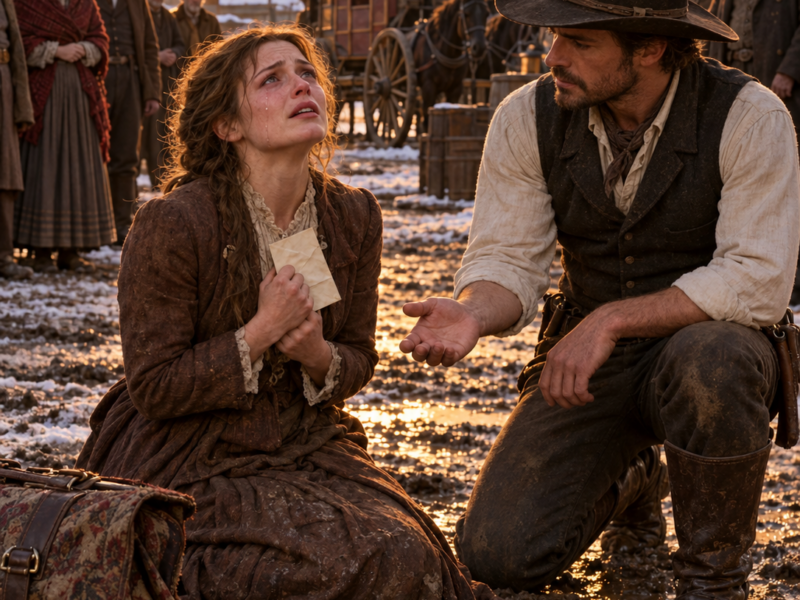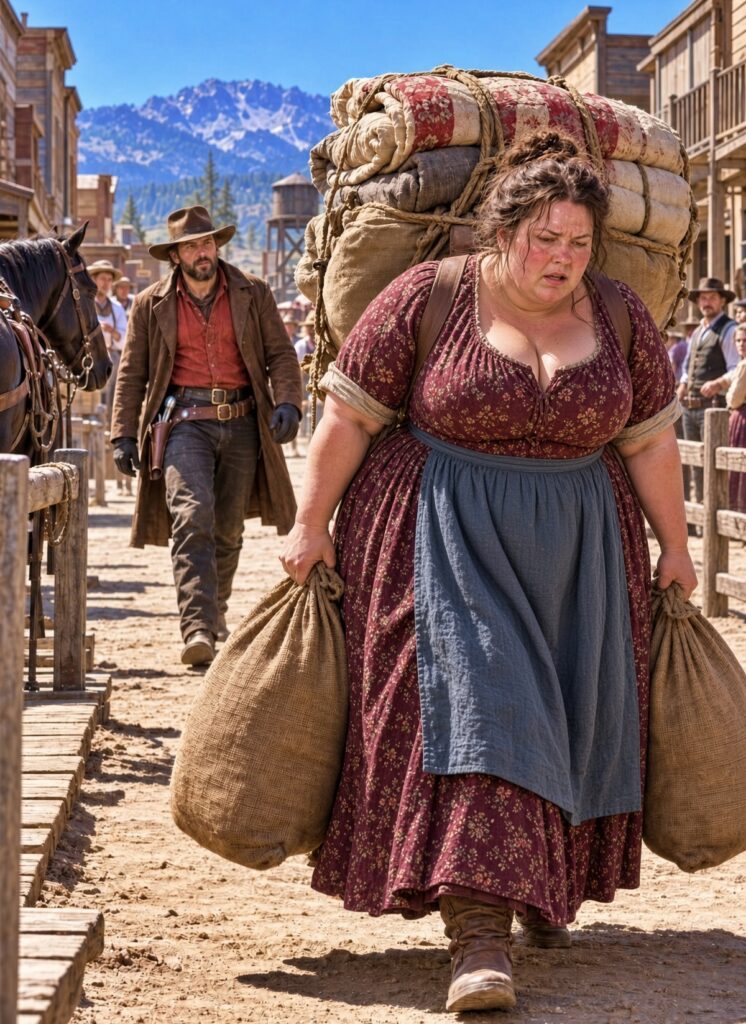
Clara’s father called her stupid, took money, and sent her west to a lonely cowboy like damaged property.
Weeks later, when powerful ranchers came to seize the cowboy’s land, the “worthless” daughter noticed one number every man in the room had missed.
The morning Edwin Bennett sent his daughter away, Clara did not cry.
She stood on the porch with one carpet bag while her father counted money behind her.
Twenty dollars.
Forty.
Sixty.
Inside Clara’s bag were two dresses, her mother’s sewing scissors, and an old Bible missing several pages.
Hidden inside the hem of her winter coat were forty-two dollars she had earned secretly repairing dresses after everyone else slept.
Edwin knew nothing about it.
Clara intended to keep it that way.
When the wagon driver produced a document, Edwin handed it over without letting Clara read it.
“Mr.
Walker agreed to take responsibility for you.”
Responsibility.
Not love.
Not marriage.
Not even shelter.
Clara was twenty-four years old, yet her father spoke as though he were transferring an unwanted horse.
Three weeks earlier, Samuel Walker had received Edwin’s letter at his isolated Montana ranch.
Edwin described Clara as too large, stubborn, plain-spoken, slow, and unlikely ever to marry.
Sam read the letter twice.
What interested him was not Clara.
It was how eagerly her father diminished her.
His reply contained only two words:
Send her.
Eleven days later, Clara stepped from the wagon beneath an enormous Montana sky.
Sam Walker was tall, quiet, sun-browned, and utterly unimpressed by appearances.
The driver handed him Edwin’s document.
“Need your signature.”
Sam read it.
Something hardened in his face.
“What is it?”
Clara asked.
“Transfer agreement,” the driver said.
Sam signed.
The wagon disappeared.
Clara stood alone with a stranger.
Then Sam asked:
“You hungry?”
That was all.
He gave her stew.
Bread.
A small bedroom.
And an iron bolt that locked from her side.
“You don’t owe me anything, Miss Bennett.”
“My father says otherwise.”
“Your father isn’t here.”
Then Sam said something nobody had ever said to her.
“If you want to leave, I’ll take you to town.”
That night, Clara placed her hidden forty-two dollars beneath her pillow.
For years, she had believed freedom meant having enough money to escape.
But in Samuel Walker’s lonely cabin, she discovered something stranger.
Maybe freedom began when someone finally stopped trying to own your choices.
And Clara had no idea that within weeks, those forty-two dollars—and the mind her father had spent years insulting—would become the difference between Samuel keeping his ranch and losing everything…

The Number Every Man in the Room Missed
For the first three weeks, Clara Bennett believed Samuel Walker regretted taking her.
She saw it in the way he sometimes paused outside the kitchen door, as though surprised to find another person there.
She heard it in the quiet scrape of his chair whenever she entered the room.
And she felt it most strongly in the mornings, when he saddled his horse before sunrise and left her alone with the stove, the chickens, and the enormous Montana silence.
But Samuel never complained.
He never called her stupid.
He never told her she ate too much.
He never commented on her plain dress or her broad shoulders or the fact that she did not move like the delicate women Edwin Bennett admired.
He simply gave her work and paid attention when she spoke.
That alone confused her.
On the fourth morning, Clara found a small wooden box beside her plate.
“What is this?”
“Open it.”
Inside were six spools of thread, three needles, beeswax, and a pair of sharp embroidery scissors.
Clara looked up.
“Why?”
“You keep repairing your dresses with that blunt pair you brought.”
She touched the scissors.
“They belonged to my mother.”
“I noticed.”
Her throat tightened.
“How?”
“You use them carefully.”
Clara didn’t know what to say.
Samuel sat across from her.
“You know how to sew.”
“Yes.”
“You know how to cook.”
“A little.”
“You can read.”
“Yes.”
“You understand numbers.”
She hesitated.
“Yes.”
“Then you’re not useless.”
Clara stared at him.
The sentence was so ordinary.
Yet it struck harder than any insult her father had ever given her.
Samuel picked up his coffee.
“Eat before it gets cold.”
She looked down.
For the first time since leaving home, Clara smiled.
Samuel’s ranch was not large by Montana standards.
Three hundred acres of rough grassland, timber, and rocky pasture stretched around a weathered cabin and an old barn.
He owned forty-two cattle.
Six horses.
Four pigs.
And a debt.
Clara discovered the last part by accident.
She had been sorting flour in the pantry when Samuel returned from town with a bundle of mail.
He dropped the letters on the table.
One envelope was stamped with the seal of the Montana Territorial Land Office.
Samuel stared at it for several seconds.
Then he opened it.
Clara saw his expression change.
“What happened?”
“Nothing.”
“That doesn’t look like nothing.”
He folded the paper.
“It’s a notice.”
“About?”
“An old survey.”
Clara waited.
Samuel sighed.
“Three ranchers claim part of my northern pasture.”
“Why?”
“They say the original boundary was marked incorrectly.”
“Was it?”
“I don’t know.”
“You signed the original deed?”
“My father did.”
“And he is—?”
“Dead.”
Clara nodded.
Samuel pushed the notice aside.
“How much land are they claiming?”
“Two hundred acres.”
Clara looked up sharply.
“Two hundred?”
“Yes.”
“That isn’t a boundary dispute.”
“No.”
“What is it?”
“An attempt to take the ranch.”
He said it calmly.
Too calmly.
Clara looked at the letter again.
“Who are they?”
“Edgar Harlan.
Thomas Crowe.
Richard Vale.”
She recognized two names.
“They own the biggest ranches in the territory.”
“That’s right.”
“Then why do they want yours?”
Samuel looked toward the window.
“Because my northern pasture sits over a creek.”
“So?”
“There’s copper in the hills.”
Clara understood.
Mineral rights.
Her father had taught her enough arithmetic and bookkeeping to know what that meant.
“How much would the land be worth?”
Samuel smiled bitterly.
“If the survey proves there’s copper, more than I’ll ever earn.”
“And if they take it?”
“They get it.”
Clara stared at him.
“Then we can’t let them.”
Samuel looked at her.
“We?”
She realized what she’d said.
“I mean—”
He smiled faintly.
“It’s all right.”
The next morning Clara went into town.
Samuel had given her money for supplies.
She returned with flour, coffee, lamp oil, and a newspaper.
The headline caught her attention.
RANCHERS DEMAND REVIEW OF NORTHERN LAND CLAIMS.
She read the article twice.
There was something wrong with it.
The article quoted the ranchers saying Samuel’s father had claimed more land than the original survey allowed.
But the dates didn’t match.
Clara frowned.
She bought another newspaper from a different town.
Same story.
Different wording.
Then she noticed something.
The survey date.
She remembered the old Bible her mother had left her.
Inside the missing pages was a handwritten note her mother had made years earlier.
Clara had never understood it.
She pulled the Bible from her bag.
The note read:
Samuel Walker’s father bought the northern tract after the flood.
See county book, page 214.
Clara stared.
Her mother had been a schoolteacher.
She had spent years helping neighbors read legal documents.
Maybe she had known something.
Clara folded the note.
That night, she asked Samuel:
“Where are your father’s old papers?”
“Why?”
“I want to see them.”
He studied her.
“Why?”
“Because I think your father owned more land than they claim.”
Samuel leaned back.
“Clara.”
“Yes?”
“You don’t have to fight my battles.”
“I know.”
“Then why are you?”
She met his eyes.
“Because you gave me a room and told me I could leave.”
He said nothing.
“That was the first time anyone had trusted me with a choice,” she continued.
“I would like to return the favor.”
Samuel looked away.
“Come with me.”
The old records were kept in a locked chest beneath the bed.
Samuel had not opened it in years.
Dust covered everything.
Receipts.
Tax records.
Letters.
Survey maps.
Clara spent two hours sorting them.
Then she found it.
A county tax receipt dated 1872.
It listed the Walker property at
512 acres
.
Clara looked at Samuel.
“How much land do you own now?”
“Three hundred and twelve acres.”
Her heart began pounding.
“Your father didn’t lose two hundred acres.”
“What?”
“He was taxed on five hundred twelve.”
Samuel took the paper.
“That could be an error.”
“Then why does the next receipt say five hundred twelve?”
She pulled out another.
And another.
Five years.
Same number.
Samuel’s face changed.
Clara spread the papers across the table.
“The original ranch was five hundred twelve acres.”
“Yes.”
“Then someone removed two hundred acres from the deed.”
Samuel stared at the documents.
“Who?”
“I don’t know.”
She searched through the chest.
Then she found a folded map.
On the map, the northern boundary was marked with a red line.
It ended beside Dry Creek.
Clara measured it.
Then compared it to the current survey.
Her fingers went cold.
“Samuel.”
“What?”
“They aren’t trying to take two hundred acres.”
He looked at her.
“They’re trying to take
two hundred acres that were never theirs to begin with.
”
The next morning, Clara rode with Samuel to town.
They went directly to the land office.
The clerk recognized Samuel.
“Walker.”
“I’m here about the survey.”
The clerk’s smile disappeared.
“It’s already been filed.”
“By whom?”
“Mr.
Harlan.”
Samuel placed the old map on the desk.
“My father owned five hundred twelve acres.”
The clerk glanced at it.
“That map is outdated.”
“Then show me the newer one.”
The clerk hesitated.
Clara stepped forward.
“Which page is the current boundary recorded on?”
The clerk looked at her.
“Who are you?”
“Samuel Walker’s wife.”
The words escaped before she could stop them.
Samuel glanced at her.
So did the clerk.
Clara’s face warmed.
The clerk cleared his throat.
“Page 214.”
Clara smiled.
“Thank you.”
They searched.
Page 214 contained the original purchase.
The acreage was unmistakable.
512 acres.
Clara pointed.
“There.”
Samuel stared.
The clerk went pale.
“That can’t be right.”
“Why?”
“The current deed says 312.”
“Then someone changed it.”
The clerk swallowed.
“You’d better speak with the territorial attorney.”
Samuel folded the paper.
“We will.”
As they turned to leave, Clara noticed another number.
The original deed had been filed in 1872.
The revised deed was filed in 1884.
But Samuel’s father had died in 1881.
Clara stopped.
“Samuel.”
“What?”
“He was dead three years before the revised deed was filed.”
The clerk said nothing.
Clara looked at him.
“Who signed it?”
The clerk lowered his eyes.
“Edgar Harlan.”
That afternoon, Edgar Harlan invited them to his office.
He was a broad man with silver hair and a gold watch.
Two other ranchers sat behind him.
Thomas Crowe.
Richard Vale.
Harlan smiled.
“Mrs.
Walker.”
Clara sat beside Samuel.
“You’ve been asking questions.”
“Yes.”
“Questions can be dangerous.”
“So can missing land.”
The smile vanished.
Samuel placed the documents on the table.
“You altered my father’s boundary.”
Harlan leaned back.
“Careful.”
Clara spoke before Samuel could.
“The revised deed was filed in 1884.”
Harlan looked at her.
“So?”
“Your document says Samuel Walker Senior signed it.”
“Yes.”
“He died in 1881.”
Silence.
Crowe shifted in his chair.
Clara continued.
“So either my husband’s father signed a document three years after his death, or the document is fraudulent.”
Harlan stared at her.
Samuel slowly turned toward her.
She continued.
“And there’s another problem.”
She opened the old tax receipts.
“The Walker ranch was taxed on five hundred twelve acres for five consecutive years.”
Harlan’s jaw tightened.
“If you don’t know how land records work—”
“I do.”
He laughed.
“You?”
Clara felt the old familiar sting.
The same laugh her father had used.
The same disbelief.
For a moment, she was back on Edwin Bennett’s porch.
Stupid.
Slow.
Worthless.
Then Samuel reached beneath the table and took her hand.
Not to silence her.
To remind her she wasn’t alone.
Clara looked at Harlan.
“I know exactly how numbers work.”
Harlan’s eyes hardened.
“Then perhaps you know that numbers can be made to say anything.”
“No.”
She smiled.
“People can.”
The meeting ended without agreement.
But the next morning, Harlan returned with a sheriff.
“Samuel Walker,” the sheriff said, “you have forty-eight hours to vacate the northern property.”
Samuel stared.
“On whose authority?”
The sheriff handed him a document.
“Territorial order.”
Clara read it.
Something immediately bothered her.
The acreage was listed as
312 acres
.
She looked at the original notice.
The claimed parcel was
200 acres
.
But the new document said the Walker property contained
312 acres total
.
Clara’s heart raced.
“Sheriff.”
“What?”
“Who calculated this?”
“Harlan’s surveyor.”
“What’s his name?”
“George Bell.”
Clara stared.
Bell.
She knew the name.
Her father had once worked with a George Bell who handled railroad contracts.
She took the document.
“May I see the survey?”
The sheriff hesitated.
Then handed it over.
Clara studied the measurements.
There.
A single number.
1,742 feet.
She pulled the old map from her bag.
She compared it.
Then smiled.
“Sheriff, this survey is wrong.”
The sheriff frowned.
“How?”
“The northern boundary isn’t 1,742 feet.”
“How do you know?”
“Because the original survey says 2,742.”
He stared.
“One digit.”
Clara tapped the paper.
“Someone removed exactly one thousand feet.”
The sheriff looked at Harlan.
Harlan’s face had gone white.
Clara continued.
“And that one missing number moves the entire boundary south.”
She turned toward Samuel.
“It gives them the land.”
Samuel stared at her.
Then slowly smiled.
“That’s the number.”
“What?”
“The number everyone missed.”
The territorial hearing was held two weeks later.
Every major rancher in the county attended.
So did the land commissioner.
Clara sat beside Samuel.
Harlan sat across from them.
The commissioner examined the records.
“Mrs.
Walker, you claim the survey was falsified.”
“Yes.”
“On what basis?”
Clara placed the documents on the table.
“Five reasons.”
She lifted the first.
“Tax records.”
Second.
“The original deed.”
Third.
“The father’s death certificate.”
Fourth.
“The original survey map.”
Fifth.
“The measurement.”
She pointed.
“Two thousand seven hundred forty-two feet.”
Harlan interrupted.
“That is an old number.”
“It is the original number.”
“The surveyor made a mistake.”
“Then why does every earlier record agree?”
Harlan had no answer.
Clara looked toward the commissioner.
“And why does the revised document use 1,742 feet?”
Silence.
The commissioner examined both maps.
Then he asked:
“Who prepared the revised survey?”
Harlan said nothing.
The sheriff answered.
“George Bell.”
The commissioner frowned.
“Where is Bell?”
Nobody knew.
Then a marshal entered.
“We found him.”
Everyone turned.
Bell stood in the doorway.
His face was gray.
The marshal pushed him forward.
“Found him at the train station.”
Bell looked at Harlan.
Then at Clara.
“I’ll testify.”
Harlan shot to his feet.
“Don’t.”
Bell flinched.
Clara stared.
The commissioner raised his hand.
“Let him speak.”
Bell swallowed.
“Harlan paid me.”
“For what?”
“To alter the survey.”
“How much?”
“Five hundred dollars.”
“And the deed?”
Bell looked down.
“Harlan gave me the original.”
The room erupted.
Harlan shouted.
“This is a lie!”
Bell shook his head.
“You told me Walker would never notice.”
Clara felt Samuel’s hand close around hers.
The commissioner ordered the room quiet.
Then he looked at Clara.
“Mrs.
Walker, you have saved your husband’s claim.”
She shook her head.
“No.”
The commissioner frowned.
Clara looked at Samuel.
“He saved me first.”
After the hearing, Samuel and Clara rode home in silence.
The sun was setting behind the mountains.
Finally Samuel spoke.
“You called yourself my wife.”
Clara’s face reddened.
“I was nervous.”
“Were you?”
“Yes.”
“Because you didn’t want them to think you were only a woman they could ignore?”
She nodded.
Samuel smiled.
“You didn’t have to say it.”
“I know.”
“I liked it.”
She looked at him.
“You did?”
“Yes.”
He stopped the horse.
Clara looked confused.
“What?”
Samuel climbed down.
Then he came around and helped her off.
“Clara.”
“Yes?”
“You remember when I told you that you didn’t owe me anything?”
“Yes.”
“I was wrong.”
Her heart stopped.
“You are owed something.”
“What?”
“My honesty.”
He took her hands.
“I didn’t send for you because I wanted a wife.”
“I know.”
“I didn’t know you.”
“I know.”
“I wanted someone to share the ranch with.”
She smiled.
“And now?”
“Now I can’t imagine the ranch without you.”
Clara’s eyes filled.
Samuel continued.
“You’ve changed everything.”
She laughed through her tears.
“My father would say you made a poor bargain.”
“I’ve made plenty of poor bargains.”
He smiled.
“This isn’t one.”
Winter came early.
The ranch survived.
The copper was eventually discovered.
But because the land belonged legally to Samuel, the mineral company had to negotiate.
The Walker ranch became valuable.
Very valuable.
Clara could have left.
She could have bought a house in town.
She could have lived independently.
Instead, she stayed.
Not because she had nowhere else to go.
Because she had somewhere she wanted to be.
Samuel built a larger house.
He added a library.
A sewing room.
And a porch overlooking the northern pasture.
Clara kept her mother’s scissors.
She kept the forty-two dollars too.
She placed the bills inside a wooden box.
Samuel once asked why.
She smiled.
“They remind me of who I was.”
“And who were you?”
“A woman who thought freedom meant having enough money to run away.”
He kissed her forehead.
“And now?”
“Now I know freedom means being able to stay because you choose to.”
Years later, Clara’s father came to Montana.
Edwin Bennett was older.
His hair had turned white.
His hands trembled.
He stood at the ranch gate looking at the enormous house and the fields stretching beyond it.
Clara walked toward him.
He stared at her.
“You look different.”
“I am.”
“You did well.”
“I did.”
He looked at the ranch.
“Your husband made this possible.”
Clara shook her head.
“No.”
Edwin frowned.
“Then who?”
She looked at him.
“I did.”
He said nothing.
She continued.
“You called me stupid.”
“I was angry.”
“You called me useless.”
“I was wrong.”
“You sold me for sixty dollars.”
His face tightened.
“I thought I was giving you a chance.”
“No.”
Clara’s voice remained calm.
“You were getting rid of me.”
Edwin lowered his eyes.
“I regret it.”
Clara believed him.
But forgiveness did not mean forgetting.
“I hope you find peace,” she said.
“Can I stay?”
She shook her head.
“No.”
He looked surprised.
“You’re my father.”
“And you’re my daughter.”
She paused.
“But this is my home.”
Edwin nodded slowly.
“I understand.”
He turned.
Clara watched him walk away.
She didn’t cry.
She didn’t feel victorious.
She simply felt free.
That evening, Samuel found her on the porch.
He sat beside her.
“Your father?”
“Gone.”
“You all right?”
“Yes.”
He looked toward the road.
“Want me to go after him?”
Clara smiled.
“No.”
“Why?”
“Because he finally gave me something useful.”
“What?”
“A reason never to become him.”
Samuel took her hand.
She rested her head against his shoulder.
The sun disappeared behind the mountains.
A breeze moved through the tall grass.
Samuel looked at her.
“You know what I still don’t understand?”
“What?”
“How you saw that number.”
Clara smiled.
“My mother taught me something.”
“What?”
“Numbers don’t lie.”
She looked toward the northern pasture.
“People do.”
Samuel kissed her temple.
“And you?”
“I learned to read both.”
He laughed.
Then Clara leaned closer.
For years, her father had told her that she was too large, too slow, too stubborn, too plain, too stupid.
But those insults had never described her.
They had described his inability to see her.
She was not stupid.
She was observant.
She was not slow.
She was careful.
She was not stubborn.
She was determined.
And she was never damaged property.
She was a woman who had survived being treated like a burden and discovered that the mind everyone mocked could save a ranch.
More importantly, it could save her from believing the people who had tried to define her.
Samuel squeezed her hand.
“Dinner?”
Clara smiled.
“You’re hungry again?”
“Always.”
She stood.
“Then come inside.”
He followed.
Behind them, the Montana sky turned violet.
The northern pasture stretched into the distance.
Five hundred twelve acres.
Exactly as it had always been.
And beside the front door, Clara kept a small wooden box containing forty-two dollars.
She never spent it.
Not because she needed it.
Because those forty-two dollars had once represented escape.
Now they represented choice.
She had come west believing she was being sent away because she was worthless.
She had arrived believing she would eventually need enough money to leave.
Instead, she found a man who never tried to own her.
A ranch that needed her.
A future she chose.
And the truth her father had spent years trying to bury:
Sometimes the person everyone dismisses is the one who notices what everyone else overlooks.
Sometimes one forgotten number can save everything.
And sometimes, the greatest freedom is not running away from the life someone else chose for you.
It is standing in the life you chose for yourself—and knowing you belong there.