
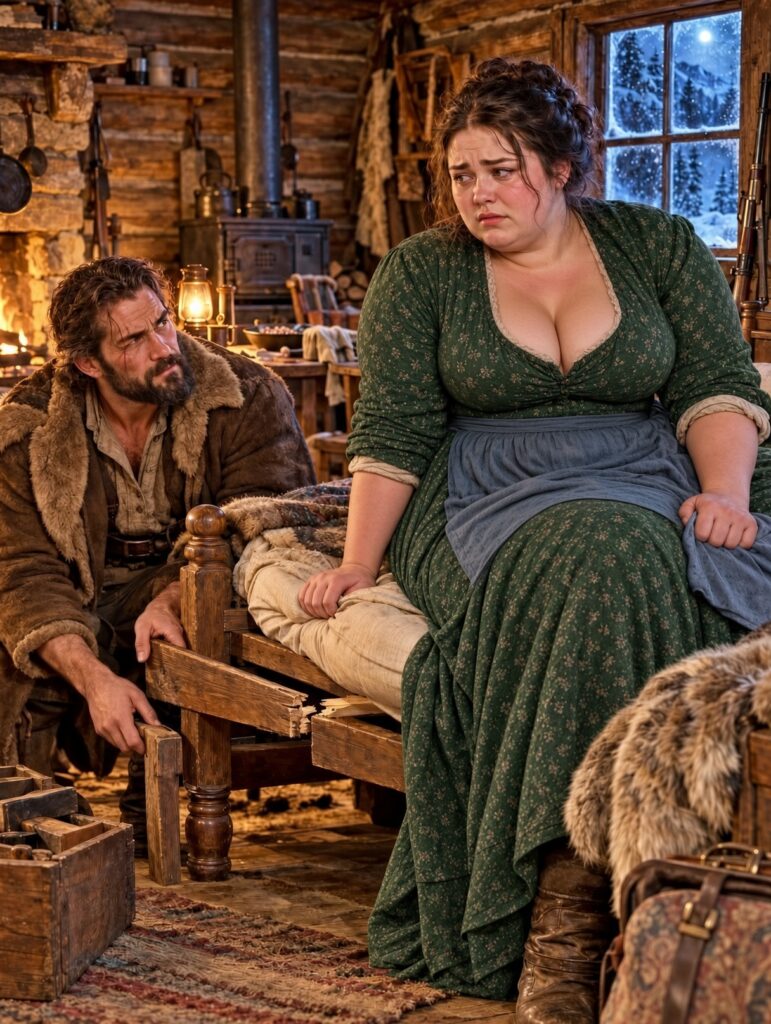
Her father sent her into the mountains because no man wanted his “ugly, oversized daughter.”On her first night, the trapper’s bed shattered beneath her weight.
Cora waited for laughter—but his first words made her wonder what else her father had lied about.
The stagecoach left Cora Hayes where the road surrendered to the mountain.
Her carpet bag landed in frozen mud.
The driver barely waited for her boots to touch the ground before snapping the reins.
By the time Cora turned around, the coach was already disappearing between the pines.
She was twenty-four years old, nearly 280 pounds, broad through the shoulders and hips, with thick arms, a heavy waist, and a square face her father had once described as “honest-looking” when he was trying very hard not to say ugly.
Her younger sister Abigail had married a banker.
Cora had been sent west.
That was the difference, according to her father.
“Some women marry upward,” he had told her.
“Some women take whatever is offered.”
Wyatt Harper appeared from the trees ten minutes later.
He wore a buffalo-hide coat and carried a rifle low in one hand.
A pale scar pulled the corner of his left eye tight.
He studied Cora.
Then said:
“You’re bigger than the picture.”
There it was.
She had known it would come.
“I am.”
“If you want to go back, go.”
“The stage already left.”
Wyatt looked down the empty trail.
“Then keep up.”
His cabin sat three brutal miles higher.
Cora reached it with burning lungs and mud to her calves, but she never once asked him to slow down.
Inside, she found a house that smelled of smoke, grease, wet leather, and years of loneliness.
She said nothing.
She rolled up her sleeves.
By supper, the stove was scrubbed, beans were simmering, and the table had been cleared of three months’ worth of traps, bullets, and dirty tin cups.
Wyatt watched her.
“You always start cleaning strangers’ houses?”
“Only when I’m expected to live in them.”
Something almost like amusement moved across his face.
That night, he pointed toward the back room.
“Bed’s yours.”
“You?”
“Fire.”
Cora sat carefully on the heavy pine frame.
The wood groaned.
Then—
CRACK.
A slat snapped beneath her.
Humiliation hit so fast she could barely breathe.
She waited for laughter.
For disgust.
For the familiar sigh that meant she had taken up too much space again.
Wyatt appeared in the doorway.
He looked at the broken frame.
Then at her face.
“Damn carpenter cheated me.”
Cora blinked.
“You’re not angry?”
“At you?”
He crouched.
“Move over.”
And for the first time in Cora Hayes’s life, a broken thing had not automatically become her fault…

I looked at my father.
For six years, I had imagined this moment.
Not this exact room.
Not this exact table.
Not General Nathaniel Cross standing beside me while my father’s champagne glass remained frozen halfway between the table and his mouth.
But I had imagined the moment when Grant Whitaker finally discovered that the daughter he had dismissed was not who he thought she was.
I had imagined anger.
Maybe satisfaction.
Maybe even tears.
Instead, I felt strangely calm.
I looked at General Cross.
“Clear the room.”
He nodded once.
“Understood, Major.”
That single word did more damage to my father’s pride than anything I could have said.
General Cross turned toward his security detail.
“Everyone except essential personnel out.
Now.”
Chairs scraped backward.
Guests whispered.
Julianne’s face had gone completely white.
Caleb looked between his father and me as if he had suddenly realized his wedding weekend had become something far more serious than a family celebration.
My mother finally looked at me.
Her lips parted.
“Mara…”
I didn’t answer.
The secure phone vibrated again.
I glanced at the screen.
BLACK CHANNEL ACTIVE. COMPROMISE CONFIRMED.
TARGET LOCATION UNKNOWN.
WINDOW: 41 MINUTES.
My stomach tightened.
This wasn’t about my family anymore.
Someone had compromised a classified operation.
And whatever was coming next had nothing to do with the champagne glasses sitting on this table.
I looked at General Cross.
“Sir, I need a secure room.”
He immediately nodded.
“Follow me.”
My father stepped forward.
“Wait.”
General Cross turned.
Grant Whitaker looked at him.
“General, with respect, that’s my daughter.”
General Cross’s expression became unreadable.
“Yes.”
Then he said quietly:
“And she’s also a United States Army intelligence officer currently handling an active national-security matter.”
My father stopped.
Julianne whispered:
“Intelligence officer?”
I turned toward her.
“Major.”
Her eyes widened.
“Major?”
I nodded.
“Major Mara Whitaker.”
My father’s face lost every trace of color.
The secure conference room was two floors below the ballroom.
The door locked behind me.
General Cross stood across the table.
Two officers joined us.
Colonel Daniel Mercer.
Lieutenant Colonel Sarah Ruiz.
I knew both of them.
They knew me.
Nobody used my rank as a question.
Nobody needed an explanation.
I placed the phone on the table.
“The priority signal came from Blackbird.”
Mercer frowned.
“Blackbird was supposed to be dark.”
“It was.”
“Then why did it activate?”
I slid the phone toward him.
“Because someone opened a channel using my authorization code.”
Ruiz leaned forward.
“Your credentials were compromised?”
“No.”
“Then someone has access to the authentication system.”
I nodded.
“That is what concerns me.”
General Cross folded his arms.
“What exactly are we dealing with?”
I looked at him.
“A leak.”
Silence.
“From where?” he asked.
“Inside the operation.”
Cross’s eyes hardened.
“Who?”
“I don’t know yet.”
The phone vibrated.
A new message appeared.
THE PACKAGE IS MOVING.
FIVE MINUTES.
I stood.
“We don’t have time.”
Cross nodded.
“What’s your recommendation?”
I answered immediately.
“Lock down the Sacramento federal corridor.
Quietly.
No public alerts.
I need three teams.”
“Done.”
“Second, I need every access log from Blackbird for the last seventy-two hours.”
Ruiz was already typing.
“Third, nobody tells my family anything.”
Cross looked at me.
“Agreed.”
He paused.
Then:
“Major Whitaker.”
“Yes, sir?”
“You said your family knew none of this.”
“They still don’t.”
His eyes flicked toward the door.
“Your father knows now.”
I sighed.
“Yes.”
“Does that compromise you?”
I looked at the secure phone.
“No.”
Then I corrected myself.
“Not unless he makes it about himself.”
He did.
Of course he did.
When I returned upstairs forty minutes later, the ballroom had been emptied.
Except for my family.
My father stood near the windows.
My mother sat on the couch.
Julianne was pacing.
Caleb remained beside her.
The moment I entered, my father turned.
“You lied to us.”
I stopped.
“No.”
His expression hardened.
“You told us you worked for a government contractor.”
“I allowed you to believe that.”
“That is lying.”
“No.”
I looked directly at him.
“You stopped asking questions six years ago.”
That silenced him.
Julianne stepped forward.
“You’re actually in the Army?”
“Yes.”
“Intelligence?”
“Yes.”
“What rank?”
I stared at her.
“You heard the general.”
She swallowed.
“Major.”
“Yes.”
She looked down at herself.
Her expensive dress.
Her diamond.
Her perfect wedding makeup.
Then back at me.
“But you’re thirty-two.”
“Yes.”
“How?”
“By doing my job.”
My father slammed his glass onto the table.
“You expect me to believe you became a major without anyone knowing?”
“I don’t care what you believe.”
His face twisted.
“You’ve embarrassed this family for years.”
I almost smiled.
“No.”
I walked closer.
“You were embarrassed by me.”
“That is not the same thing.”
“It is when you spend six years pretending your daughter is a failure because she doesn’t have a job title you can brag about.”
My mother finally spoke.
“We thought you were ashamed of us.”
I looked at her.
“I was never ashamed of you.”
Her eyes filled.
“I was protecting you.”
“From what?”
“The truth.”
She stared at me.
“What truth?”
I lowered my voice.
“My work isn’t something I can discuss at dinner.”
My father laughed bitterly.
“Your mother and I deserved to know.”
“No.”
His smile vanished.
“You didn’t.”
I took a breath.
“Because knowing my exact assignment could have gotten you killed.”
Silence.
Nobody moved.
Julianne whispered:
“You mean that?”
“Yes.”
I looked at her.
“Every time I missed your birthday, there was a reason.”
Her eyes filled with tears.
“You could have told me.”
“I couldn’t.”
“You could have said something.”
“I tried.”
“When?”
“Every time I called.”
She looked away.
My father interrupted.
“This is ridiculous.”
I turned toward him.
“No, Dad.”
My voice was quieter now.
“This is what you never understood.”
I pointed toward the secure phone.
“My silence was never weakness.”
The phone vibrated.
I looked down.
My blood ran cold.
SUBJECT IDENTIFIED.
FAMILY CONNECTION CONFIRMED.
I stared at the screen.
Then at my father.
Someone had identified my family as a vulnerability.
And whoever had done it knew exactly where I was.
“Get down!”
The windows exploded.
Glass filled the room.
I moved before I consciously thought about it.
I grabbed my mother and pulled her behind the stone column.
Julianne screamed.
Caleb dropped to the floor.
My father froze.
Three sharp cracks echoed outside.
Gunfire.
General Cross and two security officers rushed into the room.
“Major!”
“I have them.”
I pulled my mother farther behind cover.
“Stay down!”
Another shot struck the marble wall.
Dust exploded across the room.
My father’s face finally showed fear.
Not for himself.
For us.
I looked at him.
“Dad!”
He turned.
“Move!”
He obeyed.
For once, he didn’t question me.
We moved through the service corridor.
Cross led the way.
“Where are they?”
“Southwest building.”
“Distance?”
“Approximately four hundred yards.”
“Sniper?”
“Two.”
Cross looked at me.
“Can you identify?”
I checked the phone.
“Not yet.”
Then a message appeared.
THEY’RE NOT SHOOTING TO KILL.
I frowned.
Cross noticed.
“What?”
I showed him.
He stared.
“Then what are they doing?”
I looked back toward the ballroom.
“They’re forcing us to move.”
“Why?”
I already knew.
“To the parking structure.”
Cross’s expression changed.
“Ambush.”
“Yes.”
We never reached the parking structure.
I led everyone through a maintenance tunnel beneath the hotel.
The route was narrow and dark.
My mother was breathing hard.
Julianne held Caleb’s hand.
My father walked behind me.
For several minutes, nobody spoke.
Then he whispered:
“Mara.”
I didn’t turn.
“What?”
“I didn’t know.”
“I know.”
“I really didn’t know.”
“I know.”
His voice cracked.
“I thought you were…”
He stopped.
I waited.
“A disappointment.”
I closed my eyes briefly.
There it was.
The word that had followed me since childhood.
Not smart enough.
Not ambitious enough.
Not feminine enough.
Not successful enough.
Never enough.
I turned around.
“You weren’t wrong about everything.”
My father looked at me.
“I made mistakes.”
“No.”
He shook his head.
“I made choices.”
That stopped me.
He swallowed.
“And I chose Julianne because I understood her.”
His eyes filled.
“I didn’t understand you.”
For the first time, I saw my father not as the man who had humiliated me.
But as an old man who had finally realized he had spent years loving a version of his daughter that was easier for him to understand.
“I don’t need you to understand my job,” I said.
“I know.”
“I don’t need you to brag about me.”
“I know.”
“I needed you to believe I had a reason.”
He looked down.
“I should have.”
We reached the end of the tunnel.
Before opening the door, I turned toward him.
“Stay behind me.”
He almost smiled through his fear.
“You’re still giving orders.”
“Yes.”
“Good.”
I opened the door.
The attack ended twelve minutes later.
One suspect escaped.
Two were captured.
No one in my family was seriously injured.
But the intelligence operation was far from over.
The captured man wasn’t a professional assassin.
He was a courier.
And the moment I saw his face, I knew him.
Not personally.
Professionally.
He had appeared in an investigation three years earlier.
A financial intermediary.
Someone connected to a private military contractor called Northstar Meridian.
A company that had recently won several classified government contracts.
I looked at General Cross.
“This goes higher.”
He nodded.
“How high?”
“High enough that someone knew my identity.”
Cross’s expression darkened.
“Can you prove it?”
“Give me six hours.”
He looked at his watch.
“You have four.”
I smiled faintly.
“Then I’ll be faster.”
At 2:13 in the morning, I sat in the secure operations room.
My family was under protection in another wing.
My father had not complained once.
That alone felt strange.
I pulled the access logs.
Three accounts had accessed Blackbird.
One belonged to me.
One belonged to General Cross.
The third belonged to someone who should not have been there.
A senior Pentagon contractor.
My stomach tightened.
I traced the account.
Then I saw the name.
DAVID CROSS.
General Cross’s son.
I stared at the screen.
No.
That couldn’t be right.
David Cross had served four years before leaving the military.
He now worked for Northstar Meridian.
I pulled his financial records.
Transfers.
Shell companies.
Offshore accounts.
Payments from Mercer International.
Everything connected.
I stood.
“Sir.”
General Cross entered.
“What did you find?”
I turned the screen toward him.
His face changed.
“My son.”
“Yes.”
He stared at the records.
For a long moment, he said nothing.
Then:
“Are you certain?”
“Beyond reasonable doubt.”
He closed his eyes.
“I’ll handle it.”
“No.”
He looked at me.
“This is my operation.”
“You’re emotionally compromised.”
He flinched.
I continued.
“And that’s exactly why I can’t let you handle it.”
For several seconds, we simply looked at each other.
Then he nodded.
“You’re right.”
He stepped back.
“Major Whitaker.”
“Yes?”
“Do what you were trained to do.”
David Cross was arrested before sunrise.
The investigation expanded rapidly.
Northstar Meridian had been selling classified information to foreign buyers.
The Sacramento attack had been designed to frighten me into revealing the location of Blackbird’s primary intelligence archive.
They had believed my family was the weak point.
They had been wrong.
But the case exposed something else.
Someone had leaked my identity.
That person had to be close enough to know my history.
Close enough to know my family.
Close enough to know where I would be that weekend.
I thought about the hotel.
My father’s comments.
Julianne’s wedding.
Then I remembered something.
At dinner, my father had mentioned my job.
He had said:
“Low-level keyboard job.”
But I had never told him the word keyboard.
I had never told him anything about my work.
Someone had fed him information.
I went back through the evening.
The speeches.
The guests.
The staff.
The family.
Then I remembered one person who had left the room twenty minutes before the shooting.
Caleb.
Julianne’s fiancé.
My stomach dropped.
I found Caleb in a private hotel suite.
Julianne was with him.
“What’s happening?” she asked.
I closed the door.
“Julianne, I need you to leave.”
“No.”
“Please.”
She looked at my face.
Something in my expression changed her mind.
She walked out.
Caleb remained.
He looked nervous.
“You know who I am,” I said.
He swallowed.
“I know you’re military.”
“Who told you?”
He didn’t answer.
I stepped closer.
“Caleb.”
He looked away.
Then whispered:
“I didn’t know what they were going to do.”
My heart sank.
“Who?”
“My father.”
I stared at him.
“General Cross?”
He nodded.
“No.”
His face crumpled.
“Not Nathaniel.”
“Then who?”
“His brother.”
I froze.
“David?”
Caleb nodded.
“He recruited me six months ago.”
“Why?”
“Money.”
“Why my family?”
“I didn’t know.”
“That’s a lie.”
He closed his eyes.
“I knew they were looking for you.”
My hands curled into fists.
“You used Julianne.”
“I love her.”
“You put her in danger.”
“I was trying to get out.”
“By marrying her?”
He started crying.
“I didn’t know how to stop.”
I stared at him.
Then I asked the only question that mattered.
“Did you tell them about my father?”
“Yes.”
My blood went cold.
“Did you tell them where my family would be?”
“Yes.”
“And the wedding?”
“Yes.”
I turned away.
Caleb whispered:
“I’m sorry.”
I looked back at him.
“You should be.”
Security officers entered seconds later.
Caleb didn’t resist.
Julianne found me afterward.
She was crying.
“Did he ever love me?”
I didn’t know how to answer.
So I told her the truth.
“I don’t know.”
She wiped her face.
“I feel stupid.”
“You’re not stupid.”
“I didn’t see anything.”
“Neither did I.”
She looked at me.
“You’re trained to see things.”
I shook my head.
“Being trained doesn’t mean being immune.”
She stepped closer.
“Are you going to hate him?”
“No.”
“Why?”
“Because hate would mean he gets to control what I feel.”
She nodded slowly.
Then whispered:
“I wish I had defended you.”
I looked at my sister.
She had spent years competing with me without ever realizing there was no competition.
“You can start now.”
She nodded.
“I will.”
The case lasted eleven months.
Northstar Meridian collapsed.
David Cross went to prison.
Caleb cooperated with investigators and received a reduced sentence.
Julianne called off the wedding.
She moved to Boston.
My mother began therapy.
My father changed in ways I never expected.
He stopped introducing me as his daughter who “worked in government.”
He stopped explaining me.
When people asked what I did, he simply said:
“My daughter serves her country.”
That was enough.
But our relationship didn’t heal overnight.
Some wounds don’t.
Sometimes my father still called too often.
Sometimes he asked questions he wasn’t allowed to know the answers to.
Sometimes I still remembered the champagne glass.
The sentence.
The worst mistake our family ever made.
And sometimes those words still hurt.
But now he understood why.
Six months after the investigation ended, I returned home for Thanksgiving.
My father stood in the kitchen.
He was cooking.
Badly.
My mother laughed from the dining room.
Julianne arrived carrying wine.
She hugged me.
Then she stepped back.
“You look different.”
“How?”
“Peaceful.”
I smiled.
“Maybe I’m finally allowed to be myself.”
At dinner, my father raised his glass.
Everyone went silent.
He looked at me.
“For my daughter.”
I waited.
He swallowed.
“I spent years thinking I knew what success looked like.”
His eyes became wet.
“I was wrong.”
He raised the glass higher.
“Mara, I’m proud of you.”
Nobody clapped.
Nobody needed to.
I lifted my glass.
“Thank you.”
He looked at me.
“I know it’s not enough.”
“No.”
He nodded.
“But it’s a start.”
“Yes.”
We drank.
Three months later, General Cross called me into his office.
He handed me a folder.
“Promotion recommendation.”
I opened it.
“Sir?”
“Colonel wants your name on the list.”
I stared at him.
“You’re serious?”
“Very.”
I smiled.
“Thank you.”
He paused.
Then said:
“You know, your father asked me something.”
I raised an eyebrow.
“What?”
“He asked if you were ever afraid.”
I laughed softly.
“What did you tell him?”
“That every good intelligence officer is afraid.”
I looked at him.
“And?”
He smiled.
“But courage isn’t the absence of fear.”
He handed me the folder.
“It’s knowing what matters more.”
Two years after that wedding weekend, I stood in uniform at my father’s retirement ceremony.
He had spent thirty-eight years working for the federal government.
At the end of his speech, he looked into the audience.
Then he found me.
“I spent a long time thinking my daughter’s silence meant she had nothing to say.”
The room was quiet.
“I was wrong.”
He smiled.
“She had simply been doing things too important to explain.”
My throat tightened.
“And I am honored to call Major Mara Whitaker my daughter.”
The room applauded.
I didn’t cry.
Not until he stepped down from the stage.
Then he hugged me.
For a few seconds, I was eight years old again.
Not a major.
Not an intelligence officer.
Just his daughter.
He whispered:
“I’m sorry.”
I closed my eyes.
“I know.”
“I should have seen you.”
“You see me now.”
He nodded.
“Yes.”
And that was enough.
Years later, people would ask me why I kept my career secret from my family for so long.
The answer was complicated.
Part of it was security.
Part of it was protection.
But part of it was pride.
I had been afraid that if they knew what I really did, they would finally value me for my title.
And I didn’t want that.
I wanted to be loved before the rank.
Before the medals.
Before the promotions.
Before the four-star general saluted.
That night at the Fairmont had changed something.
Not because my father finally discovered I was important.
But because I realized I had spent too much of my life waiting for him to decide that I was.
I no longer needed permission to be proud of myself.
I was Major Mara Whitaker.
I served my country.
I had earned every stripe.
Every scar.
Every sleepless night.
Every silent birthday.
Every time I walked away from a mission knowing my family could never know what I had done.
And if someone asked me now what my father had taught me, I would give them an honest answer.
He taught me what it feels like to be underestimated.
But my career taught me something more important.
Being underestimated can hurt.
Being underestimated can make you angry.
But if you let it, it can also make you stronger.
Because eventually, you stop trying to prove yourself to people who refuse to see you.
You start proving yourself to yourself.
And that’s when everything changes.
I still keep the silver clutch from that wedding weekend.
The secure phone is long gone.
The dress is packed away.
But inside the clutch is a small folded photograph.
Not of my medals.
Not of my promotion.
Not of General Cross saluting me.
It’s a photograph of my father and me at Thanksgiving.
His arm is around my shoulders.
I’m smiling.
He’s smiling.
And on the back, in his handwriting, are seven words:
“I was wrong. You were never a mistake.”
I kept that photograph.
Not because I needed his approval.
But because after thirty-two years of wondering whether I belonged at the table, I finally understood something.
I had never needed a seat.
I had been carrying the table all along.


