
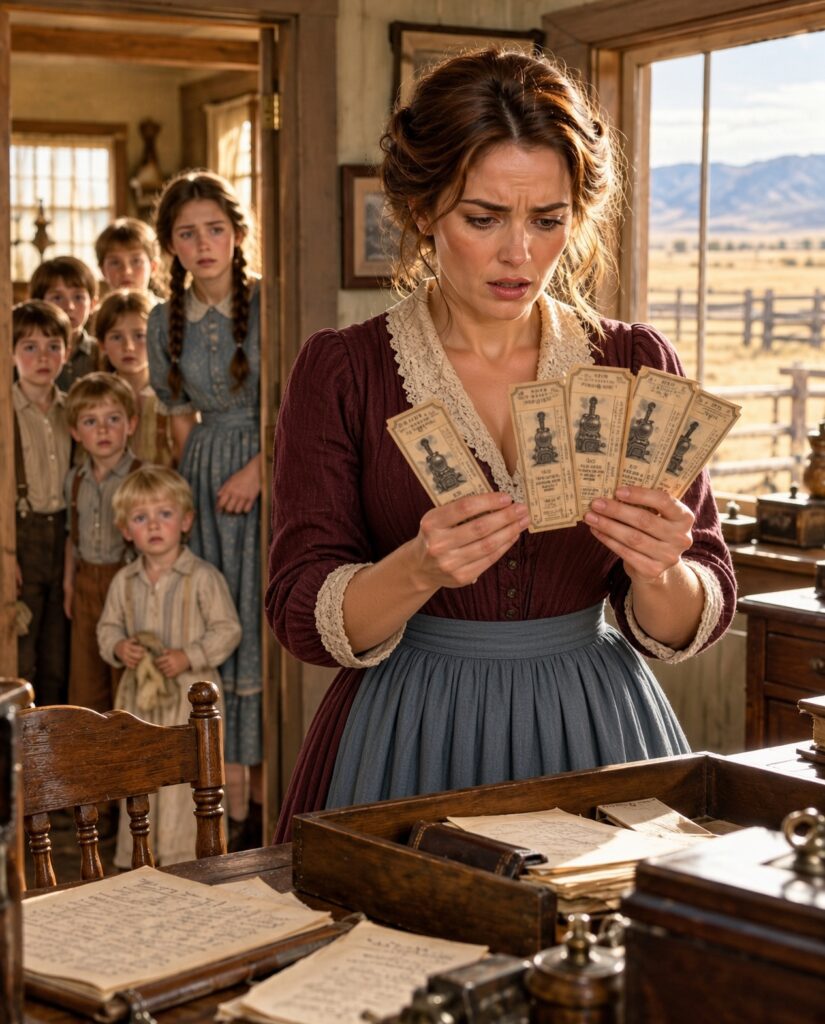
The first thing I heard when the wagon reached Reed Hollow Ranch was a gunshot.
Before I had even stepped onto Montana soil, an eleven-year-old boy stood trembling on the porch with a smoking rifle while a rattlesnake twisted in the dust beside his barefoot little brother.
I had come to cook for a widowed cowboy and his seven children—but suddenly I wondered what kind of family I had agreed to live with.
The horses reared so violently that my carpetbag fell into my lap.
“Ma’am,” the driver muttered, fighting the reins, “I can turn around.”
I almost told him to.
Then I looked at the ranch.
Reed Hollow must once have been beautiful.
Now its fences sagged, the chicken yard leaned sideways, and the barn roof looked one Montana winter away from collapsing.
Dust drifted through the yard beneath tired cottonwoods.
It looked less like a home than a place that had survived something.
“No,” I said, picking up my bag.
“I’m staying.”
The driver handed me the cast-iron skillet I had carried from Kansas through Nebraska and finally Montana.
On the porch, a girl in a faded blue dress took the rifle from the shaking boy and opened it with practiced hands.
“You the cook?” she asked.
“If this is Reed Hollow.”
“It is.
I’m Annie Reed.”
Her guarded eyes traveled over my worn dress, carpetbag, and skillet.
“You’re the fourth.”
“Fourth cook?”
“Fourth person to answer Papa’s advertisement.
The longest lasted twelve days.”
She looked about thirteen, but responsibility had made her expression older.
Her hair was tightly braided, flour marked one sleeve, and dust covered the hem of her dress.
Behind her, the boy holding the rifle swallowed.
“I only shot because Tommy was barefoot.”
I looked at the dead rattlesnake, then at the little blond child still crying beside him.
“Good shot.”
The boy’s shoulders relaxed.
Annie studied me as though that answer had surprised her.
“If you’re delicate, dramatic, or fond of speeches,” she said, “I’d rather know now.”
“I’m too tired for delicate, too old for dramatic, and I only give speeches when somebody deserves one.”
For an instant, Annie nearly smiled.
“Come in, then.”
The house unsettled me more than the gunshot had.
Everything was spotless.
But it wasn’t the comfortable cleanliness of a happy home.
The floors had been scrubbed pale.
Curtains were washed almost transparent.
Every object sat precisely where it belonged.
It felt as though seven children were desperately keeping one small corner of their world under control.
“Where’s your father?”
I asked.
“Out.”
“Is that your regular answer?”
“It’s the truest one.”
She led me into the kitchen.
Beans were sorted neatly into jars.
Potatoes had been stacked by size.
On the table sat a square loaf of homemade bread that looked as joyless as the room.
“You baked that?”
“Someone had to.”
I set my skillet on the stove.
“Do you always answer questions like you’re collecting debts?”
Annie crossed her arms.
“Do you always talk to children like they’re adults?”
“Only when children are doing adults’ work.”
That silenced her.
And that was when I understood Reed Hollow’s real problem wasn’t the broken fences or empty kitchen.
Something had happened to this family after Mrs.
Reed died.
Something nobody wanted to discuss.
Later, while searching for paper to make a list of kitchen supplies, I opened the widowed cowboy’s desk.
Beneath a stack of ranch accounts was an envelope.
Inside were six train tickets.
All one-way.
All leaving Reed Hollow.
I counted them twice.
Then I looked toward the hallway where seven children lived beneath this roof.
Seven children.
Six tickets.
And suddenly I understood why every previous cook might have left.

The sixth ticket was dated three months ahead.
I held it between my fingers and listened to the house.
Nothing.
No footsteps.
No children arguing.
No dishes clattering.
Only the low groan of wind moving through the cottonwoods outside.
I turned the tickets over.
There were no names written on them.
Just destinations.
Helena.
Bozeman.
Billings.
Helena again.
Then Cheyenne.
Six children were meant to leave Reed Hollow Ranch.
But there were seven children.
I slipped the tickets back into the envelope exactly as I had found them.
Then I heard a floorboard creak behind me.
I turned.
Annie stood in the doorway.
Her face had gone completely white.
For several seconds neither of us spoke.
Finally she whispered, “You weren’t supposed to find those.”
“I know.”
She looked toward the hallway.
“Please don’t tell Papa.”
“Why?”
“Because if he knows you saw them, he’ll send you away too.”
That stopped me.
“Annie, why would your father send me away?”
She shook her head.
“He won’t.”
“Then who will?”
She looked down.
“The same person who sent the others.”
Before I could ask what she meant, a horse thundered into the yard.
Annie flinched.
Not startled.
Afraid.
The front door opened.
A man stepped inside carrying a rifle across one shoulder.
He was tall enough to duck beneath the doorframe, broad through the chest, and covered in trail dust.
His dark hair was windblown, his jaw shadowed with several days of beard.
But what caught my attention was his face.
He looked exhausted.
Not ordinary tired.
The kind of exhaustion that had settled into a man’s bones and convinced him there was no reason to fight it anymore.
His eyes moved from Annie to me.
Then to the kitchen.
“You must be Mrs.
Carter.”
“Miss Carter.”
His expression tightened.
“My apologies.”
“You’re Mr.
Reed?”
“Daniel Reed.”
He set the rifle beside the door.
Then his eyes landed on the skillet.
“You brought that?”
“I did.”
“Good.”
He started toward the hallway.
“Mr.
Reed.”
He stopped.
I held up the envelope.
His face changed.
Only slightly.
But I saw it.
“You’ve been through my desk.”
“I was looking for paper.”
“You should have asked.”
“I would have, if I’d known you kept train tickets in there.”
Silence.
Annie had disappeared.
That bothered me more than his anger.
“Where are the children?”
I asked.
“Inside.”
“Seven of them?”
“Yes.”
“Then why are there six tickets?”
His eyes hardened.
“That’s none of your concern.”
“It became my concern when I accepted a position in this house.”
He stepped closer.
“You’ve been here less than an hour.”
“And already I’ve learned more about this family than the advertisement told me.”
“What did the advertisement say?”
“That you needed a cook.”
“It didn’t say anything about children?”
“It said seven.”
“Then you knew what you were agreeing to.”
“I did.”
He looked genuinely confused.
“Then why are you asking questions?”
“Because seven children shouldn’t look like they’re waiting for a funeral.”
His jaw tightened.
“Mrs.
Carter—”
“Miss.”
“Miss Carter, you have no idea what you’re talking about.”
“I know your oldest daughter carries a rifle because she doesn’t trust anyone else to protect her brothers.
I know your children clean this house like frightened little soldiers.
I know there are six train tickets in your desk.
And I know Annie is terrified of whatever happens next.”
His eyes flashed.
“You’ve been here less than an hour.”
“And you keep saying that as if time makes what I saw untrue.”
For a moment, I thought he might dismiss me.
Instead he looked away.
“My wife died eighteen months ago.”
“I know.”
“No.
You don’t.”
His voice was quiet.
“She died in childbirth.”
I said nothing.
“The baby survived.”
My heart tightened.
“Which one?”
“Tommy.”
“The little boy from the porch?”
“Yes.”
Daniel rubbed a hand across his face.
“Sarah bled to death before the doctor could stop it.
After that, the children stopped being children.”
I glanced toward the hallway.
“They had to.”
“Yes.”
He looked at the floor.
“I tried.”
“Try what?”
“Everything.”
His voice cracked on the last word.
“I hired cooks.
Maids.
Tutors.
Women who said they understood children.
They all lasted a few days.
Then one left after Tommy broke a plate.
Another left after Annie told her she wasn’t their mother.
The last one left after Matthew threatened her with a shovel.”
“Matthew?”
“The boy with the rifle.”
I almost smiled.
“Eleven years old.”
“He thinks he’s thirty.”
“He thinks he’s protecting his family.”
“He is.”
Daniel’s eyes lifted.
“That is the problem.”
He walked past me.
I followed.
“Why are you sending six of them away?”
He stopped.
“Because I can’t keep them.”
The words were almost inaudible.
“What do you mean?”
“The ranch is failing.”
He looked toward the window.
“Last winter killed thirty head.
Spring floods took the lower pasture.
I owe money to the bank.
The roof needs replacing.
The north fence is gone.
The cattle are thin.”
“And the children?”
“Six of them have relatives willing to take them.”
“And the seventh?”
His expression changed.
“Annie stays.”
“Why?”
“Because she’s the oldest.”
“That isn’t an answer.”
“It is the only one I have.”
I looked at him.
“No.
It’s the answer of a man who has decided one child must pay for the rest.”
His face hardened.
“You don’t know me.”
“No.”
I stepped closer.
“But I know what I saw.”
“And what exactly did you see?”
“A father preparing to break his children’s hearts because he thinks breaking them himself will hurt less than watching them suffer later.”
He stared at me.
For the first time, something in his expression cracked.
Then a small voice came from the hallway.
“Papa?”
Daniel turned.
A little girl stood there clutching a rag doll.
“What’s wrong, Lily?”
“Tommy says there isn’t enough flour for supper.”
Daniel closed his eyes.
I looked at the kitchen shelves.
He had not lied.
There wasn’t enough flour.
There wasn’t enough of anything.
I rolled up my sleeves.
“Then we’ll make something else.”
Daniel frowned.
“There’s beans.”
“Beans are supper.”
“There are six potatoes.”
“Potatoes are supper.”
“Three eggs.”
“Then we’ll make them stretch.”
He stared at me.
“You don’t have to.”
“I know.”
I turned toward the stove.
“But I was hired to cook.”
For the first time, the corner of his mouth moved.
Barely.
“That’s what they all said.”
I looked over my shoulder.
“Then perhaps they didn’t know how to cook.”
He actually laughed.
It was a short, rusty sound.
And from the hallway came seven startled faces.
The children had heard their father laugh.
Apparently, that had become rare.
By sunset, I had learned everyone’s name.
Annie, thirteen.
Matthew, eleven.
Rose, nine.
Caleb, eight.
Samuel, six.
Lily, four.
Tommy, two.
They sat around the table like strangers sharing a train compartment.
Nobody spoke.
Nobody reached for food until Daniel sat down.
I watched him.
Then I watched Annie.
She waited for him.
So did Matthew.
All seven children.
They weren’t afraid of hunger.
They were afraid of doing something wrong.
I put the bread in the center.
“Eat.”
Nobody moved.
I raised an eyebrow.
“That’s an instruction.”
Tommy grabbed a piece.
Matthew immediately reached for his wrist.
“Wait for Papa.”
I slapped Matthew’s hand gently away.
“Your father isn’t the only person in this room who knows when you’re hungry.”
Daniel looked at me.
I looked back.
“Eat,” I said again.
Tommy took a bite.
Then Lily.
Then Samuel.
Soon everyone was eating.
Daniel remained still.
“You too.”
“I’ve eaten.”
“When?”
“This morning.”
I stared at him.
“You worked all day.”
“Yes.”
“You rode thirty miles.”
“Yes.”
“You haven’t eaten since morning.”
“I said I’ve eaten.”
“That isn’t the same thing.”
Annie quietly pushed the largest potato toward her father.
“Papa.”
Daniel looked at her.
She didn’t say anything else.
He picked it up.
And ate.
I looked away.
Sometimes kindness was more embarrassing to witness than cruelty.
That night, I slept in a narrow room beside the kitchen.
I woke sometime after midnight.
Someone was crying.
I stepped into the hallway.
The sound came from upstairs.
I followed it.
At the end of the corridor was a door standing slightly open.
Inside, Tommy was sitting on the floor.
He was hugging his knees.
“Hey.”
He looked up.
“Bad dream?”
He nodded.
I sat beside him.
“What happened?”
“Mommy.”
My heart clenched.
“What about her?”
“She keeps leaving.”
I didn’t know what to say.
“She leaves in my dream.”
He wiped his face.
“Every time I catch her, she goes away.”
I pulled him against me.
“She isn’t leaving you.”
“She already did.”
I looked toward the doorway.
Daniel stood there.
He had heard everything.
His face was devastated.
Tommy reached for him.
Daniel crossed the room immediately.
He lifted his son.
Tommy buried his face in his father’s shoulder.
Daniel whispered, “I’m sorry.”
Tommy’s little arms tightened.
“For what?”
Daniel closed his eyes.
“Everything.”
I quietly left the room.
But I couldn’t sleep.
Because I finally understood the six tickets.
They weren’t simply tickets for children.
They were tickets for a father who believed he had failed.
The next morning, I found Daniel in the barn.
“You’re leaving,” he said without turning.
“I’ve been here one day.”
“You’ll leave by the end of the week.”
“Why?”
“Because this place is not suitable for a woman like you.”
“What kind of woman am I?”
“A woman who asks questions.”
“That sounds dangerous.”
“It is.”
He turned.
“Reed Hollow is falling apart.”
“Then repair it.”
“With what money?”
I glanced toward the cattle.
“How many head?”
“Forty-three.”
“How many were there last spring?”
“Seventy-nine.”
“Where did the rest go?”
“Disease.
Winter.
Predators.”
“Who owns the ranch?”
“I do.”
“Free and clear?”
His silence answered me.
“Bank?”
“Yes.”
“Amount?”
“None of your business.”
I folded my arms.
“You want me to cook in a house that’s preparing to scatter seven children.
That makes it my business.”
He stared at me.
“Twenty-three hundred dollars.”
I exhaled slowly.
“That much?”
“Due in four months.”
“And what do you have?”
“Cattle.”
“Not enough.”
“No.”
“Land?”
“Worthless without water.”
I looked toward the creek.
The water was shallow.
But it was running.
“How far does that creek go?”
“South.”
“Where does it come from?”
“The hills.”
“Does it ever dry?”
“In late summer.”
“Why?”
“Because it always has.”
I smiled.
“No.”
Daniel frowned.
“What?”
“Creeks don’t make decisions.”
I pointed toward the western ridge.
“Something is diverting that water.”
He stared at me.
“How would you know?”
“Because there’s water in that ditch.”
I walked toward it.
He followed.
The ditch ran beside the barn and disappeared beneath the old pasture fence.
I crouched.
Mud.
Fresh hoofprints.
And something else.
A wagon wheel mark.
“Someone’s been here.”
Daniel’s expression hardened.
“Impossible.”
“Why?”
“Because this land is fenced.”
I pointed.
“Your fence is broken.”
He looked at the post.
The wire had been cut cleanly.
Not broken.
Cut.
Daniel went still.
“How long?”
“Recently.”
He knelt beside the mark.
“There are wagon tracks.”
“Yes.”
“Who?”
I shook my head.
“That’s what we need to find out.”
That afternoon, Daniel rode into town.
I stayed with the children.
Annie helped me repair a torn curtain.
After nearly an hour, she finally asked:
“Are you really staying?”
“I haven’t decided.”
She nodded.
“You should leave.”
“Why?”
“Because Papa doesn’t know how to be happy anymore.”
“That isn’t your responsibility.”
“It is.”
“No.”
She looked at me.
“You don’t understand.”
“Then explain.”
She put down the needle.
“After Mama died, Papa changed.”
“I know.”
“No.”
Her voice became quieter.
“He stopped sleeping.”
I said nothing.
“He’d sit outside her room for hours.
Sometimes all night.
Then the ranch started failing.
People came asking for money.
Cattle died.
Papa started drinking.”
“Does he still?”
“No.”
“Why?”
“Because one night he fell asleep beside Tommy’s bed.
Tommy had a fever.
Papa woke up and never drank again.”
I swallowed.
“He sounds like a good man.”
“He is.”
Annie looked toward the window.
“He just doesn’t believe it anymore.”
“And the tickets?”
She hesitated.
“Uncle Henry offered to take Rose and Lily.”
“What about the others?”
“Grandmother wants Samuel.”
“Matthew?”
“Mr.
Doyle.”
“Caleb?”
“His aunt.”
“And Tommy?”
She shook her head.
“No one wants Tommy.”
“Why?”
“Because he’s two.”
I felt something inside me break.
“And you?”
“I’m staying with Papa.”
“Even if everyone else leaves?”
She nodded.
“Someone has to.”
I put the needle down.
“Annie.”
She looked at me.
“Children aren’t supposed to hold families together.”
She gave a bitter little smile.
“Then who does?”
I had no answer.
Three days later, Daniel came back with blood on his shirt.
I was kneading bread when the front door slammed.
The children ran.
“Papa!”
Daniel staggered inside.
His left shoulder was bleeding.
“Get back!” he barked.
The children froze.
I ran toward him.
“What happened?”
“Nothing.”
“That isn’t nothing.”
“It’s a scratch.”
I pulled his coat aside.
A bullet had grazed him.
“You’ve been shot.”
“I said—”
“Sit down.”
He obeyed.
That surprised both of us.
I cleaned the wound.
“Who shot you?”
“Didn’t see him.”
“Where?”
“North pasture.”
“Near the creek?”
His eyes met mine.
“Yes.”
“What did you find?”
“Fresh wagon tracks.”
“And?”
“A wagon loaded with timber.”
“Why timber?”
“Someone’s building something upstream.”
“On your land?”
“I don’t know.”
I finished wrapping his shoulder.
Then I noticed his expression.
“You know who it is.”
“No.”
“You do.”
He looked toward the children.
“Not in front of them.”
That night, after the children slept, Daniel finally told me.
“Thomas Bell.”
“Who?”
“Man who owns the sawmill south of here.”
“What does he want?”
“Water.”
I waited.
“He approached me last year.
Offered to buy part of the ranch.”
“You refused.”
“Yes.”
“How much?”
“Five thousand.”
I stared.
“You owe the bank twenty-three hundred.”
“I know.”
“So why refuse?”
“Because the land isn’t worth five thousand.”
He looked at me.
“It’s worth far more.”
“Why?”
“Because of the water.”
I understood.
“The creek.”
He nodded.
“Bell has a mill.
If he controls the creek, he controls half the valley.”
“And the six tickets?”
His face tightened.
“He knew I was struggling.”
“So he offered to buy the land cheaply.”
“Yes.”
“And when you refused?”
“He began buying my debts.”
My stomach turned.
“He owns the bank?”
“No.”
“But someone there works for him.”
Daniel nodded.
“Mr.
Harlan.”
The name meant nothing to me.
Yet I knew one thing.
This wasn’t about a dying ranch.
It was about taking a living one.
The next morning, I did something Daniel hadn’t thought of.
I counted.
Everything.
Cattle.
Eggs.
Flour.
Beans.
Seeds.
Tools.
Fencing.
Then I found the ranch ledger.
For three hours, I read every page.
The numbers were wrong.
Not obviously.
But wrong.
Feed purchases were inflated.
Cattle losses were recorded twice.
Taxes had been charged against parcels Daniel didn’t own.
And then I found something else.
A water-rights document.
Dated nineteen years earlier.
Signed by Daniel’s father.
It granted Reed Hollow permanent access to the creek.
But there was a second page missing.
I searched the desk.
Nothing.
Then Annie entered.
“What are you doing?”
“Looking for a piece of paper.”
“What kind?”
“A water-rights agreement.”
She stared.
“Papa has one?”
“He had one.”
Annie’s eyes narrowed.
“Mr.
Harlan took a box from the study last winter.”
“When?”
“After Papa got drunk.”
I stopped.
“What box?”
“Grandfather’s papers.”
“Where did he take it?”
“I don’t know.”
I smiled slowly.
“Then we ask him.”
Annie looked horrified.
“You can’t.”
“Why?”
“Mr.
Harlan is dangerous.”
“So am I.”
She blinked.
“You’re a cook.”
“I was.”
We rode into town that afternoon.
Daniel was furious.
“You are not coming.”
“I already am.”
“You could be hurt.”
“So could you.”
“This isn’t your fight.”
I pulled the reins.
“You hired me to care for your children.”
“Yes.”
“Your children live on this land.”
“Yes.”
“Then this is my fight.”
He stared at me.
Finally he sighed.
“You’re impossible.”
“I’ve been called worse.”
The town of Red Creek had a single main street, a church, a general store, a blacksmith, and Harlan’s office.
We walked inside.
Mr.
Harlan was a thin man with silver hair and pale eyes.
He smiled when he saw Daniel.
“Reed.”
“Harlan.”
Then his eyes moved to me.
“And who is this?”
“Miss Carter.”
“The new cook?”
“Yes.”
Harlan laughed.
“A cook.”
He looked at Daniel.
“You’re hiring cooks while your ranch is drowning?”
I smiled.
“I’m not the one drowning.”
His smile vanished.
Daniel almost laughed.
Harlan leaned forward.
“You should be careful, Miss Carter.”
“About what?”
“Speaking beyond your station.”
I picked up a ledger from his desk.
“Is this yours?”
“Yes.”
“Interesting.”
I opened it.
“Because it contains the same numbers as Daniel’s ranch accounts.”
Harlan went still.
I turned a page.
“Feed deliveries that never arrived.
Taxes already paid.
Cattle listed twice.”
Daniel looked at me.
Harlan’s face hardened.
“You’re accusing me of fraud?”
“I’m asking why your books match his.”
“You don’t understand accounting.”
“No.”
I closed the ledger.
“But I understand subtraction.”
I stepped closer.
“You took eleven hundred dollars from him.”
Daniel stared.
Harlan laughed.
“You have no proof.”
I smiled.
“Not yet.”
Then I placed the water-rights document on his desk.
His face drained of color.
Daniel looked at me.
“Where did you get that?”
“From your own barn.”
Harlan stood.
“That document is invalid.”
“Why?”
“Because the creek changed course.”
I looked at him.
“Water doesn’t erase ink.”
His hand tightened.
“You don’t know what you’re dealing with.”
“Actually, I do.”
I pointed to the signature.
“Your name is here.”
He froze.
Daniel stepped forward.
“You signed as witness.”
Harlan said nothing.
The room became silent.
Then he reached beneath his desk.
Daniel drew his gun.
“Don’t.”
Harlan stopped.
I looked at the document again.
There were two signatures.
Daniel’s father.
And Thomas Bell.
Harlan was only the witness.
The real enemy had just revealed himself.
We returned to Reed Hollow before sunset.
Daniel barely spoke.
“What are you thinking?”
I asked.
“That Bell will come.”
“He will.”
“He’ll bring men.”
“Probably.”
“We can’t fight them.”
“We don’t have to.”
He looked at me.
“What do you mean?”
I pointed toward the barn.
“How many cattle do you have?”
“Forty-three.”
“How many can you sell?”
“None.”
“Why?”
“Because then I won’t have enough breeding stock.”
“What if you don’t sell cattle?”
He frowned.
“What do you propose?”
“Sell something else.”
“What?”
“Information.”
He stared.
I explained.
The water-rights document proved Bell had known about the creek for years.
The fraudulent accounts proved someone had been stealing from the ranch.
The cut fence and wagon tracks showed Bell was already diverting water.
If we could prove the diversion, the county judge could stop him.
“But how?”
I looked toward the children.
“Ask Annie.”
Daniel frowned.
“Ask her what?”
“What she saw.”
Annie came forward.
“I saw the wagon.”
“When?”
“Three nights ago.”
“Who was driving?”
She hesitated.
“Mr.
Bell’s son.”
Daniel’s eyes widened.
“Why didn’t you tell me?”
“I was scared.”
I crouched beside her.
“You don’t have to be scared anymore.”
She looked at me.
“Are you sure?”
I nodded.
“Yes.”
And I meant it.
The next morning, all seven children woke before dawn.
We worked.
Matthew repaired fence posts.
Annie helped me make bread.
Rose gathered eggs.
Caleb hauled water.
Samuel fed the chickens.
Lily sorted potatoes.
Tommy carried one potato at a time and announced proudly that he was “working.”
Even Daniel joined us.
For the first time, Reed Hollow sounded like a home.
Then we heard horses.
Six riders.
Daniel stepped onto the porch.
“Get inside.”
The children obeyed.
I stayed.
Thomas Bell rode into the yard.
He was a heavy man with a black beard and expensive coat.
He dismounted slowly.
“Daniel.”
“Bell.”
“I’ve come to make one last offer.”
“I’ve already refused.”
“You misunderstood.”
Bell looked around.
“This ranch is finished.”
His eyes settled on me.
“And apparently you’ve hired yourself a new wife.”
Daniel’s expression darkened.
“She isn’t my wife.”
Bell laughed.
“Not yet.”
I stepped forward.
“Do you always insult women when you can’t answer their questions?”
Bell’s eyes narrowed.
“You should keep quiet.”
“I don’t think so.”
“You have no idea what you’re involved in.”
“I know you cut the fence.”
Daniel moved beside me.
Bell smiled.
“You can’t prove it.”
“No.”
I held up a notebook.
“But Annie can.”
His smile disappeared.
“She’s a child.”
“She saw your son.”
Bell looked toward the house.
Then toward the hills.
For the first time, uncertainty entered his eyes.
Daniel saw it too.
“You’ve been diverting my water.”
Bell’s jaw tightened.
“You have no proof.”
“Not yet.”
I smiled.
“But I have witnesses.”
Bell’s men shifted.
Then a rifle cracked from the ridge.
Everyone froze.
A bullet struck the dirt near Bell’s boot.
The children screamed.
Daniel shoved me behind him.
Another shot.
Bell’s men scattered.
And from the ridge came Matthew’s voice.
“GET OFF OUR LAND!”
I stared upward.
Matthew stood behind a rock with his rifle.
Annie was beside him.
“Matthew!”
Daniel shouted.
“Papa, we can see them!”
“Get down!”
“No!”
I couldn’t believe it.
Seven children.
One ranch.
And a group of armed men.
I grabbed Daniel’s arm.
“Don’t shoot.”
“Why?”
“Because that’s what Bell wants.”
I pointed toward the road.
“Look.”
A sheriff’s wagon was approaching.
Behind it rode the county judge.
Bell’s face changed.
“What?”
I smiled.
“The information I sold.”
Daniel looked at me.
“What did you do?”
“Sent a letter.”
“To whom?”
“Everyone who needed to know.”
The hearing took place three days later.
Bell brought lawyers.
Harlan brought documents.
Daniel brought the water-rights agreement.
I brought the accounts.
Annie brought her testimony.
Matthew brought the rifle but was ordered to leave it outside.
The county judge examined every document.
Then he asked Bell:
“Did you divert water from Reed Hollow?”
“No.”
“Did your men enter the property?”
“No.”
“Did you attempt to purchase the ranch?”
“Yes.”
“After Mr.
Reed refused?”
“Yes.”
“Did you purchase his debts?”
Bell hesitated.
“Yes.”
“Why?”
“To protect my investment.”
The judge leaned back.
“And why did you need the creek?”
Silence.
Bell looked at Harlan.
Harlan looked at the floor.
That was enough.
The judge ordered an inspection of the diversion ditch.
The county surveyor found it.
A crude dam had been built upstream.
It diverted nearly half the creek toward Bell’s mill.
The ranch had been deliberately starved of water.
But the worst discovery came afterward.
The surveyor found the original boundary marker buried beneath the new road.
Reed Hollow’s land extended nearly two hundred acres farther north than Bell claimed.
Bell hadn’t merely wanted the creek.
He wanted the land surrounding it.
The ranch wasn’t failing because Daniel was incompetent.
Someone had been slowly strangling it.
The court ordered Bell to restore the water.
Harlan was charged for falsifying financial records.
And the bank was forced to correct the fraudulent accounts.
Daniel’s debt dropped from twenty-three hundred dollars to less than eight hundred.
For the first time in eighteen months, he could breathe.
That evening, the children celebrated with pie.
Real pie.
Apple.
There wasn’t enough sugar, so I used honey.
Nobody cared.
Tommy had honey on his nose.
Lily fell asleep at the table.
Samuel was telling Caleb a ridiculous story about a chicke


