
The iron latch clicked into place, leaving Ivy alone with the question she had dreaded since summer.
Hessie watched her from the bed.
“Was Papa bad, Mama?”
Ivy crossed the room and sat beside her.
“No, sweetheart. Your father was a good man. But some men accused him of taking cattle that didn’t belong to him.”
“Did he?”
“He told me he bought them.”
“And you believed him?”
“I did. I still do.”
Hessie studied the photograph.
“Then why didn’t he come home?”
Ivy felt the old temptation to soften the answer, to invent something a child might bear more easily.
But Gaines had already tried to turn her silence into a weapon.
She would not allow him another opportunity.
“The men who accused him didn’t take him before a judge,” she said. “They hanged him.”
Hessie stared at her.
For several seconds, she made no sound at all.
Then she shook her head.
“No. Papa was coming home Friday.”
Ivy remembered that Friday.
The supper she had kept warm.
The footsteps she had imagined outside.
The terrible moment when someone finally knocked.
“I know,” she whispered.
Hessie’s face crumpled.
“Can I still talk about him?”
That broke what remained of Ivy’s composure.
She drew her daughter close.
“You can say his name every day for the rest of your life. Nothing those men did can take that away.”
They stayed together until Hessie’s sobs quieted.
Then the girl looked toward Ivy’s bag.
“Did Papa write in that little book?”
“Yes.”
“Could we read it?”
Ivy’s eyes settled on the brown parcel.
She wanted to say yes.
Instead, she told the only truth she could manage.
“Not tonight, darling.”
Hessie nodded and lay down, keeping the photograph near her pillow.
Ivy remained beside her until she slept.
Only then did she open her bag and lift out the parcel.
Thomas had repaired the cover himself. She remembered watching him work the needle through the worn leather because buying a new ledger seemed wasteful.
She ran her thumb over the stitching.
The postal wrapping carried a date from before his arrest.
That much she knew.
He had sent the book home before the committee seized him.
For months she had understood the parcel as a final keepsake.
Now, remembering the accusations in the mercantile, she wondered whether those pages might contain the last honest record of his work.
Her fingers tightened around the paper.
She could not open it.
Not yet.
A knock sounded softly at the door.
“Mrs. Mercer? It’s Wade.”
She replaced the parcel.
“Yes?”
“I left the written agreement on the kitchen table. Your copy’s beside the lamp.”
“Thank you.”
A pause.
“Anything you need?”
Ivy glanced at Hessie.
“We’ll be all right.”
“Good night, then.”
His footsteps retreated.
He did not try the latch.
He did not ask what she had told the child.
And somehow his restraint made the room feel safer.
The next morning, Ivy began work before the sun cleared the ridge.
She carried feed, inspected the pens, and showed Wade how she preferred to keep a running account of what was issued and what remained in storage.
By midday, he had discovered that she knew the difference between a number written on paper and hay actually stacked in a barn.
By evening, she had discovered something equally important about him.
He listened when she knew better.
When she corrected a feed figure, he checked it.
When she asked which pasture remained useful after light snow, he showed her.
When Hessie wandered too close to a working gate, they both stopped to guide her somewhere safer.
No one behaved as though Ivy had to prove herself worthy of supper.
But beyond the ranch, Gaines still held considerable influence.
One of Wade’s temporary men mentioned that Cole, the merchant expected to deliver their extra winter hay, owed Gaines money.
Wade stopped working for a moment.
Ivy understood the danger.
A winter herd depended on more than the hay already beneath its roof.
If Gaines could influence the supply, he could make Wade pay dearly for hiring her.
That evening, Ivy opened her account book and began marking the feed they possessed against the feed still promised.
Wade watched the pencil move.
“You think we’ll have trouble?”
“I think,” Ivy replied, “we ought to know exactly what we have before trouble comes.”
Then she drew a line beneath the final column, and together they began counting what the cattle would need to survive the winter.
Wade moved his chair beside Ivy’s, and they worked through the figures until the lamp burned low.
The numbers were not disastrous.
Not yet.
His own hay crop had been stacked under shelter. The household had provisions. The working horses were in sound condition, and the cattle could graze while the ground remained open.
But the additional hay ordered from Cole was important.
Without it, there would be little protection against a long spell of frozen pasture.
“We’ll check the stacks ourselves tomorrow,” Ivy said.
Wade nodded.
“And keep the order slip where we can find it.”
She entered the figures into her record, carefully distinguishing what they owned from what they expected to receive.
It was the kind of distinction Thomas had always insisted upon.
A promise was not property.
A number was not proof.
Ivy thought briefly of his unopened tally book, then closed her own ledger.
The following Saturday, Wade paid her six dollars.
She held the coins in her palm, feeling their weight.
For months, every purchase had diminished the little money she possessed.
Now she had earned something back.
She placed her wages in a separate purse.
The original twelve silver dollars remained tied in their handkerchief.
Wade noticed but made no comment.
That night, while Ivy repaired the lining of Hessie’s winter coat, he brought a washbasin to the kitchen table and began cleaning the supper dishes.
Hessie watched him wrestle with a stubborn pan.
“You’re supposed to wet that part first,” she told him.
“I did.”
“Not enough.”
He obeyed.
The pan slipped from his fingers and splashed water down his shirt.
For the first time since Thomas’s death, Ivy laughed without immediately feeling ashamed of it.
Wade looked down at his wet sleeve.
“Seems I need more instruction.”
Hessie laughed harder.
It was a small sound, but afterward the kitchen felt different.
No one spoke about it.
They simply finished their tasks.
The peace lasted until the next morning.
Both temporary ranch hands appeared at the house before their agreed departure date.
Ed, the older man, twisted his hat between his fingers.
“Gaines offered us winter employment,” he explained. “Advance wages if we start right away.”
Wade studied him.
“I’d hoped you’d finish that gate.”
“I know.”
Ed glanced toward Ivy and quickly looked away.
Wade paid both men what they had earned.
He did not plead.
He did not threaten.
But when they rode out, the ranch suddenly seemed much larger.
Ed lingered long enough to offer one warning.
“Men in town are being told they won’t find spring work if they hire on here.”
Wade thanked him.
Afterward, Ivy stood near the unfinished gate, looking at the loose rails, damaged water trough, and hay that still needed moving.
“I can leave,” she said.
Wade lifted a wooden brace.
“You want to?”
“No.”
“Then hold this steady while I set the rail.”
She took the brace.
He drove the first nail.
And the matter, for that afternoon, was settled.
They worked together until the gate was secure.
The following day they moved loose hay beneath shelter and repaired the trough.
Hessie carried kindling near the house and collected eggs under her mother’s watchful eye.
No one pretended the child was a hired worker.
She was nine years old.
Her responsibilities remained those of a child.
But her laughter had begun returning, and Ivy would have worked twice as hard to protect that.
By the end of the week, the expected hay had still not arrived.
Wade rode to town.
He came home near dusk without a wagon following him.
Ivy knew before he dismounted.
“Cole?”
Wade handed her the order slip.
Across it, the merchant had marked the delivery canceled.
“He’ll return the deposit,” Wade said. “But he won’t sell us another load.”
“Why?”
“Gaines holds the debt on his warehouse. He threatened to demand payment if Cole supplied this ranch.”
Ivy stared at the paper.
“So this is because you hired me.”
Wade removed his gloves.
“It’s because Gaines is accustomed to deciding what everybody else does.”
Outside, the first small flakes settled on the porch railing.
Ivy looked toward the barn.
For the first time, she understood the full price Wade might pay for giving her work.
“You could still send us away,” she said.
He met her eyes.
“Wouldn’t bring the hay back.”
“That’s not what I asked.”
“No,” Wade admitted. “It isn’t.”
He leaned against the porch post.
“I don’t intend to let Gaines choose my workers.”
Ivy folded the canceled order.
“And I don’t intend to let you lose your herd without doing something about it.”
The next morning, they counted every stack.
Wade purchased a few spare loads from their neighbor Bell after Cole returned the deposit. Another feed yard beyond the county could not supply them once the mountain pass closed to freight.
The margin remained narrow.
For several weeks, the cattle grazed between spells of snow.
Then December brought rain onto an older covering of snow, followed by a sharp freeze.
By morning, the lower pasture was sealed beneath ice.
The grass still existed.
The animals simply could not reach it.
From that day onward, feeding became a relentless obligation.
Wade cleared snow and opened frozen water.
Ivy measured hay, checked the animals, and revised their daily estimates.
They could not reduce the ration below what the cattle needed.
They could only watch their supplies diminish.
Just before Christmas, Wade found an older cow down beside the fence.
They moved her beneath shelter.
She died that afternoon.
Another followed within the week.
Wade entered both losses into the record himself.
Ivy saw how long he remained over the second entry.
He had raised animals from those bloodlines for years.
They were not merely numbers to him.
But grief did not put hay into the manger.
When he finished, Ivy brought him her latest calculation.
“Less than three weeks,” she said.
Wade studied the page.
January had not even begun.
Neither spoke for a while.
Then Ivy remembered something.
“Bell told you he sold much of his herd last summer.”
“He did.”
“And he kept the hay from his meadow?”
“Yes.”
She moved closer to the table.
“Then he’s got feed and fewer cattle to eat it.”
Wade looked up.
“Go on.”
“Offer him six good breeding cows. Not for cash. For enough hay to carry what remains into spring.”
His expression changed.
Those were animals he had intended to keep.
Parting with them would mean sacrificing future calves and future income.
“You know what you’re asking?”
“I do.”
“Those cows are worth more to me than they’d bring in a winter sale.”
“But they won’t be worth anything if we lose the herd.”
Wade looked down at the list.
He did not answer immediately.
Then he reached for a pencil and marked six entries.
“Let’s talk to Bell.”
On the first clear day of January 1885, they took Hessie to the neighboring ranch.
Bell’s wife welcomed the girl into the kitchen while the three adults examined the feed stores and discussed the exchange.
Ivy presented her figures.
Wade identified the cattle.
Bell measured what he could spare.
The arrangement was difficult but sound.
Six breeding cows in exchange for enough hay, combined with Wade’s remaining stores, to sustain the reduced herd and working horses until early spring.
At Ivy’s request, they wrote everything down.
Brands.
Animal descriptions.
Quantity of hay.
Signatures.
Each party kept a copy.
Bell watched her fold the agreement.
“Your figures are careful, Mrs. Mercer.”
“They have to be.”
Bell nodded.
“Fair enough.”
Then he looked at Wade.
“Gaines can decide where his own money goes. He doesn’t decide who I trade with.”
For Ivy, those words meant almost as much as the hay.
Not everyone in the county had surrendered his judgment.
The exchange solved one problem and revealed another.
The wagon road was buried too deeply for loaded wheels.
Bell offered his sled.
They transferred the cattle along the sheltered creek track, then began moving the hay.
On the first trip, the team struggled through deep snow beneath the trees.
The sled stopped.
Wade climbed down.
Ivy studied the load, then the remaining track.
“Take half off.”
“We’ll have to come back.”
“Then we’ll come back.”
They unloaded part onto a raised patch, protected it with canvas, and continued.
By evening, both portions were safely under Wade’s roof.
A job they expected to complete before dinner had taken almost the entire day.
They adjusted.
One adult hauled while the other maintained the ranch and looked after Hessie.
When the track allowed, Ivy drove the team herself.
When it did not, Wade handled the difficult stretches.
Neither mistook endurance for invincibility.
They made smaller trips.
Rested the horses.
Counted every load.
And gradually brought the promised hay home.
By the end of January, the remaining herd had survived without another loss.
One evening, Ivy found Wade looking across the pens.
“You’re thinking about those six cows,” she said.
“I am.”
“Regretting it?”
He shook his head.
“Regretting that it was necessary. Not that we did it.”
He looked toward her.
“I wouldn’t have seen that bargain without you.”
Ivy felt something shift inside her.
He had not said she owed him gratitude.
He had said her judgment mattered.
At the icy porch steps, Wade offered his hand.
She accepted it.
And when they reached the door, neither released the other immediately.
Inside, Hessie had placed three dishes on the table.
Thomas’s photograph stood on a shelf where she could reach it.
Wade had never asked them to put it away.
He listened when Hessie spoke about her father, sometimes asking questions about the funny stories she remembered.
The household was not forgetting Thomas.
It was learning how to live with his memory.
A few days later, Wade asked Ivy whether she might consider remaining employed through spring.
“The accounts still need keeping,” he said. “And there’ll be plenty of work once the ground opens.”
Ivy studied him.
“I’ll think about it.”
“Take the time you need.”
He offered no further persuasion.
That evening, while she was recording the final hay delivery, Hessie watched her arrange the signed receipt with their other papers.
“Why do you save everything, Mama?”
“Because people can forget what they agreed to. Paper helps us remember.”
Hessie considered that.
Then she went to their room and returned carrying the little parcel wrapped in old postal paper.
“Papa wrote things down, too.”
Ivy’s pencil stopped.
Hessie placed the parcel beside her account book.
“If Papa wrote about the cattle, shouldn’t we see what he said?”
For a long moment, Ivy could not move.
Wade entered with firewood and noticed the silence.
“Would you rather I left you alone?”
Ivy looked from him to her daughter.
Then she shook her head.
“No. I think I need to do this.”
She drew the parcel toward her.
The string came away easily.
Beneath the paper lay the familiar brown cover with its stitched corner.
Ivy opened it for the first time since Thomas’s death.
A folded sheet rested against the opening page.
She lifted it carefully, unfolded the paper, and recognized the signature at the bottom.
Gaines.
Her fingers trembled as she brought the document closer to the lamp.
Ivy pulled the lamp nearer and read the document from the beginning.
It was a bill of sale.
Eighteen head of cattle.
Seller: Mr. Gaines.
Purchaser: Thomas Mercer.
The date preceded Thomas’s arrest.
And beside the amount stood three words that made the room seem suddenly airless.
Paid in full.
Ivy read them again.
Then a third time.
Wade sat down across from her without touching the document.
“What have you found?”
She turned the paper toward him.
“Thomas bought them.”
He examined the bill.
A second receipt carried Gaines’s signature and confirmed the payment.
Beneath those papers, Thomas had recorded each animal in his tally book.
Brands.
Colors.
Earmarks.
A black cow with a white ankle.
A red steer with a split left ear.
Eighteen animals described with the exactness of a man who understood that ownership of cattle sometimes depended upon such details.
At the bottom of the list was another stockman’s signature confirming he had checked the animals at the sale.
Ivy remembered those two distinctive animals.
Their descriptions had been mentioned when the committee accused Thomas.
She pressed a hand against her mouth.
“Oh, Thomas.”
Hessie moved beside her.
“Mama?”
Ivy drew a long breath.
“Your papa bought those cattle, sweetheart. I’ve found the papers showing he paid for them.”
Hessie’s face brightened with cautious hope.
“Then they made a mistake?”
Ivy looked at Gaines’s signature.
She wanted to tell her daughter it was a mistake.
An error.
Something dreadful done in ignorance.
But the man who had signed these papers had also led the accusation.
And he had helped take away their livelihood, their home, and Thomas’s life.
“I don’t know why they did what they did,” she answered. “But these papers show your father didn’t steal those animals.”
Wade turned another page.
Thomas had left a short note explaining that he was mailing the book home before moving the cattle farther down the valley.
He wanted the records safe.
He expected to return by Friday.
Ivy covered the sentence with her fingers.
That Friday again.
The day she had waited with supper on the stove.
The day her little girl had listened for a familiar step.
For months Ivy had been unable to read the words Thomas left behind.
Now they lay before her, ordinary and unbearable.
He had planned to come home.
And he had done what a careful cattleman should do.
He had preserved proof of his purchase.
The postal wrapping showed that the book was sent before his arrest.
It had reached their cabin eight days after the hanging.
Opening it sooner could not have saved him.
The terrible comfort of that fact was accompanied by another truth.
These documents might still save his name.
Hessie touched the stitched corner.
“Can we show the men?”
Ivy looked at her daughter.
“Yes.”
Wade lifted his eyes.
“Who do you want to show first?”
It would have been easy to answer that he should confront Gaines.
He was a rancher.
He knew men in the county.
He possessed the standing Ivy had been denied.
But these were Thomas’s records.
And this was her fight.
“A lawyer,” she said. “Someone who can make them produce their own accounts.”
Wade nodded.
“I’ll take you when the road is fit.”
Two days later, a clear spell made travel into town possible with a light wagon.
Hessie stayed with Mrs. Bell, while Ivy and Wade climbed the stairs to Mr. Shaw’s law office above the harness shop.
Shaw listened carefully.
He examined the bill of sale, receipt, tally book, witness signature, and postal wrapping.
He did not promise a miracle.
He explained that the records supported a claim for the value of the cattle taken after Thomas’s death, provided the necessary arrangements could be made for Ivy to act for his estate.
That would create a lawful means of demanding relevant records.
The stock association might listen to a complaint.
But only a court could require production of documents through legal process.
Ivy understood the distinction.
She did not merely want men to feel ashamed.
She wanted the evidence established where it could not be brushed aside.
Shaw asked about the witness who had signed the cattle list.
He asked when the book arrived.
He asked whether Gaines had ever returned Thomas’s purchase money.
He had not.
“What will this cost?” Ivy asked.
Shaw explained the first expense.
She opened the purse holding her wages and counted out the payment.
The original twelve dollars remained in their handkerchief at the ranch.
They had survived too much for her to spend them without purpose.
Shaw placed the originals in his locked cabinet and supplied copies for Ivy.
Before she left, he said, “We need the man who witnessed this sale.”
“Then find him,” Ivy replied.
Over the following weeks, work continued at Wade’s ranch.
The cattle needed feeding regardless of what happened in town.
Ice still formed in the troughs.
Hay had to be measured.
Hessie still needed meals, clean clothing, and time for her lessons.
Ivy answered letters when Shaw requested information.
Wade took more of the outside work on those days, and she relieved him whenever she could.
It was no grand declaration of love.
It was simply the way two people shared a difficult burden.
Nearly three weeks passed before the witness’s sworn statement arrived.
The stockman remembered checking the eighteen animals.
He confirmed that Gaines had accepted Thomas’s payment.
He also provided a copy of his own entry recording the sale.
Reading it, Ivy felt her grief sharpen into resolve.
Another man had known the truth.
He had not been called before the hanging.
There had been no trial in which he could speak.
The men who condemned Thomas had acted without allowing the evidence to be heard.
Soon afterward, Shaw secured a court order requiring Gaines to produce relevant business records.
For months Gaines had dictated which version of events the county accepted.
Now the records he had kept for his own business were being demanded.
And Ivy was no longer standing alone before a counter with money nobody would accept.
She had lawful representation.
She had witnesses.
She had documents.
Most importantly, she had the right to pursue the matter without asking permission from the man who had destroyed her family.
Gaines intercepted her outside Shaw’s office one afternoon.
Wade had gone to the post office.
Ivy was approaching the stairs when the stockman stepped away from his horse.
“This has gone far enough, Mrs. Mercer.”
She stopped with one hand on the railing.
Gaines spoke softly.
He offered to return Thomas’s purchase money, with an additional sum for her hardship, if she withdrew the claim and kept the documents private.
He described the offer as assistance to a bereaved family.
Ivy remembered Hessie staring at the bread in the mercantile.
She remembered the coins shoved back across the counter.
“Will you put in writing that Thomas bought those cattle?” she asked.
Gaines’s expression hardened.
“I’m offering to settle an unfortunate dispute.”
“His name is the dispute.”
“Think of your daughter.”
“I do. Every day.”
She stepped toward the stairs.
“Send anything you wish to offer through Mr. Shaw. I won’t agree to silence.”
Wade appeared around the corner just as Gaines returned to his horse.
He looked from the departing stockman to Ivy.
“Are you all right?”
“Yes.”
“Do you need anything?”
“To speak to Mr. Shaw.”
Wade stepped aside so she could pass.
Inside, Shaw listened to her account and recorded it.
He cautioned that an offer to settle was not itself proof of the underlying accusations.
Ivy agreed.
She had not come to replace one unsupported claim with another.
She wanted the evidence.
Several more weeks passed.
Gaines resisted producing complete entries, but the judge required the relevant records, and copies were prepared under the court clerk’s supervision.
Shaw compared those copies with Thomas’s original papers and the witness’s statement.
Then he summoned Ivy.
On his desk lay two bundles.
One contained the proof of Thomas’s purchase.
The other contained copied entries from Gaines’s own business books.
Shaw showed her the sale entry first.
The date matched.
The amount matched.
The animal descriptions matched.
Then he opened a later entry.
Ivy read it once.
Her hand went still.
She read it again.
The same eighteen cattle had been entered back into Gaines’s herd the morning after Thomas was hanged.
The records showed no refund of Thomas’s payment.
Gaines had received money for those animals.
Then, after accusing their purchaser of stealing them, he had taken them back.
Ivy looked at Shaw.
“He kept both.”
“The records support that,” Shaw answered.
“And he stood in that store while my child went hungry.”
Shaw did not offer easy comfort.
He explained that recovering the estate’s property or its value was one matter. Questions about criminal responsibility for the hanging would have to be addressed by the proper legal officers.
Ivy instructed him to send the supporting evidence to them.
Then she requested an opportunity to address the county stock association.
She did not expect the association to act as a court.
But she wanted its members to hear what had been done in their name.
She wanted a public correction.
The meeting was arranged for March.
On the evening before it, Ivy laid her papers across Wade’s kitchen table.
Hessie watched her rehearse the order in which she would present them.
“What if Mr. Gaines talks louder than you?” the child asked.
Ivy smiled faintly.
“Then I’ll ask the gentlemen to read.”
Hessie set Thomas’s photograph beside the tally book.
Ivy kept it there.
Later, after Hessie went to bed, Wade sat across from her.
“Do you want me beside you when you speak?”
Ivy shook her head.
“I need to do this myself.”
“All right.”
“I’d like you in the room.”
“I’ll be there.”
She looked down at the papers.
“And Wade?”
“Yes?”
“I’ve decided about spring. I’d like to stay on as your employee, with the wages and duties written down just as before.”
He nodded.
“I’ll have the agreement ready.”
She reached across the table and covered his hand with hers.
For a moment, neither spoke.
She had loved Thomas.
She would always love the life they had shared and mourn the life stolen from them.
But she was beginning to care deeply for Wade.
That feeling frightened her because it was not born of desperation.
She could imagine leaving once spring roads opened.
She could imagine making a living elsewhere.
And still, she wanted to return to this kitchen.
To the work.
To the man who asked rather than assumed.
Wade turned his hand beneath hers and held it gently.
He did not ask for a promise she was not prepared to give.
The following day, Ivy entered the stock association meeting room carrying Thomas’s brown book.
The air smelled of stove smoke and damp wool.
Several men who had served on the vigilance committee sat among the members.
Gaines occupied a chair near the front.
Wade took a seat close to the aisle.
Shaw arranged the evidence on the table.
The chairman explained that the association was considering Thomas Mercer’s case and the conduct of one of its members.
Any legal proceedings would remain separate.
Ivy rose.
She gave the date Thomas had purchased the eighteen cattle.
She identified the animals.
She described the payment.
Before she could read the receipt, Gaines stood.
“A widow’s private book proves nothing.”
Ivy had expected that objection.
She placed the first court-certified copy before the chairman.
“This is not my husband’s writing.”
Gaines paused.
Ivy continued.
“This is an entry from your own business records.”
The chairman examined the page.
Then she laid Thomas’s original bill of sale beside it.
The payment amounts agreed.
The dates agreed.
The description of the cattle agreed.
Shaw explained how the court copies had been prepared.
Next came the independent stockman’s sworn statement.
He had seen Gaines accept the money.
He had checked the animals.
He had recorded the transaction himself.
Gaines suggested that Thomas might have paid for different cattle.
Ivy opened the detailed list.
“The black cow with the white ankle,” she said. “The red steer with the split left ear.”
The chairman compared the marks.
One by one, the descriptions matched the business records.
For the first time since Thomas’s death, men who had accepted Gaines’s accusations were being required to look at what Thomas had actually done.
Then Ivy presented the second bundle.
It showed the disputed cattle being returned to Gaines’s herd the morning after the hanging.
No repayment to Thomas appeared in the payment account.
One association officer looked up.
“You called these recovered property.”
“That’s what the committee understood,” Gaines replied.
Ivy faced him.
“You sold them to my husband. You accepted his money. Then you accused him of taking them.”
The room grew quiet.
Gaines argued that Thomas should have produced his papers.
Ivy placed the old postal wrapping on the table.
“He mailed his records home before his arrest. They arrived eight days after he was killed.”
A former committee member shifted uncomfortably.
“We took Gaines at his word.”
Ivy looked directly at him.
“And you did not let my husband answer.”
No one interrupted her.
“My daughter is nine years old,” she continued. “She will grow up hearing her father’s name. I want the record to tell the truth about him.”
One man shook his head.
“We can’t undo what happened.”
“I know,” Ivy said.
Her voice did not rise.
“Then do what you still can.”
The chairman reviewed the evidence and presented a statement for the association’s record.
Thomas Mercer had lawfully purchased the eighteen cattle.
The accusation that he stole those animals was false.
A vote was taken.
The statement passed.
A second vote removed Gaines from association membership.
The secretary was instructed to prepare a signed public notice and provide Ivy with a copy.
Gaines protested.
He spoke of loyalty.
Of reputation.
Of the standing he had earned among Montana stockmen.
But no one withdrew a vote.
At last he took his hat and left.
Ivy remained standing until the secretary handed her the written statement.
Thomas Mercer.
His name.
Not buried beneath an accusation.
Not spoken in whispers.
Written beside the truth.
Afterward, one of the men involved in the hanging approached her.
“I’m sorry, Mrs. Mercer.”
She studied him for a moment.
“Tell Mr. Shaw everything you know about what happened that day.”
He lowered his eyes.
She did not offer forgiveness in exchange for regret.
Outside, Wade helped secure the papers in the wagon.
“Ready for home?” he asked.
Ivy looked at the notice.
“First, let’s fetch Hessie.”
At the Bell ranch, Ivy sat beside her daughter and helped her sound out the longer words.
Hessie read the statement slowly.
Then she looked up.
“Papa didn’t steal them.”
“No, sweetheart.”
“And now everybody knows?”
“They’ve been given the proof.”
Hessie held the page against her chest.
“Can we put this beside his picture?”
“Of course.”
The following weeks brought changes, though not all at once.
Public notices appeared around town.
Some merchants and cattlemen withdrew their business from Gaines.
A few people apologized sincerely.
Others merely began acknowledging Ivy in the street.
She recognized the difference.
Through their lawyers, Gaines settled the estate’s claim for the cattle’s value.
Ivy agreed to no promise of silence.
The estate’s money was handled separately, with Hessie’s future in mind.
The inquiry into Thomas’s killing continued.
Before it concluded, Gaines sold his remaining interests and left Montana Territory.
Shaw supplied his known destination to the legal officers.
His departure did not erase the evidence or end their work.
Ivy did not go to watch him leave.
She had no wish to spend the rest of her life following the man who had destroyed so much of it.
There were other things worth doing.
In early April, she untied the handkerchief containing her original twelve silver dollars.
Those were the coins the mercantile had refused in October.
She took them to a local stone mason.
He showed her a modest piece of stone suitable for a grave marker.
Eight dollars, including the carving and setting.
Ivy asked him to write the name first.
Thomas Mercer.
She checked every letter.
Then she counted eight silver dollars onto his workbench.
When the ground softened, the mason replaced the weathered wooden board at Thomas’s grave.
Ivy and Hessie went together.
Wade drove them and waited by the wagon until Ivy invited him closer.
Hessie brushed loose dirt from the base of the stone.
Then she read her father’s name aloud.
“Papa liked it when I wrote my letters straight.”
Ivy rested a hand on her daughter’s shoulder.
“He did.”
The stone was simple.
It bore his name and dates.
There was no accusation.
No argument.
Nothing left for Hessie to defend while she stood beside her father’s resting place.
Ivy remained until her daughter was ready to leave.
Then she folded the handkerchief around the four remaining dollars.
A seamstress in town had a sturdy brown wool coat that would fit Hessie, with room for the hem to be let down as she grew.
It cost four dollars.
Hessie’s old patched coat had carried her through the terrible winter, but its seams were worn.
The new coat had strong stitching and deep pockets.
Hessie thrust both hands inside.
“Mama! My mittens won’t fall out.”
Ivy laughed.
She checked the sleeves, fastened the buttons, and paid the seamstress.
The handkerchief was empty.
She folded it and placed it carefully in her bag.
Her twelve dollars had purchased something no storekeeper could refuse her again.
A lasting marker for her husband’s name.
And warmth for their daughter.
When they stepped onto the boardwalk, Hessie stopped.
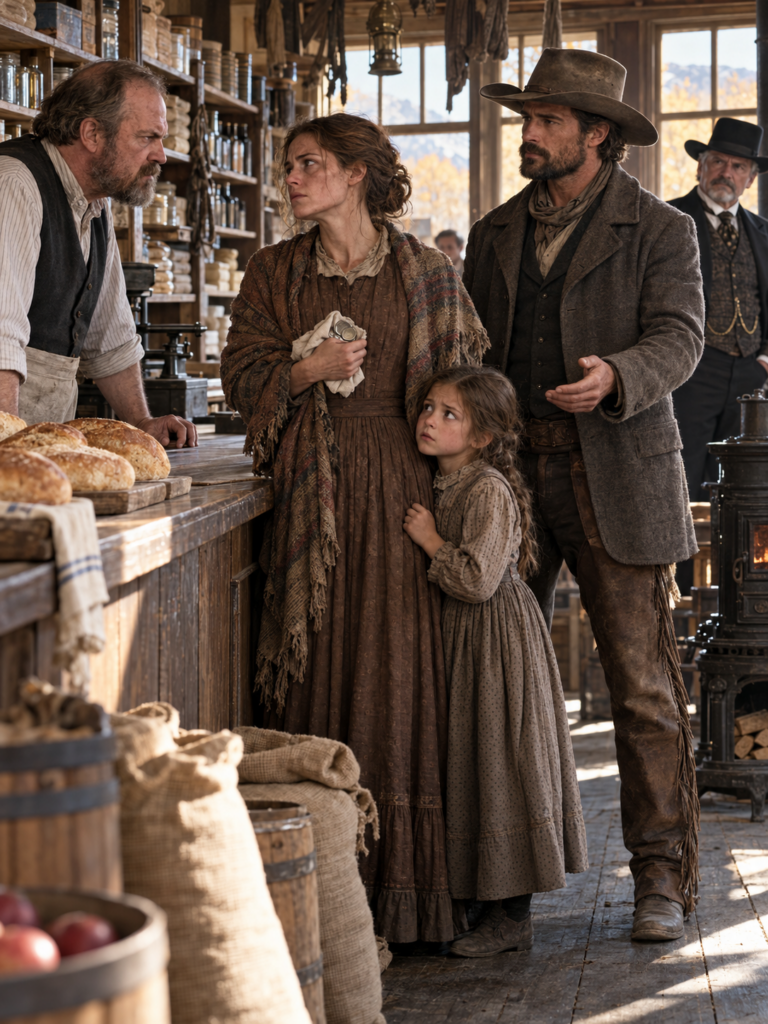
Across the street stood the mercantile.
The same door.
The same windows.
The same counter where a man had refused bread to a hungry child.
Hessie touched her new sleeve.
“Can we buy bread there, Mama?”
Ivy looked through the glass.
The storekeeper stood behind his counter, weighing coffee.
She could have chosen another shop.
There was no reason to give him her business.
But Hessie was waiting for an answer.
And Ivy no longer intended to organize her life around what other people might permit.
“Yes,” she said.
Together, they entered.
The bell rang.
Several customers turned.
Ivy led Hessie directly to the counter.
“One loaf of bread, please.”
The storekeeper reached for it.
Then he recognized her.
His face changed.
“Mrs. Mercer. About what happened last autumn—”
“You refused bread to my child,” Ivy said.
He lowered his eyes.
“Yes.”
“She was hungry.”
“I know.”
The storekeeper swallowed.
“I was wrong.”
Ivy waited.
Finally, he named the price.
She paid from her wage purse.
Hessie carried the loaf toward the door, holding it carefully against the wool of her new coat.
A woman standing near the barrels of flowers spoke Thomas’s name and said she had read the association’s notice.
Ivy thanked her.
Outside, Hessie looked up at her mother.
“They took our money today.”
“They did.”
“And Papa has his stone.”
“Yes.”
Hessie considered both things.
Then she straightened her shoulders and walked toward Wade’s waiting wagon.
Ivy followed with a feeling she had nearly forgotten.
Not triumph.
Not forgiveness.
The quiet knowledge that she could walk into town without lowering her head.
When they returned to the ranch, spring had begun drawing the snow back from the fence lines.
The ground was muddy.
The cattle still needed tending.
Wade’s herd was smaller, and replacing the breeding stock would take years of careful work.
There would be no sudden wealth.
No easy season.
But there was hay enough to finish the cold weather, a sound plan for spring, and an accurate account of what the ranch possessed.
Ivy entered the week’s final figures before putting away her pencil.
Hessie carried the loaf into the kitchen.
Thomas’s photograph stood on its familiar shelf.
Beside it lay a copy of the statement clearing his name.
Nothing about their new life required removing the old one.
Later, Ivy stepped onto the porch.
Wade was sitting on the bench, watching the last light settle over the barn.
He moved aside to make room for her.
She sat.
For a while, they listened to the sounds of the ranch.
A horse shifting in its stall.
Hessie setting dishes inside.
Wind moving softly along the house.
Then Wade removed his hat.
“I’ve been thinking about something.”
Ivy turned toward him.
“That sounds serious.”
“It is.”
He studied his hands.
“I want this place to be more than a ranch where we count the losses at the end of every winter.”
She waited.
“I want it to be a home worth coming back to.”
He looked at her.
“And when I think of that home, you’re in it. Hessie, too.”
Ivy felt her heart begin to beat harder.
Wade continued before she could answer.
“You’ve got a position here as long as you want it. If you decide otherwise, you’ve earned your wages and you’ll have my help making whatever arrangements you choose.”
“I know.”
“What I’m asking now isn’t about employment.”
He took a breath.
“I love you, Ivy.”
The words were quiet.
No grand performance.
No promise that he could erase what had happened to her.
Just the truth.
“I’d like to marry you. But only if that’s the life you want.”
Ivy looked toward the barn.
She remembered the October morning when he had stood beside her in the mercantile.
He had not promised to save her.
He had offered her work.
He had given her daughter a safe place to sleep.
He had listened to her judgment when winter threatened his cattle.
He had stood beside her without taking over when she fought for Thomas’s name.
He had never asked her to bury one love to make room for another.
And now he was offering a future without making it a debt she owed him.
She reached for his hand.
“I loved Thomas,” she said.
“I know.”
“I always will.”
Wade nodded.
“I wouldn’t ask you not to.”
She drew closer.
“But I’ve learned something this winter.”
“What’s that?”
“That loving someone who’s gone doesn’t mean a heart has nothing left to give.”
His fingers closed gently around hers.
“And I’ve learned that a home isn’t made by one person deciding how everybody else ought to live.”
Wade gave a small smile.
“You’ve taught me a fair bit about that.”
“I want us to go on making decisions together. About the ranch. About Hessie. About our work.”
“Agreed.”
“And I won’t stop keeping accounts.”
“I wouldn’t dare ask.”
She laughed softly.
Then she looked directly into his eyes.
“Yes, Wade. I’ll marry you. Because I want to.”
He brought her hand to his lips.
From inside the house came Hessie’s voice.
“Mama! Supper’s getting cold!”
Wade glanced toward the door.
“She’s right.”
“She often is.”
They stood together.
Before entering, Ivy looked once more toward the land.
She thought of the six cattle they had surrendered to save the rest.
The sledloads of hay.
The worn ledger.
The court papers.
The twelve silver dollars.
The little girl who had once asked whether she had done something wrong because nobody would sell her bread.
There were losses this place could never repair.
Thomas would never return.
No public notice could give Hessie another childhood with her father.
No settlement could restore the months Ivy had spent afraid to speak his name.
But the truth belonged to them now.
So did the right to build something new.
Inside, three places waited at the supper table.
Hessie proudly divided the loaf she had carried home.
Wade drew out Ivy’s chair, then took his own seat.
Thomas’s photograph remained on the shelf.
His brown tally book was safely preserved with the papers that had cleared his name.
And as Ivy looked from her daughter to the man she had freely chosen, she understood that the harsh winter had not given her a new life by erasing the old one.
It had shown her what could endure.
Honest work.
A child’s trust.
A name restored.
A love remembered.
And another love patiently earned.
That October morning, twelve dollars had not been enough to buy a loaf of bread.
By spring, those same twelve dollars had helped give Thomas a proper marker and Hessie a warm coat.
The bread on the table had been bought with Ivy’s own wages.
The future before her had been chosen with her own heart.
And for the first time in a long while, when Hessie asked whether they were home, Ivy could answer without the slightest uncertainty.
“Yes, sweetheart.”
She reached across the table for Wade’s hand.
“We’re home.”


