
The rotten post shifted beneath May’s hands, then dropped sideways, dragging a length of fencing toward the ground.
She stumbled backward.
The fence struck the dirt with a crack loud enough to bring Clara running from the porch.
“Mama!”
“Stay by the steps, sweetheart.”
May surveyed the damage.
What had been a crooked gate was now an opening wide enough for several cattle to pass through.
No responsible cattleman would bring a herd onto land that could not hold it.
And without the herd, there would be no payment.
May pressed both hands against her skirt.
She had wanted to prove that she could manage the ranch without depending on another man’s decisions.
Instead, she had discovered how much work Daniel used to accomplish before breakfast.
A horse approached along the public road.
Caleb.
He reined in when he saw the fallen fence.
“Would you like some help?”
May almost refused from habit.
Then Clara spoke from the porch.
“Button says the fence is broken.”
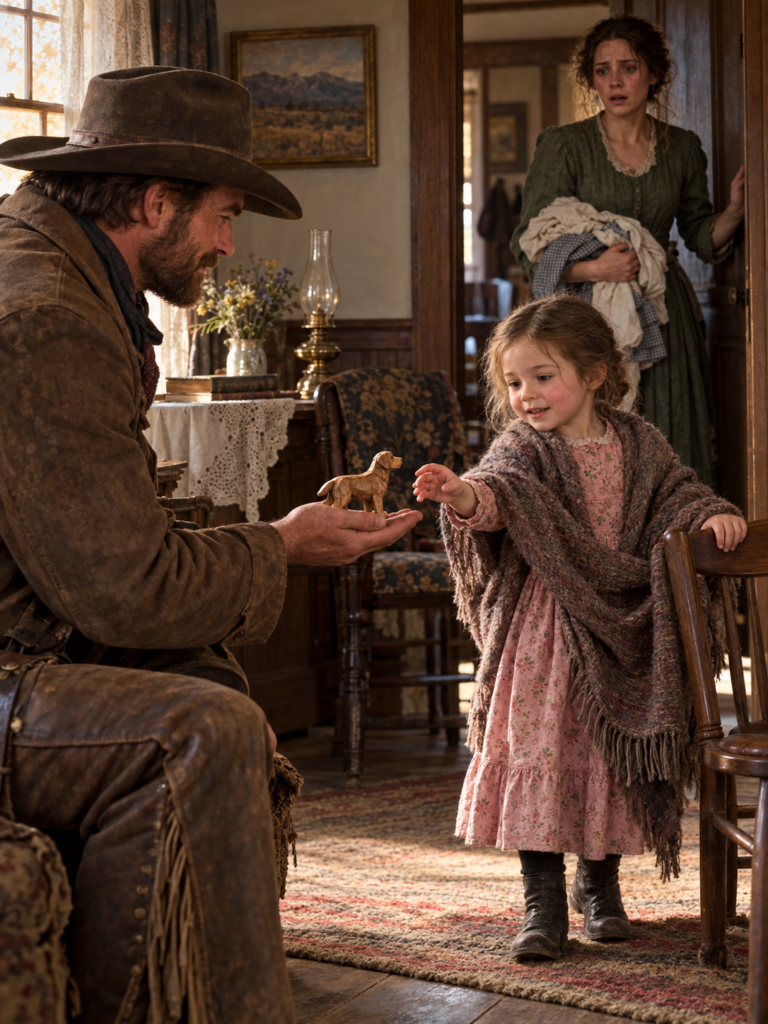
Caleb glanced solemnly toward the wooden dog.
“Hard to argue with Button.”
Despite herself, May smiled.
Then she looked at the gap.
“I’ll accept help,” she said. “But we’ll agree on the work before you begin.”
“Fair enough.”
“I won’t have a man fixing everything and afterward telling me what I owe him.”
Caleb dismounted.
“Then let’s settle it now. I’ll bring my tools and help with the posts. You decide what gets repaired. We can put the cost of any materials on paper.”
“And your labor?”
“Call it a neighbor’s favor. You’re free to say no.”
May studied him.
“Why?”
Caleb glanced at the fallen fence.
“Because it needs fixing.”
“That can’t be your entire reason.”
“No,” he admitted. “But it’s the part I know how to explain.”
She allowed him through the gate.
Together they examined the damage.
May identified boards worth keeping, marked the worst posts, and told him which corner must remain open until she could shift the gate.
Caleb listened.
He did not replace her judgment with his own.
By midday, two posts stood firm.
Clara sat beneath the porch awning with Button beside her, announcing every hammer blow as if she were supervising an important construction project.
When Caleb stopped for water, May brought him a cup.
“Amos will want to inspect the creek bank,” she said.
“He will.”
“There’s one wet patch I haven’t shown him.”
“Then show him.”
“Even if it costs me the agreement?”
Caleb met her eyes.
“Especially then.”
The answer settled something uncomfortable inside her.
She had spent months being told what she could not afford.
Very few people had spoken as though her honesty were worth preserving.
Before leaving, Caleb asked permission to inspect the repaired gate once the new boards were fitted.
May agreed.
Then she called him back.
“Mr. Marrow?”
“Caleb.”
“Caleb. I want you to understand something.”
He waited.
“If this arrangement works, the pasture money will be mine because the land is mine. I won’t have anyone saying I kept the place because a rancher took pity on me.”
His expression remained serious.
“If the agreement works, it’ll be because you knew your land and negotiated fair terms.”
May swallowed.
“Thank you.”
That Wednesday, Amos arrived with the written contract.
They sat around May’s kitchen table while Clara arranged Button and two cloth dolls on the floor.
The fee was $190.
Ninety-five dollars when the cattle arrived.
Ninety-five after the agreed grazing term.
May’s saved $39, combined with the first payment, would give her $134.
Enough to pay the bank’s $126.
Eight dollars left.
But the cattle had to reach her gate by ten o’clock on the final Thursday.
She would then have less than two hours to collect the payment, ride to town, and meet the bank’s deadline.
May insisted upon adding the payment-at-the-gate provision in writing.
Amos agreed.
She signed only after reading every line twice.
Weeks passed with fencing, sewing, and careful preparation.
Caleb came when invited.
Clara came to expect him.
One evening, the child leaned against his sleeve while he listened to a complicated story about Button’s adventures.
May watched them from the porch.
Daniel’s memory still lived in every room of the house.
Yet Caleb had never once tried to move it aside.
“I think she’s chosen you,” May whispered.
Caleb turned toward her.
Before he could answer, hoofbeats interrupted them.
A rider stopped at the gate and handed May a sealed reminder.
The bank’s deadline was tomorrow.
Noon.
The cattle were due at ten.
And not one dollar of the grazing fee had arrived.
May folded the notice, stepped into the house, and reached for Daniel’s account book.
May’s fingers closed around the worn leather account book.
The corners had softened from years of handling. Daniel’s handwriting filled its earliest pages, recording purchases of seed, repairs to the barn, feed expenses, and plans for improvements he had never lived to make.
Near the back, in May’s steadier, smaller writing, stood three figures.
$39 saved.
$95 promised.
$126 due.
The numbers had not changed.
Neither had the bank’s deadline.
Behind her, Caleb remained at the open doorway.
“Do you want me to come in?”
May nodded.
She set the book on the table and smoothed the reminder beside it.
“They haven’t changed the terms,” she said.
“No.”
“And Amos hasn’t sent word of a delay.”
“No.”
Clara sat near the stove, turning Button over in her hands.
“Is that another bad letter?”
May crouched beside her daughter.
“It’s a reminder, darling.”
“About our house?”
“Yes.”
Clara’s fingers tightened around the dog.
“Are we moving?”
May could not bear to promise what she had not secured.
“I’m doing everything I can to keep us here.”
The little girl leaned forward and put Button into her mother’s hand.
“He can help.”
May swallowed.
“He already has.”
She returned the carving and kissed Clara’s forehead.
After putting her daughter to bed, May joined Caleb on the porch.
The evening was cool, and the ground along the road remained soft where lingering wet weather had worked into the wagon ruts.
Caleb rested his forearms on the railing.
“If Amos arrives at ten, you’ve got enough time,” he said.
“If he arrives at ten.”
“Yes.”
“If he arrives an hour late?”
Caleb did not answer immediately.
“That makes things harder.”
“An hour and a half?”
“Too close for comfort.”
May watched the fading light settle over the pasture.
“I’ve been thinking of every possible way tomorrow could go wrong.”
“I expect you have.”
“I keep coming back to one thing.”
“What’s that?”
“I cannot make his cattle travel faster by worrying about them.”
“No.”
“And I cannot make the bank change its mind by pleading.”
“No.”
She turned toward him.
“So tomorrow morning, I will be ready at the gate with my copy of the contract. The moment I receive payment, I will ride straight to town.”
“I can have your horse saddled before Amos arrives.”
“Thank you.”
He hesitated.
“May, there’s something else.”
She looked up.
“About what you said earlier. About Clara choosing me.”
A breeze lifted the edge of her shawl.
“I shouldn’t have said it that way.”
“Why not?”
“Because she’s only four. She’s lost her father. I won’t let her kindness turn into a promise neither of us has made.”
Caleb nodded.
“You’re right.”
May had expected embarrassment, perhaps wounded pride.
Instead, he seemed relieved that she had said what needed saying.
“Daniel was her father,” he continued. “Nothing changes that.”
May looked toward the bedroom window.
“He was a good one.”
“Then she’ll have good things to remember.”
“She barely remembers his voice now.”
Caleb’s jaw tightened.
“That must hurt.”
“More than I can say.”
For a while, they listened to the insects in the grass.
Then May spoke again.
“Daniel used to talk to the cattle while he worked. Not because he thought they understood. He said a quiet field made the day feel longer.”
Caleb gave a faint smile.
“I’ve been known to do that myself.”
“He also sang terribly.”
“That I can’t promise to match.”
May laughed.
The sound startled her.
It had been so long since she had spoken of Daniel without the conversation ending in grief.
She looked at Caleb.
“Thank you for never asking me to forget him.”
“I wouldn’t have the right.”
“No,” she said softly. “You wouldn’t.”
Then she added, “But that doesn’t mean I haven’t noticed you.”
Caleb looked toward her.
Neither spoke for several heartbeats.
At last he said, “I have noticed you too.”
It was all he offered.
And because he asked nothing in return, May found the words more difficult to dismiss than any fine declaration.
***
Before sunrise, May was awake.
She dressed in her work clothes, fed the remaining cow, and checked the leather pouch containing her savings.
Thirty-nine dollars.
Counted twice.
She placed the bank reminder beside the money and tucked both inside a small satchel.
Her copy of the grazing contract remained in Daniel’s account book until she was ready to carry it outside.
Clara woke while May was preparing breakfast.
“Is this the big day?”
“It is.”
“Will Mr. Caleb come?”
“He said he would.”
“Button says he’ll be early.”
May smiled.
“Button has excellent confidence.”
At half past eight, Caleb arrived.
He checked May’s horse, examined the girth, and placed a filled water flask where she could reach it.
“Horse is ready,” he said.
“Thank you.”
The east gate had been repaired.
May checked the latch herself.
Then she walked along the fence line to the creek, making certain the gate dividing the grazing pasture from the house yard was secure.
Amos had agreed to bring only ten cattle.
May intended to see that the agreement remained exactly as written.
By nine, everything was ready.
By half past nine, May had already looked toward the western road more times than she could count.
Clara stood on the porch, holding Button high.
“Can he see the cows coming?”
“Not yet,” May said.
At five minutes to ten, Caleb rode to the rise beyond the gate.
He stayed within sight.
May watched him shade his eyes.
Then he turned toward her.
“Dust on the road!”
Her heart leaped.
She stepped forward.
A few moments later, the cattle appeared around the bend.
Amos rode beside them with two hands helping keep the small herd together.
May counted carefully as the animals approached.
One.
Two.
Three.
All the way to ten.
Amos halted outside the fence.
“Morning, Mrs. Harding.”
“Good morning.”
“Hope we’re not late.”
May glanced at the position of the sun and then at the small watch she had borrowed from the mantel.
“Right on time.”
Amos dismounted.
He looked over the repaired gate, the solid corner posts, and the pasture beyond.
“Better fence than when I inspected.”
“Better than it was,” May agreed.
He reached into his coat.
For one dreadful second, she thought he was searching for an excuse.
Instead, he withdrew a leather purse.
“Your first payment.”
May held out her hand.
He counted the money onto her palm.
She counted it again.
Ninety-five dollars.
Every cent.
She signed a receipt acknowledging payment, and Amos signed his copy.
Only then did May open the gate.
The cattle entered the east pasture.
For several moments, she watched them lower their heads toward the grass.
The ranch was earning money again.
Money she had arranged for.
Money she had insisted upon receiving before surrendering possession of the pasture.
Money that belonged to her.
But the satisfaction had to wait.
She turned toward Caleb.
“I need to reach the bank.”
He was already holding her horse.
May tucked the cash into her satchel and secured the fastening.
“I’ll ride with you as far as the town road,” he said.
She shook her head.
“You still have your own work.”
“It can wait until noon.”
“Caleb—”
“I’m not riding to speak for you. I’m riding because the road’s rough and there’s no harm in having company.”
May regarded him.
Then she took the reins.
“All right.”
***
They rode toward Lark Crossing at a steady pace.
May resisted the urge to drive her horse harder.
The animal had to cross wet stretches and uneven ruts, and a fall would cost far more time than sensible riding.
Caleb stayed beside her without crowding.
At the creek crossing, May chose the firmer track along the rise.
He followed her lead.
Halfway to town, a wagon was struggling through a deeply cut patch of road.
May reined in long enough to choose a narrow passage around it.
The delay seemed to last forever.
Then they were past.
When the first rooftops appeared, May felt both relief and a fresh wave of fear.
Reaching town was not the same as completing the payment.
She dismounted outside the bank.
Caleb took her horse’s reins.
“I’ll be here.”
May hurried inside.
The clerk looked up.
“Mrs. Harding.”
“I’ve come to settle the overdue installment and fees.”
She placed the notice on his desk.
Then the satchel.
The clerk opened the account ledger.
“One hundred twenty-six dollars.”
“I have it.”
May laid the money down.
Her hands were steady now.
The clerk counted each coin and bill.
Then he counted again.
He entered the amount in the ledger and prepared her receipt.
May read the figures before accepting it.
“Does this stop Monday’s sale?”
“The overdue amount and fees have been received within the stated deadline,” the clerk replied. “The scheduled foreclosure sale will not proceed.”
May did not move.
“Would you say that again?”
The clerk looked up, less formally this time.
“The sale is stopped, Mrs. Harding.”
She drew a long breath.
“Thank you.”
He slid the receipt toward her.
May took it carefully.
The ranch was not free of every future obligation. The mortgage still existed, and she would have to meet its remaining payments.
But the overdue installment was settled.
The approaching auction was stopped.
And when May stepped back into the street, she carried the paper proving it.
Caleb straightened when he saw her.
“Well?”
May tried to answer.
Nothing came.
She held out the receipt.
He read it.
Then he looked at her face.
“You did it.”
For an instant, May wanted to say they had done it together.
He had helped mend the fence, introduced her to Amos, and ridden with her through the uncertain morning.
Yet she knew why he had chosen those words.
He understood what this victory meant to her.
“I did,” she whispered.
Then the tears came.
She covered her mouth.
Caleb stepped closer but did not touch her.
“May?”
“I’m all right.”
He waited.
She laughed helplessly through her tears.
“For the first time in months, I believe I might be.”
***
Gerald Briggs encountered them outside the bank.
He noticed the receipt in May’s hand.
“Mrs. Harding. Have you considered my offer?”
“I have.”
“And?”
“The Harding ranch is not for sale.”
His gaze moved to Caleb.
“I see you’ve found assistance.”
May folded the receipt and placed it safely in her satchel.
“I’ve found a tenant for my pasture.”
Briggs frowned.
“Grazing cattle won’t solve every difficulty.”
“No,” May replied. “But they’re helping solve this one.”
He studied her.
“The bank?”
“Paid.”
The word seemed to disappoint him.
For a moment, May thought he might argue.
Instead, Briggs adjusted his gloves.
“Then I wish you luck.”
“Thank you.”
His buggy rolled away.
Caleb watched it turn the corner.
May stood straighter than she had that morning.
“I suppose he’ll find another piece of land.”
“He might.”
“I hope he pays a fair price for it.”
Caleb smiled.
“So do I.”
They returned to the Harding place that afternoon.
Clara ran from the porch the moment she saw them.
“Mama!”
May dismounted.
Her daughter reached for her.
“Did we keep the house?”
May knelt in the dusty yard.
She placed both hands around Clara’s small shoulders.
“Yes, sweetheart.”
Clara stared.
“For always?”
May refused to promise what no one could guarantee.
“We have kept it from being sold on Monday. There will still be work to do and bills to pay. But today, we get to stay.”
Clara considered this with solemn care.
Then she threw both arms around her mother’s neck.
“Button knew.”
May laughed into her daughter’s curls.
“I believe he did.”
Caleb stood beside the horse, smiling quietly.
Clara released her mother and ran toward him.
“Mr. Caleb! We’re staying!”
“So I’ve heard.”
She took his hand.
“Then you can come for supper.”
Caleb looked toward May.
May looked at the bank receipt still clutched in her fingers.
For months, every decision had been measured against what it might cost.
Now, for the first time, she could consider what she wanted.
“Yes,” she said. “He can.”
***
That evening, they ate at Daniel Harding’s kitchen table.
Clara insisted that Button receive a place beside her plate.
Caleb accepted this without argument.
May served beans, bread, and the last of a jar of preserved peaches.
It was not an elaborate meal.
Yet nothing in her house had felt so plentiful for a very long time.
When Clara had gone to bed, May brought out the account book.
Caleb watched her open it.
“I need to plan the next payment,” she said.
“You’ve got the second half of the grazing fee coming after the fall roundup.”
“Yes. And my sewing orders.”
She pointed to the figures.
“If I keep a little aside for fence repairs and don’t spend carelessly, I think I can manage.”
Caleb studied the page when she turned it toward him.
“You’ve done a fine job keeping track.”
“Daniel started the book.”
“And you’ve kept it going.”
May ran her thumb along the worn edge.
“He believed this land would give Clara something permanent.”
“He sounds like a man who thought ahead.”
“He did.”
She closed the book.
For a long moment, she looked toward the bedroom.
“Caleb, Clara asked me something before supper.”
“What was it?”
“She asked if she could give you Button.”
He looked genuinely startled.
“Why would she do that?”
“Because she thinks he belongs with the person who made him.”
Caleb shook his head slowly.
“He belongs with the person who named him.”
May smiled.
“That’s what I told her.”
Then she grew serious.
“She likes you very much.”
“I like her too.”
“And I’ve begun to care for you.”
The words hung between them.
Caleb did not move.
May felt her heart beating hard against her ribs.
“I don’t know what that means yet,” she continued. “I only know I don’t want my gratitude for your help mistaken for something else.”
“Neither do I.”
“You understand?”
“I do.”
He drew a breath.
“May, I was fond of you before the cattle came. And now that the bank’s been paid, I’m still fond of you.”
Her eyes filled again.
“I don’t want you to feel obligated,” he added.
“I don’t.”
“And I won’t ask Clara to call me anything she doesn’t want.”
May looked down.
That careful promise touched the place in her heart she had guarded most fiercely.
At last, Caleb rose.
“I’d like to keep visiting, if you’d welcome me.”
May walked him to the door.
The evening air smelled of grass and damp earth.
Beyond the porch, cattle grazed quietly in the east pasture.
“Yes,” she answered. “I’d welcome that.”
Caleb put on his hat.
Then he paused.
“And if someday you’d want more than visits,” he said, “I’d be glad to talk about it.”
May looked at him, and for the first time she did not feel that a decision was being demanded of her.
She stepped closer.
“Then perhaps,” she said, “when we’ve had time to know one another properly, we should have that conversation.”
Caleb nodded.
“I’d like that.”
He went down the steps toward his horse.
May remained in the doorway, watching him.
She had saved her ranch.
But she was beginning to understand that keeping the life Daniel had helped build did not necessarily mean closing the door against every life that might follow.
May remained in the doorway until Caleb reached his horse.
Then she called his name.
He stopped with one foot near the stirrup.
“Caleb.”
“Yes?”
“You never answered what I said about Clara.”
He turned.
May stepped onto the porch.
“The night the bank reminder came. I told you I thought she’d chosen you.”
“I remember.”
“I think I was frightened by how happy she looked beside you.”
Caleb removed his hat.
“Why?”
“Because happiness can make promises before people know whether they can keep them.”
He considered that.
May continued, her voice quiet.
“Daniel promised Clara he’d teach her to ride when she grew older. He promised me we’d repair the barn together. He promised we’d see the ranch through good years and bad.”
She swallowed.
“He meant every word. But he couldn’t keep all of them.”
Caleb stood still.
“May, I can’t promise you nothing will ever go wrong.”
“I know.”
“I can’t promise I’ll always have the right answer either.”
She gave a faint smile.
“That would be a foolish promise.”
“But if Clara wants me in her life, I’ll take that seriously. And if you want me there, I’ll take that seriously too.”
May studied his weathered face.
For once, he did not seem entirely comfortable with his own words.
He was a man who could mend a fence, judge a horse, and spend long hours in a field without complaint.
But she could see that offering his heart frightened him in a way work never had.
She crossed her arms against the evening chill.
“Then we’ll start with Sunday supper.”
Caleb smiled.
“Sunday supper.”
“And you needn’t bring another carved animal.”
He looked offended.
“I was considering a whole herd.”
May laughed.
The sound followed him down the path.
***
The weeks that followed did not transform the Harding ranch into a prosperous estate.
There were still bills.
There were still weak boards along the fence.
The barn still leaned south.
May still rose early to prepare laundry and spent evenings stitching torn coats by lamplight.
But something important had changed.
Her labor was no longer directed solely toward postponing disaster.
The first grazing payment had saved the ranch from the immediate auction.
The second, due after the fall roundup, could be planned for rather than merely hoped for.
May kept the contract beside the bank receipt in Daniel’s account book.
Every new sewing payment went into the proper column.
Expenses were recorded honestly.
She set aside money for the next mortgage installment and began a separate sum for improvements.
Whenever she grew tempted to forget the figures in a moment of relief, she reminded herself what the last six weeks had taught her.
Hope was good.
A plan was better.
And hope supported by honest work could sometimes become a future.
Caleb visited most Sundays.
Sometimes he brought a repaired tool.
Sometimes he came with news of cattle prices or a small item Clara had asked him to find.
Sometimes he arrived with nothing but his company.
May began to appreciate those visits most.
They told her he was not coming because she needed him to fix something.
He was coming because he wanted to see her.
Clara, meanwhile, had developed an elaborate life for Button.
The wooden dog inspected fence posts, guarded the kitchen shelf, attended Sunday supper, and occasionally disappeared beneath the bed after committing some imaginary offense.
Caleb listened to every report with solemn interest.
One afternoon, Clara placed Button beside his coffee.
“He says you can keep him today.”
Caleb looked toward May.
“That’s a considerable honor.”
Clara nodded.
“But you have to bring him back.”
“I will.”
“And don’t let him get cold.”
“I’ll see that he has a good place.”
“And he needs to be home before bedtime.”
Caleb accepted the conditions.
May watched him wrap the dog carefully in his handkerchief before slipping it into his coat.
It was an absurdly small thing.
Yet that night, as she tucked Clara into bed, the child asked a question that left May uncertain how to breathe.
“Mama, can somebody have two papas?”
May sat beside her.
“Why do you ask?”
“Because Papa Daniel is in heaven, and Mr. Caleb comes to supper.”
May considered her daughter’s face.
Clara was not asking to replace Daniel.
She was trying to understand how affection worked when someone had died.
“Your father will always be your father,” May answered.
Clara nodded.
“But can Mr. Caleb stay our friend?”
“He can.”
“For a long time?”
“I hope so.”
The child thought about that.
“Good.”
Then she closed her eyes.
May remained beside her a little longer.
She knew children could attach themselves quickly to anyone kind.
She also knew adults could mistake a child’s enthusiasm for permission to hurry.
She would not make that mistake.
Clara deserved certainty built from experience, not a promise spoken because everyone wanted a happy ending.
***
Autumn advanced across Wyoming Territory.
The grass in the east pasture began to yellow.
Amos Reed’s cattle filled out well during their grazing period, and May watched them with the growing satisfaction of a landowner who had learned how to make an underused field contribute to the household.
When the time came to arrange their removal, Amos rode out to inspect the herd with her.
He brought the second payment.
Ninety-five dollars.
May counted it and entered the amount in her book.
“Everything as agreed?” she asked.
“Everything as agreed.”
“Any complaints about the pasture?”
“None worth mentioning.”
May smiled.
“Then perhaps we can speak again when you need grass next season.”
Amos nodded approvingly.
“I’d be glad to.”
He glanced at the repaired corner fence.
“Caleb did good work there.”
“He did.”
Amos looked back at her.
“But you knew what you wanted done.”
May closed the book.
“Yes,” she said. “I did.”
That afternoon, after the cattle had been moved out of the field, May stood beside the empty gate.
She remembered the morning when the old post had collapsed beneath her hands.
She remembered the sickening thought that she had failed before the agreement had even begun.
The fence still bore marks from the repairs.
The boards were uneven in color.
But the posts stood straight.
May placed one hand on the gate.
Daniel had dreamed of making the ranch something lasting.
For a long time after his death, she had believed honoring that dream meant preserving everything exactly as he left it.
Now she understood differently.
Keeping the ranch alive required change.
New agreements.
New work.
New decisions.
And perhaps, eventually, new love.
***
A week later, Caleb invited May and Clara to supper at his own ranch.
It was the first time May had spent a full evening there.
His place was smaller than hers but carefully maintained.
The barn door hung square.
The water trough was clean.
His tools occupied an orderly rack beside the shed.
Nothing was elaborate.
Nothing was wasted.
Inside, the kitchen held one large table, two sturdy chairs, and a third smaller chair Caleb admitted he had recently repaired.
Clara immediately claimed it.
“It’s my size.”
“That was the general notion.”
May looked at him.
“You repaired it for her?”
“Found it put aside at the house. Needed a new rung.”
Clara climbed onto the chair.
“Button likes it too.”
“Then we’ll have to take turns,” Caleb replied.
May walked toward the window.
From there she could see the pasture fading into the evening distance.
There was a quietness to his home that reminded her of the earliest months after Daniel’s death.
But his quietness felt different.
He had chosen much of it.
She had endured hers.
When supper was finished, Clara sat at the table examining Button while Caleb showed May a shelf he intended to repair.
She noticed how easily they had fallen into ordinary conversation.
The price of feed.
The condition of her barn.
The coming cold.
Whether Clara would be old enough to begin formal lessons the following year.
Their lives were not built from grand gestures.
They were built from questions that mattered on an ordinary Tuesday.
Later, when Clara had fallen asleep on a quilt-covered bench near the stove, May stepped onto the porch with Caleb.
The stars were visible over the eastern fields.
“I understand why you like it here,” she said.
“It’s peaceful.”
“Sometimes too peaceful.”
May turned.
He looked out into the darkness.
“I worked cattle for other ranchers twelve years before I could buy this place. I was proud of it. Still am.”
“You should be.”
“For a while, I figured owning my own roof would be enough.”
“And wasn’t it?”
“It gave me a great deal. But I started noticing how quiet supper was.”
May listened.
“I’d finish a hard day’s work, come inside, sit at that table, and realize there wasn’t anybody to tell whether the gate needed fixing or the calf had finally learned to keep out of trouble.”
He gave a slight shrug.
“Didn’t seem worth complaining about. I had what I’d worked for.”
May looked toward the window where Clara slept.
“A home can be full of things and still feel empty.”
“Yes.”
She was silent for a moment.
“Daniel was always making plans,” she said. “Even when we couldn’t afford them. A better barn. Another cow. A garden fence. He used to say we’d have time.”
Caleb waited.
“When he died, I stopped making plans beyond the next payment. I thought if I looked too far ahead, I’d only discover more things I could lose.”
“And now?”
May looked across his land.
“Now I’m thinking about spring.”
He smiled faintly.
“That’s a fair distance.”
“It is.”
He turned toward her.
“May, I’ve grown very fond of you.”
She felt the familiar quickening in her chest.
“I know.”
“I’d like to court you properly. Not because Clara wants me around. Not because of the ranch. Because I enjoy being with you, and I’d like the chance to see where that leads.”
May considered the word.
Court.
It belonged to a part of life she had almost forgotten existed for her.
“You understand that I won’t leave Daniel’s memory behind?”
“Yes.”
“And the Harding place stays mine to manage.”
“Of course.”
“And I intend to keep taking sewing work.”
“Good work deserves doing.”
She watched him.
“You make everything sound terribly simple.”
“It’s seldom simple. But I don’t see much use pretending I want something different.”
May smiled.
“Then yes.”
Caleb went still.
“Yes?”
“You may court me, Caleb Marrow.”
His answering smile was so broad that she laughed.
“Have I surprised you?”
“A little.”
“Good.”
He held out his hand.
May took it.
They stood together beneath the wide night sky.
No promises beyond what they could honestly make.
No demand that the past be forgotten.
Only the beginning of something neither had expected.
***
Winter came gradually.
May and Caleb continued spending time together, though ranch duties and weather sometimes kept them apart for several days.
Clara learned that a missed visit was not the same as abandonment.
If Caleb said he expected to come Sunday and work prevented him, he sent word when he could.
He never made promises merely to quiet her disappointment.
May appreciated that.
She had lived long enough to know a child needed reliability more than excitement.
As the weeks passed, she learned more about Caleb’s habits.
He could not abide a poorly hung gate.
He had an unfortunate talent for burning bread when distracted.
He read the newspaper from beginning to end, including notices of matters that did not concern him.
He was patient with nervous horses and surprisingly helpless when Clara demanded that he invent stories about Button.
May discovered that she liked him most when he was not trying to impress anyone.
He discovered that she could argue stubbornly about the price of materials, remember figures from months earlier, and find humor in circumstances that might have defeated a less determined person.
Their affection grew through such discoveries.
It also grew through disagreement.
One afternoon, Caleb suggested helping repair a section of the Harding barn before colder weather arrived.
May agreed to discuss the work.
But when he returned the next day with more materials than they had discussed, she stopped him at the gate.
“What’s all this?”
“Boards. Thought we could strengthen the south wall while we’re at it.”
“Did we agree to that?”
“No. I figured—”
“That’s the trouble.”
Caleb looked at her.
May rested one hand on the wagon side.
“I know you mean well. But it’s my barn, and I need to know what a repair will cost before it begins.”
He glanced at the boards.
Then at her.
“You’re right.”
“I don’t want to spend my days being grateful for decisions I never made.”
“I understand.”
He was quiet for a moment.
“I brought too much without asking. That was wrong.”
May’s anger softened, though she did not withdraw her point.
“What shall we do with the extra lumber?”
“Take it back. Or use it at my place. We only use what you’ve approved here.”
“Thank you.”
He gave a rueful smile.
“I’m learning.”
“So am I.”
Later, when they worked together on the agreed repairs, May handed him nails from a small tin while he fitted a board into place.
He asked before changing the position of a brace.
She admitted when his suggestion was better than hers.
By the time they finished, the wall stood stronger.
So did something between them.
May had seen him make a mistake.
More importantly, she had seen him correct it without making her pay for having spoken.
***
By the following spring, the Harding ranch was steadier.
May had put aside money for the next payment, continued her sewing, and begun planning another possible grazing season.
She did not assume the bank would forgive future delays.
Instead, she maintained her accounts and kept a careful reserve.
Clara had grown taller.
Button had lost a tiny bit of paint from one ear, though Caleb had never painted him; Clara insisted the mark came from an encounter with a dangerous imaginary wolf.
She had also developed the habit of asking questions no adult could answer easily.
One Sunday, while May prepared dinner, Clara sat beside Caleb on the porch.
“Mr. Caleb?”
“Yes?”
“Did you know my papa?”
Caleb shook his head.
“No, sweetheart.”
“Mama says he sang badly.”
“I’ve heard that.”
“He liked horses.”
“So do I.”
“He built our house.”
“He helped make a fine home.”
Clara examined Button’s wooden ears.
“Do you think he’d like you?”
Caleb was silent for a moment.
Then he set down the small piece of leather he had been mending.
“I can’t know what he’d think of me.”
Clara looked disappointed.
“But I know he loved you,” Caleb continued. “Your mama tells me so.”
She nodded.
“And I reckon he’d want people to be kind to you.”
Clara considered that.
“Like you?”
“I certainly try.”
She moved closer.
“Good.”
May had heard the conversation through the open window.
She stood with her hands resting on the edge of the table.
Not because Caleb had said something grand.
Because he had refused to use Daniel’s memory to make himself more important.
He had left room for a father he never met.
And in doing so, he had made room for trust.
***
It was May who first spoke seriously of marriage.
They were sitting beneath the cottonwood near the Harding house after a long afternoon examining the east pasture.
Clara was gathering fallen leaves and arranging them around Button.
May had been thinking about the subject for weeks.
She had considered her finances.
Her daughter.
The distance between the two ranches.
The work required by each place.
She had also considered how she felt when Caleb arrived.
How she missed him when he did not.
How naturally she had begun to imagine his presence in the years ahead.
“I’ve been thinking about our future,” she said.
Caleb turned toward her.
“Our future?”
“Yes.”
He waited.
“I love my home,” May continued. “I won’t give it up simply because marriage might make life easier elsewhere.”
Caleb looked thoughtful.
“I wouldn’t ask you to.”
“And I don’t expect you to abandon the ranch you’ve worked so hard to buy.”
“No.”
She smiled.
“So perhaps we ought to decide whether two stubborn landowners can make a life together.”
Caleb laughed softly.
“That could be difficult.”
“Very.”
“Especially with Button supervising.”
May laughed too.
Then she grew serious.
“I care for you, Caleb. More deeply than I thought I could care for anyone again.”
His expression changed.
She saw that he understood the weight of her words.
“I love you, May.”
She closed her eyes briefly.
He did not rush to fill the silence.
When she looked at him again, she was smiling through tears.
“I love you too.”
Caleb reached for her hand.
“Then let’s talk through the practical parts before we promise anything.”
May nodded.
They did.
They discussed the Harding place, Caleb’s ranch, the work each property required, and how they might divide their time and responsibilities.
They agreed May would retain control of her ranch accounts and grazing agreements.
Her sewing earnings would remain money she managed.
Caleb would continue caring for his own livestock and land.
They would make decisions about any shared household expenses together, without assuming that one person had earned the right to command the other.
Clara’s welfare came first.
And Daniel’s memory would not be treated as something to remove from the house.
By the end of the conversation, May felt neither rescued nor swallowed into another person’s life.
She felt heard.
Caleb looked at her.
“There’s one question left.”
“I believe there is.”
He stood, then offered his hand.
May rose beside him.
“May Harding, would you marry me?”
She held his gaze.
“Yes.”
He drew a shaky breath.
She smiled.
“Yes, Caleb. I will.”
He leaned toward her but stopped, giving her time to choose.
May closed the distance and kissed him.
It was a gentle kiss.
Not a reward for saving her ranch.
Not the payment of a debt.
Not a promise that grief would vanish.
It was the first kiss of two people who knew enough about loss to understand the courage required to begin again.
A small voice interrupted.
“Are you getting married?”
They turned.
Clara stood beneath the cottonwood, Button pressed against her chest.
May knelt.
“Yes, darling. Caleb and I have decided we would like to.”
Clara considered the news.
“Will he still make wooden dogs?”
Caleb crouched beside them.
“I expect so.”
“Will he come for supper?”
“Quite often.”
Clara frowned.
“But Mama, what about Papa Daniel?”
May drew her close.
“Nothing about Papa changes.”
Caleb nodded.
“You can talk about him whenever you wish.”
Clara looked between them.
Then she placed Button into Caleb’s hand.
“Then he can come too.”
***
They married several weeks later beneath that same cottonwood.
There were no grand decorations.
May had sewn her own ivory-colored dress from modest fabric she had carefully saved for.
Clara wore her pink flowered dress, freshly mended and pressed.
Caleb wore his best dark coat.
Amos Reed attended, as did Mrs. Cooper and several neighbors who had watched May struggle to keep the Harding place.
A minister conducted the ceremony.
The vows were simple.
When May promised to love Caleb, she did so with the full knowledge that she could have continued living on her ranch without marrying him.
She had proved that to herself.
When Caleb promised to honor her, he meant more than kindness during easy days.
He meant listening when she disagreed.
Sharing work without taking command.
Accepting that the land she loved and the memories she kept were part of the woman he wanted to marry.
Clara stood beside her mother with Button tucked beneath one arm.
When the ceremony ended, she announced that the wooden dog had also enjoyed the wedding.
Everyone laughed.
Later, as the guests shared bread, preserves, and coffee beneath the tree, May slipped away to the porch.
She stood looking over the east pasture.
The grass had come back green.
The gate remained straight.
The creek reflected the afternoon sky.
Behind her, Caleb approached.
“Looking for something?”
May shook her head.
“Just remembering.”
He stood beside her.
She thought of Daniel.
Of the first winter without him.
Of mornings when she had stared at the numbers in his account book and wondered whether she had enough strength to keep going.
Of Clara’s frightened face when she asked if they would lose their house.
Of a little wooden dog placed into a child’s hand by a stranger who had no idea what kindness would mean to them.
“I wish Daniel could see that the place is still ours,” she said.
Caleb rested his hand on the railing.
“I think he’d be proud of what you’ve done.”
May looked at him.
“I hope so.”
Then she took his hand.
Together they went back to their guests.
***
Their life after marriage was not free of difficulty.
The two ranches still required labor.
There were bills to manage, fences to maintain, animals to care for, and days when fatigue made both May and Caleb less patient than they wished to be.
But they had learned how to speak plainly.
When May needed time for sewing, Caleb took responsibility for work that could be done without her.
When his cattle required attention, she respected the demands of his livelihood.
They kept clear accounts.
They asked before making decisions that affected the other’s property or work.
And they found ordinary pleasure in having someone to tell about the day’s troubles.
Some evenings, they ate at the Harding place.
Others, they stayed at Caleb’s ranch.
As the months passed, they organized their household so Clara could keep familiar routines while both properties continued to be cared for.
May did not stop being a widow in the sense that Daniel would always belong to her history.
She became a wife again without ceasing to be the woman who had loved him.
Caleb did not try to become Daniel.
He became someone Clara could trust for his own reasons.
He listened.
He kept his word.
He showed her how to handle small tools safely when she was old enough to learn.
He taught her that animals needed patience and that frightened creatures should never be rushed.
Sometimes, when she spoke about her father, he simply listened.
And when Clara eventually began calling him Papa Caleb, it was because the name had grown naturally in her heart.
He never demanded it.
May never instructed her to say it.
The child found the words for herself.
***
One autumn afternoon, more than a year after the day Clara first approached Caleb at the hotel, May opened Daniel’s account book again.
Inside lay the receipt that had stopped the foreclosure sale.
The ink had begun to fade slightly.
Beneath it was the first grazing agreement with Amos Reed.
She traced the figures with one finger.
Thirty-nine dollars saved.
Ninety-five received.
One hundred twenty-six paid.
Numbers that had once seemed to contain the whole future of her family.
She turned to a fresh page.
There she recorded the latest grazing payment and the expenses for repairing another section of fence.
She closed the book with a quiet smile.
From outside came Clara’s laughter.
May stepped onto the porch.
Caleb was kneeling beside the east gate, examining a loose latch.
Clara stood close by, holding Button as though the wooden dog were supervising the work.
“Papa Caleb,” she declared, “Button says that nail is crooked.”
Caleb leaned back to inspect it.
“Does he?”
“Yes.”
“Well, I suppose we’d better straighten it.”
Clara nodded with great satisfaction.
May watched them.
The gate had once represented everything she feared losing.
Now it stood beside a pasture that helped support the household, on land she had fought to keep.
Caleb glanced up and saw her.
“Everything all right?”
May descended the steps.
“Everything’s fine.”
He stood and brushed the dust from his trousers.
Clara hurried over.
“Mama, Button needs a new ear.”
May examined the little carving.
One ear had become noticeably worn from months of travel in pockets, aprons, and small hands.
“Do you think he can fix it?” Clara asked, looking toward Caleb.
Caleb took the dog carefully.
“I reckon we can make it sound again.”
Clara looked relieved.
“Good. Because he’s been with us a long time.”
Caleb met May’s eyes.
“Yes,” he said. “He has.”
That evening, he sat at the kitchen table with a small carving knife, patiently reshaping the damaged ear.
Clara watched every movement.
May worked nearby with a sewing order spread across her lap.
The room held the familiar sounds of ordinary life.
A knife moving carefully against wood.
A needle passing through cloth.
A child asking questions.
A man answering them.
At last Caleb returned Button to Clara.
The repaired ear was slightly different from the original.
She examined it.
“He doesn’t look exactly the same.”
“No,” Caleb agreed. “But he’s still Button.”
Clara smiled and carried him to her chair.
May looked at her husband.
There was something in the little dog’s repaired shape that made her throat tighten.
The carving had survived rough handling, long days, and a damaged ear.
It was not unchanged.
But it had not lost what made it beloved.
Caleb noticed her expression.
“What is it?”
May reached across the table.
He took her hand.
“Nothing sad,” she answered.
And that was true.
For so long, she had believed that survival meant keeping every piece of her old life from changing.
Now she knew a home could remain faithful to its beginnings while making room for something new.
Later, after Clara had gone to bed, May placed Daniel’s account book back on its shelf.
The bank receipt remained inside.
She did not throw it away.
It reminded her of a day when she had chosen not to surrender.
Of land she had kept through honest work.
Of a quiet cattleman who had offered assistance without taking away her authority.
And of a little girl who had found the courage to approach a stranger because she wanted to hold a wooden dog.
May turned down the lamp.
Caleb waited beside the doorway.
Outside, the fields rested beneath the stars.
“Coming?” he asked.
May looked once more around the kitchen.
There was Clara’s small chair.
Her sewing basket.
Daniel’s account book.
Caleb’s hat hanging on the peg.
And Button resting safely beside Clara’s bedroom door.
Nothing important had been erased.
Something precious had been added.
“Yes,” May said, taking his hand.
“I’m coming.”
Together, they walked through the home that no longer belonged to grief alone.
And when the evening grew quiet, it was not the silence of two people who had been left behind.
It was the peace of a family who had learned that love could return without asking the past to disappear.


