
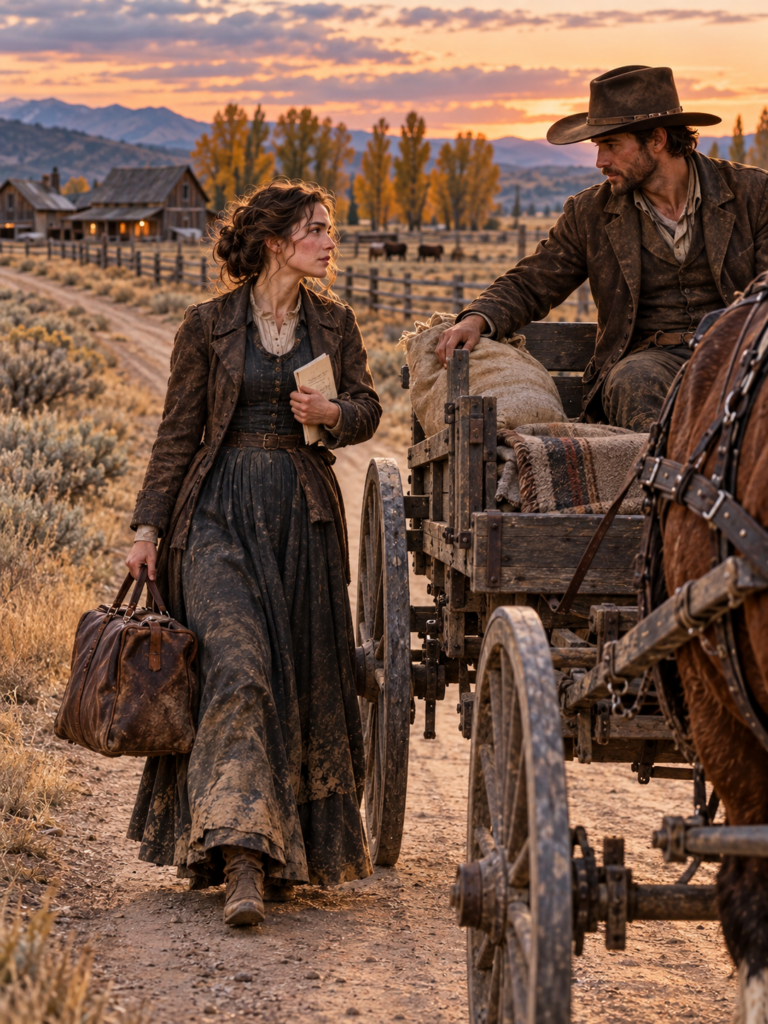
Thomas’s hand tightened on the door before the stranger had finished the sentence.
Pearl rose from Rosie’s bedside and crossed the main room slowly.
The well-dressed man noticed her.
His smile changed.
Not warmer.
More calculating.
“I wasn’t aware you had company, Holt.”
“She works here,” Thomas said.
Pearl disliked the way the stranger’s eyes moved over the room as though assigning values to furniture.
He held out a gloved hand.
“Farwell. I represent Mr. Aldis Kraton.”
Pearl did not take it.
Thomas stepped onto the porch and pulled the door nearly closed behind him.
“You were told no.”
Farwell’s expression remained pleasant.
“Offers change.”
“Mine hasn’t.”
“Kraton’s has improved.”
Pearl could hear every word.
So, she suspected, could Thomas’s daughter from the adjoining room.
She crossed to Rosie’s door and shut it softly.
Then she returned.
Farwell continued.
“You know the south access matters to him.”
“It matters more to me.”
“That ranch of his carries twelve thousand acres.”
Thomas’s voice hardened.
“This one carries my cattle.”
“And a child.”
Silence.
Pearl saw Thomas become very still.
Farwell leaned slightly closer.
“No shame in recognizing limits. A widower running stock alone might decide certainty is worth more than stubbornness.”
Pearl opened the front door.
Both men turned.
“Rosie is sleeping.”
Thomas’s anger shifted immediately.
He lowered his voice.
Farwell looked at Pearl.
“My apologies.”
“No, they are not.”
His eyebrows rose.
Pearl remained in the doorway.
“If you have business with Mr. Holt, state it without using his daughter to improve your bargaining position.”
Farwell’s smile disappeared for the first time.
Thomas said quietly, “Pearl.”
She did not look at him.
Farwell replaced his hat.
“I merely suggested practical considerations.”
“So did I.”
For several seconds nobody spoke.
Then Thomas said, “Tell Kraton the answer remains no.”
Farwell descended the steps.
“He may decide to test how secure that answer is.”
Thomas’s jaw tightened.
Farwell mounted his horse and rode away.
Only when he vanished past the cottonwoods did Pearl close the door.
Thomas remained facing it.
“How long?” she asked.
He turned.
“How long what?”
“How long has Kraton wanted this place?”
Thomas crossed to the table.
“Three years.”
Pearl sat opposite him.
“And why?”
He hesitated.
Then answered.
“The creek.”
Pearl understood immediately.
Water.
The cottonwoods.
The cattle.
The reason grass still held color near the hollow after a dry autumn.
“His land borders yours?”
“To the southeast. He wants easier access across this property.”
“And if he cannot buy it?”
Thomas looked toward Rosie’s closed door.
“He waits.”
“For what?”
“For me to get tired. Short on money. Short on help. Maybe for a dry enough year that holding this place hurts worse than selling.”
Pearl folded her hands.
“He thinks you are alone.”
Thomas looked at her.
Pearl realized only after speaking what she had said.
The room went quiet.
Thomas’s expression softened, though only slightly.
“I was.”
Pearl’s pulse changed.
She glanced toward Rosie’s room.
“I meant you are not handling the household alone now.”
“I know what you meant.”
His voice made it clear he had heard more.
Pearl stood.
“I want something understood.”
Thomas straightened.
“If Kraton’s dispute reaches this house, I will help where the work I was hired to do is concerned. I will keep Rosie safe. I will not be placed between two men in a land argument I do not understand.”
“You won’t be.”
“And I will not stay here because you feel you need another pair of hands.”
Thomas nodded once.
“Fair.”
That answer settled something inside her.
He did not ask for loyalty he had not earned.
The following Thursday he rode to the county seat to verify his filings and creek rights.
Pearl watched Rosie while he was gone.
When he returned after dark, dust and cold clung to his coat, but the tension around his mouth had eased.
“The filings hold,” he said.
Pearl exhaled.
“Kraton cannot simply take the water.”
“No.”
“Good.”
Thomas set a small paper parcel on the table.
Rosie opened it and gasped at peppermint candies.
Pearl smiled.
Then she noticed Thomas watching her.
Not Rosie.
Her.
He looked away first.
Weeks passed.
The land dispute quieted.
Winter deepened.
One evening Rosie fell asleep against Pearl beside the fire.
Thomas lifted the child carefully and carried her to bed.
When he returned, Pearl was still seated near the flames.
He sat opposite her.
For several moments he said nothing.
Then he leaned forward, elbows on his knees.
“Pearl.”
She looked at him.
“What I am about to ask has nothing to do with your wages.”
Her heart began beating harder.
“If your answer is no, the job remains yours. The room remains yours. Nothing changes unless you want it to.”
Pearl set down her mending.
Thomas looked directly at her.
“I don’t want you staying here because you have nowhere better to go.”
The fire cracked between them.
“I want to know whether you could ever choose to stay because this has become somewhere you want to be.”
Pearl’s hand tightened around the folded cloth in her lap.
For eight months before Idaho, every decision she had made had been about surviving the next loss.
Now Thomas Holt was asking her to make one that could not be measured in coins.
Pearl looked down at the cloth in her lap.
Thomas did not move.
The fire settled lower, red beneath the logs.
From Rosie’s room came one small cough, then silence.
Pearl had imagined many conversations since arriving at the ranch.
Requests about meals.
Questions about wages.
Arguments over supplies.
Perhaps, eventually, notice that the position would end.
She had not prepared for this.
“What are you asking me?”
Thomas drew a slow breath.
“I’m trying not to ask too much at once.”
“That generally means you are asking too much.”
The corner of his mouth moved.
Then he became serious again.
“I know what this arrangement is. I hired you. You came here for work. That matters.”
“Yes.”
“You depend on the wages.”
“For now.”
“I know.”
Pearl appreciated the last two words more than reassurance.
Thomas continued.
“I don’t want you wondering whether refusing me costs you your place here.”
She studied him.
“It won’t?”
“No.”
“You are certain?”
“Yes.”
“If I say there will never be anything between us beyond employment?”
“You keep the room. Four dollars a month. Sundays. Same as before.”
“And Rosie?”
“She cares for you.”
“That is not an answer.”
Thomas looked down briefly.
“No,” he said. “It isn’t.”
When he looked back, the restraint in his face had become effort.
“I care for you.”
Pearl’s throat tightened.
“There.”
He leaned back.
“That is the thing I was trying not to say badly.”
Despite herself, Pearl almost smiled.
“You have managed to say it badly in a different way.”
“I was afraid of that.”
The room grew quiet again.
Pearl had spent much of her life around men who considered declarations a form of leverage.
Thomas’s confession did not feel like one.
He had given her an exit before speaking.
That did not make the choice easier.
It made it more real.
“What would staying mean?”
Thomas frowned.
“You already stay here.”
“You know what I mean.”
He nodded.
“I do.”
Pearl waited.
“I don’t want a housekeeper permanently.”
Her spine stiffened.
Thomas saw it.
“That came out wrong.”
“Remarkably.”
“I mean I don’t want you working in this house as though every useful thing you do is owed to me because I pay you.”
He paused.
“I want a life with you.”
Pearl said nothing.
He continued carefully.
“I want you to have a say here. In the house. In how money is spent. In Rosie’s daily life, where you want one. I want you beside me because you chose it.”
Pearl looked toward the window.
The cottonwoods moved in the wind outside.
“When my position through the registry ended,” she said, “I intended to save enough money to leave.”
Thomas’s face changed.
He had not known that.
“Where?”
“I did not know.”
He absorbed this.
“My plan was not sophisticated.”
“It was still a plan.”
“Yes.”
Pearl folded the cloth.
“I had no intention of moving into another household and making myself indispensable to people who could dismiss me when it became convenient.”
Thomas’s eyes held hers.
“Did someone?”
Pearl was quiet.
He immediately added, “You don’t have to tell me.”
“I know.”
That was why she did.
“My mother died last winter.”
Thomas said nothing.
Pearl had spoken of Missouri only once.
Never of the eight months afterward.
“She had been ill for some time. I cared for her. Before that, I worked sewing and keeping accounts for a family outside St. Joseph.”
Her hands remained folded.
“When Mother worsened, I left the position.”
“To care for her.”
“Yes.”
“Then she died.”
Pearl nodded.
“The savings went quickly. Rent. Medicine. Burial.”
Thomas’s face tightened.
“I’m sorry.”
“So was I.”
She did not need more words around it.
“Afterward, the family I had worked for hired someone else. Sensibly. I asked to return anyway.”
Thomas understood before she finished.
“They said no.”
“They had every right.”
“That doesn’t mean it didn’t hurt.”
Pearl looked at him.
“No.”
There.
Another man might have offered outrage on her behalf.
Thomas offered accuracy.
She continued.
“I spent months taking temporary work. Cooking. Laundry. Mending. I learned something useful.”
“What?”
“Employment is not belonging.”
Thomas did not flinch.
“And belonging can disappear too.”
“Yes.”
“So when you ask me whether I want this to be permanent, you are asking me to trust a word I no longer believe very much.”
Thomas sat back.
“That makes sense.”
Pearl almost laughed.
“You are ruining this argument.”
“I didn’t know we were arguing.”
“I prefer a little resistance.”
“I can disagree if it helps.”
“It would not.”
Thomas looked into the fire.
After a moment he said, “Then don’t answer tonight.”
Pearl blinked.
“You brought this up.”
“I know.”
“And now you are retreating?”
“No.”
His eyes returned to hers.
“I am waiting.”
That word followed her for days.
Waiting.
Not withdrawing.
Not pressuring.
Waiting.
The household continued.
Thomas rose before dawn.
Pearl made breakfast.
Rosie asked whether chickens dreamed.
Gus arrived Friday and complained cheerfully about his knees.
Nothing changed.
Everything had.
Pearl became aware of Thomas in ways she had refused to before.
The quiet weight of him entering a room.
The care with which he hung wet coats away from the stove.
The way he always filled Rosie’s cup before his own.
The way he knocked on Pearl’s door even when he needed something as simple as spare lampwick.
He had always done that.
Now she noticed.
She also began considering practical questions.
Not romantic ones.
Practical ones were safer.
If she married him, would she retain money of her own?
Would the four dollars disappear into household funds?
Would she become unpaid labor by another name?
Would Rosie be expected to call her Mama?
That thought made Pearl uneasy in a way she could not explain.
Rosie had a mother.
Death did not erase her.
One afternoon Pearl was repairing a cuff while Rosie colored with a bit of charcoal on scrap paper.
“Pearl?”
“Yes?”
“If you stay forever, do I call you Mama?”
Pearl’s hand stopped.
She set down the needle.
“Who told you I might stay forever?”
“Papa looks strange.”
Pearl pressed her lips together.
“How?”
“Like when the cow had trouble having her calf.”
Pearl closed her eyes briefly.
Then she looked at the child.
“You already have a mama.”
Rosie nodded.
Pearl continued.
“You can call me Pearl as long as you like.”
“Even if you marry Papa?”
Children did not approach delicate subjects.
They walked straight through them.
“Yes.”
Rosie considered this.
“Good.”
“Why?”
“Mama is Mama.”
“Yes.”
“And Pearl is Pearl.”
Something tightened painfully behind Pearl’s ribs.
“That is exactly right.”
Rosie returned to her drawing.
Pearl sat motionless.
That evening, after Rosie slept, Pearl found Thomas repairing harness at the table.
“I have conditions.”
He set down the leather.
“All right.”
“If I said yes.”
His attention sharpened.
Pearl raised a hand.
“I have not yet.”
Thomas nodded.
“If I did, I would keep money of my own.”
“Yes.”
“You answered too quickly.”
“I’ve had time to think.”
Pearl continued.
“I will not become Rosie’s replacement mother.”
Thomas’s expression changed.
“She already has one.”
Pearl studied him.
“Yes.”
“I would never ask her to forget.”
“Good.”
“I don’t want her forgetting.”
The words came more roughly than usual.
Pearl saw grief surface and pass.
“My wife’s name was Anne,” he said after a moment.
Pearl waited.
“She died two years ago. Fever turned worse before we understood how bad it was.”
His eyes remained on the harness.
“Rosie remembers less every year.”
Pearl said quietly, “Then tell her stories.”
Thomas looked up.
“She deserves them.”
“I know.”
“Knowing is not the same as doing.”
He accepted that without defense.
“No.”
Pearl continued.
“If we built a life together, this house could not become a place where nobody speaks her name because it hurts.”
Thomas stared at her.
Then slowly nodded.
“That’s fair.”
“And I do not want all household labor assumed to be mine.”
“I know how to cook.”
“I have eaten your biscuits.”
“They improve with gravy.”
“Almost anything does.”
A laugh escaped him.
Pearl found herself smiling too.
Then she said, “I would want to know enough about the ranch finances not to discover one morning that some crisis has swallowed everything.”
Thomas’s smile disappeared.
“You want to see the books?”
“If I become your wife.”
He was silent for a moment.
Then he stood, crossed to the cupboard, and took out the account ledger.
He placed it in front of her.
“You can see them now.”
Pearl stared.
“I did not ask for them now.”
“I know.”
“Why?”
“Because whether you marry me or not, you live here. Kraton has already made this property part of your daily safety.”
She opened the ledger.
Thomas had kept careful records.
Feed.
Stock purchases.
Repairs.
Taxes.
Water filings.
No hidden ruin.
No secret fortune either.
A working ranch surviving because Thomas made disciplined choices.
“You could afford to pay me more than four dollars.”
Thomas looked uncomfortable.
Pearl’s eyebrows rose.
“The registry suggested the rate.”
“You did not think to question it?”
“I thought room and board—”
“Five.”
He blinked.
“Pearl—”
“Five dollars beginning next month.”
A pause.
Then Thomas nodded.
“Five.”
She extended her hand across the table.
He shook it.
Their first new agreement.
The next day, Pearl wrote the figure into the household accounts herself.
Thomas did not object.
Something about that pleased her more than it should have.
The land pressure returned in December.
Not dramatically.
Kraton was too careful for that.
Two fence posts near the south line were found pulled loose.
No cattle escaped.
Nothing could be proved.
Thomas and Gus repaired them.
Then another messenger delivered an offer.
Thomas refused.
Pearl kept the letter.
“Why?”
“Records matter.”
Thomas looked at her.
“Gus told you that?”
“No.”
She folded it carefully and placed it with the earlier correspondence.
“If a man keeps pressing, it is useful to remember exactly how.”
Thomas said quietly, “You think like a bookkeeper.”
“I was one.”
“I thought you sewed.”
“I contain multitudes.”
He stared.
Pearl stared back.
Then Thomas laughed.
The dispute did not become Pearl’s battle.
She kept her boundary.
She did, however, organize every letter, filing copy, and receipt relating to the creek in one box.
When Thomas rode to the county seat again, he took that box.
The solicitor found nothing missing.
Kraton’s pressure weakened.
Not because Pearl defeated him.
Because Thomas’s claim had always been lawful, and careful records made harassment more difficult.
By Christmas, the ranch felt different.
Rosie hung a crooked chain of paper scraps over the hearth.
Thomas brought home peppermint candies.
Pearl baked a cake using precious sugar and denied caring when Rosie declared it the finest cake in Idaho Territory.
After supper Thomas gave Rosie a small wooden cradle for Mr. Buttons.
Then he handed Pearl a parcel.
She frowned.
“We did not discuss gifts.”
“I know.”
She opened it.
Inside lay a pair of wool gloves.
Good ones.
Strong stitching.
Practical.
Pearl looked up.
“My old pair is serviceable.”
“The thumb has a hole.”
“I was going to mend it.”
“You were.”
“This is excessive.”
“They are gloves.”
“Exactly.”
Thomas smiled.
Pearl went to her room and returned with a wrapped parcel of her own.
His smile vanished.
“You said—”
“We did not discuss gifts.”
Inside was a new work shirt.
She had sewn it herself.
Thomas ran a thumb over the seam.
“You made this?”
“Your other one is almost more patch than cloth.”
He looked at her for so long Pearl became uncomfortable.
“It is a shirt.”
“I know.”
“Then stop looking at it as though I embroidered a declaration across the chest.”
Rosie said, “Did you?”
“No.”
Thomas laughed.
Later, after Rosie slept, Pearl found him by the fire wearing the new shirt.
He looked ridiculous with trousers, socks, and a shirt too good for bedtime.
“What are you doing?”
“Testing it.”
“For what?”
“Permanence.”
The word landed between them.
Pearl did not flee from it.
She sat in the other chair.
Thomas waited.
At last she said, “Ask me again.”
He went very still.
“Pearl.”
“Yes.”
“Would you stay here because you want a life with us?”
Pearl corrected him softly.
“With you.”
Thomas understood.
Rosie mattered.
But Pearl would not marry a father only because she loved his child.
Thomas’s eyes held hers.
“With me.”
Pearl breathed in.
Then out.
“Yes.”
He crossed the space between them slowly enough that she could stop him.
She did not.
He held out his hand.
Pearl placed hers in it.
His rough fingers closed around hers with remarkable care.
After a moment she turned her hand and held him back.
Thomas exhaled.
Neither rushed beyond that.
Outside, winter lay hard over Idaho.
Inside, for the first time in months, Pearl stopped thinking about where she might go next.
Then Thomas said, “There’s one more thing.”
She looked at him.
“Kraton sent another offer this morning.”
Pearl’s hand tightened in his.
Thomas’s face was grave.
“This one isn’t only for the land.”
Pearl released his hand.
“What else?”
Thomas reached toward the small desk near the wall and removed a folded document.
He gave it to her.
Pearl read slowly.
Kraton had increased the purchase amount again.
But beneath the figure was a second proposition.
A grazing arrangement.
Thomas would retain the house and a reduced portion of his acreage while granting Kraton long-term controlled access across the south tract and shared use of the creek approach.
Pearl looked up.
“That is worse.”
Thomas nodded.
“It leaves you here while giving him influence over the water.”
“Yes.”
“And once he controls access, he can make every disagreement expensive.”
“That’s how I read it.”
Pearl folded the paper.
“What do you intend?”
“To refuse.”
“Good.”
Thomas studied her.
“You didn’t ask how much he offered.”
“No.”
“It’s more money than I expected to see at once in my life.”
Pearl’s expression did not change.
“Does it buy another reliable creek?”
“No.”
“Does it give Rosie more security in ten years than a ranch with water?”
“Probably not.”
“Then the number is decoration.”
Thomas smiled faintly.
“That was my conclusion.”
Pearl handed him the paper.
“Keep it with the others.”
“I will.”
He hesitated.
“I wanted you to see it because if we marry, decisions about this place affect you.”
Pearl looked at him.
There it was again.
Not promises.
Practice.
He had begun behaving as though partnership meant information before any ceremony required it.
That mattered.
“When were you thinking?”
“About what?”
“Marriage.”
Thomas blinked.
“Whenever you want.”
“That answer is useless.”
“I thought it was respectful.”
“It is respectfully useless.”
He leaned back.
“All right. January?”
Pearl considered.
“After the first week.”
“Second Saturday?”
“Yes.”
Thomas looked almost startled by how quickly the matter settled.
Pearl raised one eyebrow.
“You asked.”
“I know.”
“Do not become frightened now.”
“I’m not frightened.”
“You look frightened.”
“I’m adjusting.”
Pearl smiled.
The days before the wedding brought no grand transformation.
There was work.
Always work.
Cattle needed feed.
Ice had to be broken from troughs.
Rosie lost one mitten and insisted Mr. Buttons had hidden it.
Pearl found it behind the woodbox.
Gus learned of the engagement and shook Thomas’s hand so vigorously that Thomas nearly dropped the bucket he was carrying.
Then Gus removed his hat before Pearl with exaggerated ceremony.
“Ma’am, I always knew he’d eventually develop sense.”
Thomas said, “You’ve known for four days.”
“Longest four days of my life.”
Pearl liked him more after that.
She and Thomas also quarreled twice.
The first time concerned the small room Pearl had occupied since arriving.
Thomas assumed she would simply move into his room after the wedding and suggested turning hers into storage.
“No.”
He stopped.
Pearl stood in the doorway of the little east-facing room.
It had been cramped.
Cold at first.
Bare.
But it had also been hers.
The first safe room she had possessed after months of uncertainty.
“What do you want done with it?” he asked.
“I do not know yet.”
Thomas nodded.
“Then nothing.”
That simple answer loosened something in her chest.
The second disagreement was about wages.
Thomas assumed her monthly pay would naturally end after marriage.
Pearl understood why.
She still objected.
“I do not want to be paid to be your wife.”
Thomas looked relieved.
“But,” she continued, “I also do not want every dollar in the household to become money I must ask you for.”
His relief disappeared.
“Then we divide what comes in?”
“Not simply divide. The ranch has expenses. The household has expenses. Rosie will need things. We need reserves.”
Thomas pulled out the ledger.
They sat at the kitchen table for nearly two hours.
Together they established household money, ranch money, savings, and personal amounts each could use without seeking permission.
It was not romantic in the usual sense.
Pearl found it deeply romantic.
Thomas trusted her with numbers that represented years of labor.
She trusted him enough to tie part of her future to those numbers.
At one point he said, “You realize most men would not spend the evening before their wedding discussing lamp oil.”
Pearl answered, “Then most men are poorly prepared for marriage.”
Thomas laughed so loudly Rosie woke and demanded to know what had happened.
“Your father learned something.”
“I learn things all the time,” Thomas protested.
Pearl looked at Rosie.
“Occasionally.”
The wedding took place in the small Harland Creek church on a bitter January morning.
Frost covered the inside corners of the windows.
Gus stood beside Thomas.
Rosie wore a blue wool dress Pearl had sewn and carried Mr. Buttons beneath one arm despite Thomas suggesting the rabbit might remain home.
Pearl overruled him.
“If he bites strangers, the church may be safer with him present.”
Rosie agreed.
Pearl walked in without escort.
No one questioned it after seeing her face.
She wore a simple dark dress and carried no flowers.
Thomas watched her approach with such open feeling that Pearl nearly lost her composure.
She did not.
Nearly.
The minister spoke.
Thomas promised fidelity, honesty, and care.
Pearl promised the same.
Neither spoke of ownership.
Neither promised that disagreement would disappear.
Neither pretended hardship was finished because vows had begun.
When the minister pronounced them husband and wife, Thomas looked at Pearl as though waiting for one last confirmation.
She gave it.
She leaned toward him first.
Their kiss was brief.
Warm.
Chosen.
Rosie whispered loudly to Gus, “Does Pearl live with us forever now?”
Half the church heard.
Pearl turned.
“That is the present plan.”
Rosie seemed satisfied.
Afterward, the three of them returned to the ranch.
Nothing about the house had changed during the ceremony.
The same stove waited.
The same chairs.
The same shelf Thomas had built for Pearl’s tins.
The same creek moved beneath winter ice.
Yet Pearl felt the difference immediately.
Not because the ranch now belonged to her automatically.
Not because marriage transformed walls.
Because she had entered that morning as someone employed inside another person’s home.
She returned having freely chosen a shared life.
The distinction was enormous.
That evening Thomas disappeared into the barn.
He returned carrying a chair.
Pearl stared.
It was new.
Straight-backed.
Medium-sized.
Sturdy.
Built to stand beside his chair near the fire.
“What is that?”
“Yours.”
Pearl ran a hand over one arm.
“When did you make this?”
“Parts of it after you went to bed.”
“For how long?”
“A while.”
“You hid lumber from me.”
“I hid a chair.”
“Poorly.”
“You didn’t find it.”
“Because I respected your barn.”
Thomas smiled.
Pearl sat.
The height was exactly right.
Her feet rested naturally on the floor.
He had measured without telling her.
Not her body, she realized.
The distance from her old chair to the ground.
The way she sat.
The chair was not extravagant.
It was not carved.
It did not shine.
It fit.
Pearl looked at him.
“This was unnecessary.”
“So was your shirt.”
“That was clothing.”
“This is furniture.”
“Exactly.”
She laughed.
Thomas sat beside her.
For a few minutes they listened to Rosie arranging Mr. Buttons for sleep.
Then Pearl rested one hand on the chair arm.
“Thank you.”
Thomas touched her fingers.
“You’re welcome.”
Marriage did not erase Anne.
Pearl insisted on that.
Within weeks she discovered Thomas knew dozens of stories about Rosie’s mother and almost never told them.
So Pearl began asking questions at supper.
“What color did Anne prefer?”
Thomas looked startled.
Rosie looked up.
“Yellow,” she said.
Thomas nodded.
“She did.”
“What did she cook badly?”
Thomas hesitated.
Then laughed.
“Biscuits.”
Rosie’s eyes widened.
“Mama made bad biscuits?”
“Terrible.”
“Worse than Papa?”
Pearl said, “Let us not invent miracles.”
Thomas gave her a look.
Soon stories began appearing naturally.
Anne once chased a chicken through the kitchen.
Anne hated thunderstorms but loved rain afterward.
Anne painted the flowers on Rosie’s chest herself.
Pearl never competed with a dead woman.
There was nothing to compete for.
Anne belonged to what had been.
Pearl belonged to what was being built.
Rosie understood this without explanation.
She continued calling her Pearl.
Months later, after scraping her knee, she shouted Pearl’s name before Thomas’s.
Pearl came running.
After the tears stopped, Rosie wrapped both arms around her neck.
Pearl held her.
No title was needed.
Spring returned slowly.
The creek swelled.
Cottonwoods showed pale leaves.
Kraton’s men stopped appearing at the south boundary after the county solicitor sent formal notice concerning interference with Holt’s registered water access.
The victory was not dramatic.
No gunfight.
No burning barn.
No villain dragged from town.
Just paperwork, clear boundaries, witnesses, and a man with a strong claim refusing to sell.
Kraton remained a neighboring landowner.
Thomas remained cautious.
Pearl kept every document.
She also improved the ranch accounts.
At first Thomas watched with mild suspicion as she reorganized his ledgers.
“You are moving things.”
“Yes.”
“You objected when I moved your tins.”
“That was without a system.”
“You believe this is different.”
“I know it is.”
He surrendered.
Within a season, he admitted she could identify unnecessary expenses faster than he could.
Pearl did not take over the ranch.
She had no desire to.
Thomas understood cattle better.
She understood accounts better.
They divided authority according to competence.
When Thomas planned grazing, he decided.
When Pearl identified a supplier quietly raising prices, Thomas listened.
When Rosie needed clothing, Pearl generally managed it.
When a foal became tangled in fencing, Thomas did not wait for Pearl to tell him what to do.
Partnership did not mean both people performing every task.
It meant neither person was treated as ornamental.
Pearl’s little east-facing room remained untouched for months.
Then one morning she stood inside it watching sunlight spread across the floor.
Thomas appeared behind her.
“You decide?”
Pearl nodded.
“I want a desk.”
“For what?”
“My accounts. Letters.”
Thomas leaned against the frame.
“Anything else?”
“Shelves.”
“How many?”
“Enough.”
“That is not a measurement.”
“It will become one.”
He smiled.
They turned the room into a workroom.
Pearl kept the east window.
She refused curtains heavy enough to block the sunrise.
Every morning light entered exactly where she had imagined it would on her first night.
That first night seemed very distant now.
Four dollars a month.
A narrow cot.
One peg.
A woman keeping hope deliberately small.
Pearl sometimes thought about the thirty-one cents she had carried off the train.
She had kept one of the coins.
A dime.
Not because it was lucky.
Pearl did not believe much in luck.
She kept it because it reminded her that she had arrived with enough judgment to protect what little she possessed.
Years did not make her ashamed of that woman.
She admired her.
Thomas did too.
One evening in early summer they sat on the porch while Rosie chased moths beneath the cottonwoods.
Thomas noticed Pearl turning the old dime between her fingers.
“You still have it.”
“Yes.”
“How much did you arrive with?”
“Thirty-one cents.”
He looked toward the road.
“You walked four miles before I found you.”
“Nearly.”
“You would’ve walked all eleven.”
“Yes.”
“I know.”
Pearl glanced at him.
“That does not mean it would have been wise.”
“I know that too.”
She slipped the dime back into her pocket.
“If you had not stopped, I would have reached Harland Creek eventually.”
Thomas nodded.
“I believe you.”
That answer pleased her more than any romantic claim that he had saved her.
He had not rescued Pearl from helplessness.
He had given a capable, tired woman a ride.
Then work.
Then space.
Then time.
Everything after that had required choices from both of them.
A year after her arrival, Rosie turned five.
Pearl made a cake.
Thomas built the girl a small stool.
Gus brought a ridiculous wooden whistle that everyone regretted within an hour.
That evening Rosie fell asleep in Pearl’s chair with Mr. Buttons under her chin.
Thomas lifted her.
Pearl followed him to the child’s room.
After he settled Rosie beneath the quilt, she murmured sleepily, “Night, Papa.”
“Night.”
“Night, Pearl.”
Pearl brushed hair from her forehead.
“Good night.”
Rosie’s eyes remained closed.
“I’m glad you got off the train.”
Thomas and Pearl exchanged a glance.
Rosie was already asleep again.
Back in the main room, Thomas said, “Did you tell her that story?”
“Once.”
“She remembered.”
“She remembers nearly everything.”
Thomas touched the back of Pearl’s hand.
“So do I.”
Another spring came.
Then another autumn.
The ranch endured good seasons and poor ones.
A calf crop disappointed one year.
Feed prices rose another.
The creek ran lower during a dry summer, but it ran.
Kraton eventually abandoned his effort to secure Holt’s route and turned his attention elsewhere.
Thomas did not celebrate.
He repaired fence.
Pearl filed the final letter.
Life rarely announced when one danger had ended and ordinary difficulties had resumed.
That suited them.
Their marriage grew through ordinary things.
He learned Pearl needed quiet before breakfast.
She learned he became unbearable when he skipped midday food.
He learned never to purchase fabric for her based on color alone.
She learned that when Thomas said he would repair something Saturday, he meant Saturday but had not necessarily specified which Saturday.
They argued.
They apologized.
They changed behavior afterward.
That mattered more than apologies.
On the fifth anniversary of Pearl’s arrival, Thomas drove the wagon toward Garvey.
Pearl rode beside him.
Rosie, now old enough to ride her own gentle pony, followed with Gus.
Thomas slowed near a bend.
“This where I caught you?”
Pearl looked around.
“You did not catch me.”
“Found you.”
“Better.”
She studied the dusty road.
Sage silvered the flats.
Evening light gathered peach-colored along the western sky.
“Yes.”
Thomas stopped the wagon.
Pearl looked at him.
“What are you doing?”
“Nothing.”
“We have somewhere to be.”
“We have time.”
He climbed down.
Pearl sighed and followed.
They stood on the roadside.
Five years earlier she had walked there with aching feet and a carpetbag growing heavier by the mile.
She remembered the uncertainty.
Not fear exactly.
The need to continue because stopping offered nothing.
Thomas leaned against the wagon.
“You never asked me why I offered you a ride.”
“You were going the same direction.”
“That was part of it.”
Pearl waited.
“You looked tired.”
“I was.”
“You also looked like you would refuse if I sounded too concerned.”
Pearl smiled.
“Accurate.”
“So I tried not to.”
“You said, ‘Ride if you want.’”
“Worked.”
“It did.”
Pearl looked toward the horizon.
“Do you know why I accepted?”
“Dark coming.”
“That too.”
She turned toward him.
“You moved the flour sack before asking.”
Thomas frowned.
“What?”
“You made a place.”
He was quiet.
“You did not reach for my bag. You did not tell me walking was foolish. You simply made room.”
Thomas considered this as if the meaning had never occurred to him.
Pearl smiled softly.
“That was why.”
He reached for her hand.
She took it.
Behind them, Rosie called, “Are we going or not?”
Pearl laughed.
Thomas raised his voice.
“We’re going.”
They climbed back onto the wagon.
As they rolled east, Pearl watched the road pass beneath them.
Soon the cottonwoods would appear.
Then the creek.
Then the house.
The lamp would be lit before dark because that was still something they did.
Not for travelers.
Not from fear.
Simply because a lit window made a home easier to find.
Pearl had once thought survival meant reducing life to what could not be taken.
A few coins.
A carpetbag.
Work exchanged for shelter.
Plans kept large and hope kept small.
She no longer believed that.
Safety had not come from needing no one.
It had come from knowing the difference between dependence forced by circumstance and partnership entered freely.
Thomas had needed help when she arrived.
Pearl had needed work.
Rosie had needed steadiness.
None of those needs had created love.
Love came later.
Through wages renegotiated at a kitchen table.
Through a shelf built for tins.
Through Anne’s name spoken instead of erased.
Through ledgers shared.
Through boundaries accepted the first time they were stated.
Through a chair built to fit one specific woman.
Through the little east-facing room becoming Pearl’s workroom because she—not necessity—decided what it would become.
As the wagon crested the final rise, the Holt ranch came into view.
Rosie rode ahead.
Thomas glanced at Pearl.
“Tired?”
“No.”
“Hungry?”
“Yes.”
“Good. I made biscuits.”
Pearl stared at him.
“Then perhaps we should turn around.”
“They’ve improved.”
“According to whom?”
“Me.”
“An interested party.”
Thomas laughed.
Pearl took his hand again.
Below them, the creek flashed through the cottonwoods.
The house stood beyond it.
A lamp burned in the front window though daylight had not completely faded.
Pearl watched that light grow larger as they approached.
Five years before, she had seen it for the first time and thought only that someone inside believed darkness was reason enough to strike a match.
Now she knew who had lit it.
She knew the rooms beyond it.
She knew which floorboard creaked near the stove, where Rosie left Mr. Buttons when she forgot him, where Thomas kept the ranch ledger, and where the morning sun entered her room.
Most of all, she knew she could have walked away.
That knowledge was part of why staying meant so much.
Thomas guided the horse down the final slope.
Pearl sat beside him, not as his housekeeper, not as a stranded traveler, not as a woman grateful to have been taken in.
As his wife.
His partner.
Herself.
The wagon passed beneath the cottonwoods and carried them home.


