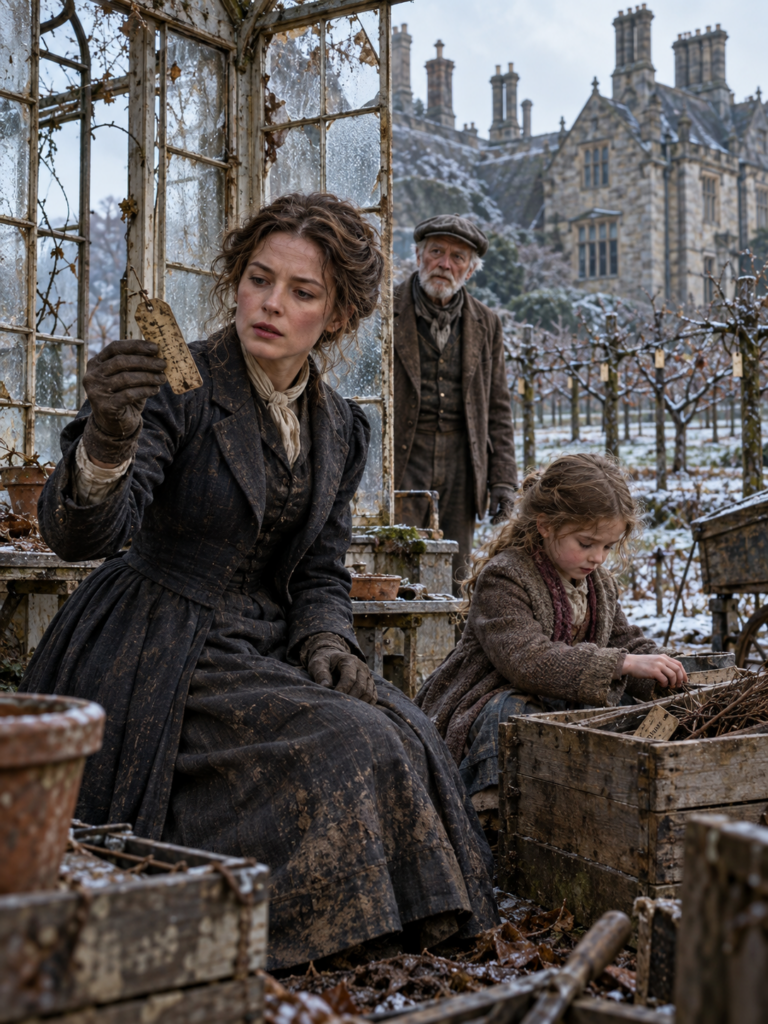
Clara stepped through the crooked greenhouse door and crossed the wet kitchen garden toward the walled orchard.
Lucy followed until Clara turned.
“Stay with Mr. Sedwick.”
“But I can help.”
“You can help by keeping the labels in order.”
Lucy considered this serious enough to accept.
Clara entered the orchard alone.
Neglect had reshaped it.
Paths disappeared beneath dead grass.
Branches crossed where careful pruning had once kept them apart.
Several trunks had split.
Suckers crowded unmanaged roots.
Then Clara found the southern wall.
Metal tags clung to three trees beneath lichen and moss.
Seventeen.
Twenty-two.
Thirty-one.
She rubbed one clean with her glove.
“These are the trial trees,” she said when Sedwick joined her.
“So Lord Ambrose claimed.”
“They are still alive.”
“A few still fruit.”
“After twelve years?”
“Poorly.”
“That is not the point.”
Clara moved closer to tree twenty-two.
Nearby orchard trees carried dark lesions along the bark.
This one showed less damage.
That proved nothing.
One surviving tree could be luck.
Three could still be luck.
But neglect severe enough to kill weaker stock had not killed these.
Clara’s pulse quickened.
Not because she had discovered value.
Because she had discovered a question worth answering.
They returned to the greenhouse.
Mr. Sedwick forced open a swollen cabinet.
Inside lay notebooks.
Clara spent the remainder of the afternoon reading.
Ambrose Wickliffe had recorded everything.
Source trees.
Rootstocks.
Late frost.
Wet summers.
Canker.
Flowering.
Fruit size.
Storage.
Failures.
Entire seasons crossed through in disappointed ink.
No boasts.
No claims of triumph.
Only years of patient comparison.
Lucy sat at the end of the bench sorting sound labels from rotten ones.
“Was he making special apples?”
“Trying to make stronger trees.”
“Did he know they would work?”
“No.”
“Then why keep doing it?”
Clara looked at the little wooden tags covering the bench.
“Because not knowing is not the same as having no reason to try.”
The road cleared two days later.
Her relatives remained available.
Clara could still leave.
Instead she spent part of her remaining money repairing one narrow section of greenhouse roof.
Not the whole structure.
Only enough to work safely.
Mr. Sedwick watched the glazier leave.
“You mean to remain?”
“For a little while.”
“Because of the trees?”
“Because I need to know whether the records match what survived.”
The first nearby grower came reluctantly.
Mr. Fenner examined Ambrose’s notes, then the numbered trees.
He did not become excited.
Clara trusted him immediately.
“Survival after neglect is interesting,” he said. “Not proof.”
“Exactly.”
They selected a limited amount of healthy propagation material.
Clara bought a fresh ledger.
Beside every success she recorded every failure.
Several grafts did not take.
One cutting weakened.
Another dried completely.
Lucy frowned at the growing list of losses.
“Why write the bad ones?”
“Because otherwise the good ones mean less.”
Then the estate agent arrived.
Mr. Dorrimple walked through the repaired section of greenhouse with the expression of a man inspecting a leak someone else had decided to admire.
“The estate cannot finance experiments.”
“I have not asked it to.”
“Thormir may eventually be sold.”
Clara closed her ledger.
“That is your concern.”
“And this?”
She looked toward the orchard.
“This is mine only until I know whether Lord Ambrose’s work has surviving value.”
“And if it does not?”
“Then I will say so.”
The answer silenced him.
Enthusiasm could be dismissed.
Evidence was harder.
Weeks later, in early spring, Clara loosened the binding around a graft from tree twenty-two.
Beneath it, living tissue had joined cleanly.
Above the union, a bud had begun to swell.
She did not smile.
Not yet.
She called Fenner.
He examined that graft, then another, then one from tree seventeen.
“These have taken.”
“Yes.”
“It still proves very little.”
“Yes.”
Clara opened her ledger and wrote down the date.
A carriage sounded beyond the courtyard.
Lucy ran to the greenhouse door.
Clara looked up.
Edmund Harkort stepped down into the mud.
He stared through the repaired panes at Clara standing beside Lord Ambrose’s notebooks, new grafts growing under her care, and the daughter he had once expected to disappear conveniently into someone else’s protection.
Then he started toward the door.
Edmund opened the greenhouse door and stopped just inside.
For several seconds he said nothing.
Clara did not rescue him from the silence.
He removed his gloves.
“You stayed.”
“The roads cleared some time ago.”
“So I heard.”
He glanced around.
The repaired portion of the glass house was modest.
Several panes did not match.
The benches were scarred.
Buckets stood beneath leaks Clara had not considered worth paying to mend.
Yet the small section being used contained ordered rows of grafts, numbered tags, Ambrose Wickliffe’s old notebooks, and Clara’s new ledger.
Nothing existed for display.
Everything had purpose.
“What exactly have you found?”
Clara might once have resented the question.
Now she welcomed it.
Questions could be answered with evidence.
She showed him Ambrose’s records.
She explained the numbered trees.
She showed him where promising grafts had taken.
Then, deliberately, she turned the ledger to the failed ones.
Edmund frowned.
“You record those too?”
“Especially those.”
“Why?”
“Because otherwise I could persuade myself of anything.”
He looked at her differently after that.
“If these trees prove valuable, Thormir will need repairs. Labor. Equipment.”
“Yes.”
“I can provide that.”
Clara closed the ledger.
“No.”
His face tightened immediately.
“You refused my allowance. Must you refuse every offer I make forever?”
“They are not the same offer.”
“Then why the same answer?”
“Because you are still offering money before asking what authority you expect with it.”
“None.”
“You believe that now.”
Edmund stepped back.
The words had been quiet.
That made them harder to resist.
“I am trying to help.”
“I know.”
“Is that no longer permitted?”
“Help is permitted.”
Clara placed one hand on the closed ledger.
“Dependence disguised as generosity is not.”
He looked at her.
“You believe that is what I gave you?”
“At Ravensley, yes.”
His jaw tightened.
“I never meant to leave you without protection.”
“But you knew I had Lucy.”
“Yes.”
“You knew the cottage belonged to your estate.”
“Yes.”
“And you knew ending the courtship would also remove our home.”
A long pause followed.
“Yes.”
Clara held his eyes.
“Then what you meant is not the only part that matters.”
For once Edmund did not defend himself.
He looked toward the damaged half of the greenhouse.
Then toward Lucy, who sat outside with Mr. Sedwick sorting labels.
When he spoke again, his voice had changed.
“If money becomes necessary later, what would make an offer acceptable?”
Clara answered immediately.
“Defined terms.”
He listened.
“No control over the work. No claim upon Lord Ambrose’s results. No assumption that because you provide money, you receive authority over decisions that belong to other people.”
Edmund nodded once.
“That is clear.”
“It is meant to be.”
He remained another half hour.
For the first time since Clara had known him, he asked more questions than he answered.
Then he left.
Clara returned to her ledger.
She recorded three failures before supper.
By June, Thormir’s work had become known beyond the neighboring farms.
A commercial nursery representative arrived carrying a proposal large enough to change Clara’s life immediately.
The nursery wanted exclusive propagation rights to the most promising Thormir stock.
In exchange, it would provide an advance sufficient to restore the working greenhouse, employ laborers, manage the orchard, and secure comfortable lodgings for Clara and Lucy.
Lucy could have a proper schoolroom.
Clara could stop counting every expenditure.
The representative spoke enthusiastically of advertising Ambrose Wickliffe’s long-lost disease-resistant fruit trees across southern England.
Clara stopped him.
“Disease-resistant?”
“Your records show remarkable survival.”
“Promising survival.”
“And your grafts have taken.”
“Some.”
He smiled.
“Mrs. Whitmore, commercial opportunity rarely waits for perfect certainty.”
“Trees do.”
The smile weakened.
Clara turned the proposed contract back toward him.
“You are asking to sell these as something they have not yet been proved to be.”
“They have survived here.”
“At Thormir.”
“A meaningful result.”
“Yes.”
“But not enough.”
“No.”
He leaned back.
“You are declining substantial security over a botanical distinction.”
Clara looked through the repaired panes.
Outside, Lucy was tying labels to stakes.
“No.”
She returned her gaze to him.
“I am declining to sell certainty I do not possess.”
The nursery representative left without a contract.
Word of the refusal traveled.
Mr. Dorrimple called it impractical.
Another landowner, upon hearing of it, remarked that a widow supporting a child had little business making principles expensive.
Clara ignored him.
She met instead with Fenner and three other growers.
They designed limited trials.
Small quantities of grafted material would go to separate orchards with different soils and exposures.
Every grower would record growth.
Disease.
Fruit set.
Weather damage.
Failure.
No one could advertise the stock as proven.
No one would own it exclusively while the trials remained incomplete.
Clara kept copies of every agreement.
When Edmund next visited, he came only after writing to ask whether she would receive him.
That mattered enough for her to say yes.
He found Clara in the orchard checking metal tags against Ambrose’s notes.
“I heard about the nursery.”
“I expected you would.”
“You refused enough money to make this place comfortable.”
“For claims the evidence does not support.”
“You might have taken the money and demanded proper testing afterward.”
“After granting exclusivity?”
Edmund said nothing.
“Their profit would depend upon favorable results,” Clara continued. “I would rather the answer belong to the trees.”
“And if every trial fails?”
“Then we will know.”
“You may have refused your best chance at security.”
Clara fastened the notebook beneath her arm.
“Lucy’s security cannot depend upon my selling another man’s unfinished work as something I already know it is not.”
Edmund looked along the old orchard rows.
Months earlier, he had made a different calculation.
He had protected his own future by allowing Clara and Lucy to carry the cost.
Now Clara had been offered comfort in exchange for shifting uncertainty onto strangers who might trust her claims.
She had refused.
Edmund did not praise her.
Instead he asked, “How many farms?”
“Four.”
“What do you need from me?”
“Nothing presently.”
He nodded.
“Then I will leave you to it.”
That summer, young Thormir grafts grew in four orchards.
Some weakened.
Several failed.
Others held.
Clara waited.
The following spring brought the answer sooner and more harshly than she expected.
April was damp.
May turned warm and unsettled.
By June, established orchards began showing serious disease.
Fenner arrived carrying notebooks spotted with rain.
“The old varieties are suffering.”
Clara opened his records.
He pointed.
“Twenty-two is holding.”
She read.
“Seventeen?”
“Holding.”
“Thirty-one?”
“Mixed.”
Reports from the other farms followed.
Not every Thormir graft survived.
Clara refused to hide that.
But across different soils and conditions, several of Ambrose’s strongest lines repeatedly endured where common stock suffered worse damage.
Letters began arriving.
Growers.
Agricultural societies.
Commercial nurseries.
Everyone wanted to know whether Thormir had found the answer.
Clara replied that Thormir had found evidence worth further testing.
Mr. Dorrimple suggested she prepare an account emphasizing the estate’s discovery.
“Thormir’s discovery?”
“It would simplify matters.”
“It would make them inaccurate.”
She required every participating farmer to submit observations under his own name.
Failures would remain.
So would soil differences.
Treatment differences.
Weather.
Ambrose’s notebooks would remain the foundation.
But no one would turn him into a legend by erasing inconvenient results.
Then Clara did something she had not done since leaving Ravensley.
She wrote to Edmund and asked for help.
Not money.
A connection.
She wanted an agricultural examiner with no financial interest in the stock.
Edmund read the letter twice.
Within a week he arranged an introduction to Dr. Henry Bellamy, a respected horticultural assessor associated with a regional agricultural society.
Then he did nothing else.
When Bellamy arrived, Clara led the inspection.
Edmund remained behind the group.
Bellamy examined Ambrose’s records, the parent trees, Clara’s propagation ledger, and all four farms’ trial reports.
At one point he turned toward Edmund.
“Your Grace, who speaks for the estate regarding ownership?”
“Mr. Dorrimple.”
“And for the trials?”
Edmund looked toward Clara.
“Mrs. Whitmore.”
Clara heard him.
She gave no sign.
For two days Bellamy examined bark, foliage, graft unions, comparative losses, and disease patterns.
At last he closed his notebook.
“I would not claim universal resistance.”
“Neither would I,” Clara said.
“But several lines have demonstrated consistent resilience beyond what chance alone easily explains. Wider controlled propagation is justified.”
Clara nodded.
“Then wider testing should come next.”
Bellamy smiled slightly.
“You are unusually determined not to be congratulated.”
“I would rather be correct late than profitable early.”
By harvest, several Thormir lines produced sound fruit.
The question was no longer whether Ambrose’s work mattered.
It was what would happen to the place where the work had begun.
Mr. Dorrimple arrived carrying offers to purchase the land, timber, orchard, and manor.
Selling remained the simplest financial solution.
Then Fenner brought another proposal.
Four growers wished to form a consortium.
They would lease the walled orchard, the usable glass house, and enough surrounding land to establish a permanent propagation and trial program.
The lease would pay the Wickliffe estate.
The plant material would remain accessible to growers.
No single nursery would control it.
Clara read the proposal twice.
Then Fenner placed another page before her.
“What is this?”
“Employment terms.”
“For whom?”
“You.”
Clara looked up.
Fenner appeared almost offended by the question.
“Someone must supervise propagation records, trials, and greenhouse work. You already do.”
“I did not create Ambrose’s trees.”
“No.”
“I do not own Thormir.”
“No.”
“Then why me?”
“Because you know the records better than anyone living, and because we have watched you refuse to claim more than the evidence supports.”
Clara stared at the paper.
No allowance.
No favor.
No promise that could vanish if a powerful family changed its mind.
Work.
Defined authority.
Written terms.
A salary.
A home for Lucy because Clara had earned the position necessary to occupy it.
She looked toward the broken and repaired panes of the glass house.
Then she picked up a pen.
Clara picked up the pen and read every line before signing her name.
The consortium’s offer did not make Thormir hers.
That mattered.
She would supervise propagation records, coordinate trials, oversee the working greenhouse, and maintain access to Ambrose Wickliffe’s original research.
Her salary was specified.
Her rooms were specified.
Her authority was specified.
So were the limits of it.
Clara requested one additional clause.
Mr. Dorrimple frowned as she dictated it.
“All material derived from Lord Ambrose Wickliffe’s documented trial stock must remain traceable to his records.”
Fenner nodded.
“Reasonable.”
“And failures remain part of the record.”
Dorrimple looked up.
“You expect to bind future growers to preserving disappointments?”
“I expect the successes to mean something.”
He sighed.
But he wrote it.
By October, the agreement was signed.
For the first time since Edmund had withdrawn the cottage at Ravensley, Clara knew where Lucy would sleep the following month without depending upon affection, pity, or aristocratic convenience.
Thormir remained part of the Wickliffe estate.
Clara inherited nothing.
She preferred it that way.
She had found useful work.
That was different.
Edmund arrived several days later.
Rain tapped against the repaired greenhouse panes.
Where dead cuttings had once lain beneath dust, rows of young grafts now stood in order.
Lucy was helping Sedwick move clean pots from one bench to another.
Edmund walked slowly beside Clara.
“So this is what you inherited.”
Clara turned her head.
“I inherited nothing.”
He stopped.
Then he nodded.
“No. I suppose that is the point.”
She waited.
Edmund rested one hand against the back of an empty chair.
“When I sent you away, I believed my position gave me the right to decide which obligations mattered most.”
Clara’s expression did not change.
“My family mattered. My name. The settlement being discussed. The marriage they wanted me to consider. Those seemed substantial.”
“And Lucy and I seemed manageable.”
Edmund looked at her.
“Yes.”
The admission was ugly.
Clara let it remain ugly.
“You had less power to make the consequences difficult for me,” he said.
“Yes.”
“I knew the cottage belonged to Ravensley.”
“Yes.”
“I knew you had nowhere permanent arranged.”
“Yes.”
“And I called money a solution because I could afford it more easily than I could afford opposing my family.”
Clara folded her hands before her.
“That is closer.”
Edmund gave a faint, humorless smile.
“To forgiveness?”
“To accuracy.”
The answer struck him.
Clara had no intention of making repentance comfortable simply because it was sincere.
Outside, Fenner argued with a laborer about drainage.
Lucy laughed at something Sedwick said.
Thormir was noisy now.
Useful noise.
Edmund looked toward the greenhouse benches.
“You spent nearly a year refusing easier choices whenever their cost would be paid by someone else.”
“Not always.”
“Often enough.”
Clara studied him.
“Noticing is not the same as changing.”
“I know.”
No request followed.
That surprised her.
Edmund simply took his leave.
Winter settled over the estate.
Clara’s days acquired structure.
She and Lucy occupied three habitable rooms near the east corridor.
No one pretended they were grand.
One fireplace smoked in certain weather.
A window rattled.
The roof still leaked above a disused passage.
But Clara paid for their life through her work.
Lucy began lessons with a village teacher several mornings each week and spent the remaining hours inventing grand responsibilities in the greenhouse.
At seven, she considered herself an authority on labels.
“Not upside down,” she told one laborer severely.
Clara intervened.
“Lucy.”
“But it was.”
“That does not make you his supervisor.”
Lucy considered this.
“Who is?”
“Mr. Fenner today.”
“Then I should tell Mr. Fenner.”
The laborer hid a smile.
Clara did too.
The first public distribution of tested Thormir stock was planned for the following spring.
Clara insisted that each bundle include a clear propagation history.
Source tree.
Trial location.
Observed failures.
Observed strengths.
Nothing exaggerated.
Commercial interest grew anyway.
Perhaps because of that.
A second nursery offered favorable terms without demanding exclusivity.
Two growers requested training in grafting methods recorded in Ambrose’s notebooks.
Dr. Bellamy recommended continued observation through several more seasons before broader disease claims were made.
Clara agreed.
No fortune appeared.
No miraculous inheritance.
No hidden deed transformed Lucy into an heiress.
The work simply became valuable because it proved useful.
That pleased Clara more deeply than a dramatic rescue ever could.
In February, she received a letter from Edmund.
It was brief.
He asked whether he might visit in April during the first distribution.
No mention of money.
No reminder of what he had once done for her.
No assumption that his presence would be welcome.
Clara read the letter twice.
Then she wrote:
You may attend if you wish. The distribution begins at nine.
Nothing more.
When April came, wagons arrived along Thormir’s lane from farms across the county.
Crates stood ready beneath the greenhouse wall.
Young grafts rested inside, each wrapped for travel and labeled by source.
Clara moved from table to table checking records.
Fenner supervised loading.
Bellamy spoke with growers about conditions under which the trial results had been obtained.
Lucy stood beside Sedwick with a list she was not permitted to alter.
Edmund arrived without ceremony.
He spoke first to Bellamy.
Then to Fenner.
He did not place himself beside Clara when visitors congratulated her.
She noticed.
Hours later, the last crate was loaded.
Clara watched a wagon disappear through the trees.
Something in her chest loosened.
The work no longer depended on Thormir.
That was the true success.
Ambrose had not spent years trying to produce trees for one dead man’s walls.
His work belonged in living orchards.
Among farmers.
In weather.
Under conditions no greenhouse could control.
Edmund found Clara beside the orchard wall.
Early leaves moved in a mild wind.
“You were right to refuse the first nursery.”
Clara glanced at him.
“That is easier to say now.”
“Yes.”
He accepted the correction immediately.
“At the time, I thought security was the strongest argument anyone could make.”
“You often did.”
“I know.”
Silence settled between them.
Once, Clara might have filled it because Edmund’s discomfort still mattered to her.
Now she let him bear his own.
He looked toward the greenhouse.
“You no longer need anything from Ravensley.”
“No.”
“Or from me.”
“No.”
He drew a slow breath.
“Then perhaps I can ask something without attaching provision to it.”
Clara turned fully toward him.
“Ask.”
“Would you consider allowing me a place in your life again?”
She did not answer.
Edmund continued.
“Not because I can secure you. I cannot claim that now without insulting both of us.”
Clara listened.
“Not because regret earns forgiveness.”
“It does not.”
“I know.”
His voice was quieter than it had been the day he ended their courtship.
“What I felt for you did not disappear simply because I behaved as though duty required me to dispose of it.”
Clara looked toward the lane where the last wagon had vanished.
“You did dispose of it.”
“Yes.”
“You did not merely hesitate, Edmund.”
“I know.”
“You removed Lucy’s home.”
“Yes.”
“You offered money so the result would not trouble your conscience.”
“Yes.”
“You allowed your family’s opinion of me to matter more than the promises you had made privately.”
His face tightened.
“Yes.”
Clara watched him.
No defense.
No explanation.
No attempt to convert apology into pressure.
That was new.
“I will not return to what we had.”
“I would not ask you to.”
“I will not teach Lucy that a man’s title makes his failures less serious.”
“Nor should you.”
“And if you ever offer help again, I decide whether it is useful before you decide whether it is generous.”
“Yes.”
Clara almost smiled.
“You agree very quickly now.”
“I have discovered that arguing with accurate criticism is tiring and rarely improves it.”
That did make her smile.
Barely.
Edmund saw it.
He did not move closer.
“Then if anything exists between us,” Clara said, “it begins here.”
“Here?”
“Not at Ravensley. Not before.”
He nodded.
“Here.”
“And possibility is not certainty.”
“No.”
“You are not forgiven because you asked correctly.”
“I know.”
“You may find that rebuilding trust is less pleasant than regretting its loss.”
“I expect so.”
Clara studied him as she had once studied Ambrose’s notebooks.
Not searching for the answer she preferred.
Looking for what the evidence supported.
Then she walked toward the greenhouse.
After several steps she looked back.
“Lucy takes tea at four.”
Edmund remained where he stood.
Clara raised an eyebrow.
“That was not an invitation to stand in the orchard all afternoon.”
Understanding reached him.
“I see.”
“Do you?”
“Apparently more slowly than I once imagined.”
He followed.
That was how it began.
Not reconciliation.
Not yet.
Access.
Edmund visited again two weeks later.
He wrote first.
Clara said yes.
He arrived while she was examining weak growth on one experimental line.
His instinct was to offer an opinion.
He stopped himself.
“What do you think happened?”
Clara looked at him.
“You are asking me?”
“Yes.”
“Poor graft union. Possibly incompatible stock.”
“Can it be saved?”
“Perhaps. Perhaps not.”
He nodded.
Then he waited.
The conversation moved elsewhere.
Small things mattered now.
Edmund stopped treating restraint as passivity.
When he wished to help, he asked what was needed.
Sometimes Clara answered nothing.
He learned to accept that.
Once he offered to pay for additional schooling for Lucy.
Clara refused.
His face showed disappointment.
Then he said, “All right.”
No argument.
No warning about pride.
No claim that refusing him harmed the child.
Later, Clara reconsidered a different arrangement.
“Lucy needs access to books beyond the village school.”
Edmund listened.
“Ravensley’s library is available.”
“Under whose authority?”
“Yours while you are there.”
“That is too vague.”
He almost laughed.
“Then tell me what would not be vague.”
They agreed that Lucy might use the library one afternoon each week under Clara’s supervision, without implication of obligation.
The first time they returned to Ravensley House, Clara expected memory to overwhelm her.
It did not.
The room where Edmund had ended their courtship was only a room.
Lucy cared more about the library ladder.
“May I climb it?”
“No.”
“What if Lord Ravensley holds it?”
“No.”
Edmund hid amusement behind a book.
Clara saw him.
“Do not encourage her.”
“I said nothing.”
“You looked supportive.”
“I deny it.”
Lucy sided with him.
Clara regretted bringing either of them.
But the afternoon passed pleasantly.
That mattered too.
Over the next year, Thormir’s work expanded carefully.
Nothing became grand.
One additional greenhouse section was repaired.
A second ledger became necessary.
More growers joined the trials.
Several Ambrose lines disappointed under broader conditions and were removed from recommendation.
Clara recorded those results with the same care as the successful ones.
Three lines continued to perform strongly.
Bellamy’s later reports supported wider commercial use, still with proper limitations.
By then growers had stopped calling Thormir a curiosity.
It had become a working center.
Clara’s authority there no longer surprised anyone who mattered.
One winter afternoon she found Lucy in the greenhouse reading one of Ambrose’s notebooks.
The child traced a faded entry with her finger.
“Do you think he knew we would find these?”
“No.”
“Then why did he write everything down?”
Clara sat beside her.
“Because careful work should remain useful even when the person doing it is gone.”
Lucy thought about this.
“Like Father’s things?”
The question caught Clara unexpectedly.
Her husband had been spoken of less often as the years passed.
Not erased.
Simply no longer occupying every room in memory.
“Some things,” Clara said.
“Do you miss him?”
“Yes.”
“Does that make it wrong that you like Lord Ravensley?”
Children could destroy elaborate defenses with astonishing efficiency.
Clara looked through the glass toward bare orchard branches.
“No.”
Lucy nodded as if confirming an arithmetic answer.
“Good.”
“Why good?”
“Because he is coming tomorrow.”
Clara turned.
“What?”
Lucy froze.
That expression told everything.
“Lucy.”
“He said it was a surprise.”
“When?”
“He told Mr. Sedwick.”
“And Mr. Sedwick told you?”
“No.”
Lucy became fascinated by the notebook.
“I heard.”
Clara closed her eyes.
The next morning Edmund arrived.
Before he could remove his coat, Clara said, “You have recruited my daughter into conspiracy.”
His face showed immediate alarm.
“I told Sedwick.”
“She heard.”
“Of course she did.”
“You should know better.”
“I do now.”
Clara’s mouth betrayed her with a smile.
Edmund stared.
“What?”
“Nothing.”
“It is not nothing.”
“You have become very cautious.”
“I was informed caution was necessary.”
“It remains necessary.”
“Then I will remain cautious.”
Years earlier, he would have tried to charm the boundary away.
Now he respected it enough to let humor exist inside it.
That difference was not dramatic.
It was more important than drama.
Another year passed before Edmund asked again whether Clara could imagine marriage.
They were walking through the orchard after the autumn records had been completed.
He did not produce a ring.
He did not speak of protection.
He did not describe what Ravensley could give Lucy.
“I am not asking for an answer today.”
“Good.”
“I am asking whether the question itself is welcome.”
Clara looked at him.
That distinction told her more than any speech might have.
“Yes,” she said.
“The question is welcome.”
Edmund released a breath.
Clara continued walking.
He followed at the same pace.
Months later, she gave him the answer.
Yes.
But not because he had become a duke worthy of forgiving.
Titles had nothing to do with it.
Not because Thormir needed his money.
It did not.
Not because Lucy needed a father imposed upon her life.
She did not.
Clara said yes because over time Edmund had behaved differently when no reward was guaranteed.
He had accepted refusal.
He had fulfilled promises made in writing.
He had supported Lucy without claiming authority he had not been given.
He had learned that generosity without limits could become control.
He had learned that remorse was not repair.
And he had remained long enough for Clara to judge change by conduct rather than intention.
Their marriage did not move Clara permanently into Ravensley House.
That surprised nearly everyone.
It did not surprise Edmund.
Clara continued directing Thormir’s propagation work.
Lucy divided her weeks between the two estates as schooling required.
Edmund traveled between them often enough that Sedwick eventually stopped announcing him.
Thormir remained leased by the growers’ consortium.
Clara’s salary remained hers.
Her professional authority did not become decorative because she had married a duke.
When a newspaper later called her “the Duchess who rescued Lord Ambrose Wickliffe’s lost varieties,” Clara sent a correction.
She had not rescued them alone.
Ambrose had developed them.
Sedwick had preserved what he could.
Fenner and the other growers had tested them.
Bellamy had examined the results independently.
The trees themselves had survived.
Her role had been to recognize unfinished work and refuse to lie about what it proved.
The newspaper printed only part of the correction.
Clara complained for three days.
Edmund wisely agreed with her.
Years later, the oldest section of the glass house was finally dismantled.
Its timbers had become unsafe.
Clara stood with Lucy—no longer six, and now tall enough to remember the abandoned greenhouse as something from early childhood—while workers removed the last broken panes.
“Will you miss it?” Lucy asked.
“The broken part?”
“The way it was.”
Clara considered.
“No.”
Lucy seemed surprised.
“It is where everything began.”
“No.”
Clara looked toward the thriving propagation houses beyond it.
“It is where we found what someone else had begun.”
That distinction had shaped her life.
Ravensley had once taught her what happened when security depended upon another person’s courage.
Thormir had taught her something better.
Work could survive the person who began it.
Evidence could survive reputation.
A woman could accept help without surrendering authority.
Forgiveness could be possible without pretending injury had not happened.
And love, if it returned, did not have to restore the old arrangement.
It could begin again under different terms.
Clara had entered Thormir in sleet with two trunks, one child, and no promise beyond a roof that still held against the weather.
She found no hidden fortune.
No secret inheritance.
No dead lord’s title waiting to become hers.
What she found was harder to recognize and more durable once earned.
Work worth doing.
Authority grounded in competence.
A home governed by terms no one could withdraw on a whim.
A future Lucy could watch being built rather than granted.
And eventually, a man who had once failed her badly enough to lose her trust—and who learned that getting another chance did not mean receiving back what he had thrown away.
The new greenhouse stood where broken panes had once admitted winter rain.
Ambrose Wickliffe’s strongest orchard lines grew miles beyond Thormir now.
Their labels still carried his name.
Clara’s ledgers remained beside his.
Failures beside successes.
Questions beside answers.
And every spring, when the first graft buds opened, Clara walked the rows slowly before anyone else arrived.
Not because the place belonged to her.
Because responsibility did.
That was the legacy she had chosen.