
The cellar hatch dropped toward Ruth’s face, shutting out the morning light and leaving her with the smell of potatoes, packed earth, and old wood.
She caught the ladder with one hand.
Above her, Ezra dragged a feed sack partly across the hatch.
“Morning, Otto,” he called.
Ruth held her breath.
The blacksmith’s boots scraped against the porch steps.
“Been riding since daylight,” Kesler said. “Thought I’d ask whether you’ve seen a woman traveling alone.”
Ruth knew that voice.
For three years, she’d heard it across Sunday dinner tables. Otto had laughed at Nathaniel’s jokes, praised his work, and assured Ruth that marriage required patience.
Once, when she’d shown him a swollen wrist, he’d told her a wife could soften a difficult husband through gentleness.
She had believed him.
That memory hurt worse than her ribs.
“There’s a reward notice in town,” Ezra said.
“Fifty dollars. More than fair for information.”
“You offering it yourself?”
“She’s accused of killing a boy I raised.”
Ruth heard the grief beneath his anger.
She had loved Nathaniel once. She remembered the young man who brought flowers home and spoke of a good life together.
She also remembered the man he’d become.
“You know why she did it?” Ezra asked.
“Because she wanted him dead.”
“That’s what the notice says?”
“It says she’s wanted.”
“Then there’s a difference between wanting to question somebody and deciding she’s guilty.”
Silence.
Otto’s boots shifted.
“You sound mighty particular about a woman you’ve never met.”
Ruth closed her eyes.
Ezra did not answer immediately.
“I’ve no intention of helping anyone hang a person without a hearing.”
“And if she’s guilty?”
“Then the law can hear evidence.”
Otto gave a humorless laugh.
“Some of the men riding with me aren’t inclined to wait.”
The words struck Ruth harder than the cellar’s cold.
She had feared arrest.
She hadn’t understood how close she might be to something worse.
“You ought to tell those men to put away their ropes,” Ezra said.
“Easy advice when it isn’t your family buried.”
Another silence followed.
Then Otto spoke more quietly.
“I raised Nathaniel after his father died. Taught him the forge. Fed him at my table. I know what kind of boy he was.”
“You know the boy,” Ezra replied. “That doesn’t mean you know every hour of the man’s life.”
Ruth pressed her palm against the cellar wall.
She wished she could stand aboveground and say those words herself.
But she knew Otto’s face when contradicted. She knew how quickly sorrow might turn into rage.
Finally, his horse snorted.
“If you see her, send word.”
“I’ll do what’s right, Otto.”
“See that you do.”
The horse turned.
Ruth listened until the hoofbeats faded.
Then came Ezra’s voice.
“Ruth.”
Once.
“Ruth.”
Twice.
“Ruth.”
Three times.
She pushed upward.
Ezra moved the feed sack and lifted the hatch.
When she climbed out, she found him kneeling beside the opening, careful not to touch her unless she asked.
“He knows something,” she whispered.
“He suspects.”
“He’ll come back.”
“Likely.”
Her eyes filled.
“You should have taken the money.”
“No.”
“He’s not an evil man, Ezra. That’s what makes it worse. He genuinely believes Nathaniel couldn’t have done what he did.”
Ezra considered her.
“Then somebody needs to show him what he refused to see.”
She looked down at her hands.
“There may be someone who can.”
Ezra waited.
“A doctor in Milbrook. Silas Mercer. He treated my wrist once. My ribs another time.”
“Did you tell him what happened?”
“No.”
“Would he remember?”
“I think he knew I was lying about the injuries. He always wrote things down.”
For the first time, Ezra saw something beyond fear in her expression.
Possibility.
But it vanished almost immediately.
“If those records still exist, they’ll expose things I spent years hiding.”
He nodded.
“They’re yours to decide about.”
Ruth looked toward the road.
Then she made a choice.
“Find out whether Dr. Mercer kept his notes. Nothing more. Don’t tell the town what happened to me. Not yet.”
“I won’t.”
“And Ezra?”
“Yes?”
“If there’s a way to be heard before a judge, I want to stand there myself. I won’t let you speak my whole life for me.”
“You shouldn’t have to.”
She crossed to the kitchen table, pulled out the chair, and sat despite the pain in her side.
“Then bring me paper.”
Ezra fetched a sheet and set the inkwell beside her.
Ruth dipped the pen.
Her first words came slowly.
Her hand shook.
But she wrote her name in full.
Ruth Vance.
Then she began recording the injuries she had once hidden, while Ezra stood at the window and watched the road that Otto Kesler might travel again.
The pen scratched across the paper as Ruth added the date of the first injury she could clearly remember.
Ezra remained by the window.
He could see the narrow road winding through the cottonwoods, empty now except for the dust Otto Kesler’s horse had left behind.
“Don’t write more than you can bear today,” he said.
Ruth did not lift her head.
“I spent three years deciding what I could bear. I think I’d better start deciding what I can tell.”
He left her to the page.
She worked for nearly an hour, stopping whenever her hand cramped or a memory made the words difficult.
When she finished, she folded the paper once.
It was not a confession.
It was an account.
And it belonged to her.
“I’d like you to keep this somewhere safe,” she said.
Ezra took it only after she held it toward him.
“Would you rather I knew what’s in it?”
“Not yet.”
“Then I won’t read it.”
He placed the folded sheet in a clean envelope and set it on the mantel where she could see it.
That small obedience unsettled Ruth almost as much as his generosity.
Nathaniel had never accepted a closed letter, an unanswered question, or a private thought without treating it as an insult.
Ezra simply went outside to tend the horses.
For a long while, Ruth listened to the familiar sounds of ranch work: a bucket striking the pump, hooves shifting on hard ground, the creak of a gate.
She began to understand that peace was not always silence.
Sometimes it was knowing the ordinary noises would remain ordinary.
That evening, she asked Ezra whether he truly believed a doctor’s notes could matter.
“They might,” he answered. “But a fair hearing matters more than any one piece of paper.”
“Otto has friends.”
“So do men who believe in doing their jobs.”
“You make it sound simple.”
“I don’t mean to.”
He set a plate of supper before her.
“I mean there’s a road between where you are and whatever happens next. We ought to see where it leads before deciding it’s closed.”
Ruth studied him.
“You’ve been thinking about this.”
“Yes.”
“Why?”
The question seemed to catch him in a place he hadn’t expected.
He sat across from her.
“Because you’re not the first woman I’ve known who was frightened of the man she married.”
Ruth waited.
Ezra turned his cup between his hands.
“I had an older sister. Back in Missouri.”
He spoke without trying to make his own sorrow larger than hers.
“She married when I was young. I remember seeing marks on her arms. She told us she’d hurt herself around the wagon.”
“And you believed her?”
“I wanted to.”
He looked at the table.
“Years went by before I understood that wanting to believe a comfortable thing can be a kind of cowardice.”
Ruth said nothing.
“My father tried to bring her home once. She wouldn’t leave. Last I heard, she was still with him.”
“How long ago?”
“Nine years since I heard from her.”
The silence that followed was different from the strained pauses Ruth remembered from her marriage.
Nobody was waiting for an apology.
Nobody was measuring the other person’s obedience.
Finally, Ruth asked, “Do you blame yourself?”
“For not knowing better sooner, sometimes.”
“You were a boy.”
“That doesn’t always quiet the thought.”
She looked at the darkening window.
“I used to think I could make Nathaniel gentle if I learned to do everything correctly.”
Ezra’s eyes lifted.
“I don’t believe his cruelty was yours to mend.”
She pressed her lips together.
It was such a plain sentence.
She wished someone had spoken it to her years earlier.
Over the next two days, Ruth recovered enough to move more comfortably, though her ribs still protested when she worked too long.
Ezra did not forbid her tasks.
He brought a chair to the kitchen so she could sit while preparing food, and left the heavier work alone when she said she was capable of managing it herself.
They developed a rhythm.
He rose before dawn to see to the stock.
She prepared breakfast when she felt well enough, and sometimes he did.
She mended his work clothes, and he repaired the loose hinge on the spare-room door after she mentioned that it would not close properly.
Neither called these exchanges a bargain.
One afternoon, as Ruth examined the household supply ledger, she noticed Ezra had bought lamp oil twice within the same fortnight.
“Did you forget you’d already purchased some?”
He leaned over the ledger.
“That’s possible.”
“Or the merchant charged you twice.”
Ezra considered the figures.
“You’re likely right.”
“I kept my father’s accounts when I was younger,” she said. “He raised bees back in Ohio.”
“Then you know more about these pages than I do.”
“Quite a bit more, judging by your handwriting.”
He laughed.
The sound surprised both of them.
Ruth found herself smiling before she remembered how unfamiliar that felt.
On the sixth day after her arrival, Ezra rode into Red Gate for salt and nails.
Ruth stayed behind by choice, her written account still safely folded on the mantel.
He had not planned to do more than purchase supplies and return.
But as he walked past the boardinghouse, a doctor’s newly hung shingle caught his attention.
DR. SILAS MERCER.
The name stopped him.
Ruth had spoken of that doctor with such certainty that Ezra had imagined him still in Milbrook.
Now the man was practicing within riding distance.
Ezra stood beneath the shingle for several seconds.
He might have knocked immediately.
Instead, he remembered Ruth’s request.
Find out whether he kept his notes.
Nothing more.
He finished his errands and rode home.
When he told her, she gripped the table’s edge.
“Here? In Red Gate?”
“There’s a doctor by that name.”
“Did you speak with him?”
“No. I wanted to tell you first.”
She stared at him.
“Why didn’t you ask?”
“Because I promised you I’d ask only what you wanted asked.”
Ruth looked away.
For years, promises had been things Nathaniel made when he needed to be forgiven.
Ezra seemed to regard them as instructions for his own conduct.
“Then I want you to go back,” she said. “Ask him whether he remembers me. Ask if the records still exist.”
“And if he wants to see you?”
She drew a long breath.
“Tell him he may come here. But he mustn’t tell anyone where I am until we’ve discussed what can be done.”
Ezra nodded.
The following afternoon, Dr. Silas Mercer opened his door to find a rancher holding his hat and asking a question that made the physician’s face go still.
“Do you remember treating Ruth Vance in Milbrook?”
Mercer glanced toward the street.
“Why?”
“She asked me to speak to you.”
“Where is she?”
“Safe for now.”
Mercer’s expression sharpened.
“Mr. Colton, I cannot discuss a patient’s circumstances simply because another person asks.”
“That’s fair. She asked whether you kept notes about a wrist injury and a later injury to her ribs.”
The doctor slowly removed his spectacles.
“Both cases?”
“Yes.”
Mercer looked toward the closed cabinet behind his desk.
“I remember.”
“Did you keep records?”
“I did.”
Ezra released a breath.
“Would you be willing to speak with her about them?”
Mercer took a moment before answering.
“I would. And if she wishes to give a formal account, I’ll testify to what I observed myself.”
He replaced his spectacles.
“But I won’t pretend I witnessed what happened inside her marriage.”
“Neither will she.”
Mercer studied him.
“Is she the woman on the reward notice?”
“Yes.”
“And is she truly afraid of being killed before she can appear before a magistrate?”
“Her husband’s uncle has men searching for her. Some are talking about ropes.”
The doctor’s expression hardened.
“Then we need the sheriff.”
Ezra hesitated.
“She hasn’t consented to surrendering herself.”
“I’m not asking you to surrender her. I want to know whether the sheriff can guarantee she’ll reach a hearing alive.”
They went together to Sheriff Walter Pike’s office.
Pike listened to the account without interrupting.
When Ezra finished, the sheriff sat forward.
“If Mrs. Vance presents herself willingly, and Doctor Mercer is prepared to speak about the injuries, I can take her into lawful custody and arrange for her account to be heard.”
“Will she be protected?”
“From Otto Kesler and anybody thinking about a rope? Yes, so far as my authority and men can manage it.”
“Can you promise she’ll go free?”
“No.”
The answer weighed heavily.
Pike did not soften it.
“A magistrate will have to consider what happened. I can’t decide it beforehand.”
Ezra appreciated the honesty, although it gave him nothing easy to carry home.
“Then she makes the choice,” he said.
“That’s right,” Pike answered. “Not you. Not the doctor. Not her husband’s uncle.”
The three men rode to the ranch that afternoon.
Ruth saw them approaching and felt the familiar urge to run.
But Ezra dismounted first.
“It’s all right,” he said. “They’re here because you said the doctor could come.”
Mercer removed his hat.
“Mrs. Vance.”
“Doctor.”
They faced one another across the porch.
For an instant, Ruth was back in his examination room, trying to explain a broken wrist with a story neither of them believed.
“I kept the records,” Mercer said.
Ruth’s eyes filled.
“You remember?”
“Yes.”
“Even after all this time?”
“I remember what I treated. And I remember worrying about how you were being injured.”
She looked at the ground.
“I wish I’d told you.”
He answered quietly, “I wish I’d known how to help you ask for safety.”
Ruth invited him inside.
They spoke privately while Ezra and Pike waited near the fence.
Mercer described the records, their dates, and what he could honestly testify about.
He did not exaggerate.
The records could support a history of injury. They could not, by themselves, establish every detail of Nathaniel’s death.
Ruth respected him more for saying so.
When they emerged, she stood on the porch facing the sheriff.
“If I come to Red Gate, I want to give my own account.”
“You will.”
“And I won’t be paraded through town as though the notice has already judged me.”
“I’ll do what I can to prevent that.”
“Will Doctor Mercer be permitted to testify?”
“If the magistrate calls for it, yes.”
She looked at Ezra.
He offered no instruction.
No plea.
Only the steady attention of a man who understood that whatever happened next must be hers to choose.
“Tomorrow morning,” she said at last.
Pike nodded.
“I’ll meet you on the road at the edge of town.”
“I’ll ride there myself.”
“Very well.”
After the sheriff and doctor departed, Ruth sat on the porch until dusk.
Ezra brought two cups of coffee.
“You don’t have to go,” he told her.
“I know.”
“You can still change your mind.”
“I know that, too.”
She looked toward the western mountains.
“But I didn’t shoot Nathaniel so I could spend the rest of my life hiding beneath somebody else’s floor.”
Ezra sat beside her, leaving a little space between their chairs.
“I’ll ride with you as far as you want.”
She turned toward him.
“Ezra, why are you doing all this?”
He considered the question.
“Because somebody ought to have stood beside you when you first asked for help.”
A tear slipped down her cheek.
“And because,” he added, “I’ve come to care what happens to you.”
Her eyes met his.
Neither moved closer.
Neither looked away.
For the first time, Ruth understood that she might someday welcome affection without fearing the price of it.
The next morning, she rose before sunrise.
Her ribs still ached, but she dressed herself carefully, pinned her hair, and collected the folded account from the mantel.
Ezra saddled the horses.
When she came outside, he was waiting beside the gate.
“Ready?”
Ruth looked back at the small house that had sheltered her without asking her to disappear.
“Yes.”
Then Rufus began barking.
Ezra turned.
Hoofbeats rolled along the road.
Not one rider.
Many.
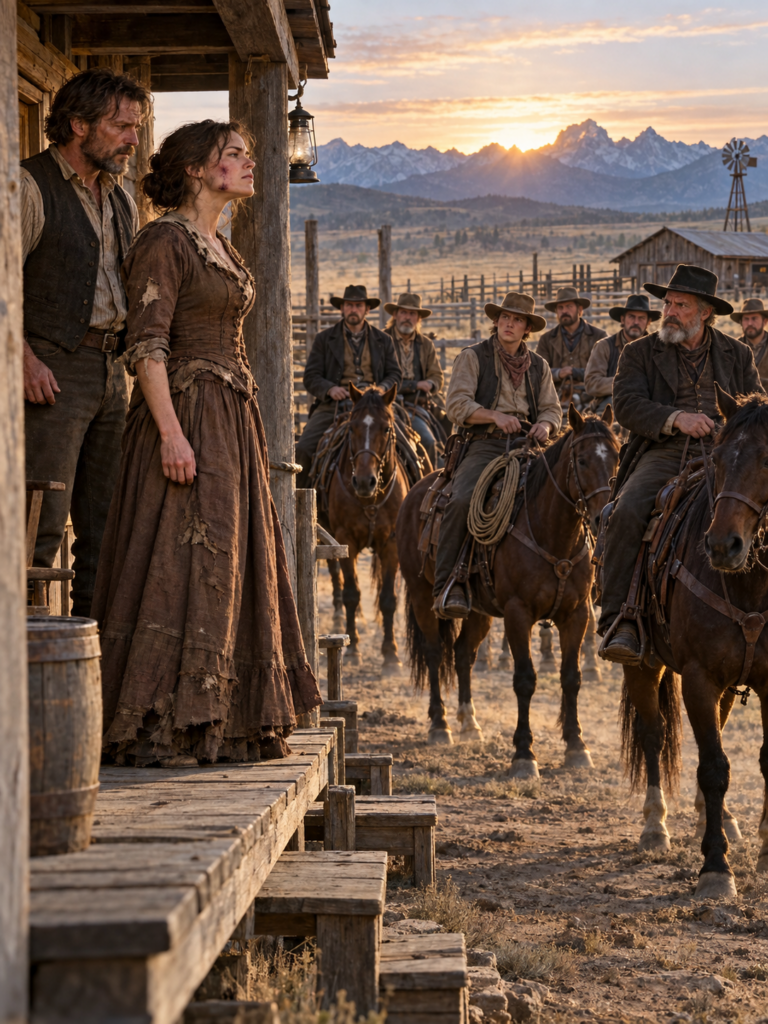
Six or seven men came around the cottonwoods, Otto Kesler leading them, his rifle in its saddle scabbard.
A coil of rope hung from a younger rider’s saddle.
Ezra moved toward Ruth.
“Inside. They don’t know you’ve agreed to go before the sheriff.”
She looked at the approaching men.
Then at the house.
She went inside while Ezra followed and barred the door.
Outside, Otto Kesler shouted.
“Colton! I know she’s in there!”
Ezra took one long breath, opened the front door, and walked out onto the porch with empty hands.
Behind him, Ruth heard the voices rising.
She looked at her written account.
Then she took hold of the door latch.
Ruth lifted the latch.
The door opened an inch, and the cold morning air touched her face.
Outside, Ezra stood at the edge of the porch, facing seven mounted men.
Otto Kesler had dismounted.
The blacksmith’s broad shoulders filled his coat, his beard streaked with gray, his face drawn tight by grief and four nights of restless anger.
“I’m asking once more, Colton,” he said. “Bring her out.”
Ezra kept his hands visible.
“You don’t need to do this.”
“My nephew is dead.”
“I know.”
“And you’ve hidden the woman who shot him.”
“I gave shelter to an injured woman who says she defended her life.”
Otto took another step.
“Don’t dress it up.”
“I’m not.”
Behind him, the younger rider with the rope shifted in his saddle.
Ruth saw the loop hanging against the horse’s flank.
It was ordinary hemp.
The sort used around a ranch every day.
But she understood perfectly what it meant here.
She stepped fully through the doorway.
“Mr. Kesler.”
Ezra turned.
For an instant, concern crossed his face.
“Ruth—”
She shook her head.
He stopped speaking.
That, more than anything, gave her courage.
She had spent years being interrupted by a husband who believed her voice belonged to him.
Now, with seven armed riders before her, the man nearest her allowed her to speak.
Otto stared.
“You.”
“Yes.”
“You killed him.”
Ruth gripped the folded paper in her hand.
“I shot Nathaniel while he was trying to strangle me.”
A murmur passed through the riders.
Otto’s face reddened.
“You expect me to believe that?”
“I expect you to hear it.”
“He never raised a hand to anyone in his life.”
“You never saw him raise one.”
“I knew that boy.”
“So did I.”
Her voice shook.
She steadied it.
“I knew him when he brought flowers to the house. I knew him when he apologized for frightening me. I knew him when I still believed he could become kind again.”
Otto looked as though each sentence struck a place he was trying to protect.
“And I knew him,” Ruth continued, “when he turned his belt buckle against me because he knew the bruises would be harder to explain.”
One of the riders looked away.
Ruth held Otto’s gaze.
“I came to you once. You remember that?”
His jaw tightened.
“You said you and Nathaniel had been quarreling.”
“I showed you my wrist.”
“You told me—”
“I told you he had a temper.”
Otto fell silent.
“You said a patient wife could make him gentler. So I went home and tried to be patient.”
The wind stirred the loose hair at Ruth’s temple.
“It didn’t save me.”
The young rider shifted again.
Otto glanced toward the rope.
For the first time, he seemed to notice it as something belonging to the present moment rather than to the justice he imagined himself seeking.
“She’s telling you what happened,” Ezra said. “You don’t have to take my word for it. There’s a doctor who treated her. There are records.”
Otto’s eyes narrowed.
“What doctor?”
“Silas Mercer.”
“Mercer left Milbrook.”
“He practices in Red Gate now.”
Otto looked between them.
“Convenient.”
Ruth took a step forward.
“Then ask him yourself. But you won’t put a rope around my neck before somebody hears what he has to say.”
The young rider’s horse moved restlessly.
He reached down and pushed the dangling rope back over the saddle horn.
A small action.
Yet Ruth saw it.
And for the first time since the men arrived, she understood that not everyone in the yard had already made his final decision.
Otto did not move.
“I’m supposed to turn away because you say Nathaniel hurt you?”
“No,” Ruth answered. “You’re supposed to let the law hear us.”
“There’s a reward for finding you.”
“Then you’ve found me.”
Her voice grew stronger.
“But you haven’t found the truth by riding here with seven men.”
Ezra remained beside her, a little behind now.
The choice to stand in front of them was hers.
He knew it.
She knew he knew.
Then another sound reached the yard.
Horses coming fast.
Several of Otto’s men turned in their saddles.
From the road appeared Sheriff Walter Pike and Dr. Silas Mercer.
Pike’s badge caught the morning light.
He rode directly between the gathered men and the porch before dismounting.
“Otto,” he said.
The blacksmith looked at him with open surprise.
“Sheriff.”
“Seems you’ve forgotten that Mrs. Vance agreed to meet me on the road this morning.”
Otto frowned.
“You knew where she was?”
“I knew she intended to present herself willingly.”
Pike’s gaze traveled over the mounted men, settling briefly on the rope.
“And I’m pleased I arrived before anybody did something that couldn’t be undone.”
Mercer dismounted beside him.
His leather satchel hung from one hand.
Ruth felt a strange weakness in her knees.
The physician had seen her injured before.
But this was the first time he was seeing her injuries become a matter no one could quietly dismiss.
“Mrs. Vance,” he said.
She nodded.
“Doctor.”
Mercer turned to Kesler.
“I treated your nephew’s wife twice in Milbrook. Once for a broken wrist, and again for injured ribs. I recorded what I observed at the time.”
Otto’s expression changed.
“That’s no proof my nephew caused them.”
“No,” Mercer said. “It isn’t proof of everything that happened in their house. But it is evidence of repeated injuries, and I can testify to the circumstances in which she came to me.”
“Her injuries could have been accidents.”
“They could have,” Mercer answered. “That’s why the facts deserve examination rather than guesswork.”
The plain honesty of the reply made Otto falter.
Mercer opened his satchel.
“I’ve brought the notes because Mrs. Vance agreed that they could be used at a lawful hearing.”
Otto stared at the papers.
The blacksmith had spent days holding to the image of the child he’d raised.
A nine-year-old boy with soot on his face, learning to fit his first horseshoe.
He knew Nathaniel had been stubborn.
He knew the young man drank too much on occasion and could speak harshly when crossed.
But he had never permitted himself to imagine what might happen behind a closed kitchen door.
“Why didn’t she tell me?” Otto asked.
Ruth’s face tightened.
“I did.”
The answer was quiet.
It landed harder than shouting.
Otto looked up.
“You didn’t tell me he’d kill you.”
“No. Because when I told you he frightened me, you told me to go home and do better.”
Otto’s eyes fell.
For a long moment, the only sound was a horse chewing at its bit.
Then Sheriff Pike spoke.
“Mrs. Vance, are you still willing to come with me and give your account?”
Ruth looked toward Ezra.
He did not answer for her.
“Yes,” she said.
“You understand I can’t promise what the magistrate will decide?”
“I understand.”
“I can promise you’ll be brought before lawful authority. And no man standing here has permission to settle this with a rope.”
Pike turned to Otto.
“Take your riders home.”
Otto looked at Ruth again.
“She killed the boy I raised.”
“And she’s entitled to be heard,” Pike said. “Your grief doesn’t give you the right to decide the verdict.”
The older man’s shoulders sagged.
For an instant, Ruth saw not an enemy but a grieving uncle confronting a terrible possibility.
Nathaniel might have been loved by the family that raised him and still have been cruel to the woman he married.
Both things could be true.
At last, Otto looked toward the young rider.
“Put that rope away properly.”
The man obeyed.
Kesler stepped back toward his horse.
“I’ll hear the evidence,” he told Pike. “All of it.”
Then he mounted.
He did not apologize.
Ruth had not expected him to.
The riders turned one by one and followed him down the road.
Only when they disappeared among the cottonwoods did Ruth realize how hard she had been gripping her statement.
The folded edges had cut into her palm.
Ezra looked at her.
“You all right?”
“Not yet.”
He nodded.
“That’s fair.”
She studied the empty road.
“But I think I might be.”
***
The hearing took place several days later in Red Gate.
Ruth spent those days under Sheriff Pike’s authority, with arrangements made for her safety while the magistrate prepared to hear the account.
Ezra visited when permitted.
He brought clean clothing, a little food, and the news that Rufus had stolen a whole portion of breakfast from the kitchen table.
Ruth laughed despite herself.
“You shouldn’t have left it where he could reach.”
“I’ve told him that.”
“And?”
“He disagrees.”
They smiled.
Then the conversation turned quiet.
Ruth studied him.
“You know you can still step away from all this.”
“I know.”
“You’ve already done more than anybody had reason to expect.”
“That’s not why I came.”
“Then why?”
He sat opposite her.
“Because I wanted to see you.”
The simplicity of it left her without an answer.
She was not accustomed to being wanted without a demand attached.
After a while, she said, “I don’t know what I have left to give anyone.”
Ezra looked at her steadily.
“I’m not here to collect anything.”
She lowered her eyes.
The words stayed with her long after he left.
At the preliminary examination, Dr. Mercer testified to the injuries he’d treated and the records he’d kept.
He described their dates, their nature, and the explanations he’d been given.
He did not claim knowledge he lacked.
Ruth respected him for that.
Then she was called.
She stood before the justice of the peace, hands cold, mouth dry.
For one terrible moment, she remembered the kitchen in Milbrook.
Nathaniel coming toward her.
The hard shine of the belt buckle.
The pistol in her apron pocket.
The pressure of fingers around her throat.
The fading edges of the room.
And the sound that followed.
She gripped the edge of the witness stand.
Then she spoke.
At first, her voice trembled so badly she scarcely recognized it.
She explained the beginning of the marriage.
The apologies.
The injuries.
The attempts to find help.
The fear that had grown until carrying Nathaniel’s pistol seemed less frightening than being without it.
She told the justice what had happened that final night.
She did not exaggerate.
She did not pretend to remember every second.
“I remember believing I was about to die,” she said. “I remember reaching for the pistol. I remember the shot. I cannot tell you that I made some careful decision in those moments. I only know I was trying to live.”
The room remained silent.
Ruth looked toward the spectators.
Ezra sat near the back.
He wasn’t smiling.
He simply watched her with the quiet attention he’d given her that first night beside the pump.
She returned her gaze to the justice.
“I did not go into my marriage intending to kill my husband,” she said. “I wanted a home where I could live without fear. In the end, I was frightened in every room of it.”
Her voice steadied.
“I am here because I won’t run from what happened anymore.”
Otto Kesler testified afterward.
He spoke of Nathaniel’s childhood and the years he’d raised him.
He said he’d never personally seen his nephew strike Ruth.
Then he paused.
The room waited.
“And I have to admit,” he said, “that I never asked her the right questions when she came to me for help.”
He looked toward Ruth.
“I thought I knew enough.”
His voice roughened.
“I didn’t.”
That was all.
It did not undo the past.
But it was the first truth Ruth had ever heard Otto speak publicly about his part in it.
After considering the testimony and evidence presented, the justice found insufficient cause to hold her for trial and ordered her discharged.
No declaration from the bench could return the years she’d lost.
No ruling could erase Nathaniel’s death or the fear she’d carried.
But she was free to leave.
When Ruth stepped outside, afternoon sunlight lay across Red Gate’s dusty street.
She stopped on the courthouse steps.
A wagon creaked past.
Somewhere a hammer struck metal at Otto’s forge.
Men and women went about their ordinary business.
For a moment, Ruth could hardly understand that she was permitted to do the same.
Then she saw Ezra waiting beside the horses.
He did not rush toward her.
He gave her room to come down the steps.
“Well?” he asked gently.
“They let me go.”
“I heard.”
Her eyes filled.
“I kept thinking something else would happen. That somebody would stop me at the door.”
“Nobody did.”
“No.”
She smiled through tears.
“Nobody did.”
Ezra held out the reins of the horse she’d ridden to the ranch.
“What would you like to do now?”
The question startled her.
She could travel to her sister in Cheyenne.
She could look for work in town.
She could leave Wyoming altogether.
For the first time in years, the possibilities were real.
“I’d like to go back to the ranch,” she said.
Ezra nodded.
“For tonight?”
Ruth looked at him.
“For now.”
He accepted the answer exactly as she’d given it.
***
Ruth remained through autumn.
Then through the first deep cold of winter.
She did not call herself Ezra’s housekeeper.
He did not call her his responsibility.
She helped because she wished to contribute, and she began to earn her own money by taking in mending from families in Red Gate.
By January, she had three regular customers.
She kept the coins in a small wooden box in her room.
The first time Ezra noticed it, Ruth felt compelled to explain.
“It’s only my sewing money.”
“I know.”
“I want to keep it separate.”
“Then it ought to stay separate.”
She watched him for a moment.
“You really don’t mind?”
“Ruth, you’ve earned it.”
Her fingers rested on the box.
“I used to have to explain every penny.”
“You don’t have to explain these.”
She closed the lid.
Something old and frightened within her loosened.
Their days filled with work.
Ezra repaired fence rails and tended the stock.
Ruth took care of her customers’ garments and helped keep the ranch accounts.
When the weather permitted, they walked the property together, discussing repairs and supplies.
Sometimes she disagreed with his plans.
He listened.
Sometimes his judgment proved better.
She listened in return.
They learned to make decisions without turning difference into a contest of power.
One winter evening, Ezra found her sitting at the kitchen table with a letter.
It had come from her sister in Cheyenne.
“You going to visit?” he asked.
“I think I’d like to when travel is easier.”
“You should.”
She studied him.
“You wouldn’t mind?”
“Why would I?”
“Because I might decide to stay there.”
He stood quietly for a moment.
Then he pulled out the chair opposite her.
“I’d miss you.”
Her throat tightened.
“But I wouldn’t ask you to give up your sister to spare me that.”
Ruth looked down at the letter.
For years, leaving had meant escaping.
Now she was discovering that she could go somewhere without having to flee.
She reached across the table and rested her hand over Ezra’s.
It was the first time she’d touched him without necessity.
He went still.
Then he turned his hand beneath hers.
They sat that way for a while, neither pretending it meant less than it did.
***
Early spring brought clearer skies and softer ground.
One morning, Ruth walked out to the fence where Ezra had first found her.
The same pump stood nearby.
The same bench waited beneath the cottonwoods.
She carried Nathaniel’s pistol in one hand.
It had been returned after the authorities no longer required it.
For months, she’d kept it carefully secured.
Now she examined the worn grip and remembered the terror that had made her carry it.
Ezra emerged from the barn and stopped when he saw her.
He did not approach immediately.
“You all right?”
“Yes.”
She looked at the weapon.
“I carried this because I thought there’d come a day when nobody would help me.”
Ezra waited.
“And there was such a day.”
Her voice remained steady.
“I won’t pretend otherwise.”
She turned the pistol in her hand.
“But I don’t want every morning of the rest of my life to begin with remembering that kitchen.”
She took the unloaded weapon back inside and placed it on the cabinet’s upper shelf, out of everyday reach.
Ezra followed only when she called him.
“I don’t need to carry it anymore,” she said.
He nodded.
“Then don’t.”
She looked at him.
“I know putting it away doesn’t guarantee I’ll never be frightened again.”
“No.”
“But I think I can live without letting fear make every decision.”
Ezra smiled faintly.
“You’ve been doing that for a while already.”
Later that week, a letter arrived from Otto Kesler.
Ezra placed it beside Ruth’s cup without opening it.
She recognized the handwriting.
For a long time, she left it untouched.
Then she broke the seal.
Otto wrote that he had spent the winter considering what Ruth had told him.
He did not ask her to forget Nathaniel, or to excuse his own failure.
He offered to shoe her horse without charge if she ever cared to accept.
Ruth read the letter twice.
Then she folded it.
“He thinks shoeing a horse can make up for three years?”
Ezra shook his head.
“I don’t think he believes that.”
“Neither do I.”
She set the letter aside.
“Maybe I’ll answer him someday.”
“That’s yours to decide.”
She looked out toward the road.
“I don’t hate him the way I did.”
“That’s something.”
“But I don’t forgive him yet.”
“You don’t owe him that either.”
Ruth turned toward Ezra.
There was affection in her face now, unmistakable and unguarded.
She had begun to love him gradually, through a hundred ordinary moments.
A basin placed outside her door.
A promise kept.
A letter left unopened.
A hand offered without insisting she take it.
She knew those things might seem small to other people.
To Ruth, they had become the foundation of a life she never thought she would know.
That evening, they sat at the kitchen table while the last sunlight warmed the walls.
Ezra had finished repairing a harness strap.
Ruth laid aside the shirt she’d been mending.
“I’ve been thinking about Cheyenne,” she said.
He looked up.
“Your sister?”
“Yes. I mean to visit her this summer.”
“Good.”
“And I’ve been thinking about coming back.”
His hands became still.
“To Red Gate?”
“To this house.”
Ezra watched her carefully.
“I’d be glad.”
Ruth smiled.
“I know you would.”
She leaned forward.
“But I want to be clear about something.”
“All right.”
“I don’t want to live here because you saved me. And I don’t want to be somebody you have to protect from the world.”
“I know.”
“I want to work. I want to see my sister when I choose. I want a say in the way we live.”
Ezra nodded.
“You ought to have all those things.”
“And I want to stay with you.”
His expression changed.
For the first time since she’d known him, he seemed to have difficulty finding words.
“Ruth—”
“Not because I need your roof.”
She reached for his hand.
“Because I want the life we might make beneath it.”
Ezra looked at their joined hands.
Then he raised his eyes.
“I love you,” he said.
No speech.
No promise that trouble would never find them.
Just the truth.
Ruth drew a breath.
“I love you, too.”
His thumb moved gently across her fingers.
“Are you certain?”
She smiled.
“Ezra, I’ve spent most of my life being told what I ought to want. I know the difference now.”
He laughed softly.
She leaned toward him, and when he met her halfway, their first kiss was quiet and unhurried.
There was no fear in it.
No debt being paid.
No obligation being accepted.
Only two people choosing to be near each other.
They made no hurried marriage plans.
Ruth wished to visit her sister first, continue her sewing work, and decide with Ezra how their shared household would operate.
He agreed.
They discussed money, rooms, livestock, and the everyday matters that made a home possible.
Ruth would keep her earnings and contribute to household expenses by choice. Ezra would continue managing the ranch stock, while both would have a voice in purchases and improvements affecting their shared life.
Nothing had to be settled through a single grand declaration.
They were learning to build trust in daylight.
One evening, months after she’d first appeared at the fence, Ruth stepped outside with two cups of coffee.
Ezra was replacing a loose rail near the pump.
She set the cups on the bench.
“Remember this place?” she asked.
He straightened.
“I do.”
“I was certain you were going to turn me in.”
“I remember that, too.”
“You told me nobody was going to chase me off a fence rail for wanting water.”
“Still true.”
She looked at the gate.
“At the time, I didn’t believe anybody could give something without expecting payment.”
Ezra laid down his hammer.
“You’ve given me plenty, Ruth.”
She raised an eyebrow.
“Better accounts?”
“For one thing.”
“Bread that doesn’t come out hard enough to mend a fence?”
“That, too.”
She laughed.
He stepped closer.
“But mostly,” he said, “you’ve given me somebody to share the days with.”
Ruth looked toward the house.
The windows caught the evening light.
Her sewing lay inside beside his harness tools.
Two coats hung by the door.
Two cups stood on the bench.
A household once arranged around one man’s solitary habits had gradually made room for two independent lives.
She turned back to him.
“You said something to me that first night.”
“I said a fair amount.”
“Not while God’s your witness.”
Ezra’s expression softened.
“I remember.”
“You meant it.”
“Yes.”
She took his hand.
“I think that’s when my life began to turn. Not because you promised to save me from everything.”
She glanced toward the road she’d once watched in terror.
“But because you refused to hand me over to men who hadn’t heard my voice.”
Ezra squeezed her hand gently.
“You were the one who stood before them.”
Ruth considered that.
Then she smiled.
“Yes,” she said. “I was.”
He picked up the two cups.
Together they walked toward the house.
Ruth reached the doorway first.
She opened it herself and stepped into the warm kitchen, knowing she could leave whenever she wished, knowing Ezra would respect her freedom, and knowing just as surely that she wanted to return.
Once, she had stood at that fence believing every man who offered shelter would eventually demand obedience.
Now she understood the difference between a place where she was kept and a place where she was welcome.
Ezra followed her inside.
She turned, took one cup from his hand, and smiled.
“Thank you,” she said.
“For what?”
“For meaning what you said.”
He looked at her with the quiet affection she’d learned to trust.
“You don’t owe me thanks for doing what’s right.”
“I know.”
Ruth reached for his hand again.
“But I’m free to give them.”
And in the peaceful house beyond the fence, that freedom was the beginning of everything they chose to build together.


