
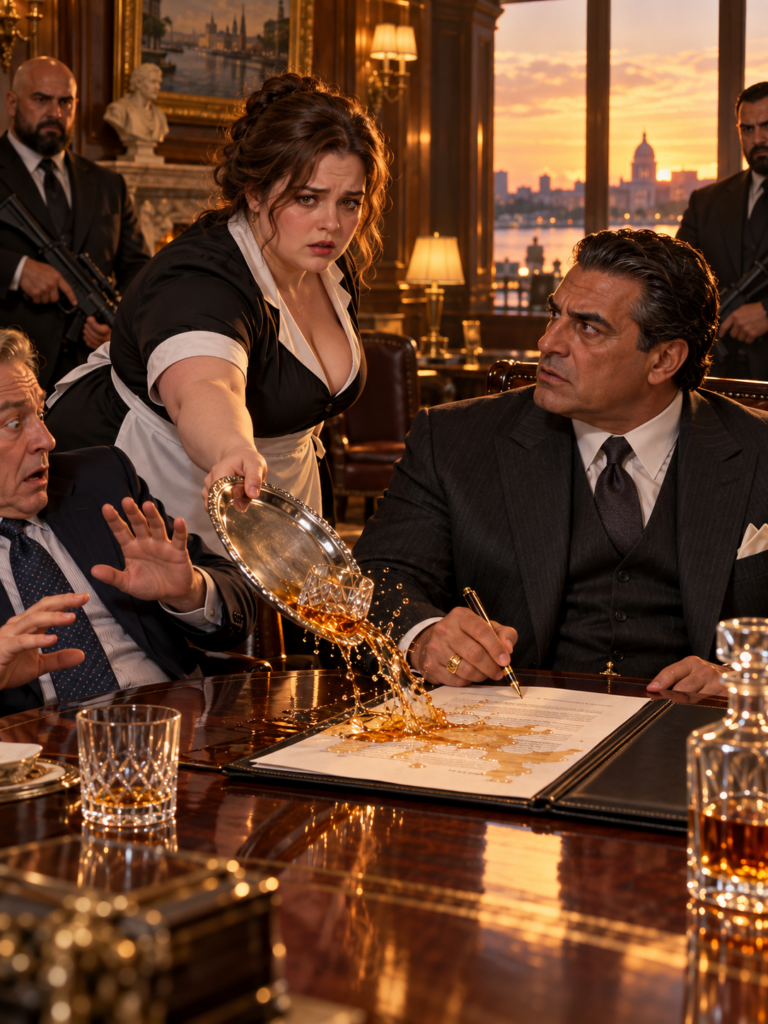
As Paola unfolded the final appendix, a loose sheet slipped from the packet and slid toward Lionel Crane.
He reached for it.
Paola caught the corner first.
“Don’t touch that,” she said.
Crane stared at her.
“You have absolutely no authority here.”
“Neither do you over evidence that may concern my accounts,” Aurelio replied.
He turned to his underboss.
“Have our lawyer preserve the original documents.”
The guards remained tense, but Aurelio ordered every weapon lowered.
Paola examined the loose sheet.
It contained a transaction reference, a date, and an internal approval code.
She recognized the format.
“Mr. Bianchi, who authorizes transfers from your construction businesses?”
“My finance department.”
“Does one person approve them?”
“Not normally.”
“Then somebody may have bypassed your controls.”
Crane laughed nervously.
“You’re making accusations without understanding the transactions.”
“You’re right about one thing,” Paola answered. “I don’t have enough evidence yet to prove exactly what happened.”
Aurelio looked at her with unexpected approval.
She continued.
“But these figures make no sense as independent transactions. The money leaves one group of companies, appears in an account connected to the proposed lender, and then shows up in the documents being used to justify that lender’s ability to finance the deal.”
“That proves nothing,” Crane snapped.
“It proves the transaction trail needs examining before anyone signs.”
Aurelio closed the leather folder.
“The agreement is suspended.”
Crane’s expression hardened.
“You can’t afford to walk away.”
“I can afford to investigate.”
“Your companies will collapse without my money.”
Aurelio leaned forward.
“Then tell me why my missing money appears to be financing your offer.”
Crane said nothing.
For the first time, Paola saw the man across the table without his polished confidence.
He was frightened.
And frightened men with powerful connections could become dangerous.
Aurelio instructed his underboss to secure the club’s financial records and contact independent counsel.
Crane would not be signing anything that day.
He protested loudly, threatening lawsuits, business retaliation, and the withdrawal of every dollar.
Aurelio listened without interruption.
Then he said, “You may leave through the front entrance. My counsel will be in touch.”
Crane stared at him.
“You’re letting a waitress destroy a forty-million-dollar transaction?”
“No,” Aurelio replied. “I’m allowing an unanswered financial discrepancy to stop it.”
Crane collected his briefcase.
Before leaving, he looked at Paola.
“You should have kept pouring drinks.”
The words made her skin cold.
Aurelio noticed.
“Mr. Crane,” he said.
The businessman paused.
“Any attempt to intimidate her will become part of this dispute.”
Crane walked out without replying.
Only after the doors closed did Paola realize how badly her hands were shaking.
She reached for her tray.
“I should get back to work.”
“Paola.”
Aurelio’s voice stopped her.
“How much did you understand before you spilled the bourbon?”
“Enough to know the numbers weren’t independent.”
“And you were certain?”
“No.”
That answer surprised him.
“I was certain something was wrong,” she explained. “Not who was responsible.”
Aurelio looked toward the documents.
For six months, he’d trusted men with prestigious qualifications, expensive offices, and promises of loyalty.
A waitress had noticed what they had missed.
“How far did you get with your accounting degree?”
“Three years.”
“Why did you stop?”
“My mother was ill. The bills kept growing. Somebody had to work.”
“And your family?”
“My younger sister is still in college.”
Aurelio’s expression softened.
“I’m sorry about your mother.”
Paola nodded, unable to speak for a moment.
“Thank you.”
He gestured toward a chair.
“Please sit. I want to ask you to review something else.”
She hesitated.
“Am I being paid for that?”
Aurelio blinked.
Then, unexpectedly, he smiled.
“Of course.”
“Because I can’t miss a shift to work for free.”
“Fair.”
“And if I tell you something you don’t want to hear?”
“Today suggests you won’t have much trouble doing that.”
Paola almost laughed.
Almost.
Then Aurelio placed another ledger before her.
“This contains our reported construction losses.”
She opened it.
The first page showed a series of transfers.
The second showed internal reconciliations.
On the third, Paola found something troubling.
A code repeated beside several missing payments.
The same code appeared in the appendix Crane had brought.
But this time it was accompanied by a name.
Not Lionel Crane.
A senior member of Aurelio’s own financial staff.
Paola looked up.
“Do you trust this person?”
Aurelio followed her gaze.
His expression became unreadable.
“With everything.”
She pointed to the entry.
“Then someone needs to explain why their authorization appears on both sides of these transactions.”
Aurelio leaned closer to the document.
For several seconds, he said nothing.
Then his phone vibrated.
His underboss was calling from downstairs.
Aurelio answered.
He listened, his jaw tightening.
“Say that again.”
Paola watched the color drain from his face.
The underboss had discovered that the senior accountant’s office had been emptied.
Computer equipment was missing.
Personal files were gone.
And the accountant had disappeared less than an hour before the meeting.
Aurelio slowly lowered the phone.
Paola glanced at the ledger.
Then at the empty chair across from her.
The mistake she’d exposed was no longer just a financial discrepancy.
It was the first visible piece of a betrayal already in motion.
Aurelio placed the phone beside the open ledger.
“How long has he been gone?” Paola asked.
“Nobody knows.”
“Then don’t assume he’s guilty just because he’s missing.”
Aurelio looked at her.
“His authorization appears on the transactions. His office has been cleared out. What would you assume?”
“I’d assume there are questions worth answering.”
He studied her.
“You’re careful with accusations.”
“My professors used to say numbers tell you what happened, not always why.”
Aurelio looked toward the windows.
Below them, the late-afternoon traffic moved through downtown Providence.
His grandfather had built the family’s harbor interests with decades of difficult agreements, political relationships, legal enterprises, and criminal compromises.
Aurelio had inherited an empire whose reputation intimidated rivals.
But that reputation had not protected him from the quiet disappearance of money.
He returned his attention to Paola.
“I need someone who understands these documents and isn’t connected to the people who’ve been handling them.”
“Then hire an independent forensic accounting firm.”
“I intend to.”
“Good.”
“But I also want you involved.”
Paola’s fingers tightened around the ledger.
“Mr. Bianchi, I didn’t finish my degree.”
“You identified a pattern my entire finance office missed.”
“That doesn’t make me qualified to run an investigation.”
“No. It makes you qualified to explain what you noticed.”
He paused.
“And I would compensate you for your time.”
She considered his offer.
Aurelio was used to giving orders and having them obeyed.
Paola was used to people assuming desperation would make her accept anything.
Neither habit was suitable for this conversation.
“I’d want the scope in writing,” she said.
“Naturally.”
“And the ability to refuse work involving anything illegal.”
Aurelio leaned back.
“You know who I am.”
“Yes.”
“Then you know some parts of my business aren’t suitable for an ordinary accounting engagement.”
“That’s precisely why I’m telling you.”
He regarded her for a long moment.
Then he nodded.
“Fair enough.”
She looked almost surprised.
Aurelio noticed.
“Did you expect me to argue?”
“Honestly?”
“Please.”
“Yes.”
The corner of his mouth lifted.
“Then I suppose I’ve disappointed you.”
“Not yet.”
He laughed quietly.
It was the first genuine laugh she’d heard from him.
***
Twenty minutes later, Aurelio’s underboss returned.
The accountant’s office had been secured for review, and the independent legal and financial teams were being contacted.
Lionel Crane had left the building.
His two bodyguards had gone with him.
Nothing further had been heard from him.
But Crane’s departure did not reassure Aurelio.
He knew the businessman operated through layers of corporations and intermediaries.
If the financial scheme was real, exposing it could affect more than a single transaction.
“Paola,” Aurelio said, “I need to ask you something unpleasant.”
She looked up.
“Is there anyone who might have noticed you examining the financial documents before today?”
“Not deliberately.”
“Think carefully.”
She remembered the evenings when the chief accountant had complained loudly near the bar.
The routing code he’d repeated.
The glance he had given her when he realized she was close enough to hear.
Her stomach tightened.
“There was one occasion.”
She explained.
Aurelio listened without interrupting.
“When was this?”
“About three months ago.”
“Did he say anything to you afterward?”
“No. But he asked the manager whether I’d been working that shift.”
Aurelio’s expression hardened.
“And your manager told him?”
“I assume so.”
He stood and walked toward the window.
Paola watched his reflection.
“You think he was checking whether I’d heard something.”
“It’s possible.”
“Then you need to tell your investigators.”
He turned back.
“I intend to.”
Paola stood.
“Mr. Bianchi, I have another shift tomorrow.”
He looked at her as though she’d mentioned something from another universe.
“You’re worried about your shift?”
“I’m worried about keeping my job.”
“After what happened here?”
“Especially after what happened here.”
He was silent.
She continued.
“The club manager could fire me for spilling that drink. My sister’s tuition is due soon, and I can’t afford to lose another paycheck.”
Aurelio’s face changed.
He had spent the afternoon discussing forty million dollars as if it were a number on a page.
For Paola, one lost paycheck could damage her family’s entire month.
The contrast unsettled him.
“I’ll make sure you aren’t disciplined for this.”
She crossed her arms.
“I’d rather have that conversation with my manager myself.”
Aurelio paused.
“All right.”
“And please don’t tell me my money problems are over.”
His brows rose.
“Why would I?”
“Because men with money sometimes think writing a check settles everything.”
He considered her.
Then he said quietly, “I don’t want you to feel purchased, Paola.”
The directness caught her off guard.
“Good.”
***
They entered the private elevator together.
Aurelio had offered to escort her downstairs because reporters and business associates were already gathering near the entrance.
Paola stood beside him, holding her folded apron.
The polished doors reflected their contrasting figures.
Aurelio’s broad shoulders nearly filled his charcoal jacket.
Paola’s generous curves softened the severe lines of her uniform.
She had spent years feeling that her body made people overlook her intelligence.
Now the most powerful man she’d ever met was studying her with an expression she couldn’t quite interpret.
“What?” she asked.
“Nothing.”
“You’re staring.”
“You’re observant.”
“That’s how this entire mess started.”
He smiled faintly.
“Then perhaps I should answer honestly.”
She waited.
“I’ve noticed you long before today.”
Paola’s cheeks warmed.
“You have?”
“You’re the only person at that bar who remembers everyone deserves to be treated like a person.”
“That’s called doing my job.”
“Not everyone does it.”
The elevator slowed.
Aurelio looked forward.
“You’ve also never seemed impressed by me.”
“I’m impressed by how much bourbon you drink.”
He laughed.
“I walked into that.”
“Yes, you did.”
The doors opened.
For a brief moment, the crisis upstairs felt very far away.
Then a security officer approached.
“Boss. We have a problem.”
Aurelio’s expression tightened.
“What kind?”
“A vehicle associated with Crane’s security company has been parked near the rear entrance. Two men are inside.”
Paola felt the warmth leave her face.
The officer continued.
“They haven’t approached the club. But they appear to be watching the service corridor.”
Aurelio looked toward Paola.
“That’s where employees leave, isn’t it?”
She nodded.
He turned to the officer.
“Notify building security and the police. Preserve the camera footage. Nobody confronts them unless necessary.”
The officer hurried away.
Aurelio looked back at Paola.
“I’m arranging a safe ride home.”
She hesitated.
“My sister is expecting me.”
“Then call her.”
“You’re not going to tell me I have to stay?”
“No.”
Aurelio paused.
“But somebody may have noticed you interrupted Crane’s deal. I don’t think you should leave alone.”
Paola considered that.
She didn’t like needing protection.
But she understood the difference between pride and recklessness.
“All right,” she said. “A ride home. Not an armed escort standing outside my apartment.”
“We can discuss practical arrangements based on what the security team learns.”
“Fine.”
His expression softened.
“Thank you for trusting me with that much.”
“Don’t make me regret it.”
“I’ll try not to.”
***
Before Paola could leave, a violent crash echoed from the lower floor.
Both turned.
A second crash followed.
Then came gunfire.
The security officer shouted into his radio.
“Shots fired near the service entrance!”
Aurelio immediately guided Paola behind a thick concrete support column.
“Stay here.”
She gripped his sleeve.
“What’s happening?”
“I don’t know yet.”
For all his power, Aurelio couldn’t see through walls or know how many attackers had entered.
He could only respond to the information he had.
His underboss appeared from the corridor.
“Boss, two armed men forced their way through the loading area. Security is containing them, but the rear exit isn’t safe.”
“Where’s the nearest protected room?”
“West office.”
Aurelio turned to Paola.
“Can you move?”
She nodded.
“Then come with us.”
They crossed the corridor quickly, keeping away from the glass doors leading toward the club floor.
Another burst of gunfire sounded below.
Paola flinched.
Aurelio didn’t tell her not to be afraid.
He simply held the office door open and waited until she was inside.
The room had no exterior windows.
Its heavy door locked behind them.
Paola stood near the desk, breathing hard.
Aurelio listened to the radio reports while his underboss coordinated with security.
For several minutes, the only sounds were distant shouting and the steady hum of ventilation.
Then came the message.
Two attackers had been apprehended.
One security guard was wounded.
Emergency services were on their way.
The immediate threat was contained.
Aurelio lowered the radio.
Paola sank into a chair.
Her hands were shaking again.
“Are you hurt?” he asked.
She shook her head.
He kept his distance.
“Would you like some water?”
“Yes.”
He handed her a bottle.
She drank slowly.
For a long time, neither spoke.
Then Paola looked up.
“You said Crane could retaliate.”
“I said there was a risk.”
“And now someone has fired guns inside the building.”
Aurelio’s jaw tightened.
“We don’t know yet whether Crane ordered it.”
“But you suspect him.”
“Yes.”
Paola stared at the water bottle.
She had expected anger.
She hadn’t expected guilt to settle so heavily in her chest.
“Maybe I should have kept quiet.”
Aurelio crouched beside the chair, remaining far enough away that she had room to move.
“Look at me, Paola.”
She did.
“You didn’t cause those men to come here.”
“I interrupted the deal.”
“Whoever planned violence made that decision. Not you.”
Her eyes filled.
“I was only trying to stop you from making a mistake.”
“And you did.”
“But now—”
“Now we handle the consequences without blaming the person who told the truth.”
She studied him.
His voice was controlled.
His expression was serious.
He wasn’t promising impossible safety or claiming he could destroy every enemy with a gesture.
He was accepting that the world he controlled had brought danger into her ordinary life.
For the first time, Paola realized he understood the responsibility.
***
By nightfall, the club had been cleared.
The wounded security guard was receiving medical care.
Police were investigating the shooting.
Aurelio’s lawyer had obtained preservation orders for the relevant business records.
And Paola sat in the rear of a secure car headed toward her apartment.
Aurelio accompanied her at her invitation.
She had called her sister, reassuring her that she was safe without concealing the seriousness of the incident.
Now she watched Providence’s streetlights pass beyond the tinted window.
“Mr. Bianchi?”
“Aurelio.”
She looked at him.
“You keep saying that.”
“Because I would prefer you to call me by my name.”
She hesitated.
“All right. Aurelio.”
He smiled faintly.
“Better.”
She glanced toward the city.
“What happens if the accountants confirm the money was stolen?”
“We challenge the transfers, pursue recovery, and decide whether the businesses can be saved without Crane’s financing.”
“And if they can’t?”
Aurelio looked out his window.
“Then some of them may fail.”
The answer surprised her.
She had imagined mafia bosses as men who always found ways to force the world into obedience.
But Aurelio looked tired.
Human.
Afraid of losing something that mattered.
“Your grandfather built those ports,” she said.
“He did.”
“You don’t want to let them go.”
“No.”
She turned toward him.
“Then don’t confuse saving them with keeping every single thing exactly as it was.”
He looked at her.
“What do you mean?”
“Maybe some losses are real. Maybe some businesses were already struggling. Recovering stolen money won’t fix every problem.”
He considered that.
She continued.
“A forensic audit can tell you where the money went. But you’ll still need to decide what kind of business you want left afterward.”
Aurelio was quiet for several seconds.
Then he smiled without amusement.
“Most people tell me what I want to hear.”
“That’s probably why you’re in trouble.”
He laughed softly.
“You’re going to be extraordinarily inconvenient.”
“I’ve been told.”
The car stopped outside her apartment building.
Paola reached for the door.
“Thank you for the ride.”
“Aurelio,” he said.
She looked back.
“Yes?”
“Tomorrow, my attorney will send you an offer for a limited consulting assignment. You’re under no obligation to accept.”
“And tonight?”
“Tonight, you go home and rest.”
Paola nodded.
She stepped onto the sidewalk.
Then she turned back.
“Aurelio?”
“Yes?”
“I’m glad you didn’t sign.”
His expression softened.
“So am I.”
She began walking toward the entrance.
Before she reached the door, her phone vibrated.
An unfamiliar number.
A message appeared.
It contained a photograph of her younger sister outside Providence College.
Underneath was a single sentence.
Tell Bianchi to stop the investigation.
Paola stopped walking.
Then she turned and hurried back toward the car, holding the phone out to Aurelio.
Aurelio took one look at the message and stepped out of the car.
Paola’s face had gone pale.
“That’s my sister,” she whispered.
“I can see that.”
“They know where she goes to school.”
Aurelio examined the photograph without touching the phone.
The image showed a public sidewalk near the college entrance.
There was no evidence that her sister had been harmed.
But somebody had taken the photograph and used it as a threat.
Aurelio looked at Paola.
“Call her.”
Paola immediately dialed.
The phone rang twice.
Then her sister answered.
“Paola? What’s wrong?”
The relief was so sudden that Paola nearly cried.
“Are you safe?”
“What? Yes. I’m at the library.”
“Has anyone followed you?”
“I don’t think so. Why?”
Paola looked at Aurelio.
He nodded.
“Tell her the truth,” he said quietly.
So Paola did.
Not every detail of the criminal dispute.
But enough.
Someone had threatened her.
The photograph suggested her sister might be watched.
She needed to remain somewhere secure while the authorities investigated.
Her sister agreed to stay with friends inside the college residence that evening and contact campus security.
When the call ended, Paola pressed the phone against her chest.
“I’m not going to let them use her against me.”
Aurelio’s expression remained grave.
“I’ll help you make sure she’s protected.”
“Without deciding everything for us?”
“Without deciding everything for you.”
She nodded.
They contacted the police handling the club shooting and shared the message.
Aurelio’s lawyer arranged for the threat to be preserved as evidence.
The college was notified.
And only after Paola knew her sister was safe did she agree to return temporarily to the club’s secured administrative offices to give a full account of the message.
***
The following morning, Paola made a decision.
She would not withdraw what she had discovered.
But she would not become another person whose life revolved entirely around Aurelio Bianchi.
She called the independent forensic accounting firm his attorney had retained.
Then she asked for a meeting.
Aurelio attended.
So did his lawyer and the firm’s lead investigator.
Paola arrived with a notebook.
She was wearing the same black trousers she used for work, but she’d changed into a simple cream blouse.
Her hair was pinned neatly behind her head.
The investigator, a woman named Evelyn Price, examined the copied financial appendix Paola had flagged.
“You identified these similarities while serving drinks?”
“Yes.”
Evelyn studied the transaction references.
“That’s impressive observation.”
Paola felt her cheeks warm.
“But it isn’t proof of the whole scheme,” she replied.
“No,” Evelyn agreed. “And understanding that distinction is part of good forensic work.”
Aurelio watched the exchange with quiet interest.
Evelyn continued.
“The records suggest a pattern of diverted funds and potentially misleading financing representations. We need independently authenticated bank records, complete ledgers, and transaction histories.”
Paola opened her notebook.
“I’ve made a list of the entries that appear connected.”
She pushed it across the table.
Evelyn examined the pages.
Then she looked up.
“Have you considered returning to school?”
Paola laughed awkwardly.
“Many times.”
“You’re clearly talented.”
“My mother’s medical bills don’t care about talent.”
The room went quiet.
Aurelio looked down.
He knew Paola worked long shifts to pay debts left by her mother’s illness and help her younger sister finish college.
He also knew she would reject anything that felt like charity with strings attached.
So he said nothing.
Evelyn considered Paola’s notes.
“We have an opening for a paid junior research assistant on this investigation. It’s temporary and subject to our hiring checks, but you could apply.”
Paola stared at her.
“A paid position?”
“Yes. You’d work under qualified accountants, learn the process, and help organize the records.”
For a moment, Paola couldn’t speak.
Then she glanced at Aurelio.
He gave her a small nod.
Not permission.
Encouragement.
She turned back to Evelyn.
“I’d like to apply.”
***
The investigation unfolded over several weeks.
It wasn’t glamorous.
There were thousands of documents.
Incomplete account histories.
Invoices that didn’t match payments.
Corporate structures designed to conceal who benefited from the transactions.
And mistakes that had to be separated from deliberate misconduct.
Paola spent hours alongside trained professionals, sorting records and identifying repeated references.
Sometimes her initial suspicions were wrong.
Evelyn corrected her.
Paola learned.
Other times, her memory for unusual figures helped the team locate connections buried across separate files.
The work was exhausting.
But for the first time in years, she came home tired from using the mind she had nearly forgotten she possessed.
Aurelio kept his distance from the investigation.
He received reports through legal counsel.
He was not allowed to dictate what the auditors concluded.
And Paola came to respect him more because he accepted that limitation.
***
The first major finding concerned the vanished chief accountant.
He had not disappeared because someone kidnapped him.
He had deliberately left the country shortly before Crane’s attempted deal.
His financial activity, recovered through the investigation, connected him to a series of unauthorized transfers.
Further records indicated that Crane’s companies had received funds routed from businesses affiliated with Aurelio.
The transfers passed through intermediate companies before appearing in accounts presented as evidence of Crane’s lending capacity.
The result supported Paola’s original concern.
Crane had been offering financing connected to money that appeared to have originated with the very businesses he was trying to acquire.
But there was another complication.
Some of Aurelio’s businesses were genuinely struggling.
The construction companies had suffered losses unrelated to the theft.
Several shipping contracts were underperforming.
Even if the diverted money could be recovered, the organization would need major restructuring.
Evelyn explained the findings at a private meeting.
Aurelio listened in silence.
Then he asked, “How much can we recover?”
“We can’t guarantee an amount,” Evelyn answered. “Some transactions may be reversible. Others will require litigation or cooperation from financial institutions.”
Aurelio looked toward Paola.
She could see how much he wanted certainty.
“Tell him the rest,” she told Evelyn.
Evelyn nodded.
“Even full recovery wouldn’t solve your operational problems. Some business units will require refinancing, restructuring, or closure.”
Aurelio stared at the report.
His grandfather’s legacy was more fragile than he had imagined.
For a moment, Paola worried he would reject the findings.
Instead, he closed the document.
“Then we deal with the real numbers.”
She felt a quiet surge of respect.
He wasn’t choosing the answer that preserved his pride.
He was choosing the one that gave him a chance to rebuild.
***
The shooting at the club and the threat against Paola’s sister were investigated separately.
Evidence eventually linked the attackers to security contractors associated with Crane’s business network.
Additional communications supported the conclusion that the attempted intimidation was connected to the failed financing transaction.
Crane denied responsibility.
His lawyers contested the allegations.
But investigators obtained enough supporting evidence to pursue formal charges related to the financial scheme and associated violence.
Aurelio was furious when he learned the extent of the intimidation.
Paola could see it in the way his jaw tightened.
She found him standing beside his office window, staring over Providence.
“You want revenge,” she said.
He didn’t pretend otherwise.
“Yes.”
“And what would that accomplish?”
He turned.
“Some men only understand consequences.”
“Then let him face consequences that don’t require you to make another bad decision.”
Aurelio looked at her.
“You think I’m incapable of restraint.”
“No.”
She stepped closer.
“I think you’re angry. And angry people sometimes convince themselves that whatever they want to do is necessary.”
The words stung.
He looked away.
After a long moment, he said, “You’re right.”
Paola hadn’t expected agreement.
Aurelio continued.
“I’ve spent most of my life believing power means having the final word.”
“And now?”
He looked toward the financial reports on his desk.
“Now I’m learning how expensive that belief can be.”
She smiled faintly.
“That sounds painful.”
“It is.”
“Good.”
He laughed quietly.
“You do enjoy telling me that.”
“Only when you deserve it.”
***
One evening, Aurelio asked Paola to join him for dinner.
Not a business meeting.
Not another review of the financial reports.
Dinner.
She stared at him across the conference table.
“Are you asking me on a date?”
“Yes.”
“You’re aware I’m working on the investigation into your companies.”
“Which is why I wanted to ask rather than presume.”
Paola considered him.
For months, she’d watched him learn to listen.
He had disagreed with her.
Sometimes sharply.
But he had never punished her for speaking.
And despite everything she knew about his criminal world, she had discovered a man capable of unexpected gentleness.
Still, she needed to be careful.
“I won’t be involved romantically while I’m assigned to this investigation,” she said.
Aurelio nodded.
“I understand.”
She raised an eyebrow.
“That’s it?”
“What would you prefer? An argument?”
“No.”
“Then I won’t give you one.”
He smiled.
“When the assignment ends, if you still want dinner, the invitation stands.”
Paola felt warmth rise in her cheeks.
“All right.”
***
Three months later, the forensic investigation reached its formal conclusions.
The financial records supported substantial claims against Crane’s network and the former chief accountant.
Civil recovery proceedings were underway.
Financial authorities were examining the movement of funds.
And Aurelio had begun restructuring his legitimate businesses.
He sold several failing interests.
Renegotiated debt.
Reduced unnecessary spending.
And replaced the accounting arrangements that had permitted the diversions to continue unnoticed.
The Providence ports remained under Bianchi control, though saving them required hard choices and painful compromises.
It was not a miraculous recovery.
It was work.
But the empire hadn’t collapsed.
Paola’s temporary assignment ended.
Evelyn offered her another position.
This time with the accounting firm itself.
A full-time role.
Training support.
And a schedule that would allow her to finish her degree.
Paola stared at the offer letter.
For the first time since her mother’s illness, the future looked like something she could plan instead of merely survive.
She accepted.
Then she went to see Aurelio.
***
He was in his office when she arrived.
The same office where he had once considered surrendering control of the ports.
The same gold fountain pen rested beside his desk.
But the stack of financial documents was smaller now.
And his face no longer carried the exhaustion she’d seen that afternoon.
“Paola.”
He stood.
“How are you?”
“I have news.”
He smiled.
“Good news, I hope.”
“Evelyn offered me a permanent job.”
His face brightened.
“That’s wonderful.”
“I accepted.”
“Congratulations.”
She watched him carefully.
He didn’t ask whether she’d continue working for him.
Didn’t offer to double her salary.
Didn’t try to keep her close by making her dependent.
He simply looked happy for her.
That mattered.
“There’s something else,” she said.
Aurelio waited.
“My sister’s doing well. She’s finishing the semester with good grades.”
“I’m glad.”
“And I’ve enrolled to complete my own degree.”
He smiled.
“That sounds like a great deal to celebrate.”
Paola took a breath.
“Do you remember asking me to dinner?”
Aurelio became very still.
“I do.”
“I said we could discuss it after the investigation.”
“Yes.”
She smiled.
“The investigation is finished for me.”
He looked at her.
“Then may I ask again?”
She laughed.
“Yes.”
His smile widened.
“Paola DeLuca, would you have dinner with me?”
“I’d love to.”
***
Their first date took place at a small restaurant overlooking Providence’s waterfront.
No private club.
No armed men standing behind their chairs.
No confidential contracts between them.
Just two people sitting across from each other, discovering what remained when danger no longer dominated every conversation.
Paola ordered pasta.
Aurelio ordered grilled fish.
He asked about her accounting classes.
She asked about his grandfather.
He told her stories about the old harbor, about growing up around men who believed loyalty was everything, and about how difficult it had been to recognize that loyalty without accountability could become blindness.
She listened.
Then she told him about her mother.
How she’d worked extra shifts while helping Paola study.
How she’d believed both her daughters should have opportunities she never had.
And how she had died before seeing either of them graduate.
Aurelio reached across the table.
He stopped before touching her hand.
“May I?”
Paola looked at him.
Then she placed her hand in his.
“Yes.”
He held it gently.
“I’m sorry she isn’t here to see what you’ve accomplished.”
Paola swallowed.
“Me too.”
They sat quietly for a moment.
Then Aurelio said, “For what it’s worth, I think she’d be proud.”
A tear slipped down Paola’s cheek.
She smiled through it.
“I hope so.”
***
Their relationship grew slowly.
There were disagreements.
Difficult conversations.
Moments when Aurelio’s instinct was to arrange a solution before Paola had asked for one.
She challenged him.
He learned to ask.
And Paola learned that accepting care didn’t automatically mean surrendering independence.
When he offered to help with the remaining medical debt, she told him the matter belonged to her.
He respected that.
When she eventually asked for an introduction to a reputable financial adviser who specialized in debt restructuring, he provided names without involving himself in her private accounts.
She made the decisions.
Paid what she could.
Negotiated the rest.
And slowly rebuilt the stability she had lost.
Aurelio admired her for it.
Not because she refused every kindness.
But because she knew the difference between a gift and an obligation.
***
One year after the afternoon at the private club, Paola returned to the same VIP lounge.
This time, she wasn’t carrying a serving tray.
She wore a simple burgundy dress, her dark hair falling softly around her shoulders.
Her full figure was no longer something she tried to hide.
She had learned to inhabit her body with the same quiet confidence she brought to her work.
Aurelio waited beside the mahogany table.
On its polished surface sat the old gold fountain pen.
He smiled when she entered.
“Do you remember what happened here?”
Paola laughed.
“How could I forget? I destroyed a very expensive contract.”
“You prevented me from making the most expensive mistake of my life.”
She walked closer.
“I also nearly lost my job.”
“I know.”
“And you frightened me.”
Aurelio’s expression softened.
“I know that too.”
She looked at the pen.
“At the time, I thought the only way to make you listen was to spill bourbon across the papers.”
He nodded.
“And now?”
She met his eyes.
“Now I think you’d listen if I just asked.”
Aurelio smiled.
“I would.”
She looked around the room.
The same tall windows.
The same afternoon light.
The same table where she’d discovered the transaction trail.
But nothing felt the same.
Not because the room had changed.
Because she had.
Aurelio approached.
“I have something I want to ask you.”
Paola raised an eyebrow.
“Another accounting question?”
“No.”
He held out his hand.
“Would you like to build a life with me?”
Her heartbeat quickened.
Aurelio continued before she could answer.
“Not because you saved my business. Not because I can offer you protection or money. I want you because of who you are.”
He paused.
“I know my world is complicated. I know there are things you may never be comfortable with. I’m not asking you to ignore them.”
Paola watched him.
“Then what are you asking?”
“Whether we can keep choosing each other, without pretending either of us has the right to control the other.”
Tears gathered in her eyes.
She thought of the woman who had entered this room with aching feet, overdue bills, and a serving tray held like a shield.
The woman who had believed survival meant being unnoticed.
Now she had a career.
An education she was completing.
A sister whose future looked bright.
And a man who respected the independence she’d fought so hard to recover.
Paola stepped closer.
“Yes,” she whispered.
Aurelio’s face softened.
“But I have a condition.”
He smiled.
“Of course you do.”
“My life stays mine.”
“Always.”
“And yours stays yours. We tell each other the truth about the parts that affect us, even when it’s difficult.”
“Agreed.”
She placed her hand in his.
“Then yes, Aurelio. I want to build something with you.”
He gently drew her closer.
“May I kiss you?”
Paola smiled.
“You’d better.”
He laughed, then kissed her.
There was no audience demanding their love.
No contract waiting for a signature.
No bargain that exchanged financial security for affection.
Only two adults choosing one another.
***
Months later, Paola stood outside Providence College wearing her graduation gown.
Her younger sister rushed toward her, laughing and crying.
“You did it!”
Paola hugged her tightly.
For years, she’d imagined this moment.
Finishing what she’d started.
Honoring their mother’s belief in her.
Proving to herself that the years spent working double shifts had delayed her dream, not destroyed it.
When she stepped back, she saw Aurelio standing nearby with a small bouquet of flowers.
He wasn’t flanked by guards.
He wasn’t making speeches about her accomplishments as if he’d purchased them.
He was simply smiling.
“I’m proud of you,” he said.
Paola accepted the flowers.
“Thank you.”
Her sister grinned.
“Do you know he was more nervous about today than you were?”
Aurelio looked offended.
“That’s confidential.”
Paola laughed.
Then she looked down at her diploma.
She remembered the afternoon she’d recognized a banking reference on a document she wasn’t supposed to read.
The trembling hands.
The spilled bourbon.
The men who had laughed at her.
And the gold pen hovering over a signature that might have cost a family its entire business.
She hadn’t known that speaking up would lead her here.
She’d simply known silence would be wrong.
Aurelio offered his hand.
Paola took it.
They walked toward the celebration together.
Years earlier, he’d been a feared man convinced power meant controlling everything.
And she’d been a waitress convinced her value was measured by how much she could endure.
They had both learned otherwise.
Aurelio still carried responsibility for the dangerous world he’d inherited, and Paola never pretended those responsibilities were harmless.
But her career was independent of him.
Her choices remained her own.
And their love survived because neither demanded that the other surrender the right to disagree.
The waitress who once spilled bourbon to stop a disastrous signature no longer needed to ruin a contract to make herself heard.
And the mafia boss who once believed loyalty meant obedience had finally learned the difference between being feared and being trusted.
Their greatest victory wasn’t the money recovered, the ports saved, or the enemies brought to account.
It was the freedom to stand beside each other without one standing above the other.
And for Paola DeLuca, that was worth more than any empire.


