
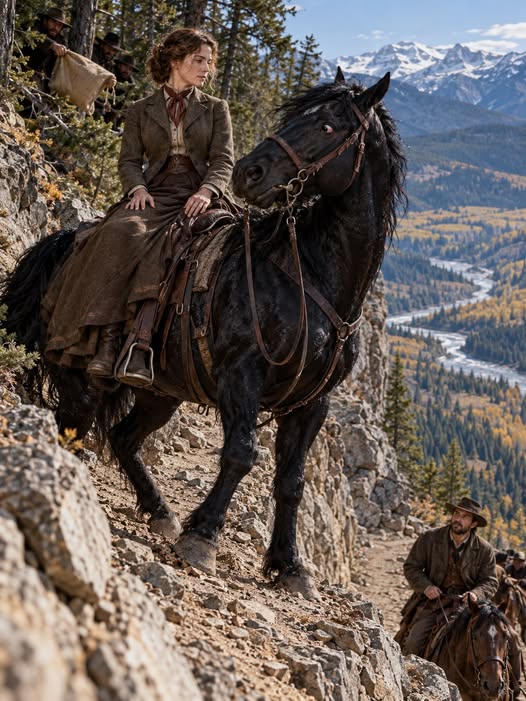
The missing-horse problem led her into territorial sale catalogs.
Marble began with names.
Registered names first.
Barn names second.
Colors, markings, ages, sires, dams, scars, and brands after that.
Cinder Creek’s records were too untidy to reveal theft simply by listing what was gone. So she stopped asking which horses were missing and asked a different question.
Which horses had appeared somewhere else?
For three days she worked through old sale circulars kept in the ranch office, newspaper advertisements from Helena and Billings, remount notices, auction lists, and transport receipts.
The first match was almost nothing.
A bay gelding called Flint in a Meridian Remount advertisement had the same age, star, left-hind stocking, and sire line as a Cinder Creek horse recorded six months earlier under the barn name Flintlock.
Marble did not celebrate.
Names changed.
Descriptions repeated.
Coincidence happened.
Then she found a second.
A gray mare sold from Meridian to an army contractor had a clipped description nearly identical to one of Thatcher’s yearlings that had supposedly died of fever.
Then a third.
A chestnut.
White heel.
Narrow blaze.
Foaled from one of Cinder Creek’s best broodmares.
Listed in Thatcher’s old notes as “sold private.”
No buyer named.
No amount entered.
Meridian had sold a horse matching him four months later.
Marble took a fresh sheet of paper.
She drew three columns.
Cinder Creek.
Missing record.
Meridian appearance.
By sunset, there were six horses on it.
She carried the sheet to Thatcher.
He read the first line.
Then the second.
By the fourth, he had stopped leaning against the desk.
“Where did these come from?”
“Catalogs.”
“I mean how did they leave here?”
“I do not know yet.”
His jaw tightened.
“Six.”
“Six likely matches.”
“You think there are more.”
“Yes.”
He looked toward the barn.
“Who signs sale authority?”
“You.”
“And when I’m gone?”
“Gus sometimes.”
“Anyone else?”
“Bookkeeper used to prepare papers. Jeb Moran handled transport for three years.”
“Where is Moran?”
“Meridian.”
That silenced the room.
Marble had not known.
Thatcher looked at her.
“He left last autumn.”
“To work for Crowell?”
“Yes.”
“Why?”
“More money, he said.”
Marble set the paper down.
“Then do not ride to Meridian.”
Thatcher gave her a look.
“I was already considering it.”
“That is why I said it.”
“He stole from me.”
“We do not know that.”
“He handled transport.”
“And if he did steal, you arriving angry tells him exactly what we know.”
Thatcher paced once across the office.
“You expect me to sit here?”
“I expect you to let me finish.”
He turned.
“You have said that before.”
“And you were glad you listened.”
He did not like the reminder.
That was not the same as rejecting it.
“How long?”
“Two days.”
“You had a week.”
“I found more than I expected.”
Thatcher looked at the six names again.
“One day.”
Marble folded her arms.
“Two.”
“One and a half.”
She stared at him.
He exhaled.
“Two.”
That evening she did not go to the office after supper.
She went to Iron Comet.
Thatcher was already there.
The stallion stood loose in the round pen.
No saddle.
No bridle.
No rope attached.
Marble remained outside.
Thatcher sat on the top rail.
“You said you would open the pen and let him choose.”
“I did.”
“He has been standing there ten minutes.”
“That is a choice.”
Iron Comet watched her.
Marble kept her shoulders turned slightly aside.
No direct pressure.
No reaching.
No attempt to make him perform calmness for her.
After several minutes, the stallion took one step closer.
Then stopped.
Thatcher said nothing.
Another step.
Marble lowered her eyes.
Iron Comet came within six feet.
His nostrils widened.
Then a hammer struck somewhere near the far barn.
Metal on metal.
Iron Comet wheeled.
The movement was explosive.
He hit the far side of the pen, spun again, and came back with his head high and whites showing around both eyes.
Thatcher dropped from the rail.
Marble lifted one hand.
“Stay.”
“He’ll come through that fence.”
“No.”
“You do not know that.”
“No.”
She kept her voice low.
“But I know what happens if two people rush him.”
Thatcher stopped.
Iron Comet ran another circle.
Then another.
Marble did not move toward him.
At last he slowed.
She waited until his breathing changed.
Only then did she step backward.
Not forward.
The stallion followed one pace.
Thatcher saw it.
Marble opened the gate.
Iron Comet stood watching.
She left the pen.
“He failed,” Thatcher said quietly.
“No.”
“He panicked.”
“Yes.”
“That is the problem.”
“That is the symptom.”
Thatcher looked at her.
Marble closed the gate.
“He came back to thinking.”
She nodded toward the hoof marks.
“He did not strike the fence. He did not charge. He ran until he could stop.”
“You call that improvement?”
“Yes.”
Thatcher studied the stallion.
Then Marble.
“You really think he can come back.”
“I think he deserves to be observed before anyone decides he cannot.”
That sentence followed Thatcher into the next morning.
Marble spent it in the transport papers.
She found the pattern shortly before noon.
Missing horses did not leave Cinder Creek as sales.
They left as expenses.
Two listed as veterinary hauling.
One as breeding transport.
Three as stock transfers with destination abbreviations that looked legitimate until Marble compared the handwriting.
All six transport notes had been prepared by Jeb Moran.
Four carried an approval mark that resembled Thatcher’s initials.
Resembled.
Not matched.
Marble had spent seven years working with contracts.
People repeated letters differently when hurried, angry, tired, or cold.
But forged initials repeated themselves too perfectly.
These did.
Thatcher stared at them.
“I never signed these.”
“I believe you.”
“You believe?”
“I am not calling something proven because I want it proven.”
His expression shifted.
“Philadelphia taught you that?”
“My father did.”
Marble turned another page.
“Philadelphia merely gave me more opportunities to watch men lie in ledgers.”
She found one more thing.
Feed purchases at Cinder Creek had not decreased despite the reduced portions reaching the mares.
Someone was not merely starving horses.
Feed was leaving.
The delivery totals were correct.
Storage totals were wrong.
Marble walked the granary.
Measured bins.
Compared them to the weekly entries.
Then she asked Gus who had keys.
“Me. Thatcher. Moran used to.”
“Used to?”
“Key was never returned.”
Gus’s face changed as he said it.
Marble did not.
“When did you last change the lock?”
“We didn’t.”
That evening Thatcher changed it.
Quietly.
No announcement.
No accusations.
The following morning, one ranch hand named Everett Pike asked why.
Thatcher answered, “Old lock.”
Nothing more.
Marble noticed Pike’s reaction.
Too quick.
Only a glance.
But toward the back loading door.
She wrote his name in the margin of her notes.
Then she watched.
Two nights later, she heard a wagon after midnight.
She did not leave the house.
That would have been foolish.
Instead she woke Thatcher.
He listened.
The sound came from the granary road.
They went outside together.
No lantern.
The wagon moved without lamps.
Thatcher whispered, “Stay here.”
Marble whispered back, “No.”
He looked at her.
“I know the records. You know the land.”
He hated that she was right.
They followed at a distance.
The wagon stopped behind the granary.
A man climbed down.
Everett Pike.
He tried the new lock.
Stopped.
Then crossed to the side window.
Thatcher stepped forward.
“Looking for something?”
Pike froze.
The second man on the wagon jumped down.
Marble recognized him from a transport sketch in the old payroll book.
He had worked seasonal hauling.
Not Cinder Creek staff.
Meridian.
The two men ran.
Thatcher did not chase far.
That surprised Marble.
He came back breathing hard.
“You could have caught one.”
“And broken my neck in the dark.”
She nodded.
“Good.”
“Your approval is overwhelming.”
At dawn, Pike was gone.
So were his bedroll and spare boots.
But he had left behind something better than a confession.
A folded transport voucher in the bunkhouse stove, half burned.
Meridian Remount.
Marble laid it flat beneath a paperweight.
A delivery date.
Four horses.
No names.
Payment split between two men.
One set of initials belonged to Moran.
The other was Pike’s.
Thatcher sat across from her.
“That is enough.”
“For what?”
“To go to Crowell.”
“For a conversation, yes.”
“To accuse him.”
“No.”
Thatcher’s eyes hardened.
“Marble.”
“We have proof Moran and Pike moved horses. We have proof they were paid through Meridian paperwork. We do not yet have proof Crowell ordered it.”
“You think his men stole breeding stock and he did not know?”
“I think what I can prove and what I suspect are still different things.”
Thatcher pushed back from the desk.
“That distinction gets narrower every hour.”
“Yes.”
“But it still exists.”
He paced.
She let him.
Then she said, “There is another problem.”
He stopped.
“The buyers.”
Twelve pending contracts.
Two had already sent inquiries about weak mares and delayed breeding.
One had requested a second inspection before final payment.
If the theft became a public scandal before Thatcher could prove what remained sound, buyers might walk away regardless of guilt.
“What do you suggest?”
Marble looked toward the breeding barn.
“First we identify every horse on the place correctly.”
“We already counted.”
“We counted bodies.”
She shook her head.
“I want parentage, breeding condition, ownership history, sale eligibility, and every missing animal separated from every badly recorded one.”
“That will take days.”
“Yes.”
“We may not have days.”
“Then help me.”
He did.
So did Gus.
For four days, Cinder Creek became a ranch under audit.
Every horse was brought through.
Marble read teeth where ages were uncertain.
Checked markings.
Compared foaling notes.
Matched scars to veterinary scraps.
Corrected aliases.
Three of the supposedly missing twenty-one were simply duplicated under different names.
Two belonged legally to clients boarding mares for breeding.
One yearling had never been entered after foaling.
Four more were legitimate purchases buried under unpaid invoices.
That left eleven horses actually unaccounted for.
Seven appeared in Meridian sales.
Four had vanished into records too poor to trace.
The number was smaller than Marble first feared.
The pattern was worse.
The seven identifiable horses were all useful.
Not random stock.
Two young mares from strong maternal lines.
Three sale geldings.
One proven broodmare.
And a colt sired by Iron Comet before the accident.
Marble looked at that final entry.
“When was this colt sold?”
Thatcher came beside her.
“He wasn’t.”
“Your note says he was transferred after weaning.”
“To north pasture.”
“The transport paper says Billings.”
Thatcher stared.
“Crowell has one of Comet’s sons.”
“If the catalog match is right.”
“Why take him?”
Marble looked toward Iron Comet’s stall.
“Because if Comet never breeds again, the son becomes more valuable.”
Silence.
Then Thatcher understood the larger shape.
Starve the best mares.
Discredit another as infertile.
Remove sale stock.
Take bloodline animals.
Let Cinder Creek appear poorly managed.
Wait for buyers to stop trusting it.
Then buy the weakened ranch or its horses cheaply.
It did not require destroying every animal.
Only confidence.
“Crowell wanted the ranch.”
“He wanted value at a discount.”
Thatcher’s face went cold.
Marble touched the ledger.
“Now we need to keep you from giving him exactly what he wants.”
“How?”
“The buyers come in nine days.”
Thatcher nodded.
“We show them everything.”
He looked at her.
“Everything?”
“The missing stock.”
“The bad records.”
“Yes.”
“The feed theft.”
“Yes.”
“You want me to tell twelve buyers that my own operation was compromised?”
“I want you to tell them before Crowell does.”
Thatcher said nothing.
“Confidence built on concealment is already lost.”
He looked toward the window.
“What do we show them instead?”
Marble closed the ledger.
“A ranch that found the problem and corrected it.”
“And breeding stock?”
She looked toward Iron Comet.
Thatcher followed her gaze.
“No.”
Marble did not answer.
“No,” he repeated.
“He is your strongest bloodline.”
“He is not safe.”
“He is not ready to ride.”
“That is not the same thing?”
“No.”
She stood.
“I am not proposing anyone ride him.”
“What are you proposing?”
“A breeding demonstration.”
Thatcher stared.
“You want to put mares near that horse?”
“One mare.”
“No.”
“A calm proven mare.”
“No.”
“In a controlled paddock.”
“No.”
“With no crowd close enough to pressure him.”
“Marble.”
She waited.
Thatcher pressed both hands against the desk.
“He panicked under gunfire. He put me on the ground. He broke through a fence.”
“And in the round pen he heard a hammer strike and chose flight instead of attack.”
“He is still frightened.”
“Yes.”
“That is your argument?”
“That is the reason not to punish him for being frightened.”
Thatcher looked at her for a long time.
“You care about that horse.”
“Yes.”
“Why?”
Marble thought before answering.
“Because everyone keeps describing what he did on the worst day of his life as though it is the whole truth about him.”
Something in Thatcher’s face changed.
She had not meant the sentence to reach beyond the stallion.
It did.
Her father’s death.
Her brother taking over.
Seven years of work becoming irrelevant in one inheritance.
A woman crossing half a continent because staying meant being reduced to somebody’s unmarried sister in a business she had helped build.
Thatcher understood more than she had said.
He lowered his voice.
“And if he fails?”
“Then he fails.”
“You are willing to risk that in front of buyers?”
“No.”
She shook her head.
“We test him before they arrive.”
Thatcher looked at the stall again.
“If I agree, I watch.”
“You already established that.”
“And I stop it if I think he is dangerous.”
Marble considered.
“If you see something I do not, say it.”
“That is not what I said.”
“That is what I agree to.”
He almost argued.
Then did not.
Iron Comet’s first controlled exposure to a mare happened two mornings later.
The mare was Willow Bell, calm, experienced, and uninterested in drama.
Marble led her into the adjoining paddock.
Not the same enclosure.
Iron Comet saw her.
His body changed immediately.
Attention forward.
Neck arched.
But not panic.
Marble stood well outside both fences.
Thatcher beside her.
Iron Comet approached the dividing rail.
Willow Bell sniffed once.
Then returned to grazing.
The stallion pawed.
Called.
Moved the fence line.
Marble watched his feet.
His eyes.
His breathing.
Then a wagon rattled along the distant road.
Iron Comet startled.
He jumped sideways.
Recovered.
Stopped.
Thatcher exhaled slowly.
Marble said nothing.
The next day they repeated it.
Then again.
On the fourth day, the dividing gate was opened into a larger controlled pasture.
Iron Comet entered.
Willow Bell kept grazing.
He approached.
No striking.
No chase.
No panic.
Only the behavior of a stallion remembering what he was.
Thatcher gripped the top rail.
Marble looked at him.
He was not smiling.
His eyes were wet.
He turned his face away before she could decide whether to pretend she had not seen.
“I gave up on him,” he said.
Marble waited.
“I told myself I was protecting people.”
“Perhaps you were.”
“I was also afraid of him.”
“That can be true too.”
He looked at her.
“You make unpleasant truths sound ordinary.”
“They usually are.”
The buyers arrived in September.
Twelve contracts represented more money than Cinder Creek could afford to lose.
Crowell arrived too.
Not invited.
He rode in near noon with Jeb Moran beside him.
Thatcher saw them from the barn.
Every muscle in his back tightened.
Marble stepped beside him.
“Do not.”
“I have not moved.”
“You are thinking loudly.”
Crowell dismounted smiling.
“Boon.”
“Crowell.”
His gaze shifted to Marble.
“So this is the Philadelphia bookkeeper.”
“Records manager,” Marble said.
He smiled wider.
“I hear you have been busy.”
“I have.”
Crowell looked toward the buyers gathering near the sale pasture.
“A shame about the ranch.”
Thatcher took one step.
Marble spoke first.
“What shame?”
Crowell looked at her.
“The mares losing condition. Missing horses. Buyers do become nervous.”
Marble held his gaze.
“Only when facts are hidden.”
That changed his expression.
Not much.
Enough.
At the inspection, Thatcher did something Crowell did not expect.
He told the buyers himself.
Seven horses had been traced through falsified transport documents.
Feed had been diverted.
Three mares had been deliberately underfed.
One mare had been falsely removed from breeding.
A former employee and a current hand were implicated.
Territorial authorities had copies of the papers.
The ranch books had been rebuilt.
Every horse offered for sale could now be traced.
Some buyers looked uneasy.
One asked, “Why should we trust what comes out of this place now?”
Thatcher glanced at Marble.
Then answered.
“Because the woman who found the problem has authority over every breeding and sale record from this day forward.”
Marble looked at him sharply.
They had not discussed that.
He continued.
“No horse leaves Cinder Creek without her documentation matching mine.”
Crowell laughed.
“You put your ranch in a woman’s hands?”
Marble looked at him.
“No.”
The buyers turned.
“Mr. Boon put the records in mine.”
She gestured toward the pastures.
“The ranch remains his.”
Thatcher almost smiled.
Then came the breeding demonstration.
Not a performance.
No tricks.
No rider.
Iron Comet entered the paddock with Willow Bell.
He was alert.
Powerful.
Nervous.
Alive.
One buyer stepped closer to the rail.
“That is the horse who went bad?”
Thatcher answered.
“That is the horse we mishandled after an accident.”
Crowell’s smile disappeared.
Iron Comet crossed the paddock.
A distant rifle cracked from somewhere beyond the south ridge.
Not near.
Probably a hunter.
Still enough.
The stallion exploded sideways.
Every buyer stiffened.
Thatcher’s breath caught.
Marble did not move.
Iron Comet ran six strides.
Stopped.
Turned.
Looked toward the sound.
Then toward Willow Bell.
The mare had lifted her head but remained still.
Iron Comet’s breathing came hard.
One second.
Two.
Three.
Then he walked back to her.
The entire rail went silent.
Marble looked at Thatcher.
“That,” she said quietly, “is recovery.”
One of the buyers nodded.
Another asked to see Iron Comet’s breeding record.
Marble already had it prepared.
Crowell left before supper.
Jeb Moran did not.
The territorial deputy arrived first.
Marble never saw the confrontation.
She did not need to.
The papers were enough.
Within two weeks, Meridian returned five identifiable Cinder Creek horses pending formal settlement.
Two had already been sold onward and required compensation instead.
Pike was arrested after being found near Helena.
Moran admitted moving stock under false instructions but claimed Crowell never knew.
Whether that was true could not be proven cleanly.
Thatcher wanted Crowell ruined.
Marble told him evidence did not become stronger because anger wanted it to.
So they pursued only what could be established.
The result was less satisfying than revenge.
It was also true.
Crowell paid restitution tied to transactions his operation had accepted without proper ownership papers.
Cinder Creek recovered money.
Its buyers stayed.
Ten of the twelve contracts closed.
Two buyers walked away.
Marble considered that a success.
Thatcher considered it a wound until she reminded him that no honest business kept every customer.
By winter, Duchess was back in the breeding program.
The thin mares regained condition.
The feed system changed completely.
No single hand controlled both storage and distribution records.
Every ration change required two entries.
Every transported horse received a written description copied into ranch books before leaving the property.
Thatcher complained that Marble had made horse selling resemble a bank.
She told him banks occasionally knew what they owned.
He stopped complaining.
Iron Comet never became the horse he had been before the accident.
That was not the goal.
He became something else.
Reliable in controlled breeding.
Manageable from the ground.
Still sensitive to sudden noise.
Never forced back under saddle.
That decision belonged to Thatcher.
Marble respected him more for it than she would have respected a dramatic attempt to prove bravery.
In spring, Iron Comet sired three foals.
One was a black filly with a small white star.
Marble found Thatcher standing at the foaling stall before sunrise.
“You named her yet?”
“No.”
“Good.”
He glanced at her.
“Why?”
“Your names are terrible.”
He looked offended.
“Iron Comet is an excellent name.”
“It sounds like a locomotive collision.”
“You came from Philadelphia. You cannot criticize locomotives.”
Marble smiled.
A year earlier, she would not have believed this life possible.
Not because of Montana.
Not because of Thatcher.
Because she had believed losing her father’s business meant losing the work that made her herself.
Cinder Creek had taught her otherwise.
Work could belong to skill before it belonged to property.
Knowledge traveled.
So did judgment.
The day Thatcher finally asked her to stay permanently, he did not mention marriage.
They were in the office.
Marble had just completed the annual breeding book.
He stood across from the desk.
“I want to change your contract.”
She looked up.
“That sounds ominous.”
“Five-year term.”
“Better.”
“Profit share on sales tied to breeding decisions.”
She stopped turning the page.
“Go on.”
“Authority over records, transport approvals, and breeding documentation.”
“Already doing it.”
“I want it written.”
That mattered.
He knew it did.
Marble leaned back.
“What else?”
“A house.”
Her expression changed.
“Whose?”
“Yours.”
She waited.
“There is an empty foreman’s cottage east of the creek. Needs a roof.”
“You are offering housing as part of employment?”
“Yes.”
“Not as something else?”
He held her gaze.
“No.”
Marble nodded.
“Then write it.”
He did.
She signed three days later after changing two clauses.
Thatcher accepted both changes.
Their courtship began six months after that.
Not because proximity made it inevitable.
Because by then Marble had enough power to leave.
That was important to her.
One evening Thatcher walked her back to the cottage after they had spent most of the day sorting yearlings.
At the gate, he stopped.
“I want to ask something unrelated to horses.”
“That eliminates most of your conversation.”
“I know.”
She waited.
“May I court you?”
Marble looked at him for a long moment.
“You remember what I said on the station platform.”
“That you did not come west looking for a husband.”
“I meant it.”
“I know.”
“And if I say yes now, that does not mean the journey was secretly about finding one.”
“I know that too.”
“Good.”
He smiled.
“Is that a yes?”
“It is permission to begin.”
“That sounds like a records manager.”
“You hired one.”
He laughed.
Two years later, they married.
Not because Cinder Creek needed a mistress.
Not because Thatcher needed someone to save him.
Not because Marble needed security.
By then she had wages, profit share, professional authority, her own savings, and enough reputation that two other breeding operations had tried to hire her away.
She married him because she could have left.
And chose not to.
On their wedding morning, Iron Comet stood in the north paddock.
No saddle.
No ribbons.
No symbolic nonsense Thatcher would have hated and Marble would have mocked.
Just a black stallion grazing beneath a Montana sky.
Three of his offspring now carried Cinder Creek papers.
All correctly recorded.
The black filly had become one of the finest young mares on the ranch.
Marble kept her.
Years later, buyers sometimes asked about the scandal.
The missing horses.
The starved mares.
The rival ranch.
Stories improved themselves over time until people began claiming Marble had uncovered the entire scheme within forty-eight hours of stepping off the train.
She corrected them.
“It took weeks.”
They preferred the legend.
She preferred the books.
Because the books showed what really saved Cinder Creek.
Not one brilliant discovery.
A woman willing to count horses.
A rancher willing, eventually, to let his authority be challenged.
A frightened stallion allowed to recover without being forced to prove anything.
Feed measured instead of assumed.
Names matched to bodies.
Transport papers read instead of filed.
And people learning that trust was not the absence of inspection.
It was what remained after inspection had become possible.
One autumn afternoon, Marble stood beside Iron Comet’s paddock with the old first ledger in her hands.
The page still read:
Iron Comet. Black stallion. Observe.
Thatcher came up behind her.
“You keeping that forever?”
“Yes.”
“It is inaccurate now.”
“No.”
He looked over her shoulder.
“How?”
Marble watched the stallion lift his head toward them.
Gray had begun appearing around his muzzle.
He was older.
Calmer.
Still himself.
“Observation never stopped being the right instruction.”
Thatcher rested both hands on the rail.
Across the ranch, young horses moved through pasture grass.
The mares were in good condition.
The sale barn was full.
Every animal on the place existed correctly in Marble’s books.
Cinder Creek had not survived because one frightened stallion saved it.
Iron Comet had done something more believable.
He had forced them to reconsider what they thought they knew.
About danger.
About failure.
About broken things.
About people too.
Marble closed the ledger.
Years earlier, she had stepped from a train and put her trunk at Thatcher Boon’s boots.
She had told him she wanted work, not a husband.
She had meant every word.
The work came first.
Then respect.
Then choice.
Only after all three did love become possible.
And because of that, when Marble finally chose Cinder Creek as home, nobody there could mistake the choice for surrender.


