Part 1
On October 12, 1888, Clara Holloway received fourteen days to leave the only home she had ever shared with her husband.
The man delivering the notice was barely old enough to shave.
He stood on her porch in Argent, Colorado, holding a cream-colored envelope stamped with the seal of the Gilded Spur Mining Company. Behind him, the mountains rose like walls of gray iron, their upper slopes already covered with snow.
“Mrs. Holloway?” he asked.
“Yes.”
“I’ve been instructed to deliver this personally.”
Clara looked at the envelope.
She knew what it contained.
For three weeks, she had heard the whispers at the mercantile, outside the church, and along the muddy road leading to the mining office.
The company was reclaiming its houses.
And widows, apparently, no longer qualified as people worth accommodating.
“Your name is Davies, isn’t it?” she asked.
“Yes, ma’am.”
“Your father works at the assay office.”
“He does.”
“Then I suppose you understand what happens when a company decides something has no further value.”
The young man lowered his eyes.
Clara accepted the envelope.
She was thirty-five years old, with chestnut hair beginning to show silver near her temples and hands hardened by years of washing, sewing, cooking, and helping her husband collect samples from the mountains.
Four months earlier, she had been a wife.
Now she was a widow.
And in fourteen days, she would be homeless.
She unfolded the notice.
The Gilded Spur Mining Company formally terminated her occupancy of the residence assigned to her late husband, Elias Holloway. She was required to surrender the property within fourteen calendar days.
In consideration of her cooperation, the company offered a settlement of sixty-five dollars.
Clara read the amount twice.
Sixty-five dollars.
Seven years of marriage reduced to a sum scarcely sufficient to carry her through a Colorado winter.
“The superintendent wanted you to understand that the payment is intended to assist with relocation,” Davies said.
Clara looked up.
“And does Mr. Thorne believe sixty-five dollars will purchase a new home?”
The young man swallowed.
“I couldn’t say, ma’am.”
“Then perhaps he believes it will purchase a coffin.”
Davies went pale.
Clara regretted the cruelty of her words almost immediately. The boy had not written the notice. He was simply doing the work someone more powerful had assigned him.
She folded the paper carefully.
“Tell your superintendent that I received his letter.”
“Yes, ma’am.”
“And tell him I will answer it.”
Davies nodded, then hesitated.
“Mrs. Holloway, I’m truly sorry.”
For the first time, Clara’s expression softened.
“I believe you are.”
She closed the door.
The house fell silent.
Above the fireplace hung a framed photograph of Elias, taken shortly after their wedding. He had stood with one hand resting on her shoulder, his dark hair combed neatly, his smile slightly crooked.
Elias had never been a handsome man by the standards of the women in town.
His nose had been broken in a riding accident. His shoulders were narrow. His hands were frequently stained by mineral dust.
But when he looked at Clara, she had always felt as though she were the most important discovery he had ever made.
She crossed the room and touched the photograph.
“Well, Elias,” she whispered, “they’ve finally decided what we’re worth.”
The mantel clock ticked.
Outside, wind moved through the ponderosa pines.
No answer came.
Four months earlier, Elias had died in the north shaft when a section of unstable rock collapsed during a geological inspection.
The company called it an unfortunate accident.
Clara had heard other words from the miners.
Preventable.
Careless.
Warnings ignored.
She had asked Superintendent Walter Thorne whether Elias had raised concerns about the shaft.
Thorne had replied that her husband had been a competent geologist, but that mountain work carried unavoidable dangers.
His answer had been delivered with the same expression a man might wear while discussing a broken wagon wheel.
Clara had never forgotten it.
Now the same man wanted her out of the house.
She sat at the kitchen table, where Elias had spent so many evenings studying maps.
The surface still carried a small burn mark from the night he accidentally knocked over an oil lamp. He had apologized for weeks.
She had told him that if they were fortunate enough to grow old together, the mark would become something to laugh about.
They had not been fortunate.
Clara opened the drawer beneath the table and removed a pencil and a sheet of paper.
She wrote one word.
Assets.
Beneath it, she listed the company’s settlement.
$65.00.
Her personal savings from sewing, selling eggs, and repairing miners’ clothing amounted to $22.40.
Total: $87.40.
She owned a ten-year-old bay mare named Juniper, a saddle, her husband’s geological instruments, two trunks of clothes, household furniture, and a collection of books.
Then she wrote another word.
Obligations.
Food.
Lodging.
Transportation.
Winter fuel.
Horse feed.
Medical expenses if sickness came.
She began calculating.
A stagecoach ticket to Denver would consume fifteen dollars.
A boarding room would cost at least four dollars a week, and food would be extra.
She might find work as a seamstress, but Denver had plenty of women looking for employment.
Women younger than she was.
Women without the reputation of having a husband killed in a mining accident.
Women with relatives to help them through hard times.
Clara had no such relatives.
Her parents were buried in Ohio.
Her only brother had gone west years earlier, and his letters had stopped arriving.
She considered selling Juniper.
The thought made her stomach tighten.
Elias had purchased the mare during their second year of marriage. The animal had carried Clara through mountain snowstorms, across streams, and along trails so narrow that one misplaced hoof might have sent them tumbling into ravines.
Selling her would mean losing the last living creature that had shared their marriage.
“No,” Clara said aloud.
Juniper would stay.
She crossed the possibility off her list.
By midnight, the calculations had become merciless.
She could afford to leave Argent.
She could not afford to begin again.
A gust rattled the window.
Clara pulled her shawl tighter around her shoulders.
The first substantial snow could arrive any day. Once the mountain roads closed, supplies would become expensive and travel dangerous.
A woman without money or shelter could die before anyone noticed she was missing.
For several minutes, Clara stared at the paper.
Then her eyes moved toward the bookshelf.
Elias’s journals stood together in a row.
There were twelve of them, leather-bound and numbered in his careful handwriting.
During their marriage, he had filled those books with observations about Sentinel Ridge, the surrounding valleys, and the complicated geological formations beneath the mining settlement.
Clara had helped him organize them.
She knew his handwriting better than her own.
She remembered the evenings when he returned home with frozen fingers and a head full of discoveries.
“Look at this formation, Clara,” he would say, spreading a sketch across the table. “The mountain is telling us something.”
She had laughed.
“Mountains don’t talk.”
“Everything talks, sweetheart. Most people simply don’t listen.”
Clara rose and removed the first journal from the shelf.
Its leather cover felt familiar beneath her fingers.
For four months, she had been unable to open his notebooks.
They smelled faintly of tobacco, dust, and the pine resin that clung to his clothes.
But now she carried one to the kitchen table.
She lit another lamp.
And she began to read.
At first, she found ordinary geological observations.
Descriptions of granite formations.
Measurements of underground water pressure.
Sketches of fault lines.
Notes about mineral deposits.
Then, in a journal dated August 1886, she found an entry that made her sit upright.
At the top of the page, Elias had written:
Sentinel Ridge, South Face.
Below the title was a drawing of a large granite overhang, partly concealed by trees and loose stone.
Clara leaned closer.
The drawing showed a natural chamber approximately twenty feet wide and twelve feet deep.
Its entrance faced south.
Its floor was dry.
A natural vertical fissure ran through the rear wall.
Beside the sketch, Elias had written several paragraphs describing the location.
Then came a sentence that changed everything.
A man could survive an entire winter here, provided he had the knowledge and determination to make proper use of the stone.
Clara read it again.
And again.
Outside, the temperature dropped.
Inside the little company house, a widow who had been given fourteen days to disappear began to imagine doing something no one in Argent would believe.
She would not go to Denver.
She would not beg Superintendent Thorne for mercy.
She would not spend her last dollars renting a room from people who might turn her out when the money disappeared.
She would go into the mountains.
And she would build herself a home.
Part 2
The following morning, Clara carried Elias’s journal to the kitchen table and spread a hand-drawn map beside it.
She spent two hours studying the route.
The shelter lay approximately four miles from Argent, high on the southern face of Sentinel Ridge.
The climb would gain nearly a thousand feet in elevation.
A stream crossing marked the first landmark. Beyond it, a narrow deer trail wound through ponderosa pine and aspen before reaching a steep slope of loose granite.
Clara knew the country well enough to understand its dangers.
A twisted ankle could leave a person stranded.
An early storm could erase every visible trail.
And a woman attempting to carry winter supplies into the mountains would need more than courage.
She would need planning.
That afternoon, she walked to the Gilded Spur office.
Superintendent Walter Thorne received her behind a polished oak desk.
He was a broad man in his fifties, with carefully trimmed sideburns, expensive boots, and the comfortable expression of someone accustomed to other people stepping aside when he entered a room.
“Mrs. Holloway,” he said. “I trust you’ve received our notice.”
“I have.”
“And I hope you understand the company has acted generously.”
Clara remained standing.
“Generously?”
“The sixty-five-dollar settlement is not required under the terms of your late husband’s occupancy agreement.”
“Then I suppose I should thank you for allowing me to purchase a few weeks of survival.”
Thorne sighed.
“Please don’t make this unnecessarily difficult.”
Clara looked at the framed mining maps hanging behind him.
Elias had helped draw several of them.
“Mr. Thorne, my husband worked on this mountain for years.”
“And was well compensated.”
“He warned your engineers about the north shaft.”
Thorne’s expression hardened.
“We have discussed that matter.”
“Not to my satisfaction.”
“The investigation was concluded.”
“By whom?”
“By the company.”
Clara held his gaze.
The answer told her everything she needed to know.
For a moment, she considered saying more.
She wanted to ask why the company had ignored Elias until it needed his knowledge, then forgotten him when his body was carried out of the mine.
She wanted to ask how many men would have to die before someone listened.
But she had not come to argue.
“I need written confirmation,” she said, “that once I vacate the house and accept the settlement, the company will make no claim against my husband’s personal papers, instruments, or belongings.”
Thorne frowned.
“Why would we want those?”
“Then you should have no objection.”
He studied her for a moment.
Finally, he summoned his clerk.
A brief acknowledgment was prepared and signed.
Clara read every word before folding it into her pocket.
She left without offering her hand.
Outside, she found young Davies standing beside the hitching rail.
He looked uncomfortable.
“Mrs. Holloway,” he said, “are you leaving town?”
“Not exactly.”
“People are saying you might.”
“People say many things.”
He hesitated.
“My father thinks you’ll have trouble finding a place before winter.”
“Your father is probably right.”
Davies looked toward the distant ridge.
“I wish there was something I could do.”
Clara studied him.
“There may be, someday.”
Then she mounted Juniper and rode home.
For the next three days, she dismantled seven years of marriage.
She wrapped plates in old newspaper.
She tied bundles of clothing with twine.
She sorted Elias’s tools into crates and placed his journals inside a wooden trunk lined with canvas.
The rocking chair her mother had given her went into the pile to be sold.
So did the good dining table, two upholstered chairs, and a set of embroidered curtains.
The wedding china she left behind.
She could not justify transporting something so fragile into the wilderness.
But when she lifted the small blue teacup Elias had given her on their first anniversary, she could not put it down.
He had purchased it during a trip to Denver.
The glaze was uneven, and a tiny painted bird decorated the side.
“I saw it and thought of you,” he had told her.
“Because I’m small and easily broken?”
“No,” he had answered, laughing. “Because the little bird looks ready to fly straight out of that cup.”
Clara wrapped it in her softest shawl.
That would go with her.
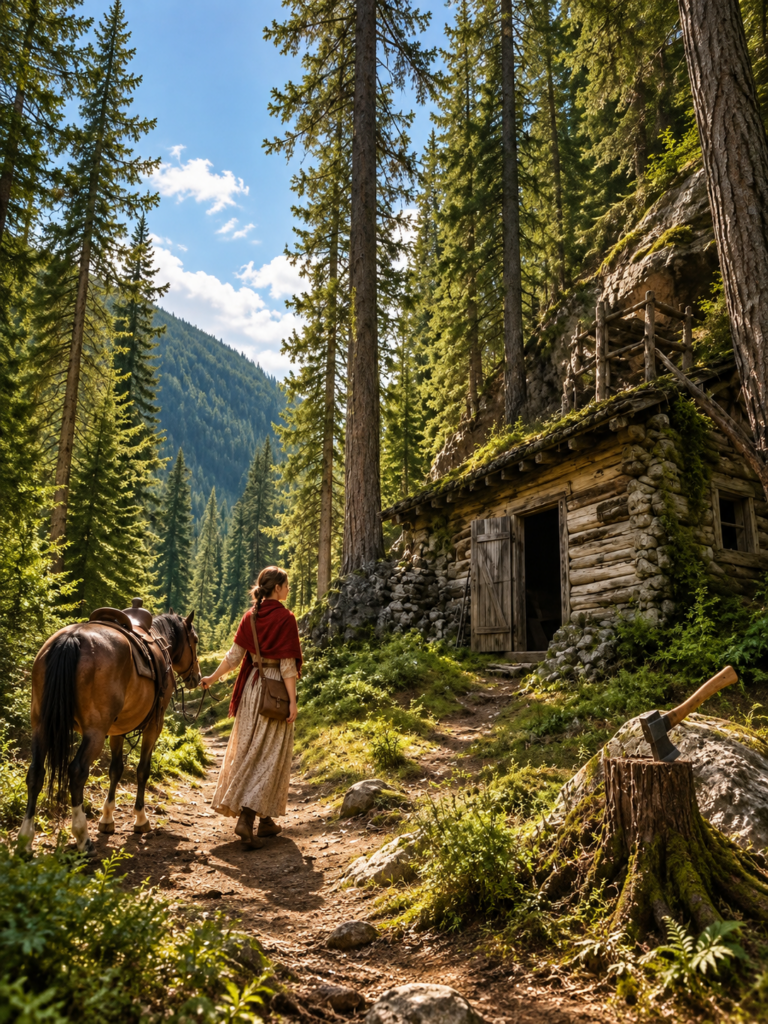
On the fourth morning, she saddled Juniper, packed food and tools, and began the journey to Sentinel Ridge.
The mare moved carefully across the frozen ground.
Clara followed the route in Elias’s journal, stopping often to compare the landscape with his sketches.
By noon, the settlement had disappeared behind the trees.
The silence was immense.
There were no wagon wheels, no steam whistles, no distant hammering from the mines.
Only wind moving through the branches and Juniper’s steady breathing.
Near the creek, Clara dismounted.
Ice had formed along the edges, but the central ford remained shallow.
She led the mare across.
The freezing water seeped into her boots.
By the time they reached the opposite bank, her toes were numb.
She continued.
The trail steepened.
Loose stones rolled beneath her feet.
Twice, she had to stop and catch her breath.
At one particularly difficult section, Juniper refused to move forward.
Clara looked ahead.
A narrow shelf of exposed rock crossed the slope.
The drop beyond it was not sheer, but it was steep enough to cripple a horse.
Clara stroked the mare’s neck.
“You’re right, old girl. No sense dying because we’re impatient.”
She searched the hillside until she found a longer, safer route through a stand of pines.
By midafternoon, she reached the old-growth aspens Elias had described.
Beyond them lay the granite slope.
And hidden behind a tumble of stone was the overhang.
Clara stood motionless.
It existed.
For three days, she had feared that Elias’s description might have exaggerated its usefulness.
But there it was.
A broad, natural chamber beneath a massive shelf of granite.
She tied Juniper to a pine and approached carefully.
The entrance was partially concealed by rocks and wind-bent shrubs.
Inside, the air felt noticeably calmer.
The floor was packed earth and gravel.
The stone overhead appeared solid.
The rear fissure rose toward a narrow opening above.
Sunlight entered from the south, illuminating a pale strip across the floor.
Clara walked slowly through the space.
Twenty feet wide.
Twelve feet deep.
A high ceiling toward the front.
Enough room for a bed, a stove, storage, and a worktable.
The western wall contained an unusual mineral seam.
White quartz twisted through the granite, threaded with dark, metallic streaks.
She remembered the note Elias had written.
A small deposit of argentite. Interesting, though likely too limited to justify commercial extraction.
She touched the seam.
“Still looking for silver, are you?” she whispered.
She could almost hear her husband’s laugh.
Then she turned back toward the entrance.
The work ahead was staggering.
She would need a wall sturdy enough to withstand mountain winds.
A door.
A chimney.
A protected place for Juniper.
Enough wood to survive months of freezing temperatures.
Enough food that a blizzard would not become a death sentence.
And she would have to accomplish most of it alone.
For one brief moment, the enormity of what she had chosen threatened to overwhelm her.
She sat on a rock.
Her hands trembled.
“What am I doing, Elias?”
The mountain gave no answer.
She imagined herself in January, hungry and freezing, trapped inside an unfinished shelter while snow buried the entrance.
She imagined a search party finding her body in spring.
Then she looked at the journal resting beside her.
Elias had written something on the opposite page.
The weakness of a structure is seldom the stone itself. More often, it is the failure to understand how the stones belong together.
Clara read the sentence slowly.
She stood.
“Then we’ll learn,” she said.
She returned to Juniper, mounted, and began the journey back to Argent.
The next morning, Clara entered Porter’s Mercantile carrying a list.
Silas Porter looked up from behind the counter.
He was sixty-eight years old, with thin white hair, heavy eyebrows, and the weathered hands of a man who had spent most of his life handling tools, grain sacks, and stubborn customers.
“Well, Clara,” he said gently. “What can I do for you?”
She placed her list on the counter.
“I need supplies.”
Silas adjusted his spectacles.
He read the first few lines.
Then he looked at her.
Then back at the paper.
“A ten-pound sledgehammer?”
“Yes.”
“A pickaxe?”
“Yes.”
“Two hundred feet of rope?”
“Preferably good hemp.”
“Twenty pounds of nails?”
“Will that be a problem?”
“No, ma’am.” He paused. “But I haven’t seen anyone purchase this particular collection of goods unless they were preparing to build something.”
Clara said nothing.
Silas continued reading.
A small cast-iron stove.
Stovepipe.
A handsaw.
A canvas tarp.
Flour, beans, salt pork, and coffee.
Finally, he removed his spectacles.
“Clara, where are you going?”
She looked toward the window.
“Up the ridge.”
For several seconds, Silas said nothing.
Then he lowered his voice.
“Not into those mountains for winter.”
“I found a place.”
“What kind of place?”
“A granite shelter. Elias marked it in his journals.”
Silas leaned against the counter.
“Clara, I knew your husband. He was a clever man. But cleverness doesn’t stop a blizzard.”
“No,” she said. “Good walls, dry fuel, and a working stove do.”
He studied her face.
“Do you have all three?”
“Not yet.”
“Then you’ve got very little time.”
“I know.”
He sighed.
“Let me see that list again.”
They worked through the supplies.
The total came to sixty-eight dollars and fifty cents.
A wagon to carry the heavy equipment as far as the creek would cost another five dollars.
Clara counted the money onto the counter.
Each coin felt like another piece of her safety disappearing.
When she finished, Silas looked at the small pile.
“You’ll need feed for that mare.”
“I’ve made arrangements to buy oats when I can.”
He shook his head.
“Not good enough.”
He disappeared into the back room.
When he returned, he carried a wooden box containing lamp wicks, matches, soap, and kerosene.
He set it beside her purchases.
Then he pointed toward a large sack near the door.
“One hundred pounds of oats.”
“Silas—”
“Don’t argue.”
“I can’t pay for those.”
“I know.”
Clara straightened.
“I didn’t come asking for charity.”
Silas’s expression softened.
“Then don’t call it charity.”
“What should I call it?”
He rested both hands on the counter.
“Elias once spent half a day helping me find a spring when my well ran dry. Wouldn’t take a cent. Said one neighbor ought to help another before trouble turns into tragedy.”
Clara lowered her eyes.
“I remember.”
“Well, I haven’t forgotten.”
She looked at the supplies.
For months, she had forced herself to remain composed.
Now her throat tightened so painfully that she could barely speak.
Silas pretended not to notice.
“My boy Henry can help with the wagon,” he continued. “And if you need something hauled farther up that mountain, we’ll figure out what can be managed before the snow closes in.”
Clara nodded.
“Thank you.”
Silas reached across the counter and squeezed her hand.
“Come spring,” he said, “I expect you to walk back into this store and tell me how wrong I was to worry.”
Clara managed a small smile.
“I intend to.”
But that evening, as she packed her final belongings, snow began falling outside the company house.
And for the first time, Clara understood that she was not merely racing against eviction.
She was racing against winter itself.
Part 3
Clara began building before sunrise.
The first week nearly broke her.
Every morning, she woke in the temporary tent she had pitched beneath the granite overhang, pulled on stiff boots, and worked until the weakening afternoon light made further labor dangerous.
She cleared loose stone from the floor.
She dug drainage trenches outside the entrance.
She gathered granite from the scree slope and sorted each piece according to shape and weight.
The largest stones had to be rolled.
Medium-sized pieces could be carried a few steps at a time.
Smaller stones were reserved for filling gaps in the wall.
At first, she moved too quickly.
On the third day, she lifted a heavy block and felt a sharp pain tear across her lower back.
The stone slipped from her hands.
It struck the ground inches from her boot.
Clara fell to one knee.
For several minutes, she could not straighten.
A cold sweat broke across her forehead.
She knew what an injury meant.
No one would bring her firewood.
No one would build the wall.
No one would carry her food.
If she became unable to work, the mountains would not make allowances because she was grieving.
She dragged herself beneath the overhang and sat against the cold granite.
Tears came then.
Not the quiet tears of mourning she had shed after Elias’s funeral.
These were angry, exhausted tears.
She hated the company.
She hated the mountain.
She hated the absurdity of a world in which a woman could spend seven years building a life and lose it because the wrong man signed a document.
Most of all, she hated the empty space beside her.
Elias would have known how to lift those stones.
He would have made some foolish remark about the stubbornness of granite.
He would have told her to rest before she hurt herself.
“Where are you when I need you?” she whispered.
The question echoed faintly beneath the rock.
She cried until the tears stopped.
Then she opened his journal.
On one page, he had sketched a simple wooden lever used for shifting heavy samples.
Clara studied it.
The next morning, she found a stout pole and a rounded stone suitable for a fulcrum.
With the lever, she moved a block that had defeated her the previous day.
She stood beside it, breathing hard.
Then she laughed.
It was a small, startled laugh, but it was the first genuine laughter she had heard from herself since June.
“Well,” she told Juniper, “perhaps your old master left us a few tricks after all.”
From that day forward, she worked differently.
She measured before lifting.
She used ropes, leverage, and gravity whenever possible.
She rested before exhaustion made her careless.
She learned that stubbornness was useful only when guided by judgment.
The wall rose gradually.
It began as a low line of stone across the entrance.
Then it reached her knees.
Then her waist.
She made the base broad and stable, setting larger rocks beneath smaller ones and filling gaps with carefully selected fragments.
The entrance faced south, where winter sunlight could reach deep into the chamber.
Clara planned a modest window beside the doorway to admit light when the heavy door was closed.
She framed the opening with timber she had salvaged from a discarded shed near Argent.
The wood was weathered but sound.
Each piece carried faint reminders of another person’s abandoned work.
As the wall climbed, she began gathering firewood.
There was plenty of fallen timber in the surrounding forest, but cutting it into manageable lengths required hours of labor.
Her hands developed blisters.
The blisters broke.
New skin hardened beneath them.
At night, she rubbed her fingers with grease and wrapped the worst places in strips of clean cloth.
She kept a careful record of her supplies.
The flour diminished.
The beans lasted longer.
The salt pork was reserved for days when the work demanded extra strength.
Coffee became a morning luxury.
She measured out oats for Juniper, knowing the mare would need more feed once snow covered the remaining grass.
Occasionally, she rode into Argent for supplies or to collect belongings from the old house.
The company had changed the locks two days after she surrendered the keys.
A new engineer and his family had already moved in.
On one visit, Clara passed the property and saw a woman’s dress hanging beside the kitchen window.
A child’s wooden wagon stood on the porch.
The rocking chair was gone.
Her husband’s photograph was gone.
Everything that had once made the building a home had disappeared.
She stopped Juniper across the road and stared.
Then she turned the mare toward the mountains.
She would not stand there mourning a house that no longer belonged to her.
Her memories belonged somewhere else.
They belonged wherever she carried them.
By the middle of November, the stone wall stood four feet high.
The doorway had a timber frame.
The stove rested on a raised hearth of flat rock.
Clara had worked the stovepipe into the natural fissure and sealed the surrounding gaps with carefully packed clay and stone.
Before using it through the winter, she inspected the joints and tested the draft, making adjustments until smoke moved steadily upward rather than entering the room.
The first successful fire changed everything.
Clara knelt beside the stove, watching the flames catch.
Orange light danced across the granite.
The pipe warmed.
The stone nearest the hearth slowly absorbed the heat.
Outside, the wind sharpened.
Inside, warmth began to spread.
Clara sat on an overturned crate and held her hands toward the stove.
For a long time, she did nothing else.
She remembered the first winter of her marriage.
Elias had brought home a little iron stove from a mining camp.
Its door had hung crookedly.
They had spent an entire afternoon repairing it together.
When it finally worked, he had declared himself the luckiest man in Colorado because he possessed a warm house and a wife who tolerated his mistakes.
Clara looked around her unfinished refuge.
“I hope you’re watching,” she whispered.
She wished he could see what his notes had made possible.
The next day, Henry Porter arrived with additional supplies.
He carried a bundle of hinges, two lengths of lumber, and a sack of potatoes his father had insisted she accept.
The young man stood beneath the granite overhang, staring at the wall.
“Mrs. Holloway,” he said, “you built all this?”
“Juniper helped.”
Henry grinned.
“I doubt she stacked the stones.”
“No, but she’s been supervising.”
He ran a hand over the wall.
“My father said you were determined. He didn’t tell me you were building a fortress.”
Clara looked at the stonework.
“It’s not much to look at.”
“Ma’am, it’s more than most men could manage.”
She shook her head.
“Most men have better things to do than prove they can survive being thrown out of their own homes.”
Henry’s smile faded.
He helped fit the hinges, then spent the afternoon cutting and setting the rough timber door.
Before leaving, he glanced toward the western wall.
“What are those black streaks?”
“Something Elias found.”
“Silver?”
“Possibly.”
Henry approached the vein.
He reached toward it, then stopped.
“Are you going to dig it out?”
Clara shook her head.
“Not while that wall is holding up my roof.”
Henry laughed, unaware of how important those words would become.
By evening, the door could close securely against the wind.
Clara placed the small blue teacup on a narrow shelf beside her bed.
She hung Elias’s photograph above it.
She folded his journals into a wooden chest near the stove.
And for the first time, she slept inside a home she had built herself.
Three days later, a storm swept down from the north.
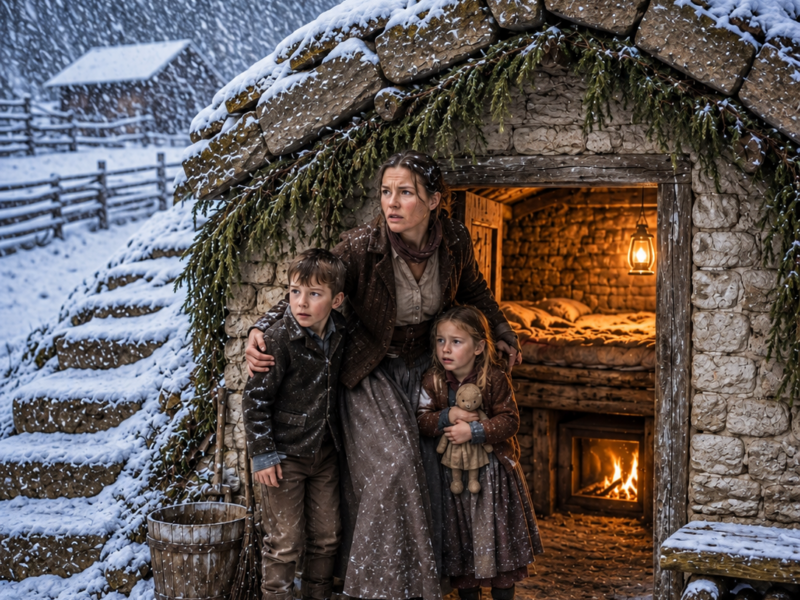
Snow fell so heavily that the trees vanished behind moving white curtains.
The wind screamed against the ridge.
The temperature dropped far below freezing.
Clara woke in the darkness to a sound like someone beating against her door.
She sat upright.
For an instant, she thought a person had come calling.
Then she realized the sound was snow and wind striking the timber.
She checked the stove.
Added fuel.
Pulled on her coat.
And struggled outside to reach Juniper.
Snow had drifted across the entrance to the mare’s lean-to.
Clara cleared it with a shovel.
Juniper stood shivering beneath the canvas roof.
Her water had begun to freeze.
Clara carried snow inside, melted it on the stove, and returned with a bucket of warm water.
“Drink, sweetheart,” she murmured.
The mare lowered her head.
Clara rubbed the animal’s neck until her fingers ached.
Then she returned inside.
The storm continued for six days.
By the third day, the doorway was nearly buried.
Clara dug a narrow passage through the snow.
The work was slow and exhausting.
Each trip to Juniper required clearing fresh drifts.
Each bucket of melted snow consumed fuel.
Each meal came from carefully measured supplies.
At night, Clara listened to the wind and wondered whether she had made a terrible mistake.
There were moments when the stove seemed too small and the darkness too large.
Once, she woke trembling from a dream in which Elias stood outside the door calling her name.
She opened her eyes to the silence of the stone chamber.
For a moment, she could not remember where she was.
Then she saw his photograph.
And the little blue cup.
And the neatly stacked firewood.
She whispered, “I’m still here.”
On the sixth morning, the wind stopped.
The silence that followed was almost frightening.
Clara opened the door and stepped into a tunnel of snow.
Outside, the world had been transformed.
The trees stood buried to their lower branches.
Drifts rose taller than a man.
The distant settlement was invisible.
But her shelter had survived.
The roof had not shifted.
The wall remained sound.
The stove still burned.
Juniper was alive.
Clara climbed onto a snowbank and looked across the white mountains.
She raised her face toward the sunlight.
Then she began to cry.
This time, there was no anger in her tears.
Only relief.
She had done it.
She had survived the first great storm.
And somewhere beneath the cold granite of Sentinel Ridge, a secret her husband had carried to his grave remained undisturbed.
Part 4
Silas Porter arrived nine days after the storm.
He had traveled as far as the creek on horseback, then crossed the remaining snow on borrowed snowshoes.
When Clara heard him calling from outside, she hurried to the entrance.
“Silas?”
“Unless another foolish old man has climbed this mountain carrying potatoes.”
She opened the door.
He stood in the snow with frost on his beard, a pack over one shoulder, and a look of astonishment on his face.
“My Lord,” he said.
Clara stepped aside.
“Come in before you freeze.”
Silas entered the shelter.
He stopped just inside the doorway.
The stove glowed warmly.
A kettle steamed on its flat top.
Firewood was stacked neatly against the eastern wall.
Food supplies rested on shelves.
The bed was tucked into a protected corner.
A small table stood beneath the window.
Elias’s photograph hung above the blue teacup.
Silas removed his gloves.
“Well, I’ll be damned.”
Clara raised an eyebrow.
“Language, Mr. Porter.”
“I believe the circumstances justify it.”
He walked around the chamber, examining the stonework.
“Clara, this place is warmer than half the cabins in Argent.”
“That’s because half the cabins in Argent were built by men who expected to leave after finding silver.”
Silas chuckled.
Then he grew serious.
“We were worried about you.”
“I imagined.”
“After that storm, I feared I’d come up here and find…”
He stopped.
Clara touched his arm.
“I know.”
He looked at her hands, the calluses, the scratches, the small scars.
“You did all this alone?”
“Mostly.”
Silas shook his head.
“Elias would be proud.”
Clara looked toward the photograph.
“I hope so.”
They drank coffee beside the stove.
Silas told her about the storm’s damage in town.
The Miller family’s roof had partially collapsed beneath the snow.
Mrs. Jensen had nearly exhausted her firewood.
Several miners had been injured when ice blocked a ventilation passage near the north shaft.
The Gilded Spur Company was struggling with equipment failures and unstable tunnels.
Clara listened without satisfaction.
She knew too well what mining accidents did to families.
“Were the injured men brought out?” she asked.
“All of them.”
“Good.”
Silas studied her.
“After the way that company treated you, I wouldn’t blame you for wanting to see it fail.”
“I don’t care whether Mr. Thorne loses his position,” she answered. “But there are wives and children depending on those miners coming home.”
Silas nodded slowly.
“That’s something Elias would have said.”
A week later, John Miller climbed to her shelter.
His youngest daughter had developed a persistent cough, and the family’s damaged cabin could not hold warmth.
John stood outside the entrance, hat in hand.
Clara recognized him immediately.
He and his wife had crossed the street to avoid her after the eviction notice became public.
Now he looked desperate.
“Mrs. Holloway, I heard you might know something about keeping a place warm.”
Clara opened the door wider.
“Come inside.”
John stared at the stone walls.
“How much firewood does this take?”
“Less than you might think, once the stone has warmed.”
He explained the condition of his house.
Cold air entered around the windows.
The north wall had gaps between the logs.
Snow melted from the damaged roof and froze along the interior beams.
Clara listened.
Then she took a piece of charcoal and drew a rough picture on a board.
She showed him how to seal the drafts, divert meltwater, and protect the exposed wall from the wind.
She explained why the placement of his stove mattered.
Before he left, she gave him a bundle of dry firewood.
John hesitated.
“I don’t have much money.”
“I didn’t ask for any.”
He looked ashamed.
“Mrs. Holloway, I should’ve helped when the company put you out.”
Clara said nothing.
He turned his hat in his hands.
“My wife wanted to bring you supper. I told her we shouldn’t get involved.”
“Why?”
John lowered his head.
“I work for Gilded Spur.”
Clara understood.
A man with three children and a damaged roof could not easily risk losing his wages.
She did not excuse his silence.
But she recognized the fear behind it.
“I was angry,” John admitted. “When I heard what happened, I was angry. But I kept my mouth shut.”
Clara looked at him for a long moment.
“Then perhaps next time you’ll find your voice.”
He nodded.
“I hope so.”
After he left, Clara stood beside the door, watching his figure disappear among the trees.
She had imagined that being abandoned by her neighbors would make it impossible to trust them again.
Instead, she discovered something more complicated.
People could fail one another.
And still be capable of doing better.
By Christmas, other families had begun coming to Sentinel Ridge.
Clara showed Mrs. Jensen how to improve the draft of her little stove and conserve fuel.
She helped two young miners plan a safer wood-storage shed.
She advised a family whose cellar flooded whenever snow began melting.
Sometimes visitors brought food.
Sometimes they brought tools.
Sometimes they simply came to sit beside the warm stove and talk.
Clara had not intended to become useful to the people who had watched her lose her home.
But usefulness had a way of restoring dignity.
One January afternoon, a stranger arrived at the shelter.
He wore a dark wool coat, sturdy boots, and a leather satchel across his shoulder.
His beard was neatly trimmed, and his eyes moved across the rock face with unusual attention.
“Mrs. Holloway?”
“Yes.”
“My name is Arthur Arkwright. I’m a consulting geologist from Denver.”
Clara’s expression cooled.
“Are you working for Gilded Spur?”
“At present.”
“Then you’ve had a difficult climb for a conversation you may not enjoy.”
Arkwright smiled faintly.
“I suspected as much.”
He removed his hat.
“May I explain?”
Clara stepped aside.
Inside, Arkwright examined the shelter with growing interest.
He studied the entrance, the orientation, the stone wall, and the chimney.
“Extraordinary,” he murmured.
Clara poured him coffee.
“It’s a place to live, Mr. Arkwright. Nothing more.”
“I disagree.”
He knelt beside the stove.
“You’ve used the natural granite mass to moderate temperature changes. The southern exposure provides solar warmth. The sheltered entrance reduces direct wind pressure.”
“Elias wrote about those things.”
Arkwright looked up.
“Elias Holloway?”
“My husband.”
The geologist became still.
“Your husband was Elias Holloway?”
Clara nodded.
Arkwright rose slowly.
“I knew his name. He wrote a paper on the geological formations of this region.”
Clara felt a sudden, unexpected warmth.
Someone beyond Argent remembered Elias for his work.
“He loved these mountains,” she said.
“I can see that.”
Arkwright walked toward the western wall.
Then he stopped.
His eyes fixed on the dark mineral streaks in the quartz.
“Mrs. Holloway,” he said, “may I examine this?”
Clara nodded.
He removed a small magnifying lens from his satchel and leaned closer.
His expression changed.
“Where did you find this formation?”
“It was here when I arrived.”
“Did anyone else know about it?”
“My husband recorded it.”
Arkwright straightened.
“Recorded it where?”
“In his journals.”
The geologist turned toward her.
“May I see them?”
Clara hesitated.
They were the last complete record of Elias’s working life.
She had guarded them through eviction, snowstorms, and hunger.
But Arkwright had spoken of her husband with genuine respect.
She opened the wooden chest and removed the journal from August 1886.
He read silently.
One page.
Then another.
He returned to the sketch of the south-facing overhang.
Then he turned to notes describing fault lines and mineral deposits farther along Sentinel Ridge.
His breathing changed.
“Mrs. Holloway,” he said, “do you realize what your husband documented?”
“A great deal of rock, from what I understand.”
Arkwright did not smile.
“He mapped geological structures that our current surveys have failed to identify.”
Clara watched him.
“What structures?”
“Fault lines. Water-bearing formations. Unstable layers beneath the company’s workings.”
He turned several pages.
“Look here. This note describes a fractured band of schist near the north shaft. And here, an underground water source beneath the main drift.”
Clara’s stomach tightened.
“The north shaft?”
“Yes.”
“That’s where Elias died.”
Arkwright slowly lowered the journal.
For a long moment, neither spoke.
Then Clara asked the question she had carried since June.
“Did my husband know that shaft was dangerous?”
Arkwright studied the notes.
“He recognized geological conditions that could make it dangerous. Whether the company understood or acted on his warnings is another matter.”
Clara sat down.
She remembered Thorne’s dismissive expression.
The closed investigation.
The vague statements about unavoidable risks.
And Elias’s body arriving in a wagon beneath a canvas sheet.
Arkwright continued examining the journal.
The longer he read, the more troubled he became.
At last, he closed the book.
“Mrs. Holloway, I need to speak with you about these records.”
Clara folded her hands in her lap.
“Then speak plainly.”
He looked toward the silver-bearing seam in the wall.
“Your husband left behind more than a description of this shelter. He may have left geological information that the company urgently needs, and evidence worth examining regarding its handling of the mine.”
Clara felt the room grow strangely quiet.
“What would that mean?”
“It means we must establish exactly what the company knew, what your husband reported, and when.”
He looked at the journals again.
“And before anyone removes a single page from your possession, you should have independent legal advice.”
Outside, snow began falling.
Inside, Clara realized the journals that had kept her alive might also contain the truth about the death that had made her a widow.
Part 5
Arthur Arkwright returned to Argent carrying copies of the relevant journal entries.
Clara kept the originals.
It had been her condition.
He had agreed without argument.
Three days later, a lawyer from Denver arrived at Porter’s Mercantile.
His name was Samuel Whitcomb, a gray-haired attorney who had spent much of his career handling property disputes, mining agreements, and claims involving injured workers.
Silas closed the store early so they could speak privately.
Clara sat across from Whitcomb at a table in the back room.
Arkwright had brought several survey maps.
“Mrs. Holloway,” Whitcomb began, “Mr. Arkwright has explained the geological significance of your husband’s work. I want to establish a few things before we discuss any agreement with the company.”
Clara nodded.
He asked about Elias’s employment.
His consulting arrangements.
The journals.
The eviction notice.
The signed acknowledgment confirming her ownership of his personal papers and instruments.
When Clara produced that document, Whitcomb examined it carefully.
“Who requested this?”
“I did.”
“Why?”
“Because Mr. Thorne wanted everything connected to Elias removed from the house. I wanted to make certain he couldn’t decide the journals belonged to the company.”
Whitcomb glanced at Arkwright.
“That was prudent.”
Then the attorney asked about the mine accident.
Clara described the day Elias died.
The superintendent’s statements.
The investigation conducted by the company itself.
Her unanswered questions.
Arkwright unfolded a map.
“The records describe geological instability in precisely the region where the north shaft collapsed,” he explained. “They also describe faults and underground water sources that have become relevant to more recent problems.”
Whitcomb studied the pages.
“Does this prove the company was negligent?”
“Not by itself,” Arkwright answered. “But it establishes that Holloway recognized conditions that the company’s later surveys inadequately represented.”
Clara looked between them.
“Then the company still needs his work?”
“Very much,” Arkwright said.
Whitcomb leaned forward.
“And that gives us an opportunity to negotiate.”
The negotiations began the following week.
Superintendent Thorne initially refused to meet with Clara.
He insisted the geological records were simply observations made while Elias worked in the company’s territory.
Whitcomb responded with copies of the signed acknowledgment and evidence that some of Elias’s surveys had been conducted independently.
He also made clear that the journals were not themselves an automatic mining title. Any mineral interest would require separate verification.
Nevertheless, the company needed the information.
Its engineers had been forced to halt operations in several sections of the mine.
The unexpected water intrusion continued.
Investors were demanding answers.
And Arkwright’s preliminary report indicated that expensive reconstruction might be necessary unless the geological structure was understood.
Eventually, representatives from the company’s Denver office became involved.
Thorne’s authority weakened.
By February, he was no longer directing the negotiations.
One afternoon, Arkwright rode to Clara’s shelter with a new proposal.
She welcomed him inside.
He removed his coat and warmed his hands beside the stove.
“Well?” Clara asked.
“The company is prepared to purchase full access to your husband’s geological records, subject to terms approved by your attorney. They also want to settle all outstanding disputes connected to his consulting work and your removal from the house.”
“How much?”
“Fifteen thousand dollars.”
Clara remained silent.
Arkwright watched her carefully.
“It is a substantial sum.”
“Yes,” she said.
More money than Elias had earned in several years.
More money than she had ever imagined possessing.
Enough to leave the mountain forever.
Enough to buy a comfortable house.
Enough to secure her old age.
But Clara did not smile.
“What else?”
“The company will transfer the deed to your former residence into your name.”
She looked at the stove.
The little iron door glowed faintly.
“And Mr. Thorne?”
“He has been dismissed from his position.”
Clara closed her eyes for a moment.
She had imagined hearing those words countless times.
Yet now that they had come, they brought no sudden happiness.
Thorne losing his job would not bring Elias back.
Fifteen thousand dollars would not erase the memory of receiving an eviction notice four months after burying her husband.
A house deed would not return seven years of marriage.
Arkwright seemed to understand.
“There is also a proposed public statement recognizing your husband’s geological work,” he said. “And an acknowledgment that the company’s handling of your departure caused unnecessary hardship.”
Clara opened her eyes.
“An acknowledgment?”
“Yes.”
“Will they say they were wrong?”
Arkwright hesitated.
“In measured language.”
She almost laughed.
“Companies do seem fond of measuring things.”
He smiled faintly.
Clara stood and walked to the bookshelf.
She removed Elias’s photograph and held it in both hands.
When she spoke again, her voice was quiet.
“I want them to understand something, Mr. Arkwright.”
“I’m listening.”
“I don’t want a fortune because they were cruel to me. I want my husband’s work treated with the respect it deserved while he was alive.”
Arkwright nodded.
“And I want the men still working in those mines to have the benefit of what he discovered.”
“That can be included.”
“Then tell Mr. Whitcomb I will consider the agreement.”
The final documents were signed in Denver.
Clara traveled there with Silas Porter, who insisted that a woman making the largest transaction of her life should not have to face the city alone.
She wore her best dark dress.
Her hair was pinned neatly beneath a modest hat.
The company representatives occupied one side of a long polished table.
Clara sat with her attorney on the other.
The agreement provided fifteen thousand dollars in exchange for defined rights to reproduce and use Elias’s geological surveys, along with a negotiated settlement of the related disputes.
The company transferred ownership of the old house to Clara.
It issued a public acknowledgment of Elias Holloway’s contributions.
And it agreed to have independent engineers review the geological risks identified in his records before continuing work in the affected sections.
Clara insisted on reading the documents herself.
Every page.
Every clause.
Every signature.
When she finished, she placed the pen on the table.
“Gentlemen,” she said, “my husband spent his life trying to understand those mountains. I hope you will listen more carefully to the next man who tells you the rock is dangerous.”
No one answered.
She did not expect them to.
The following week, Argent received news of the settlement.
People gathered outside Porter’s Mercantile to discuss the widow who had been driven from her home and returned with a fortune.
Some called it justice.
Others called it extraordinary luck.
Clara knew better.
There had been nothing lucky about the days she spent hauling granite.
Nothing lucky about waking in darkness to feed the stove.
Nothing lucky about digging through snow to reach Juniper.
And nothing lucky about losing Elias.
What she had gained had come through knowledge, persistence, and the unwillingness to let powerful men decide that her life no longer mattered.
Spring arrived slowly.
The snow began retreating from the lower slopes.
Water returned to the creeks.
The pines released the scent of warming bark.
Clara could have moved back into her old house immediately.
Instead, she remained on Sentinel Ridge until the mountain trails cleared.
Then she rode down to Argent and visited Silas.
He was standing behind the counter, sorting a shipment of nails.
“Well,” he said, looking up, “if it isn’t the richest woman in the county.”
Clara smiled.
“Not the richest.”
“Close enough.”
She leaned against the counter.
“Silas, you’ve been talking about retiring.”
He narrowed his eyes.
“What are you plotting?”
“I want to buy the store.”
Silas stared.
“Porter’s Mercantile?”
“Unless you’ve opened another business without telling me.”
He slowly removed his spectacles.
“Clara, I’ve spent forty years building this place.”
“I know.”
“It isn’t just a building.”
“I know that too.”
He looked at her for a long moment.
Then he asked, “Why?”
Clara glanced around the store.
She remembered the day she had stood at that counter counting out nearly every dollar she possessed.
She remembered the free oats.
The lantern wicks.
The kerosene.
The old man’s kindness when the rest of the town had turned away.
“Because when I had nothing,” she said, “you helped me build something.”
Silas lowered his head.
For several seconds, he said nothing.
Then he cleared his throat.
“Well,” he muttered, “I suppose someone has to stop Henry from giving away half the inventory.”
Clara laughed.
They completed the sale that spring.
Under her ownership, the mercantile became more than a place to buy flour, nails, and tools.
Clara stocked practical supplies for winter.
She kept lists of families who might need help before storms.
She organized repairs for elderly neighbors whose roofs could not withstand heavy snow.
She made certain miners’ wives knew where to obtain food when accidents interrupted their husbands’ wages.
She offered fair prices and expected fair payment from those who could afford it.
But she never forgot what it felt like to stand on a porch holding a notice that said her life must be packed away in fourteen days.
Some evenings, after closing the store, Clara walked past the house where she and Elias had lived.
It belonged to her now.
She had arranged for the property to be repaired and maintained.
But she did not hurry to move back inside.
The walls still held memories.
Some were beautiful.
Others were too painful to revisit every day.
Over time, she began inviting children from the settlement to see Elias’s maps and learn about the mountains.
She showed them his drawings of rock formations.
She taught them how to read the land, recognize dangerous slopes, and respect weather that could turn deadly without warning.
Sometimes she told them about the shelter on Sentinel Ridge.
The children listened with wide eyes.
“You really lived in a cave, Mrs. Holloway?” one little boy asked.
“A stone house,” Clara corrected.
“Were you scared?”
“Very.”
“Then why didn’t you leave?”
She thought for a moment.
“Because leaving wasn’t always safer. And because I knew more than I thought I did.”
The boy considered that.
“Did your husband teach you?”
“Yes,” Clara said. “He taught me a great deal.”
“Then he saved you?”
Clara looked toward the distant mountains.
For several seconds, she did not answer.
Finally, she smiled.
“He helped me learn how to save myself.”
Every autumn, before the first heavy snow, Clara returned to the ridge.
Juniper grew older, and eventually Clara made the climb with a younger horse, but she always stopped at the same bend in the trail where Elias had once shown her the valley below.
She would look across the pines, breathe the cold mountain air, and continue toward the stone shelter.
She kept the place ready.
The wall remained strong.
The stovepipe was inspected and repaired when necessary.
A supply of dry firewood rested near the hearth.
The shelves held flour, beans, and other provisions.
The small blue teacup still stood beneath Elias’s photograph.
On one autumn evening, years after the eviction, Clara sat beside the stove while early snow drifted past the window.
The granite walls were warm.
The kettle was singing.
She opened the journal that had changed her life.
There, beneath Elias’s sketch of the hidden overhang, was the line she had read when she had almost nothing left.
A man could winter there if he had the will.
Clara smiled.
She took out a pencil.
Beneath his words, she wrote:
So could a woman.
Then she closed the journal and rested her hand upon its worn leather cover.
She no longer needed the shelter to escape hunger or homelessness.
She no longer needed its walls to prove that she was stronger than the people who had cast her aside.
But she would never abandon it.
Because that rough little home beneath the granite held a truth no bank account, property deed, or company apology could ever fully express.
They had taken away her house.
They had dismissed her husband’s work.
They had expected the cold to finish what their cruelty had begun.
Instead, Clara Holloway had taken the knowledge of a dead man, the strength of her own hands, and the last eighty-seven dollars she possessed—and built a place that winter could not conquer.
The company had believed she was a woman with nothing left.
But on Sentinel Ridge, surrounded by stone, snow, and the memory of the man she loved, Clara had discovered what Elias had understood all along.
The greatest treasure hidden in those mountains had never been the silver.
It was the knowledge that a person who had lost almost everything could still build a life worth living.