The first warning came from inside the cabin.
At two in the morning, Maggie Thornton woke to the sound of her eight-year-old son trying not to cough. Billy had buried his face in a wool blanket so he would not wake his little sister. His narrow shoulders jerked with each breath.
Across the room, five-year-old Emma slept curled around a worn rag doll.
Maggie stepped barefoot onto the floor. Cold climbed through her feet at once.
The fire was still burning.
That was the problem.
She crossed to the wall thermometer and lifted the lantern.
45 degrees, with flames in the fireplace.
Outside, autumn had barely surrendered to winter. Maggie stood there for several seconds, staring at the number. Then she looked toward her children.
If the cabin was already this cold, December would finish what November had started.
And somewhere beneath a loose floorboard was something her missing husband had left behind. Something that pointed toward a hole in the mountain.
What she was about to build looked foolish to nearly everyone who saw it.
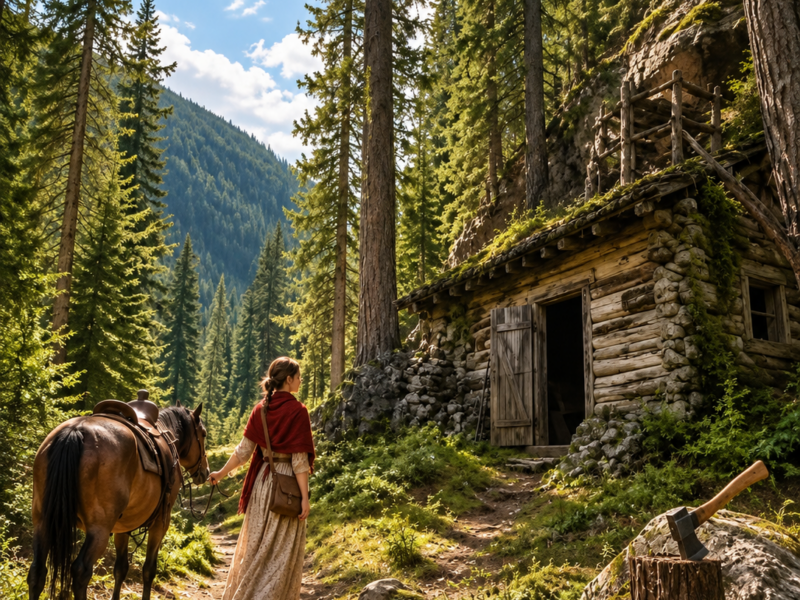
It was September 1886 in Montana Territory.
Maggie was 32, with chestnut hair usually pinned away from her face and hands hardened by thirteen years of frontier work.
Her husband, Robert Thornton, had ridden into the mountains in July to help bring cattle down from summer range.
He promised three weeks.
Three weeks passed, then four.
By August, men from the settlement had searched trails, creek crossings, and high grazing country.
They found nothing.
No horse, no saddle, no Robert.
Maggie stopped asking the search parties when they would go out again after she saw the way they removed their hats before speaking to her, but she still kept Robert’s coat hanging beside the door.
Emma noticed it every evening.
“When is Papa coming back?”
Maggie’s hands would pause over whatever she was doing.
“Not tonight, sweetheart.”
That was all she could manage.
Then Maggie found the notebook.
One floorboard near Robert’s chair had worked loose. Beneath it lay a small leather book covered in dust.
His handwriting filled the pages.
There were measurements of a limestone opening on the hillside behind their property. Temperatures had been written beside several dates.
50 degrees. 52. 51.
The outside weather changed. The numbers inside barely moved.
Robert had found a cave.
On the final page, he had written that the place might protect the family if winter became severe.
Maggie sat beside the open floorboard until the lantern burned low.
Robert had never told her, but he had measured it because he had been thinking ahead.
Now he was gone.
The measurements remained.
Maggie closed the notebook and slipped it beneath her pillow.
She might have ignored it if Billy had been healthy.
He was not.
His cough had started months earlier. By fall, it had moved deeper into his chest.
The nearest doctor listened to Billy breathe one afternoon and remained beside the bed longer than Maggie liked.
“Keep him warm,” he finally said.
Maggie glanced toward the fireplace.
“How warm?”
“As warm as you can.”
His eyes moved toward the gaps between the cabin logs.
He did not need to say anything else.
That night, Maggie stopped looking at the cabin as a home.
She studied it as a structure.
The log walls had opened at the joints. Old clay had cracked away. Cold air slipped through spaces narrow enough to miss in daylight, but wide enough to steal heat all night.
The fireplace was worse.
Flames climbed beautifully, but most of their heat went straight up the chimney.
The roof leaked warmth. The ground pulled it downward.
Maggie counted the firewood stacked outside.
Then she counted again.
It would not last.
Her father had taught engineering back east when Maggie was a girl. She had spent childhood evenings watching him sketch walls, chimneys, air channels, and foundations.
He taught her one rule she had never forgotten.
Do not ask whether something feels warm. Ask where the heat goes.
Maggie looked around the cabin.
Here it went everywhere except toward her children.
The next morning, she left Billy in charge of Emma and climbed the limestone hill carrying Robert’s notebook, an oil lamp, matches, and a small hammer.
The cave entrance was almost invisible.
Brush covered a narrow opening in the rock.
Maggie dropped to her knees. Cold stone scraped her skirt as she crawled inside.
For the first few yards, the ceiling remained low.
Then the passage opened.
Maggie slowly stood.
Lamplight moved across pale limestone walls.
The chamber was larger than she expected.
Dry leaves covered part of the floor, but there was no standing water, no animal bones, no wet streaks running down the walls.
She placed the thermometer on a flat stone.
Then she waited.
Outside, the morning air was close to freezing.
Inside, the needle settled near 50 degrees.
Maggie touched the wall.
The stone did not feel warm.
It did not need to.
It was stable.
That mattered more.
She walked deeper into the chamber and raised the lamp.
A narrow crack ran through part of the ceiling.
Possible ventilation.
The floor was solid enough to support weight. The entrance was small enough to control.
She began seeing shapes that did not yet exist.
A barrier near the opening to slow the cold air.
A raised stone bed so the children would not sleep against the cold floor.
A small fire beneath it, not a fireplace meant to heat the air.
Something different.
Heat the stone.
Let the stone hold it.
Maggie crouched and drew lines through the dust with one finger.
A sleeping platform here. Firebox beneath it. Smoke channel along the side. Fresh air from the entrance.
She stopped.
If she made one mistake with the smoke, the cave could kill them.
If the stone cracked above the firebox, it could collapse beneath their weight.
And if she spent weeks building this instead of gathering more wood, then discovered it did not work, there might not be enough time left to recover.
Maggie sat alone in the cave with Robert’s notebook resting across her knees.
From somewhere outside came the faint call of geese moving south.
She listened until the sound disappeared.
Then she opened the notebook again.
By noon, Maggie was carrying the first stones uphill.
She told no one what she was building.
For six days, she worked alone.
Her palms split, her shoulders bruised beneath the carrying sling.
Each evening, she returned home before the children began asking questions.
But secrets did not remain secret for long in a settlement that small.
On the seventh afternoon, Marcus Fletcher saw her coming down the hill.
Marcus had built cabins in the valley for thirty years. Men trusted his judgment because his roofs stayed up and his chimneys drew clean.
He stopped his horse.
“Mrs. Thornton.”
Maggie kept walking.
“What are you doing up there?”
She shifted the tool bag against her hip.
“Working.”
“On what?”
Maggie looked at him.
“My winter.”
Marcus watched her continue toward the cabin.
Before sunset, curiosity carried him up the same hill.
He found the cave.
Inside were stacked stones, scraped floor markings, tools, and the beginning of a curved wall.
Marcus stared at the work.
Then he understood what Maggie intended to do.
By nightfall, people at the trading post were already talking about the widow who planned to put her children underground for winter.
Maggie heard the whispers the following morning.
She did not answer them.
She climbed the hill again.
But that afternoon, while fitting another heavy stone into the curved entrance wall, she heard boots scraping through the narrow passage behind her.
Maggie turned.
Marcus Fletcher stepped into the chamber carrying a lantern.
He looked at the unfinished wall, then at the marks for the sleeping platform, then at Maggie.
“You cannot put those children in here.”
Maggie lowered the stone from her hands.
Marcus moved closer.
“Winter has not even started yet.”
Maggie wiped the limestone dust from her fingers.
“No,” she said.
Her eyes shifted toward the thermometer hanging from the cave wall.
“That is why I still have time.”
Marcus Fletcher did not leave.
He set his lantern on a flat rock and ran one hand across Maggie’s unfinished wall.
“You have children depending on you.”
“I know.”
“This stone will be colder than your cabin.”
Maggie picked up another rock.
“Only if I leave it cold.”
Marcus frowned.
Maggie pointed toward the rear of the chamber.
“I am not trying to heat the cave the way you heat a cabin.”
“Then what are you trying to heat?”
“The bed.”
For a moment, Marcus said nothing.
Maggie walked to the rectangle she had marked on the floor.
She explained only what mattered.
A raised platform of stone would stand here. Beneath one end, she would build a small firebox. Hot air would travel through a channel under the platform before leaving through a vent.
The fire would warm hundreds of pounds of stone.
Then the fire could die.
The stone would remain warm.
Marcus looked from the markings to Maggie.
“You have never built one.”
“No.”
“You have never tested one.”
“No.”
“And you intend to put Billy and Emma on top of it.”
“After I test it myself.”
Marcus rubbed his jaw.
He had expected foolishness.
What bothered him was that the plan did not sound foolish.
Still, he shook his head.
“I would repair the cabin.”
“With what?”
That stopped him.
Maggie stepped closer.
“I have enough wood to survive part of the winter. I do not have enough to feed that fireplace through five months of hard cold.”
Marcus looked away.
He knew the cabin.
He knew she was right about that.
Maggie lifted the stone again.
“You build houses, Mr. Fletcher. I am trying to keep two children warm.”
Marcus picked up his lantern.
“I hope you know the difference.”
“So do I.”
He left without another word.
By the beginning of November, winter had moved down from the mountains.
Water froze overnight in shallow buckets. The grass hardened beneath white frost.
Maggie began waking before daylight.
She cooked breakfast, checked Billy’s breathing, left food where the children could reach it, then climbed the hill.
Every hour mattered now.
The entrance wall came first.
Maggie curved it inward rather than building straight across the cave.
The opening remained behind it, but outside air could no longer rush directly into the sleeping chamber.
Cold air entering the cave struck stone first.
The deeper chamber remained still.
It was a small difference.
Maggie could feel it against her face.
Then came the platform.
She collected broad stones from the creek and dragged them uphill on a rough wooden sled.
Some were too heavy.
She rolled those.
Others slipped from her hands and smashed against the hillside.
One caught her thumb between two rocks.
Maggie jerked her hand free.
Blood ran across her palm.
She wrapped it in a strip torn from an old flour sack and went back for the stone.
By evening, she could barely close her fingers.
The next morning, she returned.
A neighbor named Helen Morrison finally noticed.
Helen was an older widow who lived two miles away. She had spent enough winters in Montana to recognize what cold did to people who entered November unprepared.
She came to Maggie’s cabin carrying a pot of stew.
“You look terrible.”
Maggie glanced down at her torn hands.
“I have looked worse.”
Helen set the pot on the table.
“Where are you going every morning?”
Maggie did not answer immediately.
Helen waited.
That was one reason Maggie trusted her.
Helen rarely filled silence just because it was there.
Finally, Maggie reached for her coat.
“Come with me.”
They climbed the hill together.
Helen crawled through the entrance behind Maggie and straightened inside the chamber.
The lantern revealed the curved wall first, then the half-built platform, then the firebox opening underneath it.
Helen slowly walked around the stonework.
“You built this?”
Maggie nodded.
Helen touched the platform.
“What is it?”
“A bed.”
Helen looked underneath.
“You plan to put a fire under your bed?”
“A small one.”
Helen stared at her.
Then Maggie explained.
Not formulas, not engineering terms, just heat.
Stone warmed slowly. Stone cooled slowly.
The cave itself stayed near the same temperature even when the outside air changed sharply.
If Maggie could add controlled heat to enough stone, she might not need to keep a large fire burning all night.
Helen looked around again.
“How much wood would it save?”
“I do not know yet.”
There was the danger.
Everything depended on the test.
Helen pulled off her gloves.
“What needs doing?”
Maggie blinked.
“You believe me?”
“I believe December is coming.”
Helen pointed toward the platform.
“What needs doing?”
From that day forward, Maggie was no longer completely alone.
Helen watched Emma when necessary. She brought meals. Sometimes she kept Billy indoors when Maggie worked.
She could not carry the largest stones, but she gathered kindling and dried grass for the clay mixture, and she kept quiet.
The platform slowly rose.
Maggie built it eighteen inches above the floor.
The firebox sat beneath one end. A narrow passage carried hot air farther beneath the stone before turning toward the vent.
She lined the hottest section with stones taken from old fire rings.
She packed clay into vulnerable gaps.
Then she waited for everything to dry.
That waiting nearly broke her schedule.
November was disappearing.
One morning, Billy coughed until he had to sit on the edge of the bed with both hands gripping the blanket.
Maggie crouched in front of him.
His face looked pale in the gray window light.
“You are staying inside today.”
“I can help.”
“You can help by doing what I asked.”
Billy looked toward Emma, then toward his mother’s bandaged hands.
“Is it the cave?”
Maggie stopped.
Billy lowered his eyes.
“I followed you last week.”
Maggie sat beside him.
“You should have told me.”
“I thought you might be leaving, too.”
His voice was so quiet that Maggie almost missed the words.
She looked at him.
Robert had ridden away one morning and never returned.
Now his mother disappeared toward the hill every day.
Maggie reached beneath the mattress and brought out Robert’s notebook.
“Your father found that cave.”
Billy stared at it.
“He did?”
“He measured the temperature. He thought it might help us someday.”
She placed the notebook in his hands.
Billy recognized the handwriting immediately.
His thumb moved slowly across one crooked line of ink.
“Did Papa know he was not coming back?”
“No,” Maggie answered quickly, because that much she could give him with certainty. “No, Billy.”
The boy lowered his head.
His shoulders began to move.
Maggie put an arm around him.
Emma continued playing near the hearth, quietly arranging Daisy’s yarn hair.
After a while, Billy wiped his face with his sleeve.
“Will the room work?”
Maggie looked toward the window.
“I am going to find out.”
The test came three nights later.
Outside temperature: 24 degrees.
Maggie took both children into the cave with blankets, food, a lantern, and the thermometer.
Emma treated the whole thing as an adventure.
She climbed onto the finished platform with Daisy.
“We sleep here if it works?”
Maggie knelt at the firebox.
She struck one match.
Dry kindling caught.
Small flames moved beneath the stone.
Maggie fed them carefully.
No roaring fire. No wasted heat.
For two hours, she watched the smoke.
It traveled through the channel.
The vent drew properly.
No smoke entered the sleeping chamber.
Then she stopped adding wood.
The flames shrank.
Finally, darkness returned beneath the platform.
Maggie placed her palm on the stone.
Warm.
She waited an hour.
Still warm.
Another hour.
Still warm.
Billy fell asleep. Emma followed soon after.
Maggie remained awake with the thermometer beside her.
Outside, the temperature fell below 20 degrees.
Inside, it stayed near 50.
Four hours after the fire died, Maggie touched the platform again.
Warmth remained inside the stone.
Billy had been sleeping beside her all night.
He had not coughed, not once.
Maggie sat beside the children until pale morning light reached the cave entrance.
The system worked.
But when she stepped outside, she noticed something above the Bitterroot Range.
A line of clouds had gathered across the northern peaks.
Dark, low, moving fast.
Later that morning, hundreds of geese crossed the valley, heading south.
By afternoon, the wind had changed direction.
An old rancher at the trading post looked north and quietly began buying lamp oil.
Maggie watched him.
“How bad?”
The man pulled on his gloves.
“Bad enough that I would not waste another day.”
Maggie left without buying anything.
She hurried home.
There were still supplies to move into the cave. The ventilation opening needed one final adjustment. She needed more dry wood inside.
And Billy’s cough had started again.
That night, Maggie woke when the cabin roof gave a hard wooden groan.
She opened her eyes.
The wind was pressing against the north wall.
Beside her bed, Robert’s notebook lay closed beneath the lantern.
Maggie looked toward the children, then toward the black window.
A few seconds later, something struck the glass.
Not rain.
The first hard grains of ice.
By December 20th, the valley had changed color.
The sky had gone flat and gray.
The mountains disappeared behind low cloud.
Even the animals seemed to know something was coming.
Birds vanished from the fence lines. Deer moved down from higher ground.
At night, the wind no longer came in short gusts.
It stayed, a steady pressure from the north.
Maggie felt it through the cabin walls.
She spent the next two days moving everything that mattered into the cave.
Blankets, dried meat, flour, a water bucket, lamp oil, matches wrapped in cloth, extra socks for the children, a small medicine bottle for Billy, and more dry wood than she thought she would need.
She stacked it deep inside the chamber where snow could not reach it.
Then she checked the smoke channel again.
The vent was clear. The firebox stones were holding. The entrance wall had not shifted. The sleeping platform was dry.
Everything depended on those details.
Now, on the afternoon of December 22nd, Marcus Fletcher rode past the Thornton cabin.
His horse was already crusted with ice.
“You should come into town,” he called.
Maggie stood by the woodpile.
“Why?”
“Families are gathering near the trading post. Bigger buildings, more people, more hands if something goes wrong.”
Maggie looked toward the hill.
Marcus followed her eyes.
“You are serious about staying in that cave.”
“Yes.”
His jaw tightened.
“Mrs. Thornton, this storm could bury the entrance.”
“I widened the upper vent.”
“That is not the same as a door.”
“No.”
Maggie picked up another bundle of wood.
“But my cabin cannot hold heat.”
Marcus looked at Billy standing in the doorway behind her.
The boy coughed into his sleeve.
Marcus lowered his voice.
“If you change your mind, come before dark.”
Maggie nodded.
“Thank you.”
He rode away.
That evening, the temperature dropped fast.
Maggie kept the children dressed indoors.
Billy wore two shirts beneath his coat. Emma slept in her stockings.
Near midnight, the roof began to snap and creak.
Maggie sat beside the window with the lamp turned low.
Ice struck the glass in dry little bursts.
Then came snow.
Not soft flakes.
Hard crystals driven sideways.
The world beyond the window disappeared.
Maggie did not sleep.
Before dawn, she checked the thermometer.
39 degrees inside.
The fireplace still held red coals.
Billy woke coughing.
This time, the fit did not stop quickly.
He bent forward with both arms pressed against his ribs.
Maggie crossed the room and held him upright.
Emma woke beside him.
“Mama.”
Maggie looked at the window.
There was no morning light, only white movement.
She made the decision.
“Get dressed.”
Billy looked toward her.
“The cave?”
“Yes.”
Emma sat up.
“Now?”
“Now.”
Maggie wrapped Emma in wool.
She tied a scarf across the girl’s mouth and nose.
Billy pulled on his boots but stopped halfway to catch his breath.
Maggie knelt and finished them for him.
Then she opened the door.
Or tried to.
It moved less than an inch.
Snow had packed against the outside.
Maggie pushed harder.
Nothing.
She grabbed the iron shovel.
For nearly ten minutes, she worked through the narrow opening.
Snow blew into the cabin. It covered the floorboards.
Emma stood behind the table, clutching Daisy to her chest.
At last, the door opened far enough.
The wind hit Maggie so hard she stepped backward.
Cold air rushed into the room.
Billy coughed again.
Maggie tied a rope around her own waist.
She looped the other end through Billy’s belt.
Then she lifted Emma.
“You keep one hand on me.”
Billy nodded.
“What if I fall?”
“You get back up.”
“What if I cannot see?”
“You follow the rope.”
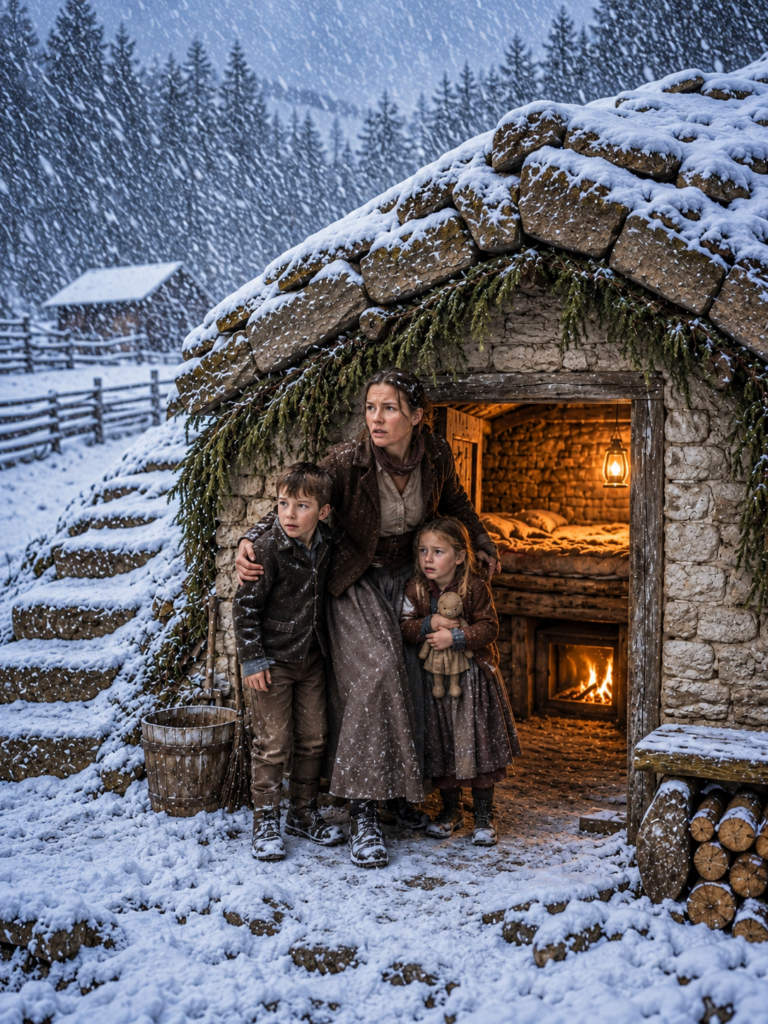
Maggie stepped outside.
The storm erased distance.
The cave was only seventy yards away.
She could not see ten.
Snow struck her eyes.
The wind shoved against her coat.
Emma buried her face against Maggie’s shoulder.
Billy followed behind.
Ten steps, then twenty.
The rope pulled tight.
Maggie stopped.
Billy had fallen.
She turned and found him on one knee.
“Up.”
He tried.
Slipped again.
Maggie shifted Emma higher and reached for him.
The wind pushed all three sideways.
For a few seconds, Maggie lost the direction of the hill.
That was the moment that could kill them.
The cabin had disappeared behind white air.
The cave could not be seen ahead.
There was no path anymore, only snow.
Maggie lowered one boot and felt the ground.
Flat.
She moved left.
Still flat.
Right.
The ground rose slightly.
The hill.
She followed the slope.
Billy stumbled behind her.
Emma had stopped making any sound.
Maggie looked down.
The little girl’s eyes were open. Her face was pale above the scarf.
“Stay with me.”
Emma nodded weakly.
They climbed.
Another gust struck them.
Billy cried out.
The rope snapped tight again.
Maggie turned.
His glove was gone.
His bare hand had sunk into the snow.
Maggie grabbed it and pulled him upright.
His fingers were already turning red.
She pushed the hand beneath her coat against her own body.
“Keep it there.”
They moved again.
Then Maggie’s knee struck stone.
She almost fell.
Her hand reached forward.
Limestone.
The cave mouth.
She dropped beside it.
“Billy, inside.”
He crawled through first.
Maggie pushed Emma after him.
Then she squeezed through the opening.
The storm disappeared.
Not completely.
The wind still pressed outside, but inside the sound became distant.
Maggie lay on the cave floor for several seconds, breathing hard.
Billy sat against the wall.
Emma was still holding Daisy.
They were alive.
That was enough for the next minute.
Then Maggie began working.
She lit the lamp, checked Billy’s hand.
No white patches.
Good.
She stripped the wet outer layer from Emma and wrapped her in a dry blanket.
Then she crawled to the firebox.
One match.
Kindling caught.
The draft pulled smoke through the channel.
Maggie fed the fire slowly.
Dry sticks first, then small split wood.
The stone began taking heat.
She placed her hand on the platform.
Cold.
Twenty minutes later, less cold.
Forty minutes later, warm.
Billy lay down.
His breathing still sounded rough.
Maggie put one hand against his back.
“Slow.”
He nodded.
Emma climbed beside him and pressed Daisy between them.
Outside, the storm grew louder.
Snow began creeping into the first few feet of the entrance.
The curved wall stopped most of it from reaching the chamber.
Maggie watched the drift build.
That worried her.
If snow sealed the lower entrance completely, the vent had to keep drawing.
She held the lamp near the smoke channel.
The flame leaned.
Air was still moving.
Good for now.
Hours passed.
The fire died.
The stone stayed warm.
Maggie checked the thermometer.
56 degrees.
She waited another hour.
55\.
Billy had stopped coughing.
Emma slept with one cheek pressed against the blanket.
Maggie sat awake near the entrance.
Around midnight, the sound above them changed.
A deep scraping noise moved through the rock, snow shifting over the hillside.
Then came a dull impact.
Maggie looked toward the entrance.
Part of the snow wall outside had collapsed inward.
The opening narrowed.
She moved quickly and pushed loose snow back with a board, but more slid down.
She stopped.
Digging too much could bring the whole drift inside.
Maggie checked the vent again.
The lamp flame still leaned, barely.
She stared upward.
The vent was their chimney.
Their air, their only path for smoke.
If the entrance closed behind her…
Billy stirred.
“Mama.”
“I’m here.”
“Is something wrong?”
Maggie looked at the narrowing entrance.
“No.”
Then the lamp flame straightened.
Maggie froze.
No lean.
No draft.
She moved it closer to the vent.
Nothing.
The air channel had stopped pulling.
Somewhere above them, the blizzard had buried the opening, and the next fire could fill the cave with smoke.
Maggie did not light another fire.
She sat beside the dead firebox and watched the lamp flame.
Straight, still.
No draft.
Behind her, Billy and Emma slept on the warm stone platform.
The heat stored beneath them would not last forever.
Neither would the air.
Maggie took the lantern and moved toward the vent.
She held one hand beneath the opening.
Nothing.
No pull, no movement.
Snow had sealed it somewhere above.
She looked toward the entrance.
Most of it was buried now.
Only a narrow, dark gap remained near the top.
That gave her one choice.
She crawled toward it.
The snow outside had packed hard against the cave mouth.
Maggie pushed with both hands.
A slab broke free and spilled inward.
Wind punched through the opening at once.
Cold air rolled along the floor.
The curved stone wall caught most of it before it reached the children.
Maggie kept digging.
Not enough to open the whole entrance.
Just enough to let air move again.
She returned to the lamp.
The flame leaned slightly.
That was all she needed.
Maggie waited another minute.
Still leaning.
She crawled back to the firebox.
This time she built the smallest fire she could.
A handful of kindling, two thin pieces of wood.
No more.
Smoke slipped into the channel.
Maggie watched every breath of it.
Nothing entered the room.
The draft had returned.
She placed one palm against the platform.
Still warm.
Good.
She let the fire burn for less than an hour.
Then she starved it out.
By morning, the storm had become worse.
There was no true sunrise, only a pale gray glow behind flying snow.
Maggie checked the thermometer.
52 degrees.
Outside, she could not know the exact number, but frost had formed on the rocks nearest the entrance.
Billy woke slowly.
He sat up and waited.
No cough came.
He looked surprised.
Maggie noticed.
“So did I,” she said.
Billy touched his chest.
“It does not hurt as much.”
Maggie nodded.
That was enough.
Emma woke next.
Her first concern was Daisy.
She lifted the rag doll, checked its button eyes, then looked toward Maggie.
“Is the storm done?”
“Not yet.”
Emma frowned.
“How long?”
Maggie looked toward the white entrance.
“As long as it needs.”
The second day became a pattern.
Fire.
Heat the stone.
Let it die.
Wait.
Maggie used very little wood.
That mattered more with every passing hour.
She had carried enough into the cave for several days, but she treated every stick as if it were the last.
Billy helped count.
Emma broke dried twigs into shorter pieces.
At one point, the girl held up a crooked branch.
“This one looks like a chicken.”
Billy laughed.
It was the first time Maggie had heard him laugh since his father disappeared.
She turned toward the firebox so the children would not see her face.
Outside, wind hammered the mountain.
Inside, Emma made a wooden chicken peck at Daisy’s blanket.
Hours later, Maggie heard a new sound.
Not wind.
Something heavier.
A cracking boom from the direction of the cabin.
Billy looked up.
“What was that?”
Maggie knew.
Part of the roof or a tree.
Possibly both.
“I do not know.”
She did know one thing.
If they had stayed there, the cabin might already have failed.
That night, Billy sat beside her near the entrance.
Emma slept behind them.
“Do you think Papa would like this room?”
Maggie stared at the weak glow coming through the snow.
“Yes.”
Billy waited.
“He found the cave.”
“I know.”
“He started the idea.”
Maggie looked toward the stone platform.
“You finished it, too.”
Billy frowned.
“I did not build anything.”
“You kept Emma calm. You carried supplies. You counted the wood. You did what needed doing.”
Billy rubbed his hands together.
Then he asked quietly, “What if he never comes back?”
The question had been waiting for months.
Maggie did not give him a story.
She looked at him.
“I do not know if he will.”
Billy lowered his head.
Maggie placed Robert’s notebook in his lap.
“But what he left us is here.”
Billy opened it.
The pages caught the lantern light.
Neither of them spoke for a while.
On the third morning, the wind weakened.
Not stopped.
Weakened.
Maggie noticed because she could finally hear individual sounds again.
Snow sliding, wood creaking somewhere below, a raven calling far across the valley.
She stood.
“Stay here.”
Billy nodded.
Maggie wrapped herself tightly and crawled through the entrance.
The outside world had disappeared beneath white.
Snow reached her waist in places.
The cabin was almost gone.
Only part of the roof and chimney remained above the drift.
One side of the porch had collapsed.
The woodpile was buried.
Maggie stared at it.
Then she turned toward the cave.
Warm air touched her face from inside.
The difference between the two places was almost hard to believe.
She was halfway back when she heard someone shouting.
“Maggie!”
A figure moved through the snow.
Marcus Fletcher.
He was tied to a rope running back toward another man behind him.
Marcus reached the hillside, breathing hard.
“You are alive.”
Maggie pointed toward the cave.
“So are the children.”
Marcus stared at the opening.
“You stayed in there?”
“Yes.”
“All three days?”
“Yes.”
His eyes moved toward the nearly buried cabin, then back to Maggie.
“May I see?”
She led him inside.
Marcus crawled past the entrance wall, then stopped.
Emma sat on the platform with Daisy.
Billy was eating a piece of bread.
The room was warm enough that neither child wore a coat.
Marcus removed one glove.
He touched the platform.
His hand stayed there.
“It is warm.”
“The last fire ended hours ago.”
Marcus looked at the thermometer.
He read the number twice.
Then he slowly turned toward Maggie.
Outside, the temperature had fallen far below zero.
Inside, the room remained above 50 degrees.
Marcus walked around the platform.
He studied the firebox, the smoke channel, the curved wall, the vent, every part he had dismissed.
Finally, he stood upright.
“I was wrong.”
Maggie said nothing.
Marcus looked at Billy.
The boy was not coughing.
He looked at Emma.
Her cheeks had color again.
Then he looked back at Maggie.
“I thought stone would steal your heat.”
“It can.”
Marcus frowned.
Maggie placed a hand on the platform.
“Or hold it.”
Marcus nodded slowly.
Before leaving, he stopped at the entrance.
“There are families in worse shape than you.”
Maggie looked toward him.
“How bad?”
“Two barns collapsed. Several people are sick. The Millers burned furniture last night.”
Maggie glanced at her remaining wood.
Then at the cave.
“How many can fit in here?”
Marcus stared at her.
“You want to bring people here?”
“The storm may return tonight.”
Marcus looked deeper into the chamber.
“Maybe six more. Eight, if no one complains.”
Maggie wrapped her coat around herself.
“Then bring the sickest first.”
By afternoon, footsteps began appearing on the hillside.
Helen Morrison arrived with a teenage girl from the Patterson family whose breathing had become shallow in the cold.
Then came Mrs. Miller with two children.
Then old Henderson, his shoulder wrapped after part of his roof had fallen.
The winter room became crowded.
Blankets covered the stone platform and floor.
Maggie shortened the heating cycles.
Marcus helped tend the firebox.
Helen prepared broth.
Billy gave his place on the warmest section of the platform to the Patterson girl.
He slept beside the wall instead.
That evening, Marcus watched him.
“You learned that from your mother?”
Billy shook his head.
“My father found the cave.”
Marcus glanced at Maggie.
Billy continued.
“Mother figured out what to do with it.”
No one mocked the cave now.
When the wind returned after sunset, every person inside heard it.
The sound rolled over the hillside.
The entrance wall held.
The vent drew.
The stone stayed warm.
And the people waited.
The storm finally broke.
On December 27th, sunlight touched the entrance for the first time in days.
Maggie stepped outside.
The valley looked wounded.
Roofs sagged. Fences had vanished. Trees lay broken beneath snow.
Smoke rose from the few chimneys still burning.
Behind her, someone began crawling out of the cave.
Then another.
Then another.
Marcus emerged last.
He stood beside Maggie and looked down at the settlement.
“I have built houses for thirty years.”
Maggie said nothing.
Marcus brushed snow from his sleeve.
“I think I have some things to learn.”
Over the following weeks, people came to see the winter room.
Maggie showed them the firebox, the air trap, the smoke channel, the stone platform.
She did not tell them to copy it exactly.
She told them to understand why it worked.
Some built heated cellar rooms.
Some improved their fireplaces with heavier masonry.
Others dug shelters into hillsides and lined them with stone.
Marcus changed the way he built chimneys and hearths.
Billy watched all of it.
Years later, he would work with stone himself.
But on that winter morning, he was still only eight.
He stood beside the cave entrance holding Robert’s notebook.
Emma sat in the snow nearby with Daisy propped against one boot.
Maggie looked once toward the ruined cabin, then back at the hidden room in the hill.
Three days earlier, people had called it a foolish place to sleep.
Now footprints covered the slope leading toward it.
Maggie reached for Billy’s hand.
The boy closed the notebook.
Behind them, warmth still rose from the stone, even though the fire had already gone out.