
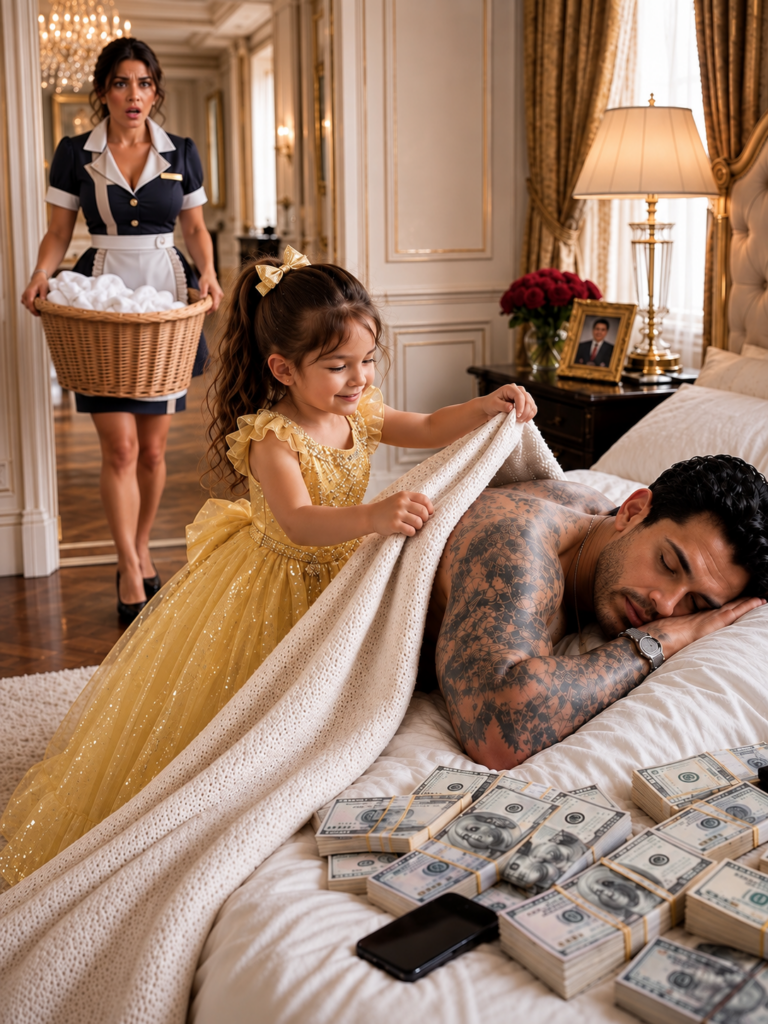
For several seconds, nobody moved.
Sofia stood beside my chair with one hand still resting on the edge of the blanket. The fabric had slipped slightly when I opened my eyes, and she seemed to be considering whether she ought to pull it back up.
Maria stood in the doorway.
Her face had gone pale.
Not guilty.
Not exactly frightened, either.
It was the expression of someone who had spent years guarding a door and had suddenly realized the lock was no longer there.
I wiped my face before Sofia could study the tears too closely.
At four years old, she had not yet learned the adult habit of pretending not to notice pain.
“Why are you crying?” she asked.
I glanced at Maria.
She looked as if she might step forward, but I answered before she could.
“I had a sad thought.”
Sofia accepted this with the solemn consideration children sometimes give simple truths.
“About your mommy?”
The question landed softly.
That almost made it harder.
“Yes,” I said.
She nodded as if this explained everything.
Then she tucked the blanket under my arm.
“My mommy says sometimes sad thoughts need blankets.”
A sound escaped Maria. It might have been a laugh if it hadn’t trembled at the edges.
“Sofia,” she said gently, “it’s late.”
“But Mr. Daniel was cold.”
“I’m sure Mr. Daniel can manage.”
Sofia looked at me for confirmation.
For most of my life, people waited for my approval before making decisions that involved thousands of dollars, entire buildings, sometimes entire futures.
Never once had anyone looked at me as seriously as that little girl did while waiting to know whether I required a blanket.
“I’m all right now,” I told her.
“Okay.”
She smiled.
Then she noticed the envelope on the table.
I watched her eyes settle on it.
This was what I had been waiting for.
The test.
The proof.
Instead, she pointed at the money and whispered to Maria, “You forgot to clean that.”
Maria closed her eyes for half a second.
“It isn’t ours to clean.”
“Oh.”
Sofia turned back to me.
“You should put it away. Money falls.”
I stared at her.
Then, despite myself, I laughed.
It was a quiet laugh, rusty from lack of use.
Sofia grinned as if she had accomplished something.
Maria didn’t.
Her gaze remained fixed on me.
There were too many unsaid things between us now.
I stood.
Sofia immediately grabbed the blanket so it wouldn’t fall.
“I’ll take her upstairs,” Maria said.
“No.”
The word came out sharper than I intended.
Sofia’s smile disappeared.
I softened my voice.
“I mean—Sofia should go to bed. But you and I need to talk.”
Maria’s fingers tightened around the doorframe.
“I know.”
Sofia looked between us.
“Am I in trouble?”
“No,” Maria and I said at the same time.
That made Sofia giggle.
For some reason, the sound made Maria’s eyes shine.
She crouched beside her daughter.
“Come on, corazón. Toothbrush, pajamas, story.”
“Two stories.”
“One.”
“One big story.”
“We’ll negotiate upstairs.”
Sofia took Maria’s hand, then stopped.
She looked back at me.
“Good night, Mr. Daniel.”
“Good night, Sofia.”
She tilted her head.
“Don’t be alone.”
Then she disappeared into the hallway.
The house became silent again.
But it was not the same silence.
For years I had valued quiet because quiet meant control. No unexpected footsteps. No laughter from rooms I wasn’t using. No questions. No voices speaking over one another.
Now the silence felt enormous.
I looked at the money on the table.
The wallet.
The phone.
Evidence of a test that suddenly embarrassed me.
I gathered everything and put it away.
Then I waited.
Maria returned twelve minutes later.
I knew because I checked the clock three times.
She stood just inside the living room without sitting.
“She’s asleep?”
“Almost. She asked why you were sad.”
“What did you tell her?”
“That grown-ups have memories.”
“That’s all?”
“She’s four, Daniel.”
There it was again.
My first name.
No “Mr. Hale.”
No cautious distance.
“Why did you call me Daniel before?”
She looked toward the staircase.
“Because for a second I forgot who you were supposed to be.”
That answer unsettled me more than a lie would have.
“And who am I supposed to be?”
Her eyes came back to mine.
“My employer.”
“That’s not what I asked.”
“No.”
“Then answer me.”
Maria took a breath.
“You are a man everyone in this house is careful around.”
I nearly smiled.
“Everyone except your daughter.”
“Sofia doesn’t understand reputations.”
“Maybe she’s smarter than the rest of us.”
That almost reached Maria.
Almost.
But then I remembered the words that had changed everything.
My daddy was cold before he died.
And Maria’s expression when Sofia said them.
I sat down.
“Who was her father?”
Maria remained standing.
“His name was Gabriel.”
The name meant nothing to me.
Or I thought it didn’t.
“Gabriel what?”
“Torres.”
“Your husband?”
“No.”
“Boyfriend?”
“A long time ago.”
“What happened to him?”
Her eyes moved toward the dark windows.
“He died.”
“I gathered that.”
A shadow of frustration crossed her face.
For the first time since she had begun working for me, Maria looked almost angry.
“Then don’t make me say it like I’m filling out paperwork.”
I leaned back.
Most people apologized when they spoke to me that way.
Maria didn’t.
Strangely, I respected her more for it.
“Fair enough.”
She crossed her arms, though not defensively. It seemed more like she needed something to hold.
“Gabriel was kind. Too trusting. He believed people were better than they were.”
“That gets expensive.”
“Sometimes.”
“How did he die?”
She hesitated.
And there it was.
The door.
The locked one.
The reason fear had appeared in her face.
“I don’t know the whole truth,” she said.
“You know enough to be afraid I’ll learn it.”
“Yes.”
“Why?”
Maria finally sat down across from me.
Because she was no longer standing, I noticed how tired she looked.
Not tonight-tired.
Years-tired.
The sort of exhaustion that settles behind the eyes of people who have spent too long solving tomorrow before they are finished surviving today.
“Gabriel worked for one of your companies,” she said.
The room seemed to narrow.
“Which one?”
“East River Freight.”
I knew the name immediately.
A warehouse and trucking company in Queens.
Legal on paper.
Mostly legal in reality.
It had belonged to me for nine years.
Gabriel had died five years ago.
I searched my memory.
Accidents.
Firings.
Medical leaves.
Names.
Too many names.
“I don’t remember him.”
“I know.”
Something about the way she said it made my chest tighten.
“You expected me to?”
“No. That’s part of the problem.”
“What does that mean?”
Maria looked down at her hands.
“He was a night dispatcher. Nothing important. Not to people at the top.”
The old version of me would have taken offense.
Nothing important.
As if she were accusing me of measuring human value by rank.
But I had.
I still did, sometimes.
“What happened?”
“Gabriel found discrepancies in delivery records.”
I said nothing.
“At first he thought they were bookkeeping mistakes. Trucks leaving with one manifest and returning with another. Loads that were logged twice. Payments made through companies that didn’t seem to exist.”
My mind became cold and precise.
Not because I was angry.
Because I recognized the pattern.
“Who was supervising the warehouse?”
Maria looked at me.
“Vincent Russo.”
For the first time that night, I stopped breathing normally.
Vincent.
Of course.
The betrayal had not started when I discovered it.
Betrayal never did.
It had roots.
Quiet ones.
Old ones.
“Go on.”
“Gabriel told me he’d found something strange. I told him to leave it alone.”
“Did he?”
“For a while.”
“Then?”
“He believed someone was stealing from you.”
That almost made me laugh, though there was nothing funny in it.
“He wanted to protect me?”
“He wanted to protect his job. He thought if your company lost money, people like him would be the first ones dismissed.”
Reasonable.
Painfully reasonable.
“What did he do?”
“He copied records.”
“Did he bring them to me?”
“No.”
“Vincent?”
Maria shook her head.
“He didn’t trust Vincent.”
My fingers tightened around the armrest.
“Why?”
“Gabriel said the numbers changed whenever Vincent came to the warehouse.”
Simple.
Not proof.
But enough to make a careful man suspicious.
“What happened to the records?”
“I don’t know.”
“You expect me to believe that?”
She looked directly at me.
“Yes.”
Something in her voice stopped me.
Not defiance.
Certainty.
“What happened to Gabriel?”
Maria pressed her lips together.
“He left work one night and never came home.”
My thoughts jumped ahead.
She saw it.
“No,” she said quickly. “Not what you’re thinking.”
“What am I thinking?”
“That someone made him disappear.”
“Did they?”
“I don’t know.”
“But he’s dead.”
“Yes.”
“How do you know?”
“His car was found the next morning after an accident outside the city. He was alone.”
She said it carefully.
No unnecessary details.
I appreciated that, especially with Sofia sleeping upstairs.
“The police ruled it an accident?”
“Yes.”
“Did you believe them?”
Maria’s silence answered.
I stood and walked toward the fireplace.
There was no fire.
It was August, and the night outside was thick with summer heat.
Still, I stared into the empty hearth as if something might appear there.
“Why come work for me?”
That was the question.
Not Gabriel.
Not Vincent.
Her.
She had entered my house knowing exactly who I was.
Knowing where Gabriel had worked.
Knowing Vincent’s name.
Knowing enough to fear the truth.
“I needed a job.”
“You could have cleaned a thousand houses.”
“Not for what this one pays.”
I turned.
“That’s not the whole answer.”
“No.”
“Then give me the rest.”
Maria looked toward the staircase again.
When she spoke, her voice was softer.
“Three months ago, I found something.”
The air changed.
“What?”
“A photograph.”
“Of Gabriel?”
She nodded.
“He kept a box of old papers at my mother’s apartment. Tax documents. Insurance. Things I didn’t want to look at after he died.”
“And you looked three months ago.”
“My mother was moving. I had to sort everything.”
She rubbed her thumb against her palm.
“In the bottom of the box was a photograph I’d never seen.”
“Who was in it?”
“Gabriel.”
“And?”
“You.”
I stared at her.
“Me?”
“Yes.”
“Where?”
“Outside East River Freight.”
I searched my memory.
I visited that warehouse dozens of times.
Hundreds of employees could have been somewhere behind me in a photograph.
“That doesn’t mean I knew him.”
“I know.”
“What else?”
“On the back, Gabriel wrote a date.”
“When?”
She told me.
May 14, five years ago.
I knew the date.
I knew it because May 14 was the day Vincent had convinced me to fire a regional supervisor named Thomas Bell.
Bell had been with me for eight years.
Vincent said he was skimming money from contracts.
The evidence looked clean.
Too clean, I realized now.
Bell had sworn he was innocent.
I hadn’t listened.
“What else did Gabriel write?”
Maria met my eyes.
“Four words.”
“What words?”
She hesitated.
Then she said them.
“Daniel Hale knows nothing.”
I felt the room tilt, though of course it hadn’t moved.
“What?”
“That’s what he wrote.”
I walked back to the chair but didn’t sit.
“Why would he write that?”
“I don’t know.”
“You’ve been working here how long?”
“Seven weeks.”
“And you never intended to tell me?”
“I didn’t know what it meant.”
“So you came here to find out.”
“At first.”
Finally.
Truth.
I should have been angry.
Instead, I felt tired.
“So you lied to me.”
“On the application? No.”
“You omitted why you wanted the position.”
“There wasn’t a question asking whether my daughter’s late father once worked for you.”
I looked at her.
She looked back.
Then, to my surprise, I almost smiled.
“Convenient.”
“Accurate.”
The smile vanished.
“Did you search my office?”
“No.”
“My bedroom?”
“No.”
“The basement rooms?”
“No.”
“Did you ever take anything?”
“No.”
“Copy anything?”
“No.”
“Photograph anything?”
“No.”
“Listen outside doors?”
Maria’s eyebrows rose.
“Your men talk loudly enough that nobody needs to.”
Despite myself, I laughed once.
She didn’t.
“I came here because I thought being close to your household might help me understand whether Gabriel had been afraid of you.”
“And?”
Her expression changed.
“Now I think he was afraid for you.”
That was ridiculous.
I almost said so.
Men were afraid of me.
They were afraid for their jobs, their money, their standing.
Nobody was afraid for me.
“Why?”
“Because of the photograph.”
“Four words aren’t evidence.”
“No.”
“What else?”
Maria stood.
“I should show you.”
“Show me what?”
“The photograph.”
“Where is it?”
“In my bag.”
She left the room.
I listened to her footsteps disappear down the hallway.
For one irrational second, I wondered if she would keep walking.
Out the front door.
Down the drive.
Gone.
I realized I didn’t want her to.
That irritated me.
A few minutes later she returned carrying an old brown envelope.
She didn’t hand it to me immediately.
“Before you see this, I need you to understand something.”
“You’re in my house holding evidence connected to a man who betrayed me. I’m listening.”
“Gabriel wasn’t involved in whatever Vincent was doing.”
“You can’t know that.”
“I knew him.”
“So did I know Vincent.”
Her face softened.
That was worse.
Not pity.
Recognition.
“You trusted the wrong person,” she said. “That doesn’t mean everyone you trust will be wrong.”
I felt my father’s hand on my six-year-old shoulder.
Never let anyone see what can hurt you.
I heard Vincent laughing at my dining table.
I saw Sofia pulling a blanket over me.
Everyone wants something.
The belief had kept me alive.
Or at least I had always called it living.
“Give me the photograph.”
Maria did.
The picture was slightly bent at one corner.
It showed East River Freight beneath a gray spring sky.
I was standing near the loading dock in a dark coat, speaking to Vincent.
Behind us, several employees crossed the yard.
One was a young man with curly black hair.
Gabriel.
He wasn’t looking at the camera.
He was looking at Vincent.
There was nothing remarkable about it.
Then I turned the photograph over.
May 14.
Daniel Hale knows nothing.
Below those words, in smaller handwriting, was something Maria apparently hadn’t mentioned.
V.R. changed manifests again.
Ask Thomas.
I read it twice.
Then a third time.
“Thomas Bell.”
“You know him?”
“I fired him the day this picture was taken.”
Maria’s eyes widened.
“Why?”
“Vincent told me Bell was stealing.”
We both looked at the photograph.
For years, I had thought Vincent’s betrayal had begun near the end.
Perhaps because believing that allowed me to preserve the first ten years.
The birthdays.
The weddings.
The long drives.
The promises.
Maybe I hadn’t been betrayed by eleven years of friendship.
Maybe I’d only been betrayed by one terrible final year.
A lie could be survived if you made it small enough.
But this photograph was five years old.
“Do you know where Bell is?” Maria asked.
“No.”
“Could you find him?”
“Yes.”
Then I stopped.
That answer had come too quickly.
The old instinct.
Find him.
Question him.
Control the information.
But something had changed.
Not much.
A crack.
Maybe only the width of a child’s whisper.
Still, it was there.
“I can ask,” I corrected.
Maria noticed.
She didn’t comment.
“There’s something else,” she said.
I looked at her.
“What?”
“Gabriel had a key.”
“A key to what?”
“I don’t know.”
Of course.
Mysteries apparently reproduced when ignored.
She reached into the brown envelope and removed a small brass key.
It was old-fashioned and narrow.
A paper tag had once been attached, but only a torn piece of string remained.
“I found it with the photograph.”
I took it.
There was a tiny number engraved near the base.
“Safe deposit box?”
“I thought so.”
“Locker?”
“Maybe.”
“Did you try anything?”
“I didn’t know where to start.”
I turned the key in my fingers.
“Why not bring this to the police?”
Maria gave me a tired look.
“Five years after an accident, with a photograph, a note, and a key to nowhere?”
“Fair point.”
“And if Gabriel had discovered financial crimes involving your business, I didn’t know whether going to the police would make things better or worse.”
“You thought I might be responsible.”
“At first.”
The words should have offended me.
They didn’t.
“Do you still?”
“No.”
She said it without hesitation.
That unsettled me more than suspicion had.
“Why?”
Her gaze went to the blanket still lying across the chair.
“Because tonight you put cash where I could take it.”
I stiffened.
She continued.
“You’ve been testing me since I arrived.”
I said nothing.
“The cabinet in the kitchen that you left unlocked last week? The watch on the library desk? The conversation you had with Mr. Keane when you knew I was cleaning the hall?”
“You noticed.”
“Daniel, you are not subtle.”
I almost laughed.
Nobody had ever accused me of that before.
“You knew?”
“Of course.”
“And you stayed.”
“I need the job.”
“Only the job?”
She glanced at the photograph.
“At first, no.”
“And now?”
Maria thought about it.
“I don’t know.”
That was the most believable answer she could have given.
I walked to the window.
The estate lights glowed across the lawn.
Beyond them, the city lay somewhere past the trees.
New York.
Millions of windows.
Millions of private lives.
For decades I had believed power meant knowing what everyone wanted before they asked.
Money.
Position.
Protection.
Access.
Fear made people predictable.
But Maria had come into my house wanting truth.
Sofia wanted me not to be cold.
Neither fit my system.
“What exactly did Sofia mean?” I asked.
Maria frowned.
“What?”
“‘My daddy was cold before he died.'”
Pain moved through her face, but it was quiet.
“One of the last things Gabriel said when he called me that night was that he was freezing.”
“Why?”
“It was raining. He’d left his coat at work.”
That was all.
No dark secret.
No horrifying revelation.
Just a young man standing somewhere in the rain, calling the woman he loved and complaining about being cold.
Somehow, that simplicity hurt more.
“Does Sofia remember him?”
“No. She was born six months after he died.”
I turned sharply.
Maria looked down.
“Gabriel never met her?”
“No.”
I thought of Sofia saying my daddy was cold before he died as if it were a memory.
“Then how does she know?”
“Because I told her stories.”
Maria smiled sadly.
“I wanted her to have something. Not the accident. Not the questions. Just small things. He hated olives. He sang badly. He couldn’t fold towels properly. He called me every night when he left work.”
“And the cold?”
“I told her once that the last time I heard his voice, he said he wished he’d brought his coat.”
She swallowed.
“Sofia remembers everything.”
I looked at the key in my hand.
“You’ve carried all of this alone.”
“So have you.”
“That’s different.”
“Is it?”
Yes.
I almost said yes.
My losses were mine.
My distrust was earned.
My loneliness was chosen.
But the words sounded weaker inside my head than they once had.
A soft thump came from upstairs.
Maria looked toward the ceiling immediately.
“Mama?”
Sofia’s sleepy voice drifted down the hall.
Maria started toward the stairs.
I followed before thinking.
Sofia was standing at the top in pink pajamas, clutching a stuffed rabbit.
“I couldn’t sleep.”
Maria climbed the last steps.
“Bad dream?”
“No.”
“What happened?”
“My bunny fell.”
She held up the rabbit.
Maria kissed her forehead.
“A tragedy.”
Sofia noticed me at the bottom of the stairs.
“Mr. Daniel?”
“Yes?”
“Are you still sad?”
Maria looked at me.
I could have lied.
I had lied more convincingly about more important things.
“A little.”
Sofia considered this.
“Mommy says little sad goes away slower.”
Maria closed her eyes.
“Apparently I say many things.”
Sofia nodded.
“Yes.”
I smiled.
“Go back to bed.”
“Okay.”
Then she pointed toward the living room.
“You keep the blanket.”
“I will.”
She disappeared with Maria.
I stood alone beneath the staircase.
Something strange happened then.
I realized no one in this house had asked me for anything all night.
Not money.
Not permission.
Not a favor.
Just honesty.
It felt more dangerous than any demand I’d ever received.
And more valuable.
The next morning, I called Arthur Keane into my office.
Arthur had worked for me for twenty-two years.
He was sixty-three, silver-haired, and possessed the rare talent of making disagreement sound like weather reporting.
He had been my attorney, adviser, negotiator, and occasionally the only person willing to tell me when I was being unreasonable.
He entered holding coffee.
“You look terrible,” he said.
“Good morning to you.”
“I considered lying, but you’ve always claimed to value accuracy.”
“Close the door.”
He did.
I put the photograph on the desk.
Arthur picked it up.
His expression changed slowly.
“Where did you get this?”
“Maria.”
“The housekeeper?”
“Her daughter’s father is Gabriel Torres.”
Arthur sat.
That told me more than anything he could have said.
“You know the name.”
“I do.”
My stomach tightened.
“From where?”
“East River Freight.”
“Everyone remembers the warehouse except me.”
“You had nine companies and three acquisitions that year.”
“That isn’t an excuse.”
“No.”
Arthur turned the photograph over.
I watched him read.
“Thomas Bell,” he murmured.
“You remember him too.”
“Yes.”
“Where is he?”
Arthur looked at me.
“Why?”
“Because I may have fired an innocent man.”
He placed the photograph down carefully.
“Daniel, you have fired many innocent men.”
“Helpful.”
“You hired them back when you learned you were wrong.”
“Did I learn I was wrong about Bell?”
“No.”
“Then find him.”
Arthur didn’t move.
I knew that expression.
“What?”
“You don’t find people anymore.”
I leaned back.
“Excuse me?”
“You ask whether they wish to speak with you.”
“That’s what I meant.”
“No, it isn’t.”
I stared at him.
Arthur drank his coffee.
“You’re becoming irritating in your old age.”
“I’ve always been irritating. You only recently developed enough patience to notice.”
A year ago, I might have ended the conversation.
Instead, I sighed.
“Ask Thomas Bell if he’ll meet me.”
Arthur nodded.
“And if he says no?”
The answer felt unfamiliar in my mouth.
“Then he says no.”
Arthur studied me.
I hated being studied.
Finally he said, “I’ll call him.”
As he reached the door, I spoke.
“Arthur.”
He turned.
“Did you know about Gabriel?”
His face grew serious.
“I knew an employee died in a car accident. I didn’t know he had been looking into Vincent.”
“Would you tell me if you had?”
“Yes.”
“Even then?”
He understood the question beneath the question.
Even when Vincent was alive.
Even when I trusted Vincent more than anyone.
Arthur’s answer came quietly.
“I tried to tell you about Vincent twice.”
I stared at him.
“What?”
“The first time, you said I was jealous of his influence.”
I remembered.
God help me, I remembered.
A dinner.
Arthur questioning a contract Vincent had arranged.
Me dismissing him.
“And the second?”
“You told me loyalty required trust.”
I closed my eyes.
My father’s voice again.
Never let anyone see what can hurt you.
Somewhere along the way, I had turned that lesson inside out.
I had hidden weakness so thoroughly that I had also hidden uncertainty.
And a man who never admitted uncertainty became very easy to deceive.
“I’m sorry,” I said.
Arthur’s expression changed.
Not dramatically.
Just enough.
“That’s new.”
“Don’t get used to it.”
“There he is.”
Then he left.
I sat alone with Gabriel’s photograph.
Thomas Bell agreed to meet two days later.
Not at my estate.
At a diner in Yonkers.
Arthur told me this as though he expected objection.
“Fine.”
“Fine?”
“That’s what I said.”
“You’re going to a diner.”
“I’ve been to diners.”
“When?”
“Recently.”
“When?”
I frowned.
“1998.”
Arthur nodded.
“Practically yesterday.”
The diner smelled like coffee, toast, and old vinyl booths.
Thomas Bell was already seated when I arrived.
He had changed.
Of course he had.
Five years will do that.
His hair was grayer. His shoulders looked narrower. There were reading glasses folded beside his cup.
He stood when he saw me, then seemed annoyed at himself for doing it.
“Mr. Hale.”
“Thomas.”
Arthur slid into the booth beside me.
Thomas glanced at him.
“I didn’t realize this was a legal meeting.”
“It isn’t,” I said.
Arthur lifted his coffee.
“I’m decorative.”
Thomas almost smiled.
That helped.
I placed a copy of the photograph on the table.
His smile disappeared.
“Where did you get that?”
“You recognize Gabriel Torres.”
Thomas stared.
“Yes.”
“What did he tell you?”
Thomas leaned back.
For several moments he simply looked at me.
“You really didn’t know.”
“No.”
“I always wondered.”
“About what?”
“Whether you were part of it.”
Arthur became very still beside me.
“Part of what?” I asked.
Thomas rubbed a hand over his jaw.
“Vincent was moving money through shipments. Nothing dramatic. Small amounts across a lot of invoices. Enough that nobody noticed.”
“Gabriel noticed.”
“He noticed the manifests.”
“And you?”
“I noticed the payments.”
“Why didn’t you come to me?”
Thomas laughed softly.
“I did.”
I stared at him.
“You never spoke to me.”
“No. I sent a report.”
“To whom?”
Thomas looked almost sorry for me.
“Vincent.”
Of course.
“Why him?”
“He was your second-in-command. I asked for a meeting with you. He said he’d arrange it.”
“And instead?”
“Three days later, you fired me.”
The waitress came by with a coffee pot.
Nobody spoke until she left.
I looked at Thomas.
“You told me you were innocent.”
“I was.”
“I didn’t listen.”
“No.”
“I should have.”
Thomas watched me carefully.
“Why are we here, Hale?”
“Because Gabriel is dead. Vincent betrayed me. And Maria deserves to know what happened.”
At Maria’s name, Thomas frowned.
“Maria?”
“Gabriel’s partner.”
Thomas’s expression softened.
“He talked about her.”
“Did he tell you she was pregnant?”
Thomas went still.
“No.”
“He may not have known.”
I saw that realization settle over him.
“He would’ve been happy,” Thomas said.
“She thinks so too.”
Thomas looked at the photograph again.
“Gabriel was scared.”
“Of Vincent?”
“Not at first. At first he thought Vincent was just covering bad accounting.”
“And later?”
“He found a storage ledger.”
My attention sharpened.
“What storage ledger?”
“Boxes transferred out of East River Freight.”
“To where?”
“I never knew.”
“Did Gabriel?”
“He thought he did.”
Thomas pointed at the photograph.
“He said Vincent kept copies of everything because Vincent trusted paper more than people.”
That sounded exactly like him.
“Where?”
“Gabriel told me he’d found a numbered storage record.”
“What number?”
Thomas closed his eyes, thinking.
“I don’t remember.”
I put the brass key on the table.
His face changed.
“Where did you get that?”
“Maria found it among Gabriel’s papers.”
Thomas picked it up but didn’t turn it.
“Two-fourteen.”
“You recognize it?”
“Not the key.”
“What, then?”
“The number.”
Arthur leaned forward.
“From where?”
Thomas looked between us.
“Gabriel said it the day before I was fired.”
My heartbeat slowed.
“What exactly did he say?”
Thomas stared at the key.
“He told me, ‘If they erase the records, remember 214.'”
No one spoke.
Then Arthur asked the obvious question.
“Two-fourteen what?”
Thomas shook his head.
“I never knew.”
We spent the next week looking.
Carefully.
Quietly.
Not like men hunting enemies.
Like people trying to reconstruct a life.
Arthur searched old corporate leases.
I reviewed property records.
Maria went through Gabriel’s papers again.
Even Thomas helped.
He emailed a list of storage companies that East River Freight had used.
None had unit 214 connected to Vincent.
Then, on Sunday afternoon, Sofia solved what four adults could not.
She was sitting at the kitchen table drawing.
Maria had brought her because the regular sitter was ill.
I entered looking for coffee.
Sofia held up a picture.
“That’s you.”
The figure had an enormous square head and what appeared to be six fingers.
“I look distinguished.”
“That’s your office.”
She pointed to a large rectangle.
“And that’s Mommy.”
Maria was drawn with yellow hair.
Maria’s actual hair was almost black.
“And that’s me.”
Sofia’s figure was mostly purple.
“Why are you purple?”
“It’s my favorite.”
Naturally.
I poured coffee.
On the counter lay Gabriel’s photograph.
Maria had apparently been looking at it again.
Sofia saw it.
“That’s Daddy.”
I froze.
Maria did too.
“You know him?” I asked.
“Mommy showed me pictures.”
Sofia hopped down and came over.
She pointed at Gabriel.
“That’s Daddy. That’s Mr. Daniel.”
Her finger moved.
“And that’s twenty-one-four.”
I looked at Maria.
“What did she say?”
Sofia pointed through the background of the photograph.
“There. Twenty-one-four.”
I bent closer.
Behind Gabriel, barely visible through the open loading dock, was a blue metal cabinet.
White numbers had been painted across it.
Not 214.
21-4.
A warehouse section.
Aisle 21, locker 4.
Thomas had remembered the number correctly.
We had interpreted it incorrectly.
I called Arthur.
East River Freight had renovated that warehouse three years earlier.
Most of the old employee lockers were removed.
But some had been transferred to a secondary storage building in Brooklyn.
Including rows from the old loading dock.
Two days later, Arthur found the inventory.
Aisle 21.
Locker 4.
Still listed.
Still unopened.
Maria and I stood in front of it the following morning.
The brass key fit.
Neither of us turned it immediately.
“You should,” I said.
Maria shook her head.
“He wrote that you knew nothing.”
“He was your family.”
“He was connected to your business.”
“We open it together.”
She looked at me.
“Together?”
The word seemed to surprise both of us.
“Yes.”
So we did.
Inside were three folders.
A small notebook.
A disposable camera.
And a sealed envelope.
Maria’s name was written across the front.
Her hand flew to her mouth.
For several seconds she couldn’t speak.
I stepped away.
“Take your time.”
She picked up the envelope.
The paper had yellowed around the edges.
The handwriting was unmistakably the same as the writing on the back of the photograph.
Maria.
She sat on an overturned crate.
I turned toward the door.
“Daniel.”
I stopped.
“I don’t know if I can open it alone.”
The old me would have considered that an invitation to hear information.
The man I was becoming understood it differently.
It was a request not to be alone.
I sat beside her.
She opened the letter.
Her eyes moved across the first few lines.
Then she covered her mouth.
“What is it?”
Maria looked at me.
Tears filled her eyes, but there was something else there too.
Wonder.
“He knew.”
“Knew what?”
She handed me the page.
At the top, Gabriel had written:
Maria,
If you’re reading this, then I was right to leave copies somewhere safe. First, I need you to know the most important thing.
I know about the baby.
My eyes went to Maria.
She laughed through her tears.
“He knew about Sofia.”
I gave the letter back immediately.
“Read it.”
“You don’t want to?”
“It’s yours.”
Maria looked at me for a long moment.
Then she nodded.
She read silently.
Her face changed with every paragraph.
Grief.
Relief.
Affection.
Confusion.
Finally she stopped.
“What?”
She looked toward the folders inside the locker.
“Gabriel wasn’t trying to expose Vincent.”
“What was he doing?”
“He was trying to protect you.”
I stared at her.
“Why?”
She handed me the final page.
One line near the bottom had been underlined.
Vincent thinks Daniel trusts him more than anyone, and that may be the most dangerous thing in the whole building.
Below it Gabriel had written:
If anything happens, give the blue folder to Daniel Hale himself. Not Vincent. Not security. Not anyone else.
I looked into the locker.
Three folders.
Red.
Green.
Blue.
Maria reached for the blue one.
Inside were copies of invoices, shipping manifests, bank transfers, and handwritten notes.
Evidence.
Not just of Vincent stealing.
Of something more personal.
Arthur turned the last page and frowned.
“What?”
He pointed.
There was a list of dates.
Beside each date was a name.
Thomas Bell.
Gabriel Torres.
Arthur Keane.
And mine.
The dates next to Arthur and me had been circled.
Maria studied them.
“What does it mean?”
“I don’t know.”
Arthur did.
I saw it in his face.
“Arthur.”
He looked older suddenly.
“What?”
“The dates.”
Arthur tapped the page.
“This one beside my name is the day I first questioned Vincent about the warehouse contracts.”
My skin went cold.
“And mine?”
He looked at me.
“That’s the day you told Vincent you were changing your will.”
Silence filled the storage room.
I remembered that day.
A private conversation.
Only Vincent and I.
At least, I had thought it was.
Maria looked at me.
“What were you changing?”
I stared at the paper in Arthur’s hand.
“My beneficiaries.”
“To whom?”
I didn’t answer immediately.
Because suddenly I remembered something I had not thought about in years.
Something my father had arranged before his death.
Something Vincent had known.
If I died without a wife or child, a controlling share of several companies did not pass to my relatives.
It passed into a trust managed by two senior officers.
One of them had been Arthur.
The other had been Vincent.
And five years ago, I had told Vincent I intended to remove him from that trust.
I looked at Gabriel’s notes again.
Maybe Gabriel had not only discovered what Vincent was stealing.
Maybe he had discovered why Vincent needed my trust so badly.
Maria’s voice was quiet.
“Daniel, what are you thinking?”
I looked at the photograph of Gabriel.
A man I had never noticed.
A man who had apparently noticed everything.
“I’m thinking I’ve spent five years believing Vincent betrayed me because he wanted what I had.”
I looked at Maria.
“But what if Gabriel discovered that wasn’t the whole truth?”
The blue folder came home with us.
Not to my office.
Not to Arthur’s firm.
Home.
That distinction mattered more than I expected.
Maria placed the folder on the dining room table while Sofia sat nearby eating apple slices and arranging them into what she insisted was a family of dolphins.
Arthur and I had spent another hour in the storage building cataloging every document.
Nothing inside suggested immediate danger.
Nothing required secrecy from Maria.
What it did require was patience.
That was inconvenient.
Patience had never been one of my more developed qualities.
“You’re staring at the folder,” Maria said.
“I’m thinking.”
“You’re glaring.”
“I don’t glare at paper.”
“You absolutely glare at paper.”
Sofia looked up from her apple dolphins.
“Mr. Daniel makes this face.”
She lowered her eyebrows dramatically.
Maria burst out laughing.
I did not.
At first.
Then Sofia crossed her arms and made my expression even more severe.
I laughed despite myself.
Arthur, who had joined us for an early dinner, leaned toward her.
“That’s remarkably accurate.”
“Whose side are you on?”
“Historically? Whichever side feeds me.”
Maria put a plate in front of him.
“Then today you’re on mine.”
“I’ve reconsidered my loyalties.”
The word should have bothered me.
Loyalty.
Once, I would have heard accusation in it.
Now I heard only Arthur teasing Maria over roasted chicken.
That difference did not feel dramatic.
Most important changes didn’t.
They simply happened enough times that one day the old reaction stopped arriving.
Sofia pushed one apple slice toward me.
“This one is the daddy dolphin.”
I looked at it.
“What happened to the mommy dolphin?”
She pointed at another slice.
“She’s there.”
“And the baby?”
A tiny piece sat between them.
I nodded.
“A strong resemblance.”
“Don’t eat them.”
“I wouldn’t dream of it.”
Five minutes later, Sofia forgot the dolphins entirely and asked for crackers.
I looked at the three apple pieces.
Family, according to a four-year-old.
Apparently all it required was proximity and imagination.
I pushed that thought aside.
There were documents to understand.
After Maria took Sofia upstairs for her bath, Arthur opened the folder.
“Let’s start with what we know.”
“I know Vincent lied to me for years.”
“That is emotionally relevant and analytically useless.”
“You were more pleasant before dinner.”
“No, I was hungry.”
Arthur arranged several pages in chronological order.
“Gabriel believed Vincent was altering manifests and shifting funds between shell companies. Thomas independently noticed unexplained payments.”
“I know.”
“Gabriel also kept notes about meetings.”
He tapped the sheet with our names.
“That’s what interests me.”
“Because of the trust.”
“Partly.”
Arthur slid another page toward me.
It contained dates and initials.
VR.
DH.
AK.
TB.
GT.
“Gabriel watched patterns,” Arthur said. “He wasn’t only following money.”
“What patterns?”
“Who Vincent met with after certain conversations.”
I studied the list.
“These are too vague.”
“Unless we find the rest of his notes.”
“The notebook?”
Arthur nodded.
I retrieved it.
Most pages contained shipping details.
Dates.
Trailer numbers.
Dock assignments.
Then we reached the final third.
Gabriel’s handwriting became less formal.
March 8 — V.R. asked about D.H. trust documents.
March 12 — T.B. says payments don’t match deliveries.
March 18 — V.R. moved three files personally.
April 4 — A.K. came to warehouse. V.R. angry afterward.
April 22 — overheard V.R. on phone: “He trusts me. That’s the point.”
May 11 — Maria says baby may be girl. Don’t know how to tell her I’m terrified and happy at same time.
I stopped.
Arthur looked away.
The line did not belong with the others.
That was why it broke through.
Between criminal suspicion and financial records, Gabriel had written about becoming a father.
Not as a grand declaration.
As an ordinary man afraid of an ordinary future.
I closed the notebook.
“Enough tonight.”
Arthur nodded immediately.
I hadn’t expected him to.
He gathered the papers.
“Tomorrow.”
“Tomorrow.”
As Arthur left, Maria came downstairs.
She saw the closed notebook.
“Did you find anything?”
“More questions.”
“About Gabriel?”
“About everyone.”
She sat across from me.
For a while neither of us spoke.
Then she asked, “Was there anything about Sofia?”
I hesitated.
“There was a line.”
Her fingers tightened.
“What did it say?”
“That he thought the baby might be a girl.”
Maria’s eyes lowered.
“And?”
“That he was terrified and happy.”
She covered her mouth.
I looked toward the hallway.
“You okay?”
She nodded, then laughed softly.
“That’s exactly how he would have said it.”
I waited.
After a moment, she wiped her cheek.
“Thank you.”
“For what?”
“For telling me exactly.”
I understood.
Not improving the memory.
Not making Gabriel more poetic because he was dead.
Letting him remain himself.
“He should get to sound like himself,” I said.
Maria looked at me.
“Yes.”
We sat quietly.
Then she noticed the abandoned apple pieces.
“Dolphins?”
“Apparently.”
She smiled.
“You didn’t eat them.”
“I was instructed not to.”
“You obeyed?”
“I occasionally surprise people.”
Her smile remained.
“What was he like?” I asked.
“Gabriel?”
“Yes.”
Maria leaned back.
“He apologized to furniture.”
I frowned.
“What?”
“If he bumped into a chair, he’d say sorry.”
“That’s ridiculous.”
“It was.”
She laughed.
“He was terrible with directions. He believed every broken appliance could be fixed by unplugging it. He once spent forty minutes repairing a toaster that wasn’t plugged in.”
I smiled.
“He sounds competent.”
“Completely.”
“What did he want?”
The question seemed to surprise her.
“Want?”
“In life.”
Maria thought about it.
“A small house.”
“Where?”
“Anywhere with a yard.”
“For the baby?”
“For tomatoes.”
“Tomatoes.”
“He was very serious about tomatoes.”
I nodded gravely.
“A man of ambition.”
“He wanted a daughter.”
That quieted me.
Maria looked toward the ceiling.
“He told me boys would make him nervous because he’d always wonder if he was teaching them enough. Then he said a girl would terrify him because he’d spend his whole life worrying.”
“So either way, terrified.”
“Basically.”
She smiled again.
Then the smile changed.
“He never got to know she was Sofia.”
“He knew she might be.”
“Yes.”
Maria looked down.
“That’s more than I had yesterday.”
That sentence stayed with me.
More than I had yesterday.
For most of my life, I measured gain in numbers.
Revenue.
Property.
Influence.
Maria measured it in one line from a notebook.
The next morning, Thomas called.
Not Arthur.
Me.
I nearly didn’t recognize the number.
“Hale.”
A pause.
“Thomas Bell.”
“Thomas.”
“I remembered something.”
I stood.
“What?”
“You asked about 214.”
“Yes.”
“Gabriel used to carry a disposable camera.”
“We found it.”
“You developed the film?”
“No.”
“Do that.”
“Why?”
“Because the last week I worked there, he photographed loading bays.”
I looked toward the drawer where I had stored the camera.
“What was he trying to capture?”
“Not cargo.”
“What, then?”
“People.”
The film was developed through a private lab Arthur trusted.
There were twenty-three usable photographs.
Most appeared meaningless.
Trucks.
Loading bays.
Employees.
A vending machine.
A pigeon standing on a forklift.
Then photograph seventeen changed the entire direction of our search.
Vincent stood near the rear parking lot speaking with a man in a suit.
Arthur recognized him.
So did I.
His name was Samuel Vale.
Not an enemy.
That would have been easier.
Vale had worked for a bank that managed several of my corporate accounts.
He retired four years ago.
Photograph eighteen showed Vincent handing him an envelope.
Photograph nineteen showed Vale getting into a car.
A small part of the license plate was visible.
Arthur tracked it.
The vehicle had belonged to the bank.
“What does it prove?” Maria asked.
“Nothing by itself,” I said.
Arthur nodded.
“But it tells us where to ask.”
Vale lived in Connecticut.
We did not descend on his house.
Five years ago, I would have.
Arthur sent a letter.
It said simply that we were reviewing historical corporate records and wished to speak about East River Freight.
Vale called the next morning.
His voice shook.
Not because I threatened him.
I didn’t.
Because he had been waiting five years for someone to ask.
“I knew this day might come,” he said.
We met in Arthur’s office.
Vale was seventy now.
He had the careful manners of a man who had spent decades sitting across desks from wealthy people and had learned to survive by never appearing surprised.
He looked at me.
“I’m sorry.”
“For what?”
“Not telling you.”
“Tell me now.”
Vale nodded.
“Vincent approached me about your trust.”
Arthur sat forward.
“What did he want?”
“Clarification.”
“On what?”
“What happened if Daniel became incapacitated.”
I felt something inside me go still.
Vale continued quickly.
“Not dead. Incapacitated. That distinction mattered.”
“Why?”
“Because under the old terms, temporary control of several holdings shifted to the designated trustees.”
“Arthur and Vincent,” I said.
“Yes.”
Arthur frowned.
“But decisions required both signatures.”
“Originally.”
“Originally?”
Vale opened a folder he had brought.
“Three months before Gabriel died, an amendment was submitted.”
Arthur took the document.
I watched his face.
“I never signed this.”
Vale nodded.
“I know.”
I leaned forward.
“What does it say?”
Arthur read silently.
Then looked at me.
“It allowed either trustee to authorize emergency transactions independently if the other trustee was unavailable.”
“Who signed?”
“My name.”
“But not you.”
“No.”
Vale looked miserable.
“The signature was accepted.”
“By you?” I asked.
“By my department.”
“Did Vincent submit it?”
“Yes.”
Arthur’s voice hardened, though he remained calm.
“And you didn’t verify with me?”
“The paperwork appeared proper.”
Arthur stared at the page.
“Apparently my handwriting improves when forged.”
Vale winced.
I could have made him suffer for the mistake.
A younger Daniel would have enjoyed letting the silence do the work.
Instead I asked, “Why did you meet Vincent at the warehouse?”
Vale looked at me.
“Because I became suspicious.”
“Of the amendment?”
“Yes.”
“Why meet him privately?”
“I wanted an explanation before I accused a major client.”
“And?”
“He told me Arthur had authorized it.”
Arthur made a quiet sound.
Vale continued.
“I said I wanted confirmation directly. Vincent became angry.”
“What did he do?”
“Nothing.”
That mattered.
No threat.
No grand conspiracy.
Just pressure.
A man relying on confidence and proximity.
“He said Arthur was difficult to reach and that you wanted everything arranged quietly.”
“And you believed him?”
“For a few days.”
“What changed?”
Vale looked toward the photograph on the desk.
“Gabriel Torres.”
Maria inhaled.
“He spoke to you?”
“Once.”
“What did he say?”
Vale turned to her.
“He asked whether a bank document could be valid if the witness hadn’t been present.”
Maria stared.
“Why?”
“I didn’t know then.”
Vale folded his hands.
“He seemed nervous. I asked what document he meant. He said he’d seen Mr. Russo sign someone else’s name.”
Arthur leaned back.
There it was.
A witness.
Not perfect.
Not conclusive by itself.
But real.
“What did you do?” I asked.
“I told Gabriel to stay out of it.”
Maria’s expression tightened.
Vale saw it.
“I was trying to protect him.”
“I know,” Maria said.
Her voice was gentle.
That kindness seemed to make Vale feel worse.
“I told Vincent I intended to report the amendment.”
“When?”
Vale gave us the date.
The day before Gabriel died.
I looked at Arthur.
He understood immediately.
“So that’s why Gabriel became afraid.”
“Possibly,” Arthur said.
Maria folded her arms.
“What happened after Gabriel died?”
Vale stared at the table.
“I lost my nerve.”
No one spoke.
He continued.
“The police called it an accident. Vincent told me Gabriel had been confused about what he saw. I told myself the amendment didn’t matter because no emergency ever occurred.”
“You told yourself that for five years?” I asked.
“Yes.”
His answer contained no defense.
Only regret.
I looked at him for a long time.
Then I asked, “Where is the amendment now?”
Vale slid the folder toward Arthur.
“Copies are here. The bank archives have the original.”
Arthur nodded.
“We can correct the record.”
Vale looked at Maria.
“I am sorry.”
Maria breathed out slowly.
“I spent years wishing somebody had done something differently.”
Vale’s eyes lowered.
“So did I.”
“I’ve learned that wishing backward doesn’t change very much.”
He looked up.
“No.”
“But telling the truth now does.”
Vale’s eyes filled.
“Thank you.”
Maria shook her head.
“Don’t thank me. Help us understand.”
So he did.
For nearly three hours.
By the end of the week, the mystery was smaller.
That surprised me.
Truth rarely arrived as one enormous revelation.
It came as dozens of ordinary corrections.
Vincent had been stealing.
He had used his position to hide transfers and alter records.
When Thomas noticed discrepancies, Vincent redirected suspicion toward him.
When Arthur questioned contracts, Vincent dismissed the concern as rivalry.
When Gabriel saw Vincent falsify Arthur’s signature, Vincent realized a low-level employee knew something that could expose years of deception.
But there was no evidence Vincent had caused Gabriel’s death.
The accident remained what the investigators had concluded.
An accident.
Maria cried when Arthur explained it.
Not because she wanted something worse to be true.
Because uncertainty had occupied so much space in her life that certainty, even painful certainty, felt almost like being given a room back.
“I thought I wanted an answer,” she said that evening.
We were sitting on the back terrace.
Sofia slept upstairs.
The garden lights made small circles along the stone path.
“You got one.”
“Yes.”
“And?”
Maria wrapped both hands around a cup of tea.
“I don’t feel the way I expected.”
“What did you expect?”
“Relief.”
“Do you?”
“A little.”
She looked toward the dark lawn.
“Mostly I feel sad for Gabriel.”
“Because he was right?”
“Because he spent his last weeks worrying about problems he didn’t create.”
I understood that too well.
“Arthur says the documents could clear Thomas completely.”
“They should.”
“They will.”
Maria looked at me.
“You could compensate him.”
“I intend to.”
“Would he accept?”
“That’s his decision.”
Her expression shifted.
“You’re getting better at that.”
“At what?”
“Letting other people decide.”
“I’ve always let people decide.”
She gave me a look.
“Daniel.”
“Fine.”
I smiled.
“Occasionally.”
For a while we listened to the summer insects.
Then Maria said, “Why didn’t you ever marry?”
I looked at her.
“That’s abrupt.”
“You asked me about Gabriel.”
“Fair.”
I leaned back.
“There were women.”
“I assumed.”
“But?”
“But I was good at choosing people who expected exactly what I was comfortable giving.”
“What was that?”
“Everything except me.”
Maria absorbed that.
“Money?”
“Yes.”
“Travel?”
“Yes.”
“Nice houses?”
“Yes.”
“Honesty?”
I smiled without humor.
“Limited quantities.”
“Love?”
I looked across the lawn.
“That word creates expectations.”
“Everything creates expectations.”
“I preferred contracts.”
“They’re easier.”
“Much.”
“Lonelier too.”
I glanced at her.
“That sounds like judgment.”
“It isn’t.”
She took a sip of tea.
“It’s observation.”
“Arthur has infected you.”
“He makes strong arguments.”
I laughed.
Then Maria became serious.
“Do you know what Sofia said yesterday?”
“I’m afraid to ask.”
“She said your house is learning.”
I frowned.
“Learning what?”
“How to be noisy.”
I looked toward the windows.
For years the estate had been immaculate.
Controlled.
Quiet.
Now Sofia’s crayons were in a drawer near the kitchen.
One of her stuffed animals had spent an entire afternoon beneath my desk.
Maria played music while cooking on Sundays when the kitchen staff was off.
Arthur had begun arriving without announcing himself to security because apparently he believed twenty-two years entitled him to ignore procedure.
It did feel noisier.
“Does she dislike that?”
“She loves it.”
I nodded.
“I suspected.”
Maria smiled.
“So do I.”
The words settled between us.
Neither of us moved toward them.
That mattered too.
Not every feeling required immediate definition.
Thomas came to the estate the following Monday.
He hesitated at the front entrance.
I understood.
The last time he had entered one of my properties, he had left without a job.
We sat in the library.
Arthur joined us.
Thomas declined coffee.
“You said you found proof.”
Arthur showed him copies of the forged amendment and Gabriel’s notebook.
Thomas read everything slowly.
When he finished, he sat back.
“So Gabriel was right.”
“Yes.”
“And I was right.”
“Yes.”
Thomas looked at me.
I knew what came next.
I deserved it.
But he didn’t raise his voice.
He didn’t insult me.
He simply asked, “Why didn’t you believe me?”
The question was harder precisely because he asked it calmly.
“Because Vincent had evidence.”
“Fake evidence.”
“I didn’t know that.”
“You could have checked.”
“Yes.”
Thomas nodded.
“That’s what bothered me.”
“I know.”
“No, I don’t think you do.”
I said nothing.
He continued.
“I didn’t expect you to trust me over Vincent. I expected you to ask one more question.”
There it was.
One more question.
How different would my life have been if I had built it around that principle instead of certainty?
Ask one more question.
Before firing Thomas.
Before dismissing Arthur.
Before deciding Maria wanted something.
Before testing her with cash on a table.
Before assuming a child’s kindness had to conceal a motive.
“I’m sorry,” I said.
Thomas looked at me.
Not shocked.
Not satisfied.
Just listening.
“I was wrong,” I continued. “And being deceived by Vincent doesn’t excuse what I did to you.”
Arthur remained quiet.
“I can correct the employment record. I can compensate you for what you lost. If you want your position restored—”
Thomas shook his head.
“I don’t.”
“Then another position.”
“No.”
I stopped.
A few years ago, I would have found that refusal difficult to accept.
Now I waited.
Thomas looked around the library.
“I built a life after you fired me.”
“Good.”
“It took time.”
“I imagine.”
“My wife went back to work. I took a smaller job. Eventually I started consulting.”
“Arthur told me.”
“I like it.”
I nodded.
“Then that’s what you should do.”
Thomas studied me.
“You’ve changed.”
“People keep accusing me of that.”
“Is it an accusation?”
“Depends on the day.”
He smiled faintly.
Then he looked at Gabriel’s notebook.
“What happens to this?”
“Maria decides.”
“Good.”
Again.
That word.
Decides.
I was learning.
Slowly.
Thomas accepted compensation for lost wages and legal costs.
Not charity.
Not a favor.
A correction.
That distinction mattered to him.
Therefore it mattered to me.
Before leaving, he stopped at the front door.
“Gabriel was a good man.”
“I never knew him.”
“No.”
Thomas looked back toward the house.
“But apparently he knew you.”
I frowned.
“He knew my name.”
“He knew more than that.”
“What?”
Thomas smiled sadly.
“He knew you could be fooled because you trusted deeply.”
“That’s not flattering.”
“It wasn’t meant to be.”
Then he left.
Two months passed.
Summer softened toward autumn.
The legal corrections unfolded quietly.
Arthur unwound the old trust amendments.
The bank acknowledged procedural failures.
Thomas’s employment history was repaired.
Maria received copies of every document related to Gabriel.
She also received the original notebook.
I kept nothing without asking.
That was harder than I expected.
Not because I wanted possession.
Because possession had always felt like certainty.
But trust was the opposite.
Trust meant allowing something important to exist outside your control.
Maria continued working at the estate.
Not because she needed to investigate.
Because, as she said, “The pay is still very good.”
I respected that answer.
Sofia continued visiting when childcare fell through.
Then, increasingly, when Maria’s schedule made it easier.
She developed an alarming familiarity with my office.
One afternoon I returned from a meeting and found her sitting in my chair.
“My seat.”
“I’m working.”
“On what?”
She held up a sheet of paper covered in circles.
“Business.”
I stared at her.
“Serious?”
“Very.”
Maria appeared in the doorway.
“I’m sorry.”
“Are you?”
“No.”
I looked at Sofia.
“What kind of business?”
She considered this.
“Cookie business.”
“Profitable?”
“Yes.”
“How much?”
“Twenty money.”
“Strong margins.”
Maria shook her head.
“You are encouraging her.”
“I encourage entrepreneurship.”
Sofia handed me the paper.
“You can work here.”
She pointed at a tiny chair beside the desk.
I stared at it.
Maria laughed.
I sat in it.
That photograph later became Arthur’s favorite thing in existence.
He claimed he would have it framed.
I informed him this would be a career-limiting choice.
He said he was sixty-three and willing to take the risk.
One evening in October, Maria found me in the library holding Gabriel’s photograph.
“You kept a copy.”
“With permission.”
“I know.”
She sat beside me.
Outside, rain tapped softly against the windows.
A colder rain than the one that had fallen on Gabriel’s final night.
“Do you ever think about him?” she asked.
“Gabriel?”
“Yes.”
“More than seems reasonable for someone I never met.”
“Why?”
I turned the photograph.
“Because he noticed what I didn’t.”
Maria waited.
“He noticed Vincent. He noticed Arthur’s signature. He noticed Thomas was telling the truth.”
“He was observant.”
“He also wrote that I knew nothing.”
Maria smiled faintly.
“That bothers you.”
“It does.”
“Because it was true?”
“Partly.”
She leaned back.
“What did your father teach you?”
The question surprised me.
“I told you?”
“Once.”
I remembered.
“Never let anyone see what can hurt you.”
“And did it work?”
I looked at her.
“For a while.”
“Did it keep you from being hurt?”
“No.”
“Then what did it do?”
I could have answered quickly.
Instead, I gave the question the respect it deserved.
“It kept people from knowing when I was hurt.”
Maria nodded.
“That’s different.”
“Yes.”
Rain moved against the glass.
“I thought that was strength,” I said.
“Maybe sometimes it was.”
I looked at her.
“You don’t have to agree.”
“I’m not disagreeing.”
She rested her hands in her lap.
“Sometimes surviving something requires walls. The problem is forgetting to build doors later.”
I stared at her.
“That’s annoyingly good.”
“My mother says it.”
“Your mother sounds dangerous.”
“She is.”
I smiled.
Maria stood.
“Sofia is asking for you.”
“Why?”
“Apparently her stuffed rabbit requires legal representation.”
“I am not a lawyer.”
“She says Mr. Arthur charges too much.”
“Smart girl.”
I put the photograph away.
Then stopped.
“Maria.”
She turned.
“Do you think Gabriel would resent me?”
Her expression softened.
“No.”
“You can’t know that.”
“No.”
“Then why answer?”
“Because I knew him.”
She came back and picked up the photograph.
“If Gabriel had blamed you, he would have written Daniel Hale is responsible.”
She turned it over.
Instead:
Daniel Hale knows nothing.
“He didn’t write that to condemn you,” Maria said. “He wrote it because he wanted the truth to reach you.”
I looked at the words.
For five years, I had believed ignorance was weakness.
Maybe Gabriel had understood it differently.
Ignorance was not betrayal.
Refusing to learn afterward was.
“Come on,” Maria said.
“The rabbit?”
“The rabbit.”
We found Sofia on the carpet in the sitting room.
The stuffed rabbit had been accused of stealing a wooden block from a toy bear.
Arthur sat on one sofa pretending to review imaginary legal notes.
“You came,” Sofia said.
“I was summoned.”
“You are the judge.”
Arthur looked offended.
“Why does he get to be the judge?”
“Because it’s his house.”
“That’s not how courts work.”
Sofia ignored him.
I took my appointed chair.
“Present the case.”
Maria sat beside Sofia.
The trial lasted fifteen minutes.
The rabbit was acquitted after the missing block was discovered beneath a cushion.
Arthur demanded reimbursement for his time.
Sofia paid him with one cracker.
“Justice,” he said, “is finally served.”
Maria laughed.
I looked around the room.
Arthur.
Maria.
Sofia.
A stuffed rabbit.
Cracker crumbs on a rug that had cost more than my first car.
The old Daniel Hale would have hated every second.
I didn’t.
That frightened me slightly.
Then I remembered something Maria had said.
Walls need doors.
Maybe opening one was supposed to feel like this.
In November, Maria asked for the afternoon off.
“My mother is coming.”
“Take the whole day.”
“I only need half.”
“Take the day.”
She narrowed her eyes.
“Is this generosity or an attempt to avoid meeting my mother?”
“The latter.”
Maria smiled.
“Too late. She’s coming here.”
I stared.
“Why?”
“She wants to know who Sofia keeps talking about.”
“I don’t like where this is going.”
“She specifically asked whether Mr. Daniel is a real person.”
“Tell her no.”
Maria laughed.
Her mother arrived at noon carrying a pie.
Elena Torres was sixty-one, compact, sharp-eyed, and completely unimpressed by my house.
She walked into the foyer, looked at the chandelier, and said, “That must be terrible to dust.”
Maria closed her eyes.
“Mamá.”
“What? It’s true.”
I liked her immediately.
Sofia ran toward her.
“Abuela!”
Elena embraced her.
Then she looked at me.
“So.”
“So?”
“You are Daniel.”
“I’ve been accused of it.”
She studied me.
Maria whispered, “Please don’t.”
“I’m looking.”
“I can see that.”
Elena nodded once.
“You look less frightening than the newspapers.”
“Mamá.”
“What? That’s a compliment.”
I smiled.
“Thank you.”
She handed me the pie.
“You eat apple?”
“Yes.”
“Good.”
Then she walked past me as though she owned the place.
Arthur, arriving ten minutes later, found this extremely entertaining.
At lunch, Elena talked about Gabriel.
Not the investigation.
The man.
She told stories Maria had forgotten.
How Gabriel once tried to fix her kitchen sink and flooded the floor.
How he brought flowers to Maria’s first nursing-school exam even though Maria later left the program when life became too expensive.
How he asked Elena’s permission to propose, then never found the right moment.
Maria froze.
“What?”
Elena looked surprised.
“He never told you?”
“No.”
“He bought a ring.”
Silence.
Maria’s eyes filled immediately.
Elena reached for her hand.
“Oh, mija.”
“Where is it?”
“I don’t know.”
“Did he have it when he died?”
“I thought maybe he returned it.”
Maria sat very still.
I thought of the storage locker.
We had removed everything.
Three folders.
Notebook.
Camera.
Envelope.
No ring.
Then I remembered the brown envelope in which Maria had kept the photograph and key.
“Did Gabriel have any other boxes?”
Maria looked at me.
“Only the one at my mother’s.”
Elena frowned.
“There was a smaller tin.”
Maria turned.
“What tin?”
“Blue. Your aunt had it after the funeral.”
“My aunt Rosa?”
“Yes.”
“Why?”
“She collected some of Gabriel’s personal things from the hospital and police storage because you were pregnant and I didn’t want you doing it.”
Maria looked stunned.
“I never knew.”
“I thought Rosa gave you everything.”
“She gave me a bag of clothes.”
Elena’s expression changed.
“Then call her.”
Rosa lived in Florida.
She answered on the fourth ring.
Maria put the phone on speaker.
The conversation began with confusion, then memory, then repeated apologies.
Rosa still had the tin.
Not because she intended to keep it.
Because she had packed it during a move and forgotten it in a closet.
Two days later she mailed it.
We opened it at Maria’s apartment.
Not my house.
Hers.
That mattered.
The apartment was small and warm, filled with family photographs and children’s books.
Sofia sat at the table coloring with Elena.
Maria and I stood in the kitchen.
Inside the tin were Gabriel’s watch.
A keychain.
Three receipts.
A folded movie ticket.
And a small velvet box.
Maria made a sound I will never forget.
Not grief.
Not joy.
Something between them.
She opened it.
Inside was a simple ring.
Nothing extravagant.
A small stone.
A thin gold band.
Exactly the sort of ring a night dispatcher saving for a baby might buy.
A note had been folded beneath it.
Maria opened it.
Three lines.
She read them silently.
Then handed them to me.
For when I stop being scared.
If she says no, pretend this never existed.
If she says yes, spend the rest of my life earning it.
I looked at Maria.
She was laughing and crying at the same time.
“What would you have said?”
“Yes.”
No hesitation.
“Immediately?”
“Probably after making him suffer for five minutes.”
“Reasonable.”
She touched the ring.
“I spent years thinking I didn’t get a goodbye.”
I looked at the note.
“Maybe you got something better.”
“What?”
“A future he intended.”
Her expression changed.
She nodded.
“Yes.”
Sofia came running in.
“Mommy, why are you crying?”
Maria crouched.
“Happy memory.”
Sofia looked at the ring.
“Pretty.”
“It belonged to Daddy.”
“Can I wear it?”
Maria smiled.
“When you’re older, maybe.”
“Five?”
“Much older.”
“Six?”
“We’ll discuss it.”
Sofia accepted this.
Then she ran back to Elena.
Maria stood.
“Thank you.”
“I didn’t do anything.”
“You remembered the box.”
“So did your mother.”
“Still.”
She looked at me for a long moment.
“You’re learning to help without taking over.”
“I feel I deserve a certificate.”
“I’ll ask Sofia to make one.”
“Perfect.”
Christmas came quietly.
I had never cared much for it.
The estate decorations had always been handled by staff.
Tasteful wreaths.
White lights.
Nothing personal.
That year, Sofia insisted the tree needed colored paper chains.
The result was objectively terrible.
I loved it.
Arthur brought wine.
Elena brought enough food to feed forty people.
Thomas sent a card.
Samuel Vale sent another, addressed to Maria.
She read it privately and later told me only that he had apologized again and that she had written back.
Vincent’s name came up less often.
That surprised me too.
For years, betrayal had occupied the center of every room I entered.
Now it had become one part of a larger story.
A painful part.
But not the entire story.
Late Christmas evening, after everyone had gone home, I found Sofia asleep on the sofa.
A book lay open beside her.
Maria was gathering wrapping paper.
“I’ll take her.”
“You don’t have to.”
“I know.”
I lifted Sofia carefully.
She stirred.
“Mr. Daniel?”
“I’m taking you upstairs.”
“Okay.”
Her head rested against my shoulder.
Halfway up the stairs, she whispered, “You’re warm.”
I stopped.
Four months earlier, she had covered me with a blanket because she thought I was cold.
Now she said it as though she had completed a task.
“You noticed?”
“Yes.”
Then she fell asleep again.
I carried her to the guest room.
Maria followed.
We tucked her beneath the blanket.
At the door, Maria looked back at her daughter.
“She loves you.”
The words struck deeper than I expected.
“She’s four.”
“So?”
“Four-year-olds love anyone who gives them cookies.”
“You don’t give her cookies.”
“Arthur does.”
“She loves him too.”
“Exactly.”
Maria smiled.
I looked at Sofia.
“I don’t know what to do with that.”
“With what?”
“Being important to someone who doesn’t want anything from me.”
Maria’s smile faded into something gentler.
“She wants things from you.”
“Like what?”
“Your time.”
I swallowed.
“That’s worse.”
“I know.”
“Because money is easier.”
“Much.”
We stood in the hallway.
Then I asked something that had been forming for weeks.
“What do you want from me?”
Maria looked surprised.
“Right now?”
“In general.”
She thought for a long time.
“Nothing you don’t choose to give.”
The answer loosened something in my chest.
My father had taught me that love gave people weapons.
Vincent had taught me that trust created openings.
Gabriel, a man I had never met, had left behind evidence that complicated both lessons.
Sofia had done something simpler.
She had given without calculation.
A blanket.
A cracker.
A seat at an imaginary business meeting.
Affection.
No contract.
No promise.
No leverage.
Maybe the thing keeping me alive had never been distrust.
Maybe distrust had only kept me protected.
There was a difference.
A large one.
“I’d like you to stay,” I told Maria.
Her eyes met mine.
“Working here?”
I smiled.
“That’s up to you.”
“And otherwise?”
I looked toward the sleeping child.
“In my life.”
Maria said nothing for several seconds.
Then she reached for my hand.
Not dramatically.
Not like a promise requiring witnesses.
Just her fingers against mine.
“I think,” she said, “we can see what that means.”
For once, uncertainty did not frighten me.
“Okay.”
She smiled.
“Okay.”
The following spring, I sold East River Freight.
Not because I wanted to erase what happened there.
Because I no longer needed to own every place connected to my past.
Part of the proceeds went into an employee assistance fund.
Thomas agreed to serve as an independent adviser.
Arthur called this “a suspiciously decent decision.”
I reminded him he was replaceable.
He reminded me he had heard that threat since 2004.
Maria reduced her hours at the estate.
She reenrolled in nursing school.
When she told me, she did it cautiously.
“I won’t be able to work full-time.”
“Then don’t.”
“I need the income.”
“We can adjust your schedule.”
She stared.
“What?”
“You expected me to offer to pay your tuition.”
“You were thinking it.”
“I was.”
“And?”
“And you would say no.”
“Yes.”
“So I won’t.”
Maria smiled.
“You’re learning.”
“Painfully.”
“I’ll let you buy textbooks.”
“Generous.”
“Very.”
She finished school two years later.
Sofia started kindergarten.
Arthur retired and then continued appearing at my office three times a week, which proved retirement was largely theoretical.
Elena visited every Sunday.
She still criticized the chandelier.
I never replaced it because I enjoyed hearing her complain.
And me?
I changed more slowly.
I did not become harmless.
I did not become naive.
I did not suddenly believe everyone was good.
People still lied.
People still wanted things.
Trust still carried risk.
But I stopped treating risk as proof something wasn’t worth having.
Years later, when Sofia was old enough to ask serious questions about her father, Maria showed her Gabriel’s notebook.
Not the financial pages first.
The personal ones.
The line about being terrified and happy.
The note beneath the ring.
The photograph.
Sofia sat at my dining room table—older now, long-legged and thoughtful—and read quietly.
Then she turned the photograph over.
“Daniel Hale knows nothing,” she read.
She looked at me.
“Was Daddy making fun of you?”
Maria laughed.
I frowned.
“I choose to interpret it charitably.”
Sofia grinned.
Then she became serious.
“He tried to help you.”
“Yes.”
“Even though he barely knew you.”
“Yes.”
“Why?”
I had wondered that for years.
Maybe Gabriel valued fairness.
Maybe he disliked watching someone be deceived.
Maybe he thought protecting his employer would protect his own small future.
Maybe people were rarely motivated by one thing.
“I don’t know,” I said.
Sofia nodded.
She was old enough now to understand that not every question received an answer.
Then she touched the photograph.
“I’m glad he did.”
“So am I.”
She looked at me.
“Would we know you if he hadn’t?”
That question stopped me.
Maria was standing in the doorway.
She heard it.
Neither of us answered immediately.
Would Maria have come to my house?
Would Sofia have covered me with a blanket?
Would Arthur and I have repaired what Vincent broke between us?
Would Thomas have received the apology I owed him?
Would I still be living in perfect silence, surrounded by guards, money, and certainty?
“I don’t think so,” I said.
Sofia smiled faintly.
“Then Daddy gave us something.”
Maria’s eyes filled.
“What?” she asked.
Sofia looked around the room.
“Us.”
No one spoke.
There was nothing to add.
I looked at Maria.
At Sofia.
At the photograph of a young man standing in the background of a warehouse yard, watching something the powerful men in front of him had failed to see.
For most of my life, I believed people entered your world because they wanted to take something.
Vincent had reinforced that belief so completely that I mistook suspicion for wisdom.
Then Maria entered my house carrying questions.
Sofia entered carrying a blanket.
Gabriel entered my life years after his own had ended, carrying evidence and the quiet hope that the truth would eventually reach the right person.
They all wanted something.
Maria wanted answers.
Sofia wanted people she loved not to feel alone.
Gabriel wanted his family protected and a wrong corrected.
I had been mistaken about only one thing.
Wanting something was not the same as taking.
Sometimes people came into your life because they hoped to build something with you.
Sometimes they asked for trust and gave it back.
Sometimes forgiveness did not erase what happened; it simply stopped the past from deciding every future choice.
And sometimes the belief that kept you alive for years became the very belief you had to release in order to begin living.
That evening, long after Sofia went home, I walked through the estate alone.
The house was quieter now.
But not empty.
There were photographs on the walls that hadn’t been there before.
Maria at graduation.
Sofia missing two front teeth.
Arthur asleep in a chair during Christmas dinner.
Elena pointing disapprovingly at the chandelier.
Thomas standing beside the employee assistance fund’s first scholarship recipient.
And one smaller frame on a shelf in the library.
Gabriel outside East River Freight.
Behind the photograph, folded carefully, was a copy of the note he’d written.
Daniel Hale knows nothing.
I smiled whenever I saw it.
Because he had been right.
I hadn’t known Vincent.
I hadn’t known Gabriel.
I hadn’t known Maria.
I hadn’t known what trust could cost—or what refusing it could cost.
Most of all, I hadn’t known that loneliness could disguise itself as strength for so long that a man might defend it like a kingdom.
Then a four-year-old girl covered me with a blanket.
And told me nobody should be alone.
Six words.
That was all.
Not a warning.
Not an accusation.
Not a demand.
Just something her mother had taught her.
Something her father, in his own way, had lived by.
Something I had spent decades refusing to believe.
Nobody should be alone.
For once in my life, I decided not to argue.


