Willa’s fingertips remained against the mallet handle.
Ezra lowered it carefully to the splitting block.
For several seconds, neither spoke.
Then she pulled back her hand.
“You may use it,” she said. “Tools don’t do anyone good hanging on nails.”
He nodded.
But when he raised the mallet again, she added, “Just don’t treat it carelessly.”
“I won’t.”
The first blow separated a thin, clean shake from the pine.
Willa examined the result before taking the next bolt.
Soon they had settled into a rhythm.
He split. She sorted. Straight pieces went into one pile, flawed pieces into another.
When her sore wrist prevented her from lifting a heavier bolt, she pushed it toward him with her boot.
He took the weight without making a remark.
That consideration irritated her less than she expected.
By noon, they had a respectable stack.
They ate outside, as the agreement required.
Willa brought bread, potatoes, cheese, and coffee. The portions were equal, and Ezra noticed that she made certain of it.
He noticed other things, too.
The way she glanced at the roof whenever the wind rose.
The way she paused before crossing the patch of ground beneath the ladder.
And the way she kept looking toward the empty place at the head of the porch table.
He did not question her.
That afternoon, she took him into the press shed.
There stood an old wooden cider press, polished by years of use.
Willa showed him how to feed the apples through the grinder, spread the pulp inside pressing cloth, and turn the great screw until the juice began to run.
Ezra worked the crank while she directed him.
“Not so fast,” she warned.
He slowed.
“Now you’re barely moving.”
“You’re a hard woman to satisfy, Miss Prior.”
“Only when somebody’s doing the job badly.”
For an instant, she smiled.
Ezra nearly missed it.
Fresh cider flowed into a clean bucket.
Willa dipped a tin cup, then held it toward him.
He drank.
The juice was sharp, sweet, and cold enough to sting his teeth.
“That’s worth hauling,” he said.
She watched him with quiet pride.
“My father used to say the first cup belonged to whoever worked the crank.”
Ezra handed it back.
“Then I reckon you’ve earned the next.”
She drank from the same cup.
Afterward, she stood looking at the press.
“I haven’t shared the first cider with anyone since June.”
Her voice had altered.
Ezra heard it.
But he only reached for another basket of apples.
“Shall we finish these?”
“Yes,” she answered after a moment. “We shall.”
Over the next two days, the work gave them a language that required little explanation.
When Ezra split shakes, Willa kept the stacks straight.
When she picked apples, he moved the heavier sacks to the press.
When a wheel on the orchard barrow began catching against its frame, he adjusted it before she lost another hour fighting it.
She showed him which apples could be stored, which must be pressed immediately, and which had already gone soft.
He listened.
And she began to understand that a man could be useful without becoming master of everything around him.
By Thursday evening, the orchard rows looked less burdened.
Several barrels of cider stood filled.
But the roof remained unfinished.
Willa examined the northern sky.
“The almanac says snow by the tenth.”
Ezra looked toward the stacked shakes.
“That doesn’t leave much time.”
“No.”
“We’ll have to begin stripping that north slope soon.”
She swallowed.
“Tomorrow.”
“Are you certain?”
She looked straight at him.
“I gave my word.”
“I know.”
“And I expect you to keep yours.”
He set down the basket he had been carrying.
“Miss Prior, there’s something I ought to tell you before we go further.”
She stiffened.
“What?”
“The evening I arrived, I was standing near the gate when you came down from the ladder.”
Her face went still.
He continued carefully.
“I heard you speak.”
Willa’s good hand closed around the basket handle.
“How much?”
Ezra could have avoided the worst of it.
He could have pretended he had caught only the words about the roof.
But the bargain between them had begun with fairness.
And he would not make dishonesty its foundation.
“I heard you ask for help,” he said. “And I heard you ask that whoever came wouldn’t require more than you could pay.”
The basket slipped from her fingers.
Three apples rolled across the porch boards.
Willa did not bend to retrieve them.
“You heard that?”
“Yes.”
“And you’ve known all this time?”
“Yes, ma’am.”
Her eyes glistened, but her voice sharpened.
“You stood there while I made you count a dime. You watched me write that agreement. You let me believe you were simply a stranger needing shelter.”
“I was a stranger needing shelter.”
“But you knew I had prayed for someone.”
“I did.”
“And you said nothing.”
“I should have told you. I’m sorry.”
She turned away.
For the first time, Ezra saw how deeply he had trespassed into something he had never meant to enter.
When she spoke again, her voice was barely audible.
“That prayer was all I had left that belonged to me.”
He took one step backward.
“I didn’t come here to collect on it.”
Willa faced him.
“Then perhaps you’ll understand why I don’t want you here tomorrow.”
Ezra waited.
She pointed toward the gate.
“Please leave in the morning.”
His face tightened.
But he nodded.
“As you wish.”
He gathered the fallen apples, set them on the table, and carried the empty basket to the press shed.
Then he returned to the barn.
Willa went inside and shut her door.
Long after dark, Ezra heard a dull, uneven sound from the yard.
A mallet striking pine.
He stood in the barn doorway.
In the weak light falling from the cabin window, Willa was splitting shakes with her injured wrist.
Each blow cost her.
Yet she continued.
Ezra took a step forward.
Then stopped.
She had asked him to leave.
He could not call himself respectful and disregard her the moment obedience became difficult.
By dawn, the mules were harnessed.
He brought the wagon through the gate.
Then, just beyond the post, he halted.
Behind him stood the unfinished roof.
Ahead lay the road to Loveland.
He had promised a week’s labor.
But the woman who had hired him had withdrawn her welcome.
Ezra loosened the reins and waited, unwilling to mistake either promise for permission to overrule the other.
Presently the cabin door opened.
Willa came down the porch steps, crossed the yard, and stopped beside the gate.
Her eyes were red.
“Mr. Colton,” she said, gripping the gatepost, “I cannot ask God again to send somebody while refusing to ask the man standing right in front of me.”
Ezra remained seated.
The morning wind moved through the bare branches.
Willa swallowed.
“Will you stay and finish the roof? On the terms we agreed.”
He answered quietly.
“If that is what you want.”
She drew a breath.
Then she reached for the gate latch and pulled it open.
The gate swung inward against Willa’s hand.
Ezra gathered the reins, but he did not move the wagon until she stepped clear.
“Same arrangement?” he asked.
“The same.”
“And the house stays private?”
“Yes.”
“Then I’ll put the mules away.”
Willa moved aside, and the wagon rolled back into the yard.
Only when Ezra had passed did she release the gate.
She stood there longer than necessary, looking at the dark wheel tracks cut through the frost.
She had nearly sent away the only man willing to climb her roof.
Not because he had demanded anything.
Because he had witnessed her need.
That distinction troubled her more than she cared to admit.
When she reached the barn, Ezra had already begun unharnessing the animals.
“I have another condition,” she said.
He turned.
“I will hold the ladder.”
“All right.”
“And if something is wrong with the roof, you tell me. You don’t spare me because it’s my house.”
“I’ll tell you.”
She hesitated.
“My father built most of what you see here. I know every board he laid.”
Ezra glanced toward the cabin.
“That gives you a better knowledge of the place than I have.”
“It does.”
“Then we’ll use it.”
There was something almost disarming about the answer.
No argument.
No indulgent smile.
No suggestion that she should go indoors and leave the man’s work to him.
He treated the knowledge as worth having.
Saturday morning, Willa stood at the foot of the ladder while Ezra checked its rails.
He found the ground beneath one foot uneven and refused to climb until the ladder was properly secured.
He settled its feet, tested the upper bearing, and tied it off.
Only then did he place his weight on the first rung.
Willa braced the rails.
Her injured wrist stayed tucked close against her body.
Ezra climbed carefully.
From below she could hear his boots shifting against the wood, the scrape of his pry bar, and the hollow sound of old shakes being lifted away.
She tried to follow his movements with her eyes.
But each time the ladder moved beneath his weight, her stomach tightened.
She had not watched another man climb that roof since June.
Now every sound from above carried the memory of one particular morning.
“There’s rot beneath this patch,” Ezra called.
“Where?”
“Just below the middle dip.”
“Can you cut it out?”
“I think so. But I’ll have to find sound wood.”
“Then do it.”
He removed another length of damaged sheathing.
The old boards broke apart too easily.
He worked slowly, keeping his weight over the sound framing.
Once Willa heard a short crack.
She gripped the rails so hard that pain flashed through her bad wrist.
“Ezra?”
“I’m all right.”
She closed her eyes briefly.
The sound had been only a piece of rotten wood breaking free.
Nothing more.
She told herself that three times before her breathing steadied.
Above her, Ezra continued stripping away the damaged roofing.
Then he stopped.
At the lower edge of the roof, where leaves and grit had collected against the gutter, a dark wooden shape lay half buried beneath old debris.
He pulled it loose.
A hammer.
Its metal head was rusted, but the hickory handle remained sound.
He turned it in his hand.
Near the grip, someone had burned two words into the wood.
A. PRIOR.
Ezra remained motionless.
Now he understood why the ladder frightened her.
He looked down.
Willa stood beneath him, her face turned upward.
“Miss Prior?”
“Yes?”
“I’ve found something.”
“What?”
He hesitated.
“Something you ought to see.”
He descended with the hammer in one hand.
As soon as his boots reached the ground, he offered it to her handle-first.
Willa looked.
Her lips parted.
For several seconds she seemed unable to draw breath.
Then she reached toward the handle.
Stopped.
And covered her mouth.
“Oh, Papa.”
Ezra held it steady.
“I found it lodged in the gutter.”
She nodded once.
Her eyes had fixed on the worn spot near the grip.
“He made that mark himself,” she whispered.
“I thought it might be his.”
Willa took the hammer.
It was heavier than she remembered.
Or perhaps her wrist had grown weaker.
She held it against her coat.
“June ninth,” she said.
Ezra said nothing.
“He went up that morning because the roof was leaking again. I’d told him we needed proper shakes, but he said we couldn’t leave the hole open until harvest.”
Her eyes traveled to the upper edge of the roof.
“He had a pail of tar and some tin. Said he’d be down before noon.”
She paused.
“I was out among the apple trees. There was one tree that wasn’t bearing properly, and I was examining the branches.”
The barn creaked faintly in the wind.
“Then I heard the ladder move.”
Ezra remained beside her.
“It wasn’t a loud sound. Just wood scraping, then something striking the ground.”
Her fingers tightened around the hammer.
“When I turned, he was lying beside the porch.”
She swallowed.
“He was still alive.”
Ezra lowered his eyes.
“He looked at me and asked whether the ladder was all right.”
The words came with terrible difficulty.
“I told him yes. I didn’t know what else to say. I thought he was asking because he intended to get up again.”
Her face crumpled.
“He never did.”
She bowed her head.
Ezra stood near enough to hear her breathing, but did not reach for her.
There were kinds of grief that could not bear being handled by a stranger.
After a while, Willa spoke again.
“He was sixty-one. He wasn’t a foolish man. He’d worked on roofs since he was young.”
“I believe you.”
“He’d wanted to replace the whole thing for two years. But Mama was sick, and the doctor had to be paid. Then there was the note on the north pasture.”
She wiped her cheek with the back of her hand.
“The money always went somewhere it was needed sooner.”
Ezra glanced toward the barn where the carefully stacked pine still waited.
“So he cut the bolts when he could.”
“Yes. He meant to finish them.”
“Did he cut all of them himself?”
“Most. I helped stack them.”
She looked toward the orchard.
“He planned everything. Where each tree would stand. Which varieties would keep through winter. How many barrels we’d need. He could tell you what ought to be done ten years from now.”
Her mouth trembled.
“But none of his plans included leaving me here alone.”
The admission hung between them.
After a while, Ezra asked about her wrist.
Willa stared at the wrapping.
“In September I tried to patch the same place.”
He waited.
“The ladder slipped on the second rung. I fell badly enough to hurt this hand.”
She turned it slightly.
“I lay there in the yard thinking about what Papa had asked me.”
“About the ladder?”
She nodded.
“I’ve hardly been able to climb since. But I kept trying.”
“You could have broken your neck.”
“I know.”
He did not tell her she must never do it again.
That would have been easy.
Instead he looked carefully at the place where the ladder stood.
“I’ll make certain this one is secured before either of us uses it.”
Willa studied him.
Then she said something he had not expected.
“The last course belongs to me.”
He glanced up at the roof.
“The last course?”
“And the ridge cap.”
Her voice grew steadier.
“You can strip the old roof. You can repair the timber and lay the shakes. But the final course is mine to nail.”
Ezra considered the height.
He considered her injured wrist.
He also considered the hammer she held against her chest.
“That’s a difficult place to work.”
“I know.”
“And it may take time.”
“I know that too.”
He looked into her face.
“Then I’ll make a safe way for you to reach it, if conditions allow.”
She swallowed.
“You won’t try to stop me?”
“If it becomes dangerous, I’ll tell you plainly. But I won’t pretend the roof belongs to me.”
Willa lowered her eyes.
“Thank you.”
It was the first time she had said those words without making them sound like payment.
That Sunday, the orchard was unusually quiet.
Ezra repaired a worn harness strap in the barn.
Willa cleaned her father’s hammer.
She rubbed the rust from its head, worked oil into the hickory handle, and laid it on a folded cloth.
In the evening she invited Ezra to the porch.
Between their plates stood a large family Bible.
Its leather cover was cracked, and several pages had loosened near the spine.
“My father read from this every night,” she told him.
Ezra sat down.
“I haven’t opened it since he died.”
She turned to the Psalms.
“That’s where the words over the door came from.”
She began reading.
Her voice was firm at first.
Then it altered when she reached the passage about labor, weariness, and sleep.
She lowered the book.
“Papa used to say a house wasn’t made sound just by working yourself to death.”
Ezra leaned forward.
“He sounds like a man who knew how to work.”
“He did.”
“And perhaps he knew when he’d taken on too much.”
Willa gave a faint, sorrowful smile.
“Knowing and doing weren’t always the same thing with him.”
She ran a finger along the edge of the page.
“I keep thinking that if I work hard enough, I can make the place as it was before.”
Ezra looked toward the darkening orchard.
“Can you?”
“No.”
The answer seemed to cost her.
“No. But when I stop working, I remember that he’s gone.”
She shut the book gently.
Ezra did not pretend to know how to repair such a loss.
He simply remained at the table while the evening grew colder.
Presently Willa asked him where home was.
“Mostly the road these days,” he said.
“You haven’t a place of your own?”
“Nothing that needs my return each evening.”
He smiled faintly.
“Hauling hay keeps a man busy. There’s always somebody who needs a load taken farther than he wants to travel.”
“You don’t mind it?”
“Sometimes. Other times, the freedom suits me.”
She looked at him more closely.
“Doesn’t it get lonely?”
“Now and then.”
It was the first personal thing he had offered without being asked about his work.
“And what do you do then?”
“Find another job, most often.”
Willa lowered her eyes toward the Bible.
“That sounds familiar.”
They sat until the last light went behind the foothills.
Then the wind shifted.
A hard gust came from the northwest, stirring the orchard branches and rattling the loose roofing.
Willa rose from her chair.
Ezra followed her gaze.
The sky had taken on a dull, heavy color.
“That isn’t the usual evening wind,” she said.
“No.”
“Snow’s coming.”
“How soon?”
“Tomorrow, perhaps Tuesday.”
Ezra looked toward the roof.
The damaged sheathing had been repaired, and a portion of the new shakes prepared.
But most of the north side remained uncovered beneath the temporary canvas he had secured over it.
They had fewer good working hours than he wanted.
“I’ll start early,” he said.
“So will I.”
Monday passed in hard labor.
Ezra worked on a secured scaffold near the eaves, laying each shake so water would run across overlapping wood rather than into the seams.
Willa sorted the boards by width and passed them up in a bucket on a rope.
Her father had taught her how to recognize a crooked shake long before she was strong enough to split one.
Now that knowledge saved them precious time.
Whenever Ezra requested a narrower board, she had one ready.
When he needed longer shakes near the valley, she knew which pile held them.
By late afternoon, half the north slope had been covered.
The worst dip was gone.
New pine lay straight and pale against the dark old roof.
Willa stood in the yard examining it.
“Papa would have liked those lines.”
Ezra climbed down.
“I hope so.”
“He hated a crooked course.”
“He’d have hated some of my early attempts, then.”
She smiled.
This time she did not hide it.
Tuesday brought a sky so low and gray that dawn hardly seemed to arrive.
Willa stepped outside before breakfast.
She drew one breath of the cold air and looked west.
“We won’t have until evening.”
Ezra joined her.
“I was afraid of that.”
They ate quickly.
Then they worked.
The wind found its way through every layer of clothing.
Ezra’s fingers grew stiff around the hammer.
Willa kept moving, lifting, sorting, and feeding the line.
She did not return to the orchard.
The apples could wait.
The roof could not.
By afternoon, fine white flakes were passing over the foothills.
Ezra covered the remaining exposed places as quickly and carefully as the work allowed.
He had no wish to leave a dangerous gap merely to gain speed.
But the weather was closing in.
At last he reached the final courses near the ridge.
Only the top section remained.
He looked toward the yard.
Willa stood holding the bucket line.
Snow gathered along the shoulders of her oversized coat.
He climbed down and approached her.
“The north slope is nearly finished.”
She looked upward.
“How nearly?”
“The last course and ridge cap.”
Her eyes moved to the hammer lying on the bench beside the porch.
Ezra knew what she was thinking.
He had known since Saturday.
“The snow’s begun to settle,” he said.
She nodded.
“I can finish it myself,” he continued. “If you decide not to climb, the work will still be yours.”
Willa stared at the roof.
For a moment he thought she might agree.
Then she reached for her father’s hammer.
“No.”
“Miss Prior—”
“I know the weather.”
“I know you do.”
“And I know what I promised.”
She lifted her eyes to his.
“Can you make the way secure?”
Ezra examined the scaffold, ladder, footing, and roof surface.
He had already tied the ladder to the framing and set its feet firmly into the ground.
The remaining work lay close to the peak, reachable from the secured working platform.
It would not be easy.
But she could approach it carefully.
“I can hold the ladder,” he said. “The scaffold is sound. Once you reach the top, keep your weight low, and don’t hurry.”
Willa nodded.
“Then that’s what I’ll do.”
He looked at her injured wrist.
“If it troubles you, stop.”
“I will.”
“And if you lose your footing, don’t reach for the hammer. Reach for the wood.”
She breathed out.
“Ezra.”
“Yes?”
“I’m frightened enough without you telling me all the ways it might go wrong.”
He closed his mouth.
Then nodded.
“You’re right.”
She tucked a handful of nails into her coat pocket.
“There’s something I need to know first.”
“Ask.”
Willa looked at the ladder.
Her face had gone pale.
“When Papa fell, he asked me whether the ladder was all right.”
Ezra remained still.
“He was thinking about it even then,” she whispered. “And now I need to ask the same thing.”
She raised her eyes.
“Is it safe enough to hold me?”
Ezra stepped to the ladder and checked it once more.
He tested the rope.
He examined the feet.
Then he placed his boot against the lowest rung.
“It is secured,” he said. “I’ll keep both hands on it.”
Willa looked up at the narrow line of unfinished roof.
Snow touched her face.
“Then hold it for me.”
Ezra gripped both rails.
And Willa placed her boot on the first rung.
The first rung held beneath Willa’s weight.
So did the second.
She tightened her good hand around the ladder and climbed slowly, concentrating on the wood immediately before her.
Ezra stood below with his boot braced against the lowest rung, both hands enclosing the rails.
He did not look away.
At the fourth rung, Willa stopped.
Her breathing became shallow.
The house seemed to fall away beneath her, although she had climbed no higher than she had many times before.
She saw the yard as it had looked that June morning.
Her father’s ladder lying in the grass.
The tin pail on its side.
The orchard basket still hanging from her arm.
For one terrible instant, she could almost hear the sound of wood sliding again.
“Willa?”
Ezra’s voice reached her from below.
She had never heard him speak her given name before.
Not once.
It steadied her more than she expected.
“I’m all right,” she answered.
“I’ve got the ladder.”
“I know.”
She climbed another rung.
Then another.
At the eighth, she paused.
A small gust sent snow across her cheek.
She closed her eyes.
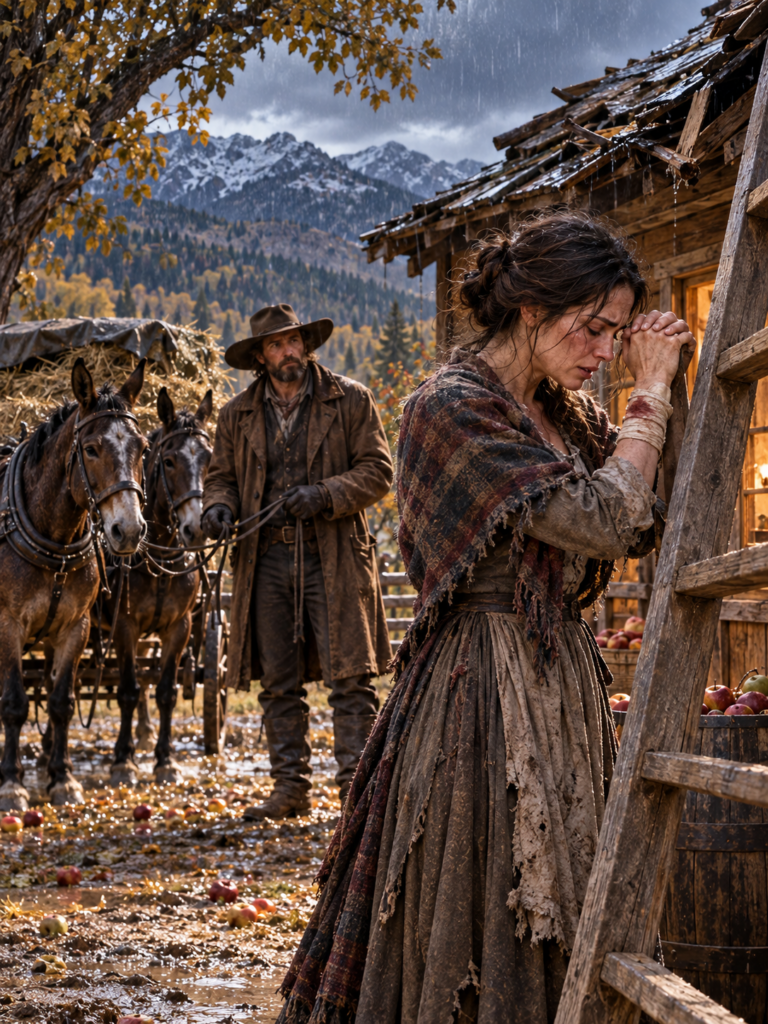
“Lord,” she whispered, “I’m here. Please help it hold.”
There was no elegant prayer in her.
No grand declaration of trust.
Only a frightened woman, a wooden ladder, and a task she had spent four months dreading.
She continued upward.
When she reached the secured scaffold, she crouched and steadied herself against the framing.
Ezra guided her from below, speaking only when she needed to shift her weight.
Then she moved toward the unfinished course.
The new shakes were damp with snow.
She placed her knees carefully and kept one hand against the sound wood.
Her father’s hammer hung through her belt.
Its worn handle pressed against her side.
For a moment she could not draw it.
She looked down the slope.
Far below, Ezra stood steady at the ladder.
Beyond him spread the orchard her father had planted.
Two hundred trees.
Branches stripped by approaching winter.
Fruit gathered or lost according to what the season allowed.
Her father had spent years making that place fruitful.
He had believed in work that would continue after him.
And now she was kneeling on the final part of something he had begun.
Willa took the hammer from her belt.
She positioned the first shake.
Her injured wrist objected when she reached for the nail, so she adjusted her position and used her good hand for the hammer.
The first blow sounded across the roof.
A sharp, clear note.
She struck again.
The nail entered the wood.
For a few seconds she forgot the height.
She understood this work.
Her father had shown her how shakes must overlap, how the grain should run, and why each board had to shed water onto the one beneath it.
She had been a girl when those lessons began.
Now, with snow gathering around her knees, she put that knowledge to use.
One nail.
Then another.
She worked slowly along the course.
Her fingers stiffened with cold.
The hammer felt heavier with each blow.
At one point she had to stop and tuck her hand beneath her coat to warm it.
“Need anything?” Ezra called.
“No.”
A moment passed.
“Except perhaps for you to stop asking.”
From below came a brief sound that might have been a laugh.
“Yes, ma’am.”
She drove the next nail.
The final shakes came into place.
Then she reached for the prepared ridge cap.
It lay just within reach.
She drew it toward her carefully, aligning it where the two slopes met.
A loose flurry of snow passed across the boards.
She waited for it to clear.
Then she set the cap.
Its pale wood crossed the peak neatly.
One side.
Then the other.
She positioned the first nail.
As she raised the hammer, her knee shifted on the wet plank.
Her boot lost purchase.
For one awful instant, her body leaned sideways.
She dropped the nail.
Her good hand seized the ridge framing.
Below, Ezra felt the movement through the scaffold and tightened his grip on the ladder.
“Willa!”
“Don’t move!”
He held still.
She pressed her weight against the wood.
Her breathing came in short, painful bursts.
The snow fell around her.
She waited until her legs had steadied.
Then she settled back onto both knees.
“I’m all right.”
Ezra did not answer immediately.
When he did, his voice was strained.
“Are you certain?”
“Yes.”
She looked at the unfinished cap.
Two nails remained.
A sensible part of her wanted to abandon the hammer and crawl back toward the ladder.
Another part remembered her father lying in the yard.
But Willa had not climbed to prove that she was incapable of fear.
She had climbed because fear had been governing too much of her life.
She picked up the nail.
Set it against the ridge cap.
And drove it home.
Then she took the final nail.
Her hand shook.
She pressed it into position.
Raised the hammer.
Struck once.
Twice.
A third time.
The last nail sank into the wood.
Willa lowered the hammer.
For several seconds she remained kneeling against the newly finished ridge.
The north slope was whole.
No broken patch.
No exposed sheathing.
No sagging strip of tin waiting for the next rain.
Only clean pine running evenly from the peak to the eaves.
She laid her hand against the ridge cap.
“It’s finished, Papa,” she whispered.
Her throat closed.
She had been carrying a terrible belief since June.
That her father had fallen while trying to protect something she should have helped him save.
That every leaking bucket was proof she had failed him.
That if she worked hard enough, climbed high enough, and endured enough pain, perhaps she could make the day of his death mean something other than loss.
But the roof was not her father.
And finishing it could not bring him back.
It could only keep his house dry.
For the first time, that seemed like enough.
Willa wiped her cheek.
Then she carefully turned toward the ladder.
“Ezra?”
“Yes?”
“Keep holding.”
“I am.”
“I’m coming down.”
She moved back toward the scaffold and eased herself onto the ladder.
One boot found the upper rung.
Then the other.
She descended slowly.
At the sixth rung, her foot slipped against the damp wood.
Her weight pulled suddenly outward.
Ezra tightened his hold.
The secured ladder shifted slightly under the force, then settled.
Willa caught the rail and pressed her shoulder against it.
For a moment she could not move.
Her breath came hard.
Then she looked down.
Ezra’s face was turned upward.
His hands remained fixed around the rails.
He had not let go.
“It’s holding,” she whispered.
“Yes.”
She laughed once, shakily.
“It’s holding.”
He said nothing.
She descended the remaining rungs.
When her boots finally touched the ground, she turned and rested against the cabin wall.
Her legs trembled too badly to carry her immediately.
Ezra stepped back enough to give her room.
Snow gathered on his shoulders.
Willa looked at the hammer in her hand.
Then at the new roof.
Then at the man standing beside her.
“You kept your word.”
“So did you.”
She shook her head.
“I didn’t believe I could.”
“You knew the work.”
“I was frightened the whole time.”
“I know.”
Her eyes filled.
“And you were frightened too.”
Ezra looked up at the roof.
“More than once.”
Willa studied him.
A man willing to admit fear had become more trustworthy to her than a dozen men promising nothing could ever go wrong.
She stretched out her good hand.
Not in payment.
Not in gratitude owed.
Simply because she wanted to.
Ezra took it.
His fingers were cold and rough.
For a moment they stood quietly together.
Then Willa released him.
“We’d better put the tools away before the snow covers everything.”
“Yes, ma’am.”
She picked up the nail pouch.
He gathered the rope and tools.
They worked until the scaffold was cleared and the ladder put away.
By the time the barn doors closed, the snow had begun falling in earnest.
That night, Willa carried the last empty bucket from beneath the ceiling.
She paused beside the stove and listened.
For months, rain had taught her to fear silence, because silence never lasted.
Sooner or later another drop would fall.
Tonight there was nothing.
No water finding its way through the roof.
No sharp sound striking a pan.
No reminder that another piece of the house was failing.
She arranged the buckets against the far wall.
Then she lit the lamp and opened her father’s Bible.
She did not read very long.
Her wrist ached.
Her shoulders were tired.
And for once, exhaustion seemed to promise rest rather than another night of unfinished work.
She closed the book.
Put out the lamp.
And slept until morning.
Ezra knew something had changed because the light in her window did not appear again during the night.
He had slept in the barn, as they had agreed.
The mules stood warm and sheltered.
Outside, snow covered the orchard rows and lay in soft white ridges along the fence.
At daybreak he went to inspect the roof.
The new north slope had taken the snow evenly.
No black patches showed through.
He checked where the eaves met the wall and examined the edge of the completed work.
Everything looked sound.
The south slope still needed more attention in better weather, but the vulnerable north side was secure.
He stood in the yard longer than necessary.
Then the cabin door opened.
Willa appeared wearing a clean apron.
Her hair was pinned neatly, and the lines around her eyes seemed less severe.
She looked at him.
Then at the roof.
Then back at him.
“The agreement says meals are to be taken on the porch,” she said.
“Yes, ma’am.”
“The agreement didn’t account for snow.”
“No, ma’am.”
She moved away from the doorway.
“Then come inside before your coffee freezes.”
Ezra removed his hat.
“Are you certain?”
Willa gave him a look.
“I’ve already opened the door, Mr. Colton.”
He wiped his boots carefully and entered.
The cabin was small.
Its furnishings were plain, but the place was kept with remarkable care.
There was a wooden table near the stove, shelves holding crockery, and seven buckets arranged neatly along one wall.
Every bucket was dry.
Willa noticed him looking.
“I haven’t put them away yet.”
“There’s no hurry.”
“I thought perhaps I’d keep one or two.”
“For the next leak?”
She shook her head.
“As a reminder that I don’t have to mend every broken thing by myself.”
Ezra looked toward the table.
Two plates waited there.
Bread.
Fried apples.
Hot coffee.
Willa gestured toward a chair.
“Sit.”
He obeyed.
She took her place opposite him.
For a few moments neither reached for the food.
Then Willa bowed her head.
Ezra followed her example.
Her prayer was halting.
She thanked God for the harvest, for the shelter that had held, and for her father, who had planted the orchard and cut the pine.
She thanked Him for the hands that had finished the work.
For the ladder that had stood.
And for the courage to climb even while afraid.
Then she fell silent.
Ezra did not rush her.
At last she whispered, “Amen.”
“Amen.”
They began breakfast.
For a little while, they spoke only of practical things.
The remaining cider.
The barrels that needed securing.
The hay waiting beneath the canvas.
The condition of the road.
Ezra still had a delivery to make in Loveland.
Willa had eight barrels of cider ready.
Under their agreement, four belonged to him.
“You’ll take your half,” she said firmly.
“I intend to.”
“And you’ll sell it at a fair price.”
“I’ll do my best.”
“If somebody offers too little, don’t take it merely to be rid of the load.”
He glanced up.
“Are you giving me instructions?”
“I’m giving you sound business advice.”
“I’ll remember it.”
She took another bite of fried apple.
Then said, “The cider should bring enough to buy what I need for the remaining repairs.”
“There’s still good wood in the barn.”
“I know. I’ll keep it dry until the weather clears.”
Ezra studied her.
“You have a plan.”
“Of course I have a plan.”
“I was beginning to think so.”
She almost smiled.
After breakfast, he carried the four barrels into the wagon and secured them beside the hay.
Willa inspected the ropes.
She adjusted one knot herself.
Ezra watched without interference.
When she finished, she stood back.
“That should hold.”
“It will.”
She walked around the wagon, checking the load.
Then her gaze moved to the orchard.
Snow rested on the bare branches.
The trees would sleep until spring.
When the thaw came, she would inspect each row, prune the damaged limbs, and prepare for another season.
There would be work enough.
There always was.
But now she could imagine doing it without trying to defeat grief through exhaustion.
Ezra finished fastening the wagon cover.
He turned toward her.
“I’ll need to see how that roof stands up to a proper thaw.”
Willa looked at him.
“In spring?”
“Yes. Snow can hide a weakness. Rain finds it.”
She folded her arms.
“Are you proposing another business arrangement?”
He considered the question.
“I suppose I might be.”
She glanced toward the barn.
“There’s work enough here. The south slope will want looking at.”
“I noticed.”
“And I expect fair terms.”
“I wouldn’t offer you anything else.”
A small silence followed.
Then Ezra added, “If you’d rather I didn’t return, say so. I’ll understand.”
Willa had not expected that.
She watched him for several moments.
“You would come all this way merely to inspect a roof?”
He looked toward the orchard.
“I’ve grown interested in how the place fares.”
“Only the place?”
Ezra removed his hat.
The question had taken him farther than he had intended to go.
“No,” he said at last. “Not only the place.”
Willa looked down at the snow beside her boots.
He did not press her.
He understood now how much she valued being able to choose without feeling compelled.
So he gave her the truth and left it in her hands.
“I’d like to see you again, Willa. But that’s yours to decide.”
She raised her eyes.
The sound of her name had become familiar during those final hours on the roof.
Now it seemed different.
Not presumptuous.
Not possessive.
Simply personal.
“I would like that too,” she answered.
Ezra’s expression softened.
“Then I’ll come when the roads clear.”
“You’d better not arrive expecting to sleep in the house.”
“I wouldn’t dream of it.”
“The barn is quite adequate.”
“So I’ve found.”
“And if you want breakfast, you’ll have to work.”
He looked at her.
“Does that mean there’s another contract?”
Willa’s mouth curved.
“Perhaps. But I’ll write the terms.”
“I’d expect nothing less.”
They went together as far as the gate.
The little twist of paper still hung from the post.
Inside was the dime Ezra had paid for his first night’s shelter.
Willa reached toward it.
Then stopped.
“You never took this back.”
“It was your fee.”
“I suppose it was.”
She untied the paper and opened it.
The coin lay in her palm.
Such a small thing.
Ten cents.
She remembered how desperately she had insisted on receiving it.
How important it had seemed to prove she would accept no kindness without paying.
Now she understood that the dime had bought only a night’s shelter for two tired mules.
Everything that followed had required something money alone could not settle.
Honesty.
Trust.
Labor freely exchanged.
And the courage to ask.
She closed her hand around the coin.
“I think I’ll keep it.”
“It’s yours.”
“Yes,” she said softly. “It is.”
Ezra climbed onto the wagon seat.
The mules shifted in their traces, impatient to move.
He gathered the reins.
“Take care of that wrist.”
“I will.”
“And don’t climb the roof alone.”
Willa raised an eyebrow.
“Now you’re giving me instructions.”
He gave a small, embarrassed smile.
“I suppose I am.”
She considered him.
Then nodded toward the snowy road.
“Travel carefully, Ezra.”
“I will.”
The wagon moved through the gate.
Willa stood watching as it followed the road between the white fields and the dark foothills.
When Ezra reached the bend, he turned once.
She lifted her hand.
He raised his hat.
Then the wagon disappeared.
For a moment, Willa stood very still.
She had been alone on the property before he arrived.
She was alone again now.
But the two kinds of solitude were not the same.
Before, the house had seemed to contain only everything she had lost.
Now it held the proof of something she had chosen to do.
She returned to the porch.
Above her, the newly repaired roof stood straight beneath the snow.
Her father’s words remained carved into the lintel.
She rested her palm against the wood.
“It’s still here, Papa,” she whispered.
Then she went inside.
The weeks that followed brought ordinary winter troubles.
There was firewood to carry.
Food to store.
Equipment to mend.
A stretch of fence to watch whenever the wind rose.
And always the careful tending of an orchard waiting for spring.
Willa kept accounts for the cider that remained hers.
She planned the repairs still needed on the south slope.
She examined the unused shake bolts and covered them securely.
Some nights she missed her father so fiercely that she had to sit beside the stove until the feeling passed.
But she no longer climbed into the barn to strike at pine in the middle of the night.
When she was tired, she rested.
When she was frightened, she admitted it.
When a job required more than one pair of hands, she began to consider whom she might ask.
That change was neither quick nor complete.
Her pride had been built across too many hard years to disappear in a week.
Yet it had loosened.
And that was enough to begin with.
During winter, she kept her father’s hammer wrapped in cloth beside the Bible.
She used it when there was work suited to her hand.
She cleaned and oiled it afterward.
The tool no longer seemed only a reminder of the day he fell.
It belonged to all the years he had worked before that morning.
And now it belonged, in part, to the day she had finished what he began.
When the first spring thaw finally softened the road, Willa inspected the north slope.
Snowmelt ran cleanly down its surface.
There was no dripping inside.
No bucket required.
She watched the water fall clear of the eaves and smiled to herself.
Then, one mild morning, she heard wagon wheels approaching.
She had been examining the earliest swelling buds in the orchard.
At first, she thought it might be a neighbor.
But when she looked toward the gate, she recognized the two mules.
Ezra Colton sat on the wagon seat.
The load was lighter this time.
He turned in slowly and stopped beside the barn.
Willa walked toward him.
“You’re late,” she said.
Ezra removed his hat.
“I hadn’t known we had an appointed day.”
“We hadn’t.”
“Then I’m relieved.”
She smiled.
“How was Loveland?”
“Busy enough. Your cider sold well.”
“It was good cider.”
“Best I hauled that autumn.”
She studied the wagon.
“Have you brought more hay?”
“A smaller load. And a few things I thought might be useful if we’re looking at the south slope.”
Willa glanced toward the roof.
“There’s still good timber to use.”
“I remembered.”
“Then I suppose you may stay long enough to discuss the work.”
Ezra descended from the wagon.
He waited beside it.
Willa looked at his outstretched hand, offered to steady her as she stepped across the muddy rut.
This time she took it without embarrassment.
They walked together toward the house.
The orchard lay behind them, the branches beginning to show the first green of a new season.
At the porch, Willa paused.
The carved Scripture stood above the door.
She looked at it a moment.
Then at Ezra.
“Would you like some coffee?”
“I would.”
“Inside?”
He smiled.
“If that’s where you’re offering it.”
“It is.”
She opened the door.
Ezra followed, wiping his boots as carefully as he had on the morning after the snow.
The table still stood near the stove.
There were two cups upon it.
The buckets had been put away.
Willa set the coffee pot down and turned toward him.
“I’ve thought about another arrangement,” she said.
Ezra waited.
“Some work in the orchard. The south roof. Perhaps repairing a few things before next autumn.”
“That sounds reasonable.”
“And if you’ve hauling to do, we’ll arrange the days around it. I’ve no wish to keep a man from his livelihood.”
“I’d appreciate that.”
She hesitated.
“There’s something else.”
He took off his hat.
“I’m listening.”
Willa looked through the window toward the trees.
“I spent last winter wondering whether I wanted your help because I couldn’t manage alone.”
Ezra said nothing.
“I can manage. I have managed.”
“I know you have.”
She turned to face him.
“But that doesn’t mean I want every supper to be eaten alone. Or that I wouldn’t welcome someone I trust sitting on the other side of the table.”
Ezra looked at the chair opposite hers.
For once he seemed to have difficulty finding words.
“I’d welcome that too,” he said.
Willa nodded.
There was no demand for a promise beyond what either of them could honestly offer.
No hurried arrangement to replace the one they had made in autumn.
Only the beginning of something both were free to accept.
She poured his coffee.
He sat down.
Outside, sunlight moved slowly through the orchard.
Later they would examine the roof.
They would discuss lumber, tools, time, and wages.
There would be work.
And disagreements.
And choices to be made in their proper season.
But for that morning, neither was in a hurry.
Willa took her place across from him.
Her father’s hammer rested on its folded cloth by the shelf.
Through the window she could see the roof, sound beneath the melting snow.
A house could be repaired with timber and nails.
Its people required something less easily measured.
Patience.
Truth.
The freedom to open a door.
And the willingness to remain when invited, without pretending that an invitation was a debt.
Willa lifted her cup.
Ezra lifted his.
For the first time in a long while, the house felt large enough to hold both memory and possibility.
And outside, the apple trees were beginning to bloom.